JumpCloud, an American commercial software company, has announced a data breach attributed to a spear phishing attack launched by a sophisticated nation-state-sponsored threat actor.
As a result, the threat actor (Nation-state) gained unauthorized access to JumpCloud systems to target a small and specific set of its customers.
Spear phishing is a type of phishing attack that targets a specific individual, organization, or business with a personalized email or message that looks authentic and comes from a trusted source.
JumpCloud’s cloud-based directory as a service platform is used to securely manage users’ identity, devices, and access across things such as VPN, Wi-Fi, Servers, and workstations.
A nation-state threat actor is a government-sponsored group that forcefully targets and gains illicit access to the networks of other governments or industry groups to steal, damage, and/or change information.
These types of attackers, in particular, go to extreme lengths to cover their tracks and make it difficult to trace their campaigns back to their country of origin. Often, they will plant “false flags” to mislead cyber investigators.
The goal of spear phishing is to get the target to reveal private information, download malware, or lose money.
On June 27 the organization discovered malicious activity in the internal system they accessed a specific area of the infrastructure but they did not find any evidence at that time about the impacts.
To avoid the potential danger, they took immediate measures to rebuild infrastructure and took a number of other actions to further secure our network and perimeter.
Also they combine with Incident Response (IR) partners to analyze the system, they also contacted law enforcement for investigation.
On July 5 at 3:35 UTC (Coordinated Universal Time) they found another unusual activity in commands frameworks.
At that time they have evidence of customer impacts so they worked with that impacted customers and help them with more security measures.
The organization decided to execute force-rotation of all admin API keys beginning on July 5 at 23:11 UTC.
They found that attackers inject the data into the command framework moreover they target only certain customers.
This incident made the organization learn to create and now share a list of IOCs (Indicators of Compromise) that we have observed for this campaign.
A debate as old as time. Which platform is better? The iPhone or Android? Of course, there’s really no right answer, and both platforms have their advantages over the other. But why exactly is the iPhone better than Android? That’s something we’re going to explore today, because there is a real argument here for the iPhone being better.
A couple of years ago, I bought an iPhone 12 Pro. After having used Android since 2009, and reviewed almost every single Android phone made in that time, I had grown bored of Android and wanted to try something new. Now, three years later, I’m on the iPhone 14 Pro and don’t see myself going back. So the reasons for why the iPhone is better, are things that I have found out myself.
While I do typically use two phones (right now, the iPhone 14 Pro and Pixel Fold), my main SIM card is in the iPhone. And no it’s not because of iMessage. It’s mainly because if I want to bring one phone only, it’s gonna be the lighter weight one, and the one with better battery life and the one that doesn’t overheat. Which is the iPhone.
Apple Silicon is more efficient
One of the big advantages that the iPhone has over Android is, Apple Silicon. Not this has been a pretty big topic with Macs lately, as Apple transitioned away from Intel to its own chipsets for its computers. But Apple has been making its own chipsets for its iPhone since the iPhone 4S. So it’s not new to this at all.
And because Apple is in control of the iPhone from top to bottom, it is able to build a chipset that is very efficient for the platform. Versus Android where OEMs basically need to use what’s available from Qualcomm, Samsung, and MediaTek.
Year-after-year, Apple’s latest chipset for the iPhone outdo the latest from Qualcomm and others. Now, that gap has started to close a bit with Qualcomm moving over to TSMC. But Apple still has a lead here.
While I do despise benchmarks, they are useful here. And as you can see in the image above, the iPhone beats the Galaxy S23 Ultra (which has Qualcomm’s latest chipset, and it’s even overclocked) in Geekbench 6. Both in the single and multi-core tests.
This is really just a product of Apple making a chipset for one specific phone. Versus Qualcomm making a chipset that is set to power hundreds, if not thousands of phones. With very many different configurations.
Longer OS support, faster OS updates
When it comes to the operating system, Apple beats Android in two ways here. First off, Apple supports its phones much longer. This year, they just dropped support for the iPhone 8, 8 Plus and X. These phones are six years old. And while they did drop support for them, so they won’t get iOS 17, they will continue to get security updates when needed.
Then you compare this to Android, and it’s a struggle to find phones that will get OS updates past 3-4 years. Even Google is only offering three years of OS updates (four years of security updates). It’s a big problem for Android, and one that likely will never be figured out.
The other side is faster OS updates. When Apple releases iOS 17 in September, it will instantly be available to billions of devices. From the iPhone XS through the iPhone 14 series. All on the same day, there’s really no waiting, other than for the servers to actually download the update. As these are big updates and the servers are getting hit by billions of devices, it can take some time.
Meanwhile, on Android, when Google releases Android 14 in September, it’ll be available for Pixel the same day (maybe). And that’s it. From September to December, we’ll see a number of phones getting the update, with Samsung likely being first to push it out. But that’s a far cry from getting the update the same day as it launches.
iMessage
If you talk to any Apple user, they will say they can’t live without iMessage. But then again, that’s really only a thing in the US. Text messaging isn’t really a thing outside of the US, or North America. Most other countries use messaging apps like WhatsApp, Signal, Telegram and others. This is likely because carriers outside of the US did not offer unlimited texting, so most people used something that was free.
As an iPhone user for three years now, I can’t say that iMessage is a must-have feature for me. It’s cool and all, and I really don’t care that some people I text come up as a green bubble. But others do care quite a bit. Including Apple, who has been resistant to adding this to Android, because they see it as a lock in to keep people on the iPhone.
Google has been trying to pressure Apple into supporting RCS, however, Google can’t even get the carriers to universally adopt it. In fact, there are problems with RCS on its own wireless carrier – Google Fi.
Apps come to iOS first
This isn’t quite the big deal it was a few years ago. But most of the time, new apps and games come to iOS first. Why? Well it’s pretty simple, from a developers standpoint. Imagine you are a single developer or have a very small team and budget and are building an app. Are you going to build an app for Android that requires a lot more work due to the many different screen sizes, processors, storage, etc. Or spend less time and build an app for iOS that really only uses two different screen sizes and all use Apple’s own processors. It’s pretty simple, and you’ll be available to a much larger audience that way.
Here’s just a few apps that landed on iOS first, and then came to Android months later: Super Mario Run, HQ Trivia, Monument Valley 2, Affinity Photo and even Snapchat. Heck, Instagram was even iOS only for a number of years. It really didn’t land on Android until Facebook bought it in 2012.
No bloatware
Perhaps the single biggest reason to get an iPhone is – no bloatware.
Though, that’s entirely true. When you first setup your iPhone, there’s a number of Apple apps pre-installed. However, the majority of these can be installed. There are a few that can’t, like Safari, the App Store, etc. But most things can be uninstalled. That’s not the case on Android. Most of them cannot be uninstalled.
Also, on Android, you have carrier bloat – at least in the US. You’ll find, especially on a Verizon device, there’s an entire folder full of Verizon apps. There’s usually a good 10 or more apps from Verizon included. On top of that, if you get something other than a Pixel, then you have all of Google’s apps as well as your OEM’s apps.
For instance, on a Samsung device. You get bloatware from Google, Samsung and your carrier. So it comes pre-installed with potentially 50 apps that you don’t need or want.
Privacy built-in
A feature that Apple has really been touting over the last few years on the iPhone, is privacy. It’s actually what got me to seriously consider an iPhone.
Apple is really the only smartphone company that doesn’t collect and sell your data, or use it for selling ads. Remember, Google is an ad company, so using a phone from Google means you’re just giving them access to more data to serve up more ads. Apple doesn’t do that. They do collect some data, but nowhere near as much as Google.
On top of that, Apple has also introduced a feature that will keep apps from tracking you. The first time you open an app, you’ll be greeted with a pop up to allow the app to track you. Most people select “ask not to track”. This is actually a big deal, Facebook reported that Apple’s change here cost them $10 billion per year.
Apple does have a few other features that are included for privacy. Like Private Relay, which is technically just a VPN, but it’s part of iCloud+ (which is as little as $0.99 per month). It also helps to keep apps and websites from tracking you and where you are. There’s also “Hide my email”. Which is exactly what it sounds like. It allows you to create a random email address for things and it forwards to the email linked to your Apple ID. So if you start getting a lot of spam at that email, just turn it off and boom all that spam is gone. This is a feature that I use a lot. I have probably 50 different email aliases with Hide My Email, because I use it whenever I sign up for something.
The Apple ecosystem
The Apple ecosystem, or as some call it, the “walled garden”, is undefeated. Apple does such a good job at making sure all of its products work well together. For instance, AirDrop. It’s a feature that I use all the time to transfer files from my MacBook Air to my iPhone 14 Pro. Other features include the ability to copy something on your iPhone and paste it on Mac or iPad, and so much more.
There’s also continuity. So if you were editing a doc in Pages on your Mac, you can then open Pages on your iPhone or iPad and continue editing it. iCloud works to keep everything in sync too. That includes backups, photos, documents and so much more. Giving you access to all of your stuff on any Apple device.
Apple’s Customer Support
Finally, Apple’s Customer Support. The biggest advantage that Apple has over Android is, the very many stores it has around the world. There are 272 stores in the US and 526 across the world, in 26 countries. Meanwhile, Google has like 3 stores, all in New York City. So naturally, Apple is able to provide better customer support in store than Google, or any other brand.
I’ve experienced Apple’s stellar customer support a few times. When I was in college, I spilled an entire glass of water on my MacBook Pro. I did have AppleCare, but it did not cover water damage back then (this was around 2010). I took it into my local Apple Store, and was upfront with them that yeah, I spilled water on it. The tech said that they typically don’t cover water damage, but they will this one time. Now this meant that they needed to send it out to be fixed. So I was without a laptop for a few days.
It was sent out, and returned to me in about 3-4 days, which was really impressive, since it went across the country to Texas. But when I got it back, the entire laptop had been replaced, and all of my data was loaded onto the new hard drive, from my old one. I was so impressed, considering I paid exactly $0 for this repair. Since then, I’ve never bought any non-Mac as a computer.
Now sure, some will argue that this is a small expense for Apple to keep a customer and get them to buy more products in the future. But even if it is, so what? They actually take care of their customers. When I was in College, I had a Dell Inspiron 13, which had overheated and fried the entire inside of the laptop, less than 6 months after it was bought. Dell basically gave me the middle finger. Do you think I ever bought another Dell laptop? Nope. They lost a customer for good, because of that decision to not honor the warranty.
And I have a few more stories about how great Apple’s customer support really is. But I won’t bore you with those here.
BAT aims to revolutionize the digital advertising landscape. This article explores the intricacies of BAT, its technical architecture, and its impact on digital advertising. Crypto trading is at its best with automated trading bots. Click immediaterevolution360 and get started with crypto trading.
The Technical Architecture of Basic Attention Token (BAT)
One key aspect of BAT’s technical architecture is its integration with the Brave Browser. Brave Browser plays a vital role in the BAT ecosystem by serving as the gateway for users to interact with the token. It incorporates BAT seamlessly into its user interface, allowing users to earn BAT tokens by opting to view privacy-respecting ads or by supporting content creators through direct contributions.
Blockchain technology forms the backbone of BAT’s decentralized platform, enabling secure and tamper-proof transactions. With blockchain, every ad impression, user attention, and token transfer is recorded and stored in a distributed ledger, ensuring transparency and accountability throughout the advertising supply chain.
BAT’s use of blockchain technology also addresses the issue of ad fraud. By leveraging the decentralized nature of blockchain, BAT provides a transparent and auditable environment that reduces the chances of fraudulent activities. Advertisers can have confidence in the authenticity of their ad impressions, as each interaction is recorded on the blockchain and can be verified.
Furthermore, BAT places a strong emphasis on user privacy and data security. Unlike traditional advertising models that rely on extensive user data collection, BAT’s approach is centered around user anonymity and control over personal information. By using the Brave Browser, users can opt-in to share their attention data while maintaining their privacy. This data is then used to match users with relevant ads, ensuring a more personalized and engaging advertising experience without compromising user privacy.
The technical architecture of Basic Attention Token (BAT) encompasses the integration with the Brave Browser, the utilization of blockchain technology for transparency and security, and a privacy-focused approach to user data. This architecture addresses the challenges of traditional digital advertising by providing a decentralized, fraud-resistant, and privacy-enhancing ecosystem for advertisers, publishers, and users alike.
BAT’s Impact on the Future of Digital Advertising
BAT’s disruptive nature stems from its ability to challenge the traditional advertising model. By leveraging blockchain technology and a decentralized approach, BAT aims to shift the balance of power from centralized intermediaries to individual users and content creators. This shift has the potential to revolutionize the advertising industry by fostering a more direct and mutually beneficial relationship between advertisers, publishers, and consumers.
One of the key impacts of BAT is the increased transparency it brings to the digital advertising ecosystem. With the use of blockchain technology, every interaction and transaction within the BAT ecosystem is recorded and stored in a public ledger, ensuring transparency and accountability. Advertisers can have a clear view of where their ad spend is going, how their ads are performing, and the impact they have on user engagement. This transparency helps build trust between advertisers and publishers, promoting a more open and fair advertising landscape.
BAT also addresses the issue of ad fraud, a persistent problem in the digital advertising industry. Through its decentralized architecture, BAT provides a secure and tamper-proof environment that reduces the risk of fraudulent activities. The immutability of blockchain ensures that ad impressions, user attention, and token transfers cannot be manipulated or faked. This significantly minimizes ad fraud, providing advertisers with more reliable and accurate data on ad performance and ROI.
Moreover, BAT’s focus on user attention and engagement has the potential to reshape the way ads are perceived and consumed. By incentivizing users with BAT tokens for their attention, BAT encourages users to actively engage with ads that are relevant and interesting to them. This incentivization model creates a win-win situation where users are rewarded for their time and attention, while advertisers benefit from more attentive and engaged audiences. This shift in user behavior can lead to higher-quality ad interactions, improved ad relevance, and ultimately, better returns on ad spend for advertisers.
BAT’s impact on the future of digital advertising goes beyond its technical aspects. It presents a paradigm shift in how the industry operates, emphasizing the importance of user privacy, consent, and control over personal data. By putting users at the center of the advertising ecosystem, BAT challenges the prevailing norm of invasive data collection and targeted advertising.
Conclusion
Basic Attention Token (BAT) has the power to transform digital advertising by providing transparency, combating ad fraud, prioritizing user engagement, and emphasizing privacy. With its decentralized approach and blockchain technology, BAT paves the way for a future where advertisers, publishers, and users can benefit from a fair, accountable, and user-centric advertising ecosystem.
There’s a way to watch YouTube videos twice as fast without the need for diving in settings and menus. YouTube is testing a gesture to switch to 2x playback speed on both mobile and desktop devices.
Boosted playback speed is this author’s manna from heaven, in regards to podcasts. Even if your favorite creator speaks fast and clearly, there’s always a guest with a different tempo that gets on your nerves. Now users can make slow-talkers act twice as fast with a simple gesture. The speed change comes handy in other scenarios, too: when you want to skip a certain part of the video, but you don’t want to miss too much of the stream by selecting random timestamps on the timeline.
Press and hold
You just need to press and hold anywhere on the YouTube player while watching a video to ‘automatically bump the playback to 2x’ (via 9to5Google). That’s for Android/iOS users. For desktop/web users, clicking and holding with the mouse/trackpad will do the trick. A message that reads ‘Playing at 2x speed’ at the top of the window will notify you, in case you don’t realize why things are going twice as fast.There’s a substantial difference between mobile and web when it comes to what happens after you let go. On Android/iOS, the playback continues at normal speed after you take your finger off the screen, while releasing the mouse/trackpad leads to a video pause.
I need this in my life, where is it?
The ‘Long press to watch at 2x’ option, found in the dedicated YouTube page for experimental new features. Of course, should you want to give it a try, you must be a YouTube Premium subscriber. This feature is available for testing until August 13.
If the tests are successful, YouTube may roll out this feature for everyone in the future. Right now, if you need to bump up the playback speed of a video, you need to dive in the settings (top-right corner for mobile, bottom-right for web) while playing and scroll down some menus, until you finally get to the ‘Playback speed’ section.
As of now, if non-Premium mobile users (or paid subscribers that have not enabled the ‘Long press to watch at 2x’ feature) press and hold somewhere in the video window, the ‘Slide left or right to seek’ option appears. Sliding left or right enables a fast forward or backward seeking of the timeline. Desktop/web users do not benefit from the same function if they click and hold on the video. Here’s a little bonus for them: using the commands ‘Shift + ’ lets you change the playback speed.
There’s a Premium Lock Screen, too
That’s not the only new Premium feature that you can test until August 13. Check out ‘Lock Screen’: it ‘disables touch input while watching a video so that accidental taps do not pause, skip or disrupt the video’. This one is available on Android and iOS only.
We’re neck-deep in the beta testing for Android 14. It looks like this version will be hitting the stable release sometime next month. According to Android Police, Android 14 will not like you updating side-loaded apps, so it will give you a new warning before you do so.
The ability to side-load apps on Android is both a blessing and a curse. One great thing about it is that you’re able to download apps that have been delisted from the Play Store. You can also download older versions of apps in case a newer update changes something you don’t like.
However, it comes with a risk. You don’t know if the APK you’re downloading contains any malware that could dig into your phone and cause trouble for you. You’ll want to be careful when sideloading apps.
Android 14 will issue a new warning when updating side-loaded apps
You’re not only able to side-load apps, you’re also able to update those apps. It’s just that those updates won’t come from the Play Store, and you’ll need to update the apps manually.
According to the report, when you try to update a side-loaded app on the Play Store, you’ll see a new warning screen pop up. The warning will read: “Update this app from [third-party app store] (beta)? This app normally receives updates from Google Play Store. By updating from a different source, you may receive future updates from any source on your phone. App functionality may change.”
This isn’t the company blocking you from updating the app. You’re given the option to update anyway or cancel it. It’s a warning reminding you of the risks of using side-loaded apps.
What Google is saying is true. Let’s not fool ourselves, there’s still the chance that you’ll run into some shady apps on the Google Play Store. However, Google does a lot to ensure that the apps you’re downloading are safe. You can’t expect the same thing from third-party app stores.
You can’t be sure that the apps you’re downloading from a third-party store have been checked at all. It’s easy to download any sort of malware to your phone.
In a rather shocking report, netizens find out that Samsung Internet might be adopting an AI model. Since Samsung uses Android, you might be expecting them to adopt Google Bard, right? Well, they might be going against your imagination to adopt ChatGPT, a strong rival to Google’s AI model.
This will mean that the company would be towing the line of Microsoft, which made this move with the Edge browser. Some experts have been able to spot a section on the Samsung web browser for various ChatGPT models. While this section might not be accessible by all at the moment, it gives an idea of Samsung’s plans.
There are several things that Samsung could achieve by integrating an AI model into its browser. This will span across the company’s benefits into how the end users will interact with these tools on an everyday basis. But what are some of the things that can be attainable with this possible Samsung Internet ChatGPT integration?
Here are a few things you could do with ChatGPT integrated into your Samsung Internet browser
There are some things Samsung users will be able to benefit from with the integration of ChatGPT into their web browser. As you already know, there are a lot of things that you can do with AI, like asking questions and getting feedback. So if you own a Samsung mobile device and use the brand’s built-in web browser, you might be in line to enjoy these benefits.
Integrating ChatGPT into the Samsung Internet browser will make the service more accessible to users. With this tool handy, Samsung users will be able to get more detailed responses and explanations when they search for stuff using the AI tool. It can also help summarize very long search results into small and understandable bits for users to digest.
Just like with the Microsoft Edge browser, Samsung might as well introduce a chatbot for users to interact with. They might as well make more AI-generated content available. This content might make shopping and other web activities easier for most users.
Well, this AI tool might make its way to Samsung users as an experimental feature. This means that its arrival on the globally available Samsung Internet browser still isn’t certain. It might arrive for certain users as a test feature in the coming months.
Once available, beta testers of the app would be able to try out ChatGPT on their mobile browser. If Samsung sees the feature as being one that the global community will appreciate, then they can roll it out publicly. Until this happens, Samsung fans will need to keep their fingers crossed while expecting more information on this feature.
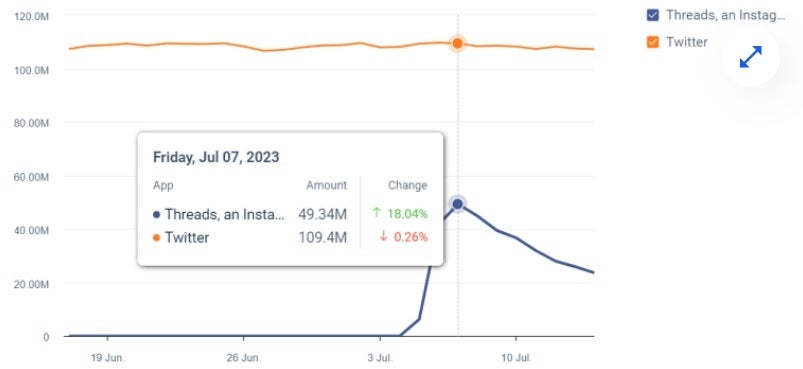
But by last Friday, July 14th, Threads’ worldwide active daily users number on Android had tumbled to 23.6 million or less than half the total it had exactly one week before. It also worked out to just 22% of Twitter’s daily active users on Android that same day. Usage of the app peaked in the U.S. where on July 7th the average amount of time spent on Threads hit 21 minutes per user. A week later, the average time each user in the States engaged with the platform had slipped to just over 6 minutes.
Even with many Twitter users trying Threads after it first launched, on the days when Threads had peak interest, the average daily users number for Twitter’s Android app was unchanged. Time used on the app was down 4.3% on those days but was still over 25 minutes. This means that even on Threads’ good days, while fewer people on Android used Twitter, those that did still spent a lot of time on the app.
Threads briefly captures a large share of Twitter’s daily active users worldwide on Android
Other data of note as released by SimilarWeb: Twitter saw its web traffic decline by 5% during the first two days that Threads was live. Even though traffic has bounced back, year-over-year web traffic for Twitter is down 11%. And Twitter’s user retention numbers are not looking good, at least on Android where the percentage of new Twitter users who continuously use the app after 30 days has dropped from 19% in 2022 to 16% this past March. That compares to a 40% user retention rate for new Instagram users.
And since Instagram users are the ones signing up for Threads, that bodes well for the future user retention rate for the upstart challenger Threads. Remember, To subscribe to Threads, you must have an Instagram account. And if you delete your Threads account, you must delete the connected Instagram account. That sounds like Threads users have a good incentive to stay subscribed to the platform.
The average daily minutes that Threads users engaged with the platform peaked and then crashed in the U.S. and worldwide
SimilarWeb does note that, for at least right now, Threads is missing a few of the most basic features and has yet to offer users a compelling reason for social media users to drop Twitter and switch to Threads, or scratch their social media itch using Threads alone.
Malwarebytes EDR and MDR removes all remnants of ransomware and prevents you from getting reinfected. Want to learn more about how we can help protect your business? Get a free trial below.
Hard to believe that it’s been over a decade since Motorola rebooted and streamlined its handset portfolio, grouping its offerings under the easy-to-remember, letter-focused sub-brands of Moto X, G, E, and eventually Z (plus the short-lived M and C series).
Then under Google’s corporate umbrella, the company attracted an entirely new generation of fans with an emphasis on value and focus-group-tested features. Before selling the company off to Lenovo in January 2014.
Fast forward to present day, wherein the now Lenovo-owned smartphone manufacturer continues to climb the global sales charts, but has adopted a much more Samsung-like approach of releasing a plethora of models each year to fill every perceived market niche and price range.
As one of only two sub-brands to survive since that 2012 reboot (along with the Moto E series), Moto G devices have led the way in this Samsungification, closely resembling the larger company’s strategy with its Galaxy A lineup.
Motorola’s Moto G14 is coming any day now
Following the currently-sold Moto Gx3 handsets, Motorola is poised to keep on keeping on with its first Gx4 model – the handsome Moto G14 – set to drop any day now. Only a skeletal framework of this 6.5-inch, punch-hole-sporting Android 13 smartphone are currently known, but it’s enough to get a pretty good feel of what we can expect from the lower-tier mid-ranger.
Moto G14 is said to offer an octa-core processor of unknown make, coupled with 4GB of RAM and 128GB of UFS 2.2 storage, G14’s highlights include a 5000mAh capacity battery, a 50-megapixel main camera, and the all-important microSD expansion slot. The water-repellant, Dolby Atmos-capable model will be available in four colors, including Butter Cream, Pale Lilac, Steel Gray, and Sky Blue. There will also be a vegan leather-backed special edition.
Look for it to appear internationally before the end of the month.
The Apple iPhone 15 is just around the corner, and new reports claim the phone could land in pink. The company has shown an interest in diversifying its color lineup in recent years, and launching an iPhone 15 in pink may not be far-fetched.
The news comes on the heels of a tweet by leaker @VnchocoTaco, aka ShrimpApplePro, that refers to a post on the Chinese social media app Weibo. The post includes a Foxconn security badge and argues that iPhone 15 will land in three new colors, green, light yellow, and pink. Likewise, Midnight, Starlight, and Product (RED) are other color options for the latest generation Apple smartphone.
Foxconn is Apple’s partner in producing iPhones in China, and both companies have a long-lasting relationship. The security badge seems to be credible and belongs to a Foxconn staff member.
Apple iPhone 15 may launch in three new colors, including pink
This is not the first leak that refers to adding new colors to the iPhone 15 lineup. Back in early July, a Chinese tipster reported about a mint green iPhone 15 that may land in September this year. In February, another tipster said Apple plans to launch iPhone 15 Pro in a new deep, dark red color. The base iPhone 15 models might also get a bright blue and bright pink color.
The announcement has sparked excitement among Apple enthusiasts worldwide, who eagerly await the upcoming edition of the renowned smartphone. The pink color option will give a fresh new look to the iPhone lineup.
The iPhone 15 will include major improvements over the iPhone 14 when it debuts in September 2023. According to reports, the phone could have a larger display, a quicker processor, a better camera, and a longer battery life. Users who want to stand out from the crowd will have an additional pink option.
The pink color option for Apple is not entirely new. Pink iPhones have previously been made available by the firm, including the iPhone 5C and iPhone 6S. However, the most recent models, such as the iPhone 13 and iPhone 14, do not come in the pink color option. The pink version might appeal to a younger audience who are constantly searching for fashionable and contemporary things.