Zoetop Business Company, the firm which owns fast fashion brands SHEIN and ROMWE, has been fined US$1.9mn by the state of New York after failing to disclose a data breach which affected 39 million customers.
The cyber security incident which took place in July 2018 saw a malicious third party gain unauthorized access to SHEIN’s payment systems. According to a statement issued by the state of New York’s Attorney General’s office SHEIN’s payment processor contacted the brand and disclosed that it had been “contacted by a large credit card network and a credit card issuing bank, each of which had information indicating that [Zoetop’s] system[s] have been infiltrated and card data stolen”.
This discovery was made after the credit card network found SHEIN customers’ payment details for sale on a hacking forum. Separate to this issue, the issuing bank for the cards had issued a fraud alert after linking fraud for several customers to payments made to SHEIN.
Following the discovery of the cyber-attack, the payment processor informed SHEIN that they must employ a cyber security forensic investigator to look into the case. The firm employed by Zoetop found that during the cyber-attack malicious actors had gained access to SHEIN’s internal systems and had accessed personal and identifying information for 39 million customers.
The data accessed included “names, city/province information, email addresses and hashed account passwords”. However, the method used to obscure them was vulnerable to hacking, allowing the malicious actors access to customers’ full password details.
Additionally, the login credentials of nearly 7.3 million ROMWE accounts were stolen in the breach and were later found for sale on the dark web in 2020.
An investigation by the New York Attorney General’s (AG) office found that Zoetop did not force any of the 39 million people affected to reset their account passwords. Zoetop instead identified 6.4 million customers of the 39 million affected who had previously placed an order with SHEIN and contacted them directly, suggesting they reset their password. Zoetop reset the passwords for the accounts affected by the ROMWE attack without informing them that they had been exposed in a data breach.
The New York AG also reported that a press release regarding the 2018 breach issued on a FAQ section of the SHEIN website contained misleading data. This included claims that only 6.4 million customers were affected in the breach and that there was “no evidence that [customer] credit card information was taken from [its] systems”, despite being previously informed that credit card data had been stolen in the breach.
The investigation discovered that Zoetop “did not provide the firm access to the compromised systems and a variety of information about [its] data security program”, “failed to adhere to PCI DSS requirements for protecting stored credit card data” and “did not use file integrity monitoring, monitor or analyze log files, retain an audit trail history, or perform quarterly network vulnerability scans”.
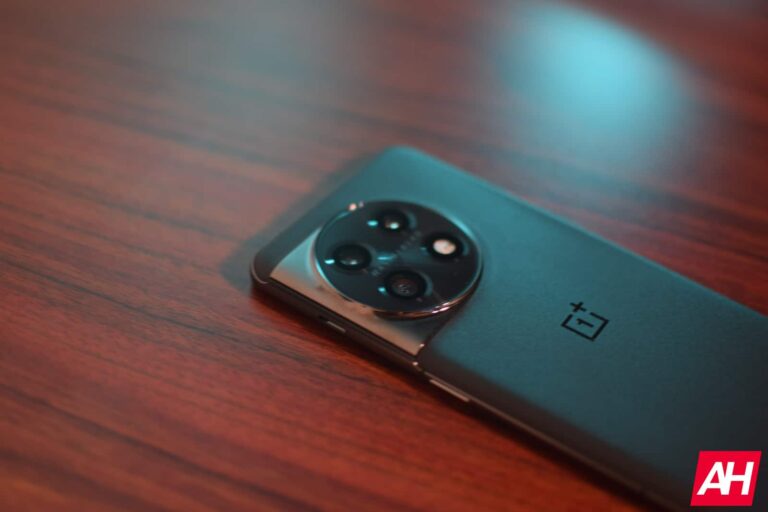
The OnePlus 11 is now out, and its set to be one of the best smartphones of 2023. So why not get some great accessories to go with your new OnePlus 11. While the charger is included in the box, this list does have a good charger or two that you could pick up for your OnePlus 11. Along with a smartwatch, extra USB-C cables and much more. So you can really get the best out of your OnePlus 11. If you haven’t already picked up the OnePlus 11, you can do so from here.
Best OnePlus 11 Accessories
In this list, you’ll find truly wireless earbuds, smartwatches, chargers, and much more. Just about everything you can think of to really take full advantage of the OnePlus 11.
While OnePlus does include a charger in the box with the OnePlus 11, it’s still a good idea to pick up another one to use when you’re traveling, or whatnot. And it’s pretty inexpensive at $35 too.
This charger can be used for a number of things, including charging your laptop, if it happens to be USB-C. Which makes this charger even more useful.
The OnePlus Watch isn’t actually new, but it is the only wearable that OnePlus makes and it works the best with a OnePlus smartphone. Making it the perfect fit for your new OnePlus 11.
This watch is able to do the usual things like tracking your fitness, so you can help get in shape. It can also bring notifications to your wrist, so you are touching your phone less.
The PopGrip from PopSockets is a really good accessory for really any phone. And the reason why this is the best PopSocket you can buy right now is because it does allow you to swap out the top. So if you want to change the color, you can do so.
PopGrip is really great because it allows you to hold onto your phone much easier, especially for larger phones, but even works great on smaller ones like the OnePlus 11. But it also doubles as a sort of kickstand for your smartphone. Allowing you to use it on long flights to watch a movie or two, without having to hold your phone the whole time. It’s a really genius invention, and it’s something that everyone should have.
You can attach the PopGrip to your case, so that it doesn’t ruin your phone too.
RAVPower Portable Charger 20000mAh PD 3.0 Power Bank
RAVPower Portable Charger 20000mAh PD 3.0 Power Bank
The RAVPower Portable Charger 20000mAh PD 3.0 Power Bank is a really great option for a battery pack for the OnePlus 11. It offers fast charging, though you likely won’t need that for the OnePlus 11, since it does offer some really good battery life.
It also uses two USB-A ports with fast charging, so you can charge other devices at the same time. RAVPower also includes two more USB-C ports for input, which is really nice, when you need to charge this battery up pretty quickly.
It’s always a good idea to get another USB-C cable or two, to have around your home. While you probably don’t need one at your office right now, since the majority of us are not actually going to work. It is good to have one in the car and other places around your home.
This is a USB-C to USB-C cable that is capable of USB-C PD speeds, so it can charge your phone pretty quickly too. That’s important in this day and age of fast charging.
The OnePlus Buds are a really great pair of truly wireless headphones from the company. And of course, they work really well with the new OnePlus 11. They also were released in a new radiant silver color that looks incredible.
These earbuds will run for around 5 hours on a charge, or 7 hours with ANC off. And with the included charging case, you can get 38 hours of playback which is pretty incredible.
The Fitbit Versa 3 is a great fitness tracker to go along with other accessories for your OnePlus 11. Especially if you’re looking to get in shape this year.
The Versa 3 is the latest in the Versa line for Fitbit. It offers up all of the fitness tracking that you’d expect from Fitbit. Including the ability to track your steps, your workouts, calories burned and much more. It can also deliver some notifications to your wrist.
The Anker PowerPort Atom PD 1 is the perfect USB-C PD charger to use with the Pixel 5. While it does still come with one in the box, it never hurts to have a spare somewhere in your home or at work.
This is a 30W charger – and yes, the OnePlus 11 tops out at 80W but this will work on other devices too. It also uses Gallium Nitride or GaN, which makes this charger a lot smaller than you’re probably used too. Which is why we think it is the best option. Since you can easily toss this into your bag when you’re traveling – if we are ever able to do that again.
This is one of the most interesting looking car mounts out there, and it really doesn’t even look like a car mount.
The Spigen Kuel S40 stealth Car Mount is a minimalist car mount for those that don’t want to use magnets. This is a car mount that folds down when it is not in use. Just open it up and stick your phone in the mount, in landscape mode and you are good to go. It’s a good option, because it is fairly small when it is not in use, so that it is not blocking your view of the road all that much.
Spigen offers the Kuel S40 Stealth car mount in only one color. Which is black and blue, so it can blend in with your car a bit more.
The OnePlus Buds 2 Pro are pretty impressive to pick up for the OnePlus 11. It has pretty punchy and powerful bass included. That’s thanks to the 11mm dynamic drivers that allow the acoustics to come to life. OnePlus Audio ID is included here, so you can hear every note in your playlist.
Battery life here is pretty good, lasting around 39 hours of playback. That’s thanks to the included carrying case. And it also has support for High-Res Audio and Google Fast Pair.
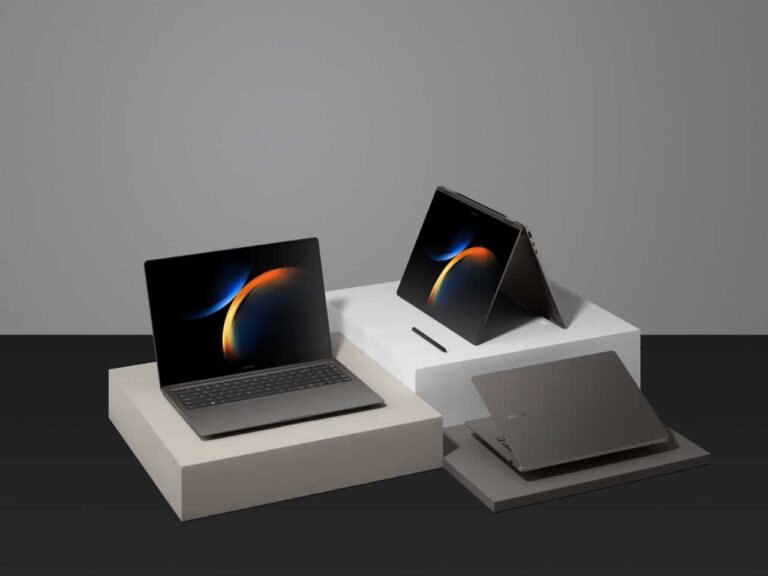
Earlier this month Samsung revealed its latest devices, which included the new Galaxy Book 3 Pro and Galaxy Book 3 Ultra, both of which you can now pre-order. The Galaxy Book series has always been about providing consumers with a premium laptop experience, but this year Samsung took it up a notch. The Galaxy Book 3 Ultra in particular showcases Samsung’s commitment to amping things up.
Not only does it come with 32GB of RAM, but it’s powered by up to a 13th Gen Intel Core i9 CPU and an NVIDIA RTX 4070 GPU. The aim here is likely to capture the creator consumer. Someone who needs a powerful enough laptop for content creation or professional use. But the specs seem to be more than capable of handling other high-load activities, too. Such as gaming.
This begs the question then. Is the Galaxy Book 3 Ultra a good gaming laptop option? Well, it’s not a gaming laptop per se. But it does seem equipped to handle games with decent graphics settings. The better question might be whether or not the cooling is up to the task. And if so, for how long?
Either way, if you’re looking for a premium laptop for, whatever your needs are, Samsung’s latest are up for pre-order through the company directly.
Pre-order the Galaxy Book 3 and get a free storage upgrade
Samsung usually has pre-order offers available for those that jump on their latest products early. And this time is no different. If you pre-order the Galaxy Book 3, you get a free storage upgrade. More specifically, Samsung will sell you the 1TB model for the same price as the 512GB model. So for example, if you pre-order the Galaxy Book 3 Ultra with an Intel Core i9, you can get the 1TB model for $2,499.99. This would normally be $2,999.99. And that’s the price it’ll go up to once the pre-order promotion is over.
The same storage upgrade offer is available for the other two models as well – the Galaxy Book 3 Pro and Galaxy Book 3 Pro 360. You can find all three at Samsung’s website.
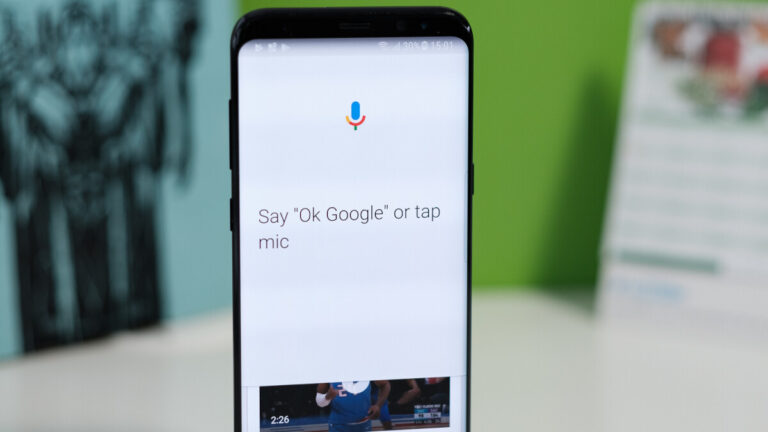
Google Assistant is considered by most device users to be the best virtual digital assistant beating out Alexa, Siri, Bixby, and others. But you might have noticed (and in all honesty, it isn’t hard to spot) that on Android, Google Assistant is always in Dark mode even if you have your system setting on Light mode. Back in October, Google said that Light mode is no longer available for Assistant on Android.
Now, Google has issued a support page titled “Assistant Uses Dark Mode By Default” in an attempt to revisit the issue. On the page, Google writes, “Google Assistant regularly tries new ideas to see what works and what could work better. This includes ways to make our products look and feel consistent throughout our product ecosystem.”
The company continues, “To offer a more helpful visual experience across all your devices, including Pixel Watch and Google TV, when you engage with Assistant on mobile Light mode is no longer available – it will now have a dark appearance, even if you have Dark theme turned off in your phone settings.”
The bottom line is that you shouldn’t expect to see Google Assistant in any other theme other than Dark and if you’re not a fan of white text on a black background, you’re SOL (Google it).
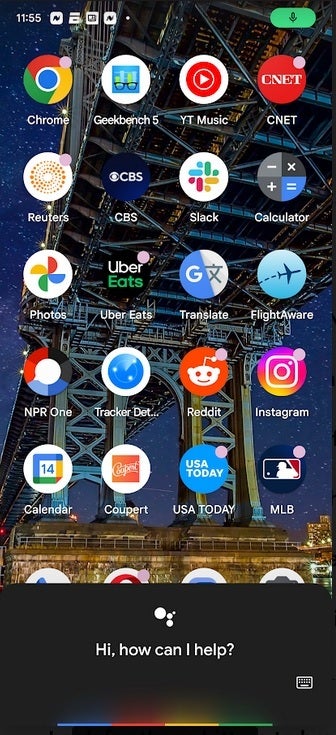
Google Assistant, on the bottom of the screen, will show up in Dark mode only on Android
As we told you less than a week ago, Google Assistant will be playing a key part in the new Google Lens feature “Search your screen.” This feature allows users to employ Lens to search photos and videos from websites and messaging and video apps. For example, if someone sends a video to you via your Messages app and you see a landmark in the background that you’re curious about, activate Google Assistant by long-pressing on your Android’s power or home button. Tap on “search screen” to get the info you want.
This feature is part of an update that will be disseminated over the upcoming months.
Perhaps there will be a day in the future when Google gives Android users the ability to decide whether they want to see Google Assistant in Dark Mode or Light Mode. But for right now, if you’re an Android user, you have no choice.
A WiFi 6E-compatible router from Google has been long awaited, and it’s finally here. It’s here at a price that is much less than the competition. For example, the eero 6E is priced at $299 for the same single-pack that Google is charging $199. And that’s actually the least expensive competitor for Google. So this is a big deal.
But the real question is, is the Nest WiFi Pro any good? Typically when a product significantly (by about 33%) undercuts the competition, it’s not very good. So is that the case here? Let’s find out in our Nest WiFi Pro Review.
Google Nest WiFi Pro Review: Unboxing & Setup
I’ll be frank here, when FedEx dropped off the Nest WiFi Pro, I thought maybe something else had been delivered. I was expecting it to be bigger and weigh more. But the Nest WiFi Pro is actually fairly small compared to the eero 6+ that I recently tested out. The Nest WiFi Pro itself is about the same size and height as my Comcast modem. Which is fairly impressive.
In the box, you’ll get the Nest WiFi Pro, an Ethernet cable, power cable and of course some instructions. It’s pretty minimal. To get started, plug it into the wall, and plug your modem into the Nest WiFi Pro.
Setting it up was quite easy. You just open the Google Home app and it should find your Nest WiFi Pro to setup. It took me about 5 minutes to set it up. And the actual input from me was pretty minimal. Making it very easy to do is a big deal. This means that I’d have no regrets about recommending my parents to get the Nest WiFi Pro for their home.
When I initially set it up, I tried to be lazy and just use the same SSID and password as my old network (which was on the eero 6+). That way I wouldn’t have to reconnect every single device in my house. That worked for about two days, until the network stopped allowing new devices to join and even refused to let known devices rejoin. So I had to factory reset it and set it up again, with a different SSID. So just a word of caution to those hoping to take the lazy way out, it might not work.
Otherwise, setup was extremely easy, and I wish all smart home products were this easy to do.
Google Nest WiFi Pro Review: Design
The design is quite polarizing, surprisingly. It’s surprising because it’s a router. But Google wanted to design this router to look nice, so that you won’t hide it away in a cabinet. That’s not a good thing to do with your router, as it will mess up your signal and speeds. It’s always good to put out in the open, and about halfway between the floor and ceiling.
So this router looks like an Easter Egg, and the pastel colors doesn’t help this very much either. I actually don’t mind the color. It matches my Comcast router and Philips Hue Bridge that are all connected to it. But the only issue I have with it is, that it is glossy. The older Nest WiFi is not glossy, and is a matte finish, which looked really nice. For some reason, the Nest WiFi Pro is glossy, which means you’re going to see more dust, dirt, scratches and more on the router. Making the whole “let it be part of your decor” thing, a bit irrelevant.
Nest WiFi Pro colors
Google does offer the Nest WiFi Pro in four colors: Snow, Linen, Fog and Lemongrass.
Google Nest WiFi Pro Review: Managing your network
As mentioned already, the Nest WiFi Pro is all managed within the Google Home app. Which makes things a whole lot easier for controlling all of your smart home devices. Once it is setup, you’ll see a new option at the top for “WiFi”, between Cameras and Routines. Just tap on that to manage your Nest WiFi Pro system.
Within the WiFi section, you’ll see the name of your WiFi at the top, along with how it’s doing. That includes a message telling you that everything is connected and working normally, or not. There’s also indicators for the internet, WiFi devices and then how many devices are connected at this time. Below that, you can see your network and devices. You can run a speed test within the app. Now I like this feature, because it does record your speedtests so you can see how things used to be, if you’re having issues. It does also run speedtests on its own to make sure things are running properly.
Now if you tap on “devices”, you are able to see what’s connected, and what kind of bandwidth they are using. You can prioritize specific devices as well. Google will let you show real-time usage, usage over the past day, week and month. Which can be very useful. This made me realize just how much bandwidth my Nest Cam uses everyday, it was a shocker.
Overall, the app makes it very easy to keep tabs on your network, prioritize devices, and apps you might use (like Zoom or Luna), and to see when you’re having problems.
Google Nest WiFi Pro Review: Should I buy it?
The Google Nest WiFi Pro is a pretty good WiFi 6E router, and definitely going to be future-proof for probably a decade or so from now. So even at $199, it’s a good investment for your home. If you’re still working from home and have a lot of devices on your network, then it’s definitely worth the money.
You should buy the Google Nest WiFi Pro if:
You use a lot of smart home products (light bulbs, thermostats, robot vacuums, etc)
You do some cloud gaming (Luna, NVIDIA GeForce Now, etc)
You have a lot of people in your home
You have a larger home (a single Nest WiFi Pro can cover 2,200 square-feet)
You should not buy the Google Nest WiFi Pro if:
You have slower internet speeds (anything under, I’d say, 200Mbps won’t notice a big difference)
Researchers found two security vulnerabilities in the ImageMagick tool that could trigger denial of service attacks or leak data. The vendors patched the bugs in time, preventing any active exploitation. Users must ensure updating to the latest patched releases to avoid any mishap.
Multiple Vulnerabilities Spotted In ImageMagick Tool
According to a recent post from the cybersecurity firm Metabase Q, their researchers found two security issues in the ImageMagick graphics tool.
ImageMagick is an open-source software for image conversion, designing, and editing. Given its free availability and support for a large number of file formats (200+), ImageMagick is a popular tool among graphic designers and web developers, particularly those dealing with open-source apps.
Specifically, the researchers found the following two vulnerabilities affecting ImageMagick.
CVE-2022-44267: a denial-of-service (DoS) vulnerability that affected the image conversion feature when parsing PNG files. According to the researchers, parsing .png files could “leave the convert process waiting for stdin input.”
CVE-2022-44268: an information disclosure vulnerability that could leak data from arbitrary remote files when parsing PNG images in the resulting image.
Exploiting both vulnerabilities simply required an attacker to upload a malicious PNG image file to the target website using ImageMagick. The researchers have shared a detailed technical analysis of both vulnerabilities in their post.
Vendors Patched The Flaws
Metabase Q’s Ocelot team discovered these images when analyzing the then-latest version of ImageMagick 7.1.0-49. Following this discovery, they promptly reported the matter to ImageMagick developers.
Consequently, the app developers worked on fixing the vulnerabilities, ultimately releasing the patches with the subsequent app release.
Their site now lists the ImageMagick 7.1.0-60 version as the latest release. Hence, to ensure receiving all the feature updates and bug fixes, users must update their websites and systems with this release at the earliest.
The campaign has been active since September 2022, and the recent surge in website infections was noted in January 2023.
Sucuri researchers have reported a backdoor that has successfully infected around 11,000 websites in recent months. Here are the details shared by Sucuri in its technical report.
It is a fact that, lately, several Google products have been exploited and abused to spread malware and other malicious components, including Google Ads, Google Home, and Google Drive.
In fact, a study revealed that Google Drive accounted for 50% of malicious Office document downloads in 2022.
Backdoor Redirecting Visitors to Hacked Sites
According to Sucuri’s research, the backdoor redirects users to sites that show fraudulent views of Google AdSense ads. The company’s SiteCheck remote scanner has detected more than 10,890 infected sites. The activity has further intensified recently, with 70 new malicious domains disguised as legitimate in 2023 and 2,600 infected sites discovered on the web.
All the infected websites detected by Sucuri were using WordPress CMS. These had an obfuscated PHP script injected into the legitimate files on the websites, such as index.php, wp-activate.php, wp-signup.php, and wp-cron.php, etc.
How Does the Attack Work?
In the past two months, Sucuri researchers have identified over 75 pseudo-short URL domains linked with redirected traffic. It must be noted that almost all of the malicious URLs appear to belong to the same URL-shortening service. Some even mimic the names of popular shortening services, such as Bitly.
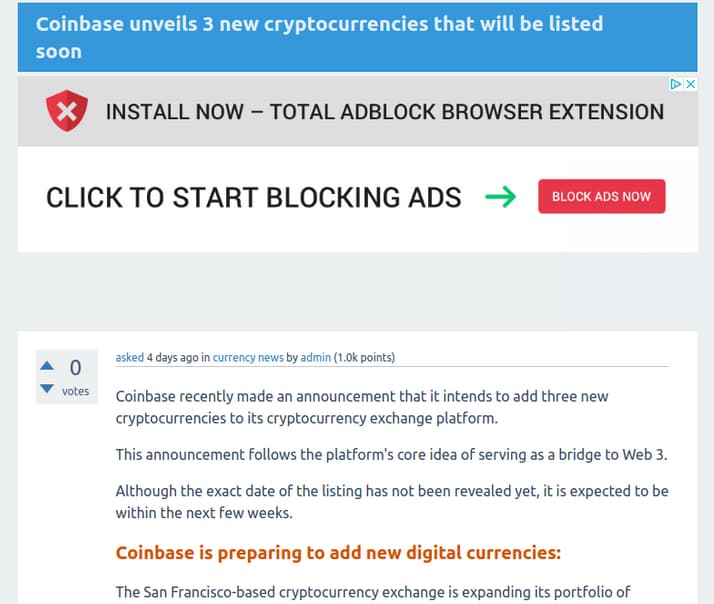
The visitors are redirected to a range of low-quality websites developed on the Question2Answer CMS, and the discussion topics are mostly related to cryptocurrency or blockchain.
Researchers believe it could be intentional to advertise new cryptocurrencies in a pump-and-dump, ICO fraud. However, researchers are certain that the primary objective of this ad fraud is to inorganically increase traffic to sites that contain the AdSense ID so that Google ads can be displayed for revenue generation.
Image source: Sucuri
How does It Evade Detection?
Some of these malicious sites also inject obfuscated code into “wp-blog-header.php.” This code works as a backdoor to ensure the malware evades disinfection attempts. It performs this by loading itself into files that run as soon as the targeted server is restarted.
“Since the additional malware injection is lodged within the wp-blog-header.php file it will execute whenever the website is loaded and reinfect the website. This ensures that the environment remains infected until all traces of the malware are dealt with.”
The malware hides its presence by suspending redirections when a visitor logs in as an administrator or visits an infected site within 2 to 6 hours. The malicious code is hidden using Base64 encoding.
How URL Shorteners Abused in the Attack?
When the user enters any domain names in their browser, they are redirected to a real URL shortening service, e.g., Cuttly or Bitly, but these are not genuine public URL shorteners. Each domain has a few working URLs that redirect visitors to spammy Q&A sites featuring AdSense monetization.
In a blog post, Sucuri researcher Ben Martin stated that the “backdoors download additional shells and a Leaf PHP mailer script from a remote domain filestacklive and place them in files with random names in wp-includes, wp-admin, and wp-content directories.”
The campaign has been active since September 2022, and the recent surge in website infections was noted in January 2023.
“At this point, we haven’t noticed malicious behaviour on these landing pages. However, at any given time, site operators may arbitrarily add malware or start redirecting traffic to other third-party websites,” researchers noted.
Dark Mode is a feature that a lot of people love on their phones and tablets, and even on their laptops. It’s because a lot of things look better in dark mode, versus a searing white background. Since a lot of us use our phones at night and in dark environments, dark mode makes a lot of sense. And on a phone like the Galaxy S23 Ultra which uses an AMOLED display, it also helps with battery life. You see, AMOLED displays light up pixels independently. So if the majority of pixels are black or darker, they use less power.
Not only that, but dark mode is also nicer on the eyes compared to light mode. But you might want to use light mode during the day, as it can be tougher to see outside when your phone is in dark mode. So it’s a good idea to use a schedule for dark mode, or add a toggle to the quick settings.
Here’s how you can turn on dark mode for the Galaxy S23.
How To Turn on Dark Mode on Galaxy S23
Open up the Settings app on your Galaxy S23 smartphone.
Next, tap on Display.
At the top of this screen, you’ll see “Light” and “Dark”. Tap on “Dark” to turn on dark mode for your device.
Now if you don’t want to have dark mode on 24/7, you can tap on “Dark mode Settings” and change there.
Within the dark mode settings, you can set a schedule.
There are two options for scheduling: Sunrise to Sunset, and a custom schedule.
Sunrise to Sunset is the best option for most people, as you’ll use dark mode when it’s dark, and light mode when the sun is out. Like using your phone in direct sunlight.
That’s it. That’s just how easy it is to turn on dark mode, and even set up a schedule for dark mode.
With the internet and social media playing a significant role in how people consume information, combating misinformation is more important than ever. To address this issue, Google recently launched a new campaign named “prebunking,” which aims to help people identify misinformation and become more resilient against manipulation.
What exactly is Prebunking?
Prebunking is a technique that goes beyond fighting individual instances of fake news. It involves teaching people how to spot false claims before they encounter them. The idea is to use short videos that highlight the techniques commonly used in misleading claims and help people develop critical thinking skills to combat misinformation.
Google first launched the campaign in Poland, Slovakia, and the Czech Republic, in collaboration with the universities of Cambridge and Bristol, by distributing the prebunking videos through social media platforms like YouTube, Facebook, Twitter, and TikTok. These videos focused on exposing the spread of false information that was being used to hold Ukrainian refugees accountable for a housing crisis in Poland.
Surveys conducted after the campaign showed that those who watched the videos were up to 8% more likely to correctly identify fake news. Given its success in Eastern European countries, Google’s Jigsaw now plans to expand the campaign to Germany.
However, prebunking videos come with their own set of challenges. The effects of the videos wear off eventually, and companies like Google will need to produce “booster” videos periodically. Additionally, to be effective, the videos must also tailor to different languages, cultures, and demographics.
The future of fighting misinformation could be AI
As Google and Microsoft are developing their conversational AIs with advanced natural language processing algorithms, it’s evident that AI could serve as a potential weapon against misinformation. Given that AI can handle massive data quantities and spot irregularities and patterns that humans might not perceive, companies like Google can design algorithms capable of identifying and flagging fake news articles or social media posts. Such a system could curb the spread of false information and notify fact-checkers to research and disprove the claim.
Apple has always cited security as the reason why it doesn’t allow sideloading on the iPhone. Sideloading is when an app is downloaded and installed from a third-party app storefront. Since Apple has no control over the apps in a third-party app store, it worries that iPhone users will end up installing malware. Android users are allowed to sideload apps although we do suggest that you limit the apps you sideload to those from developers you’re familiar with.
Thanks to Europe’s Digital Markets Act (DMA), Apple will have to allow sideloading on the continent (possibly starting with iOS 17) which will allow developers to host iOS apps outside of the Apple App Store. This means that some developers will be able to get around the 15%-30% cut that Apple collects from in-app purchases and subscriptions. The U.S. government would also like to force Apple to allow sideloading on the iPhone.
U.S. Commerce Department’s NTIA would like to see Apple allow sideloading of apps for the iPhone
A press release from the Department of Commerce’s National Telecommunications and Information Administration (NTIA) says that “the current mobile app store model is harmful to consumers and developers.” Two key points were made. One, “Consumers largely can’t get apps outside of the app store model, controlled by Apple and Google.” And two, “Apple and Google create hurdles for developers to compete for consumers by imposing technical limits, such as restricting how apps can function or requiring developers to go through slow and opaque review processes.”
NOTE: while Google does allow sideloading on Android, the report says 90% of app downloads on Android are through the Google Play Store. So when the report says that “Consumers largely can’t get apps outside of the app store model, controlled by Apple and Google,” it means that even with the ability to sideload apps on their devices, most Android users still turn to Google’s app storefront.
The NTIA would like to see Apple allow sideloading of apps and give developers the choice of using a different in-app payment platform
The NTIA report said, “Mobile apps have become an essential tool for participation in much of daily life. Given both the growing importance of mobile apps and the need to promote innovation in this space, President Biden called for a study of the ecosystem along with recommendations for improving competition, reducing barriers to entry, and maximizing the benefits for consumers as part of a 2021 Executive Order on competition.”
The report reaches the following conclusions:
Consumers need to have more control over which apps they choose as default apps, use third-party app stores, and delete or hide pre-installed apps.
Operators should not be allowed to favor their own apps or discriminate against other apps that are similar.
Legislative and regulatory agencies should prohibit restrictions on sideloading, using alternative app stores, and web apps.
Ban requirements that developers must use an app store operators’ in-app payment systems.
The NTIA would like to see Congress enact measures including “Guaranteeing that platforms allow, or provide, a readily accessible means for users to download and install third-party apps or mobile app stores, including through means other than the Google Play Store and Apple’s mobile app store, while allowing for reasonable privacy, security and safety precautions (e.g., to prevent malicious software from being installed unintentionally).”
Agency wants operators to allow users to install third-party web browsers through third-party app stores
The all-inclusive report also discusses how operators should allow users to install third-party web browsers. “To allow web browsers to be competitive…the platforms would need to allow installation and full functionality of the third-party web browsers. This would require platforms to permit third-party browsers a comparable level of integration with device and operating system functionality.”
Alan Davidson, Assistant Secretary of Commerce for Communications and Information and NTIA Administrator says, “From finding directions to chatting with loved ones, apps are a critical tool for consumers and an essential part of doing business online. It is more important than ever that the market for mobile apps remains competitive. NTIA’s recommendations will make the app ecosystem more fair and innovative for everyone.”
The NTIA might not be the most famous agency, but it is “part of the U.S. Department of Commerce [and] is the Executive Branch agency that advises the President on telecommunications and information policy issues. NTIA’s programs and policymaking focus largely on expanding broadband Internet access and adoption in America, expanding the use of spectrum by all users, advancing public safety communications, and ensuring that the Internet remains an engine for innovation and economic growth.”
The agency would like to see its recommendations enacted by lawmakers so that the rules are put in place to make the mobile app ecosystem fair for both consumers and competitors to the main operators. Those main operators would be Apple and Google.