Using CISO strategies to prevent threats

0
[ad_1]

Executive summary of CISO

CISOs are under immense pressure to protect their organization and keep them out of the breach headlines. The largest obstacle to this goal is an evolving threat landscape that is increasing in sophistication. Payments from successful ransomware attacks fuel this evolution in the form of ransomware-as-a-service models. To break the trend, this report will explore why CISOs, and their teams can no longer simply react to these threats and must prevent them from occurring in the first place.

When an organization’s cybersecurity tools are reactive solutions, they can leave the organization vulnerable to attack, recovering data and systems is not enough. Threat actors became wise to this recovery tactic and started to exfil sensitive data before launching ransomware within the victim environment. As a result, threatening to release sensitive data is often enough to force the organization to pay the ransom even if they have the ability to recover systems and data.

“Threat actors are always changing and evolving their tactics, and we need to account for that change.” 

Tony Lee

Vice-President,Global Services Technical Operations at BlackBerry

Being quick to react and recover is important, but it is only half of the picture, according to Lee, because of the name-and-shame tactics and the data released by the threat actors.

Ransomware-as-a-service, where threat actors can use already-developed ransomware tools and services to carry out attacks, continues to thrive and enable threat actors to scale like never before. Organizations that may have believed threat actors did not target before are now targets. Organizations (regardless of size) cannot afford to remain reactive and perform monitoring on a nine-to-five basis. Threat actors are working around the clock globally and a company’s defences must do the same.

In fact, the threat of “new ransomware models” was the top concern facing executives in the third quarter of 2021, according to Gartner’s latest Emerging Risks Monitor Report Those surveyed by Gartner said that ransomware was a bigger concern than pandemic related disruptions, including supply-chain issues.

Finally, organizations must be prepared to face an ever-growing cyber space, as well as a huge volume of data and endpoints. While previously it may have been easy to manage a small set of systems it is now imperative that companies are prepared to deal with an explosion in the number and types of endpoints. The rapid growth and prevalence of IoT is not just a risk to home users, but also organizations. Everything from coffee pots to smart car chargers to fish tank thermometers pose a risk to the organization. A preventative approach to solving these issues lies in the technology and strategies CISOs are deploying.

“Moving from a reactive to a preventative security posture is not an easy undertaking.”

Tony Lee

Vice-President, Global Services Technical Operations BlackBerry

By focusing on Endpoint Protection Platform (EPP), Endpoint Detection and Response (EDR), Managed Detection and Response (MDR) and Managed Extended Detection and Response (XDR) solutions, this report will reveal how CISOs can use the latest cyber security mitigation strategies to deal with this complex and fast-moving threat landscape.

Using managed services to bridge the skills gap

In the face of today’s threats, a preventative strategy should employ 24×7×365 monitoring, threat intel overlay, and continuous threat hunting, all based on AI-powered technology. AI is the force multiplier to help bridge the skills and resources gap making humans more efficient in their jobs. The predictive nature of AI-based EDR and EPP is needed to combat zero-day threats enabling the prevention-first strategy.

It is often a challenge for CISOs to deliver these types of capabilities in-house. Typically, only the largest enterprises with budgets and resources to match have a chance at solving this with in-house only resources. For the rest of the industry, there are managed solutions that are designed to scale using fixed resources.

“Even if budget is not an issue, staffing and time to build are still challenging. In many cases for organizations of all sizes, enlisting the help of an existing MDR or XDR provider is often more cost and time effective than building it yourself,” Lee explains.

Using managed services is by no means a new solution. As Lee explains, the demand for environment visibility via an EDR product is driving customers to see the value, but also realize the challenge in implementing and optimizing such a powerful product.

Also read: Five active ransomware gangs and their tactics

Next-gen AI-based EDR and EPP solutions are being used increasingly to replace legacy antivirus solutions that do not pass as meeting minimal security standards anymore.

Lee points out that using some legacy solutions may in fact mean an organization is unable to obtain cyber insurance due to a high risk of breach.

“Cyber insurers want to see next-gen products as well as EDR and 24×7 monitoring as a minimum. This combination of AI-based EPP and EDR provides a “prevention-first” strategy followed by visibility in case there is a need for investigation and validation,” Lee said.

Skill shortages

While EDR may be growing in popularity, it can prove difficult for organizations to really master as it requires both commitment and possibly even dedicated resources.

“Organizations realize the necessity [for EDR] but they do not in many cases have the in-house expertise to avoid another shelfware product so that’s why they look towards managed services,” Lee adds.

For example, in the research carried out by UK’s Department for Digital, Culture, Media & Sport, the UK government said in March 2020: “Approximately 653,000 businesses (48 percent) have a basic skills gap. That is, the people in charge of cyber security in those businesses lack the confidence to carry out the kinds of basic tasks laid out in the government-endorsed Cyber Essentials scheme and are not getting support from external cyber security providers.”

Even if organizations were willing to hire additional in-house staff, they are faced with a headcount shortage in the cyber security industry.

Moreover, in an August 2021 speech by President Biden on improving cyber security in the US, he said, “Our skilled cyber security workforce has not grown fast enough to keep pace [with hackers and criminals].”

“We’ve created our own problem because we’re focused on a detect and respond world, not a preventative world.”

Brian Robison

Vice-President of Solutions Strategy at BlackBerry

Biden noted that about half a million cyber security jobs remain unfilled.

While organizations may be grappling with this so-called skills shortage, managed services can assist by allowing organizations to have cybersecurity solutions supplied rather than building them in-house.

Brian Robison, Vice-President of Solutions Strategy at BlackBerry, views the skills shortage as a problem that has been created by the cyber security world itself. “We’ve created our own problem because we’re focused in a detect and respond world, not a preventative world. We’re spending millions and millions of dollars of our board’s money to react to a threat that could have been blocked,” he says.

“We need managed services to bridge the gap to efficiently scale to cover thousands of organizations and hundreds of thousands of endpoints. These services are able to protect more devices by efficiently using a smaller set of highly skilled people along with finely tuned processes and technology,” Lee adds.

Professional services organization KPMG said in a 2021 post that, as the skills gap becomes more acute, the answer is not just to bring in more people but to use technology and automation for repetitive tasks.

The job of technology is not necessarily to replace people but to assist those who are working in cyber security in carrying out the most important tasks.

Also read: The main challenges facing by CISOs

How investment in prevention-first pays off

Through the use of MDR and Managed XDR, combined with EDR and EPP solutions, businesses can optimize their investment in cyber security.

Ultimately, Lee believes that utilizing managed services is the most cost-effective way to ensure an organization’s cyber security.

“We have performed multiple cost model analysis for MDR/Managed XDR versus building in-house and only in the very largest organizations, such as those in the Fortune 100, would it start becoming more cost-effective for them to do it in-house,” he explains.

This is especially true for small- and mid-size organizations since employing enough staff to do the job of a managed services provider can be impractical, they are simply not large enough to absorb the investment needed for the additional headcount.

We know that small- and mid-sized businesses must carefully consider effective investment in cyber security because they are at high risk. The US Small Business Administration notes that small businesses are particularly attractive targets because they have information that cybercriminals want, and they typically lack the security infrastructure of larger businesses.

Not only do managed services provide businesses with the solutions they need to counter these threats but the shift to a prevention-first strategy also provides an opportunity to be more cost-effective with a security strategy.

“Prevention is far less time-consuming and costly than investigation and containment. The earlier we can prevent the attack in the cyber kill chain – the less resources we will need to consume. Thus, a prevention-first strategy can also help reduce the skills and resources gap along with defensive spend,” Lee says.

CISOs shifting their approach

CISOs must consider the benefits investment in a prevention-first strategy will bring to their business and Robison also says that today’s CISOs need to turn the corner from being a cost center to becoming a more proactive part of the business.

The conversation needs to change from one that is focused on investment in legacy antivirus solutions, which Robison believes is ultimately a drain on resources, to preventative solutions that stop the threat before it becomes a cost to the organization through ransom payout and remediation efforts.

“What this requires you to do is to partner with vendors that help you grow the business,” he says.

Robison compares the shift in focus CISOs must make to the actions CIOs took to move from on-premises solutions for an organization’s data to cloud solutions for their data centers.

“CIOs changed their models from being a massive cost center to becoming a more proactive business delivery model,” he says. “The CISO has not rounded that corner yet.”

“The biggest paradigm shift that I see being capable in the world today is helping the CISO change the conversation and say I need to make this investment [in a managed service].

He explains that this is essentially what the CIO did years ago when they recognized the need to get rid of the on-premises solutions which are costly to the organization and switch to the more efficient cloud-based services.

This is by no means an easy task and it is challenging for CISOs to stand in front of the board and tell the CEO there is a better way of doing things, Robison notes. Ultimately, most businesses will discover that outdated, traditional reactive solutions do not prevent breaches when a breach happens it will be extremely costly.

The cost of a breach to small- and mid-sized businesses are often astronomical and can ultimately be mitigated with commitment and investment in preventative solutions such as MDR/Managed XDR, EDR and EPP.

Using AI is imperative to the solution

AI offers solutions where computers can process large amounts of data to learn patterns, so it knows how to behave without the assistance of humans – this includes predicting what may occur next from analysis of what has already happened.

The value of MDR and Managed XDR solutions can be enhanced through the use of AI to provide the 24x7x365 coverage required in a scalable fashion.

“The reality is the human aspect of legacy EPP and EDR solutions cannot scale, there are too many new versions of new viruses,” says Robison.

The AI component of MDR/Managed XDR, EDR, and EPP is essential to have a predictive advantage against today’s threats.

In July 2021, the World Economic Forum noted that well-deployed AI can be used to counter today’s security threats. In addition, the World Economic Forum highlights that AI can help respond to threats almost immediately, especially when there is too much data for humans to process.

Also read: CISO considerations for managed XDR investment

AI-powered endpoint protection

AI is necessary because network defenders already face a huge volume of alerts. Many organizations are unable to analyse all the endpoint threats and vulnerabilities, and when coupled with the labour shortage previously discussed, this is where AI can be that force multiplier.

AI-powered endpoint protection is able to use advanced machine learning to uncover malware, fileless and user-based threats in the environment. Meanwhile, the benefits of AI are already being felt by those who use it. As of 2019, 64 percent of senior IT executives surveyed by Statista stated that AI helped lower costs to detect and respond to breaches in their organizations.

Statista stated that 83 percent of US-based respondents it surveyed agreed to the statement “we will not be able to respond to cyberattacks without AI”. Many vendors claim to employ artificial intelligence in their products as a bit of an “us too” marketing exercise, Lee says. Thus, CISOs are encouraged to look for vendors who have been in this space for a while and have mature AI math models.

“The AI component is critical to all of this otherwise it just does not scale efficiently.”

Tony Lee

Vice-President, Global Services Technical Operations, BlackBerry

“The beautiful thing about the math model is the predictive nature of it, so even when a brand-new threat comes out, there is a high probability that the math model already has coverage on the new threat without even being told about it,” Lee explains.

Essentially AI can do what humans cannot by trawling through vast amounts of information to identify threats and use the learnings from said information to predict what future threats may look like.

CISOs’ threat prevention-first strategy

To move from a reactive to a preventative strategy, CISOs must recognize that there is a need to shift away from outdated legacy antivirus technology and toward nextgen solutions that prevent attacks before they happen.

MDR, Managed XDR, EPP and EDR solutions, combined, can offer an effective approach that does not drain resources and allows organizations to minimize alert fatigue.

In addition, these solutions must work together.

“A fully integrated EPP, EDR, and managed service is required for any hope of correlating events. Trying to correlate EPP and EDR events in two disparate systems is not scalable,” Lee says.

“This needs to be delivered as a single package by managed security experts who know how to wield the products the best. Since no EPP is 100 percent, EDR provides the ability to gather evidence, threat hunt and even take extended actions.” “These two technologies combined with managed services enables incident analysts and hunters that work as an extension of your security team. This allows internal security teams to focus on key security initiatives rather than spending time and resources triaging alerts or recovering from an attack,” he adds.

AI also has a vital role as the volume of threats and incidents cannot be identified by humans alone. The predictive aspect of AI is crucial to identify threats before they happen.

While faced with a shortage of cyber security professionals, a prevention-first strategy is the only way for organizations to defend against today’s threat landscape.

Read a PDF of the report here


[ad_2]
Source link

Wear OS 3: Everything You Need To Know

0
[ad_1]

The new Wear OS is finally here, finally giving us our hands-on look at what the software will be like for users. Google was initially quiet on which current devices would get the update to it. But during the Google IO keynote on May 18, and in the months that followed, it did share some details about what to expect from the new version of its wearables platform.

Better battery life is probably the biggest thing that’s available. But it’s not the only notable improvement that Google made. users can also expect better performance, some new features, and overall just a more well-rounded experience.

This guide will break down everything there is to know about the new Wear OS platform now that it’s been available since the launch of Samsung’s new watch. We’ll update this post periodically as more information becomes available.

The new Wear OS is a unified platform

If you missed the keynote from Google IO earlier this year, you can watch a roughly 9-minute recap of the biggest parts here. But in regards to Wear OS specifically, if you missed the keynote then you missed that Google is unifying Wear OS with Samsung’s touch on the software. Officially the software is called Wear OS 3, but the user interface is called One UI Watch 3.

With Google’s smartwatch OS at the helm and Samsung’s user interface layer on top, users are getting the best of both worlds. Google’s expansive collection of smartwatch apps and Samsung’s more pleasing user experience.

As for what the new unified platform includes, there’s not a ton of specifics yet but Google has highlighted some things. Both Wear OS and One UI Watch have their strengths. Which is exactly what Google and Samsung are trying to offer. This means you’ll see things like Google Assistant and Bixby for voice-activated, hands-free functions.

While other services like Google Maps and Google Pay are being brought into the fold on Samsung’s smartwatches for the first time since the Samsung Gear Live.

Google is officially calling the new platform Wear OS 3

A recent support forum post from Google about the new Wear OS platform refers to it as Wear OS 3, confirming that this will be the official name for the software. This goes for any watches that are eligible to receive the upgrade to the software, as well as those that will launch with it out of the box.

It’s reasonable to have suspected that because Google was making this a new unified platform with Samsung, that it would come with a new name. But Google is choosing to keep the Wear OS name and simply add the new version number.

New apps and tiles are coming

If you like third-party apps on your smartwatches, then Wear OS 3 is going to be right up your alley. Google has even shared some of the apps and tiles that are going to be available once the new version of the OS rolls out.

This includes YouTube Music, Google Maps, and Google Pay for the apps. You can see some screenshots of what these apps look like in the gallery above. From Google Pay to Spotify.

Beyond the apps, Google is refreshing the looks of many of its most popular Tiles. Like weather, the alarm clock, the hand washing timer, Google News, and Google Calendar just to name a few. There’s also going to be a new Tile added dedicated to Fitbit’s Active Zone Minutes feature.

You can expect Tiles from third-party apps too. Like Spotify, Strava and others. As Google will be opening up the new Tiles API to third-party developers when the new Wear OS gets pushed out.

Samsung and Fitbit are Google’s only partners for the new Wear OS platform so far

It’s quite possible that eventually Google will have more partners for this new platform. But it’s starting out small. With Fitbit, which it owns, and Samsung, which is a clear choice. Given the popularity of Samsung’s wearables platform over the current Wear OS.

Samsung is the first to feature the new software. Because it worked with Google to develop it. As of right now, the Galaxy Watch 4 and Galaxy Watch 4 Classic are the only two smartwatches that run Wear OS 3. Though some existing watches will be getting the update to it sometime in 2022.

What watches will run on Wear OS 3?

As of right now there are 11 different watches that run on Wear OS 3. This includes the Samsung Galaxy Watch 4 and Galaxy Watch 4 Classic, as well as the Galaxy Watch 5 and Galaxy Watch 5 Pro. Additionally, the Mont Blanc Summit 3, and Google’s own Pixel Watch run on Wear OS 3 as well. And as of October 17, Fossil has started sending out the update to four of its watches. Which are the Fossil Gen 6, the Skagen Falster Gen 6, the Michael Kors Gen 6, and the Razer x Fossil Gen 6.

Fossil’s recently launched Gen 6 Wellness Edition also comes with Wear OS 3 out of the box and won’t need to be updated.

The Spotify app will support downloadable content

You’ll be able to download both music and podcasts to the watch when this feature rolls out. Meaning you can connect a pair of Bluetooth earbuds or headphones to the watch and leave the phone at home. That way you can still enjoy everything Spotify offers even if the watch isn’t connected to the internet.

Better performance, better battery life, faster load times for apps

Wear OS has been lacking in both performance and battery life for really its entire lifespan. Since it’s been available to users, these two areas have always fell short. Google knows it.

So the new Wear OS rectifies this with better performance and better battery life. This was the promise during Google’s IO announcement this year, and for the most part Google has lived up to that promise. The company states that apps load faster too. So the user experience overall should be more efficient and enjoyable for most people. In our experience, that was mostly the case.

More to the point, though, is that you’ll be able to use the watch for more than a day before having to charge it. Whereas with Wear OS 2, you’d be lucky to get to the end of the day.

It’s all about convenience

The new Wear OS makes it super easy to not only get things done but also use your favorite apps. One of the new features is the capability to easily switch back and forth between your most recently used apps.

From anywhere on the watch no less. So no matter what screen you’re on, you can hop right back to maps if that’s the last app you used.

The new Wear OS offers world-class health and fitness features

With Fitbit on board, the new Wear OS is going to be even more centered on health and fitness than ever before. The platform will come with a Fitbit app with features like Active Zone Minutes.

It’ll also include on-wrist celebrations to keep you motivated. And you’ll be able to track your progress throughout the day with just a glance. There are likely more features that will be part of the app as well.

Qualcomm says that Wear 3100/4100 chips can support the new software

Back on June 17 Qualcomm confirmed that smartwatches running on its two newest chipsets could technically support the new software.

Stating that Wear 3100 and Wear 4100 chips are capable of doing so. It also noted that it would be working to ensure that devices on these chips get the update if at all possible.

However, Google is not necessarily as committed to bringing support to older devices. The company has stated that its top priority is user experience. And it doesn’t know that those older chips can live up to the experience that it wants to provide for users.

Some manufacturers, like Fossil, have made official statements saying that none of its existing watches will get the update. Other brands, like Mobvoi, seem to be hinting that at least the TicWatch Pro 3 would be updated. And as the only Wear OS watch running a Snapdragon Wear 4100 chip, it would be a little surprising if the watch didn’t receive the new software.

Samsung’s Galaxy Watch 4 is the first device on this new platform

Samsung Galaxy Watch 4 76

Back in July Samsung showcased some of the upcoming platform that it’s working on with Google. The new user experience is officially called the One UI Watch 3. Prior to the announcement of the Galaxy Watch 4, this wasn’t an official name for the user experience, as Samsung was simply referring to it as the One UI Watch experience.

The company initially revealed the new experience during its virtual Mobile World Congress event on July 23. Noting that its upcoming smartwatch at the time, now officially known as the Galaxy Watch 4 and Galaxy Watch 4 Classic, would be the first device to run this new software.

This means that no other Wear OS smartwatches are going to have this software for a while following Samsung’s latest device that has just recently hit the market. In fact, Google also confirmed that Samsung’s Galaxy Watch 4 will exclusively feature Wear OS3 until late 2022. So this will be the only Wear OS 3 watch for the better part of a year.

According to Google, it will begin rolling out updates to compatible devices in the middle to second half of 2022.

Google Assistant and YouTube Music are not on the Galaxy Watch 4 at launch

Following the Galaxy Watch 4 announcement, Samsung confirmed that at launch, the Galaxy Watch 4 would not have access to either Google Assistant or YouTube Music. Furthermore, Google Pay is absent too. Though it will these eventually.

Samsung says it’s working closely with Google to get these services up and running on the new watch. In the meantime, users will still have access to Samsung’s own virtual assistant, Bixby. Worth noting is that YouTube Music is now available on Wear OS if you have the Galaxy Watch 4. Having been made available back around August 27.

Will any current smartwatches be upgraded to the new software?

There are three current smartwatches which have been confirmed as eligible to receive the upgrade to Wear OS 3. This includes the TicWatch Pro 3 GPS, the TicWatch Pro 3 Cellular/LTE, and the TicWatch E3.

Google also confirms that follow on TicWatch devices, as well as Fossil Group’s upcoming smartwatches later this year will also be eligible for the Wear OS 3 upgrade.

Devices eligible for upgrade will need a factory reset

In addition confirming which watches are eligible for the new software, Google has also stated that any eligible devices will need a factory reset. In the support forum post where it confirmed the Wear OS 3 name, it notes that eligible watches will need revert back to the way they were when users got the devices. Which means factory settings.

Google cites the changes to the software as the reasoning for the factory reset requirement.


[ad_2]
Source link

A huge leak shows upcoming Sony headphones and speakers

0
[ad_1]

Sony is in the headlines now because of a pretty significant leak that just happened. The design for the Sony Xperia 1 V was revealed, but the leaks don’t stop there. Thanks to Kuba Wojciechowski on Twitter, we have a leak of some upcoming Sony headphones and speakers that the company is launching.

This leak looks pretty solid, but as with any leak, you’ll want to take it with a grain of salt. We’ll want to wait on official word from the company to tell for sure. We’re not sure when Sony plans on announcing these products. However, MWC is coming up, so it’s possible that we’ll see these devices there.

New leak shows Sony headphones and speakers

This leak shows us four different products, and some of them come in different colors. Starting off with the Sony headphones, the leak shows us an affordable pair that comes in two colors. They’re called the Sony WH-CH520, and it looks like they’ll be the successor to the Sony WH-CH510 from last year. Those headphones were an affordable pair of headphones that offered some serious bang for your buck.

Looking at the pictures, they seem to be a bit rounder than last year’s iteration, and they lack the distinct texture that they had. We don’t have any specs on these headphones, but we expect similar (and, hopefully, improved) performance.

Next up, we have a some speakers coming from the company. The first is the MagicBucket Bluetooth speaker (HT-AX7). This device has an odd shape, but it seems to work. The MagicBucket has an ovular body that we expect to house some drivers. On top of the device, we see what looks like two more speakers. If anything, this speaker will deliver a big sound.

Sony MagicBucket

The Sony SRS-XV500 looks like it will be a relatively large speaker to take to parties or large gatherings. Looking at the model number, it looks like it will be a less-premium version of the SRS-XV900. That speaker is a large and pricey party speaker. So, we expect to see a more affordable price with the SRS-XV500.

Sony SRS XV500 speaker

Rounding out the list, we have the SRS-XB100 speakers. These are the smallest of the bunch, and the most affordable. These look like they’re meant to be used for personal use. These speakers look like they’ll come in four different colors: White, Black, Orange, and Teal.


[ad_2]
Source link

Google Lens gets new features you’re sure to use

0
[ad_1]

As the company notes, “Since the early days of Search, AI has helped us with language understanding, making results more helpful. Over the years, we’ve deepened our investment in AI and can now understand information in its many forms — from language understanding to image understanding, video understanding and even understanding the real world. Today, we’re sharing a few new ways we’re applying our advancements in AI to make exploring information even more natural and intuitive.”

Google Lens will now “search your screen”

So the first Google feature that we will talk about is Google Lens, which is an AI-powered search engine that uses your photos or live camera previews instead of words. Want to be surprised? Lens is used over 10 billion times each month. An update to Lens will be disseminated over the upcoming months that will allow Android users to “search your screen.” After the update, you’ll be able to use Lens to search photos and videos from websites and messaging and video apps without having to leave the app. Cool.

Google gives an example. “Say your friend sends you a message with a video of them exploring Paris. If you want to learn more about the landmark you spot in the background, you can simply long-press the power or home button on your Android phone (which invokes your Google Assistant) and then tap “search screen. Lens identifies it as Luxembourg Palace and you can click to learn more.”
Google’s multisearch allows users to search with Google Lens using text and pictures at the same time. Say you want to search for a particular item. In the Google app you tap the Lens icon on the right of the search bar located at the top of the display. Let’s say you want to find out where you can buy Lindy’s Homemade Italian Ice. So you take a photo of a container. But suppose you’re looking for a particular flavor. Here’s how you can add this information.

Multisearch will soon be available for local searches “near you”

After you snap the image the results partially appear on the bottom of the screen. Drag the tab holder up and you’ll see the results of your Lens Search with a button on top that says “+Add to your search.” Tap on that button and a field will appear where you can add text. In this case, we want to find Lindy’s watermelon ice, so we type “watermelon” and tap the magnifying glass icon at the bottom right of the QWERTY (where “Enter” would normally be) and you’ll have a more targeted result page.

Multisearch is available globally on mobile and in all languages and countries where you can use the Google Lens feature. But you can now search locally by adding the words “near me” to a Lens search to find what you want closer to you. This feature is available right now in English for U.S. users and is being added globally in the coming months. And even more exciting, in the coming months you’ll be able to use multisearch on any image found on the mobile Google search results page.

Google once again gives an example. “For example, you might be searching for “modern living room ideas” and see a coffee table that you love, but you’d prefer it in another shape — say, a rectangle instead of a circle. You’ll be able to use multisearch to add the text “rectangle” to find the style you’re looking for. We’re creating search experiences that are more natural and visual — but we’ve only scratched the surface. In the future, with the help of AI, the possibilities will be endless.”

[ad_2]
Source link

Top tips for employee cyber security training

0
[ad_1]

In this article, Cyber Security Hub explores the best ways to educate employees on email-based cyber attacks and how to ensure they follow cyber security safety practices. 

When surveyed by Cyber Security Hub for its Mid-Year Market report 2022, three in four cyber security experts said email-based threat vectors social engineering and phishing attacks were ‘the most dangerous threat’ to cyber security. 

One of the reasons why these threats are so dangerous is because of how widespread these attacks are. International consortium and fraud prevention group the Anti-Phishing Working Group (APWG) recording a total of 3,394,662 phishing attacks in the first three quarters of 2022. The APWG noted that each quarter broke the record as the worst quarter the organization had ever observed, with 1,025,968 attacks in Q1, 1,097,811 attacks in Q2 and 1,270,883 attacks in Q3. 

Social engineering and phishing attacks are often utilized by hackers to directly target employees inside a business. In 2022, research by the UK’s Department for Digital, Culture, Media and Sport (DCMS) found that of all UK businesses that identified a cyber attack against them, the threat vector for almost nine in 10 (86 percent) of those attacks was phishing.  

As these attacks specifically target employees, it places the responsibility for ensuring the attack does not progress in the employee’s hands. If employees are unsure of what to do in the event of a cyber attack, which a reported 56 percent of Americans are, then this can have devastating consequences.

These consequences are likely the reason why almost a third of cyber security professionals (30 percent) say that a lack of cyber security knowledge is the number one threat to cyber security at their organization. 

Ensuring good cyber security within businesses requires employees to be engaged with their training so they are better able to retain the information and use it at a later date when they do come across cyber security threats.

How to engage employees with email security

If employees are more aware of how cyber attacks can begin and progress, they will be less susceptible to them. Making sure employees remember this training however, is important. Email security company Tessian found that almost two thirds (64 percent) of employees admitted to not paying full attention during cyber security training and 36 percent said that they found the training ‘boring’.

If employees are not engaged, they may miss information that may be vital in the case of an actual cyber attack. With the World Economic Forum finding that 95 percent of cyber security issues can be linked to human error, businesses cannot afford this risk.

Below, Cyber Security Hub explores the tactics companies can use to better engage their employees during cyber security training.

Link bonuses to performance in security training exercises

In a discussion between Cyber Security Hub’s Advisory Board, one member suggested linking cyber security to a company’s universal goals. This helps employees understand that they are all responsible for cyber security.  

The board member explained that to do this, their company will conduct multiple phishing tests throughout the year, with the score of said tests affecting employee’s bonuses. This is because phishing attacks have an indirect influence on a company’s bottom line. Cyber attacks cost a lot of money, meaning if a cyber attack occurs, companies will lose money in operations costs. Additionally, cyber attacks may lead customers to lose trust in a company and take their business elsewhere, leading to an overall drop in profits. 

With bonuses directly linked to profit, financially motivated employees will be encouraged to be more diligent in not clicking on potentially dangerous links, as their good behavior is reinforced and rewarded.

Simulated phishing attacks can also be used to ensure employees are engaged with the subject matter, both as it requires hands-on learning and can demonstrate to employees the risks of not properly evaluating emails in real time. They can also be gamified to avoid employees ‘turning off’ during training as one in three employees report increased learning engagement when using gamified learning techniques.

Use video content to share case studies

Companies can also better engage their employees through the use of short-form video content. Studies have shown that the use of eLearning techniques like video content can increase information retention rates by up to 60 percent. With employees on the front line of defense against social engineering attacks, this retention increase can really make a difference. 

Video-based training content can include a number of different things, including real-life case studies performed by actors as video testimonials.  An example of this is a video shared to multiple social media sites entitled ‘My LinkedIn post cost my company a fortune’. 

In the testimonial, an actor shares the story of an employee who was directly involved in a cyber attack. He explains that someone posing as a recruiter enticed him into communicating with them first through comments on his LinkedIn posts, then via messages with a lucrative job offer.  

He shares that the faux recruiter built a relationship with him and finally sent him a PDF which, supposedly, contained the job offer. Instead, upon downloading and opening it, the victim found that it contained only a cover letter and two blank pages. When they reached out to the supposed recruiter, the recruiter explained that it was a secure file, and prompted him to download and install a secure PDF reader to view it properly. When this still did not work, the victim contacted the recruiter again, but the recruiter did not respond to any of his messages. He dismissed this, but weeks later there was a data breach at his company that cost the company millions of dollars. The breach was traced back to him, as the PDF reader had actually contained malware that was used to level an attack against the company. 

In a final statement, the actor warns watchers that job scam attacks are becoming more prevalent as people are frequently expected to communicate with strangers and download the attachments sent to them.

By using these eLearning techniques, companies can reaffirm the position of employees in protecting the business from cyber attacks, as well as offering them a framework of what to do during a cyber security incident. It can also provide them with tips of what to look for in potentially malicious communications.

Good cyber security relies on employee knowledge

Companies can ensure that their employees are more engaged with cyber security training by showing them that cyber security is inherently tied into their role, even if they do not have a security-based role.

By using training techniques that are designed to boost employee concentration, information retention and understanding, businesses can help strengthen themselves against future cyber attacks by best equipping their employees with key knowledge. 


[ad_2]
Source link

Bringing the theater to your home

0
[ad_1]

The XGIMI Aura is billed as one of the best ultra-short throw projectors on the market. With pretty good specs, and a pretty low price (in the world of UST projectors). The Aura is priced at $2,499, which is pretty affordable, and it’s also fairly bright at 2,400 ANSI Lumens. So the real question here is, is it worth the money? Let’s find out in our full review.

XGIMI Aura Review: Setup

Setting up the XGIMI Aura is pretty simple actually. Just take it out of the box, and set it where you want to place your projector. Plug it into the wall, and turn it on. During initial setup, you’ll be asked to sign into your Google account and adding the apps you use on Android TV.

XGIMI will also have you adjust the picture size during setup. This is so that it is not warped, and is straight on all of the sides. Now, you can of course do that, though I prefer to adjust the feet on the bottom of the Aura. All four feet are adjustable. So if your floors or the surface it is sitting on is not flat, you can still get a flat picture.

And that’s really all there is to setting up the XGIMI Aura, it’s pretty easy to do.

XGIMI Aura Review: Hardware

The Aura is probably the best built UST projector I’ve ever reviewed. While most of the competitors use plastic, XGIMI went for metal here, with some plastic too. Now, I definitely would have rather XGIMI go with an all black look here, so it doesn’t stand out as much, the look is rather unique though. Since the top is not flat, and kind of curves like a crescent.

It’s mostly the top that made of metal, while the rest of it is plastic. There’s also a nice speaker cover over the front that is for, well the speakers. I do wish it had an exposed speaker grille, as I think that looks better. But this is likely better for catching dust and such. Which, if you keep the Aura in your home for many months or even years, it’s going to get dusty. Speaking of which, it’s a good idea to dust the top of the Aura from time to time, so that the picture quality doesn’t suffer.

On the back of the Aura, you’ll find the ports. Which, I kind of like the layout of these ports. They are lined up across the entire back of the projector, instead of all in one corner. Making cable management a bit easier to handle.

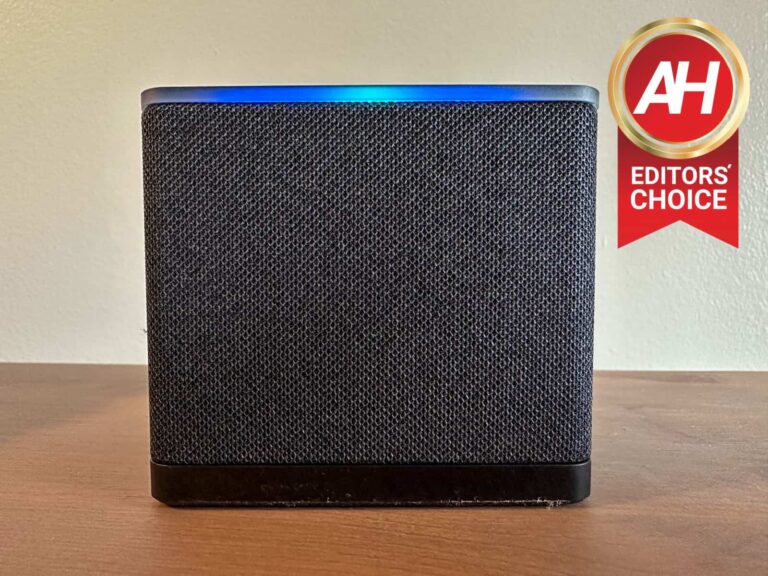
As far as ports go, XGIMI was quite generous here. Providing 3 HDMI ports (with one being ARC), though none of them are HDMI 2.1. There’s also two USB-A ports here, an audio port, optical, Ethernet and a service port available. The port selection isn’t perfect, but having three HDMI ports is really nice to have. During my time with it, I had a Sonos Beam Gen 2 connected to the first HDMI port, and a Fire TV Cube connected to the second one.

XGIMI Aura Review: Sound quality

XGIMI has four 15W speakers inside, that are tuned by Harman Kardon. And they sound good. But I still prefer to use my Sonos Beam Gen 2 and Sub Mini setup with this projector. And luckily, you can do that, or stick with the built-in speakers. The built-in speakers are big enough to fill and entire room with sound, with ease.

You can also adjust the audio in the settings, if you want more bass, or less. Also depending on what you’re playing on the projector at the time.

XGIMI Aura Projector Review AH 4

XGIMI Aura Review: Picture quality

What really matters here is the picture quality. It’s the only thing you can’t fix, with products you might already have. You can fix the software by plugging in a streaming device. You can fix the audio by using a soundbar. But the picture quality, can’t be fixed that way. The good news is, it’s pretty darn good.

On the spec sheet, the Aura is rated at 2400 ANSI Lumens. Which, I’m not all that sure how accurate that rating is, as the last projector I reviewed was a bit dimmer at 2200ANSI Lumens, but it seemed brighter and clearer. However, if you are using an ALR screen for your projector, then you’ll be just fine here. It’ll be plenty bright in bright rooms.

This is a 4K projector, with support for HDR10 and HLG. It does not have Dolby Vision support here, which is a bit of a bummer, but likely another way that Aura was able to sell this projector for under $2500.

The colors are pretty accurate here. Fortunately, they are not super washed out, even at the brightest settings. It’s not as sharp as I would have expected from a 4K laser projector. But to be honest, if I had not used other projectors recently, I likely wouldn’t notice the difference.

All in all, the picture quality is quite good. Not perfect, but given the price here, it’s good.

XGIMI Aura Review: Software

There’s not a lot to say about the software here. It’s Android TV. If you’ve used Android TV, then you know what to expect from this. That means that there’s a ton of great apps available – YouTube, Hulu, Disney+ and much more. As well as Google Assistant and Cast available.

The biggest caveat here is that, Netflix is not available. This is something we’ve run into virtually every projector that we’ve reviewed over the last few years. And it’s not the manufacturer’s fault, it’s Netflix’s. To go a bit behind-the-scenes with how these things work, Netflix needs to certify devices for its app to work. Even though Netflix is on Android TV and this runs on Android TV, Netflix still needs to certify it. But here’s where things get tricky, Netflix won’t certify it until it has sold a million units. And most projectors aren’t going to sell that many units. So there’s workarounds for it.

XGIMI doesn’t actually provide a workaround here, while others will. Instead, XGIMI recommends using a streaming device to connect to Netflix. Which is why I have a Fire TV Cube connected here. It’s rather unfortunate, but on the flip side, it’s good that XGIMI did provide three HDMI ports here. So you can plug in a streaming device, a soundbar and a gaming system.

XGIMI Aura Projector Review AH 7

Should I buy the XGIMI Aura?

The XGIMI Aura is one of my favorite UST projectors I’ve used this year. The only real downside here is the size and the lack of HDMI 2.1. But of course, adding in HDMI 2.1 would definitely raise the price here. So I think XGIMI found the right balance for the Aura.

You should buy the XGIMI Aura if:

  • You don’t have a lot of room for a big TV.
  • You want a big TV that can easily be moved.
  • You want a home theater at a decent price.

You shouldn’t buy the XGIMI Aura if:

  • You want to game at 4K120.
  • You want a smaller projector.

[ad_2]
Source link

Android 14 Will Block Malware With Enhanced Security Updates

0
[ad_1]

Google’s upcoming Android 14 will include enhanced security features to block Android malware. As reported, Android 14 will block malicious apps from accessing and exploiting sensitive permissions.

Android 14 To Block Malware From Accessing Sensitive Permissions

According to the details shared on the official Android 14 Developer version release page, the OS will prevent malware from abusing permissions access on the device, alleviating infection risks.

Google has mentioned this change in the “Behavior changes” section. Specifically, Android 14 will block malicious apps from exploiting permissions by deploying restrictions to implicit and pending intents. As stated,

For apps targeting Android 14, Android restricts apps from sending implicit intents to internal app components.

The release page also explains the changes that the OS will apply to stop malicious apps from abusing permissions on Android 14 and higher versions.

Other Android 14 Security Changes

Alongside this change, the new Android 14 also includes other behavior changes that Dave Burke, VP of Engineering, has explained simply in a post.

Some noteworthy changes regarding malware protection include,

  • Runtime receivers – apps must declare if they need to use “dynamic Context.registerReceiver() as exported or unexported” – that is, if they need to access information from other apps or should remain confined to broadcasts only.
  • Safer dynamic code loading (DCL) – since dynamically loaded executables may result in code injections, apps must mark dynamically loaded files as “read-only.”
  • Blocking app installations – apps must have a targetSdkVersion 23 or higher since most malicious apps use targetSdkVersion 22 to evade the runtime permissions model.

For now, the first developer preview of Android 14 is available for the users’ testing and feedback. Google is working to improve the new OS to ensure better support, compatibility, and security across the different devices it will support.

According to Google’s timeline, the tech giant will roll out bet releases over the next few months, whereas the stable release will appear around July 2023.

Let us know your thoughts in the comments.


[ad_2]
Source link

New Python Malware Targeting Windows Devices

0
[ad_1]

The malware features also include file transfer, keylogging, stealing passwords stored in the browser, clipboard data stealing, cookies exfiltration and more.

Threat analysis firm Securonix’s cybersecurity researchers have discovered a new malware dubbed PY#RATION allowing attackers to steal sensitive files and log keystrokes from impacted devices.

Malware Distribution Technique

The malware is distributed through a conventional phishing mechanism in which the email contains a password-protected ZIP archive. When it is unpacked, two shortcut image files appear, titled front.jpg.lkn and back.jpg.lnk. When launched, these files display the front and back of a driver’s license that doesn’t exist.

New Python Malware Targeting Windows Devices
Images used in the scam (Credit: Securonix)

With this, the malicious code is also executed, leading to two new files being downloaded from the internet. These files are titled front.txt and back.txt, later renamed to .bat docs and executed. The malware disguises itself as Cortana virtual assistant to ensure persistence on the system.

What is PY#RATION

PY#RATION is a Python-based malware that displays a RAT (remote access trojan) like behaviour to sustain control over the affected host. The malware has various capabilities and functionalities, such as keylogging and data exfiltration.

However, the unique aspect is that it uses WebSocket for exfiltration and C2 communication, and evades detection from network security solutions and antivirus programs. Leveraging Python’s built-in Socket.IO framework that facilitates client and server WebSocket communications, the malware pulls data and gets commands over a single TCP connection through open ports simultaneously.

Moreover, according to a blog post published by Securonix, the attackers use the same C2 address, which the IPVoid checking system is yet to block. Researchers believe this malware is still under active development as they have detected multiple versions since August 2022. The malware receives instructions from the operations through WebSocket and obtains sensitive data.

Potential Dangers

This Python RAT is packed into an executable that uses automated packers such as ‘pyinstaller’ and ‘py2exe’ to convert Python code into Windows executables. This helps inflate payload size (The first detected version 1.0 being 14MB and the last detected version 1.6.0 being 32 MB containing 1000+ lines and additional code).

New Python Malware Targeting Windows Devices
Infection chain of the PY#RATION python malware (Credit: Securonix)

Researchers claim that the latest version of the payload remains undetected by all except for one antivirus engine listed on VirusTotal.

The malware features include file transfer to and from the C2 server, network enumeration, shell command execution, keylogging, stealing passwords stored in the browser, host enumeration, clipboard data stealing, and cookies exfiltration. Who’s behind this campaign, the distribution volume, and campaign objectives are still unclear.

  1. Malicious PyPI Packages Dropping Malware
  2. 6 official Python repositories plagued with malware
  3. Hackers Exploiting OpenAI’s ChatGPT to Deploy Malware
  4. Hackers hit malware authors with malicious NPM packages
  5. Developers Beware: Packages Swapping Crypto Addresses

[ad_2]
Source link

Amazon is giving you a $100 Gift Card for pre-ordering the OnePlus 11

0
[ad_1]

The OnePlus 11 just went official this week, and Amazon is already discounting it. You can currently pre-order it from Amazon for $799 (this is the 16GB/256GB model). But, Amazon is tossing in a $100 gift card with your pre-order. So this is technically the regular price, but you do get $100 from Amazon for it. This is a pre-order, so it will still ship on February 16.

OnePlus 11 is a pretty impressive phone, with a starting price of $699 for the 8GB/128GB model and $799 for the 16GB/256GB model. It comes with a 6.7-inch QHD+ 120Hz Adaptive AMOLED display, powered by the Qualcomm Snapdragon 8 Gen 2 processor, with a 5,000mAh capacity battery. That’s quite impressive for the price, and the battery is pretty powerful too.

In our review, we were able to get about 10 hours of on screen time over and over again on the OnePlus 11. So it’s going to get you through the day and then some. Additionally, with the 80W charging (and the charger is in the box!), you won’t really need to worry about battery life. As the battery is going to fully charge in less than an hour.

The camera is also improved this year on the OnePlus 11. It has a 50-megapixel main sensor, 32-megapixel telephoto and 48-megapixel ultrawide. OnePlus is also using Hasselblad once again here. Giving you a great looking image every time you take a photo. Which is not something we typically say about the OnePlus 11. So that’s definitely a good thing here.

You can pick up the OnePlus 11 from Amazon today by clicking here. This deal is likely only good during the pre-order process, which will end on February 15. Additionally, this is only available on the 16GB/256GB model. And not on the cheaper 8GB/128GB model. Though we would recommend you get the higher-end model anyways. As it is worth the cash.

OnePlus 11 – Amazon


[ad_2]
Source link

YouTube will offer multiple packages for NFL Sunday Ticket

0
[ad_1]

Since YouTube was announced as the winner of the rights for the NFL Sunday Ticket package, many have been clamoring for more details. YouTube did release a bit more details yesterday during the Super Bowl. But more specifics won’t be released until this Summer, as we get closer to the 2023 season.

YouTube has again confirmed that NFL Sunday Ticket will be available included in YouTube TV and YouTube Primetime channels, as well as available as a standalone package. So you can subscribe to only the NFL Sunday Ticket. YouTube has also confirmed that YouTube TV subscribers will get a discount on NFL Sunday Ticket. Though, we don’t know what the pricing is going to be just yet. When it was with DIRECTV, it was running about $300 for the season. So expect it to be that much and potentially more.

NFL Sunday Ticket without a satellite dish

YouTube did run quite a few promos during the Super Bowl last night about NFL Sunday Ticket. And how you no longer need a satellite dish to get it. Before, you had to be a DIRECTV customer to get it. Which was a satellite TV provider. Now, you just need a decent internet connection.

The NFL Sunday Ticket is going to be available with and without the NFL RedZone. So we could see some different pricing here. YouTube has said that they will be announcing the packages for NFL Sunday Ticket in the Spring. So that customers can start signing up ahead of the 2023 season. So we should know more in the coming months about how much this will cost, and when you can start signing up.

It’s a big get for YouTube to get NFL Sunday Ticket. Of course, YouTube did pay a pretty fortune for it. The deal is worth about $2 billion per season, which is around $500 million more than what DIRECTV was paying for it.


[ad_2]
Source link