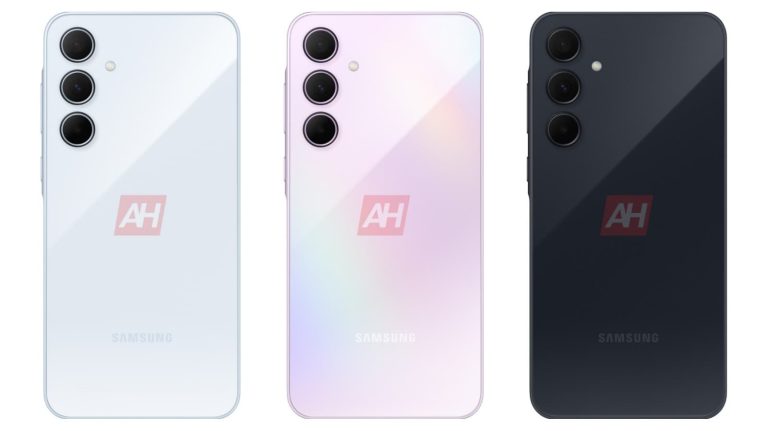
Samsung recently indirectly confirmed the nearing launch of the Galaxy A55 and Galaxy A35. The company put up support pages for the devices on its official website and published their repairability scores. Now, as we wait for the launch date, the latter model has popped up on a couple of listings online. It received regulatory approval from Thailand’s NBTC and made another visit to Geekbench with 8GB of RAM.
Samsung’s Galaxy A35 nears launch with up to 8GB of RAM
The NBTC (National Broadcasting and Telecommunication Commission) certified the Galaxy A35 with the model number SM-A356/DS, with “DS” indicating a dual-SIM variant. The listing confirmed 5G cellular connectivity but didn’t reveal anything more. Earlier certifications and leaks have revealed that the phone will run Android 14 out of the box, powered by Samsung’s Exynos 1380 processor.
A new Geekbench entry has reconfirmed this. Spotted by MySmartPrice, the same variant of the Galaxy A35 (SM-A356E) recently surfaced on the benchmarking platform to reveal its chipset, RAM size, and Android version. It appeared with 8GB of RAM. Previous Geekbench listings showed the phone with 6GB of RAM. Last year’s Galaxy A34 also came in a 4GB variant, so we don’t rule out the possibility of Samsung doing the same this year.
The Galaxy A35 is expected to sport a 6.6-inch Super AMOLED FHD+ display with a 120Hz refresh rate. We exclusively leaked its official renders early last month to reveal that Samsung has ditched the notched display design in favor of a punch-hole selfie camera, which makes the device look more modern and premium. The phone might also get a better primary camera, upgrading from a 48MP resolution to 50MP.
The FCC has already revealed that the Galaxy A35 will feature Wi-Fi 6, Bluetooth, and NFC connectivity options. The device will support a wide range of navigation systems and come with a dedicated microSD card slot. Samsung might equip it with a 5,000mAh battery and 25W fast charging. The mid-range phone will be available carrier-locked and unlocked in the US, with support for Verizon’s 5G Ultra Wideband.
Samsung hasn’t revealed the launch date yet
Samsung has yet to reveal the launch date for the Galaxy A35. It is expected to debut alongside the Gaalxy A55 in March or April. The latter model sports an identical design but comes with a metallic frame. It also packs beefier specs, including a more powerful processor (Exynos 1480). Both phones have already received regulatory approvals in numerous countries. We will keep you posted on the Galaxy A55 and Galaxy A35.
It’s finally here, ads on Netflix. On November 3, 2022, Netflix officially launched its ad-supported tier of the service. It follows in line with what other streaming services have done, but many stuck with Netflix because there were no ads.
However, it became apparent to Netflix that it was going to need to introduce an ad-supported tier as content prices kept rising. And customers will only put up with constant price increases for so long. Luckily, the ads are limited to just one tier of the service. So you have the choice of saving some cash and getting some ads served up or spending a bit more for no ads.
In this article, we’re going to go over everything you need to know about Netflix’s new ad-supported tier. That includes the price, how it compares to the other plans, how many ads you’ll see, and much more.
How much is ad-supported Netflix?
With the introduction of ads, Netflix actually improved its Basic plan, which was well past time. So now we have Standard with Ads, Standard, and Premium available.
Standard with ads: $6.99/month
Standard: $15.49/month
Premium: $22.99/month
So what’s available in each plan? Well, the Standard and Standard with Ads are essentially the same, minus the ads. However, Standard does allow you to download shows and movies on one device at a time.
Standard ups the quality to Full HD or 1080p versus 720p, which was on basic before it was axed.
Then there’s Premium. This is the plan you’ll want if you want to watch in 4K HDR. It also allows you to watch on up to 4 devices simultaneously. As well as downloading content onto up to 6 devices at a time.
What countries is this plan available in?
At launch, Netflix is making the Ads tier available in 11 countries. It will eventually open up to even more countries. However, so far the only country added since launch has been Spain.
Here are the countries where Netflix is serving up ads:
Australia
Brazil
Canada
France
Germany
Italy
Japan
Mexico
South Korea
Spain
United Kingdom
United States
How many ads will I see?
Netflix claims that you will see around four minutes of commercials per hour. That’s enough to not really both people, especially if the commercial break is all at once during an hour-long show. Netflix does caution customers by saying that this might “vary based on the title you’re watching”. But keep in mind, linear TV typically has around 14-18 minutes of ads in an hour-long show, so it’s pretty short with Netflix.
Ads will be about 15 seconds or 30 seconds in length and will appear either before and/or during the title.
So far, Netflix is not showing when ads will appear on the progress bar. Like other streaming services do, which have ads. So it’s hard to tell how the ads will be split up.
Thankfully, if you are picking up a movie or show where you left off, you can scrub through the timeline to pick up where you left off, without having to watch another ad.
All in all, ads aren’t too bad right now. But that might change. In the early days of Hulu, ads were pretty short too, but now they are worse than live TV.
What content is available on Netflix Basic with Ads?
With this new ad-supported plan from Netflix, you might be wondering if the entire catalog is available with this plan. Well, not everything is available. This is due to Netflix licensing agreements with specific studios. Whereas Netflix only has the right to stream content without ads. Because of this, Netflix has reworked some of its agreements with some studios to be able to show ads alongside these titles.
The majority of Netflix’s own original content should be available on the ad-supported plan, with a few exceptions. Like House of Cards is not available. Luckily, when you search through Netflix for a title, it will show a lock icon on it, if you are unable to watch it with the Basic with Ads plan.
Update: In 2024, the majority of the Netflix catalog will be available on its ads plan. There is still a small number of titles unavailable due to licensing terms.
Can I fast-forward or skip ads?
Unfortunately, you can not. Otherwise, what would be the point of adding in ads? As most people would just skip through them. And advertisers wouldn’t be interested in advertising on Netflix in that case.
Most other streamers do not allow skipping through ads either. Some live TV services like YouTube TV will allow you to, but only if you recorded the show or movie on your DVR. If it’s on-demand, you’re still going to get unskippable ads.
Is offline viewing available?
One of the other main benefits of paying for the ad-free plan is downloading content. The Standard with Ads plan from Netflix does not allow for offline viewing. Which means you cannot download anything on this plan. That is likely due to the fact that they would still need to show ads. Remember, ads are said to be personalized, so it would need an internet connection to do that. But if you’re watching offline, then you likely don’t have an internet connection.
Will there be ads on Kids’ profiles?
At this time, Netflix is not showing ads on Kids’ profiles. So that could be a workaround for watching ad-free Netflix at a cheaper price. But there is a caveat. Netflix won’t show ads on any children’s content. It’s likely that anything rated PG or lower (maybe even G) won’t be seen in ads. So even if you’re watching something that’s PG-13 on a kid’s profile, you’re still going to see ads.
The reason for not including ads on kids’ content is the content of the ads. While ads are personalized, Netflix (and other streaming services) can’t necessarily guarantee that kids won’t see anything inappropriate there. So there’s no ads on kids content, the same goes for HBO MAX and Disney+.
Are there going to be ads on Netflix’s mobile games?
Netflix is currently sticking to keeping their mobile games ad-free. Whether you’re on the Basic with Ads plan or the Premium plan, you’ll get the same gaming experience with its slew of games that it currently has available. Ads are only being shown with movies and shows.
Can I still use Netflix when I travel internationally?
Yes, you can still use Netflix if you have the Basic with Ads plan if you travel internationally. But, if you are in a country that doesn’t have ad-supported Netflix, then you won’t be able to use Netflix. So, it’s important to pay attention to the list of countries that are listed further up in this article, as Netflix is currently rolling out these ads to more and more countries.
Will ads be personalized to me?
Netflix says that ads will be personalized based on how you interact with the platform. That includes the genre of content you watch, where and when you use the app, and more. It will also use information that you have voluntarily provided to Netflix.
When you sign up for or switch to the Basic with Ads plan, you’ll be asked for your birth and gender. Netflix will also use that basic demographic to help personalize ads for you.
Personalizing ads is important because this makes the ads more likely to work. Which means the advertisers are going to pay more to advertise on the platform. Hopefully, that will keep the Basic with Ads plan cheaper.
Should I save money and watch some ads on Netflix?
If you’re fed up with the price increases for Netflix and are okay with a few minutes of ads, then sure, go ahead and switch to the Standard with Ads plan. Now that the Standard and Standard with Ads plans are so far apart in price, compared to when it was Basic and Basic with Ads, it makes a lot more sense to watch a few ads in between shows or movies.
For Android users, using Google Photos to store your digital media is a very popular choice. While having 128GB, 256GB, or even 512GB of storage was once upon a time enough to not have to worry about running out of space anytime soon, nowadays devices with more advanced camera systems and better quality photos and videos, usually equate to larger file sizes. Now, all of a sudden, we always need more space.
This is where cloud storage comes in. Though it is still something extra we have to pay for, it is at least flexible to the point where you can change plans and add or remove space as needed. This isn’t something you can easily do with the hardware.
On Android, when you want to share a photo or video, the file picker would normally show locally stored data. For those that wanted to attach something that is stored solely on the cloud, the extra steps of opening that cloud storage app separately and then downloading the file, would be necessary. Fortunately, this will not be the case any longer for Google Photos users.
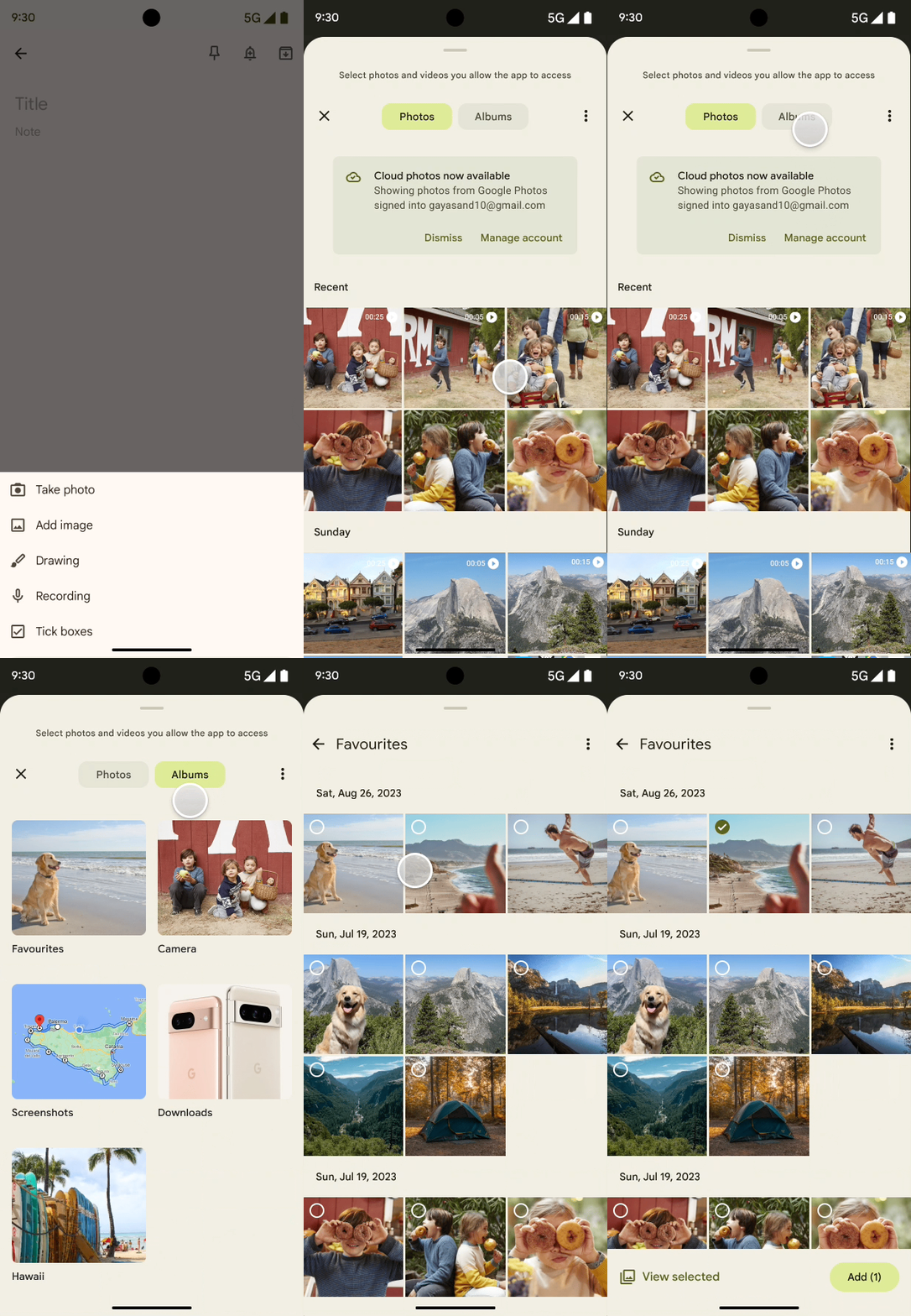
As announced in detail on the Android Developers Blog, Google is currently rolling out support for a highly requested feature that will substantially change the way you select photos from your phone. In addition to the media that is stored locally, you will now be able to easily access all of your Google Photo-backed photos and videos. It even makes use of the “Favorites” category.
Source: Google
The feature is currently rolling out as part of the February 2024 Google System Update to devices on Android 12 or above and is already enabled for Google Photos. Once it becomes available for you, you should see a notice stating that “Cloud photos now available” at the top of the Android photo picker.
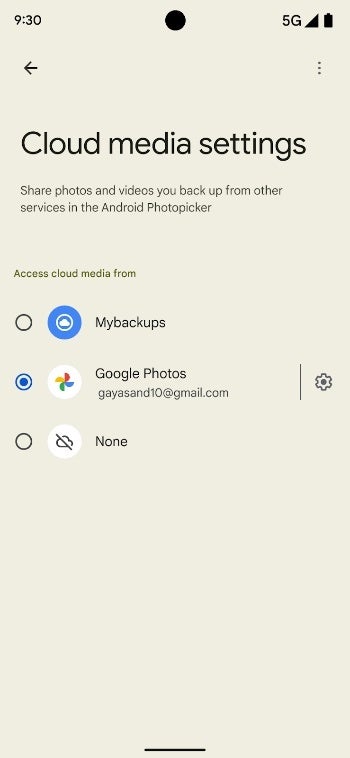
However, Google Photos isn’t the only cloud storage service that can benefit from this. An API will be available for cloud media apps enrolled in Google’s Cloud Media Provider Pilot Program, so that they too can embed this functionality into their apps. This will also allow the users to select which of the eligible apps they want to use as the default for accessing cloud media.
Image Source: Google
Having this feature will now allow Android users to have more flexibility with their device’s storage and will be able to offload some photos and videos to cloud storage without worrying about how difficult it may be to access them later. Being able to access both your local and cloud media in one place will also eliminate the need to hop between apps when opting to share memories.
Thorough, independent tests are vital as cybersecurity leaders and their teams evaluate vendors’ abilities to guard against increasingly sophisticated threats to their organizations. And perhaps no assessment is more widely trusted than the annual MITRE Engenuity ATT&CK Evaluations: Enterprise.
This evaluation is critical for testing vendors because it’s virtually impossible to evaluate cybersecurity vendors based on their own performance claims.
Along with vendor reference checks and proof of value evaluations (POV) — a live trial — in their environment, the MITRE Engenuity results add objective input to holistically assess cybersecurity vendors.
In this piece, we’ll unpack MITRE Engenuity’s most recent methodology to test security vendors against real-world threats, offer our interpretation of the results, and identify the top takeaways emerging from the evaluation of Cynet’s all-in-one security solution.
How does MITRE Engenuity Test Vendors During the Evaluation?
The MITRE Engenuity ATT&CK Evaluation is performed by MITRE Engenuity and tests the endpoint protection solutions against a simulated attack sequence based on real-life approaches taken by well-known advanced persistent threat (APT) groups.
The MITRE Engenuity ATT&CK Evaluations: Enterprise tested 29 vendor solutions by emulating the attack sequences of Turla, a sophisticated Russia-based threat group known to have infected victims in over 45 countries.
An important caveat is that MITRE does not rank or score vendor results. Instead, the raw test data is published along with some basic online comparison tools. Buyers then use that data to evaluate the vendors based on their organization’s unique priorities and needs. The participating vendors’ interpretations of the results are just that — their interpretations.
The MITRE Engenuity ATT&CK Evaluation represents one of the industry’s most trusted and in-depth assessments of how competing security solutions perform in real-world attack scenarios..
So, How do You Interpret The Results?
That’s a great question — one that a lot of people are asking themselves right now. TheMITRE Engenuity ATT&CK Evaluations: Enterprise results aren’t presented in a format that many of us are used to digesting (looking at you, magical graph with quadrants).
And independent researchers often declare “winners” to lighten the cognitive load of determining which vendors are the top performers. In this case, identifying the “best” vendor is subjective. Which, if you don’t know what to look for, can feel like a hassle if you’re already frustrated with trying to assess which security vendor is the right fit for your organization.
With these disclaimers issued, let’s review the results to compare and contrast how participating vendors performed against Turla.
MITRE Engenuity ATT&CK Results Summary
The following tables present Cynet’s analysis and calculation of all vendor MITRE Engenuity ATT&CK Evaluations: Enterprise test results for the most important measurements: Overall Visibility, Detection Accuracy, and Overall Performance.
There are a lot of other ways to look at the MITRE results, but we consider these to be most indicative of a solution’s ability to detect threats.
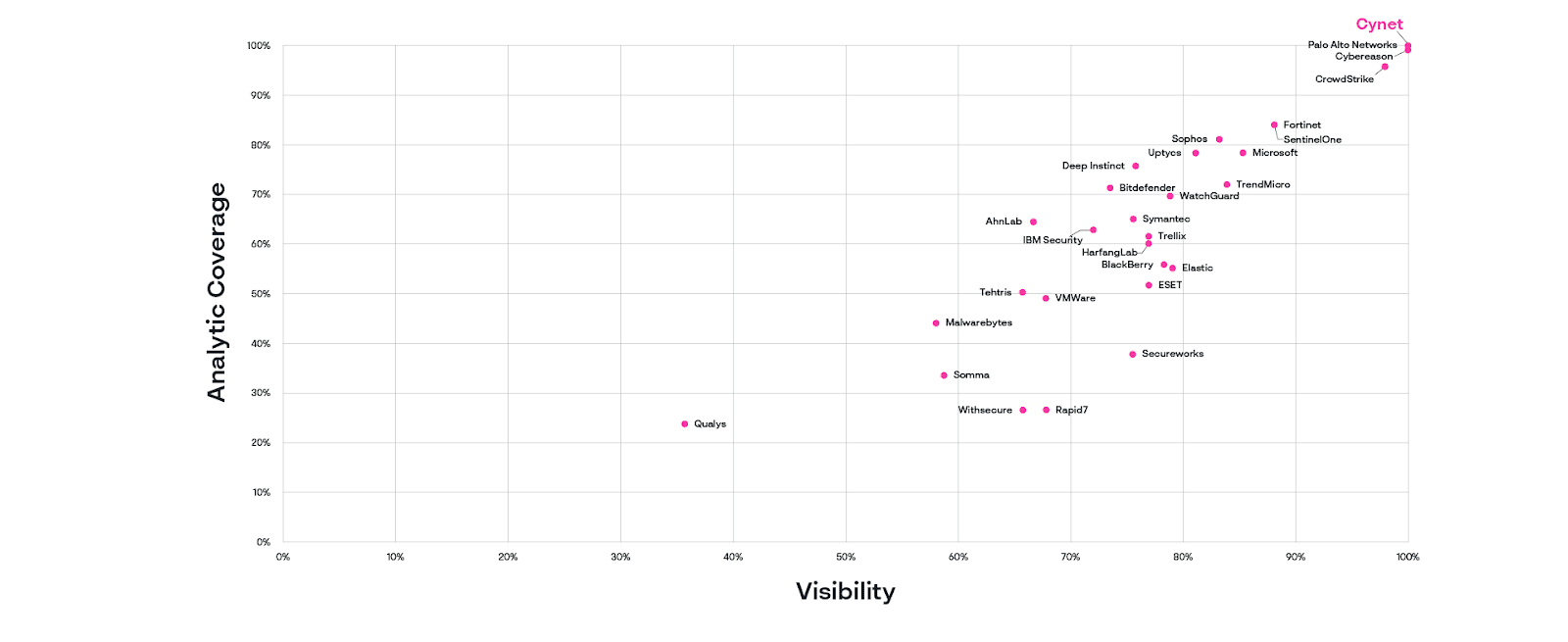
Overall Visibility is the total number of attack steps detected across all 143 sub-steps. Cynet defines Detection Quality as the percentage of attack sub-steps that included “Analytic Detections – those that identify the tactic (why an activity may be happening) or technique (both why and how the technique is happening).
Additionally, it’s important to look at how each solution performed before the vendor adjusted configuration settings due to missing a threat.
MITRE allows vendors to reconfigure their systems to attempt to detect threats that they missed or to improve the information they supply for detection. In the real world we don’t have the luxury of reconfiguring our systems due to missed or poor detection, so the more realistic measure is detections before configuration changes are implemented.
How’d Cynet do?
Based on Cynet’s analysis, our team is proud of our performance against Turla in the 2023 MITRE Engenuity ATT&CK Evaluations: Enterprise, outperforming the majority of vendors in several key areas. Here are our top takeaways:
Cynet delivered 100% Detection (19 of 19 attack steps) with NO CONFIGURATION CHANGES
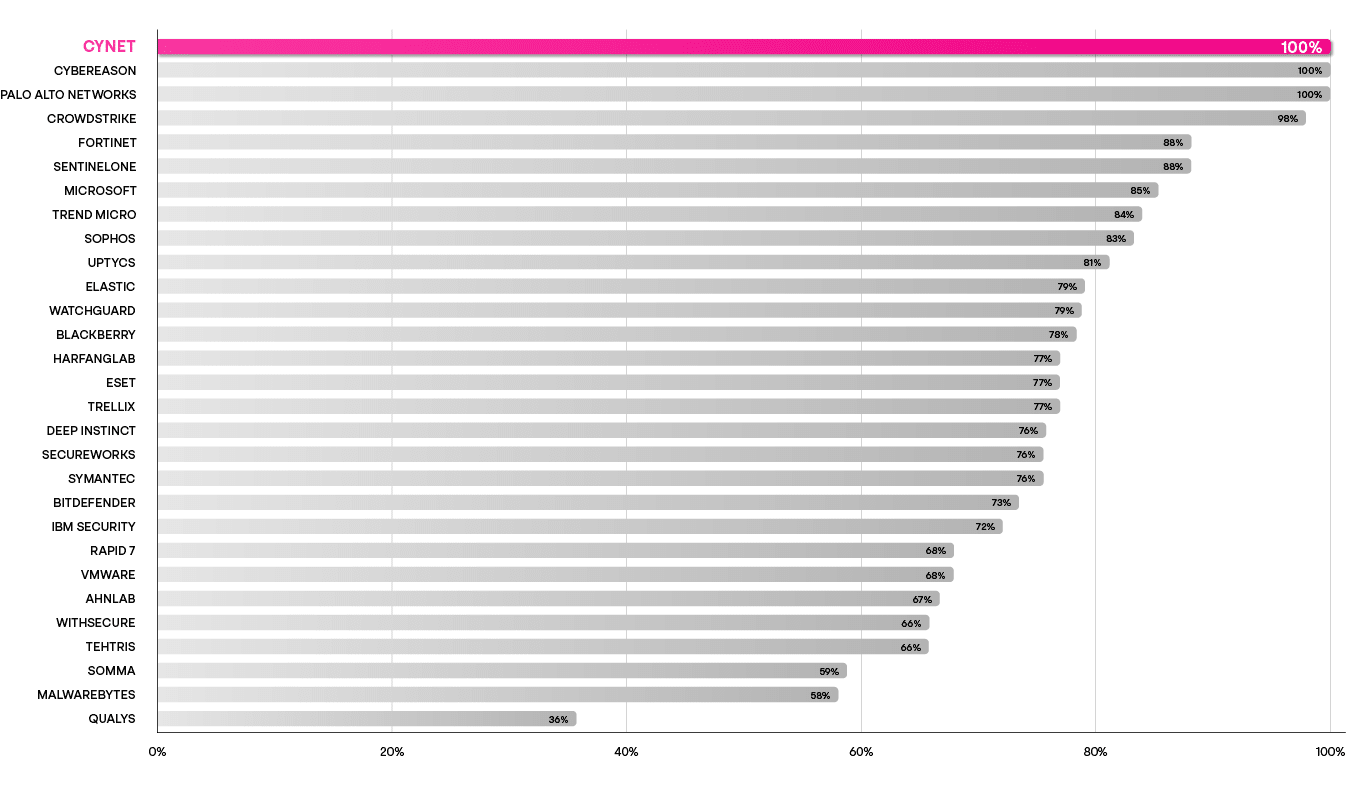
Cynet delivered 100% Visibility (143 of 143 attack sub-steps) with NO CONFIGURATION CHANGES
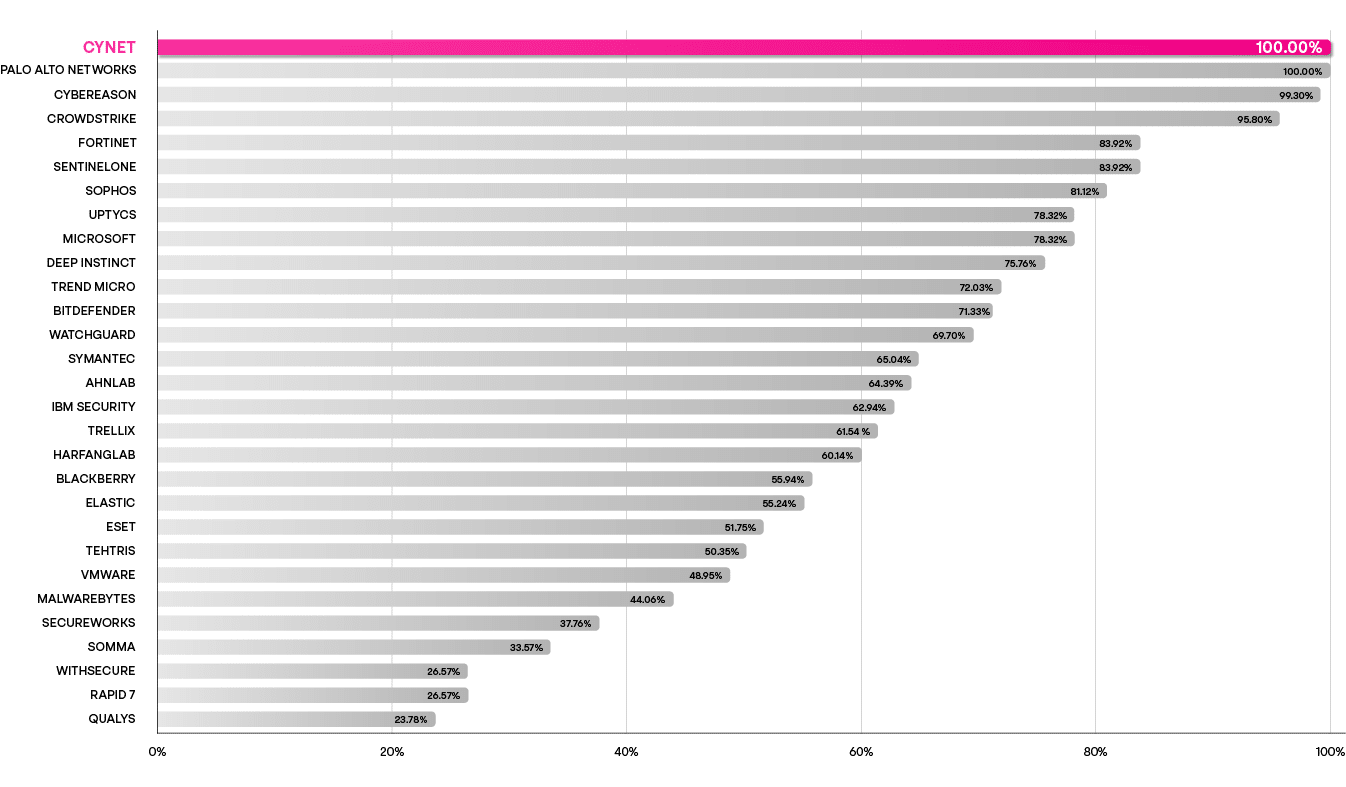
Cynet delivered 100% Analytic Coverage (143 of 143 detections) with NO CONFIGURATION CHANGES
Cynet delivered 100% Real-time Detections (0 Delays across all 143 detections)
Let’s dive a little deeper into Cynet’s analysis of some of the results.
Cynet’s all-in-one security solution was a top performer when evaluating both visibility and detection quality. This analysis illustrates how well a solution detects threats and provides the context necessary to make the detections actionable. Missed detections are an invitation for a breach. In contrast, poor quality detections create unnecessary work for security analysts or potentially cause the alert to be ignored, which, again, is an invitation for a breach.
Cynet delivered 100% visibility and perfectly detected every one of the 143 attack steps using no configuration changes. The following chart shows the percentage of detections across all 143 attack sub-steps before the vendors implemented configuration changes. Cynet performed as well as two very large, well-known, security companies despite being a fraction of their size and far better than some of the biggest names in cybersecurity.
Cynet provided analytic coverage for 100% of the 143 attack steps using no configuration changes. The following chart shows the percentage of detections that contained important general, tactic or technique information across the 143 attack sub-steps, again before configuration changes were implemented. Cynet performed as well as Palo Alto Networks, a $115 billion publicly traded company with 50 times the number of employees, and far better than many established, publicly traded brands.
Still have questions?
In this on-demand webinar, Cynet CTO Aviad Hasnis and ISMG SVP Editorial Tom Field review the most recent MITRE ATT&CK results and share expert advice for cybersecurity leaders to find the vendor that best fits the specific needs of their organization. They also unpack Cynet’s performance during the tests and identify opportunities ot advance your team’s goals with the all-in-one security solution.
Microsoft has issued patches for 73 security vulnerabilities in its February 2024 Patch Tuesday. Among these vulnerabilities are two zero-days that are reportedly being used in the wild.
The two zero-day vulnerabilities have already been added to the Cybersecurity & Infrastructure Security Agency’s catalog of Known Exploited Vulnerabilities, based on evidence of active exploitation. This means that Federal Civilian Executive Branch (FCEB) agencies need to remediate these vulnerabilities by March 5, 2024, in order to protect their devices.
The Common Vulnerabilities and Exposures (CVE) database lists publicly disclosed computer security flaws. The zero-days patched in this round of updates are:
CVE-2024-21351 (CVSS score 7.6 out of 10): a Windows SmartScreen security feature bypass vulnerability. The vulnerability allows a malicious actor to inject code into SmartScreen and potentially gain code execution, which could potentially lead to some data exposure, lack of system availability, or both. An authorized attacker must send the user a malicious file and convince the user to open it.
CVE-2024-21412 (CVSS score 8.1 out of 10): an Internet Shortcut Files security feature bypass vulnerability. An unauthenticated attacker could send the targeted user a specially crafted file that is designed to bypass displayed security checks. However, the attacker would have no way to force a user to view the attacker-controlled content. Instead, the attacker would have to convince them to take action by clicking on the file link.
The bypassed security feature in both cases is the Mark of the Web (MOTW), the technology that ensures Windows pops a warning message when trying to open a file downloaded from the Internet. When a file is downloaded, Windows adds a ZoneId in the form of an Alternate Data Stream to the file which is responsible for the warning message(s).
Another vulnerability worth keeping an eye on is CVE-2024-21413 (CVSS score 9.8 out of 10): a Microsoft Outlook remote code execution (RCE) vulnerability. Successful exploitation of this vulnerability would allow an attacker to bypass the Office Protected View and to gain high privileges, which include read, write, and delete functionality. Microsoft notes that the Preview Pane is an attack vector. The update guide for this vulnerability lists a number of required updates before protection is achieved.
Other vendors
Other vendors have synchronized their periodic updates with Microsoft. Here are few major ones that you may find in your environment.
Adobe has released security updates to address vulnerabilities in several products:
The Android Security Bulletin for February contains details of security vulnerabilities for patch level 2024-02-05 or later.
You have probably heard of Mint Mobile before. Mint Mobile has done a lot of advertising with different influencers over the years and is really seen everywhere. And it’s not hard to see why. With Mint Mobile, you can get cell service for as little as $15 per month, which grabs a lot of attention.
Of course, if that didn’t get your attention, Ryan Reynolds owns Mint Mobile. And, of course, he has starred in some of the company’s ads.
But with Mint Mobile, for some, it might sound too good to be true. So, we’re here to answer all of your questions and tell you everything you need to know about the carrier. This is to help you decide whether you should switch to Mint Mobile or not.
Update: On March 15, 2023, T-Mobile purchased Mint Mobile for $1.35 billion. T-Mobile’s CEO Mike Sievert said that it would use its size to “supercharge” Mint Mobile. It sounds like Mint Mobile will continue operating under its current brand and name.
What is Mint Mobile?
Mint Mobile is an MVNO or Mobile Virtual Network Operator owned by T-Mobile since 2023. This basically means that it runs on AT&T, T-Mobile, or Verizon’s network in the US. It doesn’t own the network, and that is how they are able to charge so much less than those three carriers do. Essentially, Mint Mobile and other MVNOs purchase access to these networks at a wholesale price. Think of it as buying from Sam’s Club or Costco and then reselling said products.
Of course, there are some downsides to using an MVNO for your phone service, which we have outlined in this explainer about MVNOs.
What network does Mint Mobile operate on?
As mentioned, Mint Mobile is an MVNO, which means it uses someone else’s network. In this case, that would be T-Mobile. Especially since T-Mobile owns Mint Mobile now. While not everyone likes T-Mobile’s network and coverage, it has consistently gotten pretty impressive over the last decade or so. And in a lot of tests, it edges out AT&T and Verizon. And with Mint Mobile using T-Mobile, it means that virtually any GSM unlocked smartphone will work on Mint Mobile.
How much does it cost?
You can get Mint Mobile for as low as $15 per month. That will come with unlimited talk and text, with 5GB of data. After you hit that 5GB of data, you’ll be dropped down to slower speeds.
For $20 per month, you can get 15GB per month. Or if you need more data, there’s 20 GB of data for $25 per month and unlimited data for $30 per month. That unlimited plan offers 40GB of 5G data and then unlimited 4G LTE data.
Mint Mobile doesn’t usually charge you per month. These prices above are for three-month plans. So for the 5GB plan, you’re paying $45 up-front for three months. This is kind of neat because it means that you won’t need to pay your bill every month.
It also offers 6 and 12-month plans. The 12-month plans are the same price but for 12 months. So, the 5GB plan would cost you $180. The six-month plans are more expensive. Ranging from $20 to $35 per month. So we would recommend getting the 3- or 12-month plan.
Is there unlimited data?
Yes, there is unlimited data available. However, most of you probably don’t need to get unlimited since there are plans up to 15GB. Since the average data a person uses per month is between two and five gigabytes. Obviously, some people do use a lot more data, and for those people, there are other plans available, including unlimited.
Like with most carriers, this is “unlimited” data. Meaning it’s not truly unlimited. You’ll get 40GB of 5G data or high-speed data. After you hit that cap, you won’t lose your data, but you’ll get slower speeds. The video always streams at 480p.
There’s no longer a cap on speeds with Mint Mobile. There used to be a cap at 20Mbps, but that was removed recently. So, depending on where you are, you may get much faster speeds.
Mint Mobile: What’s included in every plan
When does Mint Mobile reduce speeds?
No matter which plan you have, Mint Mobile will reduce your speeds after a certain amount of data. For the non-unlimited plans, once you hit your cap you’ll experience slower speeds. On the unlimited plan, you’ll see reduced speeds after around 35GB of data.
Is there 5G available?
Yes. All of the plans from Mint Mobile include 5G data.
It works on T-Mobile’s 5G network. So anywhere that T-Mobile has 5G service, you’ll get 5G on Mint Mobile, which is pretty much nationwide. Depending on your phone, you may also get mid-band and mmWave 5G through T-Mobile, which will provide even faster speeds.
Do I need to sign a contract?
Nope, as with most MVNO carriers, you don’t sign a contract. That is because you don’t finance your phone through Mint Mobile.
Mint Mobile does offer phones, and you can finance them, but not through Mint Mobile. That is done through Affirm. So, if you do miss a payment or default, your cell service won’t be impacted.
What devices work on Mint Mobile?
You can bring any GSM unlocked phone to Mint Mobile. Any phone that would work on T-Mobile will work on Mint Mobile since it runs on T-Mobile’s network.
Mint Mobile does have a handy page on its website that will help you see if your phone is compatible. But it also needs to be unlocked. Otherwise, a SIM-locked phone won’t work on Mint Mobile (or any other carrier that you didn’t buy it from).
Mint Mobile: Bring Your Own Phone
Now, if you want to buy a new phone, you can do that with Mint Mobile. Mint Mobile carries a lot of flagship smartphones. This includes the iPhone 12 and 13 lineup. For Android, there’s also the Galaxy Z Fold 3, Motorola RAZR 5G, Galaxy S21 series, Galaxy Z Flip 3, Galaxy Note 20 Ultra, and Motorola Edge (2021), among many others.
Mint Mobile also has a lot of “cheap” smartphones, like the Moto E6 for $99 or the Nokia 1.4 for $99. So there’s something for everyone.
How do I sign up?
Mint Mobile makes it pretty easy to sign up for any of its plans. Just head to its website here. Find a plan that you want to use or even just try out. Then click on “Buy Now”.
This will take you to the cart to check out. You can get your SIM instantly with an eSIM. Now, this requires an eSIM-eligible device. That’s going to be primarily iPhones. The Pixel does support eSIM, but not all Android smartphones support eSIM right now. That should change in the future, however.
It’ll walk you through bringing your number over to Mint Mobile, as well as making sure your phone (if you’re bringing your own) is compatible with its network. And, of course, unlocked.
Is switching to Mint Mobile worth it?
So here’s the big question. Is Mint Mobile worth it? Well, it really depends on your use case. If you work from home and don’t really go out much, then Mint Mobile is going to be a great option for you. The reason why I say this is because you’re going to get slower speeds on Mint Mobile versus on T-Mobile. And that’s just down to how MVNOs work, where they get deprioritized a lot more than a postpaid customer on T-Mobile.
But if you’re someone who is always out of the house or travels a lot, Mint Mobile may not be the right choice for you. And if you use more than 35GB of data per month, it’s not a good option either.
Mint Mobile is not perfect and not for everyone, but it is a good choice for those who can use it. Getting your phone bill down to as low as $15 per month is definitely pretty cool, though.
The unveiling of MX Workmate marks a significant expansion of Nokia’s offerings in the industrial sector, It is built upon Nokia’s existing communications technology utilized by industrial clients worldwide. By harnessing the capabilities of generative AI, Nokia aims to empower workers with human-like text messages that deliver crucial information and guidance, enhancing productivity and safety within industrial environments.
Mx Workmate’s application includes early warnings about machine failure and even recommendations for repairs
Stephane Daeuble, Head of Enterprise Solutions Marketing at Nokia, highlighted the diverse applications of MX Workmate, ranging from early warnings about machine failure to recommendations for repairs and strategies to improve production quality. Nokia expects this AI-driven assistant to help workers make sense of complex data streams. It will be particularly helpful for industrial companies that are grappling with a shortage of qualified staff, said Daeuble.
While generative AI has gained popularity for its ability to create human-like content, Nokia emphasizes its commitment to compliance with operational technology (OT) regulations. Daeuble stresses the importance of proper testing and fine-tuning to ensure the tool’s effectiveness across various industries, addressing potential legal and ethical concerns associated with AI deployment in industrial settings.
Besides optimistic expectations, Nokia also acknowledges the potential challenges of the development
Despite the promise of MX Workmate, Nokia acknowledges that trust in the technology may require time to develop. Daeuble underscores the need for accuracy, clarity, and traceability in AI-generated prompts, with initial safeguards in place to validate the recommendations provided by the tool. Nokia prepares to showcase the first versions of MX Workmate at the Mobile World Congress in Barcelona.
While some aspects of Nokia’s AI tool, MX Workmate, such as addressing AI hallucination, remain in the research phase, Nokia remains committed to delivering a reliable and effective tool for industrial workforce optimization.
The Head of Enterprise Solutions Marketing at Nokia projected a timeline of approximately one to one and a half years before the widespread implementation of this AI tool. Nokia anticipates that MX Workmate will play a pivotal role in shaping the future of industrial operations, driving efficiency and innovation across diverse sectors.
Google One is by no means the search giant’s most popular or profitable product, but with over 100 million global subscribers as of just last week, the cloud storage service certainly deserves to make headlines… for good and for bad reasons.
The latest story is likely to enrage some users, at least if it proves to be as bad as it looks at first glance. If you’re not a paid Google One subscriber yet and want to become one, its official website currently gives you a choice between 100GB, 2TB, and 2TB AI Premium plans.
That’s all well and good, but while those options may feel like they cater to the needs of most prospective users (alongside the free 15GB tier), there was actually something in the middle there until recently that appears to have gone away.
We’re talking about the 200GB “Standard” plan, which used to cost $2.99 a month in the US compared to the $1.99 and $9.99 fees of the 100 gig “Basic” and 2TB “Premium” options respectively. Curiously enough, existing users who already pay for the Basic plan (as is the case for this writer, for instance) can still see the 200 gig option, at least when they’re logged into their accounts.
That seems to suggest the 200GB plan removal is either being done gradually or only partially. Of course, it would be rather bizarre for Google to retain this option exclusively for existing subscribers, so if we were to guess which of the two theories is more plausible, we’d definitely go with the former.
There’s also a possibility that this is merely a mistake we’re looking at and no Google One plan will be nixed after all, but that seems highly unlikely.
Given its low monthly cost and relatively generous cloud storage allotment, the 200GB option always felt like a very solid value proposition and we’d certainly feel sorry if Google asked those on this plan to either upgrade or downgrade to a different service tier. For the time being, however, you shouldn’t panic and go there with your speculation (even though we literally just did exactly that), at least until you hear the official word from the company.
The researcher who discovered the database leak suspects it belongs to Zenlayer, an on-demand cloud server provider. However, uncertainty persists as the company has not provided any response or confirmation.
Jeremiah Fowler, a cybersecurity researcher, stumbled upon something quite alarming: a cloud database leak allegedly belonging to the global network service provider Zenlayer, left unprotected and misconfigured. What’s even more shocking is the sheer volume of sensitive data it contained: a staggering 380 million records.
384,658,212 records – 57.46 GB of Database
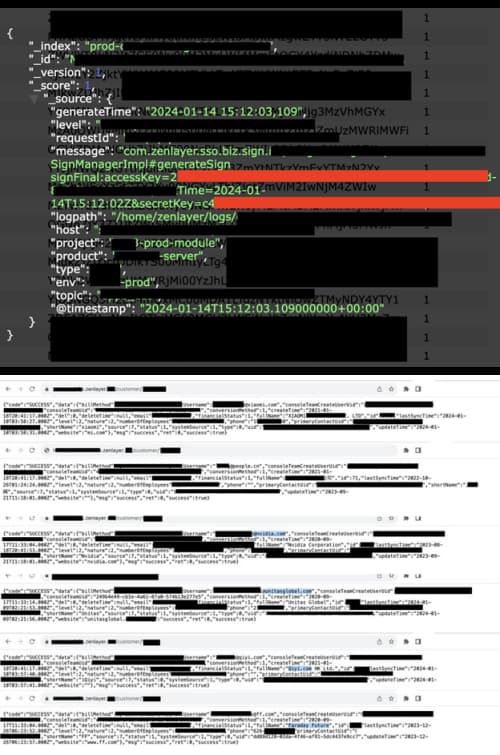
Upon further digging into the server, the analysis revealed a disturbing truth. The leaked information wasn’t just limited to mundane details; it encompassed the company’s internal workings and, even more concerning, customer data. In total, a jaw-dropping 384,658,212 records, totaling 57.46 GB, were laid bare for all to see.
What’s truly alarming is that this treasure trove of data wasn’t safeguarded by even a basic password. It was out there in the open, accessible to anyone, including those with malicious intent. Essentially, it was a “come and take it, no questions asked” scenario, leaving the door wide open for potential exploitation by threat actors.
Trove of Records Leaked
Within this database, numerous servers, error, and monitoring logs were found documenting both internal operations and customer activities. While these logs play a vital role in monitoring server performance, troubleshooting issues, and ensuring system security, they also carry a potential threat.
For your information, Zenlayer is a global network services provider offering SD-WAN, CDN, and cloud services to global brands in the telecom, gaming, media, entertainment, cloud computing, and blockchain sectors. Headquartered in Los Angeles and Shanghai, it has over 290 data centres across six continents. In 2021, Financial Times ranked it third on America’s Fastest Growing Telecom Companies list.
Exposing these logs to the public eye could disclose sensitive information. What was meant to be a tool for enhancing operational efficiency and safeguarding against potential threats could quickly turn into a liability if mishandled or accessed by unauthorized individuals.
The server also contained logging records for various applications, dashboards, vendors, notifications, and security. The exposed customer data, including names and emails of authorized individuals, could be used for targeted phishing attacks or fraudulent activities. For example, attackers may pose as a Zenlayer salesperson and ask for payment or banking information.
Additionally, the database exposure not only exposed sensitive information like user roles but also disclosed internal email addresses. This data could prove invaluable for cybercriminals, facilitating scams and social engineering attacks.
With access to these emails, malicious actors could carry out phishing campaigns targeting employees, potentially leading to the disclosure of confidential data, the installation of malware, and the compromise of credentials.
Russian Data
Fowler’s blog post on Website Planet reveals that part of the records was data of a Russian telecom carrier company, partially owned by a sanctioned state-controlled company, accused of involvement in internet traffic hijacking, or BGP (Border Gateway Protocol) hijacking, which allows attackers to intercept, inspect, or modify network traffic.
However, Fowler clarified that he wasn’t claiming that a Zenlayer customer was involved in the BGP hijacking.
Fowler also discovered logs containing VPN records and numerous IP addresses, including controller host IP, controller IP, IP LAN, jumper IP, and PXE IPMI. These IPs may reveal the organization’s internal network architecture, potentially allowing attackers to map the network, identify targets, or plan future cyberattacks.
Nevertheless, public access was secured the day after Fowler notified Zenlayer. It is unknown if the database was being managed by Zenlayer or a third party, how long it was exposed, and who else may have gained access.
Database Security, No Reply from Zenlayer
Fortunately, thanks to Fowler’s prompt responsible disclosure, the administrators managed to secure the exposed database within a day. Despite this swift action, the company failed to acknowledge or respond to the researcher’s efforts. Therefore, there remains uncertainty regarding whether the database was under Zenlayer’s direct management or handled by a third party.
Samsung will bring the Galaxy S24’s AI-powered Instant Slow-mo feature to a few older flagship devices. The company took to its official community forum in South Korea to reveal that the new feature will come to the Galaxy S23 series, Galaxy Z Fold 5, Galaxy Z Flip 5, and Galaxy Tab S9 series with a software update. It might be bundled with the One UI 6.1 update, which will also bring more AI features from the Galaxy S24 series.
Samsung will bring Galaxy S24’s Instant Slow-mo to more devices
Instant Slow-mo is one of the many new AI features Samsung introduced with the Galaxy S24 lineup last month. It lets you watch any recorded video in slow motion, no matter its original frame rate. All you need to do is tap and hold the screen while the video is playing in the gallery or the built-in video player. The device uses AI to generate intermediate motion between recorded frames to give you a smooth slow-motion video.
All of the processing and frame generations happen in real-time as long as you hold the screen. You can even edit the video to save a portion of it or the whole video in slow motion and share it on social media. It is a cool feature to have on your smartphone. During the Galaxy S24 launch, Samsung didn’t reveal whether Instant Slow-mo would come to older Galaxy phones. But we now have confirmation that it will, at least to a handful of models.
If you noticed, all of the aforementioned devices were launched in 2023 and are powered by Qualcomm’s Snapdragon 8 Gen 2 processor. Samsung isn’t bringing the feature to 2022 models because it needs a powerful GPU and NPU. The device must process 60fps videos within 16.6 milliseconds for smooth slow-motion playback in real-time. The moderator suggests the likes of the Galaxy S22 series and fourth-gen foldables can’t do that reliably.
Samsung is also working on improving the feature
Along with expanding support to older models, Samsung is working on improving Instant Slow-mo. An updated version of the feature will add support for 10-bit videos. You can currently only watch 8-bit videos in slow motion using this feature. It will also bring the resolution limit down to 480p from 720p (supported up to 8K). Lastly, the feature will work with .mov video file format along with .mp4 files.
Note that Instant Slow-mo doesn’t work with videos saved in the cloud because the resolution and quality of streaming videos may change automatically depending on network conditions. Web-only streaming files (.webm) are also not supported, though you can download and convert the video to .mp4 (soon .mov) format and watch it in slow motion. This also applies to cloud videos.
That said, you must ensure that the downloaded file meets the resolution criteria stated above. If a downloaded or shared video doesn’t have the resolution information, you cannot use Instant Slow-mo on it. If you are using a Galaxy S23, Galaxy Z Fold 5, Galaxy Z Flip 5, or Galaxy Tab S9, stay tuned for a new update that brings this cool new feature. One UI 6.1 will also be available to the likes of the Galaxy S22 and Galaxy S21.