HONOR intros MagicOS 8.0, industry’s first ‘intent-based UI’

0
[ad_1]

HONOR has just announced a new version of its Android UI, MagicOS 8.0. The company did in China, but the company did share the info in English with us. So most of what we’ll say will likely apply to the global version of MagicOS 8.0 too.

MagicOS 8.0 comes with “fully integrated platform-level AI”

The company says that MagicOS 8.0 comes with “fully integrated platform-level AI and the industry’s first to feature a revolutionary intent-based user interface (IUI)”. HONOR says that MagicOS 8.0 delivers “comprehensive improvements” in four different areas. Those areas are: smart connectivity, performance, privacy and security, and visual aesthetics.

During this event, HONOR also introduced MagicLM. That is HONOR’s proprietary on-device large language model with seven billion parameters. It is working “within MagicOS” in order to improve the platform-level AI’s ability to understand your (user’s) intentions and thus provide the best experience possible.

George Zhao, the CEO of HONOR, said the following: “From the industry’s first AI smartphone supporting MagicLive to the official debut of platform-level AI with MagicOS 7.0, HONOR has innovated with ecosystem partners over the past few years. Now, MagicOS 8.0 and MagicLM represent a significant milestone in HONOR’s on-device AI endeavors, and are a significant step towards bringing next-generation human-device interaction and ecosystem to users”.

HONOR’s MagicOS 8.0 renders services according to user intentions

HONOR says that thanks to these changes, MagicOS 8.0 renders services according to user intentions, instead of action upon requests. The IUI on MagicOS 8.0 is supposed to be able to “interpret language, images, gestures and eye movements to understand a user’s intent and offer services proactively”.

Along with MagicOS 8.0, HONOR also introduced ‘Magic Portal’. That is an intent-based shortcut recommendation feature. It will allow users to “seamlessly switch and access services between apps and devices with a simple swipe”.

In China, Magic Portal will be debuting with support for over 100 popular apps across different categories. It remains to be seen what will that support look like globally.

HONOR also added that the newly-announced MagicLM has been tweaked in collaboration with Qualcomm, so that it runs smoothly on the Snapdragon 8 Gen 3, which fuels the company’s new flagship smartphone, the HONOR Magic6 Pro.

HONOR’s MagicRing now offers 500% improved speed, and supports eight transmission channels

With MagicOS 8.0, MagicRing now supports connections from point-to-point networks to fully connected networks, with 25% better power efficiency and 500% improved speed, says HONOR. It also supports eight transmission channels.

HONOR obviously focused on talking about AI and under-the-hood improvements with MagicOS 8.0. We wonder if we’ll get any front-end features to play with. MagicOS 7 was not exactly the most feature-packed Android OS. Let’s hope HONOR worked on the front-end experience as well, perhaps even tweaked the UI a bit.


[ad_2]
Source link
Research roadblock: TikTok withdraws key tool following negative report

0
[ad_1]

One of the most popular apps in the world, TikTok, has been facing ongoing criticism and even calls for its ban. The Chinese app’s latest move is now again raising eyebrows.

TikTok recently yanked a tool used by researchers to study hashtag popularity on its app. This move, reported by The New York Times (via Engadget), came after researchers criticized the company in a report based on the tool’s data.


The tool, known as Creative Center, was a rare public method for tracking hashtag popularity. It offered data to advertisers and others. Researchers at Rutgers’ Network Contagion Institute utilized its search function to track “sensitive” hashtags related to Chinese government interests. The comparison between TikTok and Instagram led to the conclusion that many “sensitive” topics were significantly less represented on TikTok.

 
Following the report, TikTok quietly removed the search feature from Creative Center. The company cited misuse of the tool, saying that “unfortunately, some individuals and organizations have misused the Center’s search function to draw inaccurate conclusions, so we are changing some of the features to ensure it is used for its intended purpose.”


This move adds to the growing tension between social media companies and researchers delving into topics like misinformation. TikTok, like Meta and X (former Twitter), has faced challenges with researchers studying content spread.


The move to cut off this tool raises questions about TikTok’s willingness to collaborate with researchers, particularly amid increased scrutiny over its content policies and handling issues related to the Israel-Hamas war, for example. The lack of transparency has researchers concerned about the company’s approach.


The pressure has even sparked discussions in Washington about potentially banning the app or forcing its sale to an American company—though the latter seems unlikely. TikTok defended itself, asserting that the Chinese government has no influence over the app and criticizing the research for using a “flawed methodology.”


The broader conversation also involves the transparency of social media platforms. Experts argue for regulations requiring platforms to share data with external researchers, emphasizing the need to avoid leaving transparency decisions solely in the hands of platforms.


[ad_2]
Source link

The latest rules For crypto apps on the Android store

0
[ad_1]

Crypto and blockchain developers are always pushing the boundaries of what we can do with digital assets and oftentimes, apps based around this technology are launched. Users of popular app stores like the Google Play Store can download these apps to enjoy. They can be a way to look for new cryptocurrencies and new ways of earning and spending these tokens.

But if you’ve been following the news around crypto apps and app stores, you’ll know that the has been some back-and-forth regarding the rules developers have to follow to have their apps approved. Some of these rules have been so stringent that developers would rather pull their apps from the Play Store entirely. What are the current rules for crypto apps on the Andriod store? Some of them are as follows:

Crypto Mining

Mining is one of the popular ways for crypto lovers to get their hands on new tokens and involves validating transactions on the blockchain network. Crypto mining is usually done through mining hardware, desktop, and even mobile applications.

Apps image 83943893849

But while all these are popular, the Google Play Store does not allow crypto mining apps to be listed. Instead, it allows for apps that manage mining activities remotely such as apps for mining pools that let users check the status of their miners.

Crypto Trading

The Play Store allows apps that facilitate crypto trading such as crypto exchanges to operate. However, there are some requirements for this. All of these transactions need to be conducted through ‘certified services in regulated jurisdictions,” as per the store’s guidelines. On top of this, the app has to comply with the regulations of the various countries that it targets and operates in.

These apps also cannot be published in regions where crypto or crypto trading is prohibited by the government. To ensure compliance, Google might ask app developers to show proof of licensing and compliance.

Earning Tokenized Assets

Many apps these days allow people to earn digital assets for participating in challenges, games, and much more. The good news is that the Google Play Store allows these types of apps to be listed. At the same time, Google requires complete transparency when these apps are being listed in the store. Developers have to declare the presence of these tokenized assets in the Financial Features declaration form on the App Content page in Play Console.

If an asset within an app is a tokenised asset, it must be stated clearly and developers are also not allowed to glamorize or promote potential earnings from these activities.

NFTs

NFTs within apps were previously a major bone of contention for the app store but there seem to be clearer guidelines now. Gambling apps that incorporate NFTs need to fill an application to that effect. Non-gambling apps that have NFTs need to ensure that no money is paid to buy NFTs of unknown value. Additionally, the NFTs being given have to be used for the enhancement of the gaming experience for players. Google also says that “NFTs must not be used to wager or stake in exchange for the opportunity to win prizes of real-world monetary value.”


[ad_2]
Source link

Beware! Hackers Use YouTube Channels Deliver Lumma Malware

0
[ad_1]

Hackers use YouTube channels to deliver malware due to the huge user base of the platform. By using YouTube channels, hackers disguise their malicious content as:-

  • Legitimate videos
  • Legitimate links

Besides this, the popularity of YouTube also gives the threat actors the ability to evade general security measures. 

By using legitimate-looking channels, threat actors exploit users’ trust in the platform to facilitate the widespread distribution of malware.

As the cybersecurity researchers at Fortinet recently discovered, hackers are actively using YouTube channels to deliver Lumma malware, which is a C-language malware.

Document
Free Webinar

Compounding the problem are zero-day vulnerabilities like the MOVEit SQLi, Zimbra XSS, and 300+ such vulnerabilities that get discovered each month. Delays in fixing these vulnerabilities lead to compliance issues, these delay can be minimized with a unique feature on AppTrana that helps you to get “Zero vulnerability report” within 72 hours.

YouTube Channels to Deliver Malware

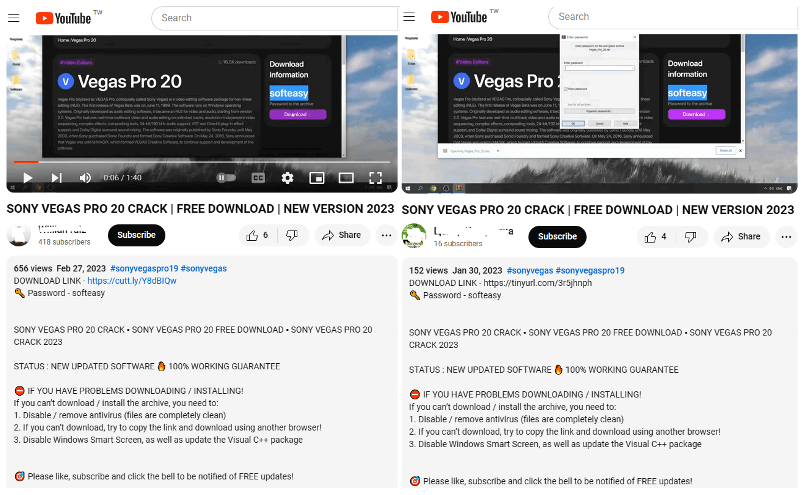
The fake YouTube videos that the threat actors create are disguised with cracked app content using:- 

  • Sneaky installation guides
  • Tricky TinyURL
  • Cuttly links

To dodge the web filters, threat actors also leverage the following platforms but without using their servers:-

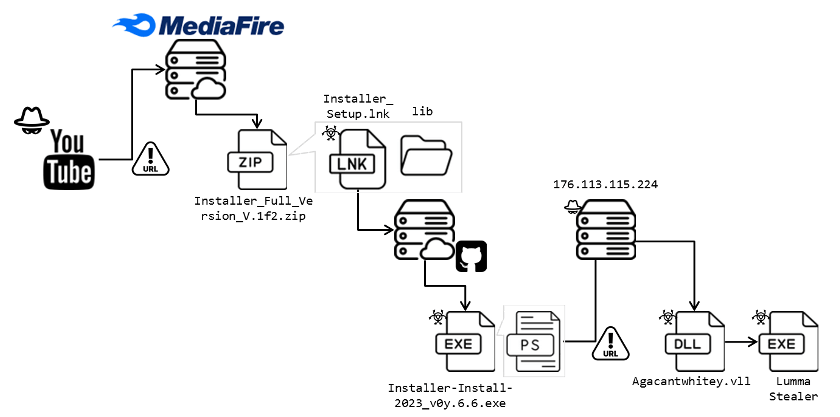
All the shared links lead to a private “.NET” loader for Lumma Stealer, a dark web-advertised malware targeting user data.

Lumma attack flow (Source - Fortinet)
Lumma attack flow (Source – Fortinet)

On the file-sharing platforms, the threat actors keep updating their malicious files to evade the security measures and trick users into downloading the malware in the form of a ZIP file that is dubbed-

  • installer_Full_Version_V.1f2.zip
Hacked YouTube Channel (Source - Fortinet)
Hacked YouTube Channel (Source – Fortinet)

The zip file contains the LNK file that triggers the PowerShell to download the “.NET” execution file from GitHub.

Here the URL which is abbreviated as “hxxp://cutt[.]ly/lwD7B7lp,” connects to the following URL:-

  • hxxps://github[.]com/John1323456/New/raw/main/Installer-Install-2023_v0y.6.6[.]exe

The following two repositories also include the NET loaders and do the same things:-

The obfuscated PowerShell script which is based on the system environment is loaded by the private .NET loader.

For discreet execution, it does the following things:-

  • Constructs a dictionary
  • Launches the PowerShell process
  • Encodes server IP in Base64

The script assesses system data to retrieve encrypted data and obfuscates it with irrelevant code. While, for the DLL file, which is invoked via “System.Reflection.Assembly]::Load(),” it decrypts the data using:-

PerkyRiggal is a crucial system inspector that decodes Lumma Stealer’s ultimate payload in Resources through PNG files using the ‘BygoLarchen’ for string encoding.

This helps in evading detection, and not only that; it even enforces the following things by checking various factors:-

After environmental checks, it decrypts resources and triggers ‘SuspendThread’ to transition the thread, which helps inject the payload.

The Lumma Stealer evades detection with obfuscation and does the following things:-

  • Communicates with C&C server
  • Sends POST messages
  • Updates to use HTTPS
  • Targets YouTube channels
  • Use bait ZIP files

Recommendations

Cybersecurity researchers strongly recommended the following recommendations:-

  • Always stay vigilant about unknown app sources.
  • Make sure to use legitimate apps.
  • Always double-check the apps’ security.

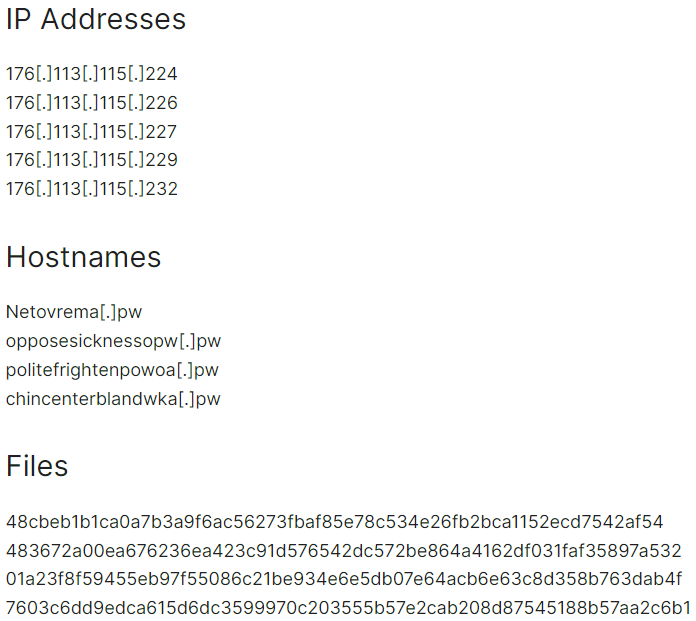
IoCs

IoCs (Source - Fortinet)
IoCs (Source – Fortinet)

Try Kelltron’s cost-effective penetration testing services for free to assess and evaluate the security posture of digital systems


[ad_2]
Source link

One in three will go: Twitch is about to lay off almost 35% of the workforce

0
[ad_1]

Out of every three people working at Amazon’s Twitch, soon, there’ll be only two.

The world’s most popular livestream platform is about to cut 35% of its workforce, or in total – about 500 workers. That’s what insiders have told Bloomberg about the latest in a series of job downsizing there.

In 2022, Amazon initiated its own job-cutting fiesta, which affected some 27,000 positions across the company and parallels with the “Red Wedding” episode from “Game of Thrones” were drawn.

In 2023, there were not one, but two rounds of layoffs over at Twitch – nearly 400 positions were slashed.

With the 500 scalps Twitch is about to take in 2024 (if that’s the only round of layoffs for the whole year), the number is getting close to a thousand dismissed employees.

Per the unnamed insiders, the cuts could be announced “as soon as Wednesday”, meaning today. They come amid concerns over losses at Twitch and after several top executives left the company in the span of a few months. A Twitch spokesperson declined to comment for Bloomberg.

Operating a huge (pronounced: “yuge”) platform that supports 1.8 billion hours of live video content a month is enormously expensive, company executives have said.

For example, in South Korea, Twitch will be ceasing its operations this February. “After several years of consideration and effort to find a way to continue operating in Korea, Twitch has decided to end its operations in Korea as of February 27, 2024, Korean time”, said an official note from the streaming giant some weeks ago.

The Amazon-owned streaming platform says it has been operating at “significant losses” because of high local costs. The company specifically pointed to the high network fees in the country. Korea introduced legislation that would force major content providers to pay to use networks in the country. Twitch has tried to balance things out and somewhat reduce costs, introducing various solutions such as adjusting the maximum video quality to 720p, but that’s apparently not enough.

In the final months of 2023, several top executives announced their departures, including Twitch’s chief product officer, chief customer officer and chief content officer. Twitch also lost its chief revenue officer, who worked on Twitch from within Amazon’s Ads unit.


[ad_2]
Source link

Hackers Using Weaponized PDF Files to Deliver Qakbot Malware

0
[ad_1]

Qakbot is a sophisticated banking trojan and malware that primarily targets financial institutions. This sophisticated malware steals sensitive information such as:-

  • Login credentials
  • Financial data

While hackers exploit Qakbot to conduct:-

  • Financial fraud
  • Unauthorized transactions
  • Gain access to personal data
  • Gain access to financial information

Qakbot malware returns after the “Duck Hunt” bust. Not only that, even Microsoft has found small-scale phishing targeting the hospitality sector since Dec 11, 2023.

Microsoft discovery of Qakbot resurface (Source - K7)
Microsoft discovery of Qakbot resurface (Source – K7)

Though all these phishing emails are low now, researchers at K7 Security Labs affirmed to expect an email volume surge due to Qakbot’s history.

Cybersecurity researchers at K7 Security Labs recently discovered that hackers use weaponized PDF files to deliver Quakbot malware.

Document
Free Webinar

Compounding the problem are zero-day vulnerabilities like the MOVEit SQLi, Zimbra XSS, and 300+ such vulnerabilities that get discovered each month. Delays in fixing these vulnerabilities lead to compliance issues, these delay can be minimized with a unique feature on AppTrana that helps you to get “Zero vulnerability report” within 72 hours.

PDF Files to Deliver Qakbot Malware

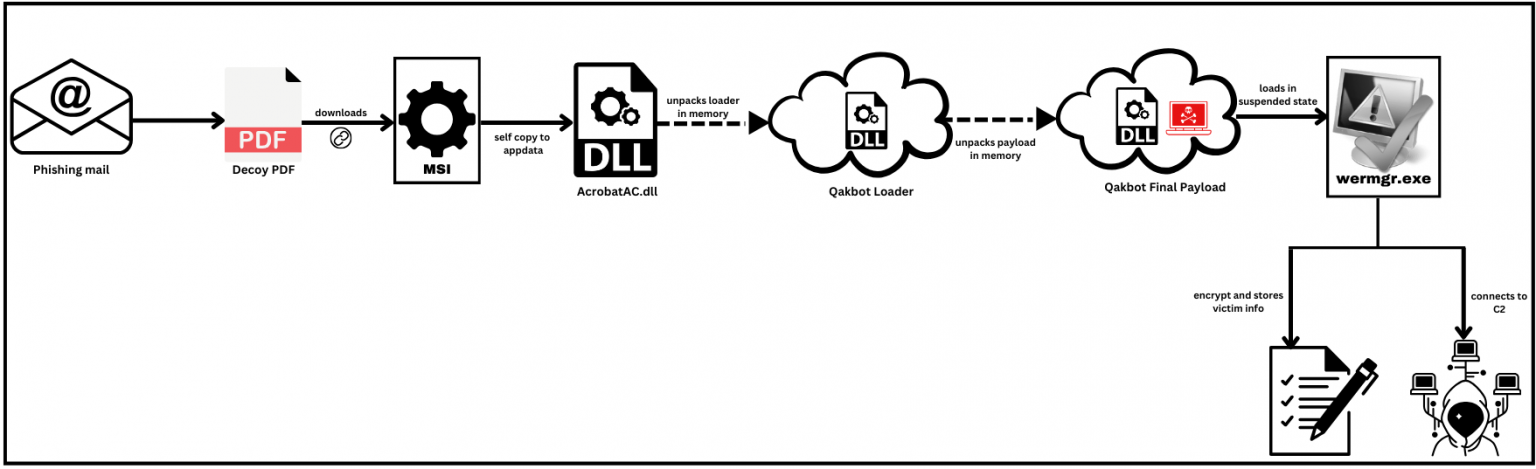
In a recent phishing campaign, researchers identified threat actors actively delivering malicious MSI files via PDFs. Further, the analysis uncovers a patched IDM DLL housing Qakbot, which is found to be using a custom packer. 

Besides this, unpacking the Qakbot DLL involves breakpoints on:-

  • VirtualAlloc()
  • VirtualProtect()

Initially, experts obtained the dump without the MZ header, and later, they identified it as Qakbot’s second-stage loader by adding the header manually. This technique helps the threat actors avoid EDR detection by avoiding MZ header scans.

Execution Flow (Source - K7)
Execution Flow (Source – K7)

In the new Qakbot campaign, security researchers noted AES encryption for victim info storage, yet the final payload retains RC4 encryption. The dynamic analysis discreetly exposes an MSI-installed temp file invoking rundll32.exe. 

The threat actor leveraging the PDFs self-copies the DLL as AcrobatAC.dll and then executes the Qakbot via EditOwnerInfo. 

The malicious DLL suspends the wermgr.exe (Windows Error Manager) as part of the kill chain. Besides this, the experts also extracted the Qakbot payload by dumping the PE file from the suspended wermgr.exe, which reveals the use of process hollowing.

Qakbot pretends to be wermgr.exe and tries to establish a covert C2 connection, however, the C2 which is inactive during analysis stops the further malicious actions.

IoCs

IoCs (Source - K7)
IoCs (Source – K7)

Try Kelltron’s cost-effective penetration testing services for free to assess and evaluate the security posture of digital systems


[ad_2]
Source link

Samsung is working with Microsoft Copilot for the Galaxy Book4 series

0
[ad_1]

Samsung, in partnership with Microsoft, is gearing up to enhance the connectivity between its Galaxy smartphones and PCs, creating a seamless experience similar to Apple’s well-established ecosystem. The collaboration aims to introduce a new level of multitasking and interaction between the Galaxy Book4 series laptops and Samsung Galaxy smartphones, leveraging the capabilities of Microsoft’s Copilot AI assistant. This move is strategically aligned to emulate the smooth connectivity that Apple users enjoy across their iPhone, iPad, MacBook, and likely the upcoming Apple Vision Pro.

The Microsoft Copilot AI assistant will enable users to access, read, and summarize text messages from their Samsung Galaxy smartphones directly on the Galaxy Book4. Moreover, users can compose or generate responses on their PC, offering a level of interaction that extends beyond just typing responses on the phone. While the idea of generating responses using AI technologies may not be universally appealing for personal messages, it holds the potential for more thoughtful and considered communication in work-related scenarios.

Samsung incorporates the AI buzzword into its Galaxy Book4 series, staying in line with the current industry trends for PCs

The initiative to integrate AI into the Samsung ecosystem shows the growing trend of laptop manufacturers leveraging artificial intelligence to enhance performance and user accessibility. In contrast to Apple’s approach of controlling both hardware and software, Samsung relies on collaboration, in this case, using Microsoft’s Copilot. This strategic move aims to provide users with a more cohesive and interconnected experience across their Samsung devices.

The Galaxy Book4’s attempt to offer a more integrated ecosystem aligns with the popularity of Apple’s all-encompassing ecosystem, where users find value in the seamless connectivity between various Apple devices. While Samsung produces hardware for both smartphones and laptops, it operates on different platforms – Android for phones and Windows 11 for laptops. Despite this distinction, the collaboration with Microsoft Copilot reflects Samsung’s aspiration to replicate the smooth and interconnected experience that defines the Apple ecosystem.

Samsung’s effort to bridge the gap between its diverse hardware offerings could pave the way for a more interconnected and user-friendly ecosystem, challenging the dominance of Apple in this space. However, we will need to test it out ourselves to explore the practicality of this collaboration with Microsoft Copilot.


[ad_2]
Source link

Google Pixel dominates MKBHD’s blind camera test: premium hardware matters?

0
[ad_1]

In the fiercely competitive world of smartphone photography, Google’s Pixel devices have once again emerged triumphant in MKBHD’s blind smartphone camera test for 2023. The popular YouTuber conducted a comprehensive evaluation of 20 smartphone models across three key categories: Daytime, Low Light, and Portrait mode. Additionally, a notable ‘average ELO rating’ category was introduced, and to the surprise of many, Google Pixel devices dominated this category.

In the daytime category of MKBHD’s blind camera test, the Google Pixel 7a secured the top spot, showcasing its stellar photography capabilities in ideal lighting conditions. The test also included a challenge to evaluate HDR handling with a window behind in full sun. The Pixel 7a outshone competitors like the Google Pixel Fold and the OnePlus Open in this category. To be fair, the budget-friendly offering from Google, or the Pixel 7a not only appears to be a great choice for camera enthusiasts but also fits someone perfectly who is looking for an all-rounder.

Interestingly, the price tag didn’t reflect in this blind test despite all the big 1″ sensors and premium lenses

Moving to the Low Light category of the blind camera test, the iPhone 15 Pro took the crown, demonstrating its ability to excel in challenging lighting conditions. Notably, two Pixel devices, the Google Pixel 8 Pro and the Google Pixel 7a, secured the second and third positions, highlighting Google’s continued success in the photography section.

In the Portrait mode category of the blind camera test, Google once again asserted its dominance, with the Pixel 8 Pro emerging as the fan favorite for this type of photography. The Galaxy Z Fold 5 and iPhone 15 Pro secured the second and third positions, respectively.

The ‘average ELO rating’ category, dubbed the ‘People’s champ,’ saw Google smartphones clinching the top three positions. The Pixel 7a secured the highest average ELO rating, followed by the Pixel 8 Pro and Pixel Fold. This resounding victory for Google underscores its popularity among fans of mobile photography.

Focusing on value for money, the ‘Most votes per dollar,’ the Pixel 7a once again emerged as the winner, showcasing its exceptional photographic performance relative to its price. The Nothing Phone (2) and OnePlus 11 claimed the second and third positions, emphasizing the balance of quality and affordability in the smartphone market.

MKBHD's blind camera test
Highest overall average-ELO (Source: MKBHD)

[ad_2]
Source link

Samsung announces Replay Wireless Controller designed for its Gaming Hub

0
[ad_1]

Samsung has announced its first video game controller called the Replay Wireless Controller in partnership with Performance Design Products (PDP). This marks the South Korean brand’s foray into the gaming segment. The ‘Designed for Samsung Gaming Hub’ is a program that partners with leading video game accessory manufacturers to create products tailored for Samsung devices.

Replay Wireless Controller is an Xbox-like controller for Samsung Gaming Hub

The Replay Wireless Controller comes in a Midnight Blue color. It has a design similar to the Xbox controller. The only differences on the controller are the dedicated TV volume buttons and the home button that can immediately launch the Samsung Gaming Hub. The Replay Wireless Controller draws its power from a built-in rechargeable battery. It claims to deliver 40 hours of playtime on a single charge. It also features a 30-feet low latency Bluetooth connectivity range for smooth gameplay.

The Replay Wireless Controller carries a price tag of $49.99 making it quite competitive compared to Xbox Series X and PS5 controllers which cost $55 and $65 respectively. The Replay Wireless Controller is available for pre-order on the PDP website, Amazon, and BestBuy. The gaming accessory will likely hit the shelves later this month. Attendees at the ongoing CES 2024 can experience the Replay Wireless Controller at the Samsung booth.

More ‘Designed For Samsung Gaming Hub’ accessories on the way

The Replay Wireless Controller is the first official licensed controller from PDP for the Samsung Gaming Hub. The South Korean brand says that it will release more accessories under this new program. The products will bear a badge designating them as being designed for the company’s cloud-based gaming platform. It will offer the best compatibility, quality, performance, safety, and security on Samsung devices.

The Samsung Gaming Hub is a cloud-based gaming platform introduced in 2022. It enables users to play video games directly on their Samsung TVs without requiring a PC or console. There are various game streaming options including Xbox Game Pass, Amazon Luna, GeForce Now, and more.


[ad_2]
Source link

Intel showcases entire 14th Gen CPU lineup at CES

0
[ad_1]

Intel like many companies is presenting its latest products at CES this week, and for the chip maker that includes revealing its entire lineup of 14th Gen CPUs. Some of these have already technically been announced through partners. At least indirectly.

Companies like Acer, Razer, Alienware, ASUS, and others have all announced new gaming laptops and desktops. And some of that hardware was stated to carry some of the new Intel 14th Gen CPUs. Such as the new Alienware m18 R2 that was announced on January 8 and features up to an Intel Core i9-14900HX CPU, a powerful 24-core beast. This is one of the new chips in Intel’s 14th Gen family that is being announced. But it’s also one of more than a few. As Intel appears to have a wide range of options for upcoming PC manufacturers.

Intel’s new chips will span across both desktop and mobile product categories. However, it should be kept in mind that mobile simply refers to laptops and not devices like smartphones.

Intel 14th Gen HX-series CPUs power the next generation of laptops

For those who want a powerful laptop that is focused more on sheer performance output, an Intel 14th Gen-powered laptop will be the way to go. The Intel Core i9-14900HX for example contains 24 cores – 8 performance cores and 16 efficiency cores – and 32 threads. It also has a 5.8GHz Turbo Frequency that Intel says is 51% faster at multitasking performance than the competition. It delivers a boost in gaming performance by 17% too.

There’s also the Intel Core i7-14700HX which Intel is positioning for creators. It should work fine for gaming too though. This chip Intel says has 50% more efficiency cores than the previous gen chips. So these will be great for users who want decent performance for tasks like content creation but also want longevity out of the battery while off the charger. The 14th Gen family as a whole also includes new Wi-Fi standards with support for WiFi7. As well as support for Bluetooth 5.4 and Bluetooth 5.3.

Intel says it has over 60 partner devices that will be released with these chips in 2024. Some of which were already announced this week. Additionally, Intel is announcing its latest range of Core U CPUs designed for thin and light laptops. These have a 5.4GHz Turbo Frequency as well as 2 performance cores and 8 efficiency cores. They also support both Wi-Fi 7 and Wi-Fi 6E in addition to Bluetooth 5.4, Bluetooth 5.3, and Bluetooth Low Energy.

Desktop PC enthusiasts can soon get their hands on Intel’s latest too

Laptops are an all-around great option for a PC if you need or desire to be more mobile. But for those who like to build their rigs, Intel is also announcing its 14th Gen desktop chips. These will have many similar traits to the mobile chips, like the 5.8GHz Turbo Frequency, and the i9 and i7 chips will have the same amount of cores as their mobile counterparts. The entire desktop range of 14th Gen chips is also now available for purchase by consumers Intel says.

Intel 14th Gen is also a bit different than Intel’s recently announced Core Ultra chips. The latter is designed more for powering the “AI PC” family of products that have been trickling out since late last year. While they can still provide ample gaming performance, they’re more focused on delivering a balance of gaming performance alongside AI-driven features for a smarter overall PC.


[ad_2]
Source link