OPPO announced two immensely compelling smartphones today, led by the OPPO Find X7 Ultra. The sad news is that the OPPO Find X7 Ultra may not launch globally. The same goes for the OPPO Find X7, actually.
The OPPO Find X7 Ultra probably won’t launch globally, unfortunately
The company did not mention anything of the sort during the launch event, but it did share some insight with us prior to the launch. The company’s representative said that there are no plans for the global launch event.
He did leave the door slightly open for the possibility of a global launch, but it doesn’t seem like it will happen. Based on what we were told, OPPO is fully focused on the China launch now, and is not even thinking of a global launch.
We do hope that the company will change its mind, though. The OPPO Find X6 Pro did not launch globally, which is a shame. That was one of the best camera smartphones we’ve used last year. It had a lot to offer in almost every aspect.
OPPO focused on the camera setup here
The OPPO Find X7 Ultra is its direct successor, and it packs even more camera prowess. It looks very promising, and it would be great if global consumers had a chance to experience it. Let’s hope OPPO will change its mind. We will review the OPPO Find X7 Ultra. The phone will be in the office very soon.
OPPO is using the ‘Quad Main Camera’ setup term for this phone’s rear cameras. Why? Well, because the company did its best to bring them on the same playing field. The whole point is that you can use either of the cameras and don’t feel like you’re using an inferior camera.
This is the first-ever smartphone with the Sony LYT-900 camera sensor & two periscope telephoto cameras
This is the first smartphone that utilizes Sony’s LYT-900 camera sensor. That 1-inch sensor is the main camera on the OPPO Find X7 Ultra. This is also the first smartphone that has two periscope telephoto cameras on the back (3x and 6x ones).
The company also worked a lot on image processing. The HyperTone Image Engine is supposed to be able to balance out those images to a high degree. We’ll see if the hype was worth it.
100W wired charging and 50W wireless charging are also included, along with one of the best displays on the market at the moment. The Snapdragon 8 Gen 3 fuels the phone, and so on. OPPO really did go all out here.
Acer is announcing four new GPUs today built on AMD’s RDNA 3 architecture with the Predator BiFrost Radeon RX 7800 XT OC, as well as the Nitro Radeon RX 7800 XT OC, 7700 XT OC, and 7600 XT OC. All four GPUs will go on sale in February of this year but Acer is only listing prices for three of them right now. The Predator BiFrost Radeon RX 7800 XT will retail for $549.99 and is Acer’s flagship out of the four GPUs.
As such, gamers can expect some real performance gains with this card. It’s PCIe 4.0 and uses dual PCIe 8-pin connectors. it also has 16GB of GDDR6 memory and a triple fan setup with three Predator FrostBlade 3.0 fans. Additionally, it has a max Game Clock of 2,254 MHz and a max boost clock of 2,565 MHz. It also has ports for HDMI 2.1 and DisplayPort 2.1. In short, it’s really fast and it stays cool under pressure. “Gamers can expect major leaps in performance and efficiency,” Acer says.
If you’re the type that likes to keep a watchful eye on stats, you can use the Predator BiFrost Utility app to monitor graphics parameters and even adjust the fan velocities.
Acer will sell three more affordable Predator GPUs based on the AMD RDNA 3 architecture
Acer’s other more affordable GPUs will offer similarly impressive performance. The Nitro 7800 XT and 7700 XT models for instance will have AI accelerators that allow for 1440p and 4K gaming. Max boost clock speeds will be 2,565 MHz and 2,599 MHz respectively, while the max game clock speeds will be 2,254 MHz and 2,276 MHz. The prices should also be a little more appealing. The Nitro Radeon RX 7800 XT will be $509.99 and the Nitro Radeon RX 7700 XT will be $459.99.
Acer doesn’t list the price for the baseline model, the Nitro Radeon RX 7600 XT. However, it’ll be less than $459.99, so our bet is around $380-$400. Whatever the cost ends up being, however, it’ll be the GPU to pick if you have a rig with less space. Acer says it measures 265.1 x 111.2 x 40.1 mm with a 2.5-slot form factor and calls it the “choice for space-conscious DIY gamers.”
All three Nitro cards will also have connectivity ports for HDMI 2.1 and DisplayPort 2.1 just like the Predator BiFrost Radeon RX 7800 XT. So you can easily use them with those newer cables if you already have them.
AsyncRAT is an open-source remote access Trojan (RAT) malware known for its ability to provide unauthorized access and control over infected systems. It was released in 2019.
Hackers use it actively for various malicious purposes, including:-
Data theft
System manipulation
Surveillance
Cyber espionage
Keylogging
Exfiltration techniques
Initial access staging for final payload delivery
Cybersecurity researchers at AT&T recently discovered that AsyncRAT malware has been actively attacking the US infrastructure for 11 months.
AsyncRAT Malware
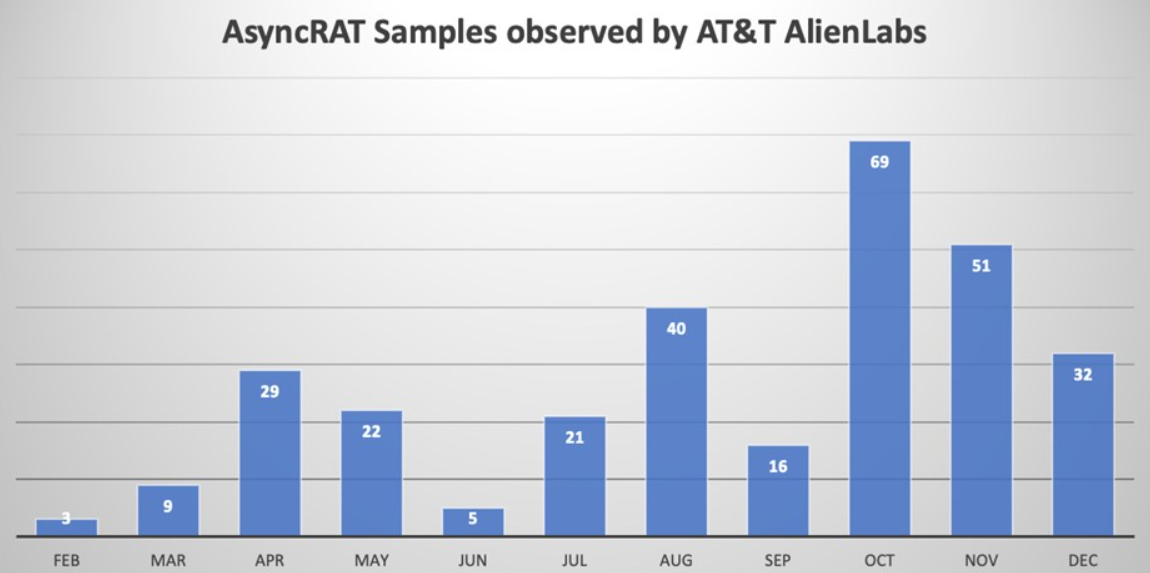
APT Earth Berberoka has used this RAT, and recently, AT&T Alien Labs noted a phishing spike in September targeting individuals with gif attachments leading to:-
SVG file
Obfuscated JavaScript
PowerShell scripts
AsyncRAT execution
Number of samples observed (Source – AT&T)
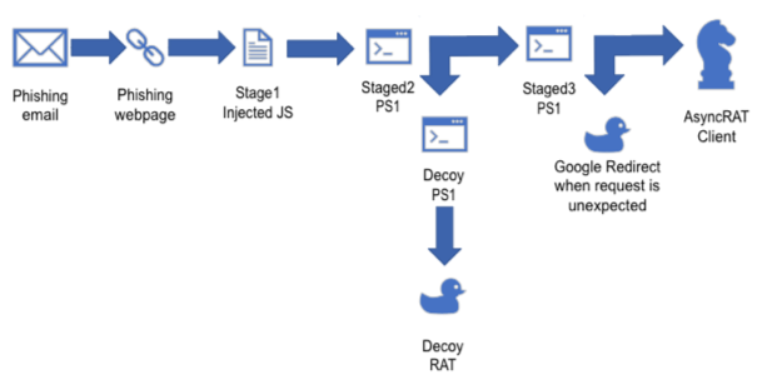
The loader’s stages are obfuscated by the C&C server that checks the victim for sandbox before deploying the AsyncRAT payload. C&C redirects to a harmless page when parameters are not met.
JavaScript files delivered via phishing with obfuscated strings like:-
Melville
church
chapter
Scottish
Meanwhile, the loader versions vary for each victim with randomized variable names, constants, and URL representation. After the GET request, C&C sends base64 script XOR’ed against a hardcoded key, unpacked with Gunzip, and executed flawlessly in PowerShell.
Execution flow (Source – AT&T)
The C&C values like 1b (VM False) are correct, while 2c (VMWare) and other wrong answers have higher values. C&C may have a table of valid responses or a value range that helps in avoiding brute force.
Anti-sandboxing technique evades popular sandboxes. Invalid answer redirects to Google or returns a new script reaching out to payload in temp[.]sh with $url variable.
However, besides this, the temp[.]sh link is consistent across samples and time, which helps in hosting the files for three days with new randomized URL paths.
The code dynamically changes and is heavily obfuscated for detection evasion, but network infrastructure remains consistent.
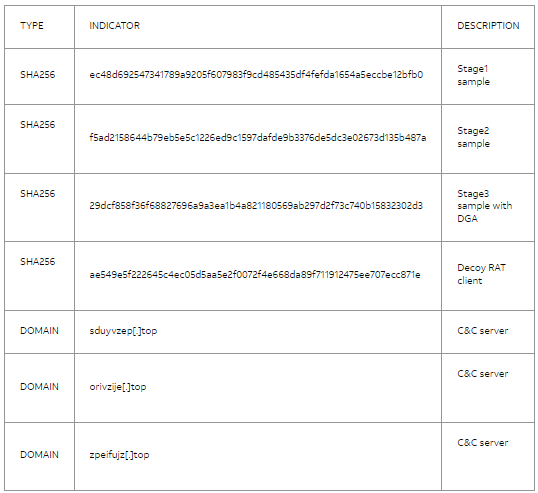
The samples use a variety of domains that are frequently updated, and among them, the common domains include:-
sduyvzep[.]top
orivzije[.]top
zpeifujz[.]top
Here below, we have mentioned all the characteristics that are followed by the domain structure:-
Top Level Domain (TLD): top
8 random alphanumeric characters
Registrant organization: ‘Nicenic.net, Inc’ (the registrar)
Country code South Africa (ZA)
Created a few days before its use
The Domain Generation Algorithm (DGA) calculates a unique domain every seven days and on every Sunday, it generates a new one.
The seed, which is derived from the day of the year, undergoes modifications for variation that includes changes to other variables and characters in the scripts.
This strategy helps threat actors avoid detection and blocking by automatically changing the C&C domain over time.
With just over a week left before the official unveiling, Samsung has stepped up its Galaxy S24 promotions. It has launched a global billboard campaign promoting the new flagships and their on-device AI capabilities. The giant billboards are up in strategic locations across several major cities worldwide. The company will unveil the devices on January 17.
Samsung ramps up Galaxy S24 promotions with Galaxy AI billboards
Samsung started putting up digital billboards promoting the upcoming Galaxy Unpacked event on January 3. The company says the billboards are now live at COEX in Seoul, South Korea; Piazza del Duomo in Milan, Italy; CentralWorld in Bangkok, Thailand; Piccadilly Circus in London, the UK; Stureplan in Stockholm, Sweden; and Central Railway Station in Warsaw, Poland.
The giant displays are also up in Chengdu, Madrid, New York, and many other major cities around the world. They show Samsung’s teaser for Galaxy AI, a comprehensive mobile AI solution that will debut with the Galaxy S24 series. “The video shows a metallic cube slowly evolving into animated stars that represent Galaxy AI and the transformative experiences it will bring,” the company explains.
You may have already seen this video on the Korean firm’s social channels. It has bet big in artificial intelligence for its next-gen flagships. Powered by its in-house generative AI model Samsung Gauss, Galaxy AI is built into the system for an intuitive and seamless AI experience for users. Leaks suggest users can switch to third-party AI solutions such as ChatGPT for some tasks.
Samsung says it is bringing a “mobile innovation that will soon change the way users live, connect and create forever.” The Galaxy S24 series will have AI built into the camera, gallery, Samsung Call, Samsung Notes, Samsung Internet, Samsung Keyboard, and various other system apps and elements. Some AI features will work offline on the device while others will require an internet connection.
These AI features are part of One UI 6.1
Samsung will offer these AI features as part of One UI 6.1, its Android 14-based custom software that will debut with the Galaxy S24 lineup. If history is any indication, the company will push the new One UI version to older Galaxy flagships and premium mid-range models later. It remains to be seen if all of the new AI features will make it into older models. Hardware constraints may make some features incompatible. Stay tuned for the official Galaxy S24 launch next week.
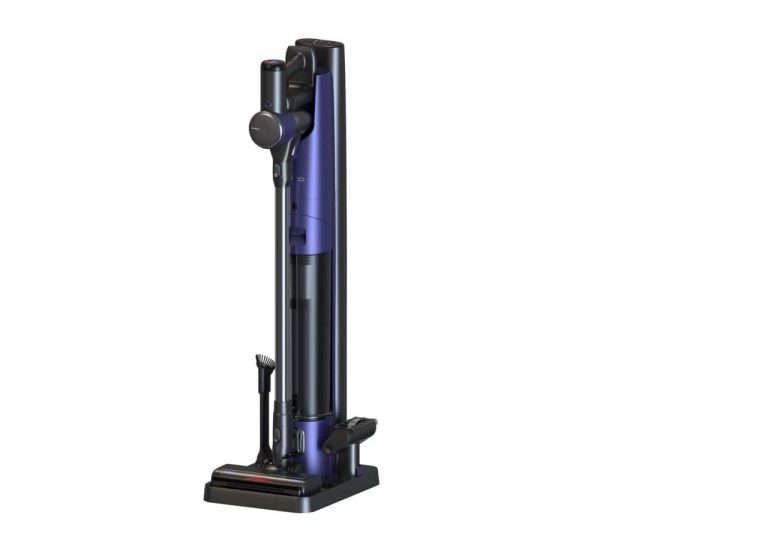
At CES 2024, Tineco will unveil a couple of new vacuums that will definitely catch your eye. First up is the new Pure One Station. Which the company is calling the “world’s smartest self-cleaning station vacuum.”
The Pure One Station’s OmniHub is able to store the vacuum neatly, recharge, and automatically self-clean the entire machine from the brush to the tubes and filters. And the best part? It’s all done hands-free. It is also able to store debris and dust for up to 60 days.
Additionally, the Pure One Station won’t get tangled, thanks to its ZeroTangle Brush head, which is able to prevent hair buildup in the roller, and PureCyclone technology that is going to separate air and dust to minimize clogging and sustain strong suction and power.
Tineco is also announcing the Floor One Switch S7. The company is positioning itself as a first-of-its-kind smart multi-function cleaner with a SwitchPro Motor that can seamlessly be switched between a floor washer or vacuum unit. Making it a super versatile vacuum. It also uses the same ZeroTangle brush head and PureCyclone technology as the Pure One Station.
Tineco is also announcing a new smart countertop oven
Finally, for the new products that Tineco is announcing today at CES, we have the Oveni One. This is a new smart countertop oven. Which comes with an onboard touchscreen and offers hundreds of built-in recipes as well as multiple cooking functions.
Tineco is reimagining how consumers can clean more efficiently, and now it is taking this same approach to the kitchen, helping you cook more efficiently with this new Oveni One.
The company has not yet announced pricing for any of these new products. That’s pretty common for CES products, and we should see more information come out in the coming months.
In a landmark victory for cybersecurity, the xDedic Marketplace, a notorious haven for cybercrime, has been shut down.
This international operation, spearheaded by the U.S. Attorney’s Office, FBI, IRS-CI, and a consortium of law enforcement agencies from Belgium, Ukraine, and Germany, marks a significant blow to the underground economy of compromised data and access.
For years, xDedic operated in the shadows of the internet, serving as a clandestine marketplace for hackers and cybercriminals to peddle their wares.
Stolen credentials, personal information, and access to compromised systems across the globe were all available for purchase, with buyers able to filter their search by price, location, and operating system.
This vast repository of ill-gotten gains fueled various criminal activities, from financial fraud and identity theft to corporate espionage and infrastructure disruption.
Unveiling the Shadowy Network:
The takedown of xDedic culminated in a meticulous investigation spanning multiple countries.
Law enforcement agencies meticulously tracked the website’s operations, unraveling its intricate web of servers strategically dispersed across the globe.
Bitcoin, the cryptocurrency employed by xDedic, was meticulously traced, providing crucial insights into the marketplace’s financial transactions and user base.
A Multi-pronged Attack:
On January 24, 2019, the hammer of justice fell. Seizure orders were executed against xDedic’s domain names, plunging the marketplace into darkness.
This decisive action resulted from close collaboration between the U.S. Attorney’s Office, FBI, IRS-CI, and their European counterparts.
The Belgian Federal Prosecutor’s Office, the Ukrainian National Police, and Europol all played crucial roles in dismantling the website’s infrastructure.
Based on evidence gathered during the investigation, authorities estimate that the website facilitated over $68 million in fraud.
The victims span the gamut of industries, including government agencies, hospitals, financial institutions, and educational institutions, underscoring the far-reaching impact of xDedic’s illicit operations.
The National Institute of Standards and Technology (NIST) has exposed critical AI vulnerabilities that can be exploited by threat actors to create potential avenues for compromising AI systems.
In a comprehensive study, researchers at the National Institute of Standards and Technology (NIST) dug into the vulnerabilities in artificial intelligence (AI) systems, revealing the exploitation of untrustworthy data by adversaries and malicious threat actors.
Despite concerns, Artificial Intelligence has become a vital player in our lives. From detecting dark web cyber attacks to diagnosing critical medical conditions when doctors fall short, it is safe to say that AI is here to stay. However, it requires strong cybersecurity measures to prevent it from falling into the hands of malicious threat actors.
Therefore, the research, titled “Adversarial Machine Learning: A Taxonomy and Terminology of Attacks and Mitigations,” can be termed a significant contribution to the ongoing effort to establish trustworthy AI.
AI Vulnerabilities Exposed: No Foolproof Defense
NIST’s computer scientists have discussed the inherent risks associated with AI systems, revealing that attackers can intentionally manipulate or “poison” these systems to cause malfunction.
The publication emphasizes the absence of a foolproof defence mechanism against such adversarial attacks, urging developers and users to exercise caution amidst claims of impenetrable safeguards.
AI in the Crosshairs: Understanding Attacks and Mitigations
The study classifies major attacks into four categories: evasion, poisoning, privacy, and abuse. Evasion attacks aim to alter inputs post-deployment, while poisoning attacks introduce corrupted data during the training phase.
Privacy attacks occur during deployment, seeking to extract sensitive information for misuse, and abuse attacks involve inserting incorrect information into AI sources.
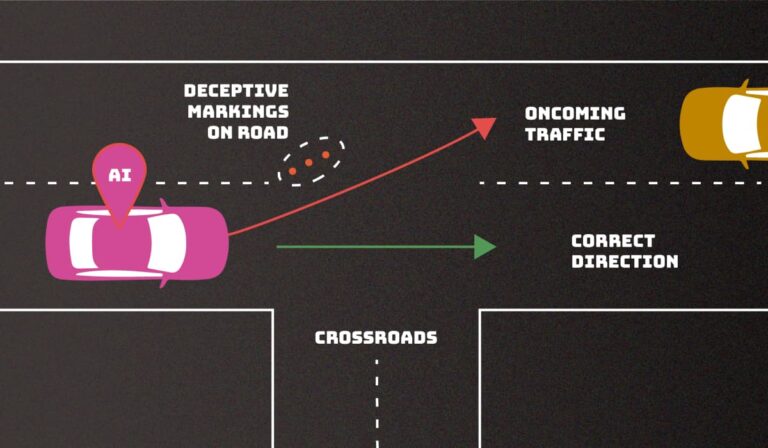
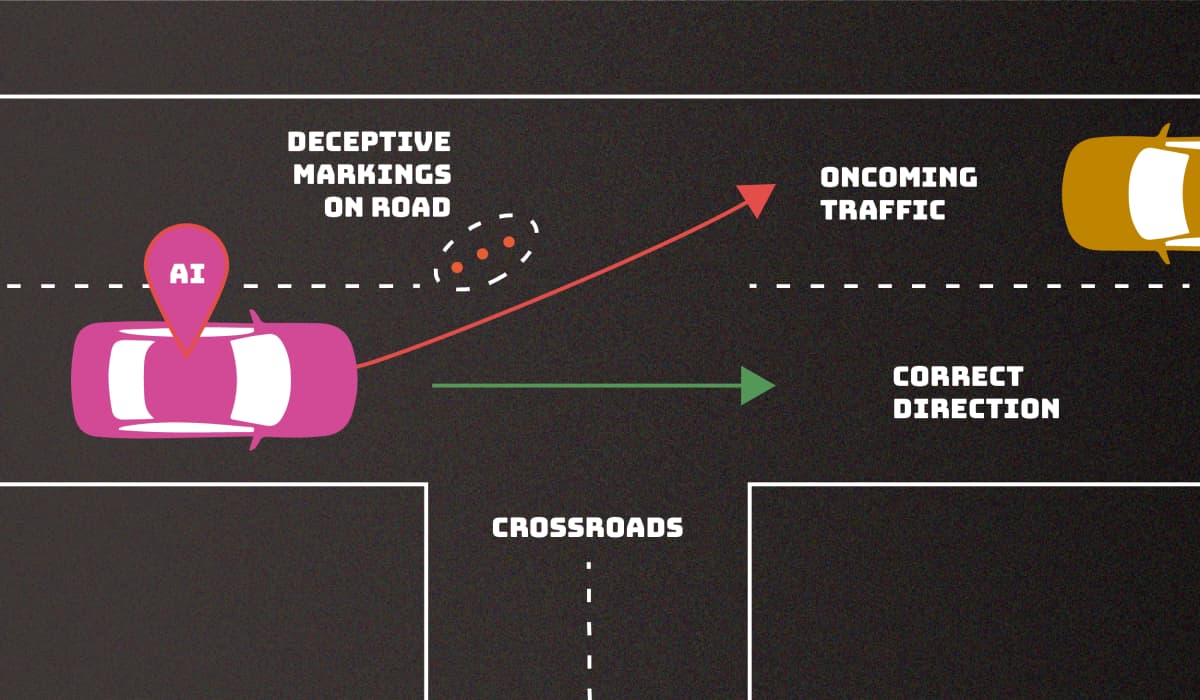
If an adversary manipulates an AI system’s decision-making, it can malfunction. For instance, in an “evasion” attack, misleading road markings could cause a driverless car to veer into oncoming traffic. NIST’s new publication outlines such adversarial tactics and suggests mitigation approaches. Credit: N. Hanacek/NIST
Challenges and Mitigations:
The research acknowledges the challenges in safeguarding AI from misdirection, particularly due to the massive datasets used in training, beyond the scope of human monitoring. NIST provides an overview of potential attacks and corresponding mitigation strategies, emphasizing the community’s need to enhance existing defences.
AI’s Vulnerability Spotlight: The Human Element
Highlighting real-world scenarios, the study explores how adversarial actors can exploit vulnerabilities in AI, resulting in undesirable behaviours. Chatbots, for instance, may respond with abusive language when manipulated by carefully crafted prompts, exposing the vulnerability of AI in handling diverse inputs. For the complete research material behind this study, visit here (PDF).
For insights into NIST’s latest study, we reached out to Joseph Thacker, principal AI engineer and security researcher at AppOmni, a SaaS security pioneer. Joseph told Hackread.com that NIST’s study is “the best AI security publication he has seen so far.
“This is the best AI security publication I’ve seen. What’s most noteworthy are the depth and coverage. It’s the most in-depth content about adversarial attacks on AI systems that I’ve encountered. It covers the different forms of prompt injection, elaborating and giving terminology for components that previously weren’t well-labelled,” noted Joseph.
“It even references prolific real-world examples like the DAN (Do Anything Now) jailbreak and some amazing indirect prompt injection work. It includes multiple sections covering potential mitigations but is clear about it not being a solved problem yet,” he added.
“There’s a helpful glossary at the end, which I personally plan to use as extra “context” to large language models when writing or researching AI security. It will make sure the LLM and I are working with the same definitions specific to this subject domain. Overall, I believe this is the most successful over-arching piece of content covering AI security,” Joseph emphasised.
Developers’ Call to Action: Enhancing AI Defenses
NIST encourages the developer community to assess and improve existing defences against adversarial attacks critically. The study, a collaborative effort between government, academia, and industry, provides a taxonomy of attacks and mitigations, recognizing the evolving nature of AI threats and the imperative to adapt defences accordingly.
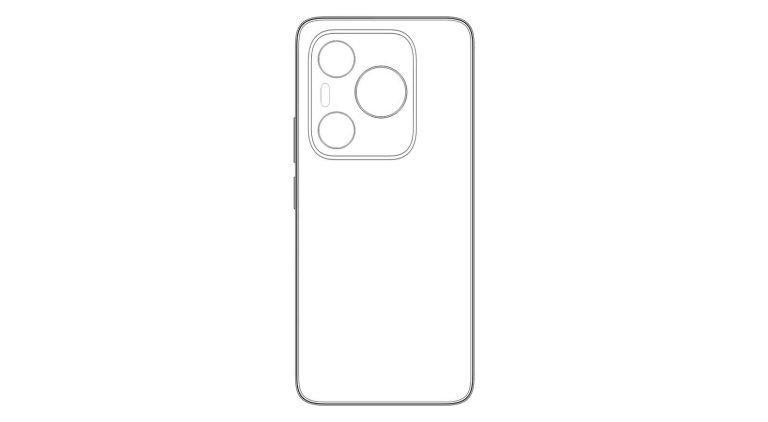
The Huawei P70 design has seemingly been revealed. The information comes from Digital Chat Station, one of the best-known Chinese tipsters. He shared a sketch of the Huawei P70 on Weibo, though we are not sure if this is the vanilla model or not.
The Huawei P70 design has been shared by a well-known tipster
Either way, if you check out the image provided below this paragraph, you’ll see the sketch in question. There are clearly three cameras included on the back here, and this is an evolution of the Huawei P60 series design.
If you take a look at the Huawei P60 series, you’ll notice that a similar setup was used. The emphasis is on the main camera, which is moved slightly to the right, while the other two cameras sit more to the left, above and below the main shooter.
Truth be said, based on this sketch, that camera island may look better than the one from the Huawei P60 series. These camera sensors will likely be larger in general, and the circles will be more cohesive than last year.
This sketch is not saying the whole story, but it’s a start
We can’t really say much from a sketch, of course, but that’s what it seems like. An LED flash sits between the phone’s ultrawide and periscope telephoto cameras. We’re not sure which is which, though. We can only assume that the one to the right is the main camera, of course, due to its size.
What’s interesting, however, is that Huawei is rumored to use a much larger and better ultrawide camera sensor this time around. That would explain the larger circles for the cameras in general.
The Huawei P60 series arrived back in March last year. Huawei could be aiming for a similar launch timeframe this time around, but we cannot be sure. We’ll have to wait and see, as there’s no official info thus far.
What we know for sure is that the emphasis will once again be on the camera setup on these devices. Huawei still has some of the best camera smartphones in the game. Therefore, we have great expectations for the Huawei P70 series, as does Huawei.
CES 2024 is happening now, and JBL has a ton of new headphones and TWS earbuds for us. These devices are in the company’s Live and Tune series of devices, and they’re all set to bring some great audio quality and features.
Be sure to check out more news about CES 2024, as there’s a ton flowing in. Also, if portable speakers are more your speed, then check out the portable speakers that JBL announced.
Here’s a rundown of the headphones that JBL announced during CES 2024
JBL isn’t a company to announce only a few devices. It just took the wraps off of 12 pairs of wearable audio devices. These include both over-the-ear headphones and TWS earbuds.
Headphones
Starting off, here are the over-the-ear headphones that JBL announced during CES. We have the Tune 520BT ($49.99), Tune 670NC ($99.99), Tune 720BT ($79.99), Tune 770NC ($129.99), Live 670NC ($129.99), and Live 770NC ($199.99). There’s a range of quality with these headphones with the Tune 520BT being the least premium. Still, this pair has a pair of 32mm drivers, Bluetooth 5.3, and up to 57 hours of listening time. This is the pair to get if you’re looking to save more money on your purchase.
At the top of the ladder, the Live 770NC has the most features. It comes with noise cancelation, large 40mm drivers, auto play/pause, JBL Personi-Fi, up to 65 hours of listening on a single charge, and many more. This is the pair you’ll want to get if you want the most from your headphones.
Other headphones include the Tune 310C ($24.95) and the Soundgear Sense ($149.99).
All of these headphones will be available to buy in March.
Earbuds
Moving onto the earbuds, JBL took the wraps off of four pairs of earbuds that all promise to give you a nice listening experience. These are the Live Buds 3 ($199.99), Live Beam 3, Live Flex3, and the 310C BL Live TWS 3.
The Live Buds 3 come with a ton of features like 10mm drivers, ANC, Bluetooth 5.3, high-res audio, six microphones, IP55, wireless charging, and more. The other models all come with similar specs and with other features as well. All of these devices offer 40+ hours of battery life with their charging cases included.
You’ll want to pick up any pair of these earbuds if you’re looking for reliable earbuds with great audio and a ton of features. We don’t know exactly when they’re going to hit the shelves, but you should expect them to land sometime in the Summer.
Each year, an estimated 13.5 million people in the US are victim to stalking. This is a worrying fact stated in the introduction of a lawsuit against Apple brought by stalking victims who charge that AirTags empowered their abusers.
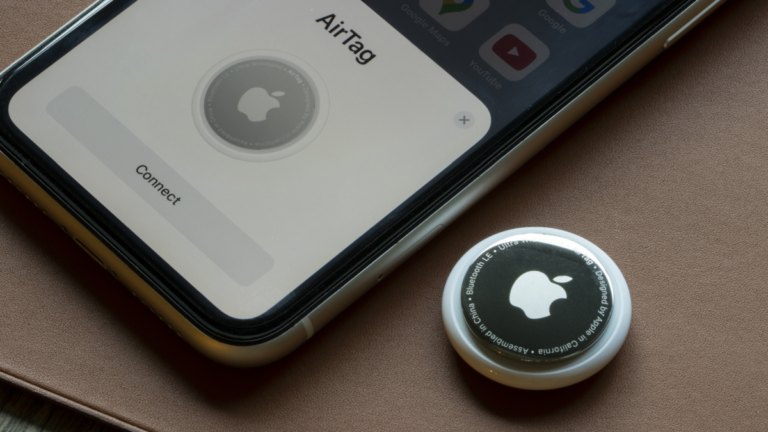
AirTags are marketed as trackers that allow you to easily find lost belongings like keys and luggage. If you lose an object, you can find the AirTag in the Find My app on another Apple device. The tracker transmits its location via Ultra Wideband technology which is more accurate than Bluetooth when it comes to determining exact location. Since the tracker shares its location with the Apple devices of others, you can also find your AirTag over large distances.
AirTags are relatively cheap ($29), small (1.29”/3.19 cm) and can run for about a year before they need the battery replaced. This makes them an ideal tool for stalkers—they just need to attach one to something that they expect you to keep with you.
An important part of a negligence claim is whether the manufacture could have foreseen the issue—in this case, the stalking issue. This shouldn’t be a problem since lots of people were screaming from the rooftops that Apple was basically putting out a product for stalkers.
From the suit:
“Prior to and upon the AirTag’s release, advocates and technologists urged the company to rethink the product and to consider its inevitable use in stalking. In response, Apple heedlessly forged ahead, dismissing concerns and pointing to mitigation featured that it claimed rendered the devices ‘stalker proof.’”
One plaintiffs’ lawyer argued that Apple did not make it possible, at the time the victim was stalked, for people being followed to locate an unwanted AirTag.
When the judge asked what Apple could have done better, the lawyer acknowledged that Apple has since made many fixes, but victims should have been alerted they were being subjected to unwanted tracking more quickly.
How do the improvements Apple made help victims?
Since AirTags were introduced, Apple has made some changes that can help potential stalking victims.
The most important one is that someone is now able to find out if an AirTag that they don’t own is moving with them over time.
On iPhones and iPads this is enabled by default, but it doesn’t hurt to check, especially if somoene may have had access to your device.
To make sure these options are enabled:
Go to Settings> Privacy & Security > Location Services: Location Services should be on
Under Location Services > System Services > Find My iPhone/iPad: Significant Locations should be on.
Under Settings you also need to make sure you’re not in Airplane Mode and Bluetooth is on.
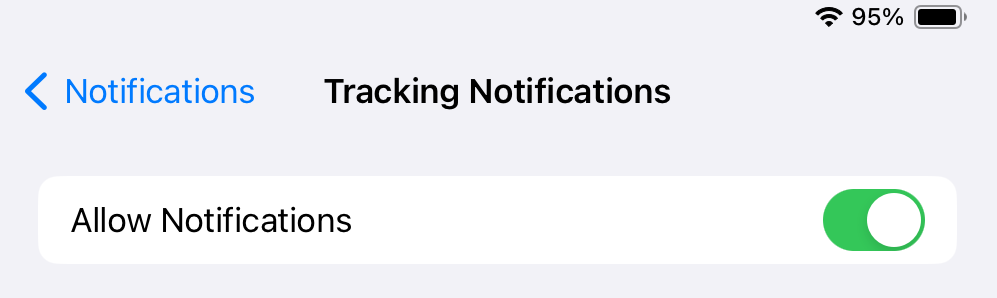
Open the Find My app, open the Me tab, and make sure Tracking Notifications are turned on.
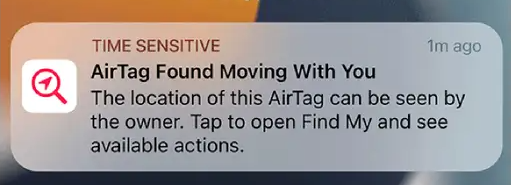
If an unknown AirTag is following you, you’ll see an alert like this:
In the Find My app, you’ll be able to see how long the AirTag has been with you and you can use the Play Sound option to have the tracker emit a noise, which can help you find it.
For Android owners, Google has created a similar anti-stalking feature. Please note that the path to find the appropriate settings may vary with vendors and Android versions, but this should give you a good idea:
Select Settings > Safety and emergency > Unknown tracker alerts. Here you can allow alerts and do a manual scan for nearby trackers.
An unknown tracker alert is sent when someone else’s tracker device is separated from them and detected to be traveling with you and out of Bluetooth range from the owner. You can trigger any found AirTag to make a sound and you’ll be able to see how long it’s been with you on a map.
There are plans to broaden the scope of the tracker alerts besides AirTags. Companies including Samsung, Tile, Chipolo, Eufy, and Pebblebee have expressed interest in supporting this technology.
We’ll keep an eye on the lawsuit and let you know how it progresses.