Vivaldi has been around for four years, but iOS users only got access to the browser three months ago. Although the iOS version of the Vivaldi received a few updates soon after release, the latest one is the most consistent and brings a lot of improvements and new features.
The highlights of the update are a configurable Address Bar and a Tab Bar. Both can now be placed at the bottom of the browser, or you can keep them on top. In addition, a new option to reverse the order of search suggestions in the Address Bar is available too.
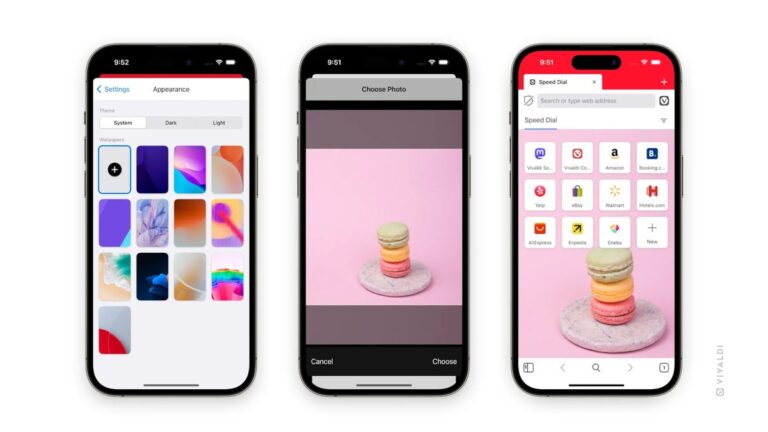
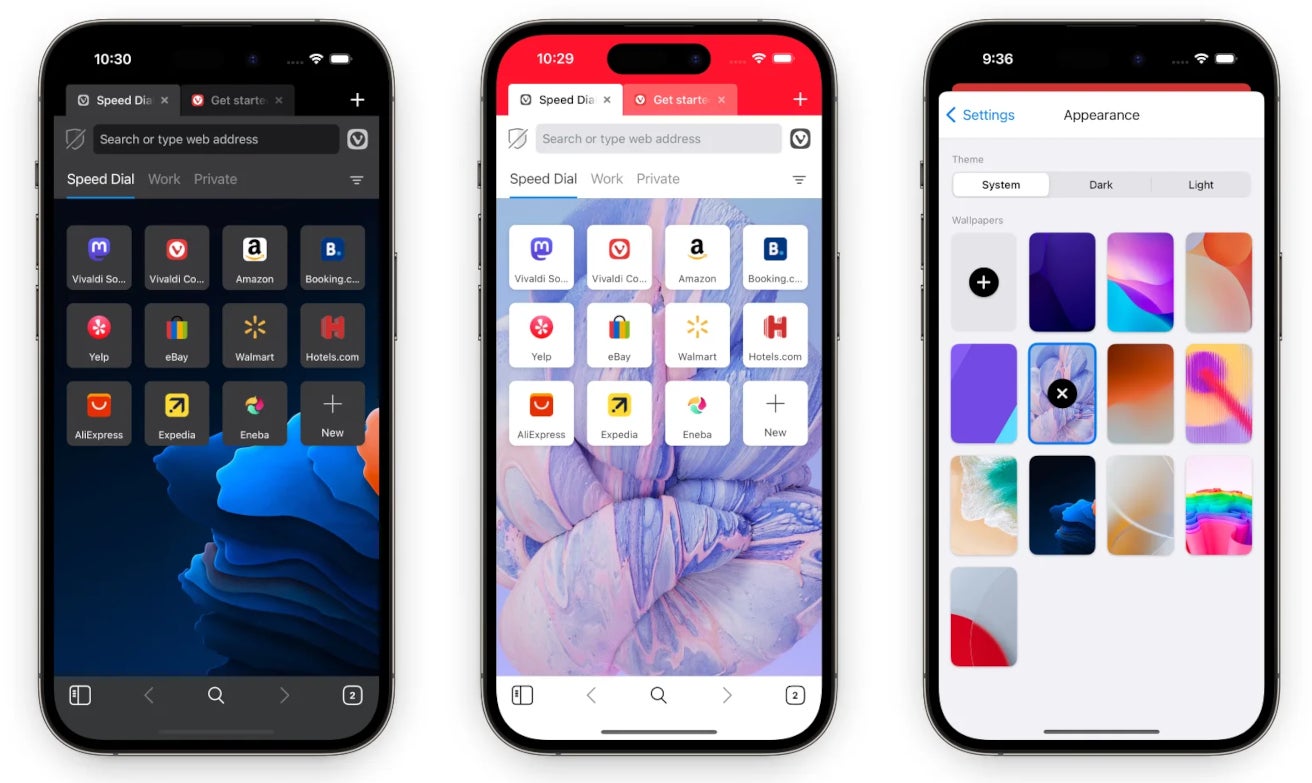
Another change included in the update is the ability to add custom images as wallpapers to the browser’s Start Page, or by choosing from a selection of preloaded wallpapers.
But the changes don’t stop here. Vivaldi’s signature feature is coming to iOS too, so the color of the user interface will now match the colors of the webpage users are visiting.
Vivaldi’s signature feature
Last but not least, Vivaldi browsing history is now available on all your devices. More importantly, all data in Vivaldi Sync is fully end-to-end encrypted. Previously, Vivaldi Sync used to sync typed history, searches, and addresses typed into the Address Field. However, the latest update allows users to rediscover anything they visited on another device anytime. The new version of Vivaldi for iOS is available for free via the App Store.
Apple previewed its next-generation version of CarPlay at WWDC back in June 2022. It was met with a lot of excitement, as the current version of CarPlay is mostly just a blown-up iPhone home screen that has larger touch targets – a lot like Android Auto, actually. Since then, we haven’t heard much about the next-generation CarPlay.
A report from Car and Driver shows off the first couple of vehicles that will launch with the new CarPlay. They come from Aston Martin and Porsche. So most of us won’t be able to use it.
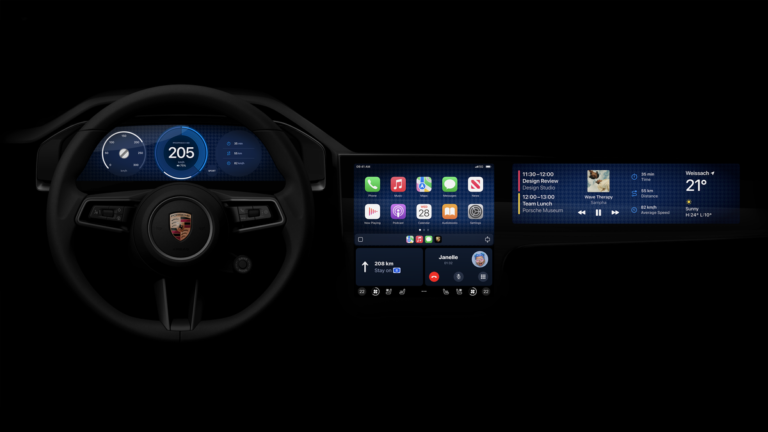
The first renders of Porsche’s CarPlay interface show that it has a trio of circular gauges in the cluster, along with a background wallpaper. Meanwhile, Aston Martin is going a slightly different route, with its cluster including central information on the screen, which has the speedometer and tachometer on either side. With the tachometer integrating the “Handbuilt in Great Britain” wraparound text.
This is Apple’s answer to Google Built-In
A few years ago, I was at Google I/O when the company was showing off a new version of Android Auto that would power the entire car. Which was originally called “Android Automotive,” and that was not a good name because it was super similar to Android Auto, even though the two products were very different. It’s now called “Google Built-In,” which makes more sense.
Essentially, Google Built-In has all of your Google services built-in. Including Google Maps, YouTube (can only used when parked, obviously), YouTube Music, the Play Store, and much more. Apple’s next-generation CarPlay is very similar to that, where the whole car is running off of CarPlay. This also means that we’re going to need to have an iPhone to get the best experience here. Similar to the Google Built-In vehicles like the Hummer EV, Blazer EV, and Polestar 2, which need an Android phone to really take full advantage. However, thanks to Google’s apps being more cross-platform, you are able to get away with using an iPhone on Google Built-In vehicles.
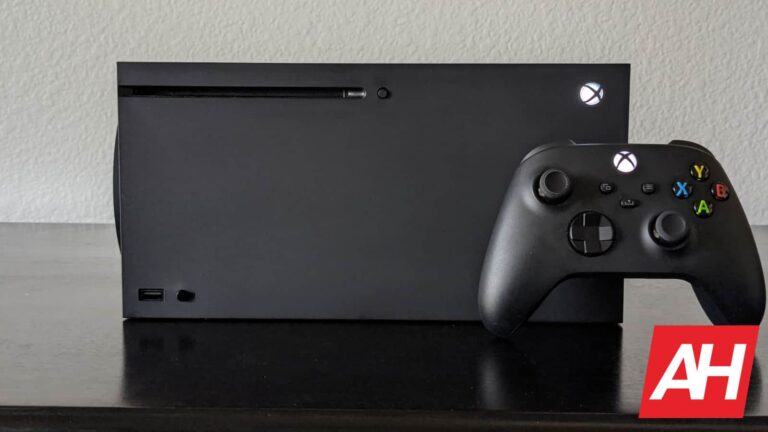
Best Buy is currently running a pretty sweet discount on the Xbox Series X, where you can pick one up for just $349. That’s saving you $150 off of the regular price, which does bring it down to its all-time lowest price.
Now if you’re looking for a cheaper Xbox, the Xbox Series S is also on sale. This one is down to $249, which is going to save you $50 off of its regular price. It has a lot of the same features as the Xbox Series X, minus the 4K120 gameplay and the disc drive. So for those playing games like Minecraft, Rocket League, etc, this is a really good option.
The Xbox Series X is such a good console. Obviously, Sony fans will disagree with that. However, this console does offer 4K120 gameplay, as well as variable refresh rate (VRR) and auto-low latency mode (ALLM). Of course, the display that you connect the Xbox Series X to needs to support those as well.
It has a custom 1TB SSD inside, which is actually more storage than the PlayStation 5 offers. This still has a disc drive, so you can still buy digital games. But one of the major advantages of the Xbox Series X|S is Xbox Game Pass. There are over 300 games available on Xbox Game Pass, with more being added all the time, and it starts as low as $10 per month. That’s cheaper than Netflix and definitely more entertaining.
You can grab the Xbox Series X from Best Buy today and pick it up curbside in as little as one hour, or have it shipped to your home and arrive tomorrow, still in time for Christmas.
While we don’t know the specific name for each color from Samsung just yet, we do have an idea of what these colors will look like. It is a nice graphite color, along with a sort of light beige color, and yellow and purple colors are available. Sort of matching the colors available on the regular Galaxy S24. Honestly, the colors are all kind of boring. Fingers crossed that the Samsung.com exclusive colors will be a bit more exciting. Typically, Samsung will announce three colors that can only be purchased from Samsung’s own website.
The Galaxy S24 Ultra will debut in January
The Galaxy S24 series is set to debut around January 17. Samsung has not yet sent invites for Unpacked, but we do expect it to be around the 17th, a week after CES. That makes this the earliest-ever smartphone announcement for Samsung. Which just seems to get earlier and earlier every year.
With the Galaxy S24 Ultra, we’re expecting much of the same compared to the Galaxy S23 Ultra, which includes a 6.8-inch QHD+ 120Hz display powered by the Qualcomm Snapdragon 8 Gen 3 processor, 8GB of RAM, and 256GB of storage. Interesting that Samsung is going to stick with 8GB of RAM, something that Samsung users have complained about for the past couple of years.
It’s also rumored to come with a 200-megapixel sensor, much like the Galaxy S23 Ultra from 2023. It should be a slightly upgraded sensor, and some better-optimized software should be used to really take advantage of that sensor. The battery is also expected to stick to 5,000mAh, with 45W charging becoming more of a selling feature for the Galaxy S24 Ultra this coming year.
Of course, the S Pen will still be included in the Galaxy S24 Ultra. Making it more of a Galaxy S and Galaxy Note hybrid device.
Artificial intelligence is advancing every day; we know that. Its ability to generate images has long been a subject of discussion. Even in recent times, such images have been used to manipulate information and produce fabricated media. To address this issue somewhat, Google released the “About this image” tool, which provides the source and background of an image, including metadata if accessible. This tool was first announced during the Google I/O Developer Conference 2023. However, recent revelations have indicated that the training dataset for AI image generation contained links to child abuse imagery. This is not only problematic but also very concerning, given the strict worldwide rules for the circulation of such content. For instance, Federal Law in the United States makes it illegal; if found guilty, one could face up to life imprisonment and a fine of up to $250,000.
Stanford researchers found traces of child abuse imagery in generative AI
The researchers at Stanford University (Stanford Internet Observatory) investigated AI image generation datasets. They discovered that the LAION-5B dataset, utilized by Stability AI’s Stable Diffusion and Google’s Imagen image generators, has come under scrutiny for containing a minimum of 1,679 illegal images sourced from various social media posts and notable adult websites.
Starting in September 2023, a group of researchers examined the LAION dataset closely to determine if it contained any inappropriate images of children. They primarily used special codes called “image hashes” to check the images. They then employed tools like PhotoDNA to confirm their findings, and experts from the Canadian Centre for Child Protection also reviewed and agreed with their results.
Many people believe that the LAION dataset stores actual pictures, but that’s not accurate. Instead, it serves as a comprehensive index or list directing users to where they can find images online. It stores web links to these images along with the accompanying text descriptions.
LAION responds, and affirms its “zero-tolerance policy.”
LAION, the non-profit organization managing the dataset, informed Bloomberg that they maintain a “zero-tolerance policy” against harmful content. And they would temporarily take the datasets offline. In response to the same report, Stability AI emphasized its policies to prevent misuse of its platforms. They clarified that although their models were trained using portions of the LAION-5B dataset. However, they specifically refined and adjusted them with safety concerns in mind.
Although researchers highlighted traces of child abuse imagery in the datasets, they explained that this doesn’t necessarily affect the model’s results. However, they cautioned that there remains a potential risk that the model might have extracted undesirable information from the images.
2024 is going to be a busy year, especially in the context of the political landscape. The upcoming year will witness several elections including the 2024 U.S. Presidential Election. But that’s not all. It will also witness the national elections in the world’s largest democracy, India, and South Africa, among others. Amid this particularly tense situation, Google parent Alphabet affirmed that it will limit how its chatbot Bard and search generative experience responds to election-related queries. It’s said to commence in early 2024.
Google is prepping up by limiting election-related queries. It told Reuters that it will “work with an increased focus on the role artificial intelligence (AI) might play” to serve voters and campaigns.
Meanwhile, Facebook parent Meta has cracked down on AI-generated political ads, barring campaigns and other regulated industries from using its generative AI tools. Additionally, Meta now requires disclosure of AI or digital alterations in political, social, and election-related ads on Facebook and Instagram. This move aims to combat misinformation and increase transparency.
Elon Musk’s X, interestingly, has made a U-turn on its global ban on political ads. Now, candidates and parties in the U.S. can advertise on the platform, prompting concerns about potential abuse and misinformation. However, X is also expanding its safety and elections team to mitigate these risks.
Governments worldwide are tightening the grips on AI-powered political ads. The European Union, for instance, is implementing mandatory labeling of such ads, including information about sponsors, costs, and targeted elections. These rules are still being worked out, but it’s a good beginning.
When it comes to gamer-centric products, we tend to see a lot of Over the Top and RGB light-riddled products. That’s one thing that adds a lot of fun to being a gamer, and pretty much anything can be a gaming product with the right flare. If you’re in the market for some TWS earbuds with gamers in mind, then I have an over-the-top and RGB-riddled item for you. I was given the opportunity to review the Hecate GX05 gaming earbuds.
When it comes to earbuds, one would wonder what will make them great for gamers. Well, there are a couple of things that a company can do to make headphones great for gamers. The company that owns Hecate, Edifier, is the company known for giving customers amazing audio experiences. So, this company providing gamers what they want should be a guarantee.
But, does it actually give gamers what they want? Sure, being over the top and adorned in RGB lights is one thing, but what’s also important is providing those core usability features and gamer-centric goodies. So, are the Hecate GX05 the perfect earbuds for the gamer and you? Let’s find out in this review.
Hecate GX05 Review: Design
When it comes to gamer Hardware, design is pretty much half of the experience. These are devices that should look great being shown off in a Twitch stream. In terms of the design of the Hecate GX05, the company really took things to a new level.
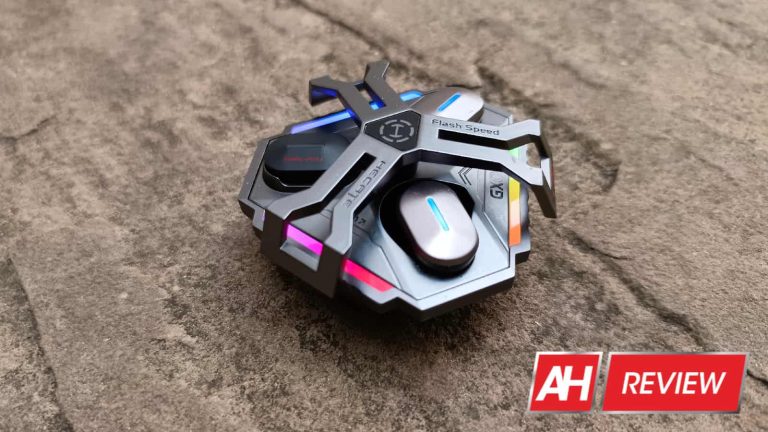
Charging case
Starting off with the charging case, this is definitely a device that looks like no other. The charging case is rather large. In it, we see the slots for the two earbuds and the USBC dongle. Above those, you’ll see a little triangular gate that rotates. This is a nice aesthetic touch. It definitely has a no-holds-barred high-octane look to it. Honestly, it looks like something out of a sci-fi movie.
Once you rotate the gate, you’ll see another standout feature of this case. Along each Edge, you see an LED strip that lights up. This is where we get the RGB light goodness. These lights will turn on, flash, and pulse based on the setting you assign. On the bottom of the case, there’s a multi-function button.
When you single press the button, you will change the lighting mode. You’ll be able to cycle through multiple colors. There’s cyan, green, red, blue, and purple. There are also different light modes. One mode has the lights stay on consistently, another mode has the light breathe, and the last mode has a rainbow of colors circling around clockwise.
The charging case is cool, futuristic, and angular. It’ll definitely catch people’s eyes.
The earbuds
The design of the actual earbuds is also pretty unique. It has a curvy ergonomic design that contrasts with the angular design of the case. However, this helps them fit inside of your ear. On the outside of the earbud, we see a gray bit of plastic that resembles brushed metal. That adds to the overall futuristic aesthetic.
Also on the outside of the earbuds, there are small LED strips. These will also light up. They light up when you place them inside of the charging case to indicate that they are charging. Also, the color of the earbuds’ light will reflect the colors of the case. The earbuds’ lights will also flash, breathe, or stay solid along with the case’s lights. Overall, both the case and the lights are very pretty. They make an amazing combination, and they’ll definitely make them stick out.
Hecate GX05 Review: Build Quality
When I said that these earbuds are over the top, I didn’t only mean in terms of design. When I first took the charging case out of the box, I was immediately shocked. I didn’t expect the case to be so hefty. The case is very heavy, and it gives it an extremely premium feeling. Basically, it does not feel like I’m holding a cheap plastic set of earbuds trying to look more expensive. I actually feel like I’m holding an expensive and premium set of earbuds.
That’s just going by the case, but the individual earbuds also have a nice quality to them. They said pretty heavily in the hand, and they all look very well built. They’re made from plastic, but that’s not an issue. I would say that these are very quality-made earbuds, and I’m sure that they will last you a long time if you get them.
Hecate GX05 Review: Audio Quality
The audio quality for these earbuds is a story with layers to it. I definitely have my reservations about the quality itself, but it’s completely justified because of one of the core gaming features of these earbuds.
Overall sound quality
So, this is something that did surprise me a bit at first until I realized what kind of earbuds I was dealing with. Again, this company is owned by Edifier, and Edifier makes some very high-quality Equipment. With these earbuds, especially with the Neo Buds Pro 2, I always got crisp and clear audio with amazing balance. I’d hear awesome clarity with a good emphasis on the low end. This is the kind of performance I expected from the Hecate GX05.
For the most part, that’s what I got. I hear a certain emphasis on the treble, which doesn’t surprise me. Many of Edifier’s earbuds that I reviewed have the same Focus. Also, the treble is supported by some very powerful and extremely clear bass. So, they pretty much lived up to my expectations. However, I could hear that the actual quality of the audio is a bit diminished compared to others. It sounds like the audio coming through the earbuds it’s just slightly lower quality.
However, this is very understandable because of a very important feature of these earbuds. That is the latency.
Latency
If you know about using Bluetooth audio equipment, then you would know about the latency (the amount of time between when the action occurs on your device and when you hear it). Bluetooth technology has not evolved to the point where there’s zero latency. Sending a high-quality signal over the air and converting it into an audio signal that you can hear takes time.
This is why Bluetooth earbuds aren’t quite great for gaming. You do not want to have a large delay between when you perform actions and when you hear them in the game. It just throws everything off, and there are some games that pretty much require you to react to actions in a split second. So, this is why many gamers stick with wired headphones… Well, with companies dropping the 3.5mm headphone jack, you can see how that could be frustrating.
However, these earbuds are advertised as ultra-low latency earbuds, and I agree with that claim. Listening to the audio from these earbuds, I could hear a significantly diminished latency compared to other earbuds. I don’t hear the sound instantaneously, but it’s pretty darn close, and it narrows the gap.
So, in order for the audio to be this low-latency, it has to be of a slightly lower quality. The lower quality makes it easier for the audio to be converted from a digital signal to an analog signal.
Imagine bumping a video down from 4K to 480p in order to have it stream smoothly on a slower connection.
Hecate GX05 Review: Touch controls
You can control your media and other functions using the touch controls. Tapping on the sides of the earbuds performs different actions. Starting off with media controls, double-tapping on either bud will play/pause the media. Holding your finger on the left earbud for two seconds will restart your current track, and doing so on the right bud will skip to the next track.
A quadruple tap on either earbud will activate/deactivate the lights for the respective bud. Lastly, triple-tapping on the right earbud will switch between Game mode (where the audio is best tuned for gaming) and music mode (the best mode for music).
Hecate GX05 Review: Balance of Bass and Treble
The balance of the base and trouble with these earbuds is another area where I had a bit of an issue with these earbuds. However, just like with the audio quality, I understand because these are made for gamers. I found that the audio had a strong focus on high-end audio. It wasn’t too bad, as it didn’t sound tinny at all. However, it just lacked some of the depth that I’ve heard with other Edifier earbuds. The audio is not as warm and immersive as I would have liked.
Listening to orchestral music like classical won’t be as immersive as with other earbuds, unfortunately. Listening to more modern and bass-heavy music, I found that the Hecate GX05 performed a bit better. The treble and bass seem to balance out more nicely, but I still wanted more depth.
I’d have to listen to very bass-heavy music to really feel the low-end audio. For example, I listened to some 90s R&B, and I think that music with that level of warmth makes these earbuds really shine.
But, there’s a good reason
Remember, these are gaming earbuds. Music and video games require different kinds of optimizations to sound their best. When you’re playing video games, immersion isn’t quite as important as with music. With video games, you’re going to want some of the higher-pitched sounds to be emphasized like voices, creature noises, footsteps, etc. If you’re playing something like Fortnite or Call of Duty, you’ll want to hear how close your enemies are, so you’ll be listening for footsteps.
So, the Hecate GX05 are designed to give gamers the edge when they’re gaming, and I found that they do. I played games like Fortnite, CoD Mobile, Genshin Impact, Dragonball Z Dokkan Battle, and more. I found that they perform incredibly with these games. Every sound was punchy and impactive.
If you’re planning on using these earbuds as your primary gaming earbuds, you won’t have any issues doing so. I think that these perform much better than traditional earbuds.
Hecate GX05 Review: Battery
It doesn’t matter how good the sound quality is if your earbuds are dead. You’ll want earbuds that can last through extended gaming sessions. Admittedly, the Hecate GX05 aren’t the best in the battery department. They’re behind some other earbuds that I’ve reviewed in the past. Using these earbuds, I was able to get north of four hours on a single charge. I feel that’s a bit below average compared to other earbuds I reviewed from Edifier. Others usually last more than an hour longer.
Using the charging case, I started to approach a full day of battery life. They ran for about 20 hours before dying on me. That’s still behind much of the competition, but I didn’t think that it was too bad. I just wish that they had more juice in them because people game for a long time each gaming session. Sometimes, four hours is just scratching the tip of the iceberg.
Charging
As with most earbuds, the charging is very fast. If you need to do a quick top-up, you’ll be able to get more than an hour of power on a short 10-minute charge. The earbuds charge completely in under an hour, so if they die on you, you won’t be out of the game for too long.
Hecate GX05 Review: What’s missing?
So, it’s obvious that these earbuds have a lot to offer. However, there are a few things that I wish the company added to these earbuds. For starters, these don’t integrate with the Edifier Connect app. This is the app interface that allows you to customize the experience for your audio devices. Since it’s not connected with the app, you don’t have access to the in-depth EQ and other tools that you can quickly access.
There’s no ANC present in these earbuds. That’s unfortunate because Edifier’s earbuds have amazing noise cancelation, and I think that these earbuds could greatly benefit from it.
Next, you can’t change the touch controls. Other earbuds allow you to customize the touch controls through the Edifier Connect app, Unfortunately, you’re stuck with the controls that are built-in.
Hecate GX05 Review: Final verdict
It’s always nice having audio equipment made specifically for gamers. Sure, they look nice with their lights, but it goes deeper than that. These earbuds are built to be great companions to gamers who are looking for a great overall experience. I think that the Hecate GX05 deliver that experience.
The audio quality is very nice, so you know that the listening experience is going to be nice. The audio quality is good, and it’s great considering the compromises made for the lower latency. Speaking of the latency, it’s very low. I got an SS tier on a rhythm game with these on. Now, that’s saying a lot!
The only issues that I have is that the battery life could be better, it’s not connected to the Edifier Connect app, and there’s no noise cancelation. These are definitely missing a few lifestyle features, but I think that they deliver a great fundamental gaming earbuds experience. I recommend that you pick these up.
In this article, we’ll compare the very best of Google and Sony in 2023. We’ll compare the Google Pixel 8 Pro and Sony Xperia 1 V, the two flagship smartphones that launched this year. The Sony Xperia 1 V was announced back in May and released towards the end of July. The Pixel 8 Pro was both announced and released in October. They’re both quite powerful smartphones but very, very different.
We’ve recently compared the Google Pixel 8 vs Sony Xperia 5 V, in case you’re interested in more compact devices. Having said that, we’ll first list the specifications of the two smartphones, and will then compare them via a bunch of other categories. Those categories include design, display, performance, battery, cameras, and audio. So, without further ado, let’s get going.
Specs
Google Pixel 8 Pro vs Sony Xperia 1 V, respectively
The design differences between these two phones are easily visible at first glance. The Pixel 8 Pro has very thin bezels, a centered display camera hole, and is rather curvy. The Sony Xperia 1 V doesn’t have a display camera hole or notch, but it has a bit thicker bezels at the top and bottom, even though they’re still rather thin. The frame is also flat all around on this phone, which is not the case on Google’s flagship.
The in-hand feel with these two devices is entirely different due to all this. They’re both quite slippery, but the Pixel 8 Pro kind of feels more ergonomic due to all the curves. Both devices do have three cameras on the back, though their camera modules are different. The Pixel 8 Pro features a camera visor on the back, which spans from the left side of the frame to the right. Oh, and it’s covered by metal.
The Sony Xperia 1 V has a more regular-looking camera island, which is also smaller. It sits in the top-left corner of the phone’s back. It’s not exactly inferior just because it’s smaller, though, not at all. The Xperia 1 V also has a physical shutter button on the right-hand side. The Pixel 8 Pro is considerably heavier in comparison, as it weighs 213 grams, compared to 187 grams of the Xperia 1 V.
In terms of dimensions, the Pixel 8 Pro is slightly shorter, quite a bit wider, and slightly thicker. The Xperia 1 V does have a slightly smaller display and a different display aspect ratio, it’s very tall and narrow. Both smartphones do offer an IP68 certification for water and dust resistance, by the way. They both also feel like premium devices, as they should.
Google Pixel 8 Pro vs Sony Xperia 1 V: Display
There is a 6.7-inch 2992 x 1344 LTPO OLED display included on the Pixel 8 Pro. That display is flat, and it supports a 120Hz refresh rate. HDR10+ content is also supported on this panel, and the display goes up to 2,400 nits when it comes to brightness. It has a 20:9 display aspect ratio, and around 87% screen-to-body ratio. The Gorilla Glass Victus 2 from Corning is included to protect this panel.
The Sony Xperia 1 V, on the other hand, has a 6.5-inch 4K (3840 x 1644) OLED panel. That display is not operating at 4K at all times, though, of course, only when you’re consuming content in 4K. This panel also supports a 120Hz refresh rate, and HDR content as well. The display aspect ratio is 21:9, and Corning’s Gorilla Glass Victus 2 is included here for protection purposes. The screen-to-body ratio on the Xperia 1 V is around 84%.
Both of these displays are great in basically every way. The colors are vivid, the viewing angles are great, and the blacks are deep. They offer great touch response, and both displays are plenty sharp. Of course, the Xperia 1 V’s panel is sharper, and some people may be able to tell the difference, but truth be said, it’s not that easy on this display size. One advantage that the Pixel 8 Pro has is the fact its display does get brighter. The Xperia 1 V is bright enough, though, so… well, you’ll be good to go with either of these two panels, in all honesty.
Google Pixel 8 Pro vs Sony Xperia 1 V: Performance
The Google Pixel 8 Pro is fueled by the Google Tensor G3 SoC. The company also included 12GB of LPDDR5X RAM here, and UFS 3.1 flash storage. The Xperia 1 V, on the flip side, comes with the Snapdragon 8 Gen 2 processor, 12GB of LPDDR5X RAM, and UFS 4.0 flash storage. Sony’s flagship technically has a more powerful processor, and it also has faster and more efficient storage.
Do note that the Tensor G3 has been crafted especially for Pixels, and it has a ton of AI capabilities. What I’m trying to say is, that both of these phones do offer outstanding performance. The Xperia 1 V is slightly faster when it comes to opening apps, multitasking, and so on, but the difference will only be noticeable if you’re using them side by side. Both smartphones offer great performance.
One area where you may notice a difference is in gaming. The Xperia 1 V is definitely the better phone for that, even though the Pixel 8 Pro can handle pretty much anything out there If you’re planning on playing the most graphically-intensive titles from the Google Play Store, the Xperia 1 V is the better choice though. Overall, however, not many people will have complaints about either device.
Google Pixel 8 Pro vs Sony Xperia 1 V: Battery
When it comes to battery capacity, the Pixel 8 Pro includes a 5,050mAh unit, while the Sony Xperia 1 V comes with a 5,000mAh battery. Those are good battery capacities for these two phones, but is the battery life any good? Well, yes, it is, on both smartphones. At first, we didn’t exactly have great battery life on the Pixel 8 Pro. The battery life jumped from 6 to 7.5 hours of screen-on-time. After a few weeks, however, things got much better and we were able to get over 7 hours of screen-on-time consistently.
The Sony Xperia 1 V, on the other hand, offers great battery life too. Getting over 7-7.5 hours of screen-on-time is doable if you’re not a gamer. Gaming will, of course, lower these numbers quite a bit, when it comes to both devices. Your mileage may vary, but even with considerable use in a single day, you can pull out great screen-on-time, consistently. Neither phone disappoints in that regard.
In terms of charging, they’re not all that different. Both smartphones support 30W wired charging (PD3.0, PPS), which is not particularly fast considering the industry standard these days, but there you have it. When it comes to wireless charging, the Pixel 8 Pro does have the upper hand. It offers wireless charging up to 23W, compared to 15W charging on the Xperia 1 V. Yes, both smartphones also support reverse wireless charging, albeit very slow. A charger is not included in either retail box, you’ll need to get one yourself.
Google Pixel 8 Pro vs Sony Xperia 1 V: Cameras
Both smartphones include three cameras on the back. The Pixel 8 Pro has a 50-megapixel main camera, a 48-megapixel ultrawide unit (126-degree FoV), and a 48-megapixel telephoto camera (5x optical zoom). The Xperia 1 V, on the other hand, features a 48-megapixel main camera, a 12-megapixel ultrawide camera, and a 12-megapixel telephoto unit (3.5x-5.2x continuous optical zoom).
Are they any good? Well, yes, in fact, these are some of the best smartphones for taking pictures and videos in the market. The Pixel 8 Pro images do end up looking more contrasty and processed, in a good way, while the Xperia 1 V does keep them a bit closer to real life, but they still pop. They’re very detailed during the daytime, and both smartphones managed to keep everything sharp and well-balanced. They both shine in the HDR department as well. The Pixel 8 Pro is capable of providing a bit more details with its ultrawide and telephoto cameras, but the difference is not that big. They both do a great job.
In low light, the Pixel 8 Pro tends to brighten up scenes a bit more. The Xperia 1 V does keep things a bit darker, but that’s something some people will prefer, as the pictures end up looking a bit more realistic. There are plenty of details, though, in low light, from both smartphones. They both balance things out well. The quality drops off with secondary and tertiary cameras, but all three shooters do a great job in low light, on both smartphones. There’s really not much to complain about here.
Audio
You will spot a set of stereo speakers on both smartphones. The sound quality coming from them is good in both cases, but the Xperia 1 V’s speakers are a bit louder. The difference is not that big, but it’s worth noting.
When it comes to an audio jack, if you need it, the Xperia 1 V is your only choice. The Pixel 8 Pro doesn’t include it, but you can always use its Type-C port for audio connections. Bluetooth 5.3 is an option on both smartphones, for wireless audio connectivity.
Warner Bros Discovery CEO David Zaslov reportedly met with Paramount Global CEO Bob Bakish on Tuesday in New York City. Axios is reporting that multiple sources say the meeting was about a possible merger between the two companies.
The meeting reportedly lasted several hours and took place at Paramount’s headquarters in Times Square. The two discussed ways that their companies could complement one another, which would obviously include merging Max and Paramount Plus together, to better compete with Disney Plus and Netflix.
Currently, it is unclear whether Warner Bros Discovery would buy Paramount Global or its parent company, National Amusements Inc (NAI). However, sources have said that both options are on the table. Currently, National Amusement Inc is worth around $479, however it is not a publicly traded company. Paramount, however, is. And its current market cap is set at $10 billion. Paramount’s stock did spike about four percent on this news but has since retreated.
Why would WBD want to merge with Paramount Global?
It wasn’t that long ago that we were shocked to see WarnerMedia (under AT&T) merge with Discovery, and it was actually AT&T selling WarnerMedia to Discovery after spending $85.4 billion (plus a court case against the DOJ) to buy Time Warner, and then it sold off all of what they bought just a few years later. But now that WBD is looking to buy Paramount Global, what’s the end game?
Well, to put it simply, consolidation. During the pandemic, every studio was launching their own streaming service. They saw everyone subscribing since everyone was stuck at home and needed stuff to watch. But now that most are back to work, that’s not quite the same story. Most streaming services need to raise rates because subscribers are fleeing to save money. That’s leaving the big streaming services thriving while smaller ones – like Paramount Plus – hurting for revenue.
There have been reports recently that Paramount was looking to work with Apple to bundle TV Plus and Paramount Plus together. Now it looks like they might just sell the whole company to David Zaslov.
The two companies actually complement each other quite well. WBD could use its international distribution footprint to help boost Paramount’s franchises, like Top Gun. Paramount’s children’s programming, like Nickelodeon and Nick Jr, could be big assets to WBD’s long-term streaming goals. Seeing CBS News and CNN combine would be pretty interesting, as well as NCIS and Criminal Minds combined with Investigation Discovery and TruTV.
This isn’t just talk either, as WBD has reportedly hired bankers to explore the deal. But for now it’s just talk, and no deal has been finalized just yet.
According to the newest beta release notes, it looks like WhatsApp audio screen sharing will be coming to Android in addition to iOS. WhatsApp implemented screen sharing not too long ago, allowing users to stream their device’s screen during video calls. Now, as WhatsApp rolls out one feature after another, the screen share function is about to be improved.
What is WhatsApp audio screen sharing?
Whenever a video call is made over WhatsApp, users have an option to share their screen. This option is not available on audio only calls. If this option is chosen, WhatsApp notifies the user that they’re about to start broadcasting their screen. If the user proceeds, the other person in the call can now watch a stream of the caller’s device’s display and everything happening on it. This does not, however, work for apps like YouTube or video games.
Screen sharing with audio will enhance this feature by letting WhatsApp broadcast the audio of the shared display as well. Which means if the person sharing their screen is watching something with audio, the other caller will hear it too. Though YouTube and similar apps do not work, this will nevertheless drastically improve the screen sharing on WhatsApp. It will be more convenient, more useful, and generally, more fun.
Work meetings will be more convenient with users being able to share visual data alongside its respective audio. Group calls between family and friends will also be more engaging now that they can so easily watch videos together. Another field this might be very useful in is tech support. Technicians will no longer have to rely on the customer to relay auditory clues to them.
When is this feature coming?
This feature is currently under development, as noted by WABetaInfo. The audio screen sharing feature was first spotted in a beta for the iOS version for WhatsApp. As it is currently still in development, it is unavailable to users. However, it should be rolling out in a few months time at best. WABetaInfo learned about the audio screen sharing from WhatsApp’s Android beta version 2.23.26.18, which has just gone live.
WhatsApp audio screen sharing will be one of many recent updates WhatsApp has made to improve its user experience. WhatsApp Channels for instance, have seen multiple updates in recent months. Privacy is another factor WhatsApp has been focusing on recently, following in the footsteps of competitors like Telegram. If Channels received multiple updates in a row, it’s possible the same might now be the case for calls going forward, which leaves a lot to look forward to.