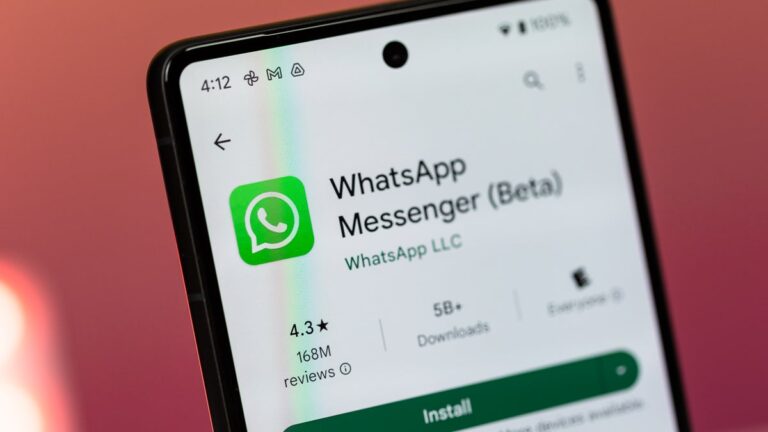
Voice messaging on WhatsApp is to become much more James Bond-ish very soon!
The world’s most popular chit-chat app is introducing the option for users to send and receive self-destructing voice messages on its platform (via Engadget).
There’s a great hunger for this type of “ephemeral data”, and if you don’t believe it, check this out: in December 2019, an analytics report announced Snapchat to be the fifth most downloaded mobile app of the decade. And you know what Snapchat was all about back then. Ahem, ahem.
Voice messages that automatically delete after being played are joining the other “Top Confidential!” messaging options that already are available for WhatsApp users. Users know very well that they can send disappearing messages and media on both Android and iOS.
For voice messages in the “Mission: Impossible” mode, one has to select View Once mode and make a voice message and it’ll self-destruct after the recipient hears it. Sure, this actively enhances privacy in the case of audio recordings that mention sensitive topics. But if the recipient is in a loud environment, has a temporary hearing loss issue, or just doesn’t pay much attention at the exact moment upon playing what you’ve sent them, be ready to re-record and send again that voice message.
WhatsApp is playing it safe and says users should only send View Once voice messages to people they absolutely trust, as there are ways to get around even the self-destructing messages – that’s just the way digital technology works. For instance, Android users can use the screen record function as they listen and anyone can use another camera or external microphone to capture the message.
The self-destructing voice messages option was talked about as early as mid-October, as we covered it when it was in beta for some testers to play with. The source’s report claims the new James Bond-ish tool is rolling out globally “over the next few days”, so stay tuned for the update.
And if you’re not sure how to send disappearing messages on WhatsApp, don’t fret. It’s super easy:
Hackers exploit Outlook and WinRAR vulnerabilities because these widely used software programs are lucrative targets.
Outlook vulnerabilities offer:-
Access to sensitive emails
Access to sensitive information
WinRAR vulnerabilities provide an entry point to manipulate compressed files, potentially executing malicious code on a victim’s system.
Cybersecurity researchers at Proofpoint recently discovered that the TA422 APT Group is actively exploiting the Outlook and WinRAR vulnerabilities to attack organizations.
Exploiting of Patched Vulnerabilities
Since March 2023, Proofpoint found Russian APT TA422 using patched vulnerabilities to target Europe and North America. The TA422 APT group is linked to the following groups and tied to the Russian GRU by the US Intelligence Community:-
While engaging in typical targeted actions, TA422 showed an unexpected surge in emails exploiting CVE-2023-23397, a Microsoft Outlook vulnerability, sending over 10,000 emails to diverse sectors.
Besides this, the operators of the TA422 APT group also exploited a WinRAR vulnerability, CVE-2023-38831, in their campaigns.
TA422 launched massive campaigns in March 2023, exploiting CVE-2023-23397 against targets in:-
Earlier, they targeted Ukrainian entities in April 2022 using the same exploit. Proofpoint noticed a significant surge in activity, with over 10,000 attempts to exploit a Microsoft Outlook vulnerability during late summer 2023.
It’s unclear if this was a mistake or a deliberate effort to gather target credentials. TA422 re-targeted higher education and manufacturing users, suggesting these entities are priority targets.
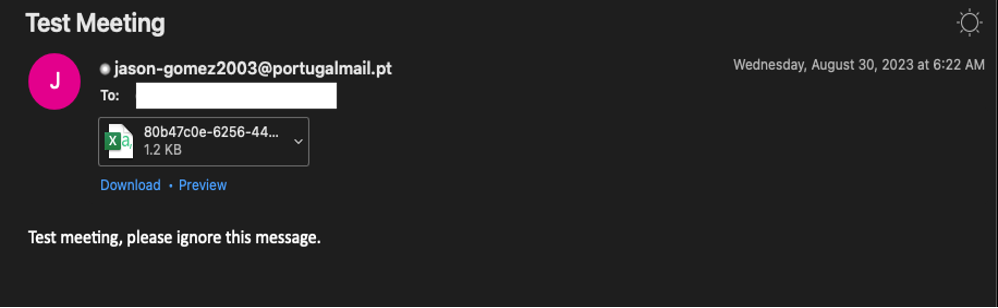
In the late summer campaign, TA422 used an appointment attachment with a fake file extension, leading to an SMB listener on a compromised Ubiquiti router.
This router acted as an NTLM listener, recording inbound credential hashes without extensive network engagement when Outlook processed the attachment.
Late summer 2023 sample of TA422 phishing email. (Source – Proofpoint)
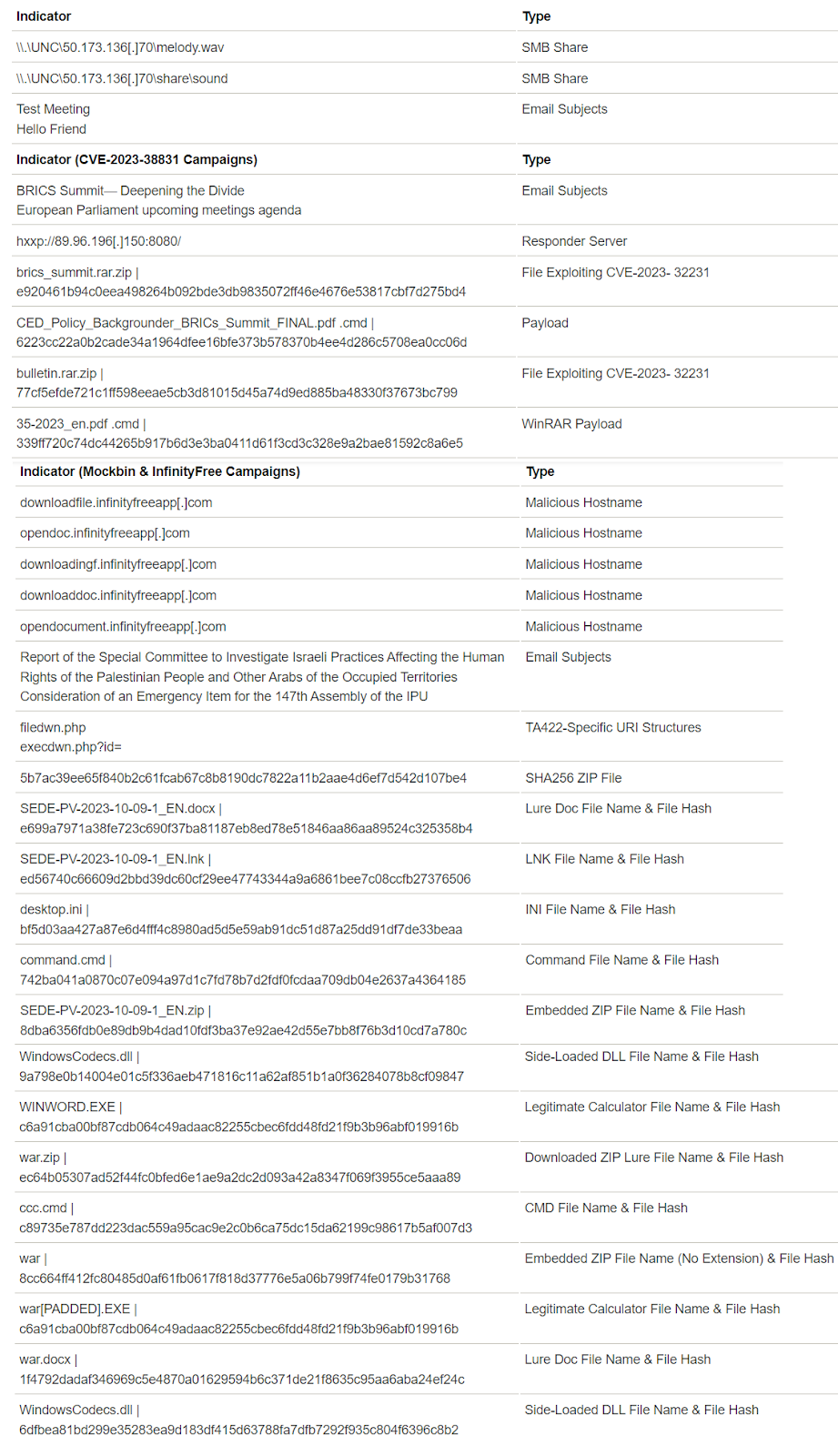
Proofpoint’s tracking of Portugalmail addresses revealed more TA422 activity. In September 2023, TA422 exploited WinRAR vulnerability CVE-2023-32231 in two campaigns, using different Portugalmail addresses and spoofing geopolitical entities.
Emails with BRICS Summit and European Parliament meeting subjects contained RAR attachments dropping a .cmd file.
The file modified proxy settings downloaded a lure document, and connected to an IP-literal Responder server. The server, likely a compromised Fortigate FortiOS Firewall, initiated the NTLM credential exchange.
Lure document from the September 1, 2023 campaign. (Source – Proofpoint)
Between September and November 2023, Proofpoint tracked TA422 campaigns using Portugalmail and Mockbin for redirection.
Targeting government and defense sectors, TA422 employed Mockbin to lead victims to InfinityFree domains. After browser fingerprinting, victims were directed to InfinityFree, initiating a chain of activity.
Despite the exploitation of disclosed vulnerabilities like CVE-2023-23397 and CVE-2023-38831, TA422 persists, likely relying on unpatched systems for continued success.
iPhones are generally considered safer than Android phones, primarily because currently iOS users can only download apps via the App Store. Apps hosted on the App Store are vetted by Apple and only apps that are considered safe are approved. Cybercriminals may have found a way to outsmart Apple though.
Apple offers an app called TestFlight for developers who want to test their apps. Up to 10,000 people can download TestFlight apps, which aren’t subject to the same scrutiny as final builds of apps.
British cybersecurity company Certo Software has found that cybercriminals are taking advantage of these lax policies to spy on iPhone users using third-party custom keyboards.
It be your own people
Certo has discovered that online criminals are offering keylogger services for those who want to keep tabs on someone they know. For as low as $30, people can install a malicious app with a third-party keyboard on someone’s phone covertly.
After the carrier app is downloaded, the third-party keyboard can be installed via the Settings app and configured to give ‘Full Access’ to an iPhone. The default iPhone keyboard is then replaced with the custom version.
The keylogger-laced keyboard records and sends all the inputs made by the victim. This gives the hacker and the abettor access to messages, the names of the websites the target visited, two-factor authentication codes, and passwords.
Since the apps are distributed through TestFlight, they avoid the strict process that apps meant for the App Store go through.
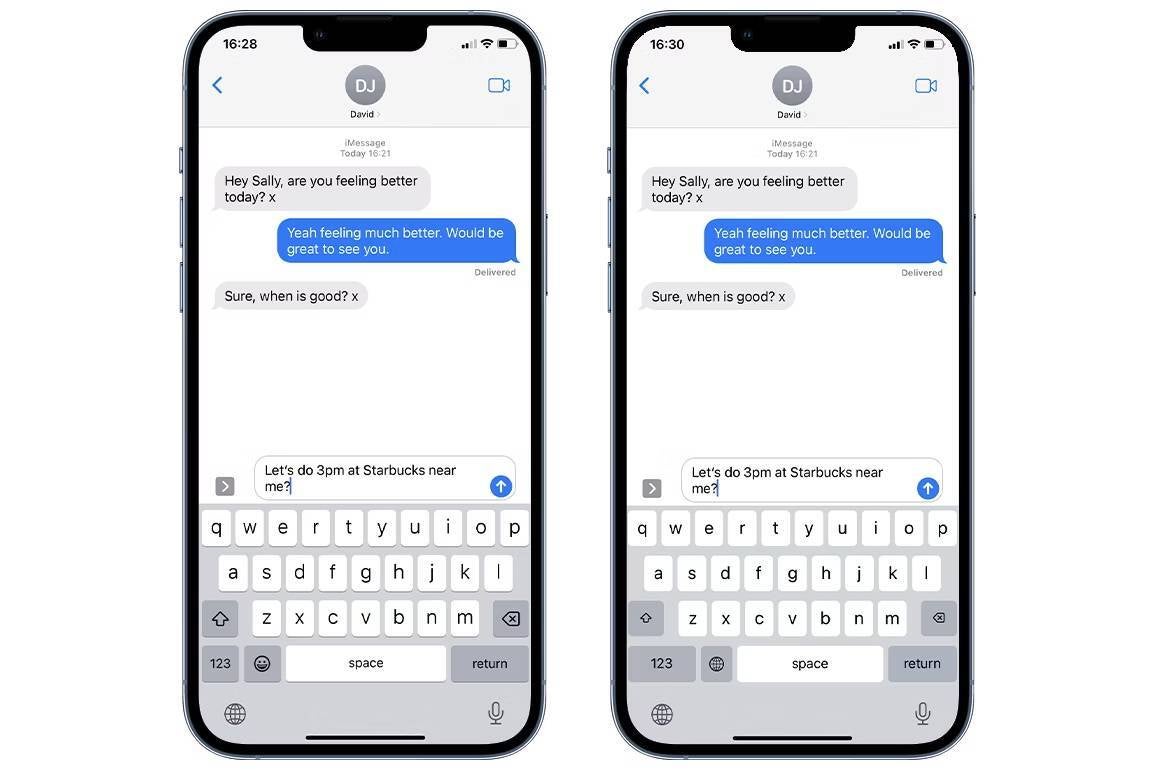
Default iPhone keyboard vs custom keyboard with keylogger
The custom keyboards look the same as the default iPhone keyboard so most people won’t realize that something fishy is up. The only way to check for them is by navigating to Settings, then tapping on General, then selecting Keyboard, and then going to Keyboards.
If you see a third keyboard in addition to ‘English (US)’ and ‘Emoji’ that you don’t remember installing, you should get rid of it by tapping on ‘Edit’ and selecting ‘Delete.’
Certo came to know about this campaign when it heard of multiple cyberstalking incidents where stalkers knew everything that a victim had typed into their phone.
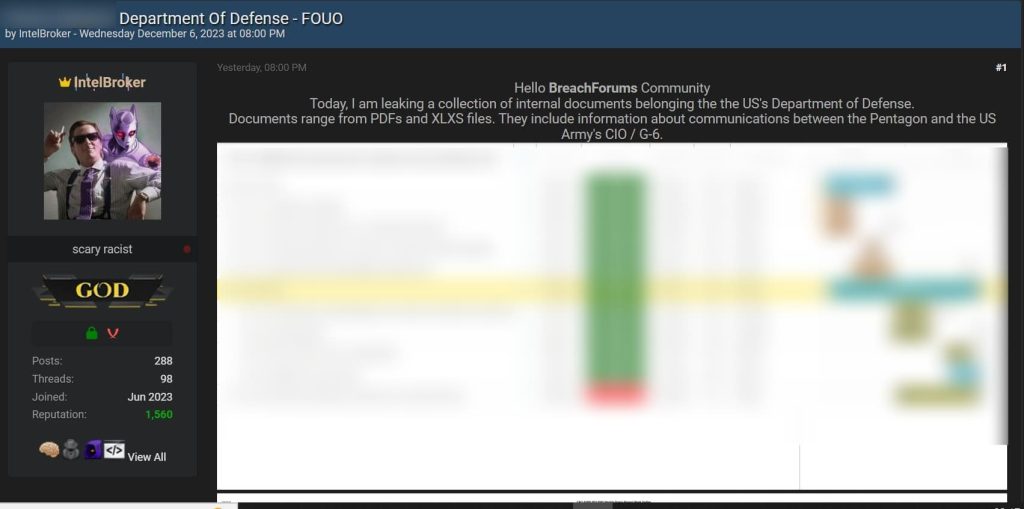
IntelBroker claims that the documents include information about communications between the Pentagon and the US Army’s CIO/G-6.
The infamous hacker, known by the online handle of ‘IntelBroker,’ alleges having acquired sensitive internal documents from the United States Department of Defense (US DoD). According to IntelBroker, the leaked data includes PDFs and XLSX files, potentially containing communications between the Pentagon and the Army’s CIO/G-6.
For readers’ information, the Chief Information Officer (CIO) is responsible for addressing IT and cybersecurity-related issues. On the other hand, G-6 refers to the Deputy Chief of Staff (DCS), who reports to the Chief of Staff of the Army. The G-6 is primarily involved in planning, strategy, network architecture, and related matters.
Some of the leaked documents are labeled FOUO (PDF) meaning ”For Official Use Only.” It is a security designation used by some governments, including the United States, to identify unclassified information that is sensitive and should be protected from unauthorized disclosure.
As seen by Hackread.com, the leaked documents are accessible for download on the Breach Forums. The same forum where, last month, another threat actor leaked a scraped LinkedIn database with 35 million user data. A couple of weeks ago, the Breach Forums witnessed the leak of a database containing the personal data of thousands of employees of the Idaho National Lab.
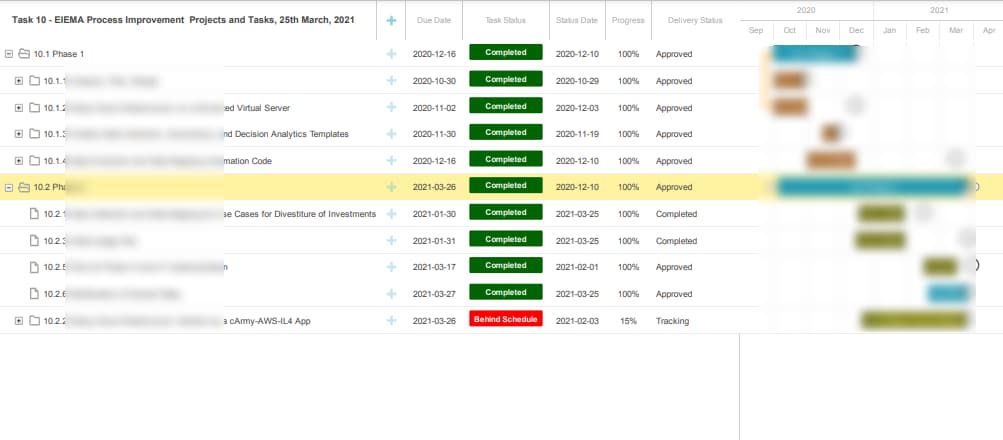
Regarding the current breach, screenshots provided by the hacker as samples reveal dates ranging from 2017 to 2021. Among the samples is a document titled “Task 10 – EIEMA (Enterprise Information Environment Mission Area) Process Improvement Projects and Tasks, dated 25th March 2021.”
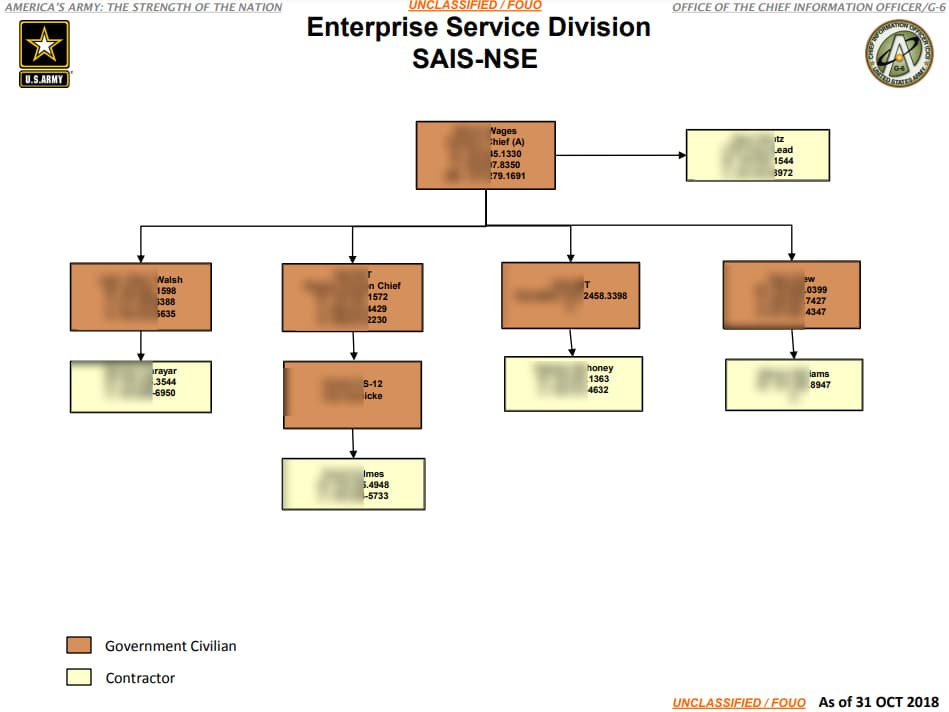
Another document, labeled “Enterprise Service Division SAIS-NSE,” includes a presentation containing personal and contact details of several civilian government officials and contractors. The information disclosed comprises their full names along with contact numbers for office, cellular, and home.
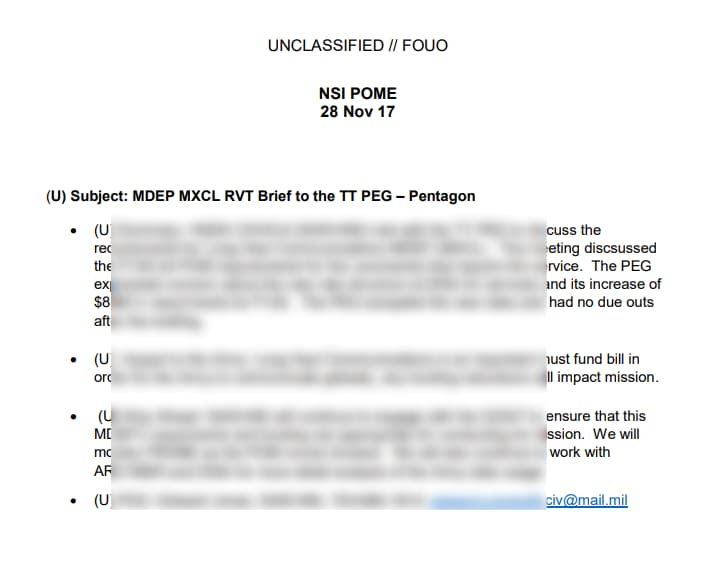
Another FOUO document, titled “MDEP MXCL RVT Brief to the TT PEG – Pentagon,” provides a summary discussing requirements for Long Haul Communication within the US Army.
Hackread.com did not conduct the usual in-depth analysis; therefore, the authenticity of the data remains uncertain. However, considering the hacker’s track record with previous leaks, it is reasonable to presume that the documents could be legitimate.
IntelBroker’s post on Breach Forums (Screenshot credit: Hackread.com)
Screenshot from one of the leaked documents (Screenshot credit: Hackread.com)
Screenshot from one of the leaked documents (Screenshot credit: Hackread.com)
Screenshot from one of the leaked documents (Screenshot credit: Hackread.com)
Additionally, according to the online malware samples repository vx-underground, “The Five Eyes (FVEY) are actively hunting him down,” signaling the severity and gravity of the situation and suggesting potential damage caused by IntelBroker to the targeted organizations.
Who is IntelBroker Exactly?
IntelBroker is an infamous threat actor/hacker known for high-profile hacks against the US government, businesses, and delivery and logistics firms worldwide. Their previous cyber attacks include breaching the US-based online grocery delivery platform Weee! and leaking the personal details of over 1.1 million customers online.
In the past month, IntelBroker claimed to have breached the US-based multinational corporation General Electric (GE) and offered data, including access related to the US government’s defense R&D agency DARPA, for sale at just $500.
Impact of Such FOUO Leaks
The severity of the impact of a FOUO leak will depend on several factors, including the nature of the information that was leaked, the extent to which it was disseminated, and the response of the government and military. However, it is clear that the potential consequences of such leaks are significant and should not be taken lightly. Here are some potential consequences:
1. Damage to national security:
Leaked FOUO documents could contain sensitive information about military strategies, troop deployments, weapons systems, or intelligence operations. This information could be used by adversaries to gain an advantage in a conflict or to plan attacks against the United States or its allies.
2. Embarrassment and political fallout:
Leaked FOUO documents could reveal embarrassing or damaging information about the government or military. This could lead to public outrage, a loss of confidence in the government, and political pressure to change policies.
3. Harm to individuals:
Leaked FOUO documents could contain personal information about military personnel or their families. This information could be used to target individuals for harassment, threats, or even violence.
4. Financial loss:
Leaked FOUO documents could reveal information about sensitive government contracts or trade secrets. This could lead to financial losses for the government or private companies.
5. Loss of trust in the military:
Repeated leaks of FOUO documents could erode public trust in the military and make it more difficult for the government to recruit and retain personnel.
iPhones are generally considered safer than Android phones, primarily because currently iOS users can only download apps via the App Store. Apps hosted on the App Store are vetted by Apple and only apps that are considered safe are approved. Cybercriminals may have found a way to outsmart Apple though.
Apple offers an app called TestFlight for developers who want to test their apps. Up to 10,000 people can download TestFlight apps, which aren’t subject to the same scrutiny as final builds of apps.
British cybersecurity company Certo Software has found that cybercriminals are taking advantage of these lax policies to spy on iPhone users using third-party custom keyboards.
It be your own people
Certo has discovered that online criminals are offering keylogger services for those who want to keep tabs on someone they know. For as low as $30, people can install a malicious app with a third-party keyboard on someone’s phone covertly.
After the carrier app is downloaded, the third-party keyboard can be installed via the Settings app and configured to give ‘Full Access’ to an iPhone. The default iPhone keyboard is then replaced with the custom version.
The keylogger-laced keyboard records and sends all the inputs made by the victim. This gives the hacker and the abettor access to messages, the names of the websites the target visited, two-factor authentication codes, and passwords.
Since the apps are distributed through TestFlight, they avoid the strict process that apps meant for the App Store go through.
Default iPhone keyboard vs custom keyboard with keylogger
The custom keyboards look the same as the default iPhone keyboard so most people won’t realize that something fishy is up. The only way to check for them is by navigating to Settings, then tapping on General, then selecting Keyboard, and then going to Keyboards.
If you see a third keyboard in addition to ‘English (US)’ and ‘Emoji’ that you don’t remember installing, you should get rid of it by tapping on ‘Edit’ and selecting ‘Delete.’
Certo came to know about this campaign when it heard of multiple cyberstalking incidents where stalkers knew everything that a victim had typed into their phone.
As the biggest microprocessing companies lean heavily into artificial intelligence (AI), AMD is joining in with a series of new chips made for AI applications, it announced. The move comes as competitor NVIDIA pivots from a focus on consumer graphics cards to AI cards that are designed for data centers. AMD is bringing these AI chips to market as both mobile processors and data center applications.
The new Ryzen 8040 line will be the next generation of AMD laptop processors and have an upgraded neural processing unit (NPU) that is designed using AMD’s XDNA architecture. This makes it particularly improved for AI uses, which is the heart of AMD’s announcement. There were nine laptop processors announced in the 8040 series, with the highest configuration sporting eight cores and 16 threads. That chip can be boosted to up to 5.2 GHz, and has a TDP of 45W. In total, seven of the nine chip configurations now have an NPU.
On the industry side, AMD is debuting its AMD Instinct MI300 series accelerators. These new chips have increased memory bandwidth and efficiency gains, making them great for use with AI. Large AI models require a lot of memory bandwidth, and the AMD Instinct MI300 platform offers 1.5x memory capacity compared to last-generation chips as a result. AMD claims this is the “highest performing accelerator in the world,” and says it performs comparably to Nvidia’s H100 platform.
“LLMs continue to increase in size and complexity, requiring massive amounts of memory and compute,” AMD CEO Lisa Su said, as reported by The Verge. “And we know the availability of GPUs is the single most important driver of AI adoption.”
Microsoft is already putting AMD’s AI chips in VMs
AMD also announced a few partnerships that will see the AMD Instinct MI300 series debut in AI applications. Specifically, the MI300A APU is intended for data center deployment, which Meta has already committed to doing. Additionally, Microsoft will use the MI300X chip in its Azure virtual machines. AMD has also worked with OEMs, like Dell and HP, who have made servers using the MI300 platform.
Large chipmakers are finding that there is a lot of financial incentive to develop chips made for AI. The technology is developing faster than some systems and manufacturers can keep up, so demand is high. Plus, from big companies to end users, plenty of people are interested in AI. That’s why AMD is releasing chips for laptops and data centers with AI capabilities, instead of just focusing on enterprise deployment.
However, AMD’s Ryzen 8040 series looks very similar to last-generation chips outside of the new NPU. Something to watch will be how much better the Ryzen 8040 will be for uses other than AI.
Many people don’t realize that the instant alert push notifications you get on your phone are routed through Google or Apple’s servers, depending on which device you use. So if you have an iPhone or iPad, any push notifications can be seen by Apple, and if you use an Android, they can be seen by Google.
But, it seems, it’s not just Apple and Google who can view them.
In a letter to Attorney General Merrick B. Garland, Senator Ron Wyden urged the Department of Justice (DOJ) to “permit Apple and Google to inform their customers and the general public about demands for smartphone app notification records.”
And, since Apple and Google serve as intermediaries in the delivery of these push notifications this puts them in “a unique position to facilitate government surveillance of how users are using particular apps, “ wrote Senator Wyden.
The type of information varies from app to app, but in certain cases, it might also contain unencrypted content, which could range from backend directives for the app to the actual text displayed to a user in a notification.
In the letter, Senator Wyden asked the DOJ to repeal or modify any policies that hinder public discussions of push notification spying.
“Apple and Google should be permitted to be transparent about the legal demands they receive, particularly from foreign governments, just as the companies regularly notify users about other types of government demands for data.”
The reason for this request stems from the fact that Apple and Google told the senator’s staff that information about this practice is restricted from public release by the government.
Apple said in a statement that it welcomed Wyden’s letter as it gave the opening it needed to share more details with the public about how governments monitored push notifications.
A source familiar with the matter confirmed to Reuters that both foreign and US government agencies have been asking Apple and Google for metadata related to push notifications to, for example, help tie anonymous users of messaging apps to specific Apple or Google accounts.
This is possible because the data these two companies receive includes metadata, detailing which app received a notification and when, as well as the phone and associated Apple or Google account to which that notification was intended to be delivered. So, if you’re using a messaging app which you’d like not to be tied to your device or online accounts, you probably shouldn’t allow those apps to show you notifications and instead check manually whether there are new messages.
Disabling notifications
After writing the above I went over the list of apps that had permissions to send me notifications and limited this to a few that I feel I need and won’t do too much harm. If you want to do the same, here is what you can do.
On Android devices open your Settings app and click on Notifications. In the dropdown menu, tap All apps. Here you can turn the app’s notifications on or off. There could be slight variations due to Android version and phone vendors.
On iPhones and iPads open the Settings app and click on Notifications. You’ll see a list of apps that are allowed to show push notifications. To disable them, you need to click on the individual app in that list and disable notifications (turn the slider from green to grey).
No doubt there is more to come on this story. We’ll keep you updated.
We don’t just report on privacy—we offer you the option to use it.
Privacy risks should never spread beyond a headline. Keep your online privacy yours by using Malwarebytes Privacy VPN.
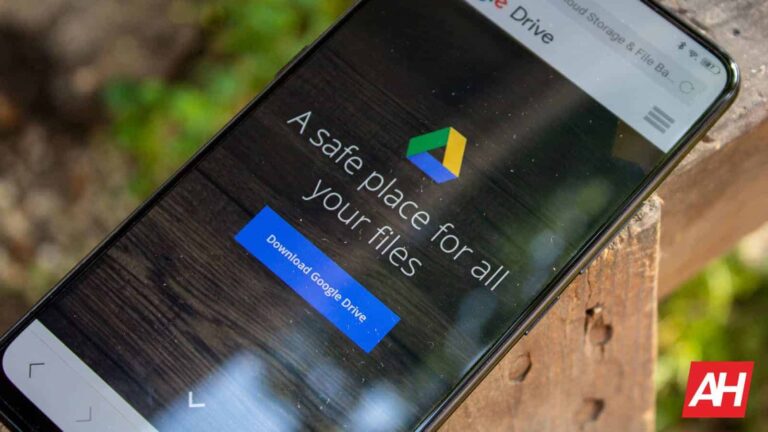
Google shared a way for you to recover missing Drive files, if a recent bug affected you. Before we get down to the actual procedure on how to do it, let’s see what happened to lead to this.
Recently, users started reporting missing Google Drive files. One specific user said that he lost around 5 months of Drive files for no reason. Many more of them shared their similar experiences.
Google reacted fast, and said that the investigation started. It didn’t take the company long to identify a culprit, it was the Google Drive for Desktop app. Google then asked users to take certain steps while the company was investigating, just to be sure they didn’t lose more files.
Here’s how you can recover missing Google Drive files
Which brings us to now. Google luckily has a fix for this problem, and no, your files are not gone for good. There is a way for you to recover them, thankfully, because losing months of saved files is a problem, of course.
Unfortunately, recovering files is not exactly as simple as pressing a button, but it’s not all that complicated either. Here’s what you need to do. After you download and open the latest version of Google Drive for Windows or macOS, you’ll need to run the recovery tool.
In order to do that, you’ll need to click on the Drive icon in the menu bar/system tray. The next step is pressing and holding the Shift key and clicking Settings. From there, select ‘Recover from backups’.
At that point, you should receive a message that says “Recovery has started”. Once the process completes, you should have all your missing files back, placed in a new folder named ‘Google Drive recovery’.
If you run into problems, you can let the company know
Now, everything should be fine after that, but if you do run into problems, you have options. Google asked users to submit feedback if they run into problems. You’ll need to submit it via the Drive for Desktop app by using the #DFD84 hashtag. The company also asked users to tick the box that includes diagnostic logs.
Samsung may bring solid-state batteries, often touted as “dream batteries,” to the market by 2027. Its battery development and manufacturing division, called Samsung SDI, has reportedly formed an internal team to accelerate the commercialization of the new type of battery. The Korean firm has already finalized its manufacturing strategies and set up a test production line.
Samsung is gearing up to commercialize solid-state batteries
The all-solid-state battery (ASB) technology will bring several advancements to the battery industry. These batteries feature a solid electrolyte, the medium through which ions flow to produce current or power. The current generation of batteries has a liquid electrolyte, which requires a separator between the positive (anode) and negative (cathode) electrodes.
A solid electrolyte doesn’t require a separator and allows for higher energy density, effectively leading to higher battery capacity in smaller packages. Moreover, there is a low risk of fire and explosion. These batteries are also said to retain the capacity for a longer period compared to existing lithium-ion solutions, i.e. better battery health. No wonder why they call them the “dream batteries.”
Research and development of ASB has been ongoing for over a decade now, with Samsung at the forefront of it. Earlier this year, the Korean media reported that the company was almost ready to produce solid-state batteries, though no timeline was available. The Korea Economic Daily now reports that Samsung has set up an ASB test production line at its Suwon research center.
The test production line was opened in March this year. The company has also formed a team to work on the commercialization of the solution. Go Joo-young, the head of the marketing team for Samsung’s battery division, will lead the new internal team. According to the new report, the firm is aiming for a market release of solid-state batteries by 2027.
Samsung SDI will use sulfide-based technology for ASB
Solid-state batteries use ceramic (sulfide or oxide) or polymer materials as the electrolyte—or composites combining ceramics and polymers. Samsung SDI will reportedly use sulphide-based electrolytes, which offer the best ion conductivity. It plans to develop batteries with an energy density of over 900 Wh/L.
Samsung is likely planning to initially make solid-state batteries for electric vehicles (EVs). It may later make ASB for smaller products such as smartphones. A previous report said that the firm will use oxide-based electrolytes for solid-state batteries for IT products. This is because oxides have greater stability and are suitable for making smaller batteries. We may get to learn more about Samsung’s ASB plans in the coming months.
Huawei could launch its budget foldableAndroid smartphone sooner than you think. Based on the latest information shared by Ross Young, that device is coming either later this month, or in early January.
Huawei could launch its budget foldable later this or next month
Ross Young, as many of you know, is a well-known display analyst. He’s rarely wrong when it comes to such predictions, so we have no reason to doubt him this time. It is rather likely that this device will launch in China first. We cannot know if it will make its way to global markets or not.
Either way, it will be more affordable in the company’s homeland, that’s for sure. That’s the case with every smartphone China-based companies release in its market compared to markets outside of China. It’s also not surprising due to taxes and everything.
Now, we don’t know much about this smartphone. A rumor appeared back in June, claiming that Huawei is working on a more affordable foldable phone. Back then, a tipster said that this phone could launch under the company’s ‘Nova’ brand.
That device could launch under the company’s ‘Nova’ brand
Huawei usually releases its mid-range phones under the ‘Nova’ brand, globally, so it would make sense. If we had to guess, we’d say that this is a clamshell smartphone, but we cannot be sure of that.
The device is tipped to cost between CNY4,000 ($563) and CNY5,000 ($703). Well, at least that was the case back in June. We’re still not sure if that rumor was credible or not, so that this info with a grain of salt.
The tipster also noted that the Snapdragon 778G could be used to fuel this smartphone. That’s basically everything we know at this point. Ross Young didn’t really share any information about the device other than the release window prediction.
Huawei launched quite a few foldables thus far, so the company has plenty of experience.