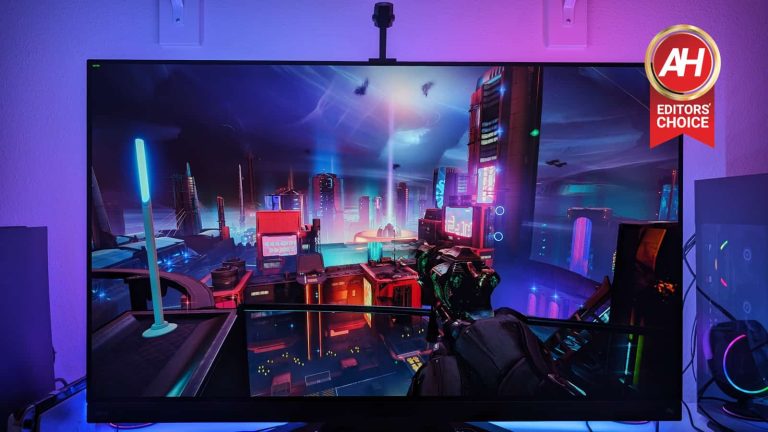
It’s 2077, and it’s my first time back in Night City in quite some time. I’d forgotten just how bright the city lights can be. The buildings are lit with vivid hues of bright greens, blues, pinks, reds, oranges, and just about every other color you can think of. No matter the time of day, the city is always alive and bustling with people. None of them are the wiser to my dealings as V the street kid working to get the president to safety.
Just then, I come back to reality and I remember that I’m not back in Night City. I’m sitting in my chair playing a game. But it’s hard to tell the difference when you’re playing a game like Cyberpunk 2077 while you have the Nanoleaf 4D hooked up. The Nanoleaf 4D is a screen mirroring and light strip kit that reflects the colors from your screen onto the wall behind your TV.
The kit is made up of an RGBIC light strip that sticks to the back of your TV, a controller box with buttons for power and changing effects, and a camera. The camera points at your screen and captures the colors on it, which then syncs to the light strip to reflect those onto the wall.
I’ve been using it while watching movies and playing games and it’s got me convinced that Nanoleaf 4D is a truly transformational entertainment experience. Expanding the visuals of that entertainment beyond the borders of your TV to make the content more immersive. And it’s the only way I ever want to play games or watch movies now. But how does it truly stack up? That’s what this review aims to break down.
Nanoleaf 4D review: Setup
Setup for the Nanoleaf 4D was a relatively painless process for me and I think it would be for anyone who picked it up. Sticking the light strip to the back of my monitor took just a few minutes. And honestly, it was more of a pain taking the monitor down than getting the light strip onto it. After getting the light strip in place, you just need to plug the controller box into a power source, then connect the light strip and camera to it.
What I like about the Nanoleaf 4D camera is that it can be configured in two ways. You can either place it on a flat surface so it stares up at the screen or clamp it to the top like you would a webcam so it stares down at the screen. This gives the user options. You might already have a webcam on top of your TV or monitor. In which case the Nanoleaf 4D camera wouldn’t be a good fit for this configuration. Not to worry though because you can just lay it flat on the desk or entertainment center using the included stand.
For me, this wasn’t an option because I have a center channel speaker sitting where the camera would need to go. So I’ve opted to clamp it to the top of the monitor which works just as well. After connecting the equipment, your last step is just to launch the Nanoleaf app and get everything connected to your Wi-Fi network. Getting everything connected in the app took me just a few minutes so all-in-all, setup for everything took maybe 15 minutes. Not too bad and worth the minor time investment I think.
The Nanoleaf 4D light strip comes in two sizes. One for 65-inch TVs and one for 85-inch TVs. I’m using mine with a monitor smaller than 65 inches, so I have the 65-inch light strip kit. The nice thing is that you can trim the light strip to fit your TV or monitor which I had to do since my monitor is under 50 inches. The kit also includes four corner brackets you can stick to the back of the TV to route the light strip through. This helps it to bend around the corners more easily as the light strip is kind of stiff. That being said they aren’t required. But I do recommend using them since it just kind of keeps things more nice and neat.
Nanoleaf 4D review: Features
You can do more than you’d think with the Nanoleaf 4D. Yes, it is just a light strip. But there are multiple modes you can flip between based on how you want the lights to look. These include the 1D, 2D, 3D, and 4D mirroring modes. With 1D the camera will only capture the most dominant color on the screen at the time and use that to reflect onto the wall. This is perfect for any kind of content that doesn’t have a lot of color-shifting.
But in most cases, I felt the colors and the experience were more accurate when using 3D or 4D. Especially if you’re playing games like Cyberpunk 2077, Starfield, and Final Fantasy XIV. Or any other game where there are lots of colors and lots of action happening. I also used it to play games like Ghost of Tsushima and Call of Duty: Modern Warfare III on PS5. Which can be pretty fast-paced and cause colors to shift around a lot.
All of these can be activated inside of the app with the tap of a button. It does take a second or two for the camera and light strip to catch up to your choice in the app. But otherwise, the change happens pretty quickly and I didn’t experience any issues with it. You can also adjust the brightness of the lights and sync them up to music playing so they breathe with the beat. This is a nice touch if you stream music on your TV or PC. But for the most part I never really used this function.
The Nanoleaf 4D also supports Razer Chroma. So if you’re using it with your PC monitor, you can launch the Nanoleaf desktop app and access the Chroma mode. This works great when you play games that have Chroma support. The visual appeal is even better if you have Nanoleaf’s bulbs or light panels. You can use the Sync+ feature to sync the light strip and those other products together too. Plus, the sync works for both the mirror modes and Razer Chroma.
Basic effects and Scene effects
In addition to the 4D effects, Nanoleaf 4D also supports a Basic effect and a Scene effect. The Basic effect is what you’d want to use if you want the light strip to reflect a specific color. I would sometimes use this effect when reading manga or other books. And try to choose a color that I felt was fitting for the material. For instance, while reading through Akira I tend to lean toward a bright red color. I felt like this set the mood for the kind of content I was reading.
The Scene effect is a bit different. These will be preset colors made into a scene with a specific set of effects that will cycle through colors or reflect a static color combination. For example, the Game Night scene cycles through magenta, orange, and cyan-like colors. Morning Routine on the other hand will be a splash of white and a couple of really muted light blue colors. I often use this one while working just for some extra light in the room during the day.
You can also create your own scene and create multiple colors and motions to make something unique to you. There’s also a fair amount of preconfigured color collections to start with. What’s neat is that there’s now a Magic Scene option where you type in a word or phrase and let the app create a scene for you based on the word or phrase you used. For instance, I typed in Tokyo Night Life and it gave me a scene that cycled through different shades of blue.
There’s a decent level of customization to how you want the lights to look. Though again, I’ll always recommend 3D or 4D mirror modes for most games and movies.
Nanoleaf 4D Review: Performance
Since this is an RGBIC light strip it can display multiple colors on the strip simultaneously, which is part of the magic of how everything works with this kit. In my experience, the performance of the Nanoleaf 4D has been pretty good. While I don’t necessarily recommend using the 1D or even 2D mirror modes as often, the 3D and 4D mirror modes are great for pretty much everything.
There are also three different vibrancy modes – Cinematic, Vivid, and Custom. Vivid is what I used for most of my time spent with the Nanoleaf 4D but it’s not always the best option. While watching certain TV shows I found that switching things to the Cinematic vibrancy setting was a better way to go. Colors are a little more muted and subtle so they don’t feel like they’re overwhelming the scene. And this was one of my only complaints with the setup. Sometimes with Vivd active things just get too busy and it takes a little bit away from the viewing experience.
If you want a little more control over what colors are being reflected you can use the Custom Vibrancy mode. This lets you adjust dynamic range, saturation, and white balance so you can find the right amount of color for whatever you’re watching or playing. You can still set these with any of the mirror modes too. So if you prefer the 4D mode like I do, you can keep it there and then tweak the colors with Custom Vibrancy until you find your perfect balance.
I did feel though that Custom isn’t necessarily what you want for every single piece of content. For a game like Cyberpunk 2077 for example, Vivid is a much better experience. The game was designed to be awash with color and Vivid really brings every scene to life. But if you’re playing something more casual, you might want a more muted or custom-tuned vibrancy level.
Nanoleaf 4D review: Security/Privacy
I’ll start by saying there isn’t an issue here with security but with the given rise of concern about privacy these days, I feel it’s worth mentioning. The 4D kit does have a camera but it’s pointed at the TV at all times so it’s ever facing outward when in use. And even then, should you wish to disable the camera you can. This can be done by either turning it off in the Nanoleaf app or by using the power button on the controller box.
More importantly, though, there’s a lens cover you can magnetically attach to the camera so it’s covered up. This cover also magnetically attaches to the backside of the camera. I found this to be a simple yet nice touch for the design. Because it ensures that I will never lose the lens cover and it always has a place to sit. You can simply flip it back and forth.
Nanoleaf 4D review: Software
You can manage all of your 4D settings either in the desktop app or on the mobile app. However, which one you use will depend on where you have the strip attached. If you’re using it with your PC monitor like I am, you can just use the desktop app, and all of the features are there. That being said, using the mobile app is often much more convenient. Whenever I was using the lights I was almost always either watching or playing something.
And if I wanted to use the desktop app I’d have to pause whatever that content was and tab out of it. Which is kind of a hassle and for me, feels like it breaks the immersion. And I kind of see the immersion as the whole reason for wanting the Nanoleaf 4D in the first place.
You’ll also have to use the mobile app if this is hooked up to your TV since there’s no TV version of a Nanoleaf app. Again though, there’s complete feature parity so it doesn’t matter which app you use. Both will do everything needed and give you access to all of the Nanoleaf 4D’s features.
While the app is intuitive to use, it does have the occasional problem with connection. This can usually be solved by simply closing out the app and relaunching it. But this can feel like a little bit of a nuisance if it happens too often. It’s not happening every time I use the lights. But weird little disconnect issues are popping up more than I’d like. Sometimes I’d open the app up and the Nanoleaf 4D would just be listed as “unreachable.” And I’d have to relaunch the app to get it to recognize the lights.
This may also simply have to do with my Wi-Fi network. Since the router is on the other side of the apartment. Luckily, if it’s not related to my network, it should be something that Nanoleaf can fix with a software update to the app. And I have noticed much better reliability with things since at least the most recent update.
Nanoleaf 4D review: Smart home integration
Nanoleaf 4D supports both Google Assistant and Amazon Alexa. So if you like, you can use the Nanoleaf 4D with either of these by issuing some voice commands. This does however seem to be limited to turning the lights on and off. This is essentially just a quick way to enable or disable the lights. I find this to be most useful if I want the lights turned on before I get home. If you want the rest of the features then you’ll need to use the proper Nanoleaf app for all that other stuff.
Still, it’s nice to see that smart home integration is available for those that want to use it. Especially if you already have quite a few other smart home products hooked up in your home or apartment.
Should you buy the Nanoleaf 4D?
If you want to transform your entertainment into something that feels truly magical, you definitely should buy the Nanoleaf 4D. It’s easily one of the best things that’s been added to my entertainment setup in the past few years. Its versatility makes it perfect for really any setup. Whether that’s strictly for movies and TV or if you want to throw in some video games too. And what’s nice is that this works with both PC and console games. Unlike the Nanoleaf light panels and bulbs which have no way to read the colors coming off your console display.
As mentioned these can sync with the Nanoleaf 4D. After doing so, they’ll display the same colors that the Nanoleaf 4D is reflecting. But they won’t do it without it. This makes the Nanoleaf 4D an especially good purchase for anyone who already has other Nanoleaf lighting products set up. Because it adds to the experience and makes things even more immersive.
At a starting price of $99.99, the Nanoleaf 4D is also pretty affordable. And it’s quite a bit easier to set up than the light panels. Overall these have been a wonderful experience for entertainment content. If you like movies and video games, you most definitely want these for your own setup.
[ad_2]
Source link