Meta sued over forcing users to pay to stop tracking

0
[ad_1]

Meta is required to get users’ consent in Europe in order to show them targeted ads. For this reason, Meta has to provide European users with a way to opt out of behavioral advertising or face fines totalling $100,000 a day.

Behavioral advertising are ads tailored to someone’s browsing habits and other online behavior. A profile of the user is built up over time, as they work their way around the web. Tracking users in this was was ruled as a break of GDPR regulations, so Meta had to find a way out.

Meta’s solution was to charge users for an ad-free experience. The choice for European users was keep using Facebook for free or pay to enjoy the platform without personalized ads. In order to enjoy your fundamental rights under EU law, Meta is essentially now proposing that users pay up to $275 per year.

However, organizations concerned about our privacy say that by doing this, Meta has changed the user’s choices from “yes or no” to “pay or okay.”

To put this into perspective, Meta’s annual revenue in 2022 was $120.18 Billion. If every user that visits Facebook daily (2.037 billion) forked out $275 per year, that would bring in roughly $560 Billion.
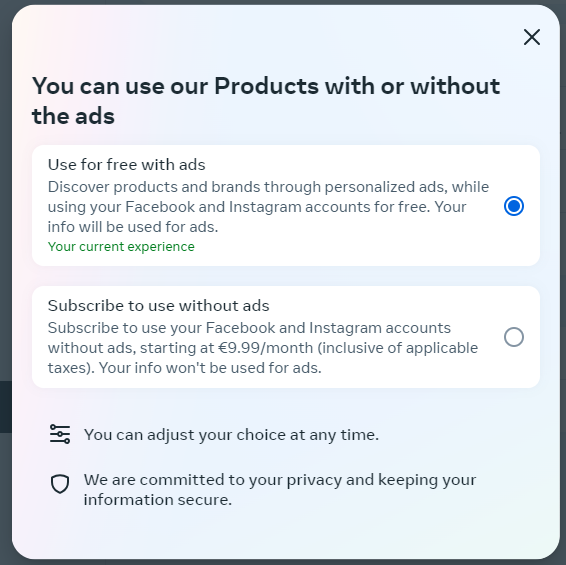
Use for free with ads or Subscribe to use without ads (€9.99/month)

The price is higher for mobile users and will rise further in 2024 for additional accounts. And note that for each linked account (Instagram) you pay an additional € 8 per month.

From Meta’s point of view it is doing the world a service by providing personalized ads.

“Every business starts with an idea, and being able to share that idea through personalized ads is a game changer for small businesses.”

But privacy group nyob (none of your business) says that keeping your personal data private is a fundamental right.

“Fundamental rights cannot be for sale. Are we going to pay for the right to vote or the right to free speech next? This would mean that only the rich can enjoy these rights, at a time when many people are struggling to make ends meet. Introducing this idea in the area of your right to data protection is a major shift. We would fight this up and down the courts.”

And they meant it. On November 28, 2023, nyob filed a complaint against Meta with the Austrian data protection authority. The group considers Meta’s action yet another attempt to circumvent EU privacy laws.

“Not only is the cost unacceptable, but industry numbers suggest that only 3 percent of people want to be tracked – while more than 99 percent decide against a payment when faced with a privacy fee.”

This strongly suggests that the EU law, which demands that consent should be “freely given” is not met in this case.

Max Schrems, the chairman of noyb said:

“When 3 percent of people actually want to swim, but 99.9 percent end up in the water, every child knows that it wasn’t a “free” choice. It’s neither smart nor legal – it’s just pitiful how Meta continues to ignore EU law.”

Meta said in response, that it had obtained a ruling of the Court of Justice of the European Union (CJEU) that accepted the subscription model as a valid form of consent for an ads funded service. It also said its pricing was in line with those of ad-free services such as YouTube Premium and Spotify Premium.

However, it conveniently seems to “forget” that ad-free services are not the same as those that gather data about you and sell them to the highest bidder to create personalized ads.


We don’t just report on threats—we remove them

Cybersecurity risks should never spread beyond a headline. Keep threats off your devices by downloading Malwarebytes today.


[ad_2]
Source link

Official OnePlus 12 camera samples are now available

0
[ad_1]

A lot of OnePlus 12 information is already available. The company kicked off its marketing campaign a couple of days ago, and as part of it confirmed a ton of details already, including the phone’s design. Well, now the company shared the OnePlus 12 camera samples.

Official OnePlus 12 camera samples are here, from all three rear-facing cameras

These camera samples have been shared by OnePlus China President, Li Jie Louis. He shared them via Weibo, and these samples include images taken with the main camera, ultrawide camera, and periscope telephoto camera. So, basically all three rear cameras.

Before we get to it, do note that the camera details have been confirmed already. The trio on the back is led by the Sony LYT-808 camera sensor, Sony’s new LYTIA camera. This smartphone will have the same rear cameras as the OnePlus Open, basically.

Li Jie Louis highlighted the company’s ‘Super Light and Shadow Image Engine’ algorithm, which will help the images from this sensor look great. He also highlighted Hasselblad’s ‘natural colors’.

The main camera shines the most, but the samples look great overall

Now, you will find three galleries below. Each of the galleries shows camera samples from one of the cameras below the article. Do note that these images are here to highlight the very best of these cameras, to show them in their best light, of course. With that in mind, they do look great. One thing to note, though, is that the images in the galleries have been compressed. You can check them out in their original quality/size by clicking here.

Main camera samples:

Ultrawide camera samples:

Periscope telephoto camera samples:

The colors really pop, especially when it comes to the main camera. They’re not oversaturated, but simply highlighted very well. We’re used to seeing that style from OPPO and OnePlus smartphones thus far. The dynamic range is also very good.

The ultrawide camera samples also look very good, but the main camera is obviously capable of doing a better job. The dynamic range is better, and so are the colors.

If you check out the periscope telephoto camera samples, you’ll see that the OnePlus 12 will be capable of capturing some really nice shots. That is not surprising following our experience with the OnePlus 12.

The phone is coming on December 5

The OnePlus 12 will launch on December 5 in China. Its global launch is coming in January, most likely on January 23.


[ad_2]
Source link

Microsoft is now on OpenAI’s non-profit board

0
[ad_1]

A week after all of the drama surrounding OpenAI has settled, it looks like the company is ready for things to get back to normal. All of the drama started with the company’s non-profit board firing CEO Sam Altman. Well, OpenAI’s got a new board, and Microsoft is now a member.

If you recall, shortly before Thanksgiving, we got the news that Sam Altman was fired from OpenAI. More information made its way to the public as time went on. Since then, Altman has made his way back to the company and all of the drama has subsided.

It’s not 100% clear as to why the company ousted the CEO. According to sources (one including Reuters), researchers at the company warned the board about a potential breakthrough that they feared could be potentially dangerous. The breakthrough project is allegedly called “Q*”. We don’t know any information about this project, so we’ll need to wait for details to come to light.

Microsoft is now on OpenAI’s board

While we wait for more information about this project, we have news about OpenAI’s biggest backer. Microsoft holds a massive 49% stake in the company, and we’re surprised that it hasn’t had a seat on the board until now.

As per the report, Microsoft will have a non-voting seat on the board. So, the Windows maker won’t be able to contribute to any large decisions that the company makes. Rather, this is just so that it can have a “Window” to look in. It wants to have a clearer view of the inner workings of OpenAI.

During all of the drama, Microsoft’s CEO Satya Nadella hinted at the company being pretty indifferent about the situation. During an interview with CNBC, he told the interviewer that Microsoft’s priority is to push AI forward regardless of the company that’s doing it. “I care about just making sure that we can innovate.”

Now, it seems that Microsoft is taking more of an active role in OpenAI’s development. It’s invested more than $13 billion in the company so far (yes, we know, that’s pocket change for Microsoft). So, the future of OpenAI seems to be looking up yet again.


[ad_2]
Source link

CISA Warns Exploitation Wastewater System Logic Controllers

0
[ad_1]

In a disconcerting turn of events, cyber threat actors have set their sights on Unitronics programmable logic controllers (PLCs) embedded in Water and Wastewater Systems (WWS). 

This perilous trend casts a looming shadow over the nation’s critical infrastructure, with the potential to disrupt the seamless provision of clean, potable water and the efficient management of wastewater.

The Cybersecurity and Infrastructure Security Agency (CISA) has sounded the alarm, issuing a compelling warning concerning this emerging threat. 

The gravity of the situation lies in the unauthorized access cyber actors seek to gain over WWS facilities, underscoring the pivotal role PLCs play in orchestrating the intricate stages of water and wastewater treatment. 

This makes them prime targets for malicious entities intent on disrupting essential services.

Behind these attacks, cyber threat actors adeptly exploit cybersecurity vulnerabilities, capitalizing on lax password security and the exposure of Unitronics PLCs to the internet. 

Once infiltrated, they wield the power to manipulate systems, potentially leading to contaminated water, service interruptions, and even physical harm to critical infrastructure.

Document
Protect Your Storage With SafeGuard

StorageGuard scans, detects, and fixes security misconfigurations and vulnerabilities across hundreds of storage and backup devices.

Unveiling a Close Call in a U.S. Water Facility

In a vivid illustration of the potential consequences, cyber actors successfully compromised a Unitronics Vision Series PLC with a Human Machine Interface (HMI) at a U.S. water facility. 

Swift intervention by the municipality’s water authority prevented any disruption to the water supply. 

Nevertheless, this incident serves as a stark reminder of the tangible threats these cyber attacks pose.

To counter this growing threat, CISA advocates for robust cybersecurity measures, including the imperative to change default passwords, enforce multi-factor authentication for remote access, disconnect PLCs from the open internet, regularly back up logic and configurations, and diligently update PLC/HMI firmware to the latest versions.

In collaboration with WWS Sector partners, CISA offers an arsenal of tools and resources designed to fortify water utilities against cyber threats. 

These resources encompass the realms of threat intelligence, cybersecurity guidelines, and industry collaboration, empowering water providers to safeguard the nation’s water supply and uphold the uninterrupted delivery of essential services.

Water utilities stand at a pivotal crossroads, urged to prioritize cybersecurity measures as a shield against the evolving landscape of cyber threats. 

By implementing robust security practices, disseminating threat intelligence, and fostering collaboration with industry partners, these defenders of water infrastructure can stand resilient in the face of cyber adversaries, ensuring the nation’s water supply remains secure and uninterrupted.

Experience how StorageGuard eliminates the security blind spots in your storage systems by trying a 14-day free trial.


[ad_2]
Source link

Galaxy S24, Galaxy S24+ certified by FCC with Wi-Fi 6E, UWB

0
[ad_1]

Over the past few weeks, Samsung has picked up several regulatory certifications for the Galaxy S24 series. We have seen the Plus model on the BIS (India) website, while the Ultra model has received approvals from the BIS, NBTC (Thailand), and KTR (South Korea). The FCC has now joined the list. The American regulatory agency recently certified the Galaxy S24 and Galaxy S24+. The Ultra model should also soon receive the FCC certification.

The Galaxy S24 series picks up another important certification

The FCC certified the Galaxy S24 with the model numbers SM-S921U and SM-S921U1. These are carrier-locked and unlocked variants for the US, respectively. The global version is SM-S921B and the Korean version is SM-S921N. Likewise, the Galaxy S24+ received the certification with model numbers SM-S926U and SM-S926U1. Its other model numbers are SM-S926B and SM-S926N, while the Ultra’s are SM-S928U/SM-S928U1, SM-S928B, and SM-S928N.

While previous certification listings didn’t reveal much about the upcoming Samsung flagships, the FCC entry has a few talking points. It confirms Bluetooth 5.3, NFC, and UWB (Ultra-wideband) support for the Galaxy S24 and Galaxy S24+, along with Sub-6GHz and mmWave 5G cellular networks. The phones also boast wireless charging, wireless power transfer (reverse wireless charging), and Wi-Fi 6E (IEEE 802.11 a/b/g/n/ac/ax).

There have been rumors that Samsung will introduce Wi-Fi 7 support to its phones with the Galaxy S24 series. However, that doesn’t seem to be happening. Or maybe the FCC didn’t evaluate the function because the final Wi-Fi 7 standard isn’t official yet. It is expected next year. The next-gen wireless standard should be common on high-end smartphones in 2025.

The Galaxy S24+ is expected to support 45W (11V/4.05A) wired charging speed, the same as the Ultra model. However, the FCC tested the phone with Samsung’s EP-TA800 25W (9V/2.77A or 11V/2025A) charger manufactured by Korean firm Dongyang E&P (electric and power). This doesn’t necessarily mean it lacks 45W charging support, though. The base model will max out at 25W (9V/2.77A).

Samsung’s next-gen flagships are less than two months away

This is all we can find in the FCC certification documents for the Galaxy S24 and Galaxy S24+. More details should emerge ahead of the launch. Samsung plans to unveil the next-gen flagships in mid-January. On January 17, 2024, to be precise. Pre-orders will begin immediately after the launch event, with a global release expected on January 30. With less than two months to go before the grand unveiling of the Galaxy S24 lineup, we expect more leaks in the coming weeks.


[ad_2]
Source link

Zyxel Command Injection Flaws Let Attackers Run OS Commands

0
[ad_1]

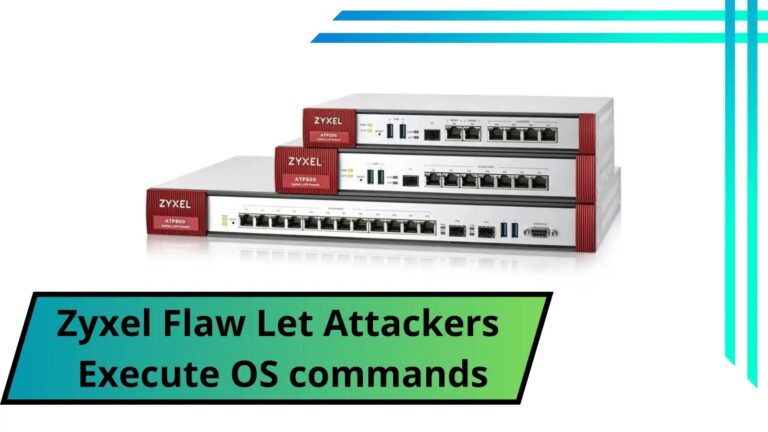
Three Command injection vulnerabilities have been discovered in Zyxel NAS (Network Attached Storage) products, which could allow a threat actor to execute system commands on successful exploitation of these vulnerabilities.

Zyxel NAS (Network Attached Storage) devices provide fast, secure, and reliable storage services for data storage and file-sharing requests. Zyxel offers Zyxel Drive, allowing users to access Zyxel NAS devices over the internet even if they are not connected to the same network. 

Users can retrieve, upload, and manage the files that are stored in the NAS devices. Zyxel has released a security advisory for these vulnerabilities and has patched the affected NAS products.

Document
Protect Your Storage With SafeGuard

StorageGuard scans, detects, and fixes security misconfigurations and vulnerabilities across hundreds of storage and backup devices.

Command Injection Vulnerabilities

CVE-2023-35138: Command Injection

This vulnerability exists in the “show_zysync_server_contents” function of Zyxel NAS devices that could allow an unauthenticated threat actor to execute operating system commands. 

An attacker can exploit this vulnerability by sending a crafted HTTP POST request. The severity for this vulnerability has been given as 9.8 (Critical).

CVE-2023-37928: Post Command Injection

This was a post-authentication command injection vulnerability that exists in the WSGI server in NAS devices. An unauthenticated threat actor can execute Operating system commands on the affected devices by sending a crafted URL.

The severity for this vulnerability has been given as 8.8 (High).

CVE-2023-4473: Command Injection in web server

This vulnerability exists in the web server of Zyxel NAS devices, which could allow an unauthenticated threat actor to execute Operating system commands. Successful exploitation of this vulnerability requires a threat actor to send a crafted URL to the vulnerable devices.

The severity rating for this vulnerability has been given as 9.8 (Critical).

Affected Products & Fixed in Versions

Affected modelAffected versionPatch availability
NAS326V5.21(AAZF.14)C0 and earlierV5.21(AAZF.15)C0
NAS542V5.21(ABAG.11)C0 and earlierV5.21(ABAG.12)C0

Zyxel also credited the consultancies and security researchers who have responsibly reported these vulnerabilities to them. Credits were given to 

  • Maxim Suslov for CVE-2023-35138
  • Attila Szász from BugProve for CVE-2023-37928, CVE-2023-4473
  • Drew Balfour from IBM X-Force for CVE-2023-4473

Experience how StorageGuard eliminates the security blind spots in your storage systems by trying a 14-day free trial.


[ad_2]
Source link

Galaxy S24 limited to 8GB of RAM, ‘Ultra’ won’t have a 16GB version

0
[ad_1]

The Samsung Galaxy S24 series RAM details are in, and they’re quite interesting. This information comes from Ice Universe, one of the most prominent tipsters out there. So, we have no reason to doubt any of this.

The Galaxy S24 series RAM details are here, and the info is rather interesting

The tipster claims that the Galaxy S24 will be limited to 8GB of RAM. That’s the only version that will be on offer. The Galaxy S24+ will be available in both 8GB and 12GB RAM flavors, though, it seems.

The Galaxy S24 Ultra, interestingly enough, will come in 8GB and 12GB RAM options, but a 16GB RAM variant will not be on offer. Pretty much everyone expected a 16GB RAM variant, it was rumored for a while now.

Ice Universe claims that TM Roh, the head of Samsung Mobile, is behind this. It’s not exactly a secret that the tipster is not the biggest fan of TM Roh, based on a number of his past tweets/posts, and the new one.

Having said that, we’re not sure what RAM and storage will the company use. It will probably be LPDDR5X and UFS 4.0, but who knows, the company may have other ideas.

All three devices have been surfacing for a while now

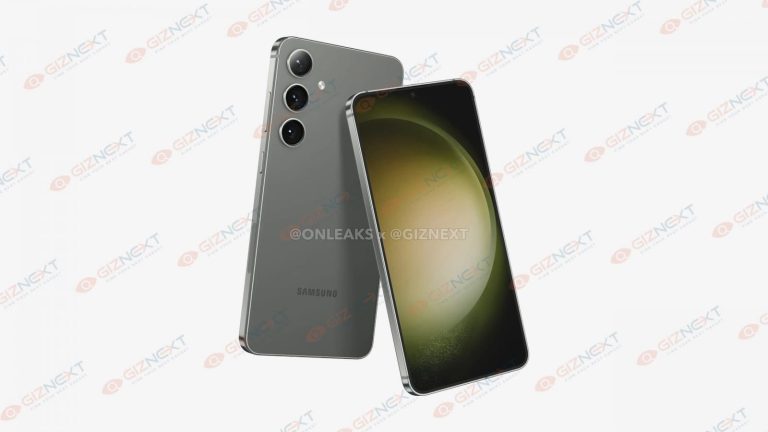
Having said that, these three devices are hardly a secret at this point. All three of them surfaced in one way or the other, a number of times. Even their designs appeared thanks to CAD-based renders.

The Galaxy S24 Ultra will have a flat display, it seems. That will be the first time, in a long time, that we don’t get a Galaxy S device with a curved display. The other two phones will also utilize flat displays.

The Snapdragon 8 Gen 3 is said to fuel the Galaxy S24 Ultra, exclusively. The Galaxy S24 and Galaxy S24+, on the other hand, will come in either Snapdragon 8 Gen 3 or Exynos 2400 SoCs. Europe will likely get the Exynos variants.


[ad_2]
Source link

Google Play honors AI innovators and cross-device experiences in the 2023 awards

0
[ad_1]

At the start of the month, Google dropped the list of nominees for this year’s Play Users’ Choice Awards. Users cast their votes in three categories—best apps, games, and books. The results are in, and we’ve got the scoop on both user picks and editors’ choices for the top apps and games in 2023. Let’s dive in!In line with this year’s vibes, Google brought in some new award categories. It is shining a spotlight on apps making waves with the latest tech, like “Best with AI” and “Best Game for Good.” Plus, it gives props to experiences that seamlessly navigate various devices, with categories such as “Best Multi-device App and Game” and “Best for Google Play Games on PC.”

Taking the crown for the best overall app of the year is Imprint: Learn Visually. This app dishes out bite-sized lessons infused with visual storytelling, giving life to concepts. With it, you can dive into psychology, history, health, technology, and more in a new and engaging way.

Claiming the title of the best game for 2023 is Honkai: Star Rail, a sci-fi spectacle boasting outstanding content depth, stunning visuals, and thoughtful design. With a sprinkle of lore and character backstories woven into the game, Honkai: Star Rail offers enduring entertainment for both seasoned role-playing game enthusiasts and newcomers alike.

Securing the top spot in the Best Multi-device App category is Spotify, sharing the limelight with the game OUTERPLANE – Strategy Anime. Play’s editors took notice of OUTERPLANE’s “ability to easily work across multiple devices,” setting it apart from other turn-based strategy experiences on Play.

Now, let’s see what the users have to say about the cream of the crop in apps, games, and books for this year. Not surprisingly, given the rapid integration of AI into our lives, Google Play’s users have crowned ChatGPT as the best app for 2023. OpenAI’s chatbot has gained such popularity that even Elon Musk, who is working on his own generative AI chatbot named Grok, remarked that “ChatGPT is scary good.”


Users have spoken, and the title of the best game for 2023 goes to MONOPOLY GO! Now, let’s delve into the winners across different categories:

Best apps of 2023


  • Best for Fun: Bumble For Friends: Meet IRL
  • Best for Personal Growth: Voidpet Garden: Mental Health
  • Best Everyday Essential: Artifact: Feed Your Curiosity
  • Best Hidden Gem: Aware: Mindfulness & Wellbeing
  • Best with AI: Character AI: AI-Powered Chat
  • Best for Families: Paw Patrol Academy
  • Best App for Good: AWorld in support of ActNow
  • Best for Watches: WhatsApp Messenger
  • Best for Tablets: Concepts: Sketch, Note, Draw
  • Best for Chromebooks: FlipaClip: Create 2D Animation
  • Best for Google TV: Max: Stream HBO, TV, & Movies
  • Best for Cars: Amazon Prime Video

Best games of 2023


  • Best Multiplayer: Farlight 84
  • Best Pick Up & Play: MONOPOLY GO!
  • Best Indies: Vampire Survivors
  • Best Story: Honkai: Star Rail
  • Best Ongoing: Stumble Guys
  • Best Games for Good: Pokémon Sleep
  • Best on Play Pass: Magic Rampage
  • Best for Tablets: Honkai: Star Rail
  • Best for Chromebooks: Minecraft
  • Best for Google Play Games on PC: Arknights

Best books of 2023

  • “In the Lives of Puppets” by TJ Klune 
  • “The Covenant of Water” by Abraham Verghese 
  • “All the Sinners Bleed: A Novel” by S.A. Cosby
  • “Bellies: A Novel” by Nicola Dinan 
  • “The Art of Scandal” by Regina Black 
  • “Hijab Butch Blues: A Memoir” by Lamya H 
  • “Fourth Wing” by Rebecca Yarros 
  • “Girls Like Girls” by Hayley Kiyoko 
  • “Boys Weekend” by Mattie Lubchansky 
  • “The Creative Act: A Way of Being” by Rick Rubin 

[ad_2]
Source link

Most Popular Websites Still Allow Users To Have Weak Passwords

0
[ad_1]

The latest analysis shows that tens of millions of people are creating weak passwords on three of the four most popular websites in the world, which do not fulfill the minimum required standards.

Researchers also found that 12% of websites had no limitations at all for the length of passwords. They made this discovery using a first-of-its-kind automated tool that can evaluate a website’s password creation regulations.

This automated tool for assessment was developed by Ph.D. student Suood Al Roomi and assistant professor Frank Li of Georgia Tech’s School of Cybersecurity and Privacy to examine every website in the Google Chrome User Experience Report (CrUX). This database contains one million web pages.  

Document
Protect Your Storage With SafeGuard

StorageGuard scans, detects, and fixes security misconfigurations and vulnerabilities across hundreds of storage and backup devices.

Outdated Password Practices Are Widespread

This tool was effective on over 20,000 websites in the database and indicated that many websites:

  • Permit very short passwords
  • Avoid blocking common passwords.
  • Use outdated specifications such as complicated characters.

Additionally, the researchers found that the majority of sites keep up with 2004 regulations, while only a few fully follow standard guidelines.

The study found that over half of the websites accepted passwords with six characters or fewer and that 75% did not enforce the suggested minimum of eight characters. Approximately 12% had no length restrictions, while 30% did not allow special characters or spaces.

Just 28% of the websites under investigation had password block lists in place, leaving thousands of websites open to hacker attempts to access users’ accounts by using popular passwords, a technique known as ‘password spraying.’

Al Roomi and Li observed the consistency of length constraints and needs for numerals, capital and lowercase characters, special symbols, combinations, and starting letters with the aid of machine learning.

Additionally, they may check to determine if websites allowed dictionary words or passwords known to have been compromised.

“As a security community, we’ve identified and developed various solutions and best practices for improving internet and web security. It’s crucial that we investigate whether those solutions or guidelines are actually adopted in practice to understand whether security is improving in reality”, said Li.

Hence, it is crucial to use strong passwords. They safeguard your private information by preventing illegal access to your device accounts and gadgets. The more difficult the password, the more secure your data will be against hackers and online threats.

You may improve organizational security and keep yourself secure from cybercriminals by enforcing the usage of multi-factor authentication (MFA).

Experience how StorageGuard eliminates the security blind spots in your storage systems by trying a 14-day free trial.


[ad_2]
Source link

Redmi K70 series announced with Snapdragon 8 Gen 3, 120W charging & more

0
[ad_1]

Xiaomi has announced its new Redmi handsets. The Redmi K70 series is official, and it consists of the Redmi K70, K70 Pro, and K70E smartphones. The cheapest variant is the Redmi K70E, it’s inferior to its siblings.

The Redmi K70 series is official, and the three phones look almost the same

All three phones are sticking to the same design language, pretty much. The major difference you’ll see when you compare all three phones is the under-display camera on the Redmi K70 Pro. The other two phones include a display camera hole.

All three are made out of metal and glass, and are the same in terms of size. They look basically the same other than the front-facing camera. Their bezels are very thin, and all the physical buttons sit on the right-hand side.

You will notice that they have flat sides, and their backplates are curved towards the sides, a little. The camera island on the back is large on all three devices, as that’s a design choice. It spans across the top of the phone’s back side.

Redmi K70 series image 1

The Redmi K70 & K70 Pro specifications

Now, we’ll talk about the Redmi K70 and K70 Pro specs together, as they are quite similar. The Redmi K70E specs will be covered separately later in the article.

The Redmi K70 and K70 Pro both utilize a 6.67-inch 3200 x 1440 AMOLED display. That display has a 120Hz refresh rate, and a 2,160Hz instant touch sampling rate. A 3,840Hz PWM high-frequency dimming is also a part of the package. The peak brightness here is 4,000 nits, while HDR10+ and Dolby Vision are also supported.

The Snapdragon 8 Gen 3 fuels the Redmi K70 Pro, while the Snapdragon 8 Gen 2 is included inside the Redmi K70. The Redmi K70 Pro goes up to 24GB of LPDDR5X RAM and up to 1TB of UFS 4.0 flash storage. The Redmi K70 goes up to 16GB of LPDDR5X RAM, and 512GB of UFS 4.0 flash storage.

120W charging is supported on both smartphones, while the two of them have the same main camera

A 5,000mAh battery is included inside both smartphones, and both of them support 120W wired charging. Wireless charging is not supported. An in-display fingerprint scanner can be found inside both phones, and the same goes for an IR blaster.

Both phones have a 50-megapixel main camera with Light Fusion 800 sensor, and an f/1.6 aperture. OIS and EIS are supported. The other two cameras are different, though. The Redmi K70 Pro includes a 12-megapixel ultrawide unit (OmniVision OV13B10 sensor, f/2.2 aperture), and a 50-megapixel telephoto unit (2x optical zoom, OmniVision OV50D40 sensor). The Redmi K70, on the other hand, has an 8-megapixel secondary camera (ultrawide, 120-degree FoV, f/2.2 aperture), and a 2-megapixel macro camera (f/2.4 aperture). A 16-megapixel selfie camera is included inside both phones.

Stereo speakers are also a part of the package, and the same goes for Dolby Atmos. Bluetooth 5.4 is also included. The two phones measure 160.86 x 74.95 x 8.21mm. They weigh 209 grams. The Redmi K70 Pro Automobili Lamborghini SQUADRA CORSE weighs 211 grams, and looks a bit different, as shown below.

Redmi K70:

Redmi K70 Pro & Lamborghini edition:

The Redmi K70E specifications

The Redmi K70E includes a 6.67-inch 2712 x 1220 OLED display with a 120Hz refresh rate. It has the same instant touch sampling rate as the other two phones, and the same goes for PWM high-frequency dimming. This display has a maximum brightness of 1,800 nits.

The MediaTek Dimensity 8300-Ultra fuels this smartphone, and it comes in 12GB and 16GB LPDDR5X versions. Three UFS 4.0 storage options are available, up to 1TB in size.

This handset supports 90W charging

There are two nano SIM card slots included here, and an in-display fingerprint scanner too. You’ll find an IR blaster at the top, and stereo speakers are a part of the package as well. Dolby Atmos is supported. A 5,500mAh battery sits inside of this phone, while 90W wired charging is supported.

A 64-megapixel main camera (OmniVision OV64B, OIS, EIS) sits on the back. An 8-megapixel ultrawide unit (120-degree FoV, f/2.2 aperture) is also included, as is a 2-megapixel macro camera (f/2.4 aperture). A 16-megapixel camera sits on the front.

The Redmi K70E measures 160.45 x 74.34 x 8.05mm, while it weighs 198 grams.

Models & pricing

The Redmi K70 Pro pricing starts at CNY3,299 ($465), and goes up to CNY4,399 ($621). The K70 pricing starts at CNY2,499 ($352), and goes up to CNY3,399 ($480). The Redmi K70E can be purchased for CNY1,999 ($282), and the most expensive model costs CNY2,599 ($366). Do note that the devices will cost more globally, no matter what sub-brand they come in. It’s possible that some of these devices will be re-released as ‘POCO’ phones.

Redmi K70 series image 3


[ad_2]
Source link