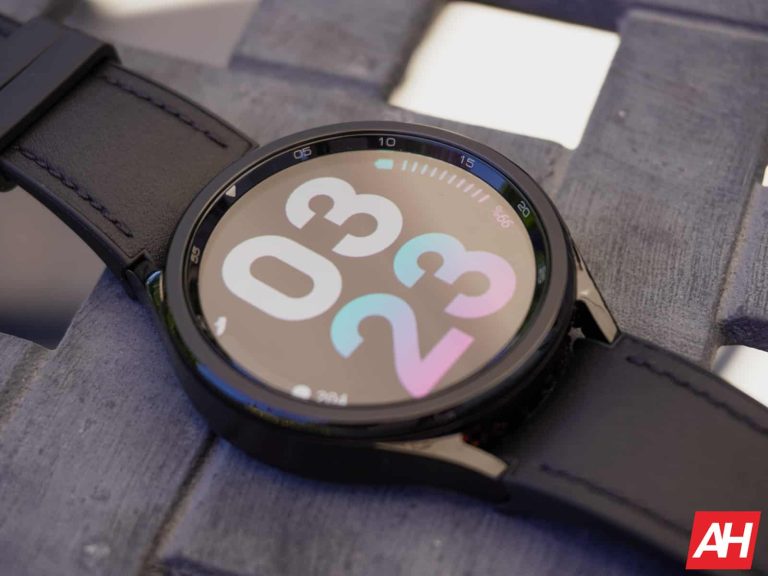
Wear OS has a robust collection of available watch faces thanks to apps like Facer, but a new app on the block aims to hand even more customization power over to the user in the form of a watch face maker. The app is called Kustom Watchface Creator and it basically gives you a huge amount of control in terms of customization. The app’s creator is the developer known as Kustom Industries, which is the same developer who makes a wildly popular app for phones called KWGT. Both apps provide the same overall feature of letting you create some deeply customized stuff for your device.
The difference is that KWGT is for making custom widgets for your homescreen. While KWCH is for designing the entire watch face. This can of course include complications which are more or less the widgets of Wear OS. Spotted by 9To5Google, this watch face maker for Wear OS takes a little getting used to. But if you stick with it you can be using something you made on your own in no time. Letting you turn your watch face into something truly unique from everyone else’s.
This Wear OS watch face maker provides limitless possibilities
More specifically, developer Kustom Industries says that your “imagination is the limit.” So in theory, if you can dream it up, you can turn it into a watch face for your device. Kustom Industries compares the level of creation to something like Rainmeter. Which is a highly customizable tool for Windows PCs that lets you transform your desktop in all sorts of ways.
KWCH is free to install but there is a paid pro version that you can buy. The pro version is mostly the same but it does come with some notable extras. Such as the capability to unlock importing from SD cards and it removes ads. The pro version also allows the creation of APK preset packs. If you’re tired of the stock watch faces for your smartwatch or you just want something you can make your own, give the app a shot. You can grab it from the Play Store link below.
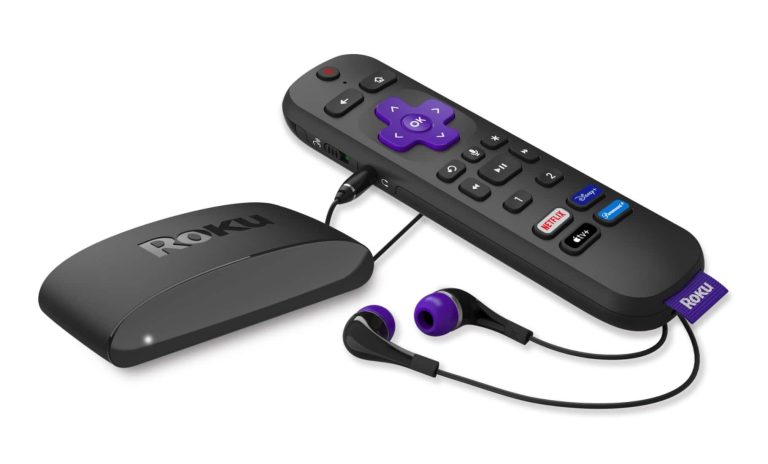
Roku has quietly launched a new streaming bundle. The “Roku Express 4K with Voice Remote Pro” is now available for pre-order from Amazon, with shipping beginning next Wednesday, October 4. Priced at $49.99, the Amazon-exclusive bundle gives you high-quality images and a feature-rich voice remote at an affordable price.
The Roku Express 4K is the company’s most affordable streaming device. It debuted with a price tag of $35, which includes a basic remote. However, the device is anything but basic. Despite its affordability, it offers 4K resolution, HDR, HDR10, and HDR10+, allowing for stunning detail and clarity with vivid colors. Its powerful quad-core processor and support for dual-band wireless networks (2.4GHz and 5Hz) make it a great low-cost streaming solution.
The “Plus” version of the Roku Express 4K adds micro USB Ethernet support for wired internet connectivity and a few other perks. These additions bump the price by $5. However, you still get the same basic remote with it, limiting your streaming experience. The new bundle replaces the remote with a much more feature-rich one if you’re willing to pay $10 more. The bundle essentially gives you the $30 priced Voice Remote Pro at half its price ($15).
The Voice Remote Pro elevates your Roku streaming experience to a new level
Launched in April 2021, Roku’s Voice Remote Pro comes with a rechargeable battery and a 3.5 mm headphone jack that supports private listening. Simply connect your wired headphones to the remote and listen to your TV without disturbing other members of the household. It’s compatible with all Roku devices, including TVs and streaming players, with some devices unlocking additional features.
With the Roku Express 4K, the Voice Remote Pro lets you swiftly power on the TV, adjust the volume, mute, launch channels, search for content, and control the streaming experience using voice commands with Alexa or Google Assistant. It also offers Apple AirPlay 2 support, allowing you to stream content directly from your iPhone, iPad, or Mac. This bundle also offers features like Continue Watching, NFL Zone, Remote Finder, and more.
According to Roku, all of this makes this bundle “perfect for new streamers or anyone looking to upgrade an existing TV.” If you’re interested in the “Roku Express 4K with Voice Remote Pro” bundle, you can now pre-order it from Amazon. Roku says this $50 bundle won’t be available for purchase anywhere else, at least not right now. The 4K streaming device and feature-rich voice remote will start shipping to consumers on October 4.
We take a look at a new Android scam involving Xenomorph malware and a hunt for cryptocurrency credentials.
Cryptocurrency owners should take heed of warnings related to Xenomorph malware—Bleeping Computer reports that the most recent version of Xenomorph now targets various cryptocurrency wallets using fake browser update messaging as bait.
Xenomorph is roughly a year old, first springing to prominence after an installation campaign via the Google Play store resulted in more than 50,000 hijacked Android phones. At the time, Xenomorph crept into the official Android store via false pretences.
As with so many mobile scams, pretending to be a system cleaning tool worked like a charm and it bypassed some security measures by grabbing the rogue component only after installation. In other words: Google Play wouldn’t have noticed anything untoward, because at time of initial installation, everything looked normal.
The malware abused permissions to log SMS, intercept notifications, and use overlays to grab login details for up to 56 different banks.
This on its own is already very malicious behaviour. A year later, Xenomorph is back with an impressive sequel in tow. It would be more accurate to say that this is part 5, after several revisions over the past 12 months which have seen Xenomorph be distributed in new ways and include new features, like multi-factor authentication bypass and cookie stealing.
The new attack involves the use of that well-worn tradition, the fake browser update landing page. Bogus “Your Chrome needs updating” pages convince visitors to download and install the new rogue Android file.
At this point, Xenomorph deploys its most favoured tactic: That of the bogus overlay. These overlays mimic various banks and (now) logins for multiple cryptocurrency services like Metamask.
We’ve warned of the dangers of handing over your cryptocurrency secret recovery phrase to random websites and extensions many times. Even folks who are well versed in these kinds of scams may not realise a genuine looking overlay is coming from an entirely unrelated Android installation.
This latest version is said to target “more than 100 different targets” making use of crafted pages to try and swipe the user’s details. It also includes a so-called “mimic” feature which allows the malware to launch bogus activity from otherwise legitimate services. As Bleeping Computer notes, this technique means the fraudsters don’t need to hide icons from the app launcher which many security tools would note as potentially dubious behaviour.
Xenomorph does a lot of this, like simulating user taps at specific screen locations and preventing the system from going to sleep, which is a boon for staying in contact with the Command & Control setup issuing orders.
The researchers who made these discoveries also mention that the infrastructure hosting the rogue files contained additional malware, malware loaders, and Windows information stealers.
There’s a good chance some of these other files may already be in circulation, or could be at some point in the near future. If you receive browser update warnings while looking at websites, don’t hit that download button.
Browser updates don’t typically announce the need to do so in the middle of your browser, and especially not when surfing. Notifications for updates are placed away from the browser window, typically inside the user interface of the browser itself. For example, to the right of your URL bar. Browsers will also tend to update automatically without you doing anything. If you want to know whether or not an update is needed, clicking into “Help” or “About” will usually get the job done.
Whether on mobile or desktop, we strongly recommend keeping your updates set to automatic. Let the browser do its job and help to keep you secure, and do your bit by ignoring any popups or in-browser messaging with an urgent notification about supposed browser updates.
We don’t just report on Android security—we provide it
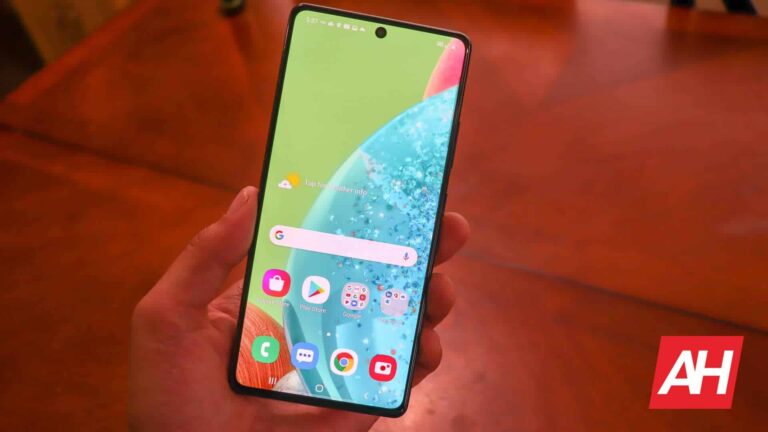
Samsung is pushing a major new update to the Galaxy A51 5G and Galaxy A71 5G in the US. The two 2020 premium mid-range smartphones are getting the company’s One UI 5.1.1. It brings several new features and improvements to the duo.
Samsung’s One UI 5.1.1 update reaches the Galaxy A51 5G, A71 5G in the US
As of this writing, Samsung’s One UI 5.1.1 update for the Galaxy A51 5G and Galaxy A71 5G is available on Verizon’s network in the US. A wider rollout should follow soon. First reported by SamMobile, the updates come with the firmware build numbers A516VSQU8GWH2 and A716VSQU8GWH2, respectively.
One UI 5.1.1 is the latest stable version of Samsung’s custom Android software for Galaxy devices. Based on Android 13, the new version debuted with the new foldables in August. The company has already pushed it to dozens of other models. It’s aging mid-range models are now joining the party too.
This update brings new features for Gallery, Camera, Samsung Health, Quick Share, Device Care, Mobile Hotspot, and many other apps and services. You’re getting a new date and time styles for photo watermarks, enhanced sleep tracking, enhanced memory management, mobile hotspot data consumption tracking, and more.
The Galaxy A51 5G and Galaxy A71 5G are also picking up the August 2023 security patch with this update. Samsung has already pushed the September SMR (Security Maintenance Release) to most of the eligible devices. However, these two models no longer get monthly security updates, so they may not receive the latest release.
We aren’t complaining, though. After all, this update is more about One UI 5.1.1 than security improvements. If you’re using the Galaxy A51 5G or the Galaxy A71 5G in the US, you can expect to receive the update in the coming days. You can check for new updates manually from the software update section of the Settings app.
These two Samsung phones won’t get Android 14
Samsung launched the Galaxy A51 5G and Galaxy A71 5G in the first half of 2020. The duo came running Android 10 out of the box. The company has since pushed Android 11, Android 12, and Android 13 to the devices. Sadly, that’s all they will ever get. One UI 5.1.1 is the last major feature update for them.
Neither model is eligible for the Android 14-based One UI 6.0 update. Samsung is currently running public beta programs for testing One UI 6.0 for eligible Galaxy devices. It’s expected to push that stable update in late October or early November, with the Galaxy S23 series getting it first. We will let you know when the rollout begins.
The Google antitrust trial is taking another turn, albeit an expected one, as public availability of the trial documents will be opened back up. Earlier this month shortly after the trial began, Google told Judge Amit Mehta that the Department of Justice was sharing trial documents by posting them publicly online via its website. Mehta in the interim ruled that the DOJ had to stop publicly posting these documents. And that a decision would be made in the near future. Mehta has now made that decision and ruled that the Google antitrust trial documents may once again be made publicly available.
For anyone who wishes to know more about the trial, this is good news. As it means more details of the trial can make it out to the public. Google has made it rather difficult for the majority of the public to ascertain what is most likely important information. Notably because the search company has very loudly opposed live streaming of the trial. So unless you’re able to hit the courtroom every day for the trial’s duration, there’s a good chance you might miss information about Google’s allegedly monopolistic practices.
But with posting of the documents being approved, that should be prevented somewhat. Having said that, there are still caveats to Mehta’s decision. As documents won’t be made available immediately. And there is a chance they may have to stay closed off from public eyes.
Google can dispute public availability of these antitrust documents
Here’s how things will work. The DOJ has agreed to inform Google of any documents it plans to post online. Google will then have until 9pm Easter Standard Time the day of posting to dispute. If it misses that window, then public posting is fair game. If it does dispute in time, though, then the DOJ will need address Google’s concerns “by the next business day.” This should allow for some leniency on both sides of the courtroom.
And it could (and should) lead to the documents that were pulled down coming back online. When or if that happens of course is still unclear. Google’s antitrust trial is expected to last for several more weeks leading well into late Fall. So expect more documents about the trial to surface.
The company behind the infamous Pegasus spyware used a vulnerability in almost every browser to plant their malware on victim’s devices.
Recent events have demonstrated very clearly just how persistent and wide-spread the Pegasus spyware is. For those that have missed the subtle clues, we have tried to construct a clear picture. We attempted to follow the timeline of events, but have made some adjustments to keep the flow of the story alive.
The vulnerabilities were discovered as zero-days by CitizenLab, while checking the device of an individual employed by a Washington DC-based civil society organization with international offices. The exploit chain based on these vulnerabilities was capable of compromising devices without any interaction from the victim and were reportedly used by the NSO Group to deliver its infamous Pegasus spyware.
Both of the vulnerabilities, CVE-2023-41064 and CVE-2023-4863 were based on a heap buffer overflow in Libwebp, the code library used to encode and decode images in the WebP format. This library can be used in other programs, such as web browsers, to add WebP support.
Security expert Ben Hawkes figured out that the vulnerability was to be found in the “lossless compression” support for WebP, sometimes known as VP8L. A lossless image format can store and restore pixels with 100% accuracy, and WebP does this using an algorithm called Huffman coding.
As we saw in the vulnerability descriptions, both vulnerabilities were buffer overflow issues. A buffer overflow is a type of software vulnerability that exists when an area of memory within a software application reaches its address boundary and writes into an adjacent memory region.
The vulnerable versions of libwebp use memory allocations based on pre-calculated buffer sizes from a fixed table, and then construct the necessary Huffman tables directly into that allocation. By creating specially crafted image files that tricked libwebp into creating tables that were too small to contain all the values, the data would overflow into other memory locations.
Even a weathered security expert like Ben Hawkes, who figured out where the problem was, had a hard time finding a way to exploit this issue. Let alone how hard it must have been when there was no clue that a vulnerability even existed. It helps that libwebp is an open source library, so anyone interested can review the code. Ben explained that even extensive fuzzing had never revealed the problem.
Someone, or a group of people, must have taken it upon themselves to really dive into the code. Ben wrote:
“In practice, I suspect this bug was discovered through manual code review. In reviewing the code, you would see the huffman_tables allocation being made during header parsing of a VP8L file, so naturally you would look to see how it’s used. You would then try to rationalize the lack of bounds checks on the huffman_tables allocation, and if you’re persistent enough, you would progressively go deeper and deeper into the problem before realizing that the code was subtly broken. I suspect that most code auditors aren’t that persistent though — this Huffman code stuff is mind bending — so I’m impressed.”
Then again, seeing the amount of money that one could cash in for a fully functional exploit chain, there should be more than enough people willing to put in the work and shove their conscience aside.
20 million dollar for top-tier full-chain mobile exploits
And although Google and Apple have issued updates to patch this vulnerability, libwebp is used in many other applications. And it may take a while before the Android update trickles down to every make and model. Regular readers may know that when there is an update for the Android operating system—software that sits at the core of about 70% of all mobile devices—it can take a very long time to reach end users due to a patch gap. This is because many mobile phone vendors sell their devices with their own tweaked versions of Android and the patches need to be tested before they can be rolled out on those versions.
“Pegasus is reportedly instrumental to several governments’ oppressive surveillance campaigns against their own citizens and residents, and, while NSO Group has repeatedly denied allegations that it complicitly sells Pegasus to human right abusers, it is difficult to reconcile exactly how the zero-click spyware program—which non-consensually and invisibly steals emails, text messages, photos, videos, locations, passwords, and social media activity—is at the same time a tool that can, in its very use, respect the rights of those around the world to speak freely, associate safely, and live privately.”
Pegasus is not new. The company behind it launched in 2010, and it reportedly gained its first overseas customer just one year later. For years, Citizen Lab has been tracking the spread of Pegasus, searching for government clients and tracking down mobile devices that were hacked by the spyware. Back in 2016, the group’s investigations helped spur MacOS updates to fix severe vulnerabilities that could have been exploited by Pegasus. In 2018, Citizen Lab also identified 45 countries that were potentially relying on Pegasus to conduct surveillance.
After learning about the findings from The Pegasus Project, former NSA defense contractor and surveillance whistleblower Edward Snowden warned that spyware is not a small problem. It is, he said, everywhere.
“When I look at this, what the Pegasus Project has revealed is a sector where the only product are infection vectors, right? They don’t—they’re not security products. They’re not providing any kind of protection, any kind of prophylactic.”
Snowden said.
“They don’t make vaccines. The only thing they sell is the virus.”
We don’t just report on Android and iOS security—we provide it
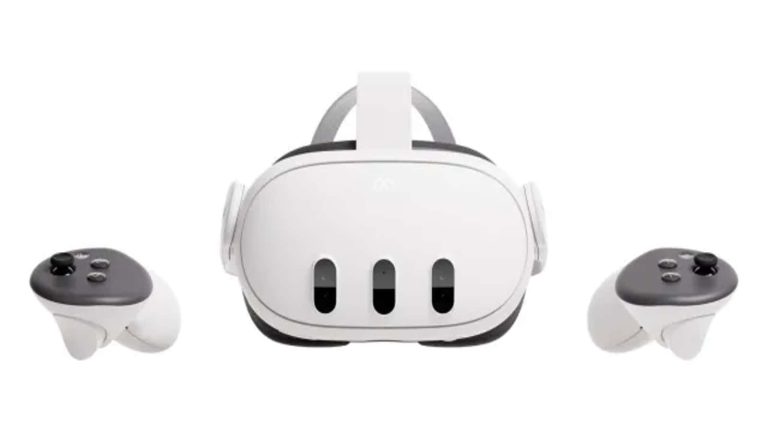
A few hours ago, Meta announced the Quest 3 VR headset as the latest entry into its product line-up. This new product brings a ton of improvements from its predecessor, which makes it more appealing to prospective buyers. The new Quest 3 is succeeding the Quest 2 that became official about three years ago.
One of the major improvements this new VR headset from Meta brings is in terms of its performance. It makes use of the Qualcomm Snapdragon XR2 Gen 2 processor for lightning-fast performance as well as better graphics display. Another area where this new headset sees some improvement is in terms of its design.
Unlike the Quest 2, this new entry comes with dual RGB cameras to help blend the real world with the VR world. With this users can stay in touch with their environment while making use of the Quest 3 VR headset. Here are all the details on the new Meta Quest 3 VR headset that will soon be available for purchase.
Meta Quest 3 specs, features, and everything that makes it stand out from the crowd
With a ton of VR headset brands in the market, there is a ton of competition for the new Meta Quest product. To stand out from the crowd, this VR headset comes with some impressive specifications under the hood. Powering this VR headset is the Qualcomm Snapdragon XR2 Gen 2 processor joined by up to 512GB storage capacity.
With its cameras, users can get a taste of mixed reality from this VR headset. This means that users will be able to see their environment while using the new Meta Quest 3 VR headset. For a more immersive viewing experience, the new Quest 3 uses 4K+ Infinite Display resolution.
The display lenses are designed to be more comfortable and the headset is lighter than the competition. To ensure comfort while in use, Meta uses what they call a Pancake lens as well as a customizable head strap. With its immersive audio experience, users will be able to better enjoy their games.
Meta’s TruTouch Haptics on the Touch Plus controllers also ensures users feel the games as they play. Meta says that they offer over 500+ gaming titles with something for every player to enjoy. Well, the new Meta Quest 3 is not all about gaming, as users can still make use of apps like WhatsApp and Messenger on the VR headset.
This new product from Meta comes in two storage options, 128GB and 512GB. As for their pricing, the 128GB option retails at $499.99 while the 512GB option retails at $649.99. Both storage options are now available for pre-order and will start to ship out in the coming weeks.
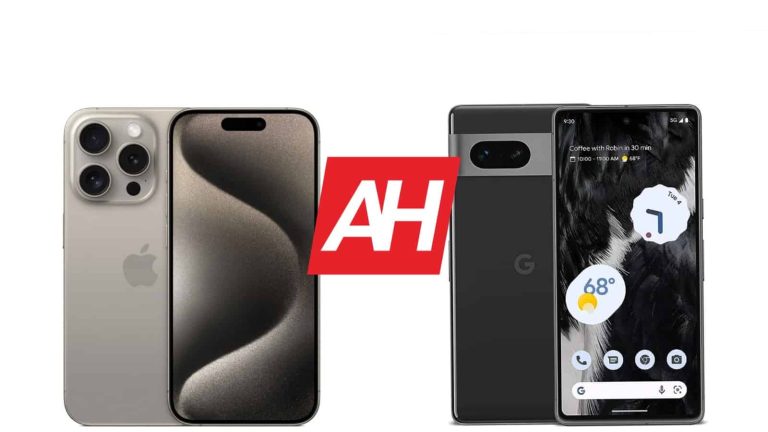
The iPhone 15 series launched not long ago. Four devices got announced, including the iPhone 15 Pro, a smaller top-end model. In this article, we’ll compare the Apple iPhone 15 Pro vs Google Pixel 7. These two are the most powerful compact devices Apple and Google have to offer at the moment. Truth be said, the Pixel 8 series is right around the corner, but comparing these two definitely makes sense at the time.
If you’re tired of huge devices, these two may be good alternatives. We’ll first list their specifications, and will then compare them across a number of categories. We’ll compare their designs, displays, performance, battery life, cameras, and audio performance. That being said, let’s get started, shall we?
Specs
Apple iPhone 15 Pro vs Google Pixel 7, respectively
These two smartphones look entirely different. That goes for all their sides, pretty much. The iPhone 15 Pro has flat sides, which are slightly curved towards the edges. It also has flat front and back sides, with a pill-shaped camera cutout. The bezels on the phone are truly thin and also uniform, while there’s Apple’s signature camera island on the back. There are three cameras included there. The phone is made out of titanium and glass.
On the flip side, the Google Pixel 7, comes with a flat display, and thin bezels, but they’re not uniform. The bottom bezel is slightly thicker than the rest. All of its buttons sit on the right-hand side, which is not the case with the iPhone 15 Pro. It has a centered display camera hole up top, and a camera visor on the back. Two cameras are included in that visor, and it connects to the frame on both the left and right sides. This phone is made out of aluminum and glass.
The iPhone 15 Pro does have a smaller display, and it’s smaller, narrower, and thinner than the Pixel 7. It’s also a bit lighter at 187 grams, compared to 197 grams. Both smartphones do offer IP68 certification for water and dust resistance, and both are very slippery in the hand. The in-hand feel is completely different, but they both feel premium nonetheless.
Apple iPhone 15 Pro vs Google Pixel 7: Display
Apple’s iPhone 15 Pro has a 6.1-inch 2556 x 1779 LTPO Super Retina XDR OLED display. That is a flat panel with a 120Hz refresh rate. It also supports HDR10 content, Dolby Vision, and gets truly bright at 2,000 nits at its peak. The display aspect ratio here is 19.5:9, and we’re looking at 461 PPI on this display. The panel is protected by the Ceramic Shield Glass.
On the other hand, the Pixel 7, has a 6.3-inch fullHD+ (2400 x 1080) AMOLED display. That panel is also flat, and it offers a 90Hz refresh rate. HDR10+ content is supported here, while the panel gets up to 1,400 nits of brightness at its peak. The display has a 20:9 aspect ratio, and the Gorilla Glass Victus protects it. The PPI here is 416, in case you were wondering.
Truth be said, both of these displays are very good. They are vibrant, have good viewing angles, and are quite sharp too. The thing is, the iPhone 15 Pro’s display does get brighter, and that’s something you’ll notice when you’re outside, especially when it’s sunny. On top of that, Apple’s handset offers a higher refresh rate on its display. The difference between 90Hz and 120Hz is not as big as between 60Hz and 120Hz, but if you’re used to 120Hz displays, you may notice that difference.
Apple iPhone 15 Pro vs Google Pixel 7: Performance
The Apple A17 Pro SoC fuels the iPhone 15 Pro, Apple’s most powerful to date. Apple also included 8GB of RAM on the inside, and up to 1TB of NVMe storage. The Pixel 7, on the flip side, is fueled by the Google Tensor G2 SoC. It also includes 8GB of RAM (LPDDR5), and up to 256GB of UFS 3.1 flash storage.
Apple’s SoC is definitely more powerful in comparison, and it’s not even close. The thing is, that chip may be running a bit too hot, and the titanium frame may have something to do with everything. It’s still early to tell, but some units are having problems. It’s nowhere close to the Apple A16 Bionic in terms of heat management, but Apple can affect that. It can tone down its performance, and thus try to amend the issue. We’ll see. It does perform really well day-to-day, and it’s more capable than the Tensor G2 in the gaming department, by a lot. That’s not exactly a bit advantage if it can’t keep the heat down, though.
The Pixel 7 runs really well day-to-day too, and it also runs games well. It does have a problem with the most demanding games, but if you tweak the settings a bit, it can tackle those too. It remains to be seen what will happen with the Apple A17 Pro, though. Some people are having serious issues with it at the time of writing this article. So it may be best to wait a bit, before you buy the phone.
Apple iPhone 15 Pro vs Google Pixel 7: Battery
There is a 3,274mAh battery included inside the iPhone 15 Pro. On the flip side, the Pixel 7 has a 4,355mAh battery on the inside. Apple’s iPhones usually have smaller battery capacities than their Android counterparts, so this is not all that surprising. What’s the battery life like, though? Well, truth be said, neither one of these two phones will break records in terms of battery life, but they’re both good enough for most people.
You should be able to get at least 6 hours of screen on time from both phones, without much gaming included in the package. The Pixel 7 did manage to surprise us, though, and go past the 7-hour mark at times. The thing is, your mileage will vary, as you’ll use the phones differently, with different apps, etc. The battery life is not bad, generally speaking, but it could be considerably better, especially considering the standards the Galaxy S23 Ultra, OnePlus 11, ZenFone 10, and iPhone 15 Plus set, amongst others.
What about charging? Well, the iPhone 15 Pro supports 20W wired, 15W MagSafe wireless, 7.5W Qi wireless, and reverse wired charging. It will support Qi2 as well once it becomes available. The Pixel 7, on the flip side, supports 20W wired, 20W wireless, and reverse wireless charging. Neither of the two phones comes with a charger in the box, though, so keep that in mind.
Apple iPhone 15 Pro vs Google Pixel 7: Cameras
The Apple iPhone 15 Pro includes a 48-megapixel main camera, a 12-megapixel ultrawide unit (120-degree FoV), and a 12-megapixel telephoto camera (3x optical zoom). The Pixel 7, on the other hand, has a 50-megapixel main camera, and a 12-megapixel ultrawide unit (114-degree FoV). Both smartphones take great pictures, but they’re actually different, as you’d expect them to be.
The iPhone 15 Pro leans more towards a more realistic representation of the environment, while Google does process those images to look great, but at times visibly processed. That’s not necessarily a bad thing, of course. Now, the iPhone 15 Pro can actually take 24-megapixel pictures by default, which does help with details, especially in good lighting. The images do end up looking a bit sharper if you pixel peep. The colors are also great. The Pixel 7 still does a better job with HDR, especially when the sun is involved.
In low light, they both do really well, but once again, different. In such scenarios, the iPhone 15 Pro keeps things a bit darker, while the Pixel 7 tends to brighten up the shots quite a bit. Both manage to pull out a lot of detail and optimize the image well. In the video department, however, the iPhone 15 Pro easily wins, it’s not even close, even though the Pixel 7 is not bad in that regard. The telephoto performance in general is a win for the iPhone 15 Pro due to the dedicated telephoto camera, while both ultrawide cameras are good, but not nearly as good as the main shooters.
Audio
Yes, both of these devices have stereo speakers, and both have good output. They’re not the loudest or the best we’ve seen, but they’re more than okay. Not many people will have complaints, as long as you keep in mind these are smartphone speakers. They’re on par, really, there’s nothing significantly better on one over the other.
Neither of the two phones includes an audio jack, unfortunately. They do both have a Type-C USB port however, which you can use to hook up your headphones. If you prefer wireless audio instead, Bluetooth 5.3 is included on the iPhone 15 Pro, while the Pixel 7 comes with Bluetooth 5.2.
Heads up, Apple users! Researchers have caught active exploitation of three zero-day flaws in Apple devices for spyware attacks. Nonetheless, Apple addressed the matter with the latest security updates for iOS, rolling out the patches to eligible devices.
Apple Zero-Day Flaws Exploited Before Patch Releases
According to a recent post from The Citizen Labs, their researchers and Google’s Threat Analysis Group (TAG) observed a tricky exploit chaining three different zero-days in Apple’s iOS devices. Mainly, they noticed that hackers deploying the Predator spyware on target iPhones via this exploit.
Specifically, The Citizen Lab discovered this new exploit while analyzing a victim device. As described, a former Egyptian parliamentarian, Ahmed Eltantawy, contacted the researchers to analyze his phone, suspecting possible intrusion. Consequently, the researchers observed numerous attempts to deploy the Predator spyware on his phone.
Predator is a notorious spyware from the European firm Cytrox, resembling its Israeli counterpart Pegasus. This particular spyware was also used earlier to target Egyptian users’ devices.
The researchers have shared the details about this spyware attempt and their discovery, in their post. In addition, Google TAG has also shared insights about their findings in their report.
Apple Fixed The Vulnerabilities With The Latest Updates
Upon discovering the newly exploited vulnerabilities, the researchers reported the matter to Apple. In response, the Cupertino giant started patching the flaws affecting its iPhones.
Shortly after, Apple released the patches for the three vulnerabilities, which affected iOS versions iOS 16.7 and earlier, with iOS 17.0.1. These flaws include,
CVE-2023-41991: signature validation bypass allowing access to a malicious app.
CVE-2023-41992: privilege escalation vulnerability allowing exploitation from a local attacker.
CVE-2023-41993: arbitrary code execution may become possible upon processing maliciously crafted web pages.
Now that the patches have been released, users must ensure updating their respective devices (iPhone, iPad, Mac, and others) with the latest security fixes at the earliest.
So, you broke your phone. Don’t worry, it happens, but now it’s time to remedy the situation. It’s time for you to do your due diligence and send it off to be repaired. Before you do that, there’s something you need to do first; secure it. Here’s how to secure your Android phone before sending it off.
In this piece, we’ll go over some useful actions you can take to make sure that your phone is safe when you send it off to be repaired. You don’t necessarily have to do all of these methods. However, it’s advised that you do something.
Why should you secure your Android phone?
Securing your phone before sending it to be repaired is an extremely important thing to do. Your phone, especially if you’ve used it for a while, holds a ton of important and sensitive information about you. We’re talking about your email address, home address, phone number, banking information, etc. That’s not to mention the media on your phone like pictures and videos.
When you send your phone to be repaired, you never know if the person taking apart your phone can be trusted. If they manage to gain access to your phone, they could possibly gain access to your sensitive information. You never know if they could steal any of your information or anything else.
Securing your phone makes it so that no one has access to your data when repairing it. It’s not as much of an issue if you’re sending your phone back to the actual OEM to be repaired. However, you’ll want to be careful when you’re sending your phone to independent repair shops.
Remove external storage
People typically keep their files on a micro SD card. Also, people typically forget that it’s in their phone when getting it repaired. It’s extremely easy to forget, and that could be bad if you have sensitive files on your card. The thing is that an SD card is the easiest thing to infiltrate. All the person has to do is pop your SD card out of your phone and copy the files to their device.
Factory reset your device
One recommended way to secure your Android phone is completely erasing all of the data on it. This is called factory resetting it. This means restoring it to the condition that it was in when it left the factory. This way, there’s no way that anyone could gain access to your data. There are a few things to know before factory resetting your phone.
Back up your app data beforehand
The most important thing to know is that factory resetting your phone is not reversible. Once your data is gone, it’s gone for good. This is why you need to back up your data. Doing this will save your data to Google’s cloud servers. After you get your phone back, you can redownload your data and more or less pick up from where you left off.
Depending on what company made your phone, the process could be a little different. Since most Android phones either use stock or near-stock Android, we’ll explain how to do it on stock Android.
Go to your settings and tap on the Google button. On the resulting page, scroll down to the Backup button. On this page, you’ll see how much storage you have left on your Google account. In the middle of the page, you’ll see the Back up now button.
When you press that button, your phone will start uploading your data to the cloud.
Back up your files
The backup feature saves most of your data like your app data, passwords, etc. However, it doesn’t affect your actual files. This means that files like pictures, music, documents, and other files will be deleted. For something like this, you’ll need to save the files in a different location. This could be in the cloud or on an external storage device.
Be careful about the accounts
Android has a security protocol where, when you factory reset the device, you’ll need to sign in with a Google account previously on that device in order to get into it. If you can’t log into that account, the phone is as useful as a paperweight.
So, if you know how to log into your Google account, then you can proceed. This means that if someone turns on your phone while repairing it, they won’t be able to use it. So, it’s highly recommended that you keep your account on the phone.
Just make extra sure that you remember how to log into your account. If you don’t remember, then you’ll want to remove your account from the phone. In the settings, go to the Passwords & accounts button. Find the Google account(s) on your phone and tap on the Remove account button.
When you do that, you’ll get a popup saying that the device’s security will be disabled. Just know that if you remove your account, it makes it possible for anyone to turn on your device and set it up as their own.
Resetting your phone
After your data is completely backed up and your accounts squared away, it’s time to actually reset your phone. Go to your settings and go to the System button. On that page, scroll all the way down to the bottom to the Reset options button.
There, you’ll see some options for things to reset on your phone. On the very bottom, tap on the Erase all data button. The system will ask you if you’re sure. Take this time to make doubly sure that you backed everything up on your phone. Once you press the reset button there’s no going back.
Lock your apps
If you don’t want to bother with setting up your device again, you can simply lock your apps. When you lock an app, you restrict access to that app and only allow people to access it if they put in a password.
This is something that might come with your phone depending on the software you have. For example, phones from Infinix and Tecno both have a function called “App Freezer”. Check to see if you have an app lock function.
If you don’t, then you can look for one on the Google Play Store. A good app to consider is simply called AppLock. You’ll set up a screen pattern when you start up the app. You’ll choose the apps that you want to lock. You can also make it so that you need to enter the pattern just to access the UI.
When you set a pattern for your apps, make sure to use a pattern that’s different from your device’s pattern.
Make sure that the person repairing your phone actually needs to access your UI
If the person repairing your phone asks for access to your UI, make sure that the repair job actually requires access. This is a good way to secure your Android phone. If you’re getting your battery or your screen replaced, chances are that they don’t need access. Make sure you keep an eye on that.