Many of you have food delivery apps installed on your phones like Uber Eats (iOS, Android), Door Dash (iOS, Android), and Grubhub (iOS, Android), to name a few. Through these apps, users can pick a restaurant, order a meal, and have it delivered. And there are some apps, such as Instacart (iOS, Android) and Shipt (iOS, Android), that you can use if you don’t feel like heading out to the supermarket but need groceries to stock your fridge and pantry with.
The DoorDash app will nudge a customer to add or raise the tip left to a driver
One food delivery app in the news is DoorDash. Now you need to understand that most “gig delivery workers” are paid less than the minimum wage and count on tips to earn enough money to pay the bills. Apps like DoorDash will suggest a tip for the driver based on the distance they are driving from the restaurant to your location and the “effort required” to make the delivery. Customers can change the amount they tip based on a set percentage or a custom amount.
The DoorDash app will remind customers to leave a tip or increase the size of a tip left for a driver
According to Insider, back in June, DoorDash added a feature to its app that allows a customer to increase a driver’s tip up to 30 days after a food order is completed. In addition, customers who have not left a tip for their delivery driver will be reminded to do so. Other food delivery firms have followed DoorDash and have added a similar feature to their apps including Uber Eats, Instacart, and Starbucks. DoorDash drivers have a base pay as low as $2 per delivery making the tips they receive extremely important.
Since the customer usually leaves the tip before receiving his/her delivery, this would be a good way for the customer to reward a driver who went above and beyond the call of duty. When announcing the feature in June, DoorDash executive Austin Haugen said, “These new nudges and reminders will encourage customers to tip and show their appreciation after their Dasher delivers an order.”
Some DoorDash drivers are concerned that customers won’t be happy with DoorDash because of the nudging for tips. One such driver, Heather Taylor, who delivers for DoorDash in Corpus Christi, Texas, said, “I think it would be annoying to 80% of customers.” Nonetheless, she says this nudging could hike her income. The tip nudging reminder comes as some drivers have become aggressive when it comes to tips with some trying to shame the customer into raising the tip in the middle of a delivery. DoorDash prohibits drivers from tip shaming customers although it does happen.
“We are literally working for tips,” says a DoorDash driver
Another DoorDash driver, Sergio Avedian, who is a spokesman for The Rideshare Guy blog, delivers about 20 hours a week in Los Angeles and says his base pay ranges on DoorDash and Uber Eats from $1.50 to $3 per order. “When base pay is so low, we have to look for high-tip, low-mileage orders,” he said. “We are literally working for tips.”
“Customers get a maximum of one nudge per order that does not include a tip,” DoorDash said in a statement. “This is not unique to DoorDash and is common practice across gig platforms.” Even during 2020, a great year for gig workers because of the pandemic, a survey from the Economic Policy Institute discovered that 14% made less than the federal minimum wage while 29% made less than the minimum wage in their state.
When Instacart announced its tip nudging feature for its app, the company said, “We’ve rolled out tipping prompts to encourage customers to consider increasing their tip anytime they rate a shopper five stars. The prompts also encourage customers to recognize their shopper’s hard work by leaving a tip if they initially choose not to leave one.” Uber Eats told Insider it has “invested heavily into improving the tipping experience for drivers and couriers.”
Massive Discord.io Data Breach Unveiled: Hacker “Akhirah” exposes a vast data breach on Discord.io, an unofficial service that provides redirect and invite links to Discord servers.
Over 760,000 Users Impacted: The breach, occurring on August 14, 2023, has jeopardized the personal information of more than 760,000 users.
Discord.io Halts Operations: In response to the breach, Discord.io has taken the unprecedented step of shutting down its operations indefinitely.
Hacker Talks to Hackread.com: Akhirah wants Discord.io to remove malicious content from the site in order to put an end to the database sale.
Exposed Data Includes Sensitive Details: Stolen information from the breach includes usernames, Discord IDs, email addresses, and salted and hashed passwords.
Urgent Call to Action: Discord.io urges users to update their passwords to mitigate the impact of the breach, while financial information remains reportedly untouched. Hackread.com is actively seeking more details from the hacker to provide comprehensive insights into the incident.
A hacker using the pseudonym “Akhirah” has unleashed a massive data breach against Discord.io, a non-official service known for providing redirect and invite links to Discord servers. The data breach, which occurred on Monday, August 14, 2023, has put the personal information of approximately 760,000 users at grave risk.
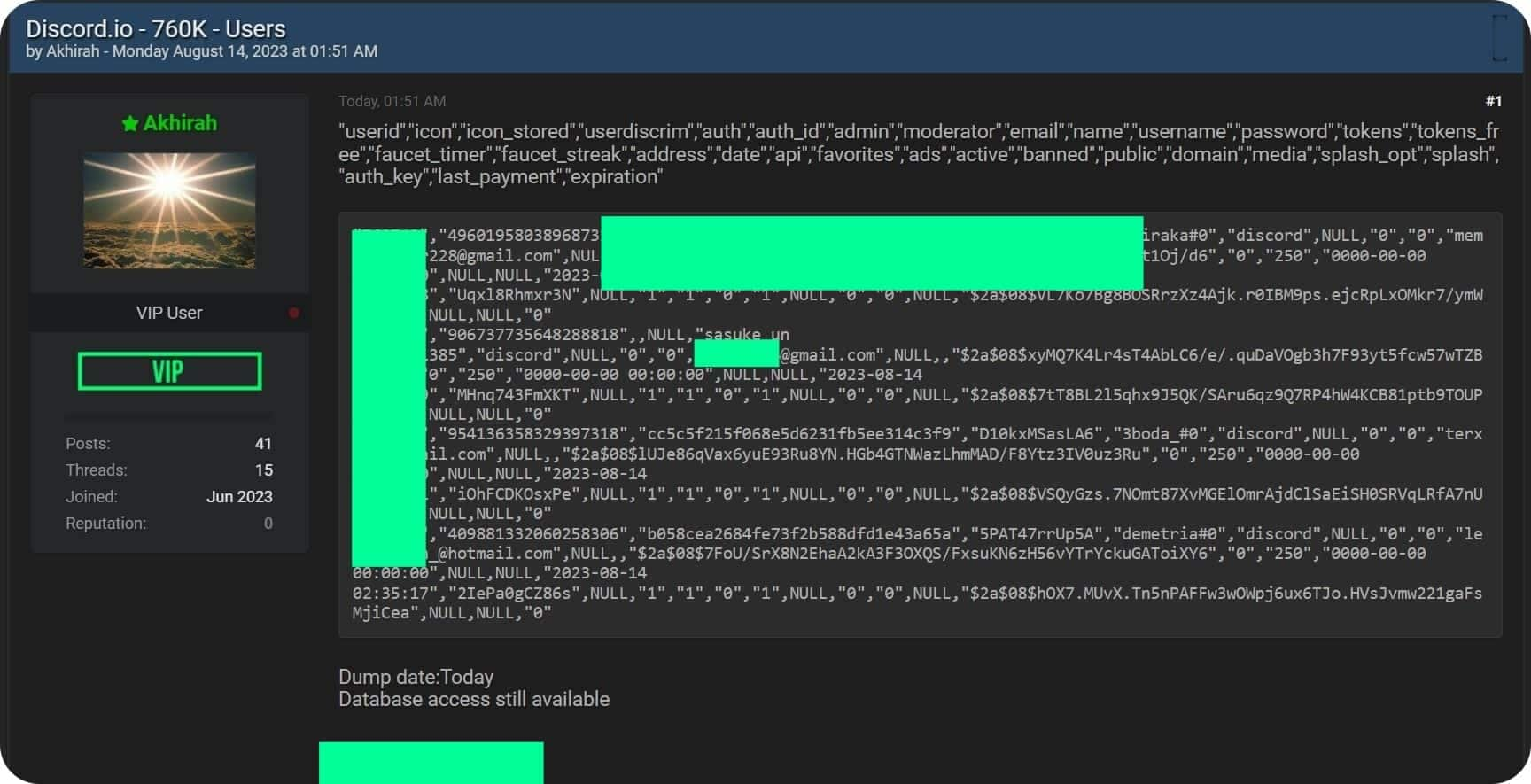
Currently, the database is being sold on the new version of Breach Forums that surfaced recently under the leadership of the infamous ShinyHunter hackers.
Discord.io database on Breach Forums (Screenshot: Hackread.com)
Initial glimpses into the database are troubling, as usernames, Discord IDs, email addresses, and salted and hashed passwords have all fallen prey to this data breach. Although the hashed nature of passwords may offer a thin silver lining, the potential for decryption looms large, underscoring the urgent need for users to fortify their defences which is why Discord.io has urged users to reset and update their passwords.
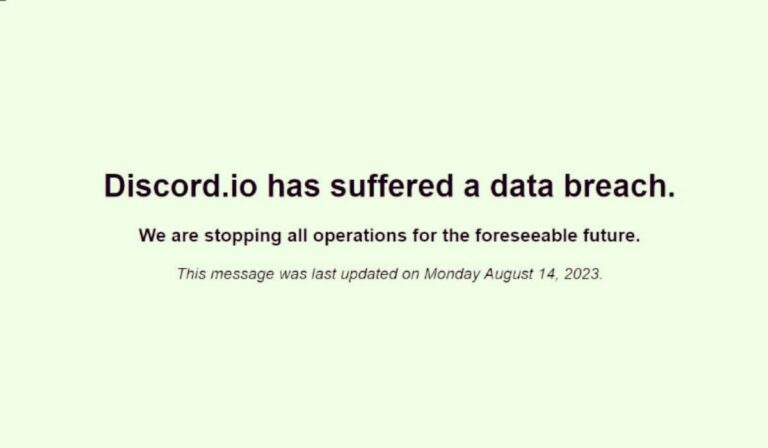
Additionally, Discord.io maintains that no financial data has been infiltrated or exposed in this breach. However, while the extent of this breach is still unfolding, Discord.io has taken a drastic step in response. The service, which was already skating on thin ice, has decided to cease all operations indefinitely in the “foreseeable future.”
Visitors to Discord.io are now greeted with a message detailing the severity of the breach. The company, in an act of transparency, has laid out the compromised data fields. This initiative aims to provide clarity to affected users about what information is now exposed and what remains untouched in the cataclysmic wake of this incident.
“We have cancelled existing premium subscriptions and we’ll be reaching out as soon as possible on an individual basis. As of this message, we have not yet been contacted by the people responsible for this breach nor have we reached out to them. As far as we currently know, the database itself has not yet been shared publicly.”
Discord.io
Here is a screenshot from Discord.io admitting the data breach and providing in-depth details about what data was stolen and which information remained untouched.
Homepage of Discord.io right now (Screenshot: Hackread.com)
Interview with the hacker Akhirah
Akhirah responded to Hackread.com, and we managed to ask him a couple of questions about the breach. Akhirah claims he is least interested in selling data; however, he wants Discord.io to remove malicious content from their site and get in touch with him to resolve the issue – no retribution or bounty required.
Hackread.com: Discord.io has shut down its operations. Would you share your thoughts on that? and share some details of how did you manage to breach them, and if you have access to their payment section as well?
Akhirah: First I have to say I hate Discord and its audience, I think most of them are paedophiles, I put the data on the market to sell but I’m not sure about it, and I haven’t sold it to anyone yet, but there are so many demands, I want to talk to the management of discord.io and agree on some issues. Plus, I don’t have access to payment-related data, just stuff I’ve shared an example of
Hackread.com: By talking to them do you mean resolving the issue and discarding the data or asking them for some sort of retribution?
Akhirah: I want to talk to him about sissy, femboy etc content and blacklisting of paedophile talks from now on.
Hackread.com: So if they remove the malicious content and people you would agree to safely discard the data and that would be the end of it?
Akhirah: Yes, that can be said. Too many children want to buy this data, it’s true that I sell data, but I’m not sure I want to sell this data. I just want to talk and agree with the admin about the sensitive issues I mentioned.
Hackread.com: Have you contacted Discord.io?
Akhirah: No, they are the victims right now and they didn’t try to talk to me, I invite them to talk, I would appreciate it if you could share this on your site.
Discord.io becomes the latest platform to shut down due to data breaches. Just a week ago, LetMeSpy Android Spyware Service also announced its permanent closure following a hacker’s successful breach and access to user data.
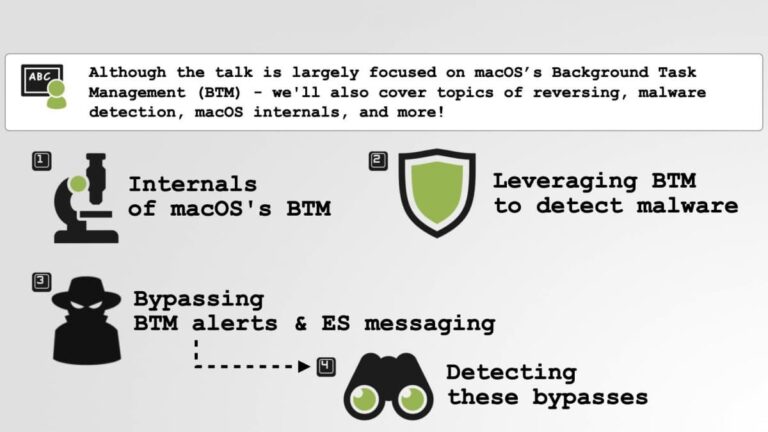
Background Task Weaknesses: macOS Ventura’s Background Task Management has vulnerabilities that allow hackers to evade detection and install malware.
Researcher’s Revelation: Patrick Wardle, a respected Mac security researcher, unveiled these vulnerabilities at the Defcon hacker conference.
Monitoring Tool’s Purpose: Background Task Management is intended to detect and alert users to software persistence, ensuring data retention after restarts.
Sophisticated Exploitation: Despite alerts and notifications, Wardle’s research shows that advanced malware can bypass the monitoring system, even without root access.
Apple’s Response Awaited: Apple has yet to respond to these findings, raising concerns about the efficacy of macOS Ventura’s security enhancements.
Renowned Mac security researcher Patrick Wardle recently unveiled potential weaknesses within Apple’s macOS Ventura, shedding light on vulnerabilities in the Background Task Management mechanism. This revelation calls into question the efficacy of Apple’s latest monitoring tool designed to detect and mitigate malware.
Image: Patrick Wardle
During his presentation at the Defcon hacker conference held in Las Vegas, Wardle shared insights into how malicious actors can exploit macOS Ventura’s Background Task Management to bypass monitoring and potentially compromise user devices.
The Background Task Management tool, introduced with macOS Ventura, aims to detect instances of software “persistence,” which is when malicious software establishes itself on a device and remains active even after restarts. Such persistence is crucial for legitimate applications, ensuring users’ apps, data, and preferences are retained across device reboots.
However, Wardle’s findings suggest that the implementation of this monitoring tool is not foolproof. Apple added Background Task Management to send notifications to users and third-party security tools if a “persistence event” occurs, alerting users to unexpected or potentially malicious persistence. Despite this enhancement, Wardle’s research demonstrates that sophisticated malware can easily evade the monitoring mechanism.
Wardle’s research focused on pinpointing vulnerabilities within the Background Task Management’s structure. He highlighted that some bypass techniques require root access, effectively granting attackers full control over a compromised device, allowing them to manipulate persistence notifications and install malware without user awareness.
More concerning are two other bypass methods that don’t necessitate root access, exploiting flaws in how the alerting system communicates with the operating system’s core (the kernel) and leveraging the capability to put processes to sleep.
The security researcher’s findings reflect broader concerns about the efficacy of macOS Ventura’s security enhancements. Wardle emphasized that the rushed implementation of monitoring tools can give users a false sense of security, potentially overlooking critical security risks.
Apple has not yet responded to requests for comment regarding Wardle’s findings. Despite the vulnerabilities exposed, Wardle remains hopeful that these revelations will encourage Apple to refine its security measures further, ensuring a safer environment for Mac users.
Last week, a rumor surfaced that Samsung will equip the Galaxy S24 Ultra with a new 50MP telephoto camera with 3x optical zoom. It would be a notable resolution upgrade from the 10MP sensor found on the current model. Tipster Ice Universe, who originally passed that rumor, has now shared more details about the new camera.
According to the source, the Galaxy S24 Ultra’s 50MP zoom camera will have a sensor size of 1/2.52 inches. That’s a bigger sensor than the Galaxy S23 Ultra’s 10MP camera. However, with five times more pixels, the pixel size has dropped from 1.12µm to 0.7μm. Samsung will probably rely on pixel binning to capture bright zoom photos during low-light conditions.
Meanwhile, a higher resolution means you’ll get better photos at non-native zoom levels as well, as long as the lighting is adequate. The source says the Galaxy S24 Ultra will offer “a good 5x zoom image quality” thanks to the new camera. The improvements are so big that Samsung plans to emphasize the sensor’s 5x zoom capabilities despite only offering 3x digital zoom.
If you remember, there have been rumors about the Galaxy S24 Ultra getting a dedicated 5x zoom camera in place of the 3x solution. Those rumors were dismissed by a reputed source a couple of months back. It turns out the rumors originated from Samsung’s new 50MP 3x zoom camera with improved 5x zoom capabilities. Unfortunately, it’s unclear if the new Ultra will also get an upgraded 10x zoom camera. The current model uses the same 10MP sensor.
The Galaxy S24 Ultra will also feature an upgraded OLED display
Along with cameras, Samsung will reportedly also upgrade the Galaxy S24 Ultra’s OLED display. While details are scarce, the same source “can confirm” that the upcoming Galaxy flagship will not keep the same screen as the current Ultra. Perhaps Ice Universe is referring to the recent report that the Korean firm will use M13 OLED panels on its 2024 flagships.
Originating from South Korea, the report last week stated that Samsung is almost certain to apply an M13 OLED display on the Galaxy S24 Ultra. It was said to be evaluating its application on the Galaxy S24 and Galaxy S24+. The new display tech allows for better picture quality while simultaneously reducing the panel thickness and power consumption. Hopefully, Samsung will use the same display on the two smaller Galaxy S24 models as well. The new Galaxy flagship will debut in early 2024.
In recent years, OLED monitors have become an increasingly popular option for gamers who want high refresh rates without compromising picture quality. However, as OLED monitors become more mainstream, the issue of burn-in has once again affected many users. Now, according to a recent report from The Verge, LG has officially confirmed a two-year warranty for burn-in on its monitors in the United States.
This clarification came after The Verge reviewed LG’s flagship 27-inch OLED gaming monitors and highlighted that the warranty did not extend to “burned-in images resulting from improper usage.” After a series of inquiries, Christopher De Maria, LG’s head of consumer PR in the US, provided a definitive response, stating, “LG now offers a two-year burn-in warranty for its OLED gaming displays.” Additionally, the company also highlighted that the updated warranty applies to both current owners of the LG 27GR95QE-B monitor and future buyers.
Some major caveats
While this new burn-in warranty offers a much-needed assurance for OLED monitor buyers, the coverage is contingent upon the monitor experiencing “normal and proper use,” explicitly excluding damage caused by “misuse [or] abuse.” This means that the warranty will cover burn-in as long as an individual uses the monitor for its intended purpose, specifically as a personal PC monitor in a residential setting, excluding commercial applications like retail signage displays. LG does not cover commercial applications due to the prolonged display of static images, which can lead to burn-in.
“Normal use means the product is used for what it was created to do. In this case, that is gaming (professional and casual) as well as desktop computing such as Windows,” said De Maria, LG’s head of consumer PR for North America.
Still better than other manufacturers
Although LG’s warranty coverage comes with conditions, it surpasses that of Acer and Asus, which do not explicitly include burn-in in their formal warranty coverage and address such cases on an individual basis. However, as the industry trends towards more widespread use of OLED monitors, manufacturers will need to enhance their warranty policies to encompass burn-in damage.
A new info-stealing malware is running active campaigns against Windows users, according to the researchers. Identified as Statc stealer, the malware can pilfer various types of sensitive information, including browser details and stored data.
Statc Stealer Threatens Windows Systems
In a recent report, researchers from Zscaler ThreatLabz have shared insights about a newly detected malware targeting Windows systems.
As elaborated, the malware, identified as Statc stealer, constitutes a new family of malware exhibiting diversified evasive and data-stealing capabilities.
Specifically, Statc is a C++ malware with effective detection capabilities for reverse engineering and sandbox environments. The malware spreads via malvertising, often mimicking legit advertisements to trick users. Clicking on an ad downloads the malware dropper on the device, where it further downloads a decoy PDF installer and another binary file that downloads the Statc payload via PowerShell script.
Once established on the device, Statc begins performing data-stealing activities, pilfering browser details and stored data from the browsers, including login credentials and crypto wallets, transmitting all stolen data to its C&C server.
If the user stored personal details in the browser for auto-filling forms, then the user also risks identity theft due to this activity. The malware can target various popular Windows browsers, such as Google Chrome, Mozilla Firefox, Microsoft Edge, Opera, Brave, and Yandex.
Alongside browser data, the malware also exploits Windows Process Monitor (ProcMon) component to steal other information, such as Anydesk and Telegram data.
After stealing the desired information, it stores the data as text files in the Temp folder, from where it transmits to the C&C after encryption.
Besides data stealing, Statc malware also exhibits evasive capabilities to bypass security controls.
While the malware presently targets Windows systems only, it remains unclear if the attackers plan to enhance Statc’s capabilities to target other systems as well.
As always, the key to evading Statc and similar malware infections is to avoid clicking on irrelevant links, advertisements, and unsolicited messages. Moreover, users must equip all their devices with robust anti-malware programs.
Fake Chrome Browser Update Scam: Trellix exposes a scheme using fake Chrome browser updates to sneak NetSupport Manager onto victim computers, granting cybercriminals control and data access.
Possible SocGholish Link: While resembling SocGholish, differences in tools raise doubt about a direct connection, highlighting evolving tactics.
Compromised Sites as Launchpads: Compromised websites act as launchpads for the attack, affecting diverse sectors, including government and finance.
Deceptive Path to RAT: Victims fall for the fake update, unknowingly downloading a malicious JavaScript file, “Browser_portable.js,” which activates NetSupport Manager.
Urgent Need for Vigilance: Trellix’s discovery underscores the critical importance of global threat intelligence and advanced security solutions in countering evolving cyber threats.
Cybersecurity firm Trellix has identified a new cyber campaign exploiting unsuspecting victims by disguising itself as a legitimate Chrome browser update. The deceptive scheme employs a malicious remote administration tool (RAT) known as NetSupport Manager RAT, allowing threat actors to gain unauthorized access to victims’ computers and seize control.
Moreover, the Trellix Advanced Research Center uncovered striking similarities to a previously reported SocGholish campaign, although a definitive connection remains elusive. Yet, concrete links between the two campaigns remain scarce.
The campaign, which came to light in late June 2023, exploits compromised websites as a platform for delivering the fraudulent Chrome update. Victims are lured into downloading and installing the fake update, unwittingly inviting the NetSupport Manager RAT onto their systems. The malware allows cybercriminals to pilfer sensitive information and manipulate victim computers to their advantage.
The modus operandi of the campaign involves injecting compromised websites with a carefully crafted HTML script tag that retrieves JavaScript content from the attackers’ command and control server.
This technique, seemingly automated, hinges on the unsuspecting victims falling for the fake browser update ruse. The success of the scheme relies heavily on the prevalence of compromised websites.
Trellix researchers found evidence of this campaign infiltrating a Chamber of Commerce website, with traffic from governmental entities, financial institutions, and consulting services. Although the site has since been cleansed of the injected script, it suffered compromise for at least one day.
The deceptive journey commences when victims encounter the injected script on a compromised website, leading them to a fake browser update page. This manipulation, which directs users to unwittingly install the NetSupport RAT, isn’t novel; similar tactics have been documented in past instances like the SocGholish campaign.
However, it’s the tools employed in the present campaign that stand apart from SocGholish. SocGholish exploited PowerShell with WMI capabilities to facilitate RAT download and installation. In contrast, the current campaign utilizes batch files (.BAT), VB scripts, and the Curl tool to carry out its malevolent operations. The use of these distinct tools underscores the evolving strategies of cybercriminals.
Should a victim succumb to the allure of the fake browser update and click on the “Update Chrome” link, a ZIP archive named “UpdateInstall.zip” containing a malevolent JavaScript file, “Browser_portable.js,” is initiated for download. This script serves as a downloader for the ensuing stage of the attack.
Upon extraction of the NetSupport Manager RAT via the downloaded 7-zip utility, execution transpires via a scheduled task, orchestrated by the “2.bat” batch file. Furthermore, this batch file also engenders persistence for the RAT, ensuring automatic execution upon system startup.
The malevolent configuration file (“client32.ini”) for the RAT reveals a gateway address set to 5.252.178.48. At this juncture, with the RAT firmly entrenched within the victim’s system, threat actors possess substantial control, enabling them to execute further malware deployment, data exfiltration, network reconnaissance, and lateral movement.
The infection chain (Screenshot: Trellix)
In conclusion, this campaign serves as a reminder that threat actors consistently exploit successful techniques to advance their malicious agendas. The deployment of familiar lures, such as the phony browser update, underscores the persistent nature of these attacks.
The proliferation of RATs, while not always updated, showcases their enduring utility for cybercriminals. As attackers adopt increasingly sophisticated tactics, the challenge of detection intensifies. The utilization of native Windows scripting languages, like VBScript and Batch script, combined with tools like Curl, exemplifies their adaptability and innovation.
Joseph Tal, Senior Vice President of Trellix’s Advanced Research Center, cautioned that the prevalence of these NetSupport RAT attacks underscores the need for comprehensive global threat intelligence and innovative security solutions.
Commenting on this, Dr Klaus Schenk, senior vice president, Security and Threat Research at Verimatrix told Hackread.com that “The reports of threat actors exploiting fake Chrome browser updates to spread the NetSupport Manager Remote Access Trojan are concerning. While the attack vector of abusing browser updates is common, this particular campaign stands out for its sophistication and targeting. The attribution to the SocGholish group, known for cyber espionage aligned with Russian state interests, makes this a high-priority threat.“
“While the details connecting this attack to SocGholish are inconclusive, the examination by Trellix seems reliable. The threat actors clearly spent time crafting a credible lure using Chrome’s market dominance. I recommend to wait a bit to see if this attacks manifests — but it would be a good idea to prioritise incident response and user education to detect and mitigate this threat,” Tal added.
“Even though users must still click a malicious link, the sophistication of this attack makes it likely to evade defenses. We should continue monitoring for new developments, but organisations should act swiftly to harden systems, update browsers, and inform personnel about this threat,” Tal recommend.
Nevertheless, the continually evolving threat landscape necessitates a proactive and holistic approach to cybersecurity, particularly as more enterprises rely on Chromium-based browsers for their web applications.
Netflix Games is a masterclass in patience and perseverance. The platform was slow to pick up speed with less than 1% of its audience using it. However, it’s been hard at work trying to make it a compelling platform. Now, Netflix announced that Netflix Games are expanding to more platforms. Get ready to play your favorite Stranger Things game with a mouse and keyboard.
In case you don’t know, Netflix has been pushing to have its own gaming platform, and that’s Netflix Games. It’s rather different from other platforms, however. If you have an active Netflix account, then you’ll be able to download a limited list of exclusive games from the Google Play Store or the iOS App Store. So, it’s not really a platform, but the company seems to be leaning in that direction.
The streaming giant even purchased different studios to produce games. If that’s not enough, last year, Netflix partnered with Ubisoft to make an exclusive Assassin’s Creed game.
Now, Netflix Games is expanding to more platforms
For the time being, you can only play Netflix games on your phone or tablet. However, the company wants to change that. Netflix announced today that it’s expanding Netflix Games to more platforms. Along with phones, you’ll be able to play your games on your computer by using your browser. When you do this, you’ll be able to play your games using your mouse and keyboard.
That’s not all, as Netflix really wants this available everywhere. The company also stated that you’ll be able to play on select smart TVs as well. This includes Amazon Smart TVs, Google Chromecast devices, Roku TVs, LG TVs, Samsung TVs, Nvidia Shield TVs, and Walmart ONN TVs. Interestingly, Netflix will let you use your phone as a controller. You can see that in the image below.
So, it seems that Netflix is looking to make it feel like its gaming platform is an actual platform. Only time will tell if this entices more people to jump on.
Apparently, Elon Musk posted a screenshot of his text messages with Mark Zuckerberg over on X this weekend. And the story isn’t what was said during the text exchange, but the fact that Zuck uses an Android. And we can tell this because Musk’s replies to him are in green, indicating SMS instead of iMessage.
It’s a bit odd that so many people on X care that Zuck is even using an Android device. But it’s pretty crazy that so many do care about that. Zuck is a billionaire, much like Musk, but for some reason, the fact he uses an Android device is such a big deal.
Now, the text messages themselves talk about how Musk keeps coming up with excuses for not fighting Zuck. And that he doesn’t want to keep hyping up something that won’t happen. To which Musk mentions “let’s fight in your Octagon” after mentioning he will be in Palo Alto on Monday. Musk still really thinks that he can beat Zuck pretty easily, mainly due to the difference in size.
Zuck using Android is not a huge surprise
There’s two reasons why Zuckerberg using an Android phone is not a huge surprise. Firstly, we know that Instagram’s head, Adam Mosseri uses an Android device. In fact, he talked quite extensively on Threads about switching recently. So seeing Zuckerberg using Android is not a big surprise.
The second reason is, Apple cut Facebook’s ad revenue quite considerably a couple years ago with iOS 14.5. When Apple debuted iOS 14.5 a couple years ago, they debuted a feature where the user could decide if the app follows them or not. Obviously, many selected “Ask not to track” for Facebook. Which caused Facebook to lose billions of dollars per year in ad revenue. And it wouldn’t be to crazy to see Zuck make the switch to Android over spite.
Microsoft Office has come a long way since it was introduced back in 1990, both in terms of functionality and aesthetics. According to a new report from Techradar, Microsoft Office is getting a new look along with a new font.
We don’t have any visuals on this new update at the moment, but the Microsoft 365 Roadmap entry does give us a little bit of information about it. Basically, this new theme will be seen across several Microsoft Office applications and services. The entry listed off Word, Excel, PowerPoint, and Outlook as the platforms getting the new theme.
It noted that these applications will use an updated color palette, and it’s interesting to think about what the company will use. The current color palette is professional and responsibly vibrant. It’s colorful enough to catch the eye, but it’s not over the top. We’re not sure if Microsoft will bring a more colorful palette or if it will go in the opposite direction.
Along with the new color palette, Microsoft also mentioned that there will be a new default font along with this new change. The font is called Aptos, and it’s notable for being pretty easy to read. It’s a san-serif font that’s pretty straightforward in its appearance.
Lastly, this new look will also involve updated default line widths. We don’t know what the company is planning on doing, so We’ll have to wait and see.
Microsoft Office is testing its new look now
as with any sort of major design update, it goes through extensive testing before it makes it to the public. This is the case with this new look for Microsoft Office. We’re not sure if the company is testing it with users or if this is only internal.
In any case, Microsoft mentioned that this updated look will make it to the public sometime in September.