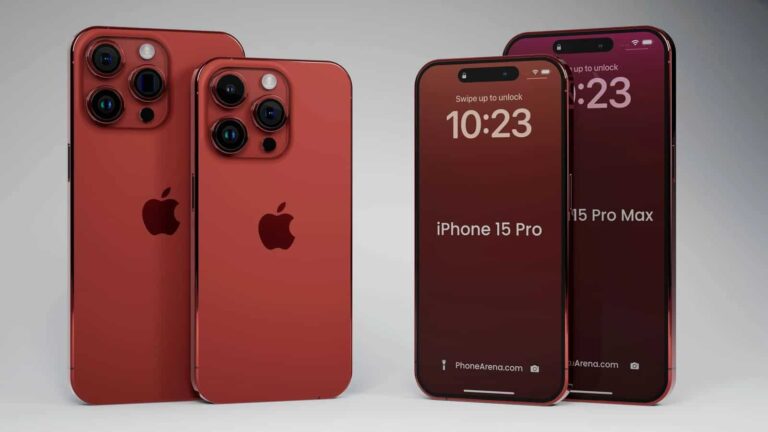
Apple has been launching its iPhone in September since the iPhone 4S, which was way back in 2011. And from time to time, the actually release of the phone does get pushed back until October, and even November with the iPhone 12 in 2020. It’s fairly rare, but it does happen.
This year, it might be happening again. According to an analyst at Bank of America, Wamsi Mohan, they believe that the launch of the iPhone 15 could be delayed by “a few weeks”.
This was part of a research note that was published, after conducting channel checks inside Apple’s supply chain. Mohan stated that the launch could slip into the fourth quarter. Which isn’t too crazy, since the iPhone typically launches about a week or two before the fourth quarter starts.
What’s interesting here is that Mohan did not give any reason for the alleged iPhone 15 launch delay. And there’s also been no other indicators that a delay could happen. So as always, take this with a grain of salt.
Will the iPhone 15 be delayed?
Honestly, it’s hard to say. While Mohan is an analyst with insider knowledge of Apple and its supply chain, the fact that he did not mention a reason for a potential delay has a lot of people shaking their heads. Now, if we see more analysts and leakers come out saying they expect a delay, then it’ll be a bit more likely. So we’ll just have to wait and see.
Typically, Apple announces the iPhone the week after Labor Day. Last year they did launch it that same week, on that Wednesday, but typically it’s the following Tuesday. With pre-orders starting that Friday, and orders arriving the following Friday.
In the past, we have seen a few models get delayed. Like the iPhone 14 Plus was delayed for a little over a month. We also saw the iPhone 12 Mini and iPhone 12 Pro Max get delayed a month in 2020, after the entire announcement was already delayed a month. Though that was understandable, with the pandemic and all. So we’ll just have to wait and see.
It’s like we’re re-living the same day over and over again, like Bill Murray’s character in the 1993 flick ‘Groundhog day’. Another day, another price hike news. This time we’re talking about YouTube Premium. Its monthly rate is going in one direction: up.
$13.99 instead of $11.99: this is the monthly sum for an individual Premium account that will greet US newcomers at YouTube Premium’s subscription page (via 9to5Google). Though not yet announced officially by Google, the new price is already there and you can check it at youtube.com/premium. Bear in mind that if you’re located outside of the US, this URL may show subscription prices in your local currency, not USD.
Please note that $13.99 is for Android/web users. If you’re subscribing from the iOS YouTube app, you’ll have to reach deeper for $18.99.
There’s a slight price hike ($1) in subscription for the YouTube Music standalone app: from $9.99 to $10.99.
The (sort of) good news is that at the moment existing YouTube Premium accounts that are ‘locked’ at $9.99 price from the last price hike five years ago are not facing the new $13.99 price.
Globally, security analysts and IT professionals heavily rely on Virustotal, a vast malware database, to scan files for viruses and malware. Even it also enables users to upload suspicious files or links to assess potential threats effectively.
VirusTotal, crucial in the battle against cyberattacks, is utilized by 70 antivirus manufacturers to compare submissions for suspicious code.
VirusTotal’s data breach exposed a subset of registered customers’ names and email addresses when an employee accidentally uploaded the data to the scanning portal of the platform.
Der Spiegel and Der Standard disclosed recently that in June, a small 313KB file unintentionally goes public, containing 5,600 names, including NSA and German secret service employees registered on VirusTotal.
Data Leak
VirusTotal, established in 2004, analyzes suspicious files and URLs for malware using antivirus engines and website scanners. However, Google acquired it in 2012, and in 2018, it became a Google Cloud Chronicle subsidiary.
Google confirmed the leak and acted quickly to remove the data, acknowledging an employee’s accidental distribution of customer group admin emails and organization names on VirusTotal.
Within an hour, Google removed the list and is now examining internal processes and technical controls for future improvements.
The data reveals government employees’ names, some present on LinkedIn, including reluctant ones, which adds importance, given their confidential nature and information access.
The leak impacts Austria’s Federal Ministry of Defense and Interior, including three BSI employees. It also affects German corporations like Deutsche Bahn, Bundesbank, and Dax giants such as:-
Allianz
BMW
Daimler
Deutsche Telekom
Abusive opportunities
Names and email addresses leaked, but passwords seem unaffected. However, the breach discloses IT security personnel in companies, services, and organizations, creating potential for social engineering and targeted phishing attacks.
The VDMA (The German Association of Mechanical Engineers) accidentally shared a portal link and password via email, visible to all Virustotal users, allowing hackers to access the portal and check for detected and undetected attacks. While the association claims they were unaware of the exposure.
Hackers employ Virustotal to evade antivirus detection for their spy software. While their basic version is free, but, paid options also exist, which enable storing files on their servers.
Experts suspect secret services use it too, testing attack codes against 70 antivirus manufacturers and tracking hackers who upload their tools.
BSI employee impact is seen as “uncritical,” but for others, risk assessment remains uncertain. Besides this, there is a strong recommendation from BSI to not upload any files to the VirusTotal scanning portal.
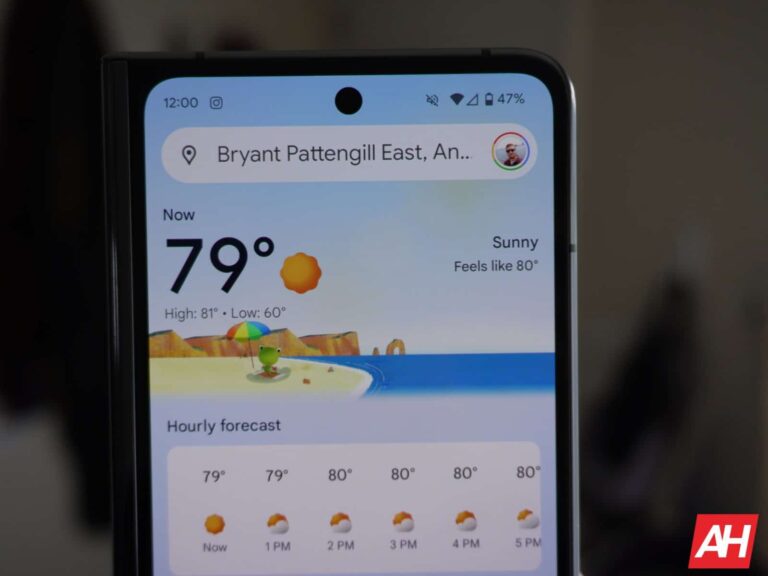
With the Google Pixel Tablet and Pixel Fold, the company debuted a redesigned version of the Weather app. And many absolutely love how it looks – including yours truly. The redesign still has not fully rolled out to phones and tablets. It’s still really only available on the Pixel Tablet and Pixel Fold, but Google is still making changes to it.
It’s really just one minor change that has been added to Google Weather here, and that’s a transparent status bar and nav bar. Which makes the app look even more beautiful and more immersive. Obviously, this is likely not an app you spend a lot of time in everyday, but still a nice change here.
The new interface should be rolling out to phones soon
It’s unclear when Google is going to roll out the new interface to other Pixel devices, and anything else that uses Google Weather. But it should be pretty soon. This is not an Android 14 feature, since it does run on Android 13 on the Pixel Tablet and Pixel Fold. So it’s unclear why it’s taken so long.
But this redesign looks amazing. It’s a lot more immersive, giving you data front-and-center. So you don’t need to scroll to get more information. Of course, that information is also available at the bottom, like the current conditions. That includes wind, humidity, UV index and Pressure. As well as the sunrise and sunset. You can also tap into each day and get the hourly conditions for the days ahead, which is a really nice feature to have at your fingertips.
Hopefully Google does roll this out to other Pixels in the very near future. We’re guessing it’ll be with the next feature drop. Which is currently set for when Android 14 rolls out around September. Normally, Android 14 comes with the first feature drop for Pixels on the new version of Android.
Instagram is bringing its users new features to help them create content faster and easier. With Reels templates, Instagram hopes to bring the right tools to further improve the overall content creation experience on its social app.
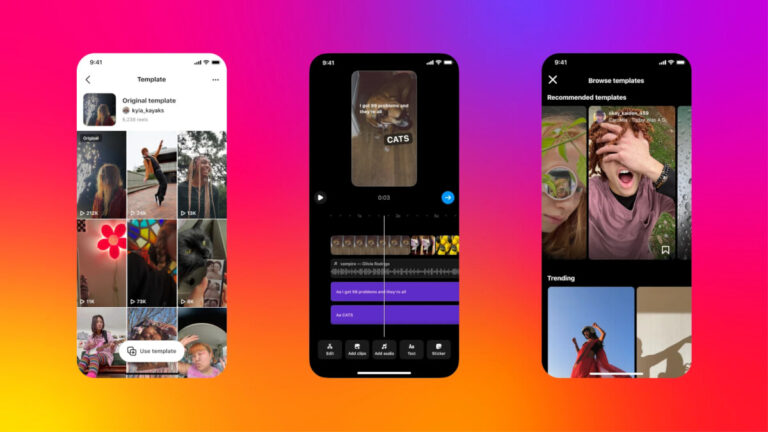
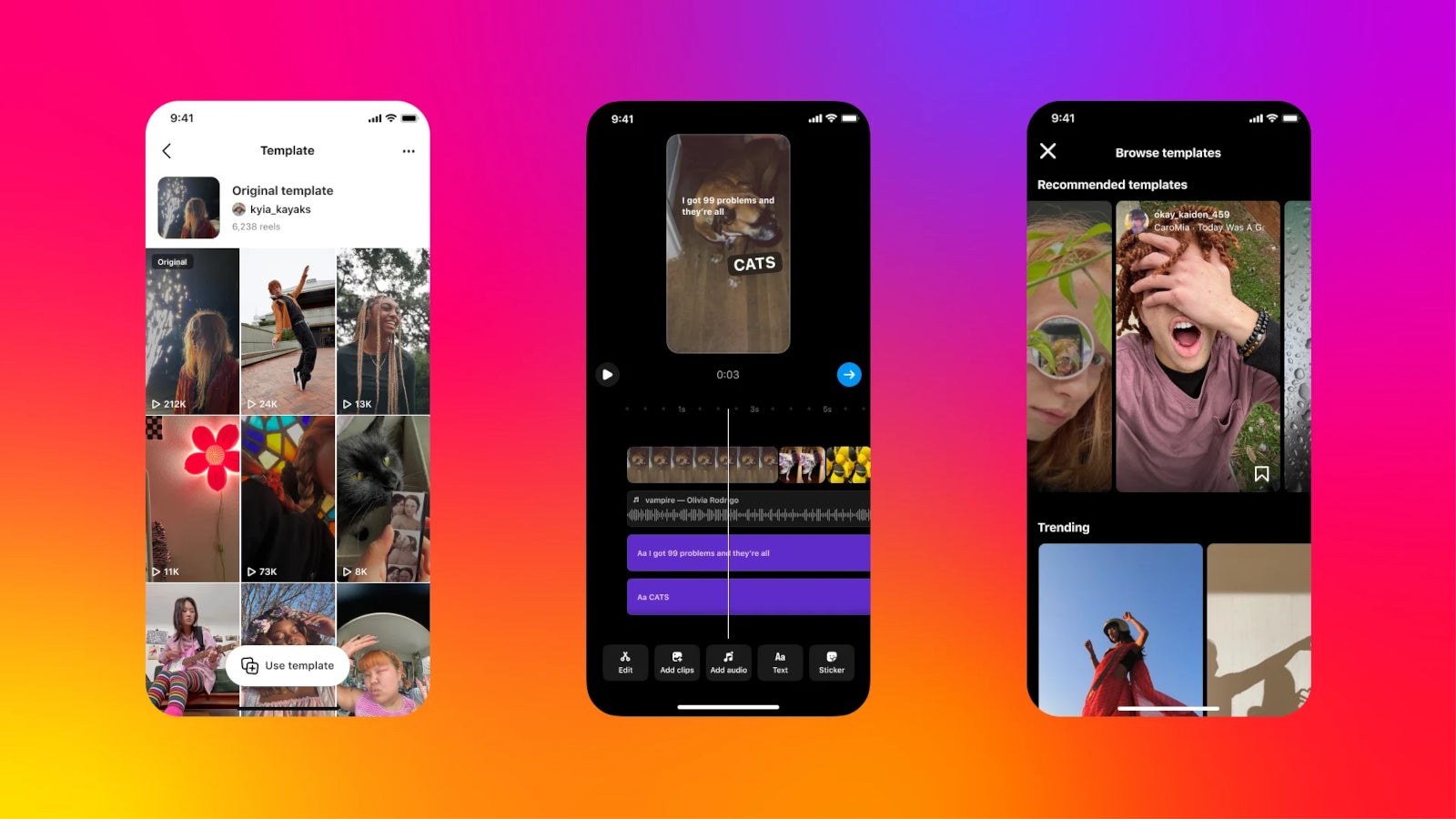
The latest Instagram update introduces a new and improved Template Browser where users can find templates by category, organized by Recommended, Trending, and templates or audio they saved. To access the new Template Browser before you start creating a reel, here is what you need to do:
Tap on the create button from the home page
Tap on “REEL”
Tap the image in the lower left corner of the screen to open to your camera gallery
Tap on “Templates”
Alternatively, the Template Browser can also be accessed through the Reels Tab by simply tapping on the camera icon, then choosing “Templates.” Once you find a template that you like, tap the “Use Template” button on the reel to start making it your own.The new bundled of tools also comes with the ability to see what templates others have used by tapping on the “Template by” button in the reel, which will redirect you to a page with examples of how people created their own reels starting from a template.
In addition to all these improvements, Instagram announced that the latest update will enhance the creation and editing experience for templates. For starters, the audio, number of clips, duration of the clips, and AR effects will automatically be added to your reel when you create one from the template.
Following this update, new features will be added to the app in the coming weeks, which will make it possible to automatically add text and transitions that were used in the original reel. All templates will be customizable, so Instagram users will be able to add or remove clips, adjust the timing of individual clips, as well as edit any preloaded element.
In an unfortunate turn of events, the computer hacker from the 1990s, who was involved in high-profile cases of computer data theft and credit card number stealing, passed away due to pancreatic cancer.
When he was 16 years old, Mitnick started his career as a hacker by accessing unsecured networks without authorization.
In the 1980s, he set his sights on Digital Equipment Corporation’s computer system as his first target.
He was given a one-year jail term, followed by three years of supervised release by the court.
Unfortunately, he was apprehended again for hacking Pacific Bell’s voicemail systems towards the end of his previous release. This led to a warrant being issued for his arrest.
Hacking into cell phones and illegally copying software led to many prison terms for Mitnick, including eight months in solitary confinement.
In January 2000, Kevin completed his last prison sentence, which he jokingly referred to as a ‘vacation.’
Following this experience, he underwent a transformation and embarked on a new career path as a White Hat hacker and security consultant.
Kevin Mitnick later became a security evangelist and ‘Chief Hacking Officer’ at KnowBe4. Also, he wrote the following books with William L. Simon:
The Art of Intrusion: The Real Stories Behind the Exploits of Hackers, Intruders & Deceivers
The Art of Deception
The Art of Invisibility
He has taught Social Engineering to hundreds of businesses and government organizations, conducted penetration tests for some of the top firms in the world, and provided security consultancy for the Fortune 500.
Throughout his career, he has appeared as a special guest on a wide variety of radio and television shows, where he has provided insightful analysis on topics concerning information security.
In April, he unveiled a powerful password-cracking tool.
This is my new bad ass password cracker. I have 24 4090’s + 6 2080’s all clustered running Hashtopolis.
Thanks to the awesome team at @KnowBe4 that set up and configured the servers for me.
Google, in an effort to rival Apple’s AirDrop, brought Nearby Share. This is the technology that lets you easily share files between Android phones and Chromebooks. Well, according to Google, Nearby Share is now available for Windows.
Nearby Share has come a long way since it was introduced in Android 9 Pie. At first, it was only available for phones. Also, when you send a file to another phone, you’d have to accept that file on the other device. That’s a nice security feature so that just anyone can’t send you a file. However, that made it inconvenient for people who are just trying to share files between their devices.
Over the years, Google added Nearby Share capabilities to Chromebooks. Also, if you’re logged into two devices with the same Google account, you can send files without needing to accept them on the receiving device.
Now, Nearby Share is available for Windows
We know that the company was working on making this happen for a few months. People were able to test this out by joining the early access program. Now, this feature is available to the public. You can download the .exe file here.
While this is available, it’s still in the beta stage. This means that it might not be completely stable. Just expect some jankiness while using it.
When you start up the application, you’ll be able to choose who can send files to your computer. The options are the same as the ones on your phone. You can choose to receive files from everyone, no one, your contacts, and devices that you’re signed into. Just like using it with your phone, you’ll want to sign into your Google account in order to automatically send and receive files.
After you choose the setting, then you’ll want to name your device. This is the name you’ll see when you open Nearby Share on another device. Be sure to pick a name that’s short and sweet. Longer names will be cut off in the selection screen.
After that, it’s as easy as sending and receiving files from your Windows computer.
Months after releasing the patch, hackers are still exploiting the security flaw in WooCommerce Payments WordPress plugin. The researchers have found the vulnerability under active attack, urging WordPress admins to update their websites with the latest plugin version immediately.
In March, the WordPress security firm Wordfence elaborated on a severe security flaw in the WooCommerce Payments plugin.
The vulnerability first caught the attention of GoldNetwork’s researcher Michael Mazzolini, whose report made the developers fix the flaw with plugin release 5.6.2.
However, it seems WordPress admins’ ignorance towards updating their websites is seemingly ruining the developers’ efforts, as Wordfence now reports detecting active exploitation of the flaw.
As explained, they detected active vulnerability exploitation starting July 14, 2023, to target different websites. What’s peculiar in this campaign is that the attackers abuse this flaw against a specific set of websites instead of targeting random websites massively.
Besides, the Wordfence team also observed a spike in the plugin enumeration requests searching for a readme.txt file in the wp-content/plugins/woocommerce-payments/ directory of websites. They explained that not all such requests were malicious. Yet, this behavior raised the alarm, making Wordfence discover the exploitation attempts.
The researchers found these requests generated from thousands of IPs, making IP blocking unsuitable for defenders. However, all malicious requests carried the header X-Wcpay-Platform-Checkout-User: 1, which prompts the site to consider incoming requests as admin requests. The attackers generating these requests then attempted to install the WP Console plugin to achieve remote code execution on target websites.
In addition to Wordfence, RCE Security shared a PoC exploit for this flaw in a separate post.
As evident from the plugin’s official WordPress page, the plugin boasts over 600,000 active installations. From these, only 40.5% of websites use the latest plugin versions. In comparison, the changelog lists the plugin version 6.2.0 as the latest release.
Given the severity of the flaw and the active exploitation, admins must update their WordPress websites with the latest plugin version immediately.
Google finally added Windows computers to its list of devices that can use Nearby Share. This is good news for people who want to share files between their phone and computer. If you don’t know how to use it, don’t worry. Here’s a handy how-to guide to help you get started. After this, you’ll be able to send files like a pro.
First off, what is Nearby Share?
There’s no point in learning how to use this if you don’t know what it is. Apple has AirDrop, and this technology gives iOS, macOS, and iPadOS users the ability to seamlessly share files between their devices. Google developed Nearby Share as an answer to AirDrop.
When you’re using it, you’re able to share all types of files between your devices. The function comes standard in all Android devices starting with Android 9 Pie. When you tap on the Share option for a file, you’ll see it as one of the options. It might occupy the list of places to share or it might sit above the list as its own button.
It’s come a long way since Google brought it along. At first, you could only send files to other Android devices. Now, you can share files with your Chromebook and Windows computers.
Also, the phone receiving the file will need to approve the file before downloading. This is a good security feature, as it means that you won’t randomly get a file from any stranger.
However, Google made a useful change. If the phone sending the file and the phone receiving the file are signed into the same Google account, the file will be sent automatically. You’ll need to choose that setting, however.
How to use Nearby Share on Windows
Using Nearby Share on your Windows computer is pretty easy to do.
Downloading and installing
First, you’ll want to download the .exe file to your computer. You can download the file here. Once you do that, go to the file and open it. The installation process is super quick, and the installer will handle all of that. After the process, you’ll see the application open up.
You won’t have the option to pin the app to the taskbar or the home screen from the installer. In order to do this, search for the app (just type in “Nearby Share”). When the search result pops up, right-click on it and click on the Open file location button.
A folder will open with a list of app shortcuts. Nearby Share will be highlighted. Drag that icon to your home screen to access it more quickly.
Setting up
When you open the app, you’ll see some initial settings. Firstly, you’ll see the option to sign in to your Google account. When you click that button, you’ll see a browser tab open up. You’ll log in on the browser. After you do that, you’ll see the Nearby Share app change a bit.
Next, after logging in, you’ll see your visibility options- who can send and receive files from you. There are four options and, if they seem familiar, they’re the same options you’ll see on your phone.
Using Nearby Share: Sending files
After you choose the desired setting, you’ll then see the screen change again. The next screen will show the previous setting you choose on the left of the screen along with the option to change it. Under it, you’ll see a little description of the setting in case you need a refresher. It also confirms the setting you chose. So, if you picked the wrong one by accident, you can get a heads-up.
The right side of the screen is where the magic happens. Up top, you’ll see the “Ready to share” text with a little animation underneath. At the bottom of the screen, there’s a rounded rectangle with the option to send files. If you can easily access the file you want to send, simply drag and drop it into the field.
There’s also the option to browse for the file. Click on the Select files button to open the File Explorer. There’s also the option to send entire folders right next to the aforementioned button. When you send a folder, it will send the actual folder and not just the files separately.
After you choose the file that you want to send, you’ll see the screen change yet again. On the left, you’ll see a list of the items that you are sharing. On the right, you’ll see it populate with a list of the available devices you can send to.
Once you click on the device you want to send it to, it will attempt to send the file(s). If you opted to only share with devices with the same Google account, it will immediately start sending. If you don’t, then that receiving device will get the approval screen. Once you tap Accept on that device, it will start sending.
Using Nearby Share: Receiving files
Receiving files is as easy as sending them. On your device, all you have to do is open the Sharing menu, tap on Nearby Share, and select the PC. Once you do that, the file will automatically start sending. You’ll see the file in your Downloads folder.
Important settings
There are some settings you can choose that will tailor the experience to your liking.
First, you’ll want to edit your visibility settings.
You can choose to receive files from everyone. This makes the process of receiving files easier. However, just know that it leaves you open to receiving files from any stranger, and that can pose a security risk. Also, if you choose this option, you will need to approve the file.
You have the option to enable this for only a few minutes or permanently. Google doesn’t tell you how long it’ll be enabled if you choose to have it on temporarily. Just expect it to last less than 10 minutes.
The next option will let you receive files from your contacts. You’ll only be able to send and receive files from people who are in your contacts. You can check out your contacts by going to contacts.google.com. You won’t need to approve files from these folks. Also, if you’re sending a file to a device signed in to your Google account, you won’t need to approve it.
Next, you can choose to only receive files from your devices. This means that the receiving device needs to be logged in to the same Google account as the device sending the file. Otherwise, it won’t show up. With this option, there is no approval step.
Lastly, there’s the option to be visible to no one. That defeats the purpose of installing the application, but it’s useful if you want to temporarily make your device invisible for any reason.
Next, edit your device name
When using Nearby Share, you’ll want to be able to identify the device you’re sending to quickly. Thus, you’ll want to choose a name for the PC that will let you easily identify that you’re sending to it.
In the upper-righthand corner, right next to your profile picture, tap on the Settings button; it’s the gear-shaped icon. Scroll down to Device name. Click on the Rename button on the right side and pick a name that’s short and sweet.
Choose which folder to save to
When you receive a file, it will automatically head to your computer’s default Downloads folder. You can change that, however. In the settings, the second option will let you designate the folder where the files will go.
With this knowledge, you’ll be able to send and share files with your Windows computer quickly and easily.
Thousands of US military emails were allegedly leaked to Mali, a country in western Africa, due to an unintentional typo error that occurred over a decade. This breach might have put US national security at risk.
According to the Financial Times report, users commonly type .ML, the country’s identifier for Mali, by mistake instead of attaching the military’s .MIL domain to their recipient’s email address.
Johannes Zuurbier, a Dutch businessman hired to look after Mali’s domain, says this issue has been going on for more than ten years despite his repeated attempts to alert the US authorities.
US Military Sensitive Information Disclosed
About 117,000 emails that were misdirected had been intercepted by Zuurbier since the year’s beginning alone. Many of these emails, in particular, included sensitive information about the US military.
Medical data, information about identification documents, names of military base employees, images of military bases, reports of naval inspections, lists of ship crews, and more are frequently included in emails.
Reports mention that military staff, travel brokers dealing with the US military, US intelligence, private contractors, and others have sent misdirected emails.
Even the travel schedule for General James McConville, the chief of staff of the US Army, on his visit to Indonesia, was included in one of these emails written earlier this year.
The email contained a complete list of room numbers, McConville’s schedule, and information on how to pick up McConville’s room key at the Grand Hyatt Jakarta, where he had been upgraded to a grand suite as a VIP.
There have been reports of multiple sources of organized leaking. Military travel agencies have been found to frequently make spelling errors in their emails.
Additionally, the exchange of emails between employees’ accounts has also been identified as a contributing factor.
“The Department of Defense (DoD) is aware of this issue and takes all unauthorized disclosures of Controlled National Security Information or Controlled Unclassified Information seriously,” said Tim Gorman, a spokesman for the Office of the Secretary of Defence.
According to Gorman, emails sent to Mali from.mil domains are “blocked,” and the sender is informed that they need to confirm the email addresses of their intended recipients.
However, Gorman admits that this does not prevent other government organizations or others collaborating with the US government from sending emails to Malian addresses by mistake.
Nevertheless, he states, “the Department continues to direct and train DoD personnel.”
This incident serves as an important reminder that even minor digital security mistakes can have major implications, especially when national security is at risk.