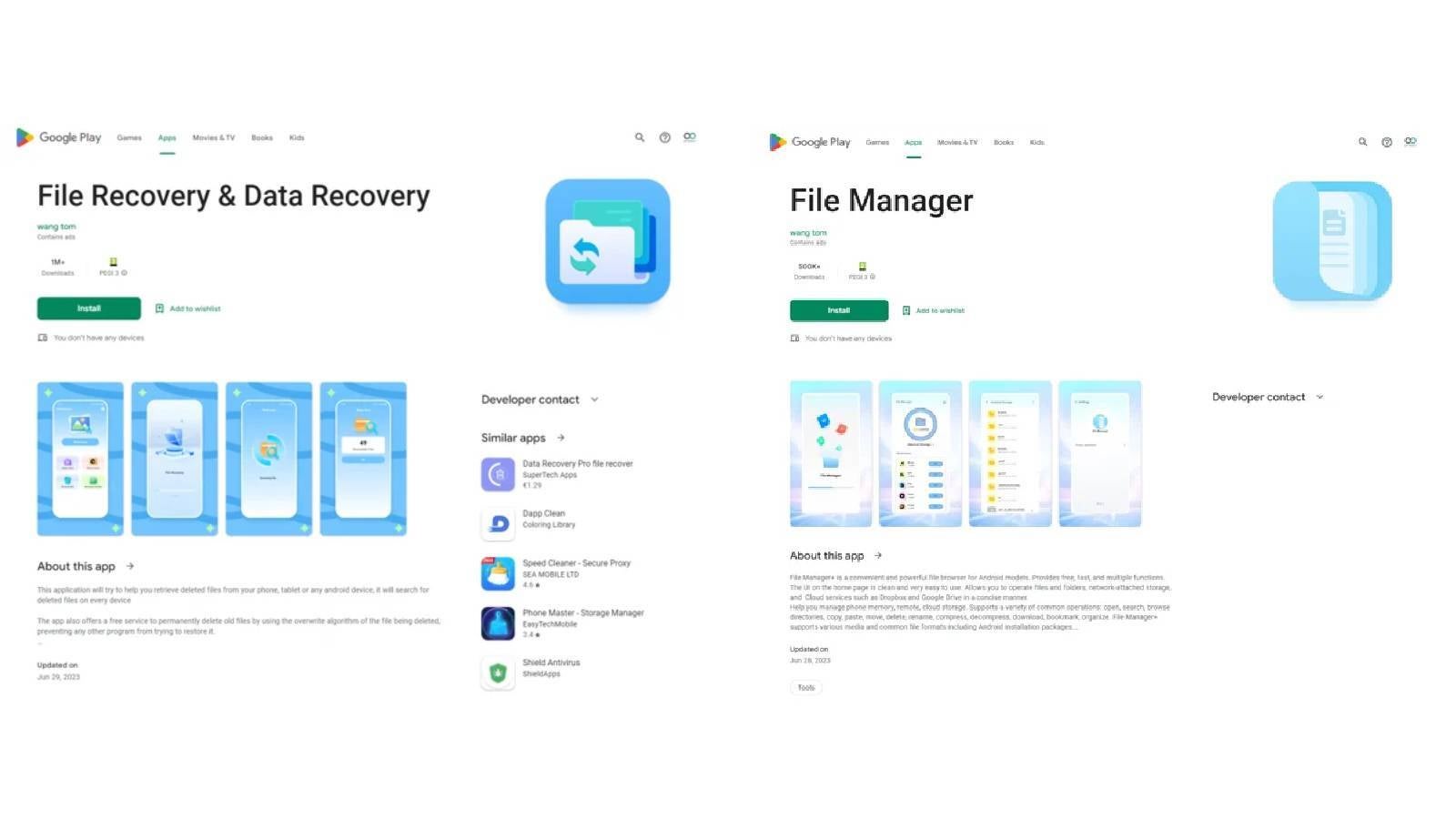
Although Play Store is generally a trusted place for downloading apps on Android phones, every now and then malicious apps manage to sneak into the app marketplace. The latest fishy apps that were found hiding on Play Store are File Recovery & Data Recovery and File Manager.
Cyber security company Pradeo says that these apps came from the same developer and were downloaded by 1.5 million users. They look like file management apps but are actually spyware and silently send user information to servers based in China.
File Recovery and Data Recovery was downloaded more than a million times, whereas 500,000 people installed File Manager. The apps asserted that they wouldn’t collect any data from smartphones, but Pradeo found that this was a false claim.
Android apps downloaded over 1.5 million times found to be sending sensitive data to China
Equally alarming is that the apps said that any collected data would not be deleted even after user request, which goes against data protection laws.
Pradeo’s analysis showed that the apps collected personal data such as:
Contacts saved in the device
Email and social network contacts
Pictures, audio, and videos compiled in the app
Real-time user location
Country code
Name of the network provider
Operating system version number (possibly to exploit vulnerabilities)
Device model
Most of this info is not required for file management and data recovery operations. The apps do not ask for user permission for collecting this data. The apps also hide their home screen icons to make it difficult to delete them. Both apps transmit data more than a hundred times, which is a frighteningly large amount.
Since malicious apps often require user input for successful attacks, File Recovery & Data Recovery and File Manager employ a tactic whereby the victim’s device restarts and the apps launch in the background.
Per a Bleeping Computer report, the apps were removed from Google Play only recently. Needless to say, if you have these apps on your phone, delete them right away. If you don’t see them on the home screen, go to the app list in settings to get rid of them.
Data stolen during attacks on schools can contain highly sensitive information.
Modern ransomware attacks are as much about stealing data and threatening to leak it as they are about encrypting data. Which means that when a school or hospital is attacked, it’s often students’ and patients’ data that’s leaked if the ransom demand isn’t met.
We have to wonder how greedy any person would need to be to show such a blatant disregard for how painful sharing that kind of information can be.
Known ransomware attacks against education, June 2022-May 2023
And, while ransomware attacks against education are a global phenomenon, the USA and the UK saw far higher rates of attacks than other countries.
Although the attacks were carried out by a large number of different ransomware gangs, one in particular stood out: Vice Society. The Vice Society ransomware gang specializes in attacking education, with almost half of its known activity (43%) directed against the sector—almost ten times the average for ransomware groups.
The documents stolen from schools and dumped online by ransomware gangs can contain very private information that goes beyond what we normally see in leaked files. But apparently it’s getting harder to convince victims to pay the ransom, so the cybercriminals are trying new tactics.
What they seem to forget, or not care about, is that they are not just extorting money from institutions, but ruining young lives in the process.
An Associated Press article talked to the families of six students who had their sexual assault case files exposed by a ransomware gang. The leaking of private records like that on both the Dark Web and the open Internet could have a lasting impact on those young people long after their school has recovered from the attack.
The ransomware groups are to blame, of course, but the education sector can improve a few things to lessen the impact of a ransomware attack.
It’s prudent to assume that at some point your organisation will fall victim to a ransomware attack. That being the case, it might be better to resort to paper records for highly sensitive information, or to store it securely encrypted on a non-networked system.
It also seems to be a problem to inform the students and their family about what has happened and what might have been stolen. The families contacted by AP said they first learned about the leaked information from the journalist instead of from the school.
Another matter to consider is the fact that identity thieves sometimes target children because the crime can go undetected for years, often until the child applies for their first loan or credit card. Even more reason for schools to inform the families of students about stolen data.
As a Vice Society representative wrote in an email to students of a victimized school:
“Additionally all of your SSN and Medical records will be put for sale, for every hacker to gain access and use your data in whatever illegal activity they want. To us, this is a normal business day. For you, it’s a sad day where everyone will see your personal and private info.”
Which goes to show that appealing to their decency is likely to fall on deaf ears, so the best defense is protection.
Prevent intrusions. Stop threats early before they can even infiltrate or infect your endpoints. Use endpoint security software that can prevent exploits and malware used to deliver ransomware.
Detect intrusions. Make it harder for intruders to operate inside your organization by segmenting networks and assigning access rights prudently. Use EDR or MDR to detect unusual activity before an attack occurs.
Stop malicious encryption. Deploy Endpoint Detection and Response software like Malwarebytes EDR that uses multiple different detection techniques to identify ransomware, and ransomware rollback to restore damaged system files.
Create offsite, offline backups. Keep backups offsite and offline, beyond the reach of attackers. Test them regularly to make sure you can restore essential business functions swiftly.
Don’t get attacked twice. Once you’ve isolated the outbreak and stopped the first attack, you must remove every trace of the attackers, their malware, their tools, and their methods of entry, to avoid being attacked again.
Malwarebytes EDR and MDR removes all remnants of ransomware and prevents you from getting reinfected. Want to learn more about how we can help protect your business? Get a free trial below.
Meta’s Threads is off to a superb start, as millions of people are cracking into the app. For all of its strengths, it has its flaws. For instance, if you want to delete your Threads account, you’ll need to delete your Instagram account as well. However, according to 9To5Mac, that’s about to change.
Over the day and a half that Threads has been up, nearly 100 million people have signed up for it. That’s a major win for the fledgling platform and a major blow to Twitter. There may be a legal battle over the two platforms, however.
If you’re interested in getting the app, you can do so right here. If you have an Instagram account, then you’ll be able to use that to sign in with just a few taps. After that, you’ll be able to use the app. You’ll also get a neat badge on your Instagram account telling everyone how quick you were to sign up for Threads.
You’ll be able to delete your Threads account without sacrificing your Instagram account
Threads is still a growing platform, and people are feeling those growing pains. One of them was the realization that your Threads account and your Instagram account are joined at the hip. You can’t delete your Threads account without getting rid of your Instagram account.
However, the company responded to the users’ complaints. Meta said that it’s “Looking into a way to delete your Threads account separately”. It sounds a little odd that the company is looking into finding a way to delete your accounts.
Meta wasn’t kidding when it said that Threads is powered by Instagram. This could be why the company was able to get it up and going so quickly. The app could be based heavily on Instagram’s pre-existing code. Instead of having to write an app from the bottom up, it could just be built on Instagram’s code. That’s just speculation.
In any case, you’ll have the ability to delete your accounts separately just in case you get tired of Threads. We don’t know when the company is going to make this change, so you’ll just need to stay tuned.
The Nickelodeon data leak has been acknowledged by Paramount, the parent company. However, amid investigations, it has been labelled as a leak containing mostly old data.
Nickelodeon, one of the world’s leading children’s entertainment TV channels, is the latest victim of a data breach. On 6th July, Hackread exclusively reported that a Twitter handle @GhostyTongue shared exclusive details on the data breach, revealing that they have inside knowledge of the massive 500GB Nickelodeon data leak.
Per the latest development, Nickelodeon claims that the hackers allegedly stole ‘decades old’ data. In an exclusive state to Hackread.com, a Nickelodeon representative said that,
We are aware of social media posts that alleged production-related files were made available without authorization and we are investigating. The alleged leaked content appears related to production files only, not long-form content or employee or user data, and some of it appears to be decades old.
Nickelodeon/Paramount
The network is currently investigating the incident. Animators impacted by the exposure of their projects for the channel are asking people to delete every leak-related post to show respect to those working on unreleased projects.
On the other hand, hackers are actively sharing screenshots of the alleged files they’ve stolen from the network, including leaks from its animation department.
Some screenshots show folders of the network’s biggest shows, including Monster High, Danny Phantom, SpongeBob SquarePants, Avatar: The Last Airbender, the Smurfs, etc. As seen by Hackread.com, the leaked data includes information on unreleased TV shows and scripts too.
Nickelodeon flash games and video content as shared by @GhostyTongue
Interview with @GhostyTongue
Hackread.com had the opportunity to interview @GhostyTongue, the person who is most vocal and has inside information about the Nickelodeon breach.
Hackread: 1: Would you be interested in telling readers about yourself?
@GhostyTongue: Not too long ago, I developed a passion for both news reporting and exploring the realms of leaking and cybersecurity. It all started when the Nintendo gigaleak occurred, and I found myself captivated by the way it unfolded and the timing of the event. Intrigued, I scoured the internet in search of similar opportunities, which led me to discover two Walt Disney Company Google CDNs. One of these CDNs contained a docx file with FTP logins, allowing me to gain access to two FTP servers. I saved all the acquired data on my personal computer and have been gradually sharing it through my Internet Archive account (archive.org/details/@stone_pac). I must admit, there is an indescribable satisfaction in preserving and safeguarding such valuable information.
Hackread: 2: Was this data leaked by hackers or an inside job as per your knowledge?
@GhostyTongue: I came across two stories about how the incident occurred. One involved a vulnerability in Viacom’s login portal, while the other involved the correct guessing of the password and username. In essence, the exact cause remains undetermined.
Hackread: 3: Can you provide more details about the nature of the leak in Nickelodeon’s animation department?
@GhostyTongue: The leak occurred in January of this year, although some sources suggest unauthorized access may have been obtained as early as the previous fall. According to information gathered from forums, approximately 500GB of files were accessed and obtained during the breach. The leaked data was initially shared within private servers, but a significant portion, approximately 10GB, was eventually released to the public.
Hackread: 4: How did you come across this information regarding the leak and the individuals involved?
@GhostyTongue: I stumbled upon this incident when a friend directed me to the original 4chan thread discussing it. They asked if I knew how to gain access, as I had previously been involved in archiving two CDNs and two FTPs for a company.
Hackread: 5: You shared a couple of screenshots (1) (2) on Twitter showing signs of regret from someone claiming over the issue. Who are they?
@GhostyTongue: One of the incidents involved a regretful situation where I had initially dismissed an apology tweet, thinking it was a fabricated screenshot, but later discovered it was genuine. The other incident occurred when I sent out a message in response to someone threatening my livelihood and attempting to dox me.
Hackread:: 6: What kind of actions or consequences did “BowDown” and “IncidentalSeventy” face, as per your knowledge?
@GhostyTongue: To the best of our knowledge, there are rumors circulating that suggest the individuals in question may have been apprehended by law enforcement or banned by Discord. According to reports, all the servers they were part of, as well as their friends, claim that they vanished without a trace. There are also rumors speculating that the authorities may have been involved in their disappearance. Additionally, it is worth noting that they were allegedly involved in the dissemination of leaked content earlier this year.
Hackread: 7: Were there any other individuals or parties involved in the leak that you are aware of?
@GhostyTongue: From what I know, individuals named BowDown and IncidentalSeventy were involved in the situation. However, upon reflecting on the person who threatened to expose my personal information (dox), their actions now appear suspicious to me.
Hackread: 8: How confident are you in the accuracy and reliability of the information you’ve shared?
@GhostyTongue: I have a high level of confidence that approximately 85% of the shared information is accurate.
Hackread: 9: Have you been in contact with any official representatives from Nickelodeon or law enforcement regarding this matter?
@GhostyTongue: As of now, I have not been contacted by anyone regarding the situation. However, I have noticed that Nick (presumably referring to Nickelodeon) has taken notice of my posts and other tweets. To test this claim, I uploaded a brief 2-second clip of an unreleased show pilot titled “Rock Paper Scissors.” Interestingly, the link to the clip was swiftly removed within a minute of the tweet being published.
Hackread: 10: Can you disclose any additional details or insights about the leak or its aftermath that we haven’t discussed yet?
@GhostyTongue: In my personal opinion, I strongly believe that there is a high probability of both “The Loud House Movie” and “The Casagrandes Movie” being delayed. Furthermore, considering the significant leak of content related to the upcoming Nickelodeon show “Rock Paper Scissors,” it is highly likely that the show might face cancellation due to the extent of the leak.
Hackread.com had earlier reported that in January 2023, Nickelodeon’s consumer products and experience portal experienced an authentication issue, and materials were leaked on Discord, after which the company patched it. The issue allowed users to access its animation department. The current leak could be linked to this incident.
The breach is under investigation, and law enforcement is focusing on two individuals using Discord usernames “BowDown” and “IncidentalSeventy,” for their alleged involvement. Nickelodeon’s legal team has acted against the perpetrators and beneficiaries of the leak by pursuing the Digital Millennium Copyright Act (DMCA). It will deter people from sharing content about the leak on websites and social media.
However, screenshots of alleged data from the TV channel are still being shared on Twitter, Reddit, and other platforms. Some researchers have shown concern over violating DMCA for discussing the leak online, but Nickelodeon’s representative didn’t comment on this.
The US-headquartered and Paramount-owned Nickelodeon is the first cable TV channel to broadcast content exclusively made for children. The network is yet to confirm whether the leak resulted from hacking or a cyberattack.
This isn’t the first time a film or television network has become the target of a data breach. Back in 2014, Sony Pictures was targeted by North Korean hackers who leaked films and script copies, company employees’ emails, and its executives’ personal information.
Then, the 2017’s HBO data breach rocked Hollywood in which hackers infiltrated HBO’s systems and leaked unreleased episodes of the popular series Game of Thrones, along with other sensitive data.
The HBO hacking saga lasted for several months, causing significant distress for the network and its viewers. It wasn’t until later that an Iranian citizen named Behzad Mesri emerged as the alleged perpetrator behind the HBO hack. Mesri was subsequently charged and indicted for his involvement in the cyberattack. To this day, he remains wanted by the FBI.
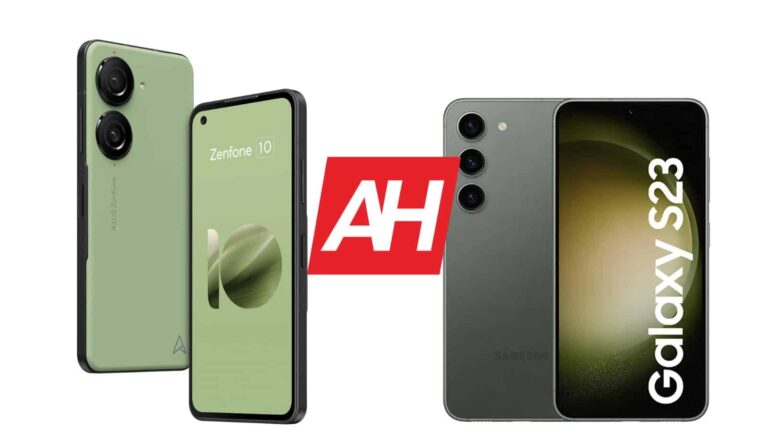
The ASUS ZenFone 10 landed recently, to offer a great option for people looking for a compact smartphone. Well, in this article, we’ll compare the ASUS ZenFone 10 vs. the Samsung Galaxy S23. These two phones are some of the best compact smartphones you’ll find on the market these days. They’re both quite compact compared to almost every other high-end smartphone out there. They are also quite different at the same time.
We’ll first list their specifications, and will then compare them across a number of other categories. We’ll compare their designs, displays, performance, battery life, cameras, and audio performance. There’s a lot to talk about here, so let’s get started, shall we?
Specs
ASUS ZenFone 10
Samsung Galaxy S23
Screen size
5.9-inch FullHD+ Super AMOLED display (up to 144Hz refresh rate, 1,100 nits peak brightness)
Both smartphones come with a frame made out of aluminum. Their backplates are different, though. The ZenFone 10 has soft-touch plastic on the back, which actually adds plenty of grip to the equation. The Galaxy S23 features a glass back. There is a flat display on the front of both phones, and both phones have very thin bezels. Display camera holes are included on both, but they’re placed in different spots.
The ASUS ZenFone 10 has flat sides all around, while the ones on the Galaxy S23 are a bit curved. You will notice separate camera islands on each of the two devices. The ZenFone 10 has two of them, while the Galaxy S23 includes three.
Each of those camera islands hosts one camera, so the Galaxy S23 has one more on the back. These two phones are about the same height, but the ZenFone 10 is narrower, and a bit thicker. They also weigh about the same, the difference is only 4 grams. Neither phone is too heavy, not at all, they’re actually quite light.
The backplate on the ZenFone 10 is a bit raised, and then curved under the 90-degree angle, but with tapered edges. That actually makes the phone a real treat to hold, especially considering the soft-touch material. The Galaxy S23 feels a lot more slippery in the hand, and quite frankly not as pleasant to hold in comparison. Both phones are not a problem to use with one hand, though the grip factor on the ZenFone 10 makes things a bit easier.
ASUS ZenFone 10 vs Samsung Galaxy S23: Display
The ZenFone 10 includes a 5.9-inch fullHD+ (2400 x 1080) Super AMOLED display with a 144Hz refresh rate (only available in some games). That panel is flat, and it also supports HDR10+ content. Its brightness goes up to 1,100 nits, and we’re looking at a 20:9 aspect ratio here. The Gorilla Glass Victus protects this display.
ASUS ZenFone 10
The Galaxy S23, on the other hand, has a 6.1-inch fullHD+ (2340 x 1080) Dynamic AMOLED 2X panel. That display is also flat, and it supports a refresh rate of up to 120Hz. HDR10+ content is supported here, and the panel goes all the way up to 1,750 nits when brightness is concerned. This display has a 19.5:9 aspect ratio, and the Gorilla Glass Victus 2 protects it.
Both of these displays are really good. They’re not only vivid, but also have great viewing angles, and the blacks are deep. They’re well-optimized, and the scrolling is very smooth too. The touch response is also really good on both phones. The Galaxy S23 does have one major advantage, and that is its brightness. Don’t get me wrong, the ZenFone 10’s display is not dim or anything, not at all, but you’ll definitely notice the difference under direct sunlight.
ASUS ZenFone 10 vs Samsung Galaxy S23: Performance
The Snapdragon 8 Gen 2 fuels the ASUS ZenFone 10. The phone also includes up to 16GB of LPDDR5X RAM, and UFS 4.0 flash storage. The Galaxy S23, on the flip side, is fueled by the Snapdragon 8 Gen 2 for Galaxy. That is basically an overclocked version of the chip. The phone also comes with 8GB of LPDDR5X RAM, and UFS 3.1 or 4.0 storage. The 3.1 version is only included in a 128GB storage model.
The performance provided by both phones is great. What we did notice is that the ZenFone 10 is a bit smoother overall, after using both phones for a while. The Galaxy S23 does have an occasional stutter that you may or may not notice, but that is mostly gone on the ZenFone 10. That’s just a small difference, but it is what we’ve noticed. In the gaming department, both phones do a great job. They do heat up to a degree, but we never had issues because of that, nor did either phone get too hot. The performance is basically great on both devices.
ASUS ZenFone 10 vs Samsung Galaxy S23: Battery
The ASUS ZenFone 10 includes a 4,300mAh battery, while the Galaxy S23 has a 3,900mAh battery on the inside. That is quite a difference, and on top of that, the ZenFone 10 also has a smaller display. The end battery life results are vastly different, actually. The ZenFone 10 simply blows the Galaxy S23 out of the water in the battery life department, it’s not even close.
We’ve been able to cross the 10-hour screen-on-time mark with the ZenFone 10, a number of times. A couple of times the phone even lasted 11 hours of screen-on-time before shutting down. The Galaxy S23 provided closer to 6, actually. Which is, once again, a massive difference. Do note that gaming was not a part of our usage most days. Your mileage may vary, however, so keep that in mind. Still, the fact that the ZenFone 10 offers much better battery life remains.
When it comes to charging, the ZenFone 10 supports 30W wired, 15W wireless, and 5W reverse wired charging. The Galaxy S23, on the flip side, supports 25W wired, 15W wireless, and 4.5W reverse wireless charging. So neither phone offers blazing-fast charging, basically. The thing is, the ZenFone 10 does ship with a charger in the box, unlike the Galaxy S23.
ASUS ZenFone 10 vs Samsung Galaxy S23: Cameras
The ZenFone 10 has a 50-megapixel main camera, and a 13-megapixel ultrawide unit (120-degree FoV). The Galaxy S23, on the flip side, includes a 50-megapixel main camera, a 12-megapixel ultrawide unit (120-degree FoV), and a 10-megapixel telephoto camera (3x optical zoom).
Samsung Galaxy S23
Now, the Galaxy S23 does like to tune up the saturation more than the ZenFone 10. That makes the images pop, though in certain situations, it can seem like a bit much. Sharpening can be a bit visible on both, but the images provided by both phones are rather good, during the day. The performance in low light is not bad, per se, but if you’ve used some of the phones with outstanding low light performance, you’ll see the difference. There’s not as much detail in low light, compared to some other flagship-grade phones. Other than that, they perform well in such conditions too.
Their ultrawide cameras are good, but nothing to write home about, and are a level under the main cameras, at least. The ZenFone 10’s ultrawide camera also lacks autofocus, which affects macro shots. When it comes to telephoto shots, the Galaxy S23 is a clear winner here, as the ZenFone 10 doesn’t even have a telephoto camera. The video recording is good on both, though the footage is more stable on the ZenFone 10 thanks to gimbal OIS.
Audio
There is a set of stereo speakers included on both devices. Those speakers are loud enough, but not to the level of larger flagship devices. The loudness levels are similar in comparison, and the sound output is good. It’s well-balanced, and you’ll even notice some bass.
If you need an audio jack on your phone, the ZenFone 10 is the way to go. The Galaxy S23 does not include one. It does have a Type-C port at the bottom, however, which you can use for wired audio connections. If you decide to go wireless, do note that both devices support Bluetooth 5.3.
We just can’t stop talking about Threads, it seems. The new social media platform from Meta is on its way to more than 100 million users in just a matter of days. Now, Android users can try out new features early because Threads opened its beta program just recently.
This is good news, as Threads is a bit bare-bones compared to Twitter. Many people are liking the platform despite the fact that it’s missing several features that most other platforms have. For instance, there are no DMs or hashtags, and there’s no general search feature. We expect these features to make it to the app eventually.
Threads opens up its beta program
In a soap opera-esque twist, Threads launched on Android and iOS at the same time. Usually, iOS gets apps and features before Android users. In another twist, this beta program is only for Android users. However, we believe that this is only for now.
The beta program will allow people to test out new and experimental Threads features early, according to 9To5Google. This is great, as there are a lot of features that people have been pining after.
How to join the beta program
If you want to join the beta program, it’s easy to do so. Go to Threads on the Google Play Store. Scroll down a bit until you see the beta area. You’ll know you’re there when you see a beaker with shapes in it. You’ll see the Join button at the bottom of the section.
When you tap on the button, it will take a few minutes for you to officially be added to the program. Just don’t be alarmed if you don’t notice any immediate change. After that, you’ll see the Update button at the top.
After you update your app, you’ll be a part of the beta program. Just know that, if you’re a part of the beta program, the app could become less stable as you use it. That’s just a reality with using beta software.
For the time being, we don’t know what new features are coming and we don’t know when they’ll be coming. You’ll just want to keep an eye out.
We’ve gathered Pokemon cards on the school playground, took pictures of them on our Nintendo 64s, battled them on our Game Boys, and walked around town to catch them on our smartphones. Now, we’ll be able to gather them in our dreams. Pokemon Sleep is a new app that will let you catch Pokemon just by sleeping, according to The Verge.
The thing about this app is that it’s a very fun sleep tracker. It will monitor how long you sleep and give you a report on how long you slept. That idea sounds odd, but sleep trackers are no new thing. Several smartwatches and fitness trackers have the ability to track your sleep and give you a report. Having healthy sleep patterns is part of being overall healthy.
Pokemon Sleep is an app where you can catch Pokemon in your sleep
There’s a fair bit to this app outside of tracking your sleep. The core mechanic is to monitor how long you sleep each night and present you with the metrics when you wake up in the morning.
The thing about this app is that it incentivizes you to practice good sleep habits. Starting off, you’ll see a Snorlax just snoozing during the day. You’ll give it food and drinks in order to help it gain strength in the form of a number. The more that you feed the Snorlax, the higher that number.
Next, when you sleep, you’ll receive a Sleep Score number based on how long you sleep that night. It looks like your Sleep Score will range from 1 to 100. The longer you sleep, the higher your Sleep Score.
When you wake up, the app will multiply your Sleep Score by Snorlax’s strength to get your Drowsy Power. The higher your Drowsy Power, the more Pokemon will gather while you sleep. So, the more you sleep, the more Pokemon will gather as you sleep. Along with Pokemon, you’ll also get a report on how you slept.
The app will recommend that you place your phone on your pillow while you sleep so that it can better track your sleep. So, if you’re comfortable with doing that, then you shouldn’t have an issue.
Pokemon Sleep is currently up for pre-registration on the Google Play Store. We’re not sure when the company’s going to officially launch the app, so you’ll want to stay tuned.
Some former Twitter employees have filed a lawsuit against the company over legal arbitration costs. They expect the social media platform to cover the costs of arbitration claims. As you might expect, Twitter has no intention to do so.
In an interview with BBC earlier this year, Elon Musk claimed he had laid off nearly 80% of Twitter staff weeks after taking over the company. The billionaire claims Twitter is now working more efficiently with much fewer employees. However, the laid-off Twitter staff first started a legal battle against their former employer over unpaid severance payments.
Their previous class-action lawsuit was rejected due to a provision in their contract. This time, they are suing the company over legal arbitration costs. The plaintiffs filed their lawsuit on July 3rd in the Northern District of California. Both parties must refer to JAMS, a legal company focused on mediation and arbitration.
Twitter former employees sue the company for arbitration costs
According to JAMS’s fee schedule, a two-party arbitration costs $2,000, and Twitter must pay the rest. As expected, Twitter won’t lose a penny easily. The social media company is asking JAMS to split the bill evenly between them and the former employee who filed their lawsuits outside California. This request, however, violates JAMS’s pre-conditional minimum standards of procedural fairness, and the agency declined it.
Twitter claims it never abided by that condition outside of California. In response, JAMS said it would close the file as they “will not proceed with cases that we have determined fall under our Employment Minimum Standards if Respondent will not abide by those standards.”
Twitter’s former employees are now in a dilemma. If they want to continue with the case, they should cover the JAMS fees, which could cost them $300 per hour to more than $15,000 per day.
Shannon Liss-Riordan, one of the employees’ lawyers, told the outlet, “The reason we had to file nearly 2,000 individual arbitration demands is because Twitter forced us to — by moving to compel arbitration. Now that it has made its bed, it doesn’t want to lie in it.”
Twitter seems to be slowly dying, and several companies are fighting to be the person over Twitter’s grave doing the peace sign. These platforms are growing too. BlueSky, the new social media platform created by Jack Dorsey, just passed a million installs on the app stores, according to data.ai.
Twitter has some serious competition. It needs to fight off newer social media platforms with far fewer resources at their disposal (with the exception of Threads, of course).
Last year, Mastodon experienced a renaissance while Twitter was experiencing the first gusts from hurricane elon. Now, BlueSky and Threads are causing trouble for the bird site, as well.
BlueSky just hit a million installs
It’s important to note that this refers to the number of app installs on the app stores. It doesn’t reflect the number of actual users on the platform. BlueSky is still on an invite system, so the number of people allowed on it is still limited. However, it shows that people are still interested in trying out BlueSky despite the invite system.
According to the report, BlueSky was able to gather a million installs across both app stores. It’s been getting an average of about 8,300 new installs per day. That seems impressive, but it’s far behind Twitter’s average of about 518,000 new downloads a day.
However, as with all other Twitter clones, BlueSky saw, and will continue to see, a large influx of users every time Twitter makes a misstep. The highest peak in installs happened in April when it officially launched to the public and there was a steady decline since then.
Then, when Elon Musk announced the rate limit and stopped people from seeing tweets when signed out, the number of downloads rose quickly. This caused BlueSky to temporarily stop new signups.
The number of active users is still unknown, but we know that it’s going to steadily rise as more people send out their complementary invite codes. Once the platform sheds the invite system, we’re sure that the number will rise even faster… that is if Threads doesn’t take all of the potential users first.
Samsung is pushing the July 2023 security update to a bunch of devices today. The latest security patch is rolling out to the Galaxy S21 series, Galaxy Z Flip 3, and Galaxy S20 FE. The company previously rolled out the July SMR (Security Maintenance Release) for the Galaxy S23 series, Galaxy S22 series, Galaxy Note 10 series, and Galaxy A53 5G, at least in some markets.
As of this writing, Samsung’s July update for the Galaxy S21, Galaxy S21+, and Galaxy S21 Ultra is available to users in Latin America. It’s rolling out in several countries in the region, including Argentina, Bolivia, Brazil, Mexico, Paraguay, Peru, and Uruguay. The new firmware build number is G99*BXXS9EWF3. Samsung’s official changelog confirms that the devices aren’t getting anything more than the latest security fixes.
This update for the Galaxy S21 series should soon expand to other regions, including the US. Meanwhile, Latin America is getting a headstart with the July SMR for the Galaxy Z Flip 3 as well, with the rollout already live in a handful of countries in the region. The 2021 clamshell foldable is getting the latest security patch with the firmware build number F711BXXS5EWF3. Once again, it’s just this month’s security fixes and nothing else.
The Galaxy S20 FE is another Samsung phone that has set foot on the July SMR. And guess what? Latin American users are getting preferential treatment again. The update is live for the 4G version of the phone in Brazil, Guatemala, Paraguay, and Trinidad & Tobago, SamMobile confirms. The updated build number for this phone is G780GXXS6EWF3. We may sound repetitive, but there are no added goodies for the Galaxy S20 FE either.
Samsung’s July update for Galaxy devices patches 90 security issues
The July update for Samsung Galaxy devices is a pretty big one, even without additional goodies. The latest security release contains fixes for as many as 90 vulnerabilities. These include over 50 Android OS flaws and 38 Galaxy-specific security issues. At least three of those were critical vulnerabilities, Google confirmed.
Samsung will push these security fixes to more Galaxy devices in the coming days while simultaneously expanding the availability of the update for the aforementioned models to more markets. If you’re using any of these phones and have yet to receive the July SMR, fret not. You will get it soon. Be on the lookout for a notification prompting you to download the OTA (over the air) release. You can also check for updates from the Settings app.