We take a look at a bogus Amazon podcast listing which promises free streams of Evil Dead Rise.
Scammers are using a novel technique with Amazon listings to trick fans of Evil Dead into downloads they may not want, and expensive rolling payments they have no interest in. Evil Dead Rise, the breakout horror film of 2023, started with big cinema numbers and has moved on to a victory lap in streaming land for good measure. In fact, it’s doing so well that the original film from 1981 has crept into the charts too:
2 Evil Dead flix top 10 in the world on HBO. Thanks, Deadites. You keep watching, we’ll keep making. pic.twitter.com/TOoTcvylkd
A good time to be a Deadite. Not so good if you’re unable to catch a legitimate stream or the movie isn’t out in your region yet. If you decide to pre-order it from Amazon, you’ll see something odd nestled in the physical media section which we’ve highlighted in red. Bizarrely, there’s a podcast claiming to offer up a free version of Evil Dead Rise via streaming.
The full movie, in podcast form? I know Amazon has some pretty impressive technology but I don’t think we’re at that level just yet. The full text reads as follows:
!Streaming Evil Dead Rise 2023 Movie Evil Dead Rise 2023 Movie Warner Evil Dead Rise 2023 Pictures! Are you looking to download or watch the new Evil Dead Rise 2023 online?
If you are looking for Watch Evil Dead Rise (2023) : Full Movie Online Free, Watch Evil Dead Rise Streaming Full Movie Online Free ||Prime.
Playing the audio clip reveals about 24 seconds of generic soft rock music, presumably only present because the “podcaster” has to upload something to create a listing. To even access the audio file, you’d need to open it via an Audible account or Amazon Music.
Clicking the link redirects you through several URLs before settling on what looks like it’s about to offer you a stream of the film.
Evil Dead Rise for download or streaming, with a “Subscribe to watch: $0.00” message underneath? You can add this to the “Too good to be true” pile.
No matter what you click, on a mobile device you may be offered a download. In testing, we saw a program claiming to offer all manner of media downloads:
In another test, we were directed to an odd payment page:
I say odd, because the URL contains the word “antivirus”, which would suggest you’re potentially signing up for a security service of some kind. Despite this, there’s no clear indication of what exactly is being paid for here. Is it a security product? Am I still trying to sign up to the supposedly “free” version of Evil Dead Rise? I don’t know, but the page says this at the top:
“This is a special offer for a limited period of 3 days which comes with a £13.00 welcome gift card to explore and buy products in one of our affiliates’ websites. By acquiring this membership you will be automatically enrolled in our affiliate membership services. The membership fee amount of £29.24 which will be automatically deducted every 14 days unless skipped or cancelled.
That’s a lot of money to pay for who knows what!
Meanwhile, clicking the movie streaming link on a desktop redirects to a generic sign up page with no additional details with regard to terms and conditions or privacy policies. Sites like this typically have a rolling subscription fee mentioned somewhere in the T&Cs. There is simply no reasonable way to know what you’re signing up for here.
How to avoid bogus spam listings on Amazon
Watch where you pay. Your typical Amazon transactions should be taking place within the main Amazon site. If you’re buying an item, watch out if you are directed to go to another URL. If in doubt, check with Amazon customer support.
Beware of “empty” content. Ebooks and audio files which do little but ask you to go somewhere else to obtain something are almost certainly scams. A one page ebook saying “Go here”, or an audio file which is bereft of audio with hyperlinks going off-site should be treated with suspicion.
This is not the first time we’ve seen inventive uses of Amazon services to promote a scam. We’ve previously covered a range of spam ebooks on the Kindle store used to link to similar streaming services. In this case, we’ve reported the account uploading these podcasts to Amazon and users of Malwarebytes products will find they’re protected from the sites involved. Groovy.
We don’t just report on threats—we remove them
Cybersecurity risks should never spread beyond a headline. Keep threats off your devices by downloading Malwarebytes today.
Twitter has started to block unregistered users from browsing the platform and viewing tweets, The Verge reports.
Since Elon Musk’s takeover in late 2022, Twitter has undergone various changes- some of which were good, and some were terrible, according to critics. Despite all initial controversies, Twitter is now a much different place for users, and evolution still continues. In one of the latest changes, Twitter now blocks unregistered users from viewing content and accessing user profiles.
This means if you’re not logged into your Twitter account, you won’t be able to access any form of content on the platform. You can’t even search for a specific tweet or user profile if you’re browsing as an unregistered user. The platform now launches a window requiring unregistered users to log into their accounts or create a new ones.
Preventing unregistered users from viewing content contradicts Elon Musk’s actions during his first days as the owner. In November 2022, Musk hired former iPhone hacker and self-driving car developer George Hotz to fix a glitch in a Twitter search and remove the login prompt. Hotz, however, left the job half-done and parted ways with Twitter.
Twitter doesn’t allow unregistered users to view tweets and user profiles
The new policy is expanding to web and mobile apps. Yet, the company has stayed tight-lipped about whether this has been an internal update or a technical glitch. However, the company could make a public announcement in the coming weeks. Given the prior changes that Musk made to the platform, the latest restriction to unregistered users seems to be an official update from the company.
The reason for the change is also obvious. Twitter aims to entice unregistered users to either open an account or log into their accounts to start engaging. In the best scenario, the new users could become Twitter Blue subscribers and enjoy more features after paying a monthly fee. In both ways, the platform will benefit.
Twitter previously allowed unregistered users to view tweets, but they were prevented from interacting with others. Free Twitter accounts can still access the content without any restriction, but they need to be a Blue subscriber to access extra features.
We take a look at research which claims a way to bypass voice recognition security by stripping synthetic aspects out of fake recordings.
Voice authentication is back in the news with another tale of how easy it might be to compromise. University of Waterloo scientists have discovered a technique which they claim can bypass voice authentication with “up to a 99% success rate after only six tries”. In fact this method is apparently so successful that it is said to evade spoofing countermeasures.
Voice authentication is becoming increasingly popular for crucial services we make use of on a daily basis. It’s a particularly big deal for banking. The absolute last thing we want to see is easily crackable voice authentication, and yet that’s exactly what we have seen.
Back in February, reporter Joseph Cox was able to trick his bank’s voice recognition system with the aid of some recorded speech and a tool to synthesise his responses.
A user typically enrolls into a voice recognition system by repeating phrases, so the system at the other end gets a feel for how their voice sounds. As the Waterloo researchers put it:
When enrolling in voice authentication, you are asked to repeat a certain phrase in your own voice. The system then extracts a unique vocal signature (voiceprint) from this provided phrase and stores it on a server.
For future authentication attempts, you are asked to repeat a different phrase and the features extracted from it are compared to the voiceprint you have saved in the system to determine whether access should be granted.
This is where Cox and his synthesised vocals came into play—his bank’s system couldn’t distingusih between his real voice and a synthesised version of his voice. The response to this was an assortment of countermeasures that involve analysing vocals for bits and pieces of data which could signify the presence of a deepfake.
The Waterloo researchers have taken the game of cat and mouse a step further with their own counter-counermeasure that removes the data characterstic of deepfakes.
From the release:
The Waterloo researchers have developed a method that evades spoofing countermeasures and can fool most voice authentication systems within six attempts. They identified the markers in deepfake audio that betray it is computer-generated, and wrote a program that removes these markers, making it indistinguishable from authentic audio.
There are many ways to edit a slice of audio, and plenty of ways to see what lurks inside sound files using visualiser tools. Anything that wouldn’t normally be present can be traced, analysed, and altered or made to go away if needed.
As an example, loading up a spectrum analyser (which illustrates the audio signal in visible waves and patterns) may reveal images hidden inside of the sound. Below you can see a hidden image represented by the orange and yellow blocks every time the audio file plays. While the currently discussed research isn’t available outside of paid access, the techniques relied upon to find any deepfake generated cues will likely work along much the same lines. There will be telltale signs of synthetic markers in the sound files, and with these synthetic aspects removed the detection tools will potentially miss the now edited audio because it looks (and more importantly sounds) like the real thing.
It remains to be seen what organisations deploying voice authentication will make of this research. However, you can guarantee whatever they come up with will continue this game of cat and mouse for a long time to come.
We don’t just report on threats—we remove them
Cybersecurity risks should never spread beyond a headline. Keep threats off your devices by downloading Malwarebytes today.
Samsung is rolling out the June 2023 security update to a bunch of Galaxy M series smartphones. The Galaxy M02, Galaxy M12, Galaxy M32, and Galaxy M40 are all getting this latest security patch, SamMobile confirms. The rollout is scattered across various markets, but all eligible units should get the new SMR (Security Maintenance Release) soon. It patches more than 60 vulnerabilities, including at least three critical Android OS flaws.
For starters, the Galaxy M02 is picking up the June update in Panama, the only Latin American country where it was sold. The model number for the phone in the region is SM-M022M, and it’s getting the new SMR with firmware version M022MUBS3BWF6. Samsung also sold this budget phone in a bunch of Asian countries, with the model number SM-M022F or SM-M022G. It’s unclear if it will update those units to the June security patch or skip this month’s release for them.
The Galaxy M12, meanwhile, is getting the June SMR globally. Depending on your unit’s model number and region, the updated firmware version is M127FXXU5DWE1, M127GXXU5DWF2, or M127NKOU5DWF1. Users in South Korea are getting One UI 5.1 with the June update. The latest One UI version has already been rolled out to the phone in other markets. Those regions are getting some system optimizations, though.
The June update is also widely available for the Galaxy M32. Users in India are getting the latest security patch with the firmware build number M325FXXU7DWF3. For the rest of the world, where Samsung sold the Galaxy M32, it’s M325FVXXU7DWE3. This mid-range phone from 2021 is getting system stability and reliability improvements along with the latest security fixes.
The Galaxy M40 is also getting Samsung’s June update widely
The Galaxy M40 is another Samsung phone that recently started picking up the June security update. Launched in June 2019, this was only sold in India and a few neighboring countries. Perhaps that explains the absence of a succeeding model. But the few users of the Galaxy M40 are now getting the latest security patch. It comes with the firmware build number M405FDDS2CWF3 and doesn’t bring anything else.
If you’re using any of these Galaxy smartphones, watch out for an update in the coming days if you haven’t already installed it. As said earlier, the June SMR patches more than 60 security issues across the Galaxy family. Your phone may be vulnerable to a handful of those. Install the update as soon as possible. You can navigate to Settings > Software update > Download and install to check for updates manually.
Proxyjacking is a cybercrime where your bandwidth is sold by criminals.
A researcher at Akamai has posted a blog about a worrying new trend—proxyjacking—where criminals sell your bandwidth to a third-party proxy service.
To understand how proxyjacking works, we’ll need to explain a few things.
There are several legitimate services that pay users to share their surplus Internet bandwidth, such as Peer2Profit and HoneyGain. The participants install software that adds their systems to the proxy-network of the service. Customers of the proxy service have their traffic routed through the participants’ systems.
The foundation of the proxyjacking problem lies in the fact that these services don’t check where the shared bandwidth is coming from. Peer2Profit and Honeygain claim to only share their proxies with theoretically vetted partners, but according to Akamai’s research they don’t check if the one offering the bandwidth is the actual owner.
Proxies and stolen bandwidth have always been popular among cybercriminals since they allow them to anonymize their traffic. What’s new about this campaign is that these same criminals are now “renting out” the bandwidth of compromised systems to make money instead of simply using them.
The researcher became aware of the campaign when they noticed an attacker establishing multiple SSH (Secure Shell) connections to one of their Cowrie honeypots. Cowrie is a medium to high interaction SSH and Telnet honeypot designed to log brute force attacks and the shell interaction performed by the attacker. It can be used to emulate a UNIX system in Python, or to function as an SSH and telnet proxy to observe attacker behavior to another system.
For the criminals the beauty of the attack is that it is mostly fileless and the files that are actually used, curl and the public Docker images for the proxy monetization services Peer2Profit and Honeygain, are legitimate and will not be detected by anti-malware solutions.
And proxyjacking is a lot less likely to be detected than cryptojacking since it requires only minimal CPU cycles and uses surplus Internet bandwidth. Interesting to note, the researchers found out that the compromised distribution server also contained a cryptomining utility, as well as many other exploits and common hacking tools.
Protection
Since these seemingly legitimate services can be used by criminals on both ends, both to anonymize their activities and to sell others’ resources, we would rather see them disappear altogether, but they should at least improve the verification of their customers and their participants.
Home users can protect themselves from proxyjacking by:
Using key-based authentication for SSH instead of passwords
Akamai added:
“In this particular campaign, we saw the use of SSH to gain access to a server and install a Docker container, but past campaigns have exploited web vulnerabilities as well. If you check your local running Docker services and find any unwanted resource sharing on your system, you should investigate the intrusion, determine how the script was uploaded and run, and perform a thorough cleanup.”
If you lack the time and resources for constant monitoring, Malwarebytes can offer Managed Detection and Response (MDR). Want to learn more about how we can help protect your business? Get in touch.
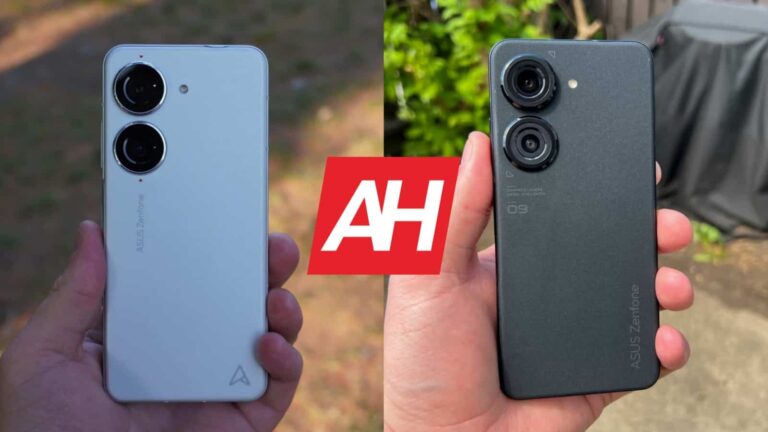
ASUS’ new compact powerhouse smartphone is here. The ZenFone 10 got announced quite recently, and we’re here to compare it to its predecessor. In this article, we’ll compare the ASUS ZenFone 10 vs ASUS ZenFone 9. The ZenFone 9 launched basically exactly a year ago at this point, and its successor brings some improvements to the table, while keeping the same design, essentially.
The ZenFone 10 comes with a more powerful chip, that is also more power efficient. It delivers wireless charging, unlike its predecessor, and an improved camera setup. We’ll first list the specs of both smartphones, and will then move to compare their designs, displays, performance, battery life, cameras, and audio performance. Having said that, let’s get started, shall we?
Specs
ASUS ZenFone 10
ASUS ZenFone 9
Screen size
5.9-inch FullHD+ Super AMOLED display (up to 144Hz refresh rate, 1,100 nits peak brightness)
If you quickly glance at both of these smartphones, you’ll see no difference, basically. They not only look almost the same, but have almost identical dimensions. The ZenFone 10 is 0.3mm thicker, but that’s about it as far as footprint differences are concerned. You will notice the difference when you pay attention to the writings and markings on the back, though. Other than, and some different color variants, they’re basically the same.
Both phones have a flat display with a display camera hole in the top-left corner. The bezels on the two phones are not uniform, unfortunately, but they’re quite thin. The sides are flat, while the backplate is made out of soft-touch plastic, which feels… well, not like plastic. It’s somewhere between plastic and OnePlus’ sandstone finish, that’s the best way to describe it. Do note that there are some differences in softness between colors, and that goes for both models.
Both smartphones have a fingerprint scanner on the right side. That button also serves as a power/lock key, and a touch panel that you can customize. The backplate on both devices sticks out on the back, so that the phone is more pleasant to use. It doesn’t curve into the frame, but towards the back. Both devices have two camera islands on the back, each of which has a single camera on the inside.
They’re exactly the same in terms of height and width, while the ZenFone 10 is a hair thicker, which is not something you’ll notice. The ZenFone 10 is also 3 grams heavier, which is also something you won’t even notice. You’re getting IP68 certification on both devices here, and both also offer an audio jack at the top. The ZenFone 10 and 9 are grippy, and feel great in the hand. They’re also great for one-handed use, and feel different than most phones out there.
ASUS ZenFone 10 vs ASUS ZenFone 9: Display
These two smartphones both have a 5.9-inch fullHD+ (2400 x 1080) display. In both cases it’s a Super AMOLED panel that is flat, and supports HDR10+ content. The top brightness is also the same, 1,100 nits. We’re looking at a 20:9 display aspect ratio in both cases, and ASUS decided to use Gorilla Glass Victus to protect both panels. Do note that the ZenFone 10 does support a 144Hz refresh rate, compared to 120Hz on the ZenFone 9, so they’re not entirely identical.
ASUS ZenFone 9
It is worth noting that the phone won’t make use of a 144Hz refresh rate unless you’re playing games, though. So, in almost every way, these two panels are the same. They’re good displays, though. The colors are vivid, the viewing angles are great, and the blacks are deep. The touch response is also good, as both displays are well-optimized. You can also tweak them further via the settings.
The thing is, both panels could be brighter. 1,100 nits is arguably enough, in general, but other high-end phones have gone above and beyond that. If you’re spending a lot of time under the sun, this could bother you. After using the ZenFone 9 for quite a long time, however, I didn’t really find any issue with it, not even during the summer. Then again I didn’t use the display that much while standing under direct sunlight, so… to each its own. Overall, though, both of these displays are quite good.
ASUS ZenFone 10 vs ASUS ZenFone 9: Performance
The Snapdragon 8 Gen 2 fuels the ASUS ZenFone 10. That is Qualcomm’s latest and greatest SoC. ASUS also included up to 16GB of LPDDR5X RAM inside of this phone, along with UFS 4.0 flash storage. The Snapdragon 8+ Gen 1 sits inside the ZenFone 9, while that device also offers up to 16GB of RAM, but LPDDR5 RAM, not LPDDR5X. UFS 3.1 flash storage is included inside the ZenFone 9.
The ZenFone 9 offered outstanding performance, and it still does, and the same goes for the ZenFone 10. Truth be said, in most cases, we can’t even tell the difference between the two. The Snapdragon 8+ Gen 1 is still a truly mighty processor. You may notice a difference during gaming, however, if you have a tendency to play the most graphically-intensive games from the Play Store. Overall, though, both of these phones provide outstanding, flagship-level performance.
ASUS ZenFone 10 vs ASUS ZenFone 9: Battery
There is a 4,300mAh battery inside both of these smartphones. The ZenFone 9 offered really good battery life, and even managed to surprise us. It stayed that way since launch, and the ZenFone 10 builds upon that. The ZenFone 10 does provide better battery life than its predecessor, and definitely the best battery life in a smartphone with a sub-6” display, though it can easily compete with much larger phones. ASUS did a fantastic job with battery life here.
Getting over 8 hours of screen-on-time with the ASUS ZenFone 9 is not a problem, well, at least it wasn’t for us. At times, the phone could even stretch its feet to 9 hours. The ZenFone 10 flies above that, as we were able to clock in over 9-10 hours of screen-on-time, and a couple of times, it even managed to reach the 11-hour mark. There are not many smartphones that can say that for themselves, especially not flagship ones. There’s not a single other compact phone out there that can reach this level, at least not one that is as powerful as the ZenFone 10.
One thing to note is that your mileage may vary, of course. Your usage will be different, as will your installed apps, signal, and so on. Now, regarding charging. Both devices support 30W wired charging, and come with a charger in the box. The ZenFone 10 also supports 15W wireless charging, and 5W reverse wired charging. The ZenFone 9 supports 5W reverse wired charging only, no wireless charging.
ASUS ZenFone 10 vs ASUS ZenFone 9: Cameras
Both of these phones have the same main camera, a 50-megapixel camera, which includes Sony’s IMX766 sensor. You’re also getting an f/1.9 aperture here, 1.0um pixel size, multi-directional PDAF, and gimbal OIS support. That sensor is not the best or the newest, but the ZenFone 9 performed well, and the ZenFone 10 builds upon that. It comes with a new version of gimbal OIS, to make things even less shaky, and that is truly noticeable when you’re shooting video. The ZenFone 10 will provide one of the most stable video footage recordings on any smartphone, if not the most stable one.
ASUS ZenFone 10
ASUS also relies on software to improve images on the ZenFone 10, as it presented some new tricks to achieve that. We’ll talk more about pictures later on. There is one more camera on the back of each phone that we have to talk about. A 13-megapixel ultrawide camera (f/2.2 aperture, 120-degree FoV, 1.12um pixel size) on the ZenFone 10, and a 12-megapixel ultrawide one (f/2.2 aperture, 1.4um pixel size, 113-degree FoV, Dual Pixel PDAF) on the ZenFone 9. Do note that ASUS, for whatever reason, didn’t include autofocus on the ultrawide camera for the ZenFone 10.
The photos from the ZenFone 10 do end up looking brighter, and a bit richer at the same time. The sharpening is also less noticeable than on the ZenFone 9. The phone does seem to have some issues with autofocus at the moment, at times, but chances are ASUS will fix that soon. The ZenFone 9 has a tendency to provide images that look a bit oversharpened in comparison, but it does a good job nonetheless. Both fare well in low light, but cannot compare to the very best camera smartphones out there.
The ultrawide cameras do a good job, but the lack of autofocus on the ZenFone 10 is mind-boggling. This does present some issues when shooting objects that are relatively close, as the proper focus can be an issue. The video footage looks great on both, but the ZenFone 10 is definitely better in that regard.
Audio
Both devices include a set of stereo speakers. Those speakers actually provide compelling loudness considering how small these phones are, and they’re actually quite close in that regard. The sound quality is also good, and well-balanced.
You will also find an audio jack on both smartphones, which is always nice to see. If you prefer to go wireless, however, you’ll be glad to hear that the ZenFone 10 supports Bluetooth 5.3, while the ZenFone 9 has Bluetooth 5.2 support.
If you didn’t already know, last week the Canada Online News Act went into effect. This particular act is set to anger certain big tech companies with new promoting platforms. Google, one of these big tech companies, is already showing how angry it is by blocking Canadian local news from its platform.
Well, Google is not the only one taking this stand, as Meta is also set to do something similar. However, this bill is set to take effect in about six months, giving these tech firms time to adjust. So why is it already getting some backlash months before it takes full effect?
The response from Google and Meta alike is a result of the requirement of this said bill. Both tech firms are totally against the idea that this bill is pushing and aren’t willing to collaborate. Google has called this bill “unworkable” and they are not considering giving it a second thought. Let’s now delve a bit into the details of the Canada Online News Act and why it’s getting on the nerves of big tech firms.
Canada Online News Act doesn’t sit well with Google and can affect local news circulation
With the Online News Act, Canada demands that big tech firms with new promoting platforms pay news providers. This sounds like a bill will favor lots of Canadian news outlets since they’d get paid for their news. But big tech firms with news promoting platforms like Google don’t find this request sensible.
Kicking against this bill, Google is now blocking Canadian news outlets from their platform. This action from Google is detrimental to not only the news outlets as businesses but also the Canadian government. You might be wondering how this will affect news outlets in Canada, as well as the country’s government.
Well, Google accounts for the majority of the news traffic within Canada as well as other regions. News outlets rely on Google’s platforms to make the news they carry reach the public. Also, the government relies on most of Google’s platforms to get information out to their citizens faster.
So by blocking Canadian news on its platform, Google is making things a bit tight for citizens of this country. Meta is also planning to do the same and restrict the flow of Canadian news on its platforms. These two platforms are only doing this to fight against the bill that doesn’t favor their businesses.
There is no telling how long Google will keep Canadian news out of its platforms. But there is a need for the parties involved in the making of this bill to reach an agreement with Google and Meta concerning this matter. More information on this matter will be made available in the coming weeks.
It’s so easy to become mesmerized and hypnotized by expensive flagship phones. We believe that the latest iPhone or Galaxy phone is the pinnacle of smartphone perfection and that anyone who’s anyone will be rocking one. That mentality blinds us to the fact that companies like Tecno can make amazing and fun phones that go for a much lower price. I had the opportunity to review the Camon 20 Pro, and believe me when I say this: This phone proves that a phone does not have to be expensive to be fun!
So, what’s the deal with this phone? What makes it great? What keeps it from being even greater? Let’s find out in the review of this Tecno Camon 20 Pro.
Tecno Camon 20 Review: Build and design
When it comes to the feeling of the device in the hand, the Camon 20 Pro sits in a bit of a gray area. This is an affordable phone, so you won’t expect it to feel like you’re grabbing a Galaxy S23 Ultra. So, when I pick up this phone, it becomes immediately apparent that I’m picking up a mid-range device, but it doesn’t feel cheap.
It’s a few steps behind my Pixel 6 in terms of premium feel, but at the same time, it doesn’t feel like I’m grabbing a cheap throw-away phone. There’s a certain heft to it that gives it more of a significant feeling. Also, I can tell that the phone is solidly-built. It’s a sturdy phone through and through. There are no creaks or groans when applying pressure to it, and it’s held up great during the review period.
Design
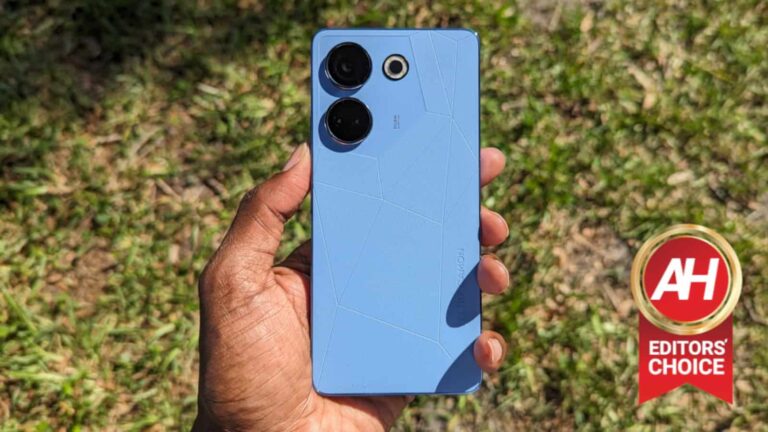
The design is one of the other fun aspects of this phone. Most flagship phones go for a more mature, sleek, and squeaky-clean look. Tecno goes in a different direction. It has this soft-touch plastic back that has a pattern etched into it.
The pattern extends throughout most of the phone’s back panel, and it gives the phone a bit of that classic futuristic aesthetic. I say most of the back because it doesn’t extend to the camera package. There’s a distinct irregular pentagonal shape around the camera package. This unique shape coupled with the large camera package defines the phone’s overall aesthetic. It’s similar to how the Glyph Interface defines the Nothing Phone (1).
It’s so unique and fun, but it still has an elegance to it. The design is bold, but at the same time, it’s subdued. The lines are subtle, and there’s enough empty space on the back to keep things from looking cluttered. You’re sure to turn heads when you take this phone out especially if you’re in a sea of iPhones and Galaxy phones.
Tecno Camon 20 Pro Review: Display
I can honestly say that the display on this phone does NOT belong on a phone in this price bracket! Phones at $300 and below typically have displays that are serviceable to nice. Some will have some nice colors and decent brightness, but they’re nothing to write home about.
The display on the Camon 20 Pro is absolutely breathtaking. I was honestly shocked at how gorgeous this display is. It’s a 1080p AMOLED display, but it goes deeper than that. Any company can slap an OLED panel on a phone and call it a day. It’ll have punchy colors and deep blacks blah blah blah.
Tecno did an amazing job calibrating this display. The colors are punchy, but they strike that perfect balance between dull and oversaturated. The panel gives you a pleasant pop of color that stops short of being too much. I’d say it’s just slightly behind the display on the Galaxy A53 5G, and that display was also beautiful. This is all made better by the silky smooth 120Hz refresh rate.
There are two color settings that this display has. One keeps the colors toned down while the other boosts the colors to be more juicy. You can choose which one suits your tastes. You can also meticulously dial in the color temperature of the display.
It’s not just the colors; this display is very bright. Brightness is an area where other mid-range phones fall short. The Camon 20 Pro’s display bucked that trend and fitted this phone with a panel that can be seen in any scenario.
Sunlight visibility is not an issue at all unless the sun is directly reflected on your display. It’s bright by default, but it has a setting where it will push the brightness even further when you’re in a bright environment.
Tecno Camon 20 Pro Review: Performance
When I saw that this was using a MediaTek processor (and one from the Helio line), I didn’t get my hopes up. Well, I tip my hat to both MediaTek and Tecno. The Camon 20 Pro’s performance is incredibly smooth. Navigating the software, jumping from app to app, etc. all run smoothly. It performs much better than what I expected from a mid-range processor, and it’s notably smoother than some phones I’ve reviewed running Snapdragon chips.
There is the occasional stutter and dropped frame. However, they’re so few and far apart. I was deeply impressed with how well Tecno optimized the software for the chip.
Tecno Camon 20 Pro Review: Gaming
When it comes to gaming, however, the Camon 20 Pro shows its mid-range ways. Don’t get me wrong; the performance isn’t bad. You’re more than capable of running any 2D game on the Play Store or the Palm Store. Games like Fishing Paradiso, Sweet Sins 2, and Snoopy Pop all run flawlessly.
3D games
Even when it comes to most 3D games, this phone can handle its own just fine. 3D games that are less graphically intensive, like DragonBall Legends, are a shoo-in, and some of the prettier games like Sky: Children of The Light run smoothly with only the occasional hiccup.
Once we start reaching the top of mobile game graphics, that’s where we see this phone chug. I’m talking about, of course, Genshin Impact. Cranking the graphics up to the highest setting, you’ll get a consistent stutter and dropped frames while you play. There will also be instances when the game will lock up for a few seconds.
However, the game wasn’t unplayable. I was able to play it as usual even when I was on high cliffs with a lot of the world being loaded in. And, remember, this is on the highest graphical setting. I found that medium is about the setting that will give you a smooth performance.
Tecno Camon 20 Pro Review: Speakers
When it comes to the speakers, I don’t really feel strongly about them. That’s because they’re not particularly good or bad. They’re… well, they’re speakers. There’s nothing particularly bad about them. They get plenty loud and they don’t get distorted until you reach the highest volume setting. They have a decently wide sound to them as well.
In the same vein, they’re not particularly amazing. This is mostly because of the lack of low-end. The bass has a hard time cutting through the rest of the sound. In music with grittier bass like an 80s pop song, you can hear the tone of the bass, but you don’t really get any of the depth. This rules out orchestral music.
It seems that the speakers have an emphasis on the high-end, however. In all honesty, if you’re into ASMR, then you’ll have a great time with the phone. Those higher tones play through pleasantly with these speakers.
Tecno Camon 20 Pro Review: Camera
So far, the Camon 20 Pro has proven to be an exceptionally good phone, but if there’s one area where this phone is truly weak, it’s the camera. The camera, understandably, is the downfall of almost all phones in this price bracket. It’s one of the hardest things to get right even for bigger companies. That being said, there are some issues with this phone’s camera performance.
Still photos in good lighting
Looking at the still photos, one thing that popped out at me was the lack of dynamic range. The images wind up looking flat and lifeless with a lack of contrast. The lack of color also adds to the overall dullness of the image. They look fine when viewed on the phone’s display, but once you view them on another display, it’ll become evident.
Still photos in low light
When it comes to low light, the quality doesn’t degrade as much as I expected. The images were exposed pretty nicely, and it managed to retain a fair amount of detail. It still has the same pitfalls as the performance in better lighting. The contrast and colors are just not there.
On the plus side, the camera was able to keep the noise in check. In situations with reduced light, I was able to get a decently well-detailed output. Overall, the performance in low light was pretty good.
Video
Videos suffer much the same issue as photos. Both the colors and dynamic range are crushed, making for a pretty flat output. There are some other unfortunate aspects of the video. For starters, the stabilization is not great at all. Casually walking makes for a shaky experience. Also, the output quality isn’t great either. While you’re able to record in 1080p and 1440p, the quality looks both oversharpened and overly compressed at the same time.
Tecno Camon 20 Pro Review: Software
Moving back to a positive note, the Camon 20 Pro comes with a great software experience. It’s a far departure from what we see with stock Android, however. There isn’t an ounce of Material You influence to be found anywhere. However, that’s not a bad thing.
I rather enjoyed using this phone’s software. It’s really optimized for the chip, and that lends to this device’s smoothness. One thing that sticks out to me was the number of customization options. Most of the customizations affect the home screen. You’re able to customize the size of the icons, icon grid, page animations, notifications badges, and much more. And I mean a LOT more!
Aside from the customizations, there are a bunch of different gestures that you can do to perform different functions like taking screenshots, summoning different menus, and opening apps. There are 10 gestures that you can do while the screen is on and 8 that you can do when the screen is off.
Another one of my favorite features is the ability to pop out apps as separate floating windows. You can pop an app out from the multi-app screen or from its notification.
There are just so many gestures, settings, customizations, and lifestyle additions that let you know that you’re getting a fully-functioning software experience. Keeping with the theme of this article, the software is one thing that makes this phone fun.
My gripes about the software
The software is great, but there are a few decisions that I just didn’t really like. They don’t drag down the experience as a whole, but I think that changing them would make things better.
The bigger complaint I have has to do with the fingerprint scanner. This comes with an extremely fast and accurate under-display fingerprint scanner. Honestly, it’s one of the best that I’ve ever tested. However, there’s one weird software decision that Tecno made. I can use the fingerprint scanner when on the lock screen… but not after I tap on a notification. After I tap on a notification, I’m forced to use the passcode. The same goes for when I use one of the screen-off gestures to open an app. I wish that I could use the fingerprint scanner to make getting into the app faster.
Lastly, the software separates the notification shade and quick settings. You swipe the top left of the screen to get the notifications and the top right to get the quick settings. That’s not intrinsically bad, but it’s counterintuitive for people who are used to them being together. You can swipe back and forth between them when they’re down, but it’d just be better if they were together.
Tecno Camon 20 Pro Review: Battery
The battery life on this phone is pretty good. It’s rocking a 5,000mAh battery. I had no problem getting a day and a half with moderate usage. This involved a decent amount of social media scrolling, gaming, and video-watching. On heavier days, you should have power in the tank by bedtime.
Tecno Camon 20 Pro Review: What’s missing?
When it comes to what’s missing, there’s not much missing that you usually find on other mid-rangers. So, these omissions don’t paint this phone in a bad light. There’s no IP certification, wireless charging, or high-quality haptics.
Conclusion
I am floored by this phone, honestly. Don’t get me wrong, it has its downers. The camera’s really bad, the speakers could be better, and the issue with the fingerprint scanner is a bit annoying. But, the Camon 20 Pro was able to bring an overall great smartphone experience with its excellent software optimization, plethora of features, great performance, decent gaming prowess, and drop-dead gorgeous display.
It’s not just that it provides such a smooth and fun smartphone experience; it’s the fact that it does so for under €300. I highly recommend that you pick up this phone!
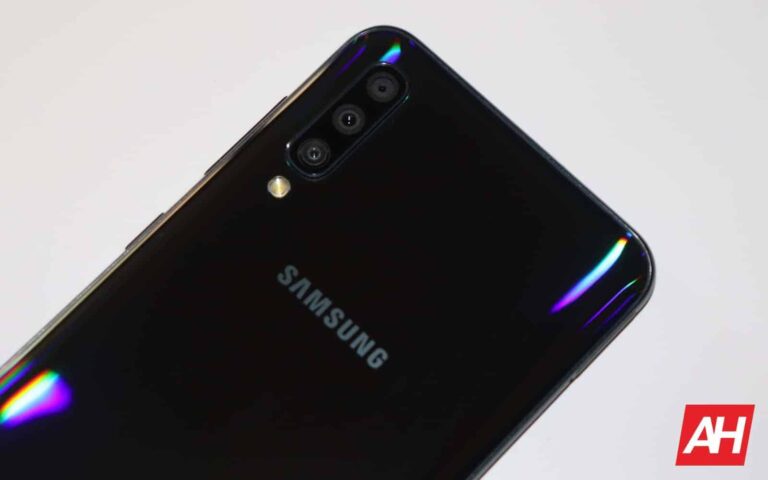
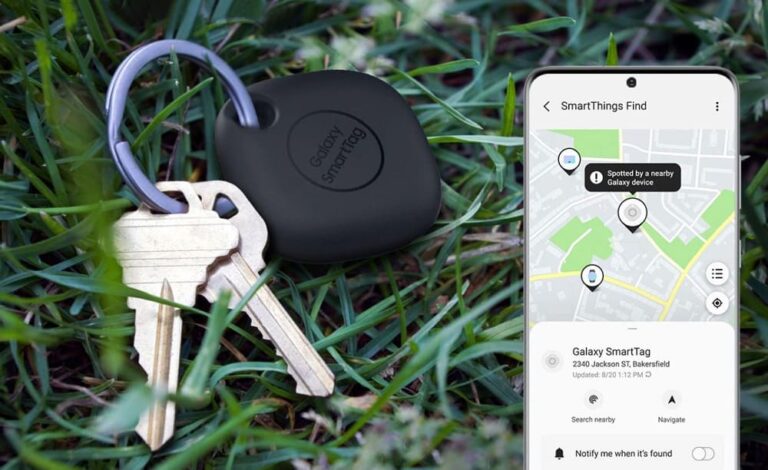
A smart object tracker may accompany Samsung‘s new foldables, tablets, and smartwatches at its Galaxy Unpacked event next month. Rumors of a second-gen Galaxy SmartTag surfaced a couple of months back but without many details. A Bluetooth SIG certification has now confirmed that the Galaxy SmartTag 2 is coming and probably coming soon.
Published today, the Bluetooth listing explicitly names the product, i.e., Galaxy SmartTag, describing it as a device used for finding and tracking things with the help of Samsung’s SmartThings IoT (Internet of Things) platform. The website lists two products with the same name and model number (EI-T5600). It appears the company will once again launch the tracker in two versions — one with Bluetooth-only connectivity and the other with ultra-wideband (UWB) support.
Speaking of Bluetooth connectivity, the Galaxy SmartTag will boast Bluetooth 5.3. It’s an upgrade over Bluetooth 5.1 found on the first-gen Samsung smart tracker. The newer version of the wireless connectivity technology, which debuted in July 2021 (Bluetooth 5.1 in early 2019), brings power, security, and functional improvements. It consumes less power and offers a more reliable and stable wireless connection with a wider range. The new Bluetooth standard is also more secure.
Unfortunately, that’s all we know about the Galaxy SmartTag 2 at the moment. It’s unclear if the new smart tracker will bring more improvements or what it will look like. Samsung would do well to raise the buzzer volume and offer better protection against dust and water. The original model’s IP53 rating isn’t as strong as Apple AirTag’s IP67. We may hear more about the Galaxy SmartTag 2 in the coming weeks as Samsung prepares for its launch.
The Galaxy SmartTag 2 may debut next month
There haven’t been many rumors about the Galaxy SmartTag 2. In March, reports emerged that Samsung is planning to launch a new smart tracker this year, but there was no telling when it will arrive. However, the timing of this Bluetooth certification suggests the Korean firm will debut it soon. And there’s no better stage than next month’s Galaxy Unpacked.
Samsung will launch a host of products during the mega event in its homeland on July 27 (July 26 in South Korea). The Galaxy Z Fold 5, Galaxy Z Flip 5, Galaxy Tab S9, Galaxy Tab S9+, Galaxy Tab S9 Ultra, Galaxy Watch 6, and Galaxy Watch 6 Classic are all but officially confirmed to debut at the event. The company may slip the Galaxy SmartTag 2 alongside them. The Galaxy Buds 3 may miss out, though.
Amazon’s action should come as no surprise that, just like the proliferation of fake news, fake reviews have also become a significant aspect of the underground scam market.
In a determined effort to protect its customers and sellers from the growing menace of fake reviews, e-commerce giant Amazon has recently launched a series of lawsuits against fraudulent individuals and organizations.
These perpetrators, operating within an underground network known as the “fake review broker” industry, have been exploiting unsuspecting consumers and tarnishing the reputation of Amazon’s marketplace.
Amazon has invested substantial resources in advanced technologies, including machine learning models and expert investigators, to proactively combat fake reviews before they reach the eyes of customers.
In 2022 alone, the company successfully blocked over 200 million suspected fake reviews from appearing on its platform. Now, by targeting the facilitators of these fraudulent practices, Amazon aims to strike at the root of the problem and hold those responsible accountable.
Amazon announced significant actions taken against 94 fraudsters operating in the United States, China, and Europe. These actions were implemented as of May 2023, showcasing the technology giant’s proactive approach to tackling the issue at hand.
It should come as no surprise that, just like the proliferation of fake news, fake reviews have also become a significant aspect of the underground scam market. In fact, as of March 2020, fake reviews accounted for 50% of the threats faced by Android-based devices, among other issues.
The seriousness of the issue is further exemplified by a notable incident in May 2021. During this incident, a misconfigured server inadvertently exposed a staggering 7GB of well-organized schemes employed by Amazon vendors to generate fake reviews for their products on the website.
According to a press release issued on June 28th, 2023, the legal actions filed by Amazon include four notable lawsuits against prominent perpetrators. Here is an overview of each case:
Amazon v. Nice Discount:
The owners and operators of Nice Discount have been accused of orchestrating a scheme to generate fake positive reviews and feedback through their “Product Tester Club.” Reviewers are enticed to leave fabricated positive reviews or feedback in exchange for refunds or monetary rewards. By connecting bad actors operating Amazon selling accounts with reviewers, the defendants have guided these individuals on when and how to post fake reviews, creating an illusion of authenticity. Case No. 23-2-10603-2 SEA.
Amazon v. Littlesmm:
The website Littlesmm has allegedly been selling packages of fake reviews to unscrupulous individuals operating Amazon selling accounts across Australia, Canada, and the U.S. Ranging in price from $20 to $440, these packages offer both positive and negative reviews. By employing Amazon customer accounts under their control, the defendants have orchestrated the posting of counterfeit positive reviews while simultaneously undermining their competitors’ product listings through fake negative reviews. Case No. 23-2-10452-8 SEA.
Amazon v. MangoCity:
The owners and operators of MangoCity have been accused of selling fake reviews for prices ranging from $50 to $4,000. Utilizing their website, video chats, and email correspondence, the defendants accept payments and subsequently deploy Amazon customer accounts to leave fabricated 5-star reviews on product listing pages. Additionally, they have targeted competitors by offering fake negative reviews on their products. Case No. 23-2-11278-4 SEA.
Amazon v. Reddit Marketing Pro:
The owners and operators of Reddit Marketing Pro have allegedly provided fraudulent services, including fake positive and negative reviews, to bad actors with Amazon selling accounts. In exchange for fees ranging from $99 for five fake reviews to $6,999 for 500 fake reviews, the defendants have employed Amazon customer accounts under their control to populate product listing pages with counterfeit reviews. They have also marketed fake “Questions and Answers” to manipulate the content displayed. Case No. 23-2-11265-2 SEA.
In a comment to Hackread.com, Chris Downie, CEO of Edinburgh, Scotland-based anti-fraud platform Pasabi said, “Fake review brokers play a central role in poisoning consumer decision-making, destroying businesses and inflicting untold damage on the wider economy.”
Downie added that “Whilst it’s encouraging to see Amazon taking these fraudsters to task via the legal system, so much more needs to be done to tackle the growing fake review epidemic which influences around £4bn in UK consumer spending every year.”
“By harnessing the power of AI and the latest fraud detection anti-fraud technology, review aggregators and business owners need to work together to identify and block fraudulent reviews, stamping out the problem before it gets any worse,” added Downie.
Amazon chief David Montague, vice president of Selling Partner Risk, said, “Our goal is to ensure that every review in Amazon’s stores is trustworthy and reflects customers’ actual experiences. Amazon welcomes authentic reviews—whether positive or negative —but strictly prohibits fake reviews that intentionally mislead customers.”
“We continue to innovate on our proactive technology to detect fake reviews and other indications of unusual behaviour. Another way we fight fake reviews is through legal action. Not only are we targeting the source of the problem but we’re sending a clear message that there’s no place for abuse in our store and we will hold fraudsters accountable,” he added.
Despite Amazon’s aggressive stance against fake review brokers, the company recognizes that this is a pervasive global problem affecting multiple industries. To address this issue effectively, a collaborative effort between the public and private sectors is required.
By taking legal action against 94 fraudsters across the United States, China, and Europe, as of May 2023, Amazon is demonstrating its commitment to combatting this menace. However, the battle against fake review brokers demands ongoing vigilance and cooperation to ensure a safe and trustworthy online marketplace for consumers and sellers alike.