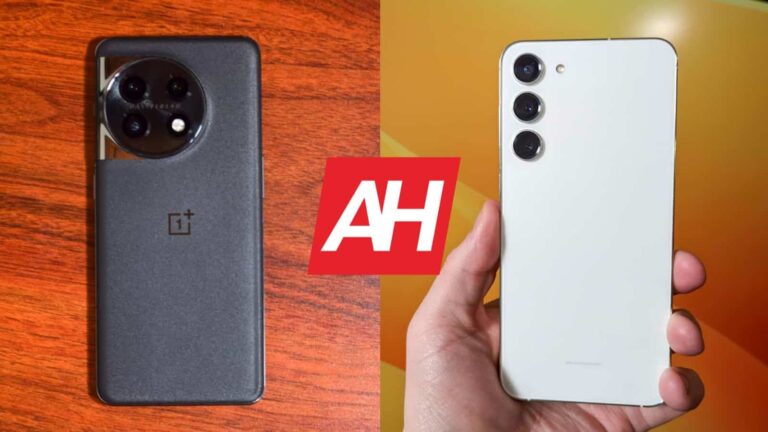
OnePlus 11 vs Samsung Galaxy S23+

0
[ad_1]

This time around, we’re comparing some high-end offerings from OnePlus and Samsung. We’ll compare the OnePlus 11 vs Samsung Galaxy S23+. Truth be said, the Galaxy S23+ is not the most powerful phone Samsung has to offer, but it’s not far from it. We’ve already covered the OnePlus 11 vs Galaxy S23 Ultra comparison. That being said, the Galaxy S23+ is a compelling phone in its own right, so this should be interesting.

We’ll first list the specs of both devices, and will then move to compare them across a number of categories. We’ll compare their designs, displays, performance, battery life, cameras, and audio performance. If you’re in the market for a high-end device, these two should be considered, that’s for sure. So, let’s get started, shall we?

Specs

OnePlus 11 Samsung Galaxy S23+
Screen size 6.7-inch QHD+ LTPO3 Fluid AMOLED display (120Hz refresh rate, curved, 1,300 nits peak brightness, LTPO down to 1Hz) 6.6-inch fullHD+ Dynamic AMOLED 2X display (curved, 120Hz adaptive refresh rate, LTPO, 1,750 nits peak brightness)
Screen resolution 3216 x 1440 2340 x 1080
SoC Qualcomm Snapdragon 8 Gen 2 Qualcomm Snapdragon 8 Gen 2 for Galaxy
RAM 8GB/16GB (LPDDR5X) 8GB (LPDDR5X)
Storage 128GB/256GB, non-expandable (UFS 4.0) 256GB/512GB, non-expandable (UFS 4.0)
Rear cameras 50MP (f/1.8 aperture, 1.0um pixel size, OIS, multi-directional PDAF)
48MP (ultrawide, f/2.2 aperture, 115-degree FoV, AF)
32MP (telephoto, f/2.0 aperture, 2x optical zoom, PDAF)
50MP (f/1.8 aperture, 24mm lens, 1.0um pixel size, OIS, Dual Pixel PDAF)
12MP (ultrawide, f/2.2 aperture, 13mm lens, 120-degree FoV, 1.4um pixel size)
10MP (telephoto, f/2.4 aperture, 70mm lens, 1.0um pixel size, OIS, 3x optical zoom, PDAF)
Front cameras 16MP (f/2.5 aperture, 25mm lens, 1.0um pixel size) 12MP (f/2.2 aperture, 26mm lens, Dual Pixel PDAF)
Battery 5,000mAh, non-removable, 100W wired (80W in the US) charging
Charger included
4,700mAh, non-removable, 45W wired charging, 15W Qi wireless charging, 4.5W Wireless PowerShare
Charger not included
Dimensions 163.1 x 74.1 x 8.5mm 157.8 x 76.2 x 7.6mm
Weight 205 grams 196 grams
Connectivity 5G, LTE, NFC, Bluetooth 5.3, Wi-Fi, USB Type-C 5G, LTE, NFC, Bluetooth 5.3, Wi-Fi, USB Type-C
Security Face scanning (front camera)
In-display fingerprint scanner (optical)
In-display fingerprint scanner (ultrasonic)
OS Android 13
OxygenOS 13
Android 13
One UI 5.1
Price $699/$799 $999.99/$1,119.99
Buy OnePlus Samsung

OnePlus 11 vs Samsung Galaxy S23+: Design

Both devices are made out of metal and glass, and both feature rounded corners. The in-hand feel is a bit different, though. The OnePlus 11 is noticeably taller and wider than the Galaxy S23+. It’s also thicker than Samsung’s offering. On top of everything, the OnePlus 11 is the lighter of the two phones. It weighs 205 grams, compared to 196 grams of the Samsung Galaxy S23+.

Both devices utilize aluminum for their frames. The OnePlus 11 has Gorilla Glass 5 on the back, while the Galaxy S23+ features Gorilla Glass Victus 2. The bezels are quite thin on both devices. The OnePlus 11 has a display camera hole in the top-left corner, and a curved display. The Galaxy S23+ has a centered display camera hole at the top, and it also includes a flat display.

They do look different from the back too, even more so. The OnePlus 11 has a round camera island, with three cameras inside it. The Galaxy S23+, on the other hand, has three separate camera islands, each of which packs in a single camera. The Galaxy S23+’s backplate is flatter than the one on the OnePlus 11. Both phones come with IP certification, but the Galaxy S23+ offers more in that regard. It has IP68 certification for water and dust resistance, while the OnePlus 11 is limited to IP64 certification.

OnePlus 11 vs Samsung Galaxy S23+: Display

The OnePlus 11 features a 6.7-inch QHD+ (3216 x 1440) LTPO3 Fluid AMOLED display. That panel is curved, and it can project up to 1 billion colors. It has Dolby Vision and HDR10+ content support, while it also supports a 120Hz refresh rate. This display has a 20:9 aspect ratio, and it can go up to 1,300 nits of brightness at its peak. The Gorilla Glass Victus is applied on top of the display, for protection purposes.

OnePlus 11 Review AM AH 06

The Galaxy S23+, on the flip side, includes a 6.6-inch fullHD+ (2340 x 1080) Dynamic AMOLED 2X display. This display is flat, and it offers a 120Hz refresh rate. HDR10+ content is supported, and the display goes up to 1,750 nits of brightness at its peak. The display aspect ratio here is 19.5:9, while the Galaxy S23+’s panel is protected by the Gorilla Glass Victus 2, in case you were wondering.

Both of these displays are great, actually. They both have great viewing angles, and both offer vivid colors with deep blacks. The OnePlus 11’s panel is sharper, but not many of you will notice the difference. The Galaxy S23+’s panel does get brighter, and you may notice that if you use your phone outdoors in direct sunlight, it is noticeable. The touch response is great on both displays, and a 120Hz refresh rate is well-optimized in both cases.

OnePlus 11 vs Samsung Galaxy S23+: Performance

The Snapdragon 8 Gen 2 fuels both of these smartphones. Well, the Galaxy S23+ does come with the Snapdragon 8 Gen 2 for Galaxy, which is clocked a bit higher. The OnePlus 11 includes up to 16GB of LPDDR5X RAM, and up to 512GB of UFS 4.0 flash storage. Do note that only the 128GB storage model has UFS 3.1 storage. The Galaxy S23+ comes with 8GB of LPDDR5X RAM, and up to 512GB of UFS 4.0 storage.

Both smartphones offer outstanding performance. They’re extremely smooth, we did not notice any lag or anything of the sort. Considering their specs, chances are it will stay that way for a while, but we’ll see. They do a great job with regular, everyday tasks, and even with demanding stuff, such as gaming. Neither phone gets too hot during gaming, or anything of the sort, and both can handle even the most demanding titles for Android. They’re basically on the same level in terms of performance.

OnePlus 11 vs Samsung Galaxy S23+: Battery

The OnePlus 11 includes a 5,000mAh battery on the inside. The Galaxy S23+, on the flip side, has a 4,700mAh battery inside its shell. The battery life is not exactly comparable, though. We’ve been able to get outstanding battery life with the OnePlus 11, not so much with the Galaxy S23+. Don’t get me wrong, the Galaxy S23+ battery life is good, but it’s nowhere near the OnePlus 11 level.

We’ve been able to cross the 10-hour screen-on-time mark with the OnePlus 11 a number of times. That phone truly shines when it comes to battery life. You can expect something closer to 7-7.5 hours of screen-on-time with the Galaxy S23+, that’s still great, though. We’re only sharing our experiences here, of course, your mileage may vary. You’ll use your devices differently, with different apps, and different signal strengths.

The OnePlus 11 blows away the Galaxy S23+ in terms of charging speed, but the Galaxy S23+ is more versatile. OnePlus’ flagship supports 100W wired (80W in the US) charging, and that’s it. The Galaxy S23+ supports 45W wired, 15W wireless, and 4.5W reverse wireless charging. Another thing to note is that the OnePlus 11 does include a charger in the box, unlike the Galaxy S23+.

OnePlus 11 vs Samsung Galaxy S23+: Cameras

The OnePlus 11 boasts a 50-megapixel main camera, a 48-megapixel ultrawide unit (115-degree FoV), and a 32-megapixel telephoto camera (2x optical zoom). The Galaxy S23+, on the other hand, has a 50-megapixel main camera, a 12-megapixel ultrawide camera (120-degree FoV), and a 10-megapixel telephoto camera (3x optical zoom). It’s worth noting that Hasselblad is also a part of the OnePlus 11 offering, mainly in regards to color tuning.

Samsung Galaxy S23 Plus Review AM AH 12

Both of these phones do a great job when it comes to photography. During the day, both phones provide vivid, and sharp images, with plenty of detail. They also do a great job when it comes to HDR shots. The images do look a bit different, but both results end up looking rich and nice. We preferred the ultrawide camera of the OnePlus 11 in all conditions, and the telephoto camera on the Galaxy S23+, mainly due to the optical zoom benefit.

In low light, both phones handle themselves nicely. They both tend to light up the scene quite a bit, which is a look most people prefer. They’re doing their best to capture the best photo, not necessarily the most realistic one. Neither phone shines in the video recording department, but they’re both more than good enough. Both companies issued a number of camera updates since launch, and fixed some issues they faced early on. These cameras are easy to recommend.

Audio

There is a set of stereo speakers included on both the OnePlus 11 and Samsung Galaxy S23+. Those speakers are good on both devices, though they’re a bit louder on the OnePlus 11. We did prefer the sound coming from the Galaxy S23+, as it seemed to be a bit more detailed, though the difference is not big at all.

What you won’t find on either phone is an audio jack. You will have to resort to their Type-C ports for wired audio connections. If you prefer wireless audio, on the other hand, both phones offer support for Bluetooth 5.3.


[ad_2]
Source link
US Senators to evaluate Big Tech layoffs’ impact on 2024 election

0
[ad_1]

In a letter to Meta, Google, and Twitter, US Senators have questioned the Big Tech abilities to fight misinformation ahead of the 2024 election after mass layoffs.

The tech giants have reduced their headcounts due to economic slowdown and post-Covid corrections. These companies own the biggest online platforms and could significantly impact public opinion.

The Senators now worry that mass layoffs might hinder the companies from fulfilling their commitment to combating misinformation. The layoffs also included members of content moderation teams who are responsible for dealing with false content on the platforms.

Minnesota Democratic Sen. Amy Klobuchar, Vermont Democratic Sen. Peter Welch, and Illinois Democratic Sen. Dick Durbin wrote the letter on Tuesday. They warned that the emergence of AI to mislead voters is “particularly troubling.”

Big Tech layoffs could impact US 2024 Elections, Senators Says

The tech companies are now facing one of the biggest exodus in their history. The problem for Big Tech is more considerable. Following the Elon Musk takeover, Twitter laid off nearly 80% of its staff, including content moderations and some engineering teams.

Google parent company Alphabet also plans to reduce 12,000 of its headcounts as well as pause the construction of a new Campus in California. Likewise, Facebook’s parent company Meta wants to eliminate 21,000 jobs over two rounds of layoffs. The impacted staff are said to get severance payments.

It remains to be seen how this exodus could impact the US 2024 election. In a statement to CNN, Meta spokesperson Andy Stone said, “We remain focused on advancing our industry-leading integrity efforts and continue to invest in teams and technologies to protect our community – including our efforts to prepare for elections around the world.”

Ahead of the 2024 election, some platforms are changing their content moderation policies. For example, YouTube now allows users to question the validity of the 2020 election and say it was stolen. Senators also pointed out the Twitter content moderation “Challenges” after Musk’s takeover and his mass layoffs.

Twitter, Meta, and Google CEO must respond to the letter by July 10. Senators asked CEOs how they prepare for the 2024 election and what their plans are to combat misinformation. Additionally, the companies need to clarify whether they need to hire content moderators and how they can battle AI-generated deepfakes in politics.


[ad_2]
Source link

US Auto Insurance Price Comparison Site RateForce Leaks Massive PII Data

0
[ad_1]

RateForce is a platform that facilitates online comparison of car insurance quotes and has boasted nearly 11 million quotes since 2014.

A massive data breach has come to light, exposing over 250,000 documents containing the personal and sensitive information of thousands of individuals from the United States.

The breach, which lasted for at least two weeks, involved an unsecured database containing scans and images of various documents, including vehicle registrations, driver’s licenses, insurance cards, vehicle titles, and state Medicaid health coverage cards.

The breach was initially discovered by security researcher Jeremiah Fowler, who stumbled upon the exposed database. Upon further investigation, it was revealed that the primary insurer associated with all the policies listed in the database was USA Underwriters.

Concerned about the severity of the data exposure, the researcher promptly reached out to USA Underwriters via email with a responsible disclosure notice. However, despite multiple attempts, the researcher received no response.

Taking matters into his own hands, Fowler managed to contact someone at USA Underwriters by phone and emphasized the urgency of the situation. Following the call, the database was finally secured and restricted from public access within two hours.

The story took an unexpected twist when Fowler received a voicemail from an individual claiming to be a detective from the Detroit Police, seeking to ask a few questions.

“I searched the name and phone number of the alleged detective and a LinkedIn account matched the same unique and uncommon name of a USA Underwriters employee. I returned the call and asked if the individual was an employee or affiliated with USA Underwriters and each time the answer was, “No”,” Fowler detailed in the report to vpnMentor.

Furthermore, the detective in question mentioned that a third-party vendor named RateForce was the owner of the compromised database. This incident is somewhat similar to the one in November 2020, in which Vertafore, an Insurance Software Solution exposed license details of 27.7M Texas drivers.

RateForce is a platform that facilitates online comparison of car insurance quotes and has boasted nearly 11 million quotes since 2014. In 2021, the company ranked second on the prestigious Inc. 5000 list of the fastest-growing private companies in the insurance industry. This revelation suggests that the breach may have affected a significant number of individuals who have utilized RateForce’s services.

The compromised records revealed a substantial presence of independent insurance agents who sold policies. It appears that most of the documents originated from agencies and car dealerships procuring insurance on behalf of their customers. While the majority of identification documents belonged to individuals from Michigan, licenses from Georgia, Arizona, and Virginia were also observed.

The database contained a staggering 96,175 folders that housed 255,756 records, totaling a size of 93.93 GB. These folders contained insurance policy cards, driver’s licenses (front and back), and, in some cases, additional documents such as auto loan information, state registrations, Medicaid or health insurance cards, utility bills, and letters from banks showing active accounts.

US Auto Insurance Price Comparison Site RateForce Leaks Massive PII Data
Type of leaked data

Moreover, the breach exposed customer and applicant names, home addresses, phone numbers, driver’s license numbers, vehicle identification numbers (VINs), and insurance policy details. Shockingly, sales records with auto dealer information, including EIN tax identification numbers, were also compromised, with some records even containing buyers’ social security numbers in plain text.

While USA Underwriters was initially thought to be the owner of the exposed database, it was later confirmed that the database belonged to RateForce, indicating the involvement of a third-party vendor.

USA Underwriters clarified that they employ a separate IT company to manage their infrastructure and disclaimed any responsibility for the management of the breached database. This incident serves as a reminder of the risks associated with third-party vendors and highlights the need for stringent security measures and oversight when handling sensitive customer information.

  1. Latitude Financial Data Breach: 14 M Users Affected
  2. General Motors collected locations of 90,000 drivers
  3. FedEx users’​ ​passports, ID & driving licenses exposed
  4. Data Breach at MCNA Dental Insurer Impacts 9M Users
  5. Pakistani ride-hailing app BYKEA exposed 400m records

[ad_2]
Source link

Malwarebytes only vendor to win every MRG Effitas award in 2022 & 2023

0
[ad_1]

Dive into where we prevented more than the rest and how we were able to do it.

MRG Effitas, a world leader in independent IT research, published their anti-malware efficacy assessment results for Q1 2023. Malwarebytes Endpoint Protection (EP) achieved the highest possible score (100%) and received certifications for Level 1, Exploit, Online Banking, and Ransomware.

These results mark the seventh time in a row we have received all certification awards and we are now officially the only vendor to win every single certification & award in 2022 and so far into 2023.

MRG Effitas assesses a product’s ability to meet today’s most pressing threats, including stopping zero-day malware, ransomware, exploits, and more—and doing so with speedy performance and low false positives.

The signature and behavior-based detection techniques and proprietary anti-exploit technology of Malwarebytes EP allowed it to detect and block more malware than any other competitor on the Q1 test. As an integral foundation layer for our EDR and MDR solutions, these results prove that Malwarebytes EP provides reliable and comprehensive protection against a wide range of threats. 

For the full results and to see how we stack up against competitors, our “Endpoint Security Evaluation Guide” eBook—based on MRG Effitas’ independent lab assessment—is an essential tool for any organization looking to make an informed decision about endpoint security. Download below!

GET THE ENDPOINT SECURITY EVALUATION GUIDE

Let’s dive into where we prevented more than the rest and how we were able to do it.

100% of ransomware blocked

Using a blend of signature and signature-less technologies, the anti-ransomware layer of Malwarebytes EP constantly monitors endpoint systems and automatically kills processes associated with ransomware activity.

MRG Effitas tested security products for 30 ransomware samples. In addition, they tested four ransomware simulator samples created in-house, ensuring the security product could only rely on its behavior scanning modules. To test for false positives, a device running Malwarebytes EP also ran three benign programs designed to mimic ransomware behavior.

Malwarebytes blocked 100 percent of ransomware threats in the MRG Effitas assessment and did so with no false positives, allowing the three benign programs to run. For this we earned the 360° Ransomware Certification.

Nebula view of detected ransomware activity 

100% of banking malware blocked

In 2021, 37% of banking malware attacks targeted corporate users.

We were one of the few vendors who earned a 360° Online Banking Certification, which means Malwarebytes EP stopped 100% of threats designed to steal financial information and money from victim’s accounts. To outperform the others, our unique detection technology again came into play.

Malwarebytes EP autoblocked 100% of the 25 financial malware samples, the Magecart credit card-skimming attack, and Botnets designed to steal credentials. 

100% of zero-day threats blocked

One of the many strong suits of our detection is that it can detect malware that has never been seen before, also called zero-day malware. Again, we were one of the only vendors to detect and block these pernicious threats, which account for 80% of successful breaches.

Built on machine learning (ML) and behavioral analysis techniques, our behavior-based detection enabled Malwarebytes EP to detect and autoblock 100% of all zero-day threats. For this, as well as blocking all Botnets, we earned the 360° Level 1 Certification.

100% of exploits blocked

The anti-exploit feature of Malwarebytes EP protects organizations from one of the most advanced cyber attacks: zero-day exploits targeting browser and application vulnerabilities. But don’t take our word for it: MRG Effitas used 8 different exploitation techniques to try and deliver a malicious payload on a device running Malwarebytes EP—but they didn’t get very far.

Malwarebytes earned the 360° Exploit Certification for autoblocked 100% of Exploit/Fileless attacks, entirely protecting the system from infection.

We were one of the few to earn the 360° Exploit Certification all thanks to our proprietary anti-exploit technology, which wraps vulnerable programs in four defensive layers that prevent an exploit from installing its payload, or even executing initial shellcode.

Our four layers of exploit protection

Anti-exploit settings in Nebula

Consistency is key

If there is one shining take away from this accomplishment, it’s that consistency is key.

You don’t want a security solution that passes rigorous tests like MRG Effitas only some of the time. You want a solution that passes them with flying colors all of the time. Clearly, Malwarebytes EP, and by extension our EDR and MDR, is that solution.

For organizations that are concerned their current solution may not be up-to-par, the MRG Effitas assessment has demonstrated—more constantly than anybody else—that Malwarebytes for Business has what it takes to keep your business safe from today’s most pressing cyberthreats.

Download THE ebook for full results


[ad_2]
Source link

Fossil smartwatches can once again use Google Assistant

0
[ad_1]

Fossil smartwatches can once again use Google Assistant, thanks to a recent update for the brand’s latest watches. Google Assistant was initially available on Fossil watches but was removed with the Wear OS 3 upgrade.

This is because Wear OS 3 removed Google Assistant entirely for a time. If you remember, when Samsung’s Galaxy Watch 4 first launched, Google Assistant wasn’t available out of the box. And it took quite a few months before an update enabled it. This is essentially what happened to the Fossil Gen 6 and other Fossil watches that were updated to Wear OS 3. Now it’s back though, adding more utility with the hands-free capabilities to do everything from search to send messages.

The update, spotted by DroidLife, is available for the Fossil Gen 6 and the Fossil Gen 6 Wellness Edition. If you haven’t seen the update on your own watch yet, you can manually check to see if there’s an update available to download.

You won’t need to install Google Assistant on your Fossil Gen 6

While you will need to install the watch update, you won’t need to install the Google Assistant app. The update software has Google Assistant as part of the update so once the software finishes installing on your watch, the Assistant features will simply work.

Realistically this only saves you a minute or two. So it’s not really a time saver, but more of a convenience thing. Still, users are sure to be happy they have one less thing to install.

You will however still need to configure Google Assistant by setting it up. You can do this through the settings menu on the watch. Scroll to Google and select it, then look for Assistant and select that. You should get a little step by step guide walking you through the setup process. After that you’re all good to go.


[ad_2]
Source link

Meta makes good on promise to remove news from Canadian Facebook

0
[ad_1]

Meta will remove news content from its Facebook and Instagram services in Canada, the company has confirmed. In a blog post on the company’s website, Meta details reasoning for the change in available news content.

“Today, we are confirming that news availability will be ended on Facebook and Instagram for all users in Canada prior to the Online News Act (Bill C-18) taking effect,” the post reads. The bill was passed earlier today. The decision to remove news from Facebook has been an ongoing stance that Meta has stood by since earlier this month. The company initially announced its plans for these changes on June 1.

Facebook says people accessing its platforms will no longer be able to get news while browsing feeds. This includes content from news publishers and broadcasters.

Meta may remove news from Facebook elsewhere

The decision made is in response to the Canadian government’s passing of the Online News Act. Which sought to come up with a solution to news publishers in Canada who have seen a significant decrease in revenue due to news being shared on Facebook and Google.

The bill would require tech companies like Facebook to reimburse publishers for lost revenue. A similar bill may pass in California called the California Journalism Preservation Act. This bill would seek a 70% share of the profits that Meta would make from news shared on its platforms. Which would then be used to support newsrooms within the state. Meta said back on June 1 that it would be “forced to remove news” from Facebook and Instagram in California if the state passes the bill.

And now that it’s doing just that for users in Canada, there’s no reason to believe it won’t do the same thing in California and elsewhere. The company says that its news removal from the two platforms won’t impact the products in other ways. Users will “still be able to connect with friends and family.”

Meta also states that the removal of news content in Canada is happening as a result of ongoing testing. This is in accordance with its agreement to comply with the bill. Only a small percentage of users are impacted though according to the company’s statement. Which likely means that some users may be able to access news content until there’s a fully developed solution.


[ad_2]
Source link

Gmail notifications on Android might now be more pleasing to your eyes

0
[ad_1]
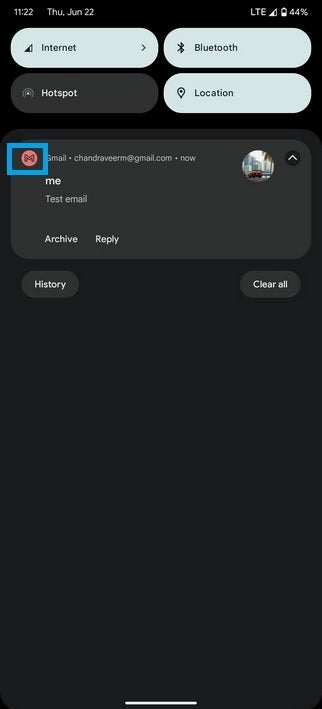
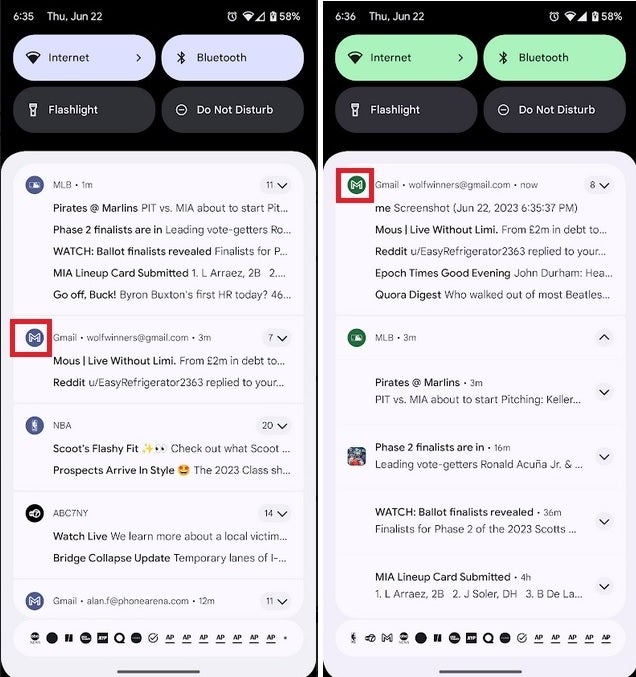
Google is finally getting around to putting dynamic theming in the last places on Android where they hadn’t before. One of these locations is the notification shade. Previously, when you pulled down the notification shade on your Android phone, the Gmail icon was red. That’s not a bad thing since the Gmail icon in that color certainly stood out and caught your eye. But the new dynamic theme color matching delivers a more pleasing aesthetic.
If you have Version 2023.05.28.54044.3362 of the Gmail app (and we will show you how to find out which version you’re running on your Android phone), the tiny Gmail icon on the notification shade will match colors with those Quick Settings lozenges that have been enabled on your handset. And those Quick Settings indicators get their color theme from the wallpaper used on the device. So in other words, the Gmail icon on the notification shade will soon take its color theme from the handset’s active wallpaper.

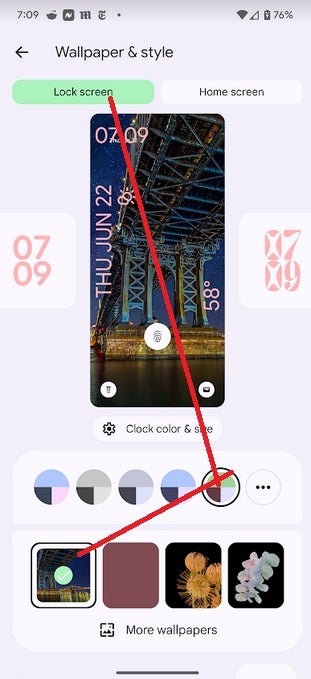
The version of Gmail on my Pixel 6 Pro running Android 14 Beta 3 does have the new feature as the Gmail icon on my notification shade is now one of the colors that has been pulled out of my wallpaper. To change the color theme based on your wallpaper, go to Settings > Wallpaper & style and under the preview of your wallpaper you will see color wheels. These colors are drawn from your wallpaper with the main color on top and accent colors on the bottom.

Tap on one and you’ll see the main color fill in the Lock screen and Home screen pills at the top of the page. In addition, the image of your wallpaper on the bottom will have a box around it with a circle inside with a white checkmark. That circle will be filled with your main color theme.

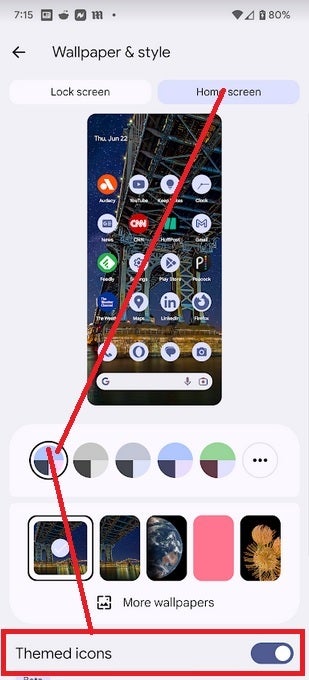
To change the color of your Android app icons, go to Settings > Wallpapers & style and press on Home screen in the upper right of the screen. Tap the color wheel you want to use (again, the main color is on the top of the wheel), scroll down to Themed icon (which is still considered a Beta), and toggle it on. Only compatible app icons will change color, but it will give your phone a refreshing new look.

To see which version of Gmail you are running, go to System > Apps > See all xxx apps. Scroll to Gmail and tap on the listing. Scroll down to the very bottom to see the version you have installed.

It’s just another way that Google allows Android users to customize their phones.


[ad_2]
Source link

CalPERS Compromised by MOVEit Hackers

0
[ad_1]

CalPERS (California Public Employees’ Retirement Systems) is an organization working to provide pension benefits for retirees and health security services for public servants and their survivors. 

CalPERS has been working alongside PBI (Public Research Services/Berwyn Group) to identify member deaths and ensure accuracy in retiree payments and beneficiaries. 

On June 6, 2023, PBI notified CalPERS that they had faced a data breach in their systems due to the MOVEit file transfer application zero-day that was reported earlier this month.

Several reports recently state that many threat groups have been using this vulnerability to exfiltrate sensitive data from organizations worldwide.

PII Involved

CalPERS has acknowledged the notification from PBI and working with cybersecurity investigators to investigate this incident further. Based on the recent announcements, the data breach involves personally identifiable information like 

  • First Name and Last Name
  • SSN
  • Current and former employee names
  • Spouse or domestic partner information
  • Child or Children’s information

PBI has contacted the law enforcement authorities and confirmed to CalPERS that they had resolved this issue and have taken security measures to prevent these kinds of incidents from happening.

Benefits from CalPERS

So as to compensate for this data breach, CalPERS has announced that they are providing free credit monitoring and restoration services through Experian IdentifyWorks for 2 years. They are also contacting affected individuals and their survivors to get these complementary benefits.

CalPERS confirmed that the data breach only involved information about retirees and their survivors, and no other data was compromised.

CalPERS also informed its customers to be vigilant towards identity theft and unauthorized transactions

MOVEit transfer application vulnerability has affected several organizations and their third-party vendors worldwide.

Organizations are recommended to get a self-study on their company and third-party vendor applications for MOVEit file transfer and patch it immediately before being targeted by any threat actors.

Manage and secure Your Endpoints Efficiently – Free Download


[ad_2]
Source link

Galaxy A14 5G & F62 bag Samsung’s June 2023 update

0
[ad_1]

Samsung has released the June 2023 Android security patch to a couple more Galaxy devices. The latest security update is now rolling out to the Galaxy A14 5G and Galaxy F62 in some markets. The company has already seeded the June SMR (Security Maintenance Release) to most other eligible devices.

As of this writing, the June update for the Galaxy A14 5G is rolling out in a handful of Asian countries. According to SamMobile, which first reported this rollout, it’s available for users in Hong Kong, Malaysia, and Taiwan. The new firmware build number for this budget handset is A146PZHU3BWF1. Samsung’s official changelog states that the phone is picking up some system stability and reliability improvements along with this month’s security fixes.

Since the Galaxy A14 5G is only eligible for quarterly security updates, Samsung may or may not push the June SMR to the device globally. It could skip a few releases in some markets, including the US. But if you’re using this phone, you may navigate to Settings > Software update and tap on Download and install to check for new updates manually. You may also get a notification once the OTA (over the air) rollout hits your Galaxy A14 5G.

Samsung also sold a 4G-only Galaxy A14 in some markets. It has yet to pick up the June SMR anywhere. This didn’t launch in the US. Meanwhile, the India-only Galaxy F62 is now getting the latest security patch. It’s the same changelog for this mid-range phone as well. Users can look forward to an update with the firmware build number E625FDDU4CWF1. The Korean behemoth didn’t release the Galaxy F62 in other markets.

Galaxy devices get dozens of security fixes with the June update

The Galaxy A14 5G and Galaxy F62 are getting more than 60 vulnerability fixes with the June update. Samsung’s official update tracker states that it patched 11 Galaxy-specific security issues this month. The remaining 50-odd patches come from Google and concern various security flaws in Android OS and other partner components that make up its Android devices. At least three of those were critical fixes.

Samsung has already updated dozens of Galaxy devices to the June 2023 security patch. It will continue to push the new SMR to the remaining few eligible models over the next few days. We will keep you posted as and when more updates arrive. Meanwhile, you can follow the steps provided above (Settings > Software update > Download and install) to check if your Galaxy device has received a new update.


[ad_2]
Source link

Philips Hue lights get improved brightness balancing & motion sensing

0
[ad_1]

The latest updates to the Philips Hue lights bring improvements in areas like brightness balancing and motion sensing. There are two updates to the software that controls these lights. Users can get the update with these new features on their mobile app store, as Signify will soon roll out the updates globally.

With this update, users of the smart lights from Signify can now better customize their Philips Hue lights to suit their tastes. The new features were made available for users after requests were made. Now they can get control of individual lights in various rooms around the house to set a mood or lighting pattern.

This is a well-needed update to the Hue light which will improve user experience and functionality. If you make use of smart light bulbs from Philips Hue, you will want to get more information on these improvements. Well this article will throw some more light on these improvements and how they’d benefit you and your household.

Get more control over your lights with the coming Philips Hue lights update

If you aren’t already aware, Signify is the name of a firm born as a result of a spinoff of the Philips light department. This spin-off took place in the year 2016 and ever since then, Signify has been in charge of the lighting business of Philips. They were also responsible for the announcement of these new features coming to Philips Hue lights.

The first of these features is the brightness balancer feature, which controls light brightness. With this feature, users can customize the brightness of individual lights around their houses. For instance, if a user has four bulbs in a room, they can now control the brightness of all four bulbs individually. This can be used to create a sort of spotlight on certain areas of the room when necessary.

Next on the list is a major improvement to the Philips Hue motion sensors. With this, users can select up to ten time slots for automatic lighting conditions whenever the sensor detects movement. This is a major improvement from the previously available two-time slots, which was a limitation for most users.

These features are coming in light of the needs of Philips Hue light users around the world. Signify says that the update to bring this feature will come in the third quarter of the year. Once available, users will be able to access these features via an app update.


[ad_2]
Source link