The Google System updates for June 2023 are now rolling out. The first batch of updates brings an optimized UI for the Google Wallet app on foldables, expanded Find My Device network, and a few other improvements. All of these changes will roll out to users with Google Play services v23.22 released a couple of days back.
Google recently announced a major update for the Wallet app. It’s adding support for TSA-compliant digital IDs, custom digital passes, Messages integration, and more. Now, as part of the June Google System updates, the company is pushing an optimized UI for the app on foldable smartphones. “Gpay support for foldable devices,” Google says in its release notes. This should mean a Wallet UI designed specifically for big-screen devices. 9to5Google has noticed that foldable phones need to be closed for making payments or using passes.
This appears to be a perfectly timed rollout ahead of the Pixel Fold and Pixel Tablet’s release later this month. Google has updated several first-party apps with UI optimizations for bigger screens in recent months, including Google Recorder. The company is seemingly committed to giving a complete experience of its apps to the buyers of these new products from the get-go. Wallet users can also now disable those fun animations that show up on the screen after completing a payment or using a pass.
Elsewhere, Google is expanding its Find My Device network for Android products with the latest system updates. The network now uses a new privacy-centric framework and supports more devices, including accessories. These updates also bring new alerts and recommendations to secure your Google Account. Last but not least, the company has added a reminder dialog for pending system updates so you don’t miss out on the latest features.
Google System updates roll out in batches
Google System updates are different from the firmware updates you get on your Android phone. These updates bring changes and improvements to the core Android components, including the Android OS, Google Play Store, and Google Play services. Those changes often impact the company’s first-party apps such as Gmail, Contacts, Wallet, Maps, and more. One such update in May fundamentally changed how saved contacts sync across your Android devices.
The latest system updates are usually installed automatically, though you can check for updates manually from the About phone section in your phone’s Settings app. You can also check for the updates for Google Play services here. Note that these updates roll out in batches throughout the month. This is the first batch of June system updates, rolling out with Google Play services v23.22. We will let you know when Google releases the second batch of the latest system updates.
Since Warner Bros and Discovery merged, CNN has had a rocky time. From the new combined company killing CNN+ before it even launched fully, and now its head is fired after CNN’s poor ratings. Showing that WBD’s CEO David Zaslav is not messing around.
Today, it was reported that CNN’s head, Chris Licht is out. This is due to the poor ratings and unhappy staff. CNN has been struggling as of late with ratings, and has fallen to third plance among the big three news channels.
In March, CNN’s primetime audience decreased by about 61%, with an average of only 473,000 viewers. Now to put things into perspective, all cable news channels have seen declines since March. However, Fox News only dropped 27% and MSNBC lost just 12% of its viewers. So CNN lost a significant larger amount of viewers since then.
Fox News is currently averaging 2.09 million and MSNBC is averaging 1.14 million, in primetime.
CNN’s new head is Amy Entelis
Amy Entelis will be taking Licht’s job for now. She is an executive CP of talent at CNN. Licht was only in the job for a little over a year, he was installed after Warner Bros and Discovery merged. But it looks like Zaslov wasn’t happy with his performance. To his credit, Licht does take responsibility for the poor ratings at CNN.
This all comes while CNN is getting ready to cut costs, which will help handle the drop in revenue. In fact, it was recently announced that CNN would be moving out of its headquarters in Atlanta, and into a cheaper location.
It comes at an interesting time, as the 2024 Presidential Campaign is start to heat up, which is a ratings boon for cable news networks like CNN. Though this campaign seems to be taking longer to get started versus, the previous two in 2016 and 2020. Of course, it’s still over a year before we even vote for president, so its still quite early.
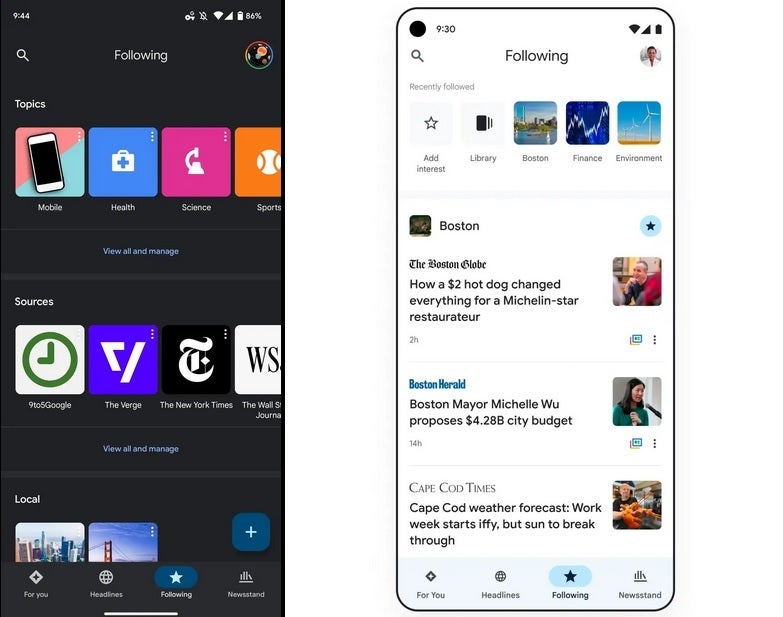
Do you use the Google News app on Android and iOS as one of your main sources for news daily? Yesterday we showed you two new Android widgets coming for the app and today we want to pass along some information about new features for the app per 9to5Google. One change is coming to the “Following” tab found at the bottom of the screen. Right now, when you tap that tab, you see suggestions of topics and sources to follow but no content is presented.
When the app is updated, the “Following” tab will present as many as three stories each with the name of the publication it was taken from and an image from the article. You will be able to add topics of interest, specific sources, and certain locations to help hone in on news stories that would be of interest to you. Google says that “articles shown on this page are determined through ranking algorithms that are similar to those used to surface content across Google News.
Google says that the revised “Following” tab for Google News is rolling out soon worldwide to Android users and will be coming to iOS later this year. And Google is also moving its News Showcase licensing program to the U.S. The company has committed to pay $1 billion to news organizations for content from over 700 news organizations. This includes limited free user access to content that is paywalled.
Current Following tab on left, the new Following on the right
The company says, “News Showcase is made up of panels that give news organizations the ability to package the most important stories of the day for readers, providing deeper storytelling and more context through features like timelines, bullets, related stories and a list of important articles. This content currently appears in Google News and Discover, bringing trusted news to readers all over the world.”
Lastly, the service known as Subscribe with Google is being rebranded as Reader Revenue Manage. With this feature, Google News users can subscribe to paid content using their Google Account and with auto sign-in, accessing this content is a snap.
If you don’t have the Google News app on your phone, tap on this link to install it on your Android phone and or click here to install Google News on your iOS device.
VMware has released security updates to fix a trio of flaws in Aria Operations for Networks that could result in information disclosure and remote code execution
VMware has released security updates to fix three vulnerabilities in Aria Operations for Networks which could result in information disclosure and remote code execution.
The vulnerabilities were found in Aria Operations for Networks which was formerly known as vRealize Network Insight. Users of versions VMware Aria Operations for Networks 6.x are under advise to applying the patches listed in the VMware KB article about these vulnerabilities.
Before you download and apply the security patch for your Aria Operations for Network deployment, it is advised to perform clean up using steps mentioned in VMware KB 88977 to avoid issues with patch upgrade failing with “Insufficient disk space toast message.”
The Common Vulnerabilities and Exposures (CVE) database lists publicly disclosed computer security flaws. The CVEs patched in these updates are:
CVE-2023-20887 (CVSS score: 9.8 out of 10): Aria Operations for Networks contains a command injection vulnerability. A malicious actor with network access to VMware Aria Operations for Networks may be able to perform a command injection attack resulting in remote code execution (RCE).
CVE-2023-20888 (CVSS score: 9.1 out of 10): Aria Operations for Networks contains an authenticated deserialization vulnerability. A malicious actor with network access to VMware Aria Operations for Networks and valid ‘member’ role credentials may be able to perform a deserialization attack resulting in remote code execution (RCE).
CVE-2023-20889 (CVSS score: 8.8 out of 10): Aria Operations for Networks contains an information disclosure vulnerability. A malicious actor with network access to VMware Aria Operations for Networks may be able to perform a command injection attack resulting in information disclosure.
Command injection is an attack method that aims to execute arbitrary commands on a system. Typically, the threat actor injects the commands by exploiting an application vulnerability, such as insufficient input validation.
Deserialization is the process of extracting data from files, networks or streams and rebuilding the data as objects. Deserialization of user input is considered a security misconfiguration, and can have serious consequences.
VMware Aria Operations for Networks helps IT teams to monitor, discover, and analyze networks and applications to build an optimized, highly available and secure network infrastructure across clouds.
Virtualization technology has taken the scalability of IT systems to the next level. Cybercriminals are very much aware of that and have a vested interest in hypervisor software and network mapping tools, because they make it easier to control a host of virtual machines. Which is much more effective than attacking individual systems.
So, vulnerabilities in such software are guaranteed to be researched by malicious actors.
We don’t just report on vulnerabilities—we identify them, and prioritize action.
If you’re excited about what Fortnite has in store for its next season, the wait is over. Chapter 4 season 3 just released its latest cinematic trailer, and it shows that, among other things, you may be able to ride raptors. Fortnite Wilds is set to launch today and it ties into an upcoming movie.
It’s not hard to see which movie when you watch the end of the trailer. Optimus Prime makes an appearance. This new season revolves around the upcoming Transformers: Rise of The Beasts. So, if you’re excited about the movie, then you will enjoy this season.
Fortnite Wilds gets its official cinematic trailer
One thing you can say about Fortnite is that it is really good at hyping up its fans. The cinematic trailer begins with four characters standing on a cliff as they watch the entire middle section of the island collapse into a gigantic jungle. Soon after coming down the cliff, they see the Raptors for which they ride to the center. In the center, there’s a large temple where they meet Optimus Prime.
Optimus Prime’s model is no bigger than the other characters, which means that you’ll most likely be able to play as him. Not only that, but we were introduced to a new weapon as well. It appears to be a giant blaster with explosive capabilities.
Fortnite Wilds is set to launch today, so you should most likely see it when you log on. If not, then you will have to just wait until it reaches your region.
Excited about the Movie?
If you’re looking forward to watching Transformers: Rise of The Beasts, the movie is now out in theaters. It’s rated PG-13, and it’s just over 2 hours long. The movie stars notable actors such as Pete Davidson, Peter Cullen, and Ron Perlman. Why not watch the movie, and then relax with a little bit of Fortnite?
Although over the past few years, Microsoft has done a commendable job in taking steps to combat malware and prevent its havoc, including the recent ban on macros from running in Office files downloaded from the internet, it looks like threat actors always find a way as the notorious Qbot malware has now evolved to remain effective against Microsoft’s latest tactic.
According to research conducted by Black Lotus Labs, the Qbot malware, which initially started as a banking trojan over a decade ago, has quickly adapted its distribution network, deployment methods, and command and control (C2) server in response to Microsoft’s changes. Additionally, threat actors have also introduced new techniques for initial access in phishing campaigns, such as using malicious OneNote files, Mark of the Web evasion, and HTML smuggling.
“Qakbot has shown resilience by employing a resourceful approach in building and developing its architecture..it demonstrates technical expertise by employing various initial access methods and maintaining a robust yet evasive residential C2 architecture,” reads the report.
Greater adaptability
Besides the new deployment methods, the Qbot operators have modified how they manage their C2 servers, as instead of relying on hosted virtual private servers (VPS), threat actors now hide the C2 servers within compromised web servers and hosts in residential IP spaces. Although this approach results in a shorter lifespan for servers, hackers can quickly obtain new ones. Approximately 90 new C2 servers are brought up every week during a spam cycle.
Furthermore, converting bots into C2 servers is crucial to Qbot’s operations. This is because over 25% of these servers are active for a day, and half do not survive beyond a week. Therefore, converted bots play a vital role in replenishing the C2 server supply.
To make matters worse, the report states that the malware will persist as a significant threat for the foreseeable future. “There are currently no signs of Qakbot slowing down.”
We take a look at a recent update for Cisco Secure System Client and why you should apply the update as soon as possible.
Cisco Secure Client is the fresh recipient of a fix to address a high-severity vulnerability related to improper permissions. The flaw allows attackers to potentially escalate privileges to the SYSTEM account.
A vulnerability in the client update feature of Cisco AnyConnect Secure Mobility Client Software for Windows and Cisco Secure Client Software for Windows could allow a low-privileged, authenticated, local attacker to elevate privileges to those of SYSTEM.
This vulnerability exists because improper permissions are assigned to a temporary directory that is created during the upgrade process. An attacker could exploit this vulnerability by abusing a specific function of the Windows installer process. A successful exploit could allow the attacker to execute code with SYSTEM privileges.
As Bleeping Computer notes, Secure Client allows for remote work thanks to a secure Virtual Private Network and also gives admins telemetry and endpoint management functionality. The attacks themselves do not need user interaction to get the exploitation ball rolling. Bleeping Computer also mentions that there is no current evidence to suggest active exploitation in the wild. With this in mind, there’s never been a better time to start patching.
As with so many other vulnerabilities out there, there is no workaround for this issue. What this means is that if you’re delayed applying an update for whatever reason, there’s no way to put a band-aid over the wound until you’re ready to hit the update button. Your setup will simply remain at risk until you do it.
The vulnerable products are as follows:
Cisco AnyConnect Secure Mobility Client Software for Windows and Cisco Secure Client Software for Windows.
Note: For releases earlier than Release 5.0, Cisco Secure Client for Windows is known as Cisco AnyConnect Secure Mobility Client for Windows.
There’s a number of products not at risk from this issue, which are listed below. You’ll note that none of them are Windows.
Cisco AnyConnect Secure Mobility Client for Linux
Cisco AnyConnect Secure Mobility Client for MacOS
Cisco Secure Client-AnyConnect for Android
Cisco Secure Client AnyConnect VPN for iOS
Cisco Secure Client for Linux
Cisco Secure Client for MacOS
This issue has been resolved with the release of Cisco Secure Client for Windows 5.0MR2, and AnyCOnnect Secure Mobility Client for Windows 4.10MR7. If you haven’t already done so, it’s time to check out the Cisco downloads page and make your network a little bit safer.
Malwarebytes EDR and MDR removes all remnants of ransomware and prevents you from getting reinfected. Want to learn more about how we can help protect your business? Get a free trial below.
Google is busy applying the Material You paint job to every corner of Android. It started this process back in 2021, and most of the software has the updated aesthetic. However, the company’s job is not done. The Google News app just got two new widgets, and these all have the Material You design, according to Android Police.
If you’re looking for a reliable source to aggregate the latest news headlines, then you might want to use Google News. As you can tell, it’s a news platform that will curate news stories based on the hottest headlines.
Also, since it’s tied to your Google account, you’ll get personalized seeds of headlines based on your search history and activity. Your Android phone may come with it already installed. If not, you can get it from the Play Store.
Google News is getting too new Material You widgets.
Before, there was only one Google News widget. Now, the company boosted it to two. The first widget is a smaller 2×2 widget, and it shows you one headline at a time. It will show you the latest top news headline. You will get the title of the article, the publication at the bottom, and the age. This will provide you with a quick at a glance look at what’s happening.
The next widget is a bit larger. This one is 4×3, and the size can be adjusted. The larger widget will show you two headlines, and they’ll all have the same information.
Being a Material You widget, all the corners are very rounded. Also, they have the classic Material You two-toned colors. The colors will comply with your system’s color palette. The background of the second widget will be a lighter shade while the actual articles will be a darker shade. That may change if you switch to dark mode.
Right now, this is not available to the general public. The widgets are in version 5.82, and the latest version on the Play Store is version 5.81. However, if you absolutely need to have these new widgets today, you can download the APK file here.
Google is pushing a new update to its generative AI tool Bard, improving its logic and reasoning skills. This update makes the service better at mathematical tasks, coding questions, and string manipulation. Bard is also getting support for exporting tables to Google Sheets.
Google developed a new technique to improve Bard’s logic skills
In March, Google incorporated PaLM (Pathways Language Model) into Bard for improved math and logic capabilities. The company said that it would continue to develop advanced logic skills for the AI tool in the coming months. As promised, it has now updated the service with capabilities for solving complex mathematical tasks and coding questions.
According to Google, a new technique called “implicit code execution” helps Bard detect computational prompts. In response, it runs code in the background to solve the question and give you accurate answers (it may get things wrong occasionally). With this update, Bard can detect and solve computational and logical prompts like:
The angle of elevation of the top of a building from the foot of the tower is 30 degrees and the angle of elevation of the top of the tower from the foot of the building is 60 degrees. If the tower is 50m high, find the height of the building.
A is older than B. C is older than B but younger than A. D is younger than E and B. B is older than E. If they sit in the increasing order of their age, who is in the middle?
Google says Bard’s improved logic and reasoning skills rely on a combination of large language models (LLMs) and traditional code. The method has improved the accuracy of Bard’s responses to computation-based word and math problems by about 30 percent. The AI tool may not always get it right, but it is getting better at such problems.
Bard now lets you export tables to Google Sheets
This update for Bard comes just a few days after Google added precise location support to the service. That addition followed a host of updates in May, including the ability to export content to Google Docs and Gmail complete with formatting. It’s now gaining support for Google Sheets export as well. If you prompted Bard to generate a table for some data, or it automatically responded with a table for your question, you can export that table to Google Sheets.
Google will likely push several more updates to Bard in the coming weeks. It is working on a host of new features for the AI tool, including chat history, refining responses according to specific tones, file uploading support, and text-to-speech. We will let you know when the company rolls out these features to Bard.
May saw a record number of 556 reported ransomware victims, the unusual emergence of Italy and Russia as major targets, and a significant rise in attacks on the education sector.
This article is based on research by Marcelo Rivero, Malwarebytes’ ransomware specialist, who monitors information published by ransomware gangs on their Dark Web sites. In this report, “known attacks” are those where the victim didn’t pay a ransom. This provides the best overall picture of ransomware activity, but the true number of attacks is far higher.
In May, Lockbit, usually the reigning king of ransomware, found a fierce competitor in MalasLocker. Last month also witnessed a record number of 556 reported ransomware victims, the unusual emergence of Italy and Russia as major targets, and a significant rise in attacks on the education sector.
Let’s jump right in with MalasLocker, who burst onto the scene last month with 171 total victims—beating out LockBit (76) by almost 100 known attacks.
Known ransomware attacks by gang, May 2023
This isn’t the first time this year a gang has overhauled LockBit and climbed to the top spot on our monthly charts. In April Cl0p rose to the number one spot by compromising over 100 victims with a zero-day vulnerability in the widely-used managed file transfer software GoAnywhere MFT.
This month, MalasLocker’s meteoric rise to the top can be explained along similar lines.
MalasLocker attacked vulnerabilities in Zimbra servers, including CVE-2022-24682, to enable remote code execution (RCE). Zimbra Collaboration, formerly known as the Zimbra Collaboration Suite (ZCS) is a collaborative software suite that includes an email server and a web client.
What sets MalasLocker most apart, however, is its unique ‘charitable’ twist. Rather than demanding ransoms, it asked victims to donate to its approved charities.
MalasLocker: The Robin Hood of ransomware?
Needless to say, it is highly unusual for a ransomware gang to purport to attack organizations on altruistic grounds. We haven’t seen it once since keeping track of gangs in early 2022.
“Unlike traditional ransomware groups, we’re not asking you to send us money. We just dislike corporations and economic inequality,” reads the MalasLocker ransom note README.txt.
One might assume that a ransomware gang principally opposed to corporations and economic inequality might disproportionately target larger and more wealthy organizations, but this isn’t necessarily the case. The gang’s blog suggests it’s open to targeting businesses of all sizes, so long as they aren’t located in “Latin America, Africa, or other colonized countries.”
We are completely unmoved by MalasLocker’s supposed altruism. Ransomware gangs (and cybercriminals in general) have a long and storied history of writing long and tedious tracts justifying their criminal activity with grandiose claims.
MalasLocker is no different. We read its manifesto so you don’t have to, and the only line you need to pay any attention to is the one that reads “so we will become just another ransomware group.”
So far, we have no confirmation that MalasLocker is keeping its word for a decryptor when a victim donates money to a charity.
Known ransomware attacks by country, May 2023Known ransomware attacks by industry sector, May 2023
Italy and Russia emerge as targets
The upswing in ransomware activity in Italy and Russia in May is striking. Both countries were propelled into the top three most targeted nations in May, a list typically dominated by the USA and the UK.
Italy saw more than a six-fold increase from the month before, and Russia went from zero reported attacks to 50 in a single month. For comparison, Italy had only eight reported ransomware incidents in April, while Russia wasn’t even listed. Similarly, in March, Russia had no reported incidents, and Italy had just eight.
The surge in attacks on these two countries is entirely due to MalasLocker, which hit more targets in Russia and Italy than anywhere else. We assume that this is not a matter of deliberate targeting but simply a matter of where there were vulnerable targets.
Either MalasLocker isn’t based in the CIS and therefore doesn’t fear the Federal Security Service (FSB), or they are going to have a very short stay in the ransomware charts.
Increased ransomware attacks on Education
The increase in ransomware attacks on the education sector in May is particularly concerning. May saw 30 known attacks—the highest we’ve seen in a single month since we started keeping records in early 2022, and the continuation of a trend that has seen a sustained increase over the past twelve months.
Known ransomware attacks against education, June 2022-May 2023
Ransomware gangs seem to be adopting a new modus operandi: Exploiting known vulnerabilities for multi-target attacks. This year we have seen Cl0p and MalasLocker attack multiple targets simultaneously with (presumably automated) targeting of specific system weaknesses, expanding the scale and impact of their ransomware operations.
Cl0p, for example, has a history of exploiting platforms like Accellion FTA and GoAnywhere MFT. In April, it shifted its focus to a vulnerability in another popular platform, PaperCut.
In June, as we prepared this report, it emerged that Cl0p was been exploiting yet another vulnerability, this time in the widely used file transfer software MOVEit Transfer. The gang started exploiting the vulnerability on May 27th, during the US Memorial Day holiday.
A security bulletin released on May 31, 2023 by Progress Software states:
“A SQL injection vulnerability has been found in the MOVEit Transfer web application that could allow an un-authenticated attacker to gain unauthorized access to MOVEit Transfer’s database. Depending on the database engine being used (MySQL, Microsoft SQL Server, or Azure SQL), an attacker may be able to infer information about the structure and contents of the database in addition to executing SQL statements that alter or delete database elements.“
This approach is unusual and should concern us all because it has the potential to make ransomware attacks more scalable.
New players
BlackSuit
BlackSuit is a new ransomware that is strikingly similar to Royal, sharing 98% of its code. Last month, BlackSuit targeted both Windows and Linux hosts.
BalckSuit could be a new variant developed by Royal’s authors, a mimicry attempt using similar code, an affiliate of the Royal ransomware gang running its own modifications, or even a breakaway group from the Royal ransomware gang.
Rancoz
Rancoz is a new ransomware variant which shares similarities with Vice Society. Its sophistication lies in its ability to modify existing code from leaked source codes to target specific industries, organizations, or geographic regions, increasing its attack efficacy and ability to evade detection.
8BASE
8Base is a newly discovered ransomware gang which, despite only recently gaining attention, has been in operation since April 2022. In May, it had a total of 67 victims.
Predominantly targeting small and medium-sized businesses (SMBs), 8Base has attacked mainly companies within the Professional/Scientific/Technical sector, comprising 36% of known attacks, followed by Manufacturing at 17%. Geographical analysis of the victims suggests a concentration in America and Europe, with the United States and Brazil being the most targeted countries.
RA Group
RA Group is a new ransomware primarily focusing its attacks on pharmaceutical, insurance, wealth management, and manufacturing firms located in the United States and South Korea.
The RA Group employs an encryptor derived from the leaked source code of Babuk ransomware, an operation that ceased in 2021. The encryptor employs intermittent encryption, which alternates between encrypting and not encrypting sections of a file to expedite the encryption process, but leaves some data partially recoverable.
Detect intrusions. Make it harder for intruders to operate inside your organization by segmenting networks and assigning access rights prudently. Use EDR or MDR to detect unusual activity before an attack occurs.
Stop malicious encryption. Deploy Endpoint Detection and Response software like Malwarebytes EDR that uses multiple different detection techniques to identify ransomware, and ransomware rollback to restore damaged system files.
Create offsite, offline backups. Keep backups offsite and offline, beyond the reach of attackers. Test them regularly to make sure you can restore essential business functions swiftly.
Don’t get attacked twice. Once you’ve isolated the outbreak and stopped the first attack, you must remove every trace of the attackers, their malware, their tools, and their methods of entry, to avoid being attacked again.
Malwarebytes EDR and MDR removes all remnants of ransomware and prevents you from getting reinfected. Want to learn more about how we can help protect your business? Get a free trial below.