MediaTek has teamed up with Nvidia to develop automotive chips. The two firms will work closely to introduce a “complete range of in-vehicle AI cabin solutions” for the next-gen always-connected cars. They announced the plans during Computex 2023 earlier this week.
MediaTek’s Dimensity Auto will use Nvidia’s GPU and AI solutions, as well as its ADAS (Advanced Driver Assistance Systems) technologies. The American chip firm will also lend its Drive OS, Drive IX, CUDA, and Tensor RT technologies for the planned automotive solution. These technologies will handle graphics, AI processing, and safety and security features of the chip.
The upcoming Automotive processors from MediaTek will feature C2C, an interconnected system that connects CPUs, GPUs, and SoCs for seamless communication across the platform. The chip will process data from various sensors and cameras on the car and provide the driver with relevant information through infotainment systems and displays for assisted driving. The Taiwanese firm will also offer built-in support for 5G cellular connectivity, Bluetooth, and Wi-Fi.
“The combination of MediaTek’s industry-leading system-on-chip and Nvidia’s GPU and AI software technologies will enable new user experiences, enhanced safety, and new connected services for all vehicle segments, from luxury to entry-level,” said Nvidia’s CEO and founder Jensen Huang (via). The companies plan to begin the production of the MediaTek Dimensity Auto platform in 2026 and launch it in 2027.
MediaTek will be up against several established players in the automotive space. Among these are its existing semiconductor rivals Samsung and Qualcomm. These firms already compete in several areas, including chips for smartphones, tablets, wearables, and TVs, though Samsung has an in-house fab for manufacturing those chips. Samsung’s Exynos Auto and Qualcomm’s Snapdragon Auto lineups offer a complete automotive solution for always-connected cars. It remains to be seen what MediaTek’s entry brings to this industry.
MediaTek and Nvidia may also launch optimized chips for premium notebooks
This partnership between MediaTek and Nvidia may not be limited to the automotive sector. There have been reports that the two companies are working closely to develop optimized chipsets for premium or high-end notebooks. MediaTek also plans to integrate Nvidia GPUs in its flagship smartphone processors.
The latter plan will not materialize this year, though. MediaTek has already confirmed that its next-gen flagship SoC will use the latest ARM tech. The new solution, presumably called the Dimensity 9300, will arrive later this year featuring the Cortex-X4, Cortex-A720, and Cortex-A520 CPU cores and the Immortalis-G720 GPU. It will rival Qualcomm’s next-gen Snapdragon 8 Gen 3.
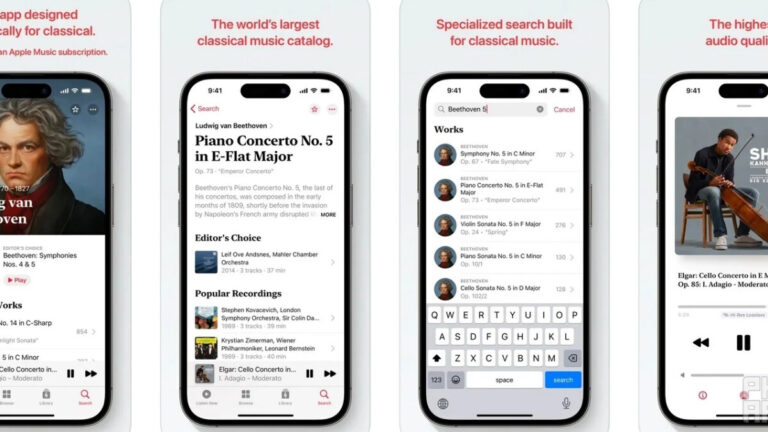
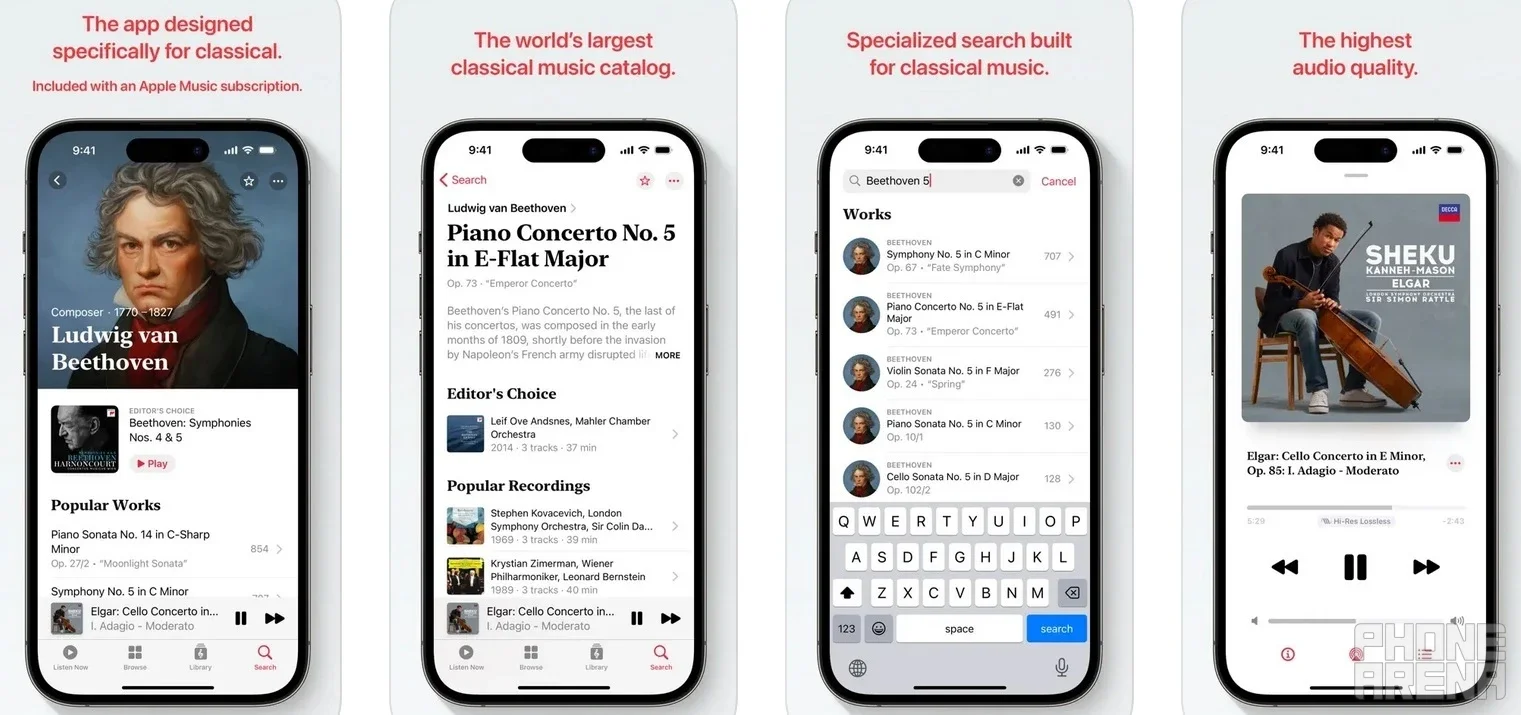
Apple announced the new Apple Music Classical app at the end of March, and its availability started with the iPhone. Now, Android users also get the possibility to enjoy a giant catalog of classical music with the app (of course, if they have an Apple Music subscription), reports 9to5Mac.
Apple Music Classical comes to Android even before coming to iPad and Mac
In 2021, Apple bought Primephonic, which was a standalone classical music subscription service. And it’s been transformed into Apple Music Classical, which was available on iPhone since the end of March. Now, it is also available on Android. Apple Music Classical is a separate app from Apple Music and it’s just centered on classical music, as the name suggests. It has around 5 million tracks from new releases to celebrated masterpieces. The app also gives you the quite useful ability to search by composer, work, conductor, and even catalog number, and find the record you’re searching for.
Interestingly enough, the app isn’t yet been adapted for iPad and is yet to be available on Mac. It’s also not available with CarPlay just yet.
Although this might seem strange at first sight, it makes quite a bit of sense when you think that it was based on Primephonic. The service’s Android app was gone after Apple purchased it.
The iPhone app hasn’t been updated yet since its release, and we expect it to get some update love now that the Android app has also been released. The app is available to download for free from the Google Play Store and accessing it is done via a standard Apple Music subscription.
SaaS (Software-as-a-Service) has become popular for delivering software applications and services over the cloud.
While SaaS offers numerous benefits, such as flexibility and scalability, it also introduces unique security challenges.
SaaS security is the measures and practices implemented to protect data and applications’ confidentiality, integrity, and availability within a SaaS environment.
Securing a SaaS environment With Perimeter81 involves a multi-layered approach encompassing various aspects, including data protection, access controls, threat detection, and compliance.
With sensitive data and critical applications in the cloud, organizations must address security risks and establish robust safeguards proactively.
This article explores the concept of SaaS security and provides insights into how organizations can protect their cloud environments.
It examines best practices, security controls, and considerations for assuring the security and privacy of data in a SaaS environment.
By implementing effective SaaS security measures, organizations can mitigate risks, maintain customer trust, and confidently leverage the benefits of cloud-based software solutions.
What is a SaaS Security?
SaaS (Software-as-a-Service) security is the measures and practices implemented to protect data and applications’ confidentiality, integrity, and availability within a SaaS environment.
As organizations increasingly rely on SaaS solutions to deliver software applications and services over the cloud, ensuring the security of these environments becomes crucial.
SaaS security encompasses various aspects, including:
Data protection: Safeguarding sensitive data is paramount in a SaaS environment. This involves implementing encryption mechanisms, access controls, and secure data storage to prevent unauthorized access, data breaches, or data loss.
Access controls: Controlling access to the SaaS application and its data is essential. Robust authentication mechanisms, such as multi-factor authentication and granular access controls based on the client’s roles and permissions, help ensure that only authorized individuals can access and manipulate data.
Infrastructure security: SaaS providers are responsible for securing the underlying infrastructure that supports their services. This includes implementing robust network security, firewalls, intrusion detection systems, and regular security updates to protect against external threats.
Application security: SaaS applications should undergo rigorous security testing, including vulnerability assessments and penetration testing, to identify and address potential software vulnerabilities. Secure coding practices and regular security patches are essential to maintain application security.
Incident response and monitoring: Establishing incident response procedures and implementing monitoring systems enable the timely detection and response to security incidents. This includes monitoring for unusual activity, security event logging, and real-time alerts to detect and mitigate potential threats.
Data privacy and compliance: SaaS providers must adhere to relevant data privacy regulations, such as the General Data Protection Regulation (GDPR) or industry-specific compliance standards. Implementing appropriate data privacy policies, consent mechanisms, and data handling practices is essential for compliance.
Vendor management: Organizations must carefully select and vet SaaS providers to ensure they meet adequate security standards. Clear contractual agreements, service level agreements (SLAs), and regular vendor assessments help ensure that the SaaS provider’s security practices align with organizational requirements.
Types of SaaS security software
Several types of SaaS security software can help organizations enhance the security of their SaaS applications and data. Here are some common types:
Identity and Access Management (IAM) Software: IAM solutions manage user identities, authentication, and access rights within SaaS environments. They help enforce strong authentication, manage user roles and permissions, and ensure secure access to SaaS applications.
Data Loss Prevention (DLP) Software: DLP solutions monitor and protect sensitive data from unauthorized access, loss, or leakage. They can identify and block sensitive information from being shared or stored inappropriately within SaaS applications, helping maintain data confidentiality and compliance.
Cloud Security and Compliance Monitoring Software: These tools continuously monitor SaaS applications and infrastructure to identify security vulnerabilities, detect anomalous activities, and ensure compliance with industry regulations. They offer log analysis, threat detection, and security event monitoring features.
Encryption and Key Management Software: Encryption software helps protect sensitive data by encrypting it at rest and in transit within SaaS applications. Key management solutions securely store and manage encryption keys, ensuring only authorized parties can access encrypted data.
Cloud Access Security Broker (CASB) Software: CASB solutions are a secure intermediary between an organization’s on-premises infrastructure and SaaS applications. They provide visibility and control over data transferred between the organization and the SaaS provider, enforcing security policies and detecting and preventing unauthorized access or data leakage.
Vulnerability Scanning and Penetration Testing Tools: These tools assess the security posture of SaaS applications and infrastructure by identifying vulnerabilities and potential entry points for attackers. They help organizations identify and remediate security weaknesses before they can be exploited.
Security Information and Event Management (SIEM) Software: SIEM solutions aggregate and analyze security event logs from various sources, including SaaS applications. They provide real-time threat detection and incident response capabilities and help organizations investigate security incidents.
Web Application Firewall (WAF): WAFs provide additional protection for SaaS applications by monitoring and filtering HTTP/HTTPS traffic. They can detect and block malicious activities, such as SQL injections or cross-site scripting attacks, helping prevent unauthorized access or data breaches.
Top security challenges created by SaaS
Software as a Service (SaaS) has revolutionized businesses by offering cloud-based applications and services.
While SaaS brings numerous benefits, it also introduces specific security challenges. Here are some of the top security challenges created by SaaS
Data breaches: SaaS solutions store large volumes of sensitive data in the cloud. This data can be vulnerable to breaches if proper security measures are not in place. Attackers may exploit vulnerabilities in the SaaS provider’s infrastructure or gain unauthorized access to user accounts, leading to data compromise.
Lack of control: With SaaS, organizations entrust their data and applications to a third-party provider. This lack of control over the underlying infrastructure and security mechanisms raises data protection and privacy concerns. Organizations must rely on the SaaS provider’s security practices and ensure they meet their requirements.
Insider threats: SaaS providers can access customers’ data, and their employees may pose potential insider threats. While reputable providers implement stringent security measures, the risk of an insider intentionally or unintentionally mishandling or accessing sensitive data remains a concern.
Regulatory compliance: Different industries and regions have specific data protection and privacy regulations. Adopting SaaS solutions requires organizations to ensure their chosen provider complies with these regulations. Data sovereignty, cross-border data transfers, and compliance with third-party services can be complex challenges.
Integration vulnerabilities: SaaS applications often integrate with other systems and services within an organization’s ecosystem. If these integrations are not secure, they can become entry points for attackers. Organizations must carefully assess and monitor the security of integrations to prevent unauthorized access and data leaks.
Account hijacking: SaaS solutions typically rely on user accounts and authentication mechanisms. Account credentials, such as weak passwords or compromised user accounts, can lead to unauthorized access, data loss, or manipulation. Organizations must enforce strong authentication practices and monitor user accounts for signs of compromise.
Data loss and availability:SaaS applications depend on the availability and reliability of the cloud infrastructure. System outages or disruptions can result in loss of access to critical applications and data, affecting business operations. Additionally, accidental deletion or corruption of data within the SaaS environment can cause data loss if adequate backup and recovery mechanisms are not in place.
Shadow IT: SaaS applications are often easy to deploy and can be adopted by individual employees or departments without proper oversight from the IT department. This introduces the risk of unauthorized and unmonitored applications, potentially compromising data security and regulatory compliance.
How to protect the cloud environment?
Perimeter81 Protecting the cloud environment with a multi-layered approach that combines technical safeguards, best practices, and ongoing monitoring.
Here are some essential steps to help protect your cloud environment:
Choose a reputable cloud service provider (CSP): Select a trusted CSP with a strong track record in security. Evaluate their security certifications, compliance measures, and data protection policies to ensure they meet your organization’s requirements.
Secure access and authentication: Implement robust authentication mechanisms for accessing your cloud environment, such as multi-factor authentication (MFA). Enforce complex passwords and regularly rotate them. Consider using a centralized identity management system to control user access across various cloud services.
Data encryption: Encrypt sensitive data both at rest and in transit. Utilize encryption mechanisms provided by your CSP, or consider using additional encryption tools. Manage encryption keys securely to prevent unauthorized access to encrypted data.
Network security: Implement network security controls, such as firewalls, intrusion detection/prevention systems, and virtual private networks (VPNs). Configure network security groups and access control lists to control inbound and outbound traffic to your cloud environment.
Patch management: Regularly apply security patches and updates to all cloud resources, including virtual machines, containers, and operating systems. Enable automatic updates whenever possible to ensure timely patching.
Data backups and disaster recovery: Implement regular backups of your critical data stored in the cloud. Test the restore process periodically to ensure data can be recovered successfully in case of data loss or system failure. Consider having a disaster recovery plan that includes cloud resources.
Security monitoring and logging: Enable logging and monitoring features provided by your CSP and implement a centralized logging system. Regularly review logs and monitor for any suspicious activities or security incidents. Utilize security information and event management (SIEM) solutions to analyze log data and detect potential threats.
Employee training and awareness: Educate your employees about cloud security best practices, including secure data handling, strong passwords, and recognizing phishing attempts. Regularly reinforce the importance of security awareness and provide training on new threats and vulnerabilities.
Vulnerability management: Perform regular vulnerability scans and penetration tests on your cloud infrastructure and applications. Identify and remediate vulnerabilities promptly to reduce the risk of exploitation.
Cloud security assessments: Conduct periodic security assessments of your cloud environment to evaluate its overall security posture. Engage third-party security experts for independent assessments, penetration testing, or audits.
Incident response planning: Develop an incident response plan specific to your cloud environment. Define roles and responsibilities, establish communication channels, and conduct drills to ensure a swift and effective response in case of a security incident.
Compliance with regulations: Understand the regulatory requirements applicable to your organization and ensure your cloud environment complies with them. Regularly assess and validate your cloud environment’s compliance with relevant regulations and standards.
SaaS Security considerations
When considering the security of Software as a Service (SaaS) solutions, there are several important considerations to keep in mind. Here are some key security considerations for SaaS:
Data encryption: Ensure data is encrypted in transit and at rest. Encryption provides additional protection for sensitive information, reducing the risk of unauthorized access.
Access controls: Implement strong access controls to ensure that only authorized users can access the SaaS application and its data. This includes enforcing strong password policies, implementing multi-factor authentication, and regularly reviewing and updating user access privileges.
Data segregation: SaaS providers should have mechanisms to ensure that different customer data is properly segregated. This prevents data leakage or unauthorized access to sensitive information between different organizations using the same SaaS platform.
Regular security updates and patches: SaaS providers should have a robust process for applying security updates and patches to their software. This helps protect against known vulnerabilities and ensures that the SaaS solution remains current with the latest security measures.
Security monitoring and incident response: SaaS providers should have robust security monitoring to promptly detect and respond to potential security incidents. This includes monitoring for suspicious activity, implementing intrusion detection systems, and having an incident response plan to mitigate and respond to security breaches.
Compliance with regulations: SaaS providers should comply with relevant regulations and industry standards, such as GDPR, HIPAA, or PCI-DSS, depending on the nature of the data being handled. Compliance ensures adequate security measures are in place to protect user data and reduce legal and regulatory risks.
Vendor due diligence: Before adopting a SaaS solution, perform due diligence on the SaaS provider’s security practices. Assess their security certifications, audits, and track record in the industry. Evaluate their data protection policies, disaster recovery plans, and business continuity measures.
Data backup and recovery: Understand the SaaS provider’s data backup and recovery mechanisms. Ensure that data is regularly backed up and that there are mechanisms to restore data in case of data loss or system failure.
Employee training and awareness: Educate employees on security best practices, such as using strong passwords, recognizing phishing attempts, and understanding their role in maintaining the security of SaaS applications and data.
Exit strategy: Plan for the end of the SaaS engagement. Ensure that data can be securely retrieved and transferred to another provider or in-house infrastructure if needed.
By considering these security aspects when selecting and working with SaaS providers, organizations can help mitigate potential risks and ensure their data and systems’ confidentiality, integrity, and availability.
Wrap Up
SaaS security refers to the measures and practices implemented to protect Software as a Service (SaaS) applications and data from unauthorized access, data breaches, and other security risks.
Protecting your cloud environment requires a comprehensive approach combining technical safeguards, adherence to best practices, and ongoing monitoring.
To safeguard your cloud environment, it is crucial to choose a reputable cloud service provider, secure access through robust authentication mechanisms, encrypt sensitive data at rest and in transit, implement network security controls, regularly apply patches and updates, back up data, and have a disaster recovery plan, monitor and log security events, provide employee training and awareness, perform vulnerability management, conduct security assessments, plan for incident response, and ensure compliance with applicable regulations.
By following these practices and continuously evaluating and adapting your security measures, you can enhance the protection of your cloud environment, mitigate risks, and maintain the confidentiality, integrity, and availability of your SaaS applications and data.
With Perimeter 81 SaaS Security, you can easily protect your cloud environments, servers, and users – Try a Free Trial/Demo.
We’re all excited about Samsung’s upcoming foldable phones, but we shouldn’t forget about Motorola’s. The company is planning on unveiling the new Razr and Razr+ in early June, and we’ve been hearing some exciting stuff about them. However, if you’re getting this phone, just know that it won’t have very robust water and dust resistance, according to TechRadar.
Motorola is really planning on making a splash with its latest Razr devices. You’ve seen rumors of the Motorola Razr+, and they show us a massive outer display that will be able to run full apps. This is a first for the foldable phone market.
Aside from that, the company is looking to bring the average price of the foldable down to a new low. If Motorola pulls this off, then it could basically revolutionize the folding phone market.
The Motorola Razr 2023 won’t have the best water and dust resistance
Think back to 2019 with the first Galaxy Z Fold in the first Huawei Mate X. Back then, a foldable phone with IP water and dust resistance seemed like the stuff that dreams are made of. However, it seems that Samsung was able to make that dream a reality and make its Galaxy Z Fold/Flip 5 as water-resistant as its 23 Ultra. That’s a feat that no other manufacturer has been able to do.
Because of this, it really shines a harsh light on the new Razr phones coming out. Motorola didn’t quite leave its phone with no water or dust resistance, however. This phone is expected to come with IP 52 water and dust resistance.
Basically, the phone will be safe from most dust particles, but it wouldn’t be completely protected against it. When it comes to water, you won’t have to worry if you get caught in a light sprinkle. However, you’ll want to avoid splashes, Heavy Rain, and (obviously) completely submerging the phone.
Now, Motorola is planning on making this phone very affordable. That’s saying a lot, seeing as Samsung launched the Galaxy Z Flip 3 at $999. By pricing the phone under that price point, Motorola will be deep within the average flagship slate phone territory. That would be significant.
The question is, would people sacrifice durability for affordability? We will get the answer to that question when Motorola officially launches this phone.
The iPhone 16 series is coming next year, and yet their screen sizes and aspect ratios have just been revealed. This information comes from Ross Young, a well-known display analyst. 9to5Mac added some display specs to the table too.
The iPhone 16 series screen sizes & aspect ratios reaveled early
Let’s start with the cheapest variant, the iPhone 16. That handset will include a 6.12-inch display, while its ‘Plus’ sibling will come with a 6.69-inch panel. Both devices will offer a 19.5:9 display aspect ratio.
So, the aspect ratio will be the same as on the iPhone 14 lineup. Don’t expect these two phones to get high refresh rate displays, they’ll still be stuck at 60Hz.
On the other hand, the iPhone 16 Pro is tipped to include a 6.27-inch display, while the ‘Pro Max’ model will come with a 6.86-inch panel. Displays on both devices will offer a 19.6:9 aspect ratio.
The iPhone 16 Pro series will feature taller displays than current-gen iPhones
So, as you can see, the iPhone 16 Pro and Pro Max will feature taller displays than the iPhone 14 Pro and 15 Pro. The iPhone 14 Pro series has a display aspect ratio of 19.5:9, and the iPhone 15 Pro models will feature the same.
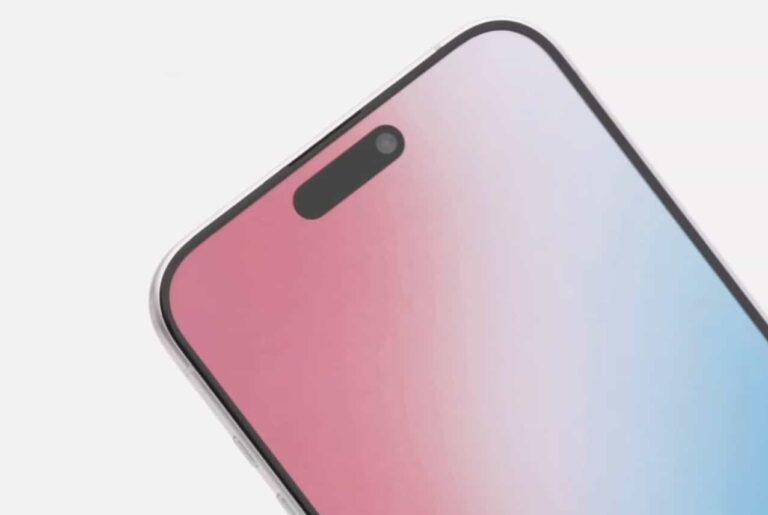
Do note that all iPhone 16 models will feature LTPS backplane displays, and also include a Dynamic Island. In other words, they’ll feature a pill-shaped cutout on the display, the same as the entire iPhone 15 lineup.
There you have it. The iPhone 15 lineup didn’t even launch, and we already have plenty of info regarding the iPhone 16 series. Do note that all iPhone 15 models are expected to arrive in September. They will all feature a Type-C USB port at the bottom, for the first time ever when it comes to iPhones. They’ll all also offer a Dynamic Island cutout on the front.
Earlier this month we told you that Google Weather is going to get a Material You makeover even though the famous Google Weather frog will still be around. Ribb-it, Ribb-it. Currently, Google Weather is actually part of the Google Search app and you can access it by tapping the local weather box at the top of the Google Discover page (swipe to the right from the first home screen page) or on the Google Search app.
Now, 9to5Google has discovered code in the latest update to version 7.5 of the Google Clock app that seems to indicate that Google will release a standalone Weather app for Android users. With a discovered package name of com.google.android.apps.weather, it seems that Google is finally divorcing its weather site from Google Search. Consider that the package name for the Wear OS version of the Weather app is the similar com.google.android.wearable.weather. The icon for the new Android weather app could be the same as the one currently used on Android and Wear OS.
Pick up the Google Pixel 7a now!
Additionally, the Clock app will soon allow you to see “Local weather on clock.” Local weather could mean that you will see the current temperature, the high and low temperatures for the day, and the current weather conditions for the cities you track. The same information could also show up on the Clock app’s widgets.
In version 7.5 of the Google Clock app, Google has hidden away useful weather-related phrases including (in alphabetical order” “Blizzard, Clear day, Cloudy, Drizzle, Flurries, Low visibility, Heavy rain, Nighttime isolated scattered thunderstorms, Rain with sleet or hail, Tropical storm or hurricane, and Very hot.”
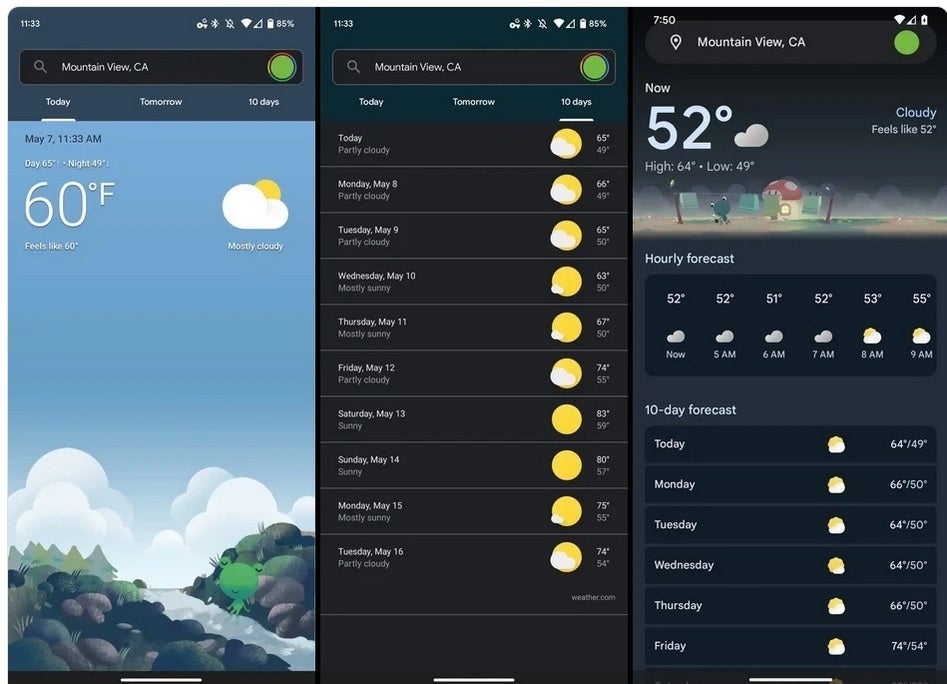
Current Google Weather page at left and center with the Material You makeover at right. Image credit 9to5Google
We could see Google release its new weather app sometime next month before the June 20th arrival of the Pixel Tablet and the release a week later of the Pixel Fold. The new standalone Google Weather app is expected to be more polished than the current cartoon-looking weather page associated with the mobile platform.
There are plenty of third-party weather apps for Android users as a quick look through the Google Play Store will attest to. Some of the more popular weather apps are the ones that would normally come to your mind first such as The Weather Channel and AccuWeather.
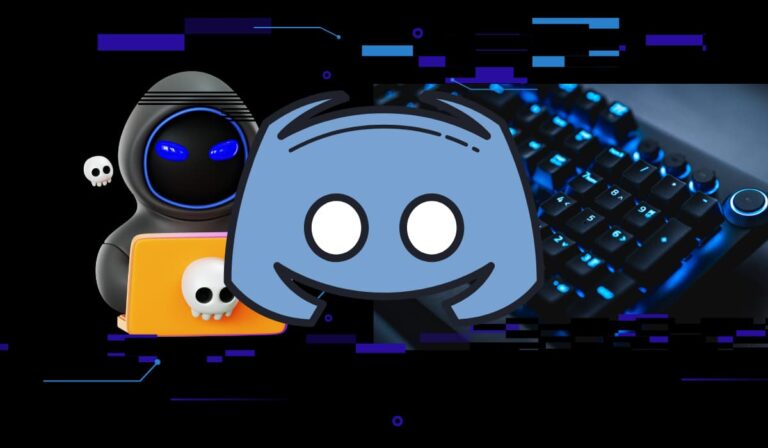
Several crypto-based Discord communities, including Aura Network, MetrixCoin, and Nahmii, have already fallen victim to the attack.
Discord communities have become prime targets for cybercriminals, with frequent attacks being reported on this platform. In a recent wave of attacks, several crypto-based Discord communities, including Aura Network, MetrixCoin, and Nahmii, have fallen victim.
According to Brian Krebs from KrebsOnSecurity, there has been a significant increase in attacks aimed at compromising admin accounts on Discord. Attackers are attempting to exploit these accounts by executing malicious JavaScript code. To trick users into executing the code, it is disguised as a seemingly harmless browser bookmark. A YouTube video has been released to demonstrate how this attack unfolds.
Deceptive Strategy:
The attackers employ a deceptive strategy by inserting JavaScript into browser bookmarks using the dragging feature on web pages. Discord admins have reported receiving interview requests from individuals posing as reporters from crypto-news outlets.
Once they agree to the interview, the admins are redirected to a fake Discord server that mimics the news outlet. They are then asked to verify their identity by dragging a button from the server to their browser’s bookmarks bar. The victims believe this action is part of the verification process and subsequently return to Discord.com and click on the new bookmark.
Malicious JavaScript Snippet:
Unbeknownst to the victims, the bookmark is a cleverly designed JavaScript snippet. This snippet covertly extracts the victim’s Discord token and sends it to the attacker’s website.
The attacker then loads the token into their browser session and proceeds to announce late-night exclusive airdrops or NFT mint events within the targeted Discord group. These announcements are intended to lure innocent members, who trust the legitimacy of the messages.
Victims are then instructed to connect their crypto wallets to a web address provided by the attacker and grant unlimited spend approvals on their tokens. Consequently, the attacker successfully drains funds from these compromised accounts. To cover their tracks, the attacker promptly deletes the messages and bans users who attempt to expose the scam.
Token Functionality and Aftermath:
The stolen token remains functional exclusively for the attacker until the original owner either log out or changes their credentials. This ensures that the attacker can exploit the hijacked account without arousing suspicion.
According to Krebs’ blog post, Nicholas Scavuzzo, an associate of Ocean Protocol, fell victim to this attack. On May 22, the admin of Ocean Protocol’s Discord server clicked on a link sent via direct message from a community member. The admin was then asked to verify their identity by dragging a link to their web browser’s bookmarks bar. Despite having enabled multi-factor authentication (MFA), Scavuzzo’s account was hijacked.
The attackers waited until midnight in Scavuzzo’s timezone to use the account, reducing the chances of immediate suspicion. They subsequently sent an unauthorized message announcing a new Ocean airdrop. Eventually, Scavuzzo contacted the server’s operator who hosted the channel, and the settings were reverted to normal.
Conclusion:
Discord admin accounts within crypto-focused communities have become prime targets for scammers utilizing malicious JavaScript bookmarks. The attackers exploit the trust of Discord admins by tricking them into executing the code disguised as innocent browser bookmarks.
Through this deceptive strategy, the scammers gain access to the victims’ Discord tokens, enabling them to carry out fraudulent activities, such as draining funds from compromised accounts. It is crucial for Discord users, especially admins, to exercise caution and be vigilant against such attacks.
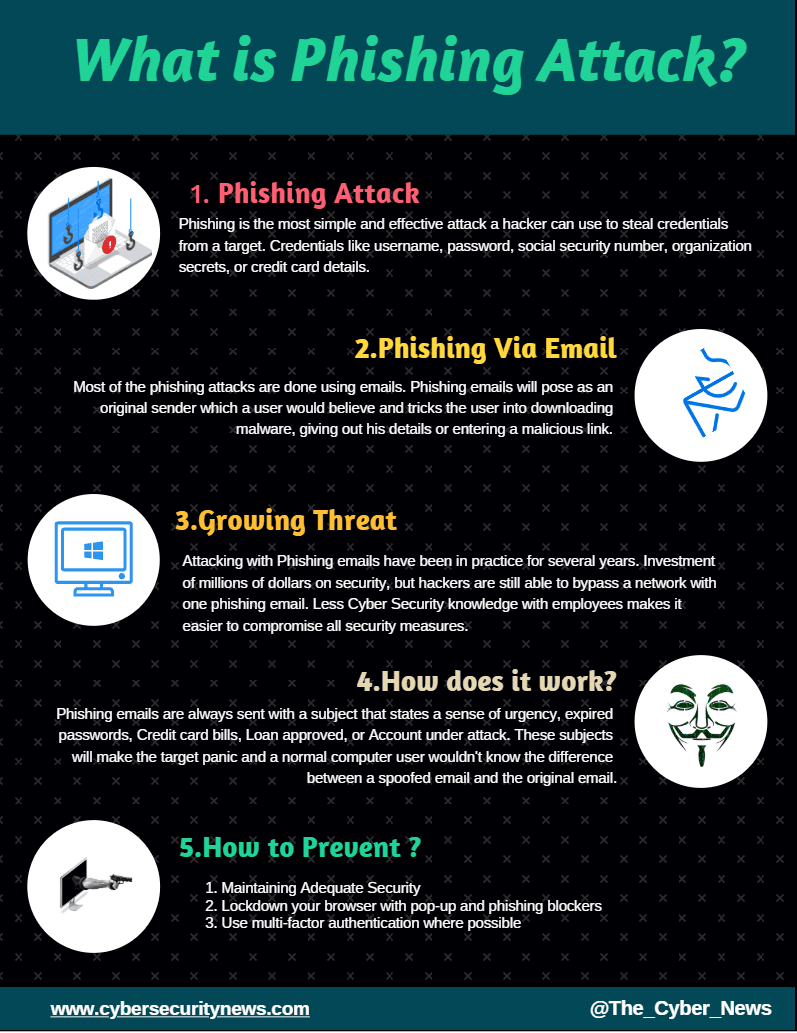
In today’s interconnected world, where digital communication and transactions dominate, phishing attacks have become an ever-present threat.
By masquerading as trustworthy entities, phishing attacks deceive users and organizations into divulging sensitive information, such as passwords, financial data, and personal details.
Phishing attacks, among the most prevalent techniques cyber criminals employ, can be straightforward yet highly effective.
Unlike breaching fortified firewalls and other robust defenses, tricking individuals into clicking malicious links or opening infected attachments is comparatively more straightforward.
The objectives of phishing attacks vary, ranging from delivering malware to stealing funds and pilfering credentials.
However, exercising sufficient vigilance can detect most attempts to extract personal information.
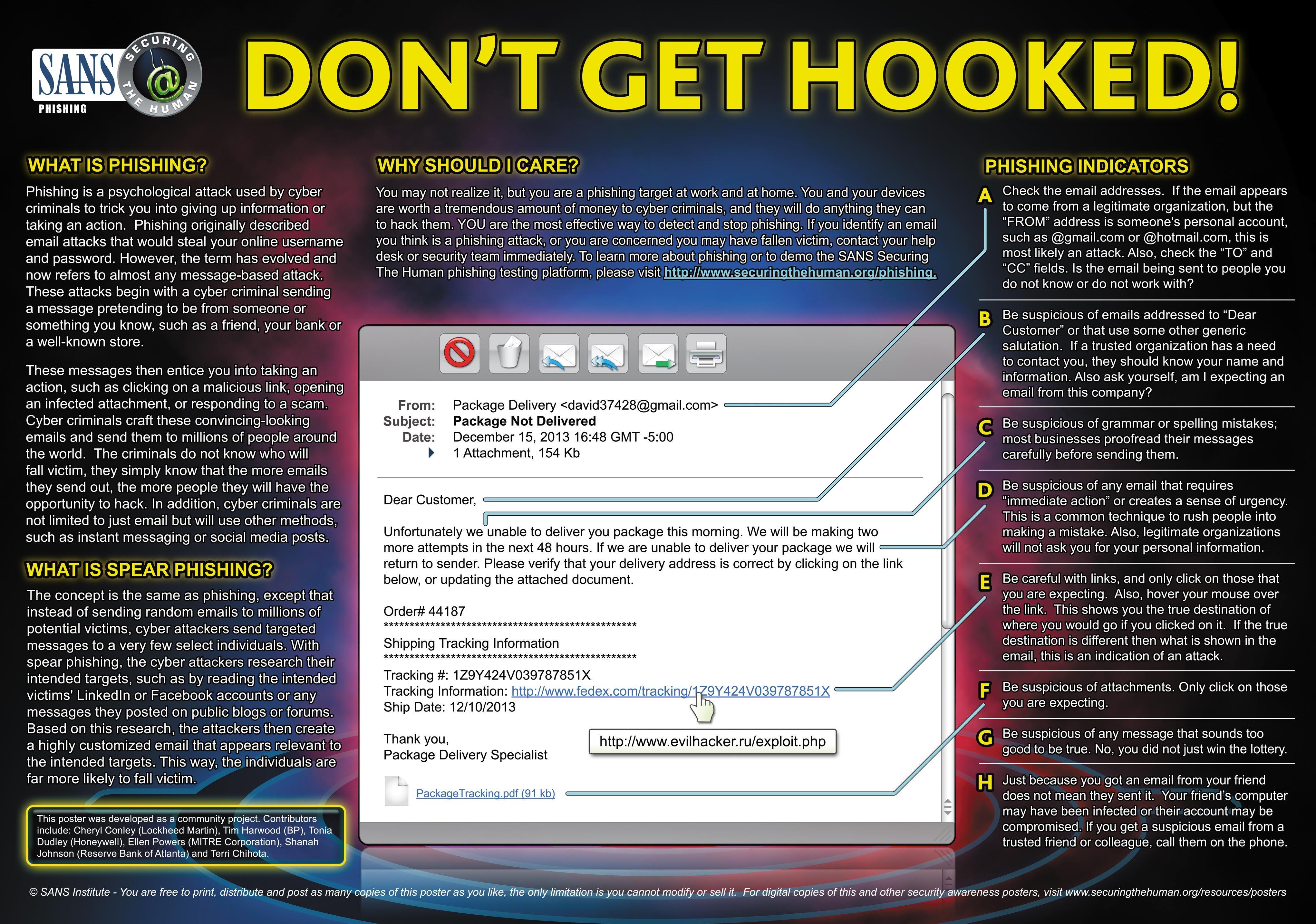
A phishing attack is a deceptive tactic employed by cybercriminals to trick individuals or organizations into revealing sensitive information or performing certain actions that can be exploited for malicious purposes.
Phishing attacks typically involve impersonating a trustworthy entity through emails, text messages, or fraudulent websites, such as a legitimate company, government agency, or financial institution.
The attackers aim to manipulate their targets into divulging confidential data, such as passwords, credit card numbers, social security numbers, or login credentials.
They frequently employ various psychological, urgency, and social engineering techniques to create a belief in legitimacy and urgency, luring victims to perform the desired actions.
Phishing attacks can lead to severe consequences, including identity theft, financial loss, unauthorized access to accounts, and compromised systems. Consequently, it is essential to maintain vigilance and implement preventative measures to defend against such attacks.
Types of Phishing Attacks
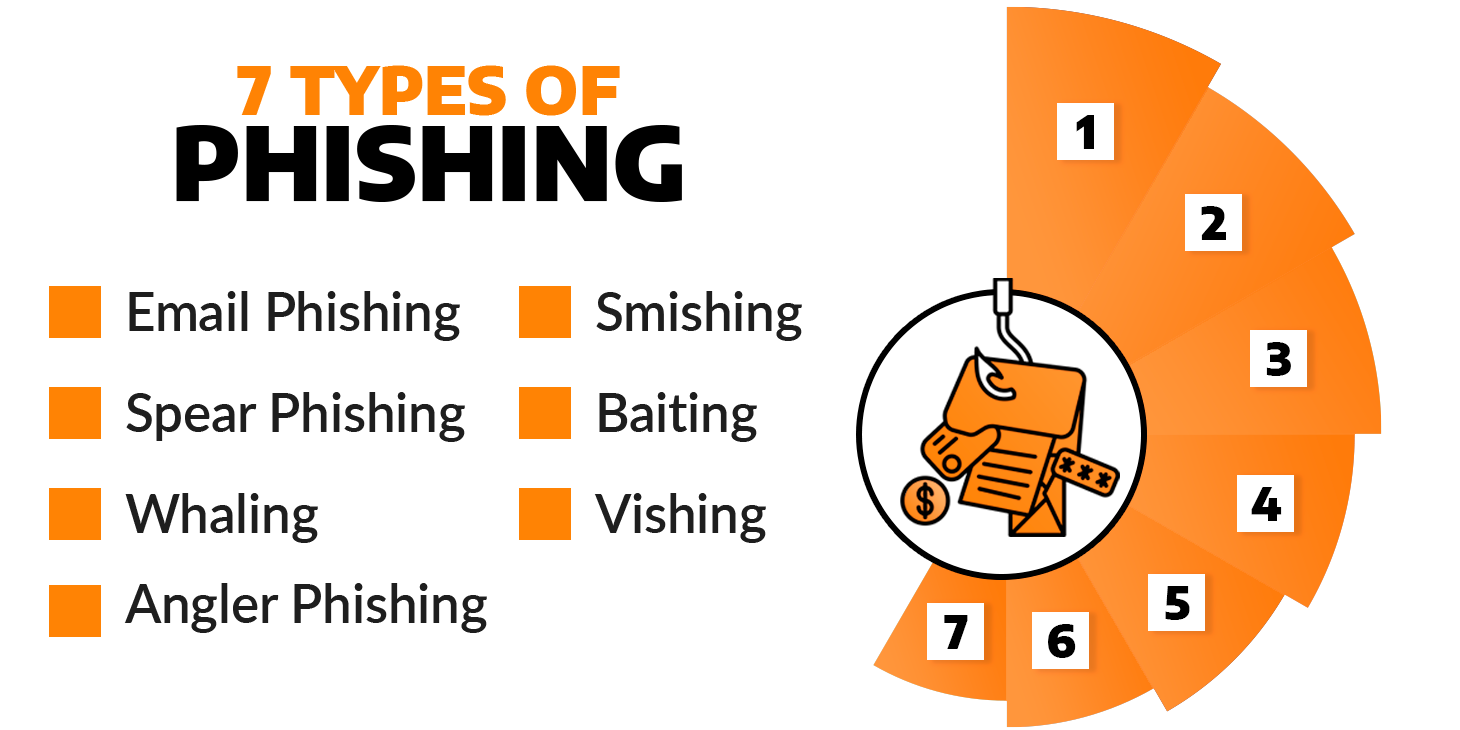
Cybercriminals employ several types of phishing attacks to exploit individuals and organizations. Some common types include:
Email Phishing: Attackers send deceptive emails, often impersonating legitimate organizations, intending to trick recipients into revealing sensitive information or performing malicious actions.
Spear Phishing: This attack addresses specific individuals or organizations, using personalized information to appear more authentic and increase the likelihood of success.
Whaling: Similar to spear phishing, whaling targets high-profile individuals, such as CEOs or top executives, aiming to gain access to valuable company information or financial assets.
Smishing: Phishing attacks are conducted via SMS or text messages, in which perpetrators convince targets to click on fraudulent links or provide personal information.
Vishing: Vishing, also known as voice phishing, entails attackers making phone calls, posing as representatives of reputable organizations, and convincing victims to divulge sensitive information.
Pharming: Intruders manipulate DNS settings or employ malware to reroute users from legitimate websites to fraudulent ones, where they can harvest sensitive data.
Clone Phishing: Attackers create a replica of a legitimate email or website, making minor modifications to deceive recipients into providing their credentials or other sensitive data.
Man-in-the-Middle (MitM) Attacks: In this type of attack, the attacker intercepts communication between two parties, gaining unauthorized access to information shared during the conversation.
Business Email Compromise (BEC): Attackers impersonate company executives or employees to trick employees into initiating unauthorized wire transfers or revealing sensitive business information.
Angler Phishing: This type of attack targets social media platforms, where attackers create fake customer support accounts or pages to steal login credentials or personal information.
How Does a Simple Phishing Attack Lead to Major Cyber Attacks
Initial Compromise: In a simple phishing attack, an attacker sends a fraudulent email or message to trick a user into divulging sensitive information, such as login credentials or account details. The attacker gains unauthorized access to the victim’s account or network if successful.
Credential Harvesting: With the compromised credentials, the attacker can access the victim’s email, social media, or other accounts. This allows them to gather more information about the victim, including contacts, personal details, and potentially additional login credentials.
Lateral Movement: With access to the victim’s account or network, the attacker can move laterally within the organization’s systems, escalating their privileges and seeking additional targets. They may exploit vulnerabilities in the network, search for weakly protected accounts, or target privileged users with higher access levels.
Internal Reconnaissance: Once inside the network, the attacker conducts reconnaissance to gather information about the organization’s infrastructure, systems, and potential high-value targets. They may search for valuable data, intellectual property, or sensitive information that could be monetized or used for future attacks.
Persistence and Persistence: The attacker may establish persistence within the compromised systems by installing backdoors, creating additional user accounts, or modifying existing configurations. This allows them to maintain access even if initial entry points are discovered and patched.
Expansion of the Attack: With a foothold in the organization’s network, the attacker can launch more advanced attacks such as spear-phishing, ransomware deployment, or data exfiltration. They can leverage compromised accounts and systems to distribute malicious payloads, infect other devices, or gain unauthorized access to critical infrastructure.
Advanced Malware Deployment: The attacker may deliver sophisticated malware or exploit kits to compromise additional systems or gain control over critical infrastructure. This can include deploying ransomware, stealing sensitive data, or conducting sabotage activities.
Data Breach and Damage: A successful phishing attack can lead to a data breach, exposing sensitive information, customer data, or proprietary information. The consequences include financial losses, reputational damage, legal ramifications, and regulatory non-compliance.
Top Prevention Checklist for Phishing Attacks
Phishing attacks have emerged as a significant threat in today’s digital landscape, exploiting human vulnerability rather than relying solely on technical vulnerabilities.
Cybercriminals utilize deceptive tactics to trick individuals and organizations into divulging sensitive information or performing malicious actions. Implementing robust preventive measures is crucial to combat this pervasive threat.
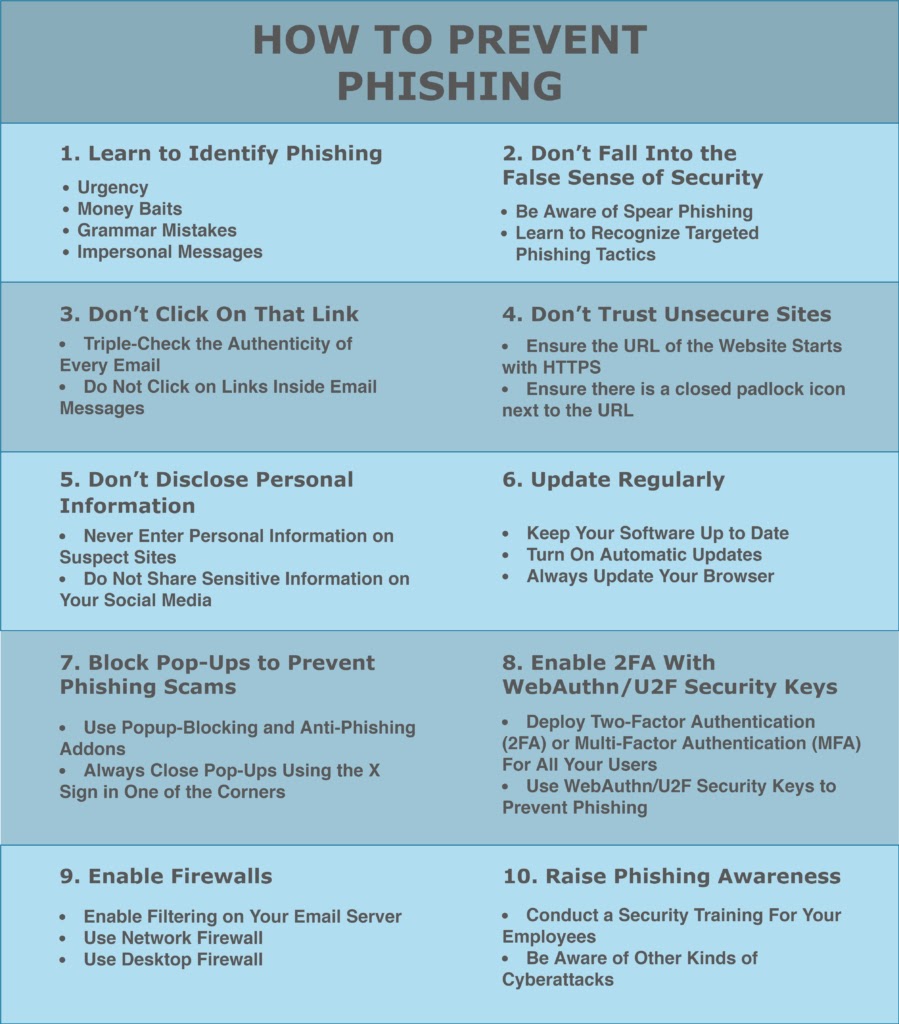
The following prevention checklist provides a comprehensive and detailed approach to shutting down phishing attacks.
By following these guidelines, individuals and organizations can enhance their defenses, minimize the risk of falling victim to phishing attempts, and safeguard valuable information and assets.
Raise Awareness
Educate individuals about the nature of phishing attacks, standard techniques employed, and potential consequences.
Train employees to recognize phishing indicators, such as suspicious email senders, unfamiliar URLs, or unexpected requests for personal information.
Conduct regular awareness campaigns, emphasizing the importance of vigilance and reporting any suspicious activity.
Implement Email Security Measures
To detect and prevent spoofed emails, utilize spam filters and email authentication protocols, such as SPF (Sender Policy Framework) and DKIM (DomainKeys Identified Mail).
Enable email encryption to protect sensitive information in transit.
Deploy advanced threat protection solutions to identify and block malicious attachments or links.
Strengthen Password Security
Encourage the use of strong, unique passwords for all accounts.
Implement multi-factor authentication (MFA) wherever possible to add an extra layer of security.
Regularly update and change passwords, particularly after any suspected phishing incident.
Verify Website Authenticity
Train individuals to check for secure connections (HTTPS) and valid SSL certificates when visiting websites.
Encourage using reputable browser extensions or anti-phishing tools to identify fraudulent websites.
Caution against clicking on links from unsolicited emails or unfamiliar sources.
Enable Security Software
Install reputable antivirus, anti-malware, and firewall software on all devices.
Keep security software updated to ensure protection against the latest phishing threats.
Perform regular system scans to detect and remove any potential malware.
Foster a Culture of Reporting
Encourage individuals to report any suspected phishing emails or incidents promptly.
Establish clear reporting procedures and provide accessible channels for reporting.
Implement a swift response mechanism to investigate and mitigate reported incidents.
Stay Informed and Updated
Keep abreast of the latest phishing trends, techniques, and vulnerabilities.
Regularly update software, applications, and operating systems to patch any known security vulnerabilities.
To stay informed about emerging threats, subscribe to relevant security alerts and industry news sources.
By diligently following this detailed prevention checklist, individuals and organizations can significantly reduce the risk of falling victim to phishing attacks.
It is crucial to remain proactive, continuously evaluate and strengthen security measures, and foster a security-conscious culture to counter the ever-evolving phishing landscape.
Remember, shutting down phishing attacks requires a multi-layered approach that combines technology, education, and user awareness. By working together, you can combat this pervasive threat and safeguard your digital ecosystem.
Best Phishing Attacks Prevention Tools
Email Security Gateways: Email security gateways scan incoming emails for suspicious content, attachments, and URLs. They use various techniques such as machine learning, heuristics, and blacklisting to identify and block phishing attempts.
Anti-Phishing Software: Anti-phishing software helps detect and block phishing websites by analyzing URLs, website reputation, and content. These tools can be installed on web browsers, operating systems, or as browser extensions.
Web Filtering and Content Filtering: Web filtering tools block access to known malicious websites and restrict users from visiting potentially dangerous or unauthorized websites. They can also filter out suspicious or malicious content from web pages.
Multi-Factor Authentication (MFA): Implementing MFA adds an extra layer of security by requiring users to provide multiple authentication factors, such as a password and a unique code sent to their mobile device, reducing the effectiveness of stolen credentials.
Security Awareness Training: Conducting regular security awareness training for employees is crucial. Training programs educate employees about phishing techniques, red flags to watch for, and best practices for handling suspicious emails or links.
Web Browser Security Features: Modern web browsers often come with built-in security features that can help protect against phishing attacks. These features include anti-phishing filters, warnings about potentially harmful websites, and safe browsing modes.
DNS Filtering:DNS filtering solutions block access to known malicious domains by analyzing and filtering DNS queries. They can help prevent users from accessing phishing websites or downloading malicious content.
Security Information and Event Management (SIEM): SIEM tools collect and analyze security event data from various sources to detect and respond to security incidents, including phishing attacks. They can provide real-time alerts and insights into suspicious activities.
Endpoint Protection Software: Endpoint protection solutions offer antivirus, anti-malware, and anti-phishing features to detect and block malicious files, links, and attachments on endpoints such as laptops, desktops, and mobile devices.
Incident Response and Reporting Tools: Having incident response tools in place enables organizations to respond to and mitigate phishing attacks quickly. These tools facilitate incident documentation, tracking, and reporting for post-incident analysis and improvement.
How do you Train your Employee for Phishing Attacks?
What is Phishing: Educate employees on what phishing is and how it works. Explain that phishing involves fraudulent emails, messages, or websites that trick individuals into revealing sensitive information, such as login credentials or financial details.
Standard Phishing Techniques: Describe common phishing techniques, such as email spoofing, deceptive URLs, and social engineering. Explain that attackers often use social engineering tactics to manipulate individuals into taking actions that compromise security.
Identifying Phishing Emails: Provide guidelines for identifying phishing emails. Teach employees to look for signs of suspicious emails, such as generic greetings, spelling or grammatical errors, requests for personal information, urgent or threatening language, and unfamiliar senders.
Suspicious Attachments and Links: Instruct employees to be cautious with email attachments and links. Advise against opening attachments or clicking on links in suspicious emails, especially if they are unexpected or come from unknown sources.
Verifying Requests: Encourage employees to verify any unusual or suspicious requests they receive, especially those related to sensitive information or financial transactions. Provide clear channels for employees to confirm the legitimacy of requests, such as contacting the person directly or the relevant department.
Secure Password Practices: Emphasize the importance of strong passwords and password hygiene. Instruct employees to create unique and complex passwords, avoid reusing passwords across different accounts, and enable two-factor authentication where available.
Reporting Phishing Attempts: Establish a straightforward process for reporting phishing attempts. Encourage employees to promptly report suspicious emails or incidents to the designated IT or security team. Please provide them with the necessary contact information or reporting tools.
Security Updates and Patching: Stress the importance of keeping software, operating systems, and applications updated with the latest security patches. Explain that attackers often target vulnerabilities in outdated software.
Regular Training and Refreshers: Conduct regular training sessions and refreshers to reinforce security awareness. Provide real-life examples of phishing emails and encourage employees to actively participate in simulated phishing exercises to test their ability to identify and respond to phishing attempts.
Ongoing Communication: Maintain ongoing communication about phishing threats and best practices through various channels, such as email newsletters, internal messaging platforms, and bulletin boards. Share real-world examples of phishing attacks to keep employees informed and vigilant.
Conclusion
The prevention checklist provides a comprehensive and detailed approach to shutting down phishing attacks.
By implementing these preventive measures, individuals and organizations can significantly reduce their susceptibility to phishing attempts and protect valuable information and assets.
By raising awareness, implementing email security measures, strengthening password security, verifying website authenticity, enabling security software, fostering a culture of reporting, and staying informed and updated, we can establish a robust defense against phishing attacks.
Remember, combating phishing attacks requires a collective effort that involves continuous education, proactive security measures, and vigilant user awareness.
By following this prevention checklist and staying proactive in the face of evolving threats, we can create a safer digital environment and protect ourselves from the harmful consequences of phishing attacks.
Together, let’s shut down phishing attacks and ensure the security and integrity of our digital interactions.
We all know that Samsung makes a ton of phones every year, and there are so many different series of phones. If you’re outside of India, you may be unfamiliar with the Galaxy F series, but there are phones out there with that branding. According to Sam Mobile, the Samsung Galaxy F54 5G is the first phone in this series to receive four major Android OS upgrades.
Last year, Samsung announced that it was going to support its phones for longer than other Android manufacturers (even Google). This involves major four Android OS upgrades along with five years of security updates. Phones launched before that time will not benefit from this new schedule.
The Galaxy F54 5G is the first phone in this series to receive four major Android OS upgrades
Samsung announced that several of its phones will receive four years of upgrades, but none of them sported the “F” series brand. This brand line primarily exists in the Indian market, and they cater more toward budget users. Regardless, they still sport the Samsung design aesthetic with the camera sensors jutting from the phone individually.
The Galaxy F54 5G has been leaked over the past several weeks, got word that it will receive four major Android operating system updates. This phone could launch in early June, which means that it will hit the market with Android 13 out of the box. So, the Galaxy F54 5G will get Android updates up until Android 17 (or Android Y).
As for this phone’s specs, the Galaxy F54 5G may have a 6.5-inch FHD+ AMOLED display with a 120Hz refresh rate. Powering it could be a Samsung-made Exynos 1380 SoC backed up by 8GB of RAM and 256GB of onboard storage.
For the camera package, we’re looking at a 108-megapixel primary camera with an 8-megapixel ultrawide camera and a 2-megapixel macro camera. Up front, we’re looking at a 32-megapixel selfie camera.
As for the battery, this phone could have a massive 6,000mAh battery. That’s 20% larger than the battery in the Galaxy s23 Ultra. So, battery life should not be an issue with this phone.
The Galaxy F54 5G may launch in the Indian market for INR $35,999 (roughly $435). If you’re thinking of getting this phone, keep an eye out for it.
It comes as no surprise that the start of the AI revolution has opened up a world of opportunities for companies to integrate artificial intelligence and streamline their workflow. Now, in a recent interview, T-Mobile CEO Mike Sievert shared the company’s plans to capitalize on artificial intelligence (AI) for customer retention.
Understanding the churn rate
Every mobile carrier discloses the net number of new postpaid phone subscribers in their quarterly reports, as well as the churn percentage, which represents the rate at which customers leave a wireless provider to join a competitor. In Q1 2023, T-Mobile achieved a postpaid phone churn rate of 0.89%, down from 0.93% in the same quarter of the previous year, making it the only carrier to report a declining churn rate.
“But still, because we’re a very big company, millions of people left us last year. And that just gnaws at us. Something was going wrong, something in the network, something in the customer interaction,” said T-Mobile CEO, Mike Sievert.
Although this declining churn rate is a concern for the company, the customers who abandoned the carrier left behind a wealth of data that holds insights into their departure. And this is where T-Mobile wants to leverage the power of AI and unravel the underlying reasons behind the mass exodus by analyzing diverse data sets related to customer experiences and ultimately reinforcing its position as an industry leader in wireless services.
“This is a major priority for our company going forward. We need to rethink our strategies in a profound way for this next era,” said Sievert.
Long way to go
While T-Mobile’s plan to use AI to better understand customers is a step in the right direction, Sievert believes AI still has a long way to go before making a significant impact. He predicts that within the next 18 months, the world will not see dramatic changes, but over the next decade, AI’s transformative potential will surpass imagination.