Starting on March 28, T-Mobile and Metro by T-Mobile customers will get their year of MLB.TV for free. As usual, you’ll need to claim it in the T-Mobile Tuesdays app. Users will be able to sign up from March 28 until April 3, to get their year of free MLB.TV. This is a $150 value, so it’s definitely one you won’t want to miss.
For any baseball fan, MLB.TV is a must-have as far as subscriptions are concerned. With MLB.TV, you’ll be able to watch any out-of-market game throughout the entire MLB season. That’s nearly 5,000 games in the regular season alone. Now, this won’t let you watch your local team, unless you are not in their market. This also won’t let you watch nationally televised games on ESPN, FOX, MLB Network, Apple TV+, TBS and Peacock.
T-Mobile is a great carrier for sports fans
T-Mobile offering MLB.TV for free is not a surprise anymore, since T-Mobile has been the official wireless carrier of the MLB for quite a few years now. And while that partnership has been ongoing, T-Mobile has offered MLB.TV for free to all of its subscribers. But T-Mobile has also given its users the MLS Season Pass for free.
The MLS Season Pass is part of Apple TV+, which has also been given to its customers for free for a year. So if you’re a big Baseball and/or Soccer fan, then T-Mobile is a great carrier to have.
This is just the latest in wireless carriers offering perks to keep customers on their networks. Verizon, for example, offers up the Disney+ bundle (Disney+, Hulu and ESPN+), as well as the Google Play Pass, Apple Arcade, Apple Music and more, depending on your plan. AT&T also used to offer HBO MAX with its plans, though that seems to be phasing out now.
One of the most underappreciated features found on a smartphone is the share sheet. This is the page that allows you to pick the platform being used to share content. The ones used by both Google Chrome and Google Photos are often criticized. The current share sheet used by the aforementioned apps is limited at first glance and requires the user to press the “more” tab to see all of the options. Ironically, having a different share sheet than the one used system-wide violates Android Guidelines.
According to Techdows (via AndroidPolice) Google is working to move the Chrome browser app to the native Android system share sheet. Signs that such a move is in the works were spotted in the Chrome Canary app. This is an unstable version of Chrome that gets updated daily and it is available from the Google Play Store. In version 112 of Canary Chrome (made available with the stable Chrome browser app at a older version), you can toggle a setting that will force the app to use the Android system share sheet by defdault.
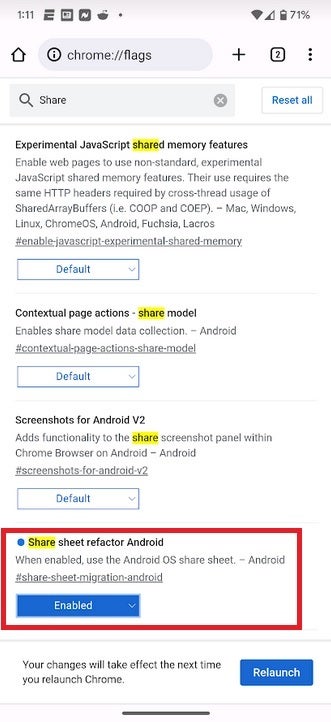
To force Chrome to use the Android system share sheet, follow these directions:
Launch Chrome
Go to chrome://flags
Search for share, find the flag “Share sheet refactor Android”
Chrome Share sheet refactor Android flag
Select Enabled
Restart the browser
After you restart the browser and request the share sheet from the triple-dot menu in the upper right corner, it will show you the native Android share sheet. Right now, this is only available on the Canary Chrome app and will be eventually be found on the stable Chrome app. Right now, my Pixel 6 Pro running Android 13 QPR2 Beta 3.1 has version 109 of stable Chrome installed. The version of Canary Chrome on my phone is 112 which does offer the migration to the Android system share sheet.
You can set Canary Chrome to run the native Android system share sheet by default
To see which version of Chrome is installed on your phone, open the app, tap the three-dot menu button found in the upper right of the display. Go to Settings > About Chrome, and the version number will appear. Once you see that you’re running version 112 of stable Chrome, follow the six steps listed above. Again, these steps work right now on Canary Chrome but we will need to wait for it to appear for the stable version of Google’s mobile web browser.
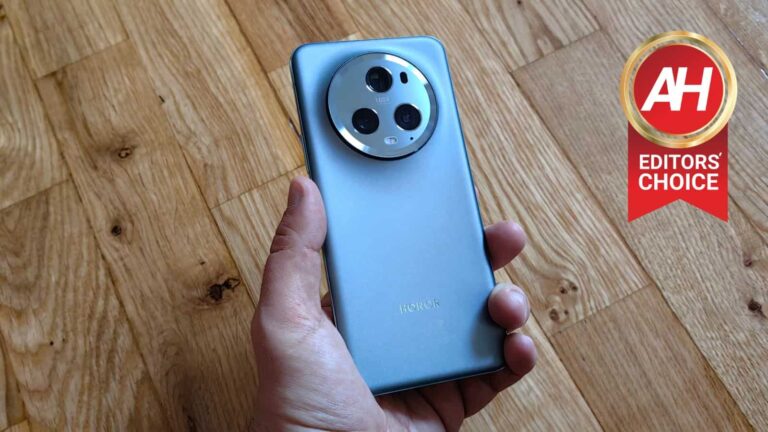
The HONOR Magic5 Pro is the company’s latest flagship, and we’re here to review it. I’ve been using it for a while now, and I do have plenty of thoughts to share. HONOR really did step up compared to last year, though. The Magic4 Pro was a good phone, but it had some downsides that this year’s iteration fixes. The HONOR Magic5 Pro actually managed to surprise me in some ways, and that’s not easy to do these days.
HONOR paid great attention to the design of this phone, while it also fixed some camera-related problems, and some other things. As it’s the case with every phone, though, the Magic5 Pro is not perfect. So, let’s find out exactly what this phone offers, so that you can be more informed before you pull the trigger.
Table of contents
HONOR Magic5 Pro Review: Hardware / Design
The HONOR Magic5 Pro is similar to its predecessor design-wise, to a degree, but we’ll get to that in a second. The HONOR Magic5 Pro includes a large display on the front, with thin bezels, and that display is also curved. There is a pill-shaped hole in the top-left corner, but there’s a good reason for that, as the phone offers 3D facial scanning. On the back, HONOR opted for a large, circular camera island, with three cameras on it. Both the front and the back sides are curved. The display also has a very slight curve on the top and bottom, by the way, not many people will notice though.
Glass models with glossy & matte coatings are available
The backplate on this phone is made out of glass, and it has a gorgeous matte coating. Well, I can talk only about the model I’ve reviewed, and that’s the green one. HONOR officially refers to it as ‘Meadow Green’. The Black model seems to have a regular, shiny coating on the back, which will, undoubtedly, attract fingerprints like crazy. That’s not the case with this green model, though, not at all. It also looks gorgeous on top of that.
The camera island gradually raises to the top
The phone has a gradual incline towards the top of the camera island on the back, which not only looks nice, but is also useful. I often anchored my finger below the camera island while I was holding the device. The light is reflected very nicely off the back of the phone, and also a ring around the camera array. Not many people will care, but if you care about such design details, you’ll probably like it. I know I do, it shows HONOR made an effort to make something different.
The camera module design is an improvement compared to the Magic4 Pro
Now, the HONOR Magic4 Pro also has a circular camera island on the back, but this one looks much better, in my opinion. It’s visually a lot more appealing, as there’s not as much going on. HONOR simplified things. The phone is still slippery, however, and also large at the same time. So, using a case may be a good idea. It does feel good in the hand, though, I didn’t feel like it was cutting into my hand uncomfortably or anything of the sort. It weighs 219 grams, but considering its size, that’s not surprising nor too much, to be quite honest. On top of everything, the phone is also water and dust resistant (IP68 certification).
A case is included
HONOR did include a case with the HONOR Magic5 Pro, which is always appreciated. As you may have guessed, it’s a regular gel case aka silicone case. It is see-through, but it’s always useful to have. This case does add quite a bit of grip for you, and will do a good job of protecting your phone. It even has some extra material on the corners, just to be safe. You can always use it just until you get another case, if you don’t like it. The point is, it’s there, and it fits this phone nicely.
HONOR Magic5 Pro Review: Display
HONOR included a truly outstanding panel here. Let’s get the specs out of the way first. The HONOR Magic5 Pro features a 6.81-inch 2848 x 1312 LTPO OLED display. That panel is curved on all four sides, and it supports a 120Hz refresh rate. It can also project up to 1 billion colors, and gets immensely bright outdoors. It can go all the way up to 1,800 nits of brightness at its peak, on the automatic setting. The display aspect ratio is 19.5:9, in case you were wondering.
The display is big, bright & vivid
So, on paper, this display looks great. Is that the case in actual use, though? Well, yes, it is. The display is not only big and bright, but it also produces very vivid colors, and it’s more than sharp enough. You can tweak it additionally in the settings, if you want. Yes, the viewing angles are also excellent. Touch response is great, and so is haptic feedback when you’re typing, or using the keyboard to move the slider. There is not a single complaint I have about this display, other than the hole in the top-left corner.
Its pill-shaped camera cutout is an eyesore, but it has a purpose
That hole does have a purpose, but those of you who don’t really use facial scanning certainly have a right to complain. It is distracting, and during my usage, I didn’t really get used to it. I presume I would if I used it for a longer period of time, but it’s not as seamless of a transition from a hole punch. The same was the case last year, actually, at least as far as I can remember. That pill-shaped hole is also not exactly close to the left side of the screen, so that certainly doesn’t help.
Functionality-wise, this is an outstanding display. It does everything a high-end display should do, and then some. If you’re not bothered by the hole in the top-left corner, you should not worry about this display at all.
HONOR Magic5 Pro Review: Performance
HONOR went all out when it comes to the Magic5 Pro internals. The company not only decided to use the Snapdragon 8 Gen 2 SoC, but also LPDDR5X RAM and UFS 4.0 flash storage. In other words, it basically grabbed the most powerful SoC available, and the fastest RAM and flash storage units out there. All that doesn’t really mean a lot without proper optimization, right? Well, based on what I’ve seen from this phone, HONOR did a really good job with software optimization as well. The Magic5 Pro performed admirably during my usage.
The performance is outstanding, even when it comes to gaming
It flew through anything I decided to throw at it, really. It managed to open apps really fast, browsing was a breeze, and so was streaming / content consumption. The phone processed images and video during my usage, while it also did a great job on the gaming front. I ran Subway Surfers, Dead Cells, and Genshin Impact on the phone. It did a wonderful job with all three games, even Genshin Impact. Quite a few phones struggle here, but that was not the case with the Magic5 Pro. I don’t think performance will be an issue on this phone for quite some time, it really did feel that smooth. I don’t really have a complaint worth noting.
HONOR Magic5 Pro Review: Battery
The HONOR Magic5 Pro does have a gigantic, high-res display to power, which is why it’s a good thing HONOR stuffed in a 5,100mAh battery here. In combination with the Snapdragon 8 Gen 2, which is very good at power consumption, I managed to get great battery life with the device. Truth be said there was not a single day when I had to charge it before I went to bed, nor was I ever anxious about battery life. This won’t mean that much to you, as your usage will be different, as will your signal, but I managed to get 8 hours of screen-on time multiple times. It still had plenty of juice left in the tank, so I probably could have pushed it even further.
66W wired & 50W wireless charging is supported
HONOR also thought about charging. The device supports 66W wired charging, and a charger is included in the box. On top of that, it supports 50W wireless charging, and both reverse wired and wireless charging. You can get it fully charged in about an hour, while 50W charging will take a bit longer. HONOR could have went with even faster wired charging, but this is faster than both Samsung and Apple offer. Still, it pales in comparison to the HONOR Magic4 Pro, which offered 100W for both wired and wireless charging. 50W wireless charging does seem to be standard with Chinese flagships these days, and is much faster than what Samsung and Apple offer as well (15W). So, we can’t really complain.
HONOR Magic5 Pro Review: Camera
The HONOR Magic5 Pro has three cameras on the back, and two on the front. The phone includes a 50-megapixel main camera (1.4um pixel size, f/1.6 aperture, 23mm lens, OIS, multi-directional PDAF), along with a 50-megapixel ultrawide camera (122-degree FoV). The third camera on the back is also a 50-megapixel one, this is a periscope telephoto unit (3.5x optical zoom, OIS). A 12-megapixel ultrawide camera (122-degree FoV) sits on the front, along with a ToF 3D depth camera. The Magic5 Pro supports advanced facial scanning.
The camera performance is improved compared to its predecessor
First things first, the HONOR Magic5 Pro has excellent hardware, when it comes to cameras. That being said, the pictures this phone can take look noticeably better than what the Magic4 Pro delivered. Most of the time they’re on point. They tend to provide good colors, plenty of detail, and well-balanced highlights during the day, for the most part. At night, the camera does allow enough light into the shot, and most of the time it balances out images.
Further optimizations are needed, though
You’ll notice that I said most of the time a couple of times there. HONOR does need to optimize things a bit more here. At times, the subject I was shooting wasn’t exactly in focus as much as it was supposed to be, while the colors weren’t exactly spot on. Some balancing is needed for this camera to truly shine, but it’s really close. It does a great job at macro photography, by the way. Even if the light is a bit challenging, as you’ll see in the camera samples below, the Magic5 Pro did a great job.
It even includes a capable periscope camera
Furthermore, this phone does include a periscope telephoto camera. It can zoom up to 100x, but I definitely would not recommend that, of course. The phone does a good job during the day with those crazy zoom levels, though not to the level of the Galaxy S23 Ultra. Still, the images up to 30x are more than usable, and noticeably improved compared to the Magic4 Pro. I’m really glad HONOR included a periscope camera here, that’s for sure.
The video recording is good. The phone performs best at fullHD recording at 30 or 60 fps, but it does a good job at 4K as well. The quality does drop off during nighttime, but not more than on most other flagship handsets out there. It’s good overall.
Camera samples (wide & ultrawide):
Camera samples (macro):
Camera samples (periscope):
HONOR Magic5 Pro Review: Software
Android 13 ships out of the box on the HONOR Magic5 Pro. The thing is, it comes with MagicOS 7.1 on top of it. MagicOS is noticeably different than stock Android, and truth be said, personally, it’s not one of my favorite implementations, your mileage may vary, though. The point is, MagicOS 7.1 works really well on this phone. It’s fluid and responsive, and quite bold at the same time. This UI basically combines Android and iOS, in a way. It has a quick search function (aka HONOR Search) when you swipe top-down across the screen, for example. It also has a preference for keeping all your apps on home screens, though you can change that and activate the app drawer.
Knuckle Gestures are quiet useful for taking screenshots
There are some interesting features included here, like Knuckle Gestures, using which you can take screenshots, take partial screenshots, and more. Also, MagicOS comes with big folders, which enable you to enlarge a regular folder so that you can activate apps directly, without opening the folder first. These are just some examples. It does lack Material You, though, and some other Android 13 features that you may be used to if you’ve used Android 13 on some other device.
The UI does look a bit cartoonish and disconnected
The UI looks a bit cartoonish, and it kind of has a disconnect from one portion to the other, design-wise. Pop-up dialogues are in all caps, and it looks a bit weird overall. This is a style preference, and if you’re annoyed by the minimalistic approach, this is certainly different. It is also worth noting that some other parts of the UI work a bit differently than on other Android phones. For example, when it comes to dismissing notifications, you can dismiss them really quickly only by swiping them away from left-to-right, not the other way around. If you do it the other way around, you’ll get several options first, and will then have to swipe again to dismiss a notification.
The UI could be more functional
Entering split screen mode is also quite cumbersome. In fact, many people won’t even know there is a split screen mode here. You cannot activate it from the overview menu directly, or via a gesture. First, you need to go to the overview menu, and open a specific app in a small window. Then you need to open the second app that you’d like to run in a split screen mode, and at that point move the windowed app to the upper or lower portion of the screen. This is quite unintuitive, and I really don’t know why HONOR implemented it this way. Also, you cannot switch places between the top and bottom app while in split screen mode.
MagicOS’ windowed mode is useful
I’ve mentioned windowed apps above, that’s a nice feature to have, and it works well on the Magic5 Pro, as long as the UI allows you to window an app. You can use it in windowed mode, or minimize it in form of a circular icon attached to the right side of the display, to use later. It’s a convenient feature, that’s for sure. If only HONOR included a split screen icon next to the window-an-app icon in the overview menu, things would be much simpler.
It’s considerably different compared to other Android implementations
Overall, this UI is quite functional, but I needed to mention some oddities, different implementations, and missing features, so that you’re ready when you boot the phone. Many people are used to some features on most other phones, so… it’s worth noting that MagicOS is a bit different.
HONOR Magic5 Pro Review: Should you buy it?
So, should you buy the HONOR Magic5 Pro? Well, this phone does have a lot of competition out there. It does also combine a unique set of features not many other phones have. You’re getting top-of-the-line specs, excellent display and battery life, fast wired and wireless charging, and 3D facial scanning all in the same package. Not to mention an ultrasonic fingerprint scanner, and more. That being said, the biggest tradeoff here is HONOR’s UI, which needs work. It doesn’t really impact the performance as much as it stands in its own way, and lacks some features that should probably be there. If you, however, want a different experience, and you don’t mind what I’ve mentioned in the software section above, the HONOR Magic5 Pro is definitely worth checking out. This phone has considerably potential.
You should buy the HONOR Magic5 Pro if:
You want a different software experience
You want all the specs
You need 3D facial scanning on an Android phone
You appreciate having truly fast wired & wireless charging
You hate OEMs who don’t include (fast) chargers in the box
You appreciate excellent battery life
You want good camera performance
You shouldn’t buy the HONOR Magic5 Pro if:
You need some of the software features this phone is missing
The Samsung Galaxy A54 and A34 wallpapers are now available to download thanks to XDA Developers. Neither of the two phones launched just yet, but they’re expected to arrive soon. You can get these wallpapers early, though.
The Galaxy A54 & A34 wallpapers are available ahead of launch
Both static and live wallpapers are available. You’ll find a total of 21 static wallpapers included in the pack. 13 of those are common One UI wallpapers, 4 are One UI 5 wallpapers, and 3 are abstract pattern wallpapers. The last wallpaper is a device-specific wallpaper, one for each phone.
The static wallpapers come in a WEBP format, in different resolutions. The live wallpapers come in 2340 x 1080 and 2400 x 1080 resolutions for the Galaxy A34 and A54, respectively. Samsung included quite colorful images here. You’ll find plenty of abstract wallpapers in the pack, which seem to be quite popular these days.
You can check out all of those wallpaper in the galleries below the article. Do note that they have been compressed, however. If you’d like to get them in full size, we’ve included a download link below the article.
There are two live wallpapers included in total
Now, in terms of live wallpapers, one device-specific live wallpaper is included on each device. You can check what they look like in the video embedded below the article.
These live wallpapers come in an MP4 format, and you’ll need a third-party app to get them running on your device. Video to Wallpaper app, for example, can make that happen for you.
Samsung still did not announce a launch date for either of the two phones. Chances are they will arrive at the same time, though. They’re also expected to launch soon, as their price tags surfaced quite recently. It seems like they’ll be pricier than expected.
Following reports of the Tesla Model Y falling steering wheels in two different cases, the EV brand will face scrutiny. These cases of the 2023 electric SUV’s steering wheels falling off have got relevant safety bodies concerned. This has led to the launch of an investigation into the new SUV from Tesla to confirm any safety concerns.
This issue is a safety hazard, and the National Highway Traffic Safety Administration (NHTSA) is looking into the case. For a clearer picture, imagine someone driving on the highway and their vehicle’s steering wheels coming off from the column. Certainly, they won’t yank off their steering wheel while driving, in this case, the steering wheel comes off on its own.
If this scary event happens, the problem will be how to pull over to the side of the road. Doing so will be difficult because the steering wheel is out of its place. This is the same situation that two 2023 Tesla Model Y model owners found themselves in.
The National Highway Traffic Safety Administration (NHTSA) is investigating Tesla
The internet has been raving ever since a video of the steering wheels of a Tesla Model Y falls off its column. This shocking event took place while the vehicle was in motion, leading to the risk of an accident. Happily, there was no accident as the vehicle owner was able to pull over and come to a stop.
After the shocking event, the vehicle’s owner took to Twitter to share their experience and seek assistance from Tesla. The owner of this vehicle posted pictures and videos of their vehicle with the steering wheel out of its column. This attracted lots of reactions from netizens, Tesla, and even the National Highway Traffic Safety Administration (NHTSA).
Tesla initially charged the vehicle owner $103.96 to repair the vehicle. But the EV manufacturer then agreed to purchase the defective vehicle back from the owner and give them a new Model Y till they could get a new one. Throughout this process, the National Highway Traffic Safety Administration (NHTSA) was in touch with the vehicle owner.
The information gathered from the vehicle owner will help the NHTSA kick off their investigations. According to available reports, this isn’t the first case where a 2023 Tesla Model Y’s steering wheel falls off. Over 120,000 Model Y electric SUVs might be affected by this issue, which involves a loose bolt in the steering wheel column.
If the investigations currently taking place find the 2023 Tesla Model Y faulty, there will be a massive recall. This won’t be the first time that Tesla will be recalling its vehicles due to technical faults. More information on this issue will be made available in the coming weeks. Once all interviews are concluded, Tesla Model Y owners will be informed whether they are returning their vehicles for repairs.
Samsung’s Camera Assistant app was released for the Galaxy S22 series with the One UI 5.0 update. Sammy plans on sharing the Camera Assistant app with more Galaxy handsets. According to SamMobile, besides bringing the Camera Assistant to more Samsung handsets, the app is expected to come with more features. One new feature will give users control over image capture speed, image sharpening, and the timer.
Pre-order the Galaxy S23 Ultra right now!
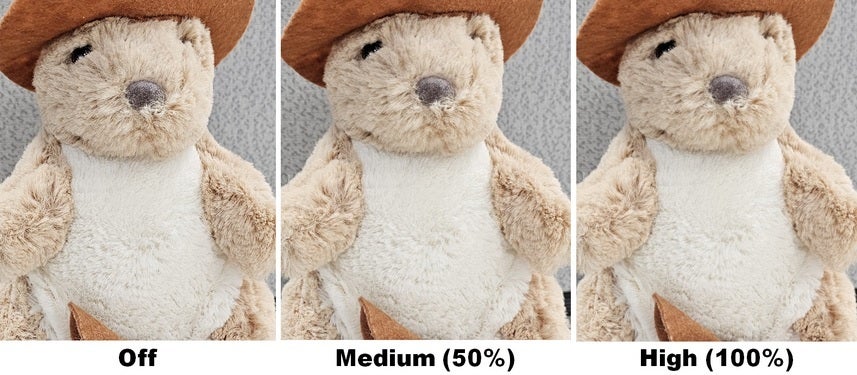
The Camera Assistant app will give users the opportunity to choose among three options for picture softening: Off, Medium (50%), and High (100%). The shutter tap speed can be changed to activate as soon as the button is pressed instead of waiting for the button to be released. A series of burst images, a GIF, or a video can be shot by sliding or holding the on-screen shutter button.
Shutter lag can also be improved by using the upgraded Camera Assistant app thanks to three new settings. Speed Priority will snap a photo as fast as possible with the quality of the photo taking a backseat to speed. Disabling the Auto HDR feature will also eliminate shutter lag. The other two shutter settings include Balanced, and Quality Priority. The former looks to balance the shutter speed along with the quality of the image. Quality Priority gives up a speedy shutter speed in favor of a focus on the quality of the picture being taken.
The Samsung Camera Assistant app delivers three tiers of photo sharpening including Off, Medium, and High
Samsung has also added additional options for the timer. Photos can now be snapped every 1 second, 1.5 seconds, 2 seconds, 2.5 seconds, and 3 seconds. And if your phone gets hot while taking photos or videos it could be due to the processing required to support whatever it is you’re doing with the camera. Having the screen brightness set all the way up could be another reason why the phone is overheating. The Camera Assistant app can be set to dim the screen automatically after 1 minute (or 10 minutes) of video recording.
So which phones are getting the Camera Assistant? Thanks for asking. The app is coming to the Galaxy Note 20 series and all Galaxy S phones starting with the Galaxy S20 line and running through the Galaxy S23 models. It also will be offered to those with the Galaxy Z Flip 3, Galaxy Z Flip 4, and all of the Galaxy Z Fold handsets from the Fold 2 through the Fold 4.
So to reiterate, these Galaxy phones will get the Camera Assistant app:
Galaxy Note 20
Galaxy Note 20 Ultra
Galaxy S20
Galaxy S20+
Galaxy S20 Ultra
Galaxy S21
Galaxy S21+
Galaxy S21 Ultra
Galaxy S22
Galaxy S22+
Galaxy S22 Ultra
Galaxy S23
Galaxy S23+
Galaxy S23 Ultra
Galaxy Z Flip 3
Galaxy Z Flip 4
Galaxy Z Fold 2
Galaxy Z Fold 3
Galaxy Z Fold 4
If you have one of the Galaxy phones in the above list, keep your eyes peeled for the update that will bring Camera Assistant to your phone.
There have been recent revelations by Microsoft that an old version of the SHEIN Android application has been found reading the contents of the clipboard on Android devices irregularly.
With more than 100 million downloads from the Google Play Store, SHEIN’s Android app is one of the most popular in the marketplace. This Singapore-based retailer has been an online fast fashion retailer for over a decade, originally operating under the name ZZKKO.
It should be possible to send the contents of the clipboard to a remote server if a particular pattern can be identified. Despite this, Microsoft hasn’t identified any malicious intent behind the behavior and is not aware of any such activities.
It is important to understand the risks that the installed applications can pose even if SHEIN didn’t have malicious intent. As an example, this can include the popular apps that are loaded from the official app store of the platform since they are highly popular.
There have been no updates to the app since the release of version 7.9.2 on December 16, 2021. Microsoft researchers reported that on March 6 they discovered this issue that has been fixed in the May 2022 update.
In order to prevent possible malicious attacks, users must make sure their installed application is up-to-date. Since mobile users frequently use clipboards to copy and paste sensitive information, clipboards are an appealing target for cyberattacks.
While in the clipboard users mainly perform the copy and paste of the following type of data:-
Login credentials
Financial data
Personal information
In order to identify and observe the code responsible for the particular behavior of the application, Microsoft’s cybersecurity analysts performed two types of analysis, and here they are mentioned below:-
Static analysis
Dynamic analysis
By exploiting this clipboard vulnerability threat actors can easily modify the contents of the clipboard for several types of other malicious activities. The application triggers a POST request to the server “api-service[.]shein[.]com.” when any content copied to the clipboard is launched.
In the past few years, Google has taken steps to mitigate the privacy risks involved with Android in order to make it more secure.
Recommendations
Here below we have mentioned all the recommendations offered by the cybersecurity analysts at Microsoft:-
Make sure that the device as well as the installed applications are always kept up-to-date.
Installing an application from a source you are not familiar with is never a good idea.
If an application is showing unexpected behavior, you should consider removing it.
Always make sure to use a robust antivirus system on your device.
As many of you know by now, the Android 14 Developer Preview 2 is out. We’ve already covered the news, but new bits and pieces are constantly popping up, like the one we’re here to talk about. Android 14 is bringing a feature called ‘Flash notifications’, which is supposed to replace a notification LED light, kind of.
Android 14 DP2 brings ‘Flash notifications’ feature to the table
LED notification lights were quite popular back in the day, many phones had them. They got phased out over time, though, even though they were immensely useful. Well, this new Android 14 feature will try to make up for it.
This feature is available via the Accessibility panel in Android 14 Developer Preview 2. Once you enter the ‘Flash notifications’ menu, you’ll be able to enable ‘Camera flash notification’ and/or ‘Screen flash notification’.
If you opt for the ‘Camera flash notifications’, your phone’s LED flash will turn on and off briefly once you receive a notification. The flashlight toggle in the phone’s Quick Settings will also be highlighted to indicate a notification has arrived. There is no option to tweak this setting, however.
‘Screen flash notifications’ are more customizable than ‘Camera flash notifications’
On the other hand, if you enable ‘Screen flash notifications’, you’ll be able to choose a color you’d like for the feature to use. The screen will flash in that color when you receive a notification. There are 12 colors to choose from here.
We’ve seen the LED flash notifications on other phones, while the screen flashing seems like a more interesting choice. It would be even more useful if we had more granular settings. If we could set a specific color for a specific app or contact. Who knows, maybe that feature is also coming.
Do note that this feature may not end up in the final Android 14 build, though. It probably will, but there’s always a chance Google will scrape it off before it releases a stable build later this year.
Samsung has started taking applications for its Mobile Advance (SMA) program for 2023. It is an equity-free grant funding scheme for tech startups working on new proof-of-concept projects. Established companies, research institutes, and other organizations building innovative technologies can also apply to the program. Companies headquartered in Europe, Canada, Israel, China, Japan, India, and the US are eligible for participation.
Launched last year, the SMA program grants funding and mentorship to innovative ideas across various tech niches over six months. Samsung says Cameras, Power, Audio, Health, On-device AI, Metaverse, ESG (environmental, social, and corporate governance), Advanced Materials, Sensors, AR (augmented reality), Wearable, and Foldable technologies are among the areas of interest this year. However, the program will also fund projects in other niches if the company finds them groundbreaking.
Selected tech startups will also get mentorship from Samsung R&D
According to the Korean behemoth, it is looking for “cutting-edge technologies that improve devices for more powerful and longer-lasting performance”. Ideas that enable a “unique user experience based on new mobile form factors such as foldable and wearable” are also on its radar.
Samsung is currently accepting applications for the program from startups and established companies in the aforementioned regions. Applications are open till the end of March. The company will evaluate all proposals in April and invite the selected applicants to pitch their ideas in person in May.
Selected firms will elaborate their projects with all necessary details in front of a panel of Samsung experts. Once all companies have pitched their ideas, the company will pick the ones that fit best in its vision.
The winning ideas will receive equity-free funding of $50,000 from the Korean conglomerate to work on the project. Samsung’s R&D (research and development) teams will also provide mentorship to the firms and help them in their development for six months starting in July this year. They will get “deep access to Samsung mobile devices and software”.
In February 2024, Samsung will invite these firms to present their demos. Depending on the final result, the tech behemoth may pick a few solutions and adopt them in its product and services.
It may also offer long-term partnership opportunities to these startups. SMA is a platform for innovative ideas to make it to the big stage in a short time. Startups that are already part of other funding programs such as an incubator or accelerator can also apply to Samsung’s Mobile Advance program. More details can be found on the company’s official website here.
They might be on opposite sides of the mobile tech battlefield, but in spite of that Google does have most of its services and applications available for Apple’s iPhones and iPads (unfortunately the same cannot be quite said as vice versa). The most recent iOS software update, however, appears to have broken one of the most widely-used Google apps across iPhone and Android phone owners alike — Google Photos.First spotted by folks at The Verge and others that went to report this issue on Twitter, the new iOS 16.3.1 update might be what’s made the Google Photos app crash when launched on iPhone. The update itself, however, is a rather insignificant one, as Apple has described it in the release notes as containing bug fixes and addressing security issues.What’s more, it is not even completely clear that it is the new iOS version that is affecting the Google Photos app per se, because even though there are a significant number of people affected, there is an equal amount of others that are not. Thankfully, a spokesperson for Google by the name of Michael Marconi came out and said that Google knows about this problem and is actively working on fixing it. Kudos to Google for being so quick on its feet even for a bug that concerns only Apple product owners.If you are heavily reliant on Google Photos, it goes without saying that you might want to wait before updating to the new iOS software version. If you are one of the unlucky ones, though, There is a good chance Google will be able to fix things up soon and get the app working again. Until then, you can always use a browser to access the platform and your photos that way.