Snap inspection. Do you know where your SIM extraction tool is right now?
We didn’t think so.
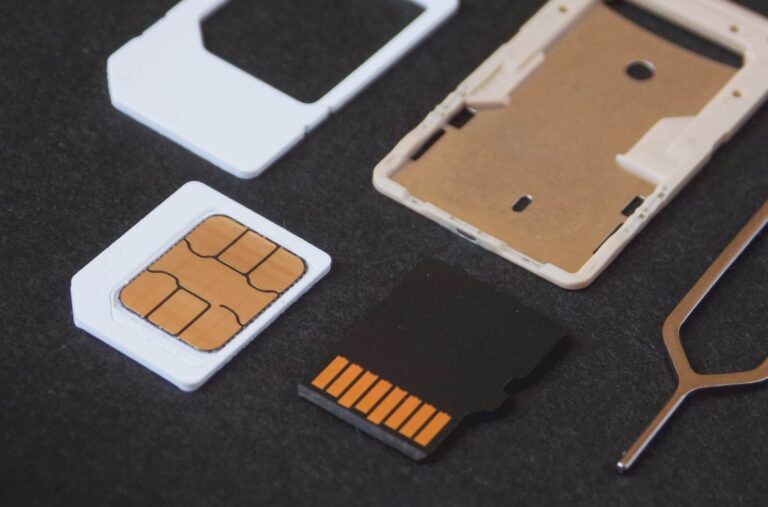
While pretty much every aspect of smartphones has become slicker and more user-friendly over the years, the process of changing a SIM card has only got trickier. In fact, you can’t even do it without using a tiny tool that you’ve almost certainly lost.
Fortunately, change is just around the corner. The humble SIM card is on the brink of being replaced by the eSIM. Here’s why that’s the best news you’ll read today.
An eSIM – which stands for Electronic Subscriber Identity Module – is a programmable alternative to a standard SIM. That means it lets you make changes through software rather than hardware.
Buying a new plan or making changes to your existing plan is as simple as going online and scanning a QR code.
Besides never having to fish out your SIM extraction tool again, the major advantage of an eSIM is that it lets you enjoy global data roaming. Once you’re set up, you can go anywhere you like without having to contact your operator or pore through T&Cs.
But the benefits don’t stop there. An eSIM is also infinitely more secure than a traditional SIM, which is surprisingly vulnerable to simjacking, SIM cloning, SIM swaps, and other nefarious acts of cyber assault.
That’s because eSIMs won’t let you use them without entering an activation code. Your personal details are locked down tight unless you give explicit permission for them to be shared.
At this point, you’re probably wondering how to get your hands on this miracle technology. It’s surprisingly easy, with a huge number of telcos already in the space and countless more set to join them over the coming months and years.
You can take your pick from no-frills offerings like Flexiroam, which offers little in the way of customer support but a huge amount of value, or comprehensive and well-supported options like Airalo, which charges a bit more for a slicker customer experience.
Or you could go for a fantastic all-rounder like Nomad, which offers fantastic value and superb performance.
One day, you might even be able to pick up an eSIM contract with Starlink, the sci-fi satellite network that beams information around the world using space lasers.
So, let’s rewind a bit to 2021. Some of you might recall that there was a mass abandonment of WhatsApp, which led to an increase in popularity of other apps like Telegram or Signal. But do you remember why that happened?
Well, WhatsApp rolled out a controversial update to their policy statement, which was a tad unclear and could be understood as “Hey, we’re going to be sending your info to Facebook from here on out, hope that’s fine”. Well, users didn’t take kindly to that. So much so that the European Union (EU) had to budge in and demand that WhatsApp improve the way it is explaining changes such as these so that the “terms” part can become more clear.
It took years — until yesterday in fact — for this to be settled and with this confirmation by the official blog of the EU, WhatsApp has completely agreed to all requirements. But does this mean that it is party time and that all Terms of Service (ToS) from Meta are gone forever, at least in the EU?
Of course not.
Regardless, WhatsApp is still one of the most used IM apps worldwide.
So, here is what WhatsApp will change from the point of view of the EU:
It is to provide clarity to future changes to contracts with users and more specifically, how that alters their rights
Furthermore, the developers of WhatsApp are to allow users to reject ToS alterations just as easily as users can accept it
Lastly, WhatsApp users are to be enabled to dismiss ToS update notifications so that they can postpone reading them in detail; In addition, no recurring notifications are to follow
That doesn’t sound that bad! So where is the catch? Well, last time that users were allowed to skip or deny ToS updates, WhatsApp informed them that certain features and functions would be disabled until further notice. While the company is yet to respond if this instance is different in any way, we don’t see how that may be the case, as the documents in question may contain entirely new segments related to newly introduced features. As such, if users don’t accept them, they won’t be able to legally function.
When the outcry of 2021 happened, WhatsApp was quick to respond that no data would be shared with Meta or Facebook. The company was quick to point out that conversations are encrypted either way, so it couldn’t possibly do that even if it wanted to. However, the damage had already been done, and hence now WhatsApp are heavily marketing their service through emphasis on security and encryption.
In review, this event is a bit of an oddball. Until we receive more information from WhatsApp on what the plan to implement these new rules is, we reserve further judgment. But if you are in a country that is part of the EU, you should definitely follow this story further. Naturally, we’ll make sure to let you know when we hear something.
The DoppelPaymer ransomware gang was involved in targeted ransomware attacks against Visser Precision, the custom part supplier for high-profile firms in the automotive and aeronautics sectors.
In a joint operation launched by the Ukrainian National Police and the German Regional Police, with support from the FBI, the Dutch Police, and Europol’s Joint Cybercrime Action Taskforce (J-CAT), core members of the DopplePaymer ransomware gang were arrested.
The arrests took place on February 28th, 2023. Europol deployed three experts to Germany for cross-checking operational information against the agency’s databases and conducting crypto tracing and extended investigations operational and forensic analysis.
During the operation, a German citizen’s house was raided and extensive searching was carried out in the Ukrainian cities of Kyiv and Kharkiv. During the investigation, a Ukrainian national was also interrogated on suspicion of holding a crucial position in the ransomware group.
The forensic analysis of the confiscated equipment is currently underway. Europol formed a Virtual Command Post for connecting investigators and experts from the USA, Germany, the Netherlands, and Europol in real-time.
Authorities analyzing the seized equipment (Image: Europol)
As reported by Hackread.com, the DoppelPaymer ransomware gang is involved in targeted, large-scale attacks against many prominent firms. Visser Precision, a part supplier for Boeing, SpaceX, Lockheed Martin, and Tesla, is among the targets of the notorious ransomware DoppelPaymer.
The hackers targeted the Colorado-based precision parts manufacturer and leaked some of their data on a website. They also asked for a ransom and have been threatening to leak sensitive data of Visser Precision’s clients.
The leaked data includes non-disclosure agreements the manufacturer of the US-based parts signed with SpaceX and Tesla. This criminal cybersecurity incident was confirmed by Visser. The company stated that the incident allowed unauthorized access by attackers who encrypted and stole sensitive data. Visser launched an investigation to detect security loopholes that had caused the hack.
It is worth noting that Visser’s business operations were not impacted and are functioning normally. The company did not disclose how the attackers managed to invade its computer networks.
The attackers behind this ransomware reportedly targeted 37 firms in Germany, and their US victims had paid 40 million between May 2019 and March 2021.
About DoppelPaymer Malware
CrowdStrike, a cybersecurity firm, reported that this file-encrypting malware first surfaced in April 2019. Its code is quite similar to BitPaymer ransomware, which is linked to a Russian cybercrime group called Indrik Spider aka Evil Corp.
It was formed in 2014 by the defunct GameOver Zeus criminal gang’s affiliates. The malware tactics are similar to a Windows-based banking malware, Dridex, equipped with a botnet and info-stealing capabilities.
“However, there are a number of differences between DoppelPaymer and BitPaymer, which may signify that one or more members of Indrik Spider have split from the group and forked the source code of both Dridex and BitPaymer to start their own Big Game Hunting ransomware operation,” CrowdStrike report read.
The attacks were enabled by Emotet malware, whereas DoppelPaymer was distributed via different channels, such as spam or phishing campaigns, in which the attached documents (VBScript or JavaScript) contained the malware.
In response to the news, Mark Lamb, CEO of HighGround.io, told Hackread.com, “This is another impactful collaboration from law enforcement, tackling a major ransomware gang not long in the wake of the takedown of the Hive ransomware gang.”
“DoppelPaymer has been causing havoc and costing organisations millions for over three years, and it relied on two of the world’s most notorious malware variants – Emotet and Dridex – to initially target businesses before executing the ransomware,” Mark added.
Mark warned that “with DoppelPaymer being a ransomware-as-a-service operation, it is likely there will be many more perpetrators behind the threat that will need to be caught before we can say goodbye to the ransomware for good.”
Mark also hopes that “the seized infrastructure should provide significantly more intelligence to law enforcement and it’s likely others behind the threat will face the heavy hand of the law very soon.”
The US Government has been working on the National Cybersecurity Strategy Document 2023 for some time now, and it’s finally been released.
The US Government has been working on the National Cybersecurity Strategy Document 2023 for some time now, and it’s finally been released. The strategy document, which replaces the last such piece of work from 2018, attempts to indicate the general direction of the US approach to cybercrime and security for the next few years.
While you don’t necessarily need to take immediate action on the points raised, there’s a lot of talk about liability for poor security practices for larger organisations, better ratings for IoT devices, and a greatly improved hiring strategy for unfilled security vacancies. If these are areas of concern for you, we highlight the important parts below.
One large part of this new strategy is that organisations potentially most well equipped to fend off attacks must step up and do more:
The most capable and best positioned actors in cyberspace must be better stewards of the digital ecosystem…we must ask more [across both the public and private sectors] of the most capable and best positioned actors to make our digital ecosystem more secure and resilient. In a free and interconnected society, protecting data and ensuring the reliability of critical systems must be the responsibility of the owners and operators of the systems that hold our data and make our society function, as well as of the technology providers that build and service these systems.
With this in mind, then, let’s highlight some of the standouts from relevant sections.
Defending critical infrastructure
Expanding the use of minimum cybersecurity requirements in critical sectors
If you work in a critical sector of industry, you can expect to see new requirements heading your way in the near future. “Existing authorities” will set new requirements for cybersecurity, and where gaps exist in statutory authorities to create minimum standards, the Administration will work with congress to close them. Regulations will be performance based and make use of existing security frameworks—no reinventing the wheel here. A focus on driving better practices in the cloud industry is also evident.
Update Federal response plans
You can expect better processes should you need to contact Federal authorities after a cyber incident, with the aim of creating a “unified, coordinated, whole of government response” with organisations able to quickly and easily find out who to contact, and when. The National Cyber Incident Response Plan (NCIRP) will be updated through this work, and the Cyber Incident Reporting for Critical Infrastructure Act of 2022 (CIRCIA) will require specific entities in critical infrastructure sectors to report incidents to CISA “within hours”.
Disruption of criminal gangs
Engaging the private sector in disruption activities
The Government wants to combine the “unique insights and capabilities” of the private sector with the ability to take decisive action by Federal agencies. There’s a strong desire here to have private sector partners organise through non-profit organisations serving as hubs for operational collaboration with the Federal government.
Virtual collaboration platforms will be used for these activities and information sharing processes, with the Government looking after the necessary security requirements and records management activities. In other words: if your organisation casts a wide security net, gathers data on attempted attacks, blocks and catches interesting files, wards off ransomware, and spots dubious network traffic, then there’s something approaching an Avengers initiative waiting in the wings.
Shape market forces
Promoting privacy and the security of personal data
Making large organisations accountable for failing to be responsible stewards of data is a key thread running throughout the strategy document. This is because the costs are often passed on to everyday people, with the biggest impact being felt on vulnerable populations.
Internet of Things devices can expect to fall under “IoT security labelling programs”, which will allow consumers to compare security protections offered by devices. The idea here is to create a market incentive for better security across the IoT space, but this is reliant upon people understanding that these labels exist, and what they mean in practice.
Shifting liability for software products and services to promote secure development practices
If you know someone who works for an organisation playing fast and loose with data, security practices, and compliance, they should be warned: there’s a liability storm coming. The Administration is going to be working with Congress and the private sector to develop legislation establishing liability for software products and services, along with a “safe harbour” for those securely developing and maintaining products and services.
Investing in a resilient future
Develop a national strategy to strengthen our cyber workforce
The hundreds of thousands of vacancies in cybersecurity positions nationwide are a sore point for this Administration. If you’re short on security workers yourself, then the proposed development of a National Cyber Workforce and Education Strategy may be what you’ve been looking for. Critical infrastructure is once again a key talking point, and it aims to improve hiring among underrepresented groups of candidates. This plan aims to make use of several already existing schemes, and also take inspiration from successful hiring practices in other nations.
What’s the response so far?
There is some criticism for the plans, mainly on the basis that plans come and go but rarely manage to keep pace with the actual speed of changing technological threats. As Bloomberg Law points out, the plan itself has no regulatory teeth and it’s now mainly up to various agencies to take the ball and run with it in terms of making new changes.
New strategies for tackling cybercrime and protecting critical infrastructure are always welcome, but it remains to be seen how much practical impact the Biden Administration’s 2023 National Cybersecurity Strategy will have over the next few years.
Have a burning question or want to learn more about our cyberprotection? Get a free business trial below.
The time has come to compare two smartphones with 1-inch camera sensors, the Vivo X90 Pro vs Xiaomi 13 Pro. I’ve reviewed both of these phones quite recently, so the impressions are still fresh on both of them. They do have the same main camera sensors, but they’re very different in many ways. Even the camera performance is considerably different, so there’s plenty to talk about here.
We’ll first list the specifications of these two phones, and will then move on to a number of other categories. These two handsets do look somewhat similar from the front, but that’s where the similarities end, design-wise. They also have different software, different displays, different SoCs, and more. So, let’s get things started, shall we?
Both of these phones are quite large. The Vivo X90 Pro is slightly taller and thicker, but they’re almost equally wide. The Xiaomi 13 Pro is heavier, though, mainly due to its ceramic backplate. The vegan leather model is lighter, but that one is available in China only, Xiaomi launched only the ceramic variant globally. The Vivo X90 Pro has a vegan leather backplate, though, at least its global model does. Both phones are IP68 certified for water and dust resistance.
The Vivo X90 Pro is less slippery due to its backplate, that’s for sure. Both devices have a centered display camera hole, and very thin bezels. Both of them also have curve displays, but the curvature is different. The curves on the Xiaomi 13 Pro display are less pronounced, and most of you will probably prefer that. On the back, you’ll notice large camera islands on both phones, and on both phones, they’re placed in the top-left corner.
Both phones have three cameras on the back, though the camera islands do look different. ZEISS optics are utilized on the Vivo X90 Pro, while Xiaomi partnered up with Leica. Both of these smartphones feel premium in the hand, that’s hard to deny. They also fit in the hand nicely. Using a case is recommended, though, as neither phone is particularly grippy, even though the Vivo X90 Pro is grippier. Their camera islands also protrude on the back quite a bit.
Vivo X90 Pro vs Xiaomi 13 Pro: Display
The Vivo X90 Pro features a 6.78-inch 2800 x 1260 curved AMOLED display. This is an LTPO display, by the way, and its refresh rate goes up to 120Hz. It can project up to 1 billion colors, and it does support HDR10+ content. Its maximum brightness is 1,300 nits. The phone offers a 20:9 display aspect ratio.
The Xiaomi 13 Pro, on the flip side, has a 6.73-inch QHD+ (3200 x 1440) LTPO AMOLED panel. That display is curved, and its refresh rate goes up to 120Hz. Dolby Vision is supported here, and the display can project up to 1 billion colors. Its brightness goes up to 1,900 nits. The Xiaomi 13 PRo’s display has a 20:9 aspect ratio, and it is protected by the Gorilla Glass Victus, in case you were wondering.
Both of these displays are excellent in real-life use, but the Xiaomi 13 Pro does have one major advantage. That advantage comes in the form of brightness. It gets noticeably brighter in direct sunlight, so if that’s important to you, it’s worth noting. Other than that, they both do the trick. They’re fluid, very responsive, the colors are vivid on both, and both displays have excellent viewing angles. The blacks are also deep on both of them.
Vivo X90 Pro vs Xiaomi 13 Pro: Performance
The Vivo X90 Pro utilizes the MediaTek Dimensity 9200 SoC. In addition to that, Vivo included 12GB of LPDDR5X RAM and UFS 4.0 flash storage. The Xiaomi 13 Pro is fueled by the Snapdragon 8 Gen 2 SoC, while it includes 12GB of LPDDR5X RAM and UFS 4.0 flash storage. Both of these phones are immensely powerful, and the MediaTek Dimensity 9200 may technically be inferior to the Snapdragon 8 Gen 2, but it’s a true flagship SoC, and it’s keeping up nicely.
Both of these phones performed admirably during my usage. They flew through everything I threw at them. Everyday tasks are a breeze for both phones, and even gaming, actually. The MediaTek Dimensity 9200 had no issues running even the most demanding games, and neither did the Snapdragon 8 Gen 2. We did notice the difference between the two SoCs, but not in the performance department, more on that later. When it comes to performance, they certainly are on par with each other, you really can’t go wrong here.
Vivo X90 Pro vs Xiaomi 13 Pro: Battery
The Vivo X90 Pro comes with a 4,870mAh battery, while the Xiaomi 13 Pro has a 4,820mAh battery pack. They both offered good battery life, but the Xiaomi 13 Pro was better in our case. The Snapdragon 8 Gen 2 is probably the reason why. That SoC has great power consumption, and the Xiaomi 13 Pro also offered better standby battery than the Vivo X90 Pro. I was able to pull out way over 7 hours of screen-on-time with the phone, crossing the 8-hour mark is not a problem. The Vivo X90 Pro, on the other hand, almost always danced between 6 and 7 hours of screen-on-time.
Do note that I did not play games on either phone, other for testing purposes (1 day). I did submit them to various other tasks, ranging from messaging and browsing, to streaming audio and watching TikTok. Your mileage may vary, of course, as you’ll have different apps installed, different usage, and different signal strengths during your usage. So, you may get considerably different results.
When it comes to charging, both of these phones truly shine. They both support 120W wired, and 50W wireless, on top of reverse wireless charging. On top of that, they also come with a charger in the box. Yes, you get a 120W charger with both phones, so you won’t have to buy one separately, which is always nice to see.
Vivo X90 Pro vs Xiaomi 13 Pro: Cameras
The Vivo X90 Pro is equipped with a 50-megapixel main camera (Sony’s IMX989 1-inch sensor), a 12-megapixel ultrawide unit (108-degree FoV), and a 50-megapixel telephoto camera (2x optical zoom). The Xiaomi 13 Pro, on the flip side, comes with a 50-megapixel main camera (Sony’s IMX989 1-inch sensor), a 50-megapixel ultrawide camera (115-degree FoV), and a 50-megapixel telephoto camera.
These two phones have the same main camera sensors, but different lenses, and different image processing as well. The images from both phones look great, but in entirely different ways. The shots from the Xiaomi 13 Pro tend to be darker, with a moodier look, on purpose. The Vivo X90 Pro is probably what most people will prefer due to a more vivid look. We’ve also noticed that the Vivo X90 Pro does a bit better in HDR situations, and the images also tend to look sharper at times. The Xiaomi 13 Pro is doing a great job, but a camera consistency update is needed. Well, at least it was at the time we reviewed it. The Vivo X90 Pro is more consistent when it comes to producing outstanding images.
Both devices do a great job in low light, while the Xiaomi 13 Pro excels in portrait photography. Xiaomi and Leica really created something special in that regard thanks to the phone’s telephoto camera, and processing. The ultrawide cameras are good on both phones, and tend to provide similar-style images to the main cameras. The video recording is good on both, but not to the level of the latest iPhone Pro models, or the Galaxy S23 Ultra.
Audio
Both of these devices feature stereo speakers, and both sets are quite loud. They also provide detailed and well-balanced sound, while you also do get a bit of bass mixed in there. These are good speakers, that’s for sure.
What you won’t find on either phone is a 3.5mm headphone jack. In order to get your headphones hooked up via a wire, you’ll need to use a dongle. For wireless connections, however, Bluetooth 5.3 is supported on both phones.
Earlier this year Samsung announced the Odyssey Neo G7, stating it would be available later in the year. That day is today, as Samsung confirms the monitor is now available for purchase. This is the company’s first flat 43-inch gaming monitor using Quantum Mini LED technology.
Samsung has other Quantum Mini LED monitors, but they all come with curved panels or in different sizes. And now Samsung offers something for gamers who prefer a flat display. Not only that, but it’s perfect for both gaming PCs and consoles. Since it’s not an ultrawide panel you can expect the console to fill out the screen. Much like you would a TV.
The large, 43-inch display will also ensure you have plenty of screen real estate for non-gaming PC activities, such as work, or enjoying a little TV. The monitor features a 4K panel with a 144Hz refresh rate, a 1ms response time, and it’s NVIDIA G-Sync compatible.
The 43-inch Odyssey Neo G7 is available for $999
When it comes to Samsung gaming monitors of this size, $999 is sort of on the low end. At least when compared to its ultrawide Odyssey G9 and Odyssey Neo G9 options.
If the price is right, then the 43-inch Odyssey Neo G7 is available directly from Samsung or through retailers like Amazon. It supports DisplayPort 1.4 and HDMI 2.1, and comes with two USB ports if needed. It also has Samsung Gaming Hub pre-installed on it. So you could just hook it up to the internet and stream games through the cloud using Xbox Game Pass, GeForce NOW, or Amazon Luna.
It even comes with one ethernet LAN port so you can hardwire it to your wireless router for a faster and more reliable connection. At 43-inches it’s definitely going to take up some desk space. But if you have the room it might be one of the best options if you have both a PC and a console on your desk.
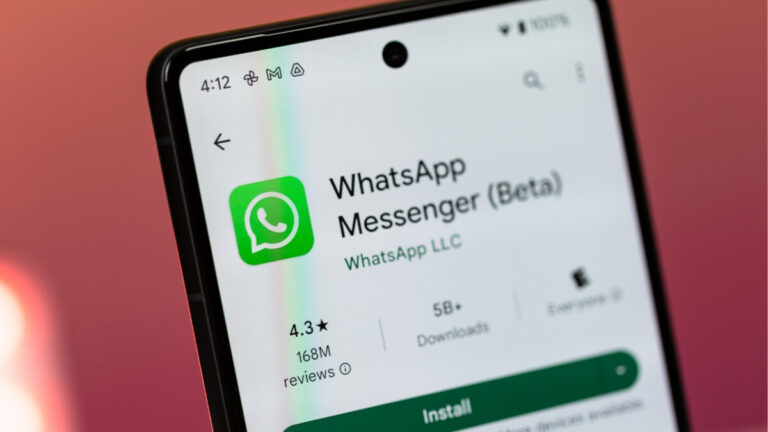
The tablet version of WhatsApp now has access to a split view thanks to a new update that was just released. The update was made available for the Android beta app which is available on the Play Store for those that were fortunate enough to make it into the beta program.
News of this update was reported by Wabetainfo which found that this change took place with the beta Android WhatsApp app, version 2.22.21.6. This newest change builds upon the version of WhatsApp that was released back in September 2022, which was compatible with tablets but was not optimized to use on larger screens.
This new feature is a game-changer for users because it optimizes the interface for tablets, it provides a better experience on a larger screen, and users can now view and use two different sections of the app simultaneously side by side on their tablet screen, as seen on the below screenshot:
Source – Wabetainfo
In the past, when users opened a chat on the tablet version of WhatsApp, the chat view would take up the entire screen. Users would then have to return to the chat list each time they wanted to switch to a different conversation. Having this new feature will allow users to switch between conversations without having to return to the chat list since it will be consistently visible whenever a chat window is opened.
After installing the most recent update of WhatsApp beta for Android from the Play Store, users will have access to a redesigned user interface that is optimized for use on tablets. However, if the new feature isn’t available to you after installing the latest beta, Wabetainfo states that there will be an upcoming update that will unlock this feature for even more users. Unfortunately, if you do not already have access to the beta version of WhatsApp, you will not be able to sign up at this time as the beta program is almost always full.
The latest ChatGPT phishing scam is currently targeting users in Ireland, Australia, Germany, Denmark, and the Netherlands.
Since its launch in November 2022, OpenAI’s AI-based chatbot, ChatGPT, has gripped the world due to its text-generating capabilities. Naturally, threat actors are looking for ways to exploit the immense stardom it has garnered in just four months. The latest discovery indicates one such attempt.
It is worth noting that cybercriminals have been eager to exploit ChatGPT to develop malware and carry out other malicious attacks, even including attempts to develop malware. On the other hand, there are several fake ChatGPT apps that are carrying out invasive data harvesting against Android and iOS users.
If you are interested in using the ChatGPT app on your Android, Hackread.com has tested the new “DialogueAI AI Chat Bot App.” This app legitimately uses the official API of OpenAI’s ChatGPT and does not collect any data from the user’s device.
Financial Phishing Scam Featuring Fake Version of ChatGPT
Cybersecurity vendor Bitdefender researchers have discovered a new phishing scam in which cybercriminals are redirecting unsuspecting users to a fake ChatGPT version. In this financial scam, the primary targets were found in the following countries:
Ireland
Australia
Germany
Denmark
Netherlands
The modus operandi of this scam involves users receiving a scam email containing a link to ChatGPT, which is, of course, fake.
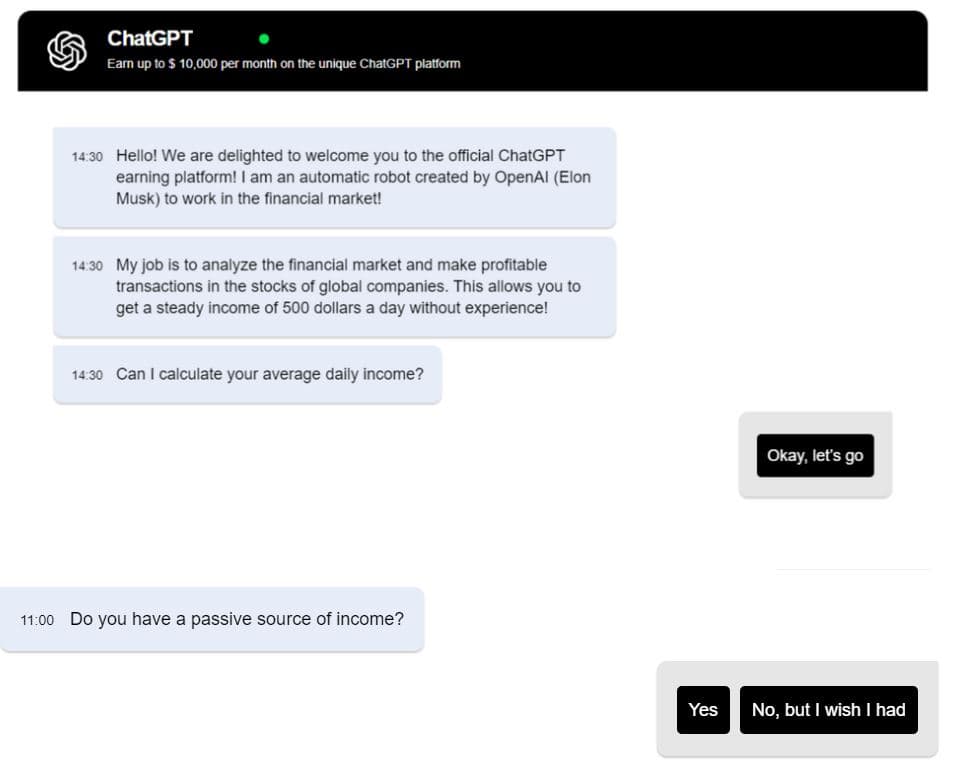
The fake and copycat ChatGPT used in the phishing scam (Image: Bitdefender)
According to Bitdefender, the scam is a “highly sophisticated financial scam” involving innovative lures, since previously, threat actors have mostly relied on weekly or monthly subscription-based lures.
How Does the Attack Work?
Bitdefender’s Antispam Labs report that in this new scam, the attackers send an unsolicited email with any of the following subject lines:
ChatGPT: New AI bot has everyone going crazy about it
ChatGPT: New AI bot has everyone in shock from it
New ChatGPTchatbot is making everyone crazy now – but it’ll very soon be as mundane a tool as Google
Why is all people panic about the ChatGPT bot?
The email itself offers insufficient details, and the recipient has to click on an embedded link for more information. This link leads them to a fake version of the ChatGPT chatbot, where they are asked to invest at least €250 and enter their banking card details, email address, ID credentials, and phone number.
Then, a copycat version of ChatGPT is delivered to the victim, which differs from the original chatbot as it offers a few pre-determined answers to the user’s queries. This chatbot was accessible only through a blacklisted domain (timegaeacom).
What Happens When Victims Access Fake ChatGPT?
The researchers at Bitdefender, headquartered in Bucharest, noticed that the fake ChatGPT first offered a brief introduction to how it could help them become successful investors. It asked for their email address for instant verification and their phone number for setting up a WhatsApp account for the promised investment.
Afterwards, they receive a call from in which scammers claim to represent a London-based firm called Import Capital. Speaking in Romanian, the rep asks victims to invest in crypto and international stock.
Further, they request crucial financial information like their permission to calculate their and their family members’ median daily salary, passive income sources, hours they daily spend working, and if they are satisfied with their current income.
They are then asked to invest €250 and provide the last six digits of their valid ID card. However, while digging deeper into the scam, Bitdefender researchers requested that a link to the investment portal be sent via email. A form was sent to them, in which they inserted a false code, so the investment was declined.
It is worth noting that the domain of Import Capital was never authorized for business in the UK, as per the alert from the FCA (Financial Conduct Authority).
This campaign is quickly expanding to other regions, so users must stay alert. That’s why it is necessary to use ChatGPT only through its official website.
Scammers acting as ChatGPT to offer financial advice (Image: Bitdefender)
Stay safe from ChatGPT-related phishing scams
Remember, as an AI language model, ChatGPT does not engage in any phishing scams. However, scammers are using the ChatGPT name to try to trick people into revealing personal information or clicking on malicious links. Here are some tips to stay safe:
Be cautious of unsolicited emails or messages claiming to be from ChatGPT that ask for personal information, such as passwords or bank account numbers. ChatGPT will never ask for this information.
Check the email address or website URL carefully to make sure they are legitimate. Scammers may create fake email addresses or websites that are similar to ChatGPT’s official ones.
Do not click on links or download attachments from suspicious emails or messages. They may contain malware or viruses.
Use anti-virus software and keep it up to date to protect your device from malware and viruses.
If you suspect that you have received a phishing email or message, do not respond to it or click on any links. Instead, report it to the appropriate authorities, such as your company’s IT department or the Anti-Phishing Working Group.
The hacker claims that it took them days to go through the list of what had been allegedly breached.
Acer Inc., a major global technology company based in Taiwan, is facing a potential data breach from a hacker going by the alias “Kernelware.” The hacker is claiming responsibility for a major data breach at Acer Inc., a leading multinational company based in Taiwan that designs and sells hardware and electronics products.
According to Kernelware, the alleged breach occurred in mid-February 2023 and resulted in the theft of a vast amount of sensitive information, totalling 160GB of 655 directories and 2869 files.
In a post on a hacker forum that surfaced as an alternative to the popular and now-seized Raidforums, Kernelware offered to sell the data trove to interested parties, saying that it contained a wide range of valuable files and documents. The hacker also shared a sample of the stolen data to prove its authenticity.
Post on the hacker forum (Image credit: Hackread.com)
The list of items included confidential slides and presentations, technical manuals, Windows Imaging Format files, binaries of various types, backend infrastructure data, product model documentation, and information about phones, tablets, laptops, and other devices.
The alleged data also contained Replacement Digital Product Keys, ISO files, Windows System Deployment Image files, BIOS components, and ROM files.
Kernelware requested payment in XMR (Monero), a privacy-focused cryptocurrency, and suggested using a middleman to ensure a successful sale. Although it is still unclear whether the data is genuine, the hacker’s willingness to use a third-party and their confidence in the quality of the stolen information indicates that the threat should be taken seriously.
“Honestly, there’s so much s**t that it’ll take me days to go through the list of what was breached lol.”
Kernelware
Acer Inc. has not yet commented on the alleged data breach or the potential sale of its confidential data. However, if verified, the data could provide valuable insights and competitive advantages to Acer’s rivals or malicious actors seeking to exploit the vulnerabilities of its products and services.
The stolen information could be used by cybercriminals for various purposes, including blackmail, identity theft, and fraud. Additionally, the exposure of Acer’s backend infrastructure and product models could reveal vulnerabilities that could be exploited by other attackers.
As always, individuals and organizations are advised to take measures to protect their sensitive data and systems, including using strong passwords, implementing multi-factor authentication, keeping their software and firmware up-to-date, and monitoring for signs of suspicious activity.
The threat of data breaches and cyberattacks is ongoing and evolving, and it requires constant vigilance and preparedness to mitigate the risks.
Microsoft has released out of band updates for information disclosure vulnerabilities in Intel CPUs, but who needs them?
Microsoft has released out of band updates for information disclosure vulnerabilities in Intel CPUs. The normal gut reaction would be to install out of band updates as soon as possible. Microsoft wouldn’t be releasing the updates ahead of the regular cycle without good reason, would it?
Well, maybe there are good reasons, but the number of users that would have to worry about these vulnerabilities is relatively small. And there are known performance issues related to applying the updates or disabling the Intel Hyper-Threading Technology. So please read on before you rush to update your system(s).
The vulnerabilities
Microsoft issued a security advisory about these vulnerabilities on June 14, 2022. Intel’s advisory about the same four vulnerabilities came out the same day, which triggers the question, why did it take so long to release the updates? We can only speculate that a lot of time was spent on figuring out how to address these vulnerabilities most effectively.
The vulnerabilities are a class of memory-mapped I/O (MMIO) vulnerabilities. In shared resource environments (for example in some cloud services configurations), these vulnerabilities could allow one virtual machine to improperly access information from another. Under normal circumstances, an attacker would need prior access to the system or an ability to run a specially crafted application on the target system to leverage these vulnerabilities.
The Common Vulnerabilities and Exposures (CVE) database lists publicly disclosed computer security flaws. The MMIO CVEs are listed as:
The underlying cause for these vulnerabilities is that Virtual Machines (VMs) share a portion of the physical processor (CPU). MMIO uses the processor’s physical-memory address space to access I/O devices that respond like memory components. Due to the incomplete cleanup in specific special register read and write operations, or shared buffers an authenticated user could potentially gain information disclosure through local access.
There is a long list of affected processors which shows the impact of transient execution attacks and select security issues on currently supported Intel® products, including recommended mitigation where affected.
Should you update?
As with many threats, the risk you are running very much depends on your threat model. If you are not running virtual machines in shared environments, I wouldn’t worry about these updates. If you are, then the ball is for a large part in the park of the provider of the cloud services, since it’s their physical machines that may or may not have the affected CPUs.
If any action needs to be taken, I would consider it their duty to let you know what needs to be done on your end.
Mitigation for these vulnerabilities includes a combination of microcode updates and software changes, depending on the platform and usage model. Microcode updates should be issued by the original equipment manufacturer (OEM). For more information, see INTEL-SA-00615.
Microcode is the name for the internal code that implements support for the processor’s instructions set.
The Windows updates are being released as manual updates in the Microsoft Update Catalog:
Another option is to disable Intel Hyperthreading, although we need to note that Intel Hyperthreading improves the overall performance for applications that benefit from a higher processor core count. So disabling it may have a negative impact, depending on the usage of the system.
According to VMWare, ensuring that no virtual machine has a PCI passthrough (VMDirectPath I/O pass-through) device configured is a viable workaround that will prevent any exploitation. VMDirectPath I/O allows a guest operating system on a virtual machine to directly access physical PCI and PCIe devices connected to a host.
Sometimes Microsoft really fails in providing a clear explanation about who needs to install an update, or even about how to do it. We get that it’s complicated when there are other vendors and OEMs involved, but referring users to highly technical third-party sites isn’t very helpful.
We do hope we have at least made clear that most of you do not have to worry about these.
We don’t just report on vulnerabilities—we identify them, and prioritize action.