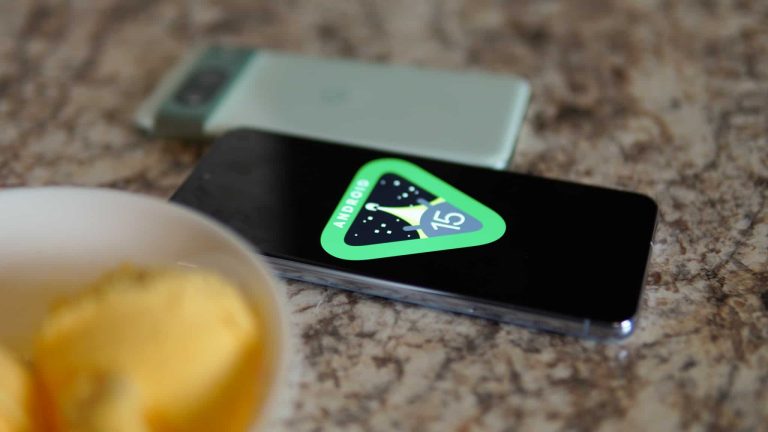
Android 15 could get a new privacy option to hide sensitive content when sharing your device’s screen. This would be a great help to avoid accidentally leaking notifications or messages during a presentation from your phone.
Android allows you to share the content of your screen, which is quite practical. However, there is no option to block things like notifications or incoming messages while you do this. So, there is always the risk of a potential leak of sensitive content. That said, Mishaal Rahman spotted something interesting about it in Android 15 Beta 1.1.
According to the Android Police report, the latest Android 15 Beta includes references to “Sensitive content protection” while sharing your screen. As its name suggests, this would prevent notifications, private messages, or content from being leaked during these situations. Currently, the feature is not functionally implemented in the OS. However, the references spotted give clues as to how it would work.
The option to hide sensitive content when sharing screens that Android 15 could get
Once implemented, the feature would bring a new API to manage UI toolkits such as Jetpack Compose, WebView, and others. Although it is not yet known exactly what possibilities the API will offer, it could hide specific items or screen sections so that they do not appear while you share your device’s screen. Also, there is a flag for “sensitive notification app protections” that would block app notifications too.
For now, it is unknown how the OS will determine which apps are “sensitive.” It would be quite useful if Android allowed you to set the specific apps that require this type of protection.
It’s noteworthy that some OEMs have already implemented a similar feature on their devices. Xiaomi is one of them, allowing you to share your screen with the peace of mind that no private or compromising notification will appear while you do so. However, Android AOSP receiving a similar tool would be great news for everyone since it would be available to many more people.
Its implementation is not yet 100% secure
It is important to note that even the source does not guarantee that the feature will be available in Android 15. With these types of features in the early stages of development, anything can happen. We could have to wait years for its implementation, or it could even be scrapped before it happens. Be that as it may, we will probably have new developments in this regard in the coming months.
Google has been firing employees who are protesting against the company’s military contracts with Israel. The company has let 20 employees go this week.
Google terminates 20 employees for “disruptive activities” inside buildings
Google has terminated the employment of 20 of its employees this week. This is the second such round of mass layoffs for going against the company’s contracts with Israel.
According to The Washington Post, Google fired at least 20 more employees from its offices in Sunnyvale and New York. These workers were let go effective 16th April 2024.
Google had already fired 28 employees last week. All these terminations were in connection to protests organized in Google’s offices. These employees had actively participated in “sit-in protests”.
NEW: Google fires at least 20 more of its employees after the anti-Israel protest; bringing the total number terminated to around 50
This comes after Google fired about 30 employees last week after they were arrested for protesting at the company’s offices in Sunnyvale,… pic.twitter.com/wOnl1cJVA3
A Google spokesperson has reportedly confirmed the company fired more workers as part of its investigation into the demonstration. The company, has, however, stressed that “every single one of those whose employment was terminated was personally and definitively involved in disruptive activity inside our buildings,”
Google has claimed it conducted a detailed investigation into the matter. The company has “carefully confirmed and reconfirmed,” the terminated employees’ active participation and involvement. “Our investigation into these events is now concluded,” the spokesperson added.
What is Project Nimbus and why are Google workers losing their jobs?
Google recently fired 28 employees from its offices in New York and California. The search giant has terminated the employment of several dozen employees over a single topic.
Specifically speaking, every employee, from the 48 Google has fired so far, participated in protests organized inside the company’s offices. These employees have been protesting Google’s cloud computing project called Project Nimbus.
Google fires 28 employees for protesting the company’s cloud contract with #Israel, following 9 employees arrests.
Full memo to Google employees warns that”if you’re one of the few who are tempted to think we’re going to overlook conduct that violates our policies, think again” pic.twitter.com/T5pdmp1dGD
Valued at $1.2 billion, Project Nimbus started in 2021. Time magazine had indicated Project Nimbus is a civilian project. It will allegedly help improve public sectors such as healthcare, transportation, and education.
The same report further stressed that Project Nimbus is not involved in “highly sensitive or classified military workloads relevant to weapons or intelligence services.”
Project Nimbus isn’t open for public scrutiny, and hence, shrouded in mystery. Some speculate it could bolster, or perhaps weaponize AI (Artificial Intelligence), for the Israeli military.
Google is working with another cloud computing giant Amazon to fulfill the contractual obligations of Project Nimbus. Google CEO Sundar Pichai issued a memo stating the company is open to debate and discussions but “there are limitations to the same.”
Even Google’s head of security, Chris Rackow reportedly issued a memo which added, “If you’re one of the few tempted to think we’re going to overlook conduct that violates our policies, think again.” This strongly indicates Google won’t cease stringent action against employees who participate in protests on the company’s premises.
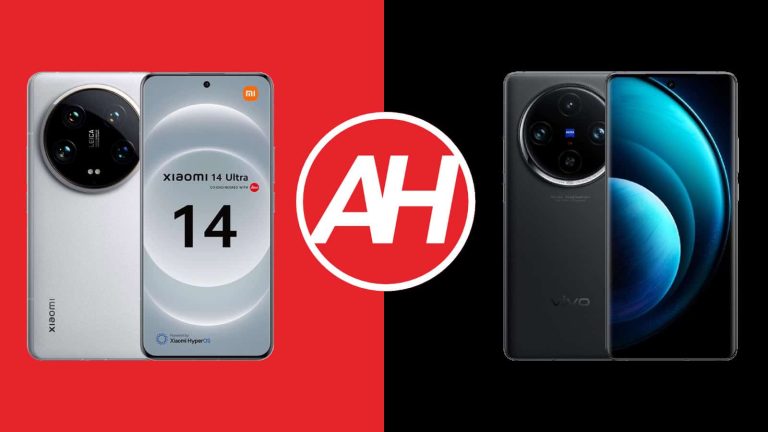
In this article, we’ll be comparing the Xiaomi 14 Ultra vs Vivo X100 Pro. These are some of the best flagships out of Chinese smartphone OEMs at the moment and at the same time some of the best flagship smartphones in general. They are especially interesting to people who want great camera smartphones, actually. Despite both being very compelling, they’re also very different at the same time.
We’ll first be listing their specifications, and will then move to compare their designs, displays, performance, battery life, cameras, and audio performance. There are some similarities, here, but also quite a few differences. Both phones come in global variants, and those are the models that we’ve used. With that in mind, let’s get to it, shall we?
If you take a look at these two smartphones side by side, you’ll notice some similarities. Both of them not only have curved displays, and a centered display camera hole, but they also have large camera oreo on the back. Let’s take it one step at a time, though. The Xiaomi 14 Ultra’s corners are slightly more rounded than the ones on the Vivo X100 Pro. Both phones also have physical buttons on the right-hand side, and the placement is also quite similar.
Both phones have a frame made out of aluminum, though a titanium variant of the Xiaomi 14 Ultra is available in China. Now, both global variants of the Xiaomi 14 Ultra (black and white) come with a vegan leather backplate. The Vivo X100 Pro combines its aluminum frame with a glass back (at least as far as global models are concerned, there is a vegan leather model in China). The Xiaomi 14 Ultra is more grippy as a result, of course. If we compare the global models alone.
The Xiaomi 14 Ultra’s camera oreo is a bit larger, and it includes one extra camera in comparison. The backplates on both phones are curved towards the edges. The Xiaomi 14 Ultra is slightly shorter in comparison, while the two phones have the same width and almost the same thickness. The Xiaomi 14 Ultra’s global variants weigh 219.8 grams, while the VIvo X100 Pro’s 225 grams. That’s what we’re focusing on here. Some other models in China have different weights, of course.
Both smartphones do offer an IP68 certification, and both feel very premium in the hand. These two handsets are quite large, though, and also quite hefty. Have that in mind before you opt for one.
Xiaomi 14 Ultra vs Vivo X100 Pro: Display
The Xiaomi 14 Ultra features a 6.73-inch QHD+ (3200 x 1440) LTPO AMOLED display. This panel is curved, and it has an adaptive refresh rate (1-120Hz). Dolby Vision is supported, and the same goes for HDR10+ content. This panel goes up to 3,000 nits of brightness at its peak, in theory. The display aspect ratio is 20:9, while the phone’s screen-to-body ratio is around 89%. The Xiaomi Shield Glass protects this display.
Vivo X100 Pro
The Vivo X100 Pro comes with a 6.78-inch 2800 x 1260 display, which is curved. This is an LTPO AMOLED panel which has an adaptive refresh rate (1-120Hz). This panel can project up to 1 billion colors, and it has a peak brightness of 3,000 nits, in theory. The display aspect ratio is 20:9, and the screen-to-body ratio is at around 90%. This panel has a slightly lower PPI than the Xiaomi 14 Ultra, due to a slightly lower screen resolution.
You’ll be glad to hear that both of these displays are outstanding, though. They’re not only vivid and have great viewing angles, but the touch response is really good, and they also get more than bright enough. That goes for basically all situations that you may find yourself in, including direct sunlight usage. The blacks are also quite deep. Both panels are curved, though, so keep that in mind, just in case you prefer flat displays. The curvature levels are different, the Xiaomi 14 Ultra’s display has less of a curve to it.
Xiaomi 14 Ultra vs Vivo X100 Pro: Performance
The Snapdragon 8 Gen 3 SoC fuels the Xiaomi 14 Ultra. That is Qualcomm’s most powerful chip at the moment. The phone also comes with 16GB of LPDDR5X RAM in its global model, and it also utilizes 512GB of UFS 4.0 flash storage. The Vivo X100 Pro is fueled by the MediaTek Dimensity 9300 SoC, the best MediaTek has to offer. This phone also includes 16GB of LPDDR5X RAM in its global variant, along with 512GB of UFS 4.0 flash storage.
When it comes to general performance, both of these phones do a great job. They open apps really fast, they’re great for multitasking, and also do a great job with multimedia, browsing, messaging, emails, image processing, and so on. When it comes to regular performance, both do a fantastic job. The experience was very fluid, and the animations the company’s provided only enhanced the experience.
What about gaming? Well, the Vivo X100 Pro did get warmer than the Xiaomi 14 Ultra during a longer gaming session. After an hour of Genshin Impact, it was noticeably warmer, even though the Xiaomi 14 Ultra was warm too. We did measure a higher temperature on the Vivo X100 Pro, though that didn’t affect the gameplay much. The frame rate did drop a little bit in comparison to the Xiaomi 14 Ultra, but that’s about it. Both can handle even the most demanding games on the platform.
Xiaomi 14 Ultra vs Vivo X100 Pro: Battery
The Xiaomi 14 Ultra includes a 5,000mAh battery. Well, its global model does. In China, the device comes with a 5,300mAh unit. The Vivo X100 Pro, on the other hand, has a 5,400mAh battery regardless of the market. Some of you may think that the Vivo X100 Pro offers better battery life considering it has a larger battery. Well, that’s not exactly the case, at least it wasn’t the case in our experience.
The Xiaomi 14 Ultra not only did a bit better in our battery drain test, but it also did a bit better during general usage. With mixed usage, we were able to get around 7-8 hours of screen-on-time on both of these phones (with no gaming involved). It did seem like the Xiaomi 14 Ultra lasted a bit longer, though, about 10% longer. The difference wasn’t really big, but it was noticeable during usage. Your mileage may vary, of course.
When it comes to charging, both of these smartphones are very compelling, to say the least. The Xiaomi 14 Ultra supports 90W wired, 80W wireless, and 10W reverse wireless charging. The Vivo X100 Pro supports 100W wired, 50W wireless, and reverse wired charging. Do note that out of the two phones, only the Xiaomi 14 Ultra ships with a charger in the retail box. You’ll need to get one separately for the Vivo X100 Pro if you want to take full advantage of its charging capabilities.
Xiaomi 14 Ultra vs Vivo X100 Pro: Cameras
The Xiaomi 14 Ultra has four 50-megapixel cameras on the back, while the Vivo X100 Pro includes three 50-megapixel units. Xiaomi’s flagship has a 50-megapixel main camera (1-inch sensor, variable aperture), a 50-megapixel ultrawide unit (122-degree FoV), a 50-megapixel telephoto camera (3.2x optical zoom), and a 50-megapixel periscope telephoto unit (5x optical zoom). Leica’s lenses are used here, and Leica also helped out with the software.
Xiaomi 14 Ultra
The Vivo X100 Pro, on the other hand, has a 50-megapixel main camera (1-inch sensor), a 50-megapixel ultrawide camera (119-degree FoV), and a 50-megapixel periscope telephoto unit (4.3x optical zoom). ZEISS is part of the package here, as the company’s anti-reflection coating is applied on the back, and ZEISS also helped out on the software side of things. When it comes to hardware itself, both are quite capable, and the same actually goes for performance itself.
We realized that both of these phones are capable of capturing fantastic photos. They do end up being a bit different, though. The Xiaomi 14 Ultra comes with Leica Authentic and Leica Vibrant modes. The difference is most of the time not that big, but the Authentic mode does mute the colors a bit at times and adds vignetting to images. The Vivo X100 Pro under its default setting leans to warmer images, and it does a great job overall.
Images from both smartphones do provide plenty of details, and they handle HDR situations great too. In low light, both smartphones do a great job of handling light sources, and reflections too. That’s not an easy thing to do, that’s for sure. Their ultrawide cameras are great, though we preferred the Xiaomi 14 Ultra’s in low light. The Xiaomi 14 Ultra does offer a bit more versatility when it comes to high-zoom photos.
Audio
You will find stereo speakers on both of these smartphones. Those speakers are more than loud enough, and the general output is rich enough. You’ll even notice some bass on both sets of speakers.
What you will not get on either phone is an audio jack. They both include a Type-C port at the bottom. So, you can hook up your headphones that way, a dongle will be required, though. In terms of wireless audio connectivity, both smartphones are equipped with Bluetooth 5.4.
The new grocery delivery subscription caters to Prime members and SNAP beneficiaries
Prime members can get unlimited grocery delivery at just $9.99 per month with the new subscription. However, this comes with a condition, the total order value must exceed $35. The new plan is applicable if customers order from Amazon Fresh and Whole Foods Markets. Amazon also mentioned that subscribers can order groceries from local grocery and specialty retailers on their website.
Amazon’s new grocery delivery subscription is even more beneficial for registered EBT cardholders in the United States. The company is offering the same benefits to the customers enrolled in SNAP at just $4.99 per month. It is worth noting that the EBT card is issued to low-income citizens who rely on the government’s Supplemental Nutrition Assistance Program (SNAP).
The company says that with this move it extends support to customers in low-income classes. Not to forget, EBT card-holding customers can avail of the benefit even if they haven’t subscribed to the Prime subscription. Amazon also includes a 30-day free trial so that customers get an idea of how the subscription works initially.
The company earlier trialed the delivery subscription
Well, it’s not that Amazon launched this grocery delivery subscription all of a sudden. Before the official unveiling, the company launched the same plan late last year as a trial in the capital of three states including Ohio, Colorado, and California. Amazon says that the feedback from 85% of customers enrolled in the plan was extremely positive leading to the official announcement.
The recent move is Amazon’s effort to solidify its existence in the market already occupied by some familiar names like Walmart and Target. Both offer a paid membership plan for grocery delivery. For reference, Walmart charges $12.95 per month to its customers who order groceries with a “Plus” plan. So, a low-cost grocery delivery subscription might work in favor of Amazon.
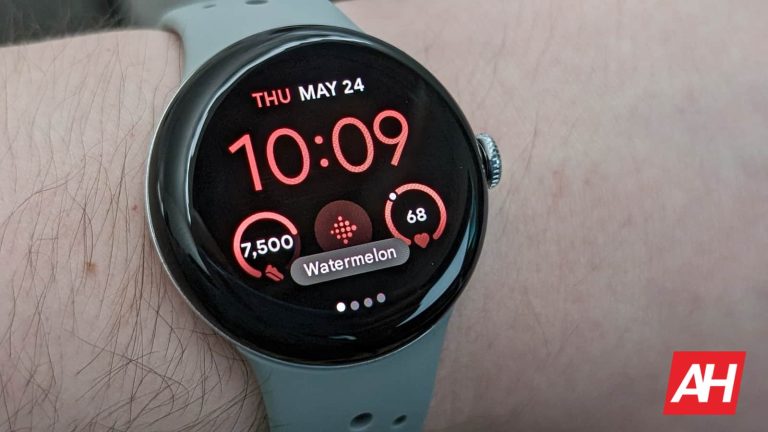
Google just launched the “Pixel Watch Warranty Helper” program to facilitate warranty claims. The new tool seeks to offer more automation to a process that previously could be a bit complex.
Perhaps you’ve gone through the frustrating situation where your device is completely damaged to such a level that it cannot be repaired. In those cases, you only have the option of requesting a replacement if the damage is covered by the warranty. However, the process for making these types of claims is not always simple.
Google made it especially complicated with the Pixel Watch series replacement service. With this method, requesting the replacement of a Pixel Watch 2 required a cumbersome and inconvenient process of up to 8 steps.
Pixel Watch Warranty Helper makes the warranty claims process more convenient
However, it seems that Google realized that it could improve on that. Its answer is the new Pixel Watch Warranty Helper program. The basis of the new system is an interactive questionnaire where you can select the appropriate option according to the problem you have.
As expected, the Pixel Watch Warranty Helper is associated with your Google account. This means that once logged in, you can easily see a list of your Google devices. The tool brings together a good set of options to check everything you need to know about the warranty status of your products. Of course, you can also request repairs or replacements from there.
The tool shows useful information about the device you choose. For example, it will show you its start and expiration dates for warranty, even if the return window is active. There are also other options for additional help for all your devices. Basically, it is a “hub” to centralize everything you need regarding repairs or warranty claims.
It is curious that the tool is called “Pixel Watch Warranty Helper.” Once you access it, you will notice that it is not only compatible with Google smartwatches. In fact, the list includes all of the company’s devices. However, ignoring the naming choice, the launch of the tool is good news for Google device owners.
Microsoft rolled out the Windows 11 Insider Preview Build 22635.3500 to the Beta Channel towards the end of last week. The build has several new features. It includes a new account manager within the Start menu and support for Gmail through Windows Share.
Some Windows 11 Insiders get to see a Game Pass ad
However, aside from focusing on improving its AI capabilities that aim to improve the user experience, the company is also introducing adverts in Windows. The latest build for Windows Insiders offers a new Game Pass ad within the Settings app. “We are introducing a new Game Pass recommendation card on the Settings homepage,” said Microsoft.
Notably this new Game Pass ad won’t bother every user. The recommendation card on the Settings Homepage shows up for users who actively play games on their PC. “As a reminder – the Settings homepage will be shown only on the Home and Pro editions of Windows 11 and if you’re signed into Windows with your Microsoft account,” the company added. So, none except the Windows 11 Home and Pro users will have to see the Game Pass ad.
Microsoft has added ‘recommendations’ to Windows 11 before. Alongside placing a Game Pass ad inside the Settings app on Windows, the company is reportedly trying out adding some in the Start menu’s ‘recommended’ section. However, it’s important to mention that the latest addition doesn’t look intrusive. As TechRadar noted, “Microsoft is really trying to blur the line between what’s an ad and what it claims are just friendly recommendations.”
An advert or just another helpful recommendation?
Many people also seem to be okay with the ads as the company is advertising its products and services like the Game Pass to people who might benefit from an improved user experience. Notably, there are also users who do not seem to like the idea even if they are from Microsoft themselves, and are not intrusive.
Not to mention they won’t be happy about recommendations of third-party services inside Windows. It’s like the UI is the digital space for the users’ work or entertainment. The addition of adverts or recommendations into the space may make it look like a billboard where the recommended products or services have nothing to do with the core user experience.
Nonetheless, we will have to see how many ads or recommendations Windows gets in the future, and more importantly, how friendly they remain.
Today, we are looking at a malicious ad campaign targeting Facebook users via Google search. It is well-known that tech support scammers attract new victims by buying ads for certain keywords related to their audience.
What is perhaps less known is how it is even possible to impersonate top brands and get away with it. We will try to respond to the ‘how they do it’ and the ‘why is Google allowing this’ questions.
Such malvertising attacks are not new and the damage they cause to consumers is growing every day. There is no one way to stop all of them, but public reporting will hopefully drive the point home that this needs to be addressed just like other types of fraud or malware.
We have reported the malicious advertiser to Google, but at the time of publishing this campaign was still on.
Malicious ad campaign for Facebook
Justin Poliachik did what many people would do, he opened up a Google search, typed facebook and clicked on the top result. In the video below, he summarizes what happened next:
Thanks to Justin for the shoutout to our blog and explaining what went down! Not sure if Justin was joking, but we don’t believe AI is going to fix malvertising, at least not for the next little while. Instead, we are going to look into more details about one particular technique. In our view, this is actually where the abuse happens the most, and where things could be improved.
Two paths make cloaking
As we said, Google seems to have a problem with brand impersonation that may not be easy to solve. We have reported such cases several times before with pretty much the same techniques.
How can Google differentiate a legitimate affiliate from a malicious actor? There are a number of data points about the advertiser via their account: user profile, payment method, budget, etc. We are not privy to those details, but they can certainly help when it comes to fraud.
More importantly, there is the ad itself: vanity URL, display text, tracking template, final URL. What happens when you click on the ad? Are you actually redirected to the URL claimed in the ad? This is a feature that appears to be so easy to abuse, and yet remains unfixed.
In the video below, we walk you through the classic tale of cloaking:
Cloaking is an old technique and in many ways can be used for legitimate purposes. After all, one needs to be able to detect real humans and not bots or crawlers for their hard-earned ad dollars budget.
Threat actors have long identified such services as very helpful tools for their malicious campaigns. True, they, like others don’t want robots, but they also don’t want Google’s scanners or security researchers to expose their malicious schemes.
Under the hood
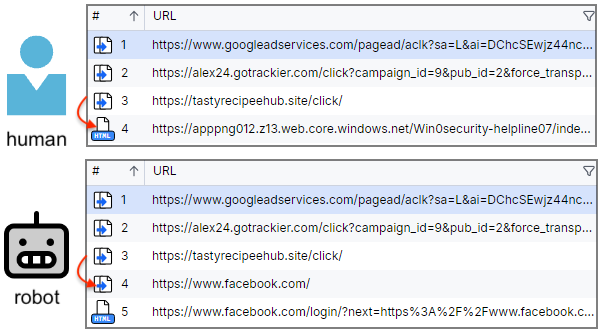
This part is a little more technical, but integral in understanding how malvertising works. As mentioned in the video above, cloaking allows to deliver two different experiences. Genuine humans can be detected from a number of factors: IP address, browser fingerprinting, etc.
A click tracking service can be used to analyze traffic, collect data, etc. All in all, such services are useful in and of themselves, but they can also easily be abused by bad actors. Within the Google ad ecosystem, advertisers will place their URL as a tracking template, and the rest will be handled outside of Google.
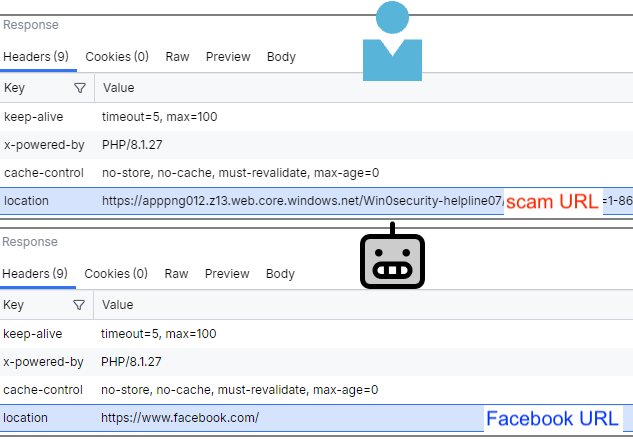
One thing that’s interesting is how scammers will abuse the click tracking service as well! All they have to do is redirect to another “legitimate” domain they control and from there decide on the final destination URL.
We can see in the image below that final redirect, which is either the scam page or the actual Facebook site:
Safeguarding your online experience
We have seen these malicious ads for years and years. It would be unfair to say that no action has ever been taken, but there is room for improvement. Individual reports from victims are not always actioned based on our experience and that of others. This is frustrating because it appears as if those individual experiences do not matter in the grander scheme of things.
Security vendors also struggle with these scams. Chasing infrastructure from one host to the next or having trouble blocking URLs that abuse legitimate providers is a real thing.
As a user you can protect yourself in various ways:
Beware of sponsored results
Block ads altogether
Recognize scam pages as fake
If you want the piece of mind and have all this covered for you, download our Malwarebytes Browser Guard extension available for different browsers.
Android users who rely on Gemini for daily tasks and information may soon be in for a multitasking treat. According to PiunikaWeb, Google is working on a significant update that will make your AI assistant more helpful, seamless, and packed with features that bring it closer to the familiar Google Assistant.
Currently, using Gemini on Android can be a bit jarring. The assistant opens a new screen whenever you ask a question, interrupting your workflow and forcing you to jump between apps. However, a future update may change all that. Gemini will soon respond to your queries in a convenient floating window directly on top of your current app. This means you can get quick answers, insights, or instructions from Gemini without ever leaving the current app you’re working in.
Check out the screenshots below (or this Google Drive video) for an overview of the multitasking feature in Gemini for Android. The app in the background is X, formerly Twitter, while Gemini is responding to queries in the foreground.
Gemini may also get faster with real-time responses
In addition to responding on top of your current app, Google is also working on a “real-time responses” feature that will let Gemini process and display information as it’s being generated. This means you can monitor calculations, summaries, or translations in progress without having to wait for an entire response to load.
Despite the mixed reactions, Google isn’t leaving Gemini Advanced behind, with reports that support for uploading any file type is also coming soon. This functionality (already available on the web version) removes a major limitation, allowing you to share documents, spreadsheets, or even creative files with Gemini for storage or analysis. Additionally, a “select text” option is joining the standard “copy text” tool, giving you greater control when working with blocks of text within the Gemini interface.
The Evolution of Gemini on Android
These exciting new features aren’t just a coincidence — they showcase Google’s continued investment in building a robust AI assistant experience for Android users. Code sleuths have dug into the latest development builds and confirmed these capabilities are in their advanced stages of testing. While we don’t have an exact release date, it’s safe to expect seamless multitasking, real-time responses, and other improvements to arrive within the coming weeks or months.
With the addition of multitasking and other features, the future looks bright for Gemini on Android. It’s clear that Google is striving for a user experience that’s not only powerful but also intuitive and integrated into your existing workflow. This looks like just the beginning, so you can expect even more innovative features as Gemini continues to evolve.
Motorola is showing the virtues of the Edge 50 Fusion in a new video. The device, which arrived a week ago alongside the Edge 50 Pro and Edge 50 Ultra, stands as one of the most exciting options in the mid-range segment. The new video highlights some of its most attractive points.
This device seeks to attract the attention of the mass public. The ad makes this quite clear by highlighting important sections for anyone, including those who are not tech-savvy. It’s 30 seconds of teasing the design, battery life, fast charging support, cameras, and even water resistance.
This short video quickly shows off key aspects of the Motorola Edge 50 Fusion
Starting with the design, the video of the Motorola Edge 50 Fusion shows the “Marshmallow Blue” color with a vegan leather rear finish. However, the device stands out aesthetically by offering different finishes in each of its colors. While the “Hot Pink” variant uses vegan suede, the “Forest Blue” model uses a smooth matte finish.
As for battery life, the smartphone includes a pretty decent 5,000 mAh cell. In addition, the 65W fast charging support will allow you, according to the company, to charge 50% of the battery in just 15 minutes. The camera section seems solvent thanks to its 50 MP main sensor assisted by OIS. The device also includes a 13 MP ultra wide camera (FOV 120˚). Motorola went the Nothing route by removing unnecessary sensors. Selfie lovers will be happy with its 32 MP front camera, too.
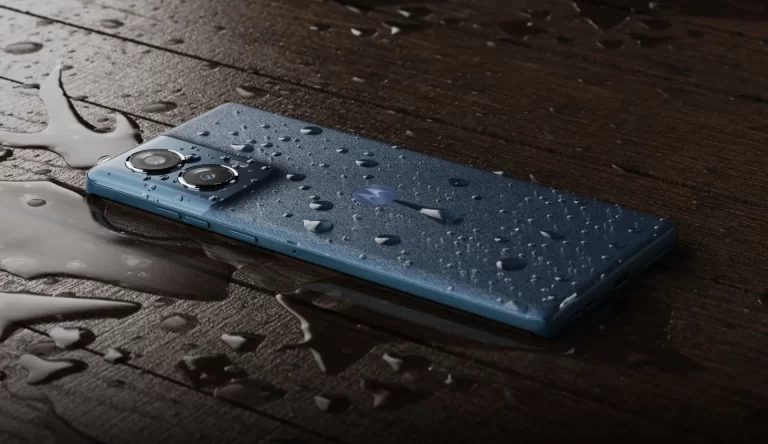
The resistance of the Motorola Edge 50 Fusion is at the high-end level. It is one of the few in its segment that can boast IP68 certification. This makes it even submersible in water (for a certain time and to a certain depth). Meanwhile, its screen is covered by a layer of Corning Gorilla Glass 5 for better protection.
With the Edge 50 Fusion, Motorola achieved a very well-rounded mid-range device. Its competitive price also positions it well in the market. It could be a strong rival to phones like the Samsung Galaxy A55. For now, the device family is available in Europe, with no US launch date yet.
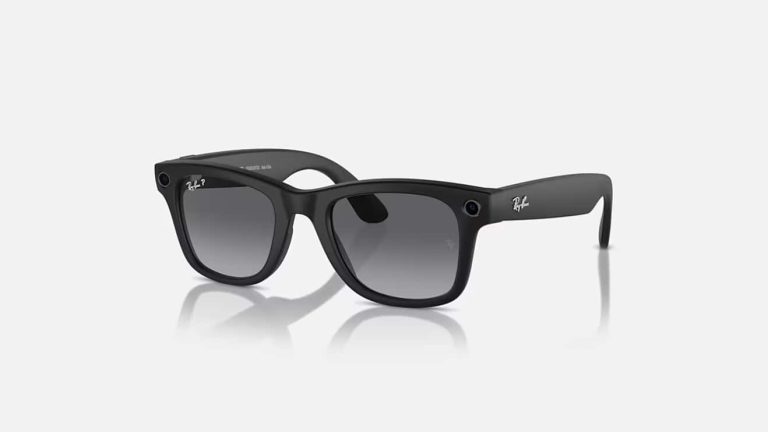
In case you don’t know what the Meta Smart Glasses are, there are a line of glasses that come equipped with a camera, microphone, and speaker. They’re able to take images, listen for hot words, and play audio. All this comes in a very seamless package that looks just like a typical pair of glasses.
We recently got the news that Meta was planning on adding AI technology to the glasses. This will allow them to use a chatbot just like ChatGPT to answer questions and observe the world. This is impressive, as it doesn’t seem like they were originally designed for this technology. That’s just a testament to their versatility.
The Meta Smart Glasses now have multimodal AI
Shortly after Meta launched these glasses, the company started doing some early testing of AI implementation. The testing has been going on for several months with only a limited number of people able to try it out. Now, however, this functionality is rolling out widely.
The overall experience, according to the Verge, seems to be pretty decent. We are at the dawn of wearable AI, so companies are still working on successfully implementing AI into a portable form factor. The Humane AI Pin looks like it is a commercial flop, and we are still waiting to see how the Rabbit R1 will fare.
However, the Meta Smart Glasses have proven to be pretty good at identifying objects. There is always the chance that it will falsely identify objects. However, we have to remember that this is a very small camera. We can’t expect it to have the sort of image clarity or reach that smartphone cameras have.
In any case, along with scanning objects, you can also speak into the glasses to get spoken answers about any sort of question. The Meta Smart Glasses offer the sort of experience you would get from something like the AI Pin, but they’re much more affordable and convenient to use.
If you are planning on picking up a pair of Meta Smart Glasses, they start at $299.99.