The M3 MacBook Air has finally launched, and there are already rumors that Apple might release the M4 chip as early as Q1 2025. Apple’s switch to its own proprietary chipsets saw a massive improvement over its Intel-based Macs and MacBooks. Since then, the company has been improving on its M-series of chipsets approximately each year. Each subsequent chipset is slightly better than the last, and doesn’t always warrant an upgrade. However, there are rumors that the M4 lineup will also come with AI.
A roadmap for the Apple M4 chip
Canalys, a global tech analysis firm, just announced a roadmap for Apple. According to this roadmap, Apple will likely release the M4 chip in the first quarter of the next year. This isn’t guaranteed of course. A multitude of factors play into when a company announces and launches a product. Hence, the Apple M4 chip launch could be delayed.
It also seems like the Apple M4 might be the first M-series chip to ship with AI capabilities. This, of course, would be huge. Much like the shift from Intel chips to M chips, this will mark a shift in how MacBooks are viewed. AI-powered chipsets have the potential of delivering many amazing and futuristic features. These include AI-powered virtual assistants, extremely powerful image and video editing, and help with drafting documents.
The shift from Intel
When Apple shifted its Macs and MacBooks to its own M chips, it catapulted the performance gains. Understandably, the older MacBooks were very much like PCs. They had to be designed to work with Intel chipsets that were also used in other computers. As such, there was no impressive synergy between the hardware and software.
This all changed when Apple announced the M1 chip. Apple Silicon, the name for Apple’s in-house SOC company, designed the M-series chips with Apple’s own software in mind. The result was devices with much better battery life and much faster and more stable performance. This jump was huge, and nowadays nobody will ever suggest buying an old Intel-based MacBook if it can be helped.
The M2 and M3 chips were impressive improvements over the M1. However, for the average user, they didn’t represent performance upgrades worth considering. If the Apple M4 chip does ship with AI, it will be the first M chip since the M1 that will definitely warrant an upgrade. Once mocked for their relatively paltry specs, the M chips have breathed new life into Apple’s Macs and MacBooks.
For many users who have sought out alternatives to using iMessage on iPhone, or Meta-owned applications such as WhatsApp, Telegram has always been a privacy-minded alternative that often spearheads fresh messaging features. However, there is a new feature that the platform has launched that is raising major concerns.Telegram recently rolled out a “Peer-to-Peer Login Program” (P2PL). Basically, this program is designed to help users in locations where SMS is not very reliable receive OTPs (One-Time Pin) codes through other Telegram users. In other words, program participants’ phone numbers become a relay for pins to be sent via SMS to help other Telegram users log in.
As helpful and innovative as this might sound, there is a catch. As outlined in the terms of the program, should you enroll, Telegram will tap into your number up to 150 times a month for these SMS messages to be sent out. This makes you solely responsible for any carrier fees that may be incurred, which may not be a big deal if these are being sent within your own location but may become costly if the recipients are international.
Furthermore, there is the issue of privacy. Participation in this program means that both you and the recipient of the OTP message can see each other’s phone numbers. This can open you up to receiving unwanted messages and possibly harassment from someone whose number you unknowingly assisted with. Telegram’s terms clearly state that they’re not liable, leaving program participants vulnerable to potential privacy breaches.
The reward for this program is a free Telegram Premium subscription, which normally costs $4.99 a month and unlocks extras like larger file uploads and faster downloads. While it is great that Telegram is exploring ways to make their premium tier more accessible, are the risks worth it? I am inclined to say no, but I’m curious what you think.
Strelastealer malware has been found to be distributed in large-scale campaigns that have currently impacted over 100 organizations across the U.S. and EU.
The malware was first discovered in 2022 and is capable of stealing a victim’s email login information and exfiltrating it to the threat actor’s C2 server.
However, the current campaigns were conducted in the form of spam emails with attachments for launching the StrelaStealer’s DLL payload.
As a means of evading detection at email gateways, threat actors have been changing the file format which prevents the matching of signatures and patterns.
Moreover, the last campaign conducted by the threat actors dates back to November 2023.
StrelaStealer Malware
According to the reports shared by Unit 42 researchers, the malware authors have been updating the DLL payload with better obfuscations and anti-analysis methods for making it extremely hard for analysts and security products to analyze the samples.
Alert Fatigue that helps no one as security teams need to triage 100s of vulnerabilities.:
The problem of vulnerability fatigue today
Difference between CVSS-specific vulnerability vs risk-based vulnerability
Evaluating vulnerabilities based on the business impact/risk
Automation to reduce alert fatigue and enhance security posture significantly
AcuRisQ, which helps you to quantify risk accurately:
Though several tactics have been used, the malware can still be detected due to the identifiable “strela” string in the DLL payload.
Nevertheless, the new variant of the malware is delivered as a zipped JScript, which employs an updated obfuscation technique in the DLL payload.
The spam emails usually had the subject line with patterns of Factura (Bill – Spanish)/Rechnung (The invoice – German) /invoice###.
Moreover, it has also been discovered that the threat actors have been heavily targeting high-tech industries with this malware.
Example spam email from campaign (Source: Unit 42)
Malware Analysis
StrelaStealer’s previous variants involve the use of ISO files that contain an LNK file and an HTML file.
Additionally, the malware also used polyglot files that vary based on the applications being executed.
Infection chain (Source: Unit 42)
When a victim clicks on the LNK file inside the ISO file, the HTML file is executed, which invokes the execution of the embedded StrelaStealer payload via rundll32.exe.
The initial DLL payload is encrypted which is decrypted during execution with the help of a constant XOR key, Unit 42 researchers said.
As of the current variant of the malware, the threat actors have been using spear-phishing emails with ZIP file attachments, which, when downloaded and opened, drop a JScript file on the system.
Comparison between old and new version of StrelaStealer (Source: Unit 42)
Following this, the JScript file drops another base64-encrypted file and a batch file.
The base64-encrypted file is embedded with certutil -f decode command which will create a Portable Executable DLL file which is dropped into either %appdata%\temp or c:\temp based on the user’s privilege.
This DLL file is then executed using the exported hello function that uses the rundll32.exe process.
Moreover, the packer of the new variant also uses a control flow obfuscation technique which has a long code block containing numerous arithmetic functions for the purpose of preventing analysis of the malware by analysts and security products.
The payload size and the decryption key depends on the configuration of the payload.
Though the file attachments for every spam email differs, the presence of strings like strela, server.php, key4.db and login.json indicates their association with StrelaStealer malware.
Furthermore, the configuration of the payload also includes the communication with the C2 server for exfiltrating the email login data from the victims.
C2 server name mentioned in the StrelaStealer malware string (Source: Unit 42)
Cybercriminals now repurpose devices like Raspberry Pi into ‘plug-and-play’ weapons for digital fraud. With GEOBOX on the Dark Web, their capabilities are even more sophisticated, enabling manipulation of GPS, network simulation, Wi-Fi mimicry, and anti-fraud filter evasion.
Cybercriminals are targeting IoT devices for illicit activities through OPSEC techniques and customizable settings, allowing these devices to operate without logs and ensure anonymity for perpetrators, reveals research from the US-based cybersecurity solutions and services provider, Resecurity.
According to Resecurity’s Cyber Threat Intelligence team, a significant discovery has been made on the Dark Web: a malicious tool known as GEOBOX. This tool can turn ordinary IoT hardware into powerful weapons for cybercriminals. GEOBOX represents a “paradigm shift in cybercriminal tactics,” highlighting the evolving nature of threats in the digital landscape.
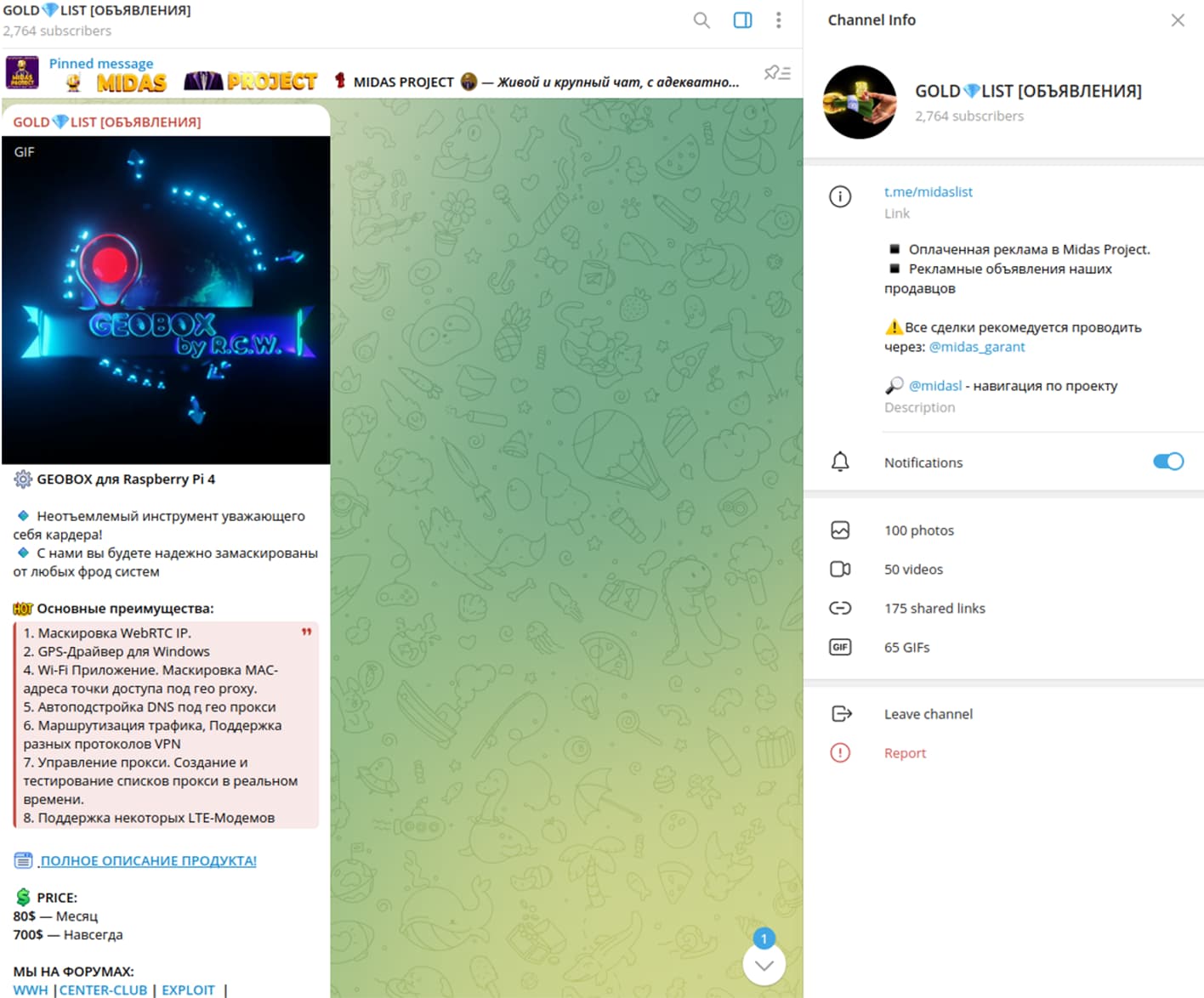
GEOBOX is being sold on Telegram (Screenshot credit: Resecurity)
GEOBOX is a powerful, deceptive tool specifically designed for the Raspberry Pi 4 Model B devices to facilitate cybercriminals in anonymization and fraud. It was first discovered while investigating an online banking theft involving a high-net-worth (HNW) client of a Fortune 100 financial company, prompting researchers to dig deeper into its workings.
The emergence of GEOBOX is not unexpected, appearing shortly after the discovery of another dark web tool known as TMChecker. TMChecker has been arming ransomware gangs, specifically targeting the e-commerce and aviation industries with precision cyberattacks.
The research blog, shared by Resecurity with Hackread.com, ahead of publication on Monday revealed that threat actors have already used multiple internet-connected GEOBOX devices as proxies, each placed at a strategic remote location, enhancing their anonymity.
This complicated the investigation and tracking process, as GEOBOX devices do not store logs by default. Resecurity observed a bad actor using GEOBOX with two LTE-based wireless modems for enhanced anonymization, particularly in remote connections.
The package can be rented for a lifetime fee of $700 or a monthly rate of $80, payable in cryptocurrency and advertised on major underground forums and Telegram. The user manual provides clear instructions on the download and installation of the Raspberry Pi OS using Raspberry Pi Imager, how to obtain the GEOBOX Software Image and work with the GEOBOX software.
It is a feature-rich tool, including WebRTC IP for discreet online communication, GPS spoofing for geolocation manipulation, and the ability to mask Wi-Fi MAC addresses. The device requires at least 4 GB of RAM, but an 8 GB version is also available offering superior performance.
Further, it connects to the internet via Ethernet or USB modem and offers various tabs like INTERNETBOX, MIDDLEBOX, Proxy, VPN, and Wi-Fi, each providing specific functionalities. Users can configure various internet connection types, including VPN protocols like L2TP, PPTP, L2TP-IPsec, Wireguard, SSTP, Zerotier, and OpenVPN, and even create a VPN tunnel within another VPN tunnel.
GEOBOX can help threat actors in cyberattack coordination, dark web market operations, sophisticated financial frauds, circumvention of government censorship, anonymous malware distribution, credential stuffing campaigns, disinformation campaigns, surveillance evasion in authoritarian regimes, content piracy and geo-restriction bypassing, and network security testing.
That’s not all. Cybercriminals can also use GEOBOX to fake their geographical location using a GPS-like driver, bypassing location verification checks on websites like Whoer.net and browserleaks.com, and creating customized accounts on popular platforms like Google and Amazon.
The emergence of GEOBOX necessitates robust digital risk monitoring and endpoint protection strategies, making collaboration between law enforcement agencies, deployment of proactive measures, and continuous innovation in cybersecurity strategies fundamental to counter such threats effectively.
Pixel Tablet and Pixel Fold users get a new Android 15 developer preview upgrade that lets them return to the old taskbar, introduced with Android 12L. Google implemented this feature for users who preferred a stable taskbar over the recent transient one.
Android 15 DP2 introduces an option to bring back the old taskbar from Android 12L
The persistent taskbar initially released with Android 12L was noteworthy for its ability to increase productivity on large-screen devices such as tablets. However, once Pixel Tablet and Pixel Fold debuted, the company revamped this feature by placing lesser emphasis on it thus opting for a transient design that came into view just for a short time after swiping up.
The transient nature of the taskbar did make sense to an average user. However, those used to multitasking could only feel limited by it. Each time people wanted to open another application they had to swipe back down from their current app to access their favorite apps, obstructing seamless multi-tasking processes.
This feature addition aims at satisfying the different tastes of users by giving them options from both taskbar styles. Following their workflow needs, users can now move back and forth between perpetual or momentary taskbars. Android 15 will upgrade the UX/UI in Pixel Tablet and Pixel Fold.
Here’s how to revive the old taskbar in Android 15 developer preview
In Android 15 DP2, Google has introduced a toggle that allows users to choose between the new transient taskbar and the old persistent one, in response to user feedback. Android Authority observed a pop-up menu with an option reading “always show taskbar,” if a user long-presses on a space after swiping upwards from the bar. Turning it on means changing the look of your Android 15’s taskbar and you won’t have to rely on gestures all the time.
All in all, this demonstrates Google’s commitment to integrating this change into Android 15 DP2 for people to feel more confident in customizing their platform and such consistent effort enables each individual to achieve ultimate success while working with any Android device including this Toggle Task Bar.
The ‘r’ in ‘rSIM’ stands for ‘resilient’. Therefore, the name of rSIM is officially Resilient SIM. It has been introduced by CSL group, in partnership with the two telecom giants mentioned in the previous paragraph.
This new SIM card is designed to improve network reliability, basically. It integrates two independent communication profiles, which is not the case with a regular SIM card. This basically allows for an automatic switch to an alternative network in the case of a connection failure or something like that.
You’re getting dual SIM capabilities inside a single SIM card
Some of you are probably saying to yourself, but that’s what dual SIM is here for. Well, yes, kind of. The thing is, you’re getting that functionality inside a single SIM card here, which is an advantage. You need only one slot for it.
So, you could, technically, use two of these SIM cards, and have four different telecom providers on your dual SIM smartphone. That’s not a use case for regular folk, but still, it’s pretty interesting.
There are two levels of resilience rSIM offers
The whole point of this is to “reduce the risk of outages by switching to a backup mobile operator profile if an outage is detected”. The company says that the SIM offers two levels of resilience, kind of. It enables seamless roaming outside of your home country, as well as “proactive solution for uninterrupted internet access”.
If you’re wondering when will rSIM become widely available, well, that won’t happen this year. A development of a version compatible with SGP.32 standards is expected next year. We’re not even sure this will see wide availability just yet, but it probably will.
Researchers have identified a set of vulnerabilities in the Saflok door locks that threaten hotel rooms’ security. Named ‘Unsaflok,’ the security flaws let an adversary to unlock Saflok RFID locks with forged cards.
‘Unsaflok’ Security Flaws Riddle Saflok Door Locks
After working hard for a year and a half, a team of researchers has now disclosed Unsaflok – a set of security flaws affecting the Saflok door locks.
According to the details shared via a dedicated web page, Unsaflok vulnerabilities exist due to the inherent flaws in Saflok’s encryption (the Key Derivation Function (KDF)) and the MIFARE Classic RFID system used in the locks. An attacker may exploit the flaw by reading specific codes from a target hotel’s keycard and writing two of their keycards. Once done, placing the two cards back-to-back on the lock’s scanner causes the first keycard to rewrite a certain code, and the second opens the lock. An adversary may do so via a $300 RFID read-write device, preparing the two keycards for tricking the target door locks.
The researchers have demonstrated the attack in a separate video, showing how an adversary may render the locks useless by exploiting Unsaflok flaws.
These vulnerabilities affect all Saflok locks launched since 1988. That means the hotels and other Saflok consumers have been using vulnerable Saflok locks all along. The researchers haven’t detected any exploitation attempts yet but don’t rule out such a threat.
Patches Released But Need Aggressive User Input
According to Wired, the researchers began working on this subject following an invitation to hack a Vegas hotel room. Consequently, they found and reported the vulnerabilities to dormakaba—Saflok vendors—in September 2022.
Following their report, the vendors began working on a fix, eventually deploying the updates to hotels in November 2023. Until March 2024, roughly 36% of the affected locks received the update. And now, the researchers decided to go ahead with the disclosure to inform the users about the potential threat.
Nonetheless, given the extensive use of Saflok locks, the vulnerabilities affect over 13,000 RFID locks installed across various hotels and homes globally. This requires immediate attention from all users to address the matter by updating the lock software or replacing the locks. Until the matter gets largely addressed, the researchers have decided to hold the PoC release.
UPDATE: Android 14 is reaching T-Mobile OnePlus 9 and OnePlus 9 Pro users in the US. This is the last major Android update they’ll get. You can find more information at the very end of the article.
OnePlus announced its OnePlus 9 series flagships on March 23, 2021. As part of this flagship series, the company announced the OnePlus 9 and 9 Pro handsets. In addition to them, the company also talked about its first-ever smartwatch, the OnePlus Watch.
Having said that, the OnePlus 9 and 9 Pro are the first two smartphones from the company to include Hasselblad branding on the back. OnePlus partnered up with Hasselblad in order to boost the cameras on the OnePlus 9 series. This time around, it seems like Hasselblad only helped with the color science, but that partnership will delve much deeper into the camera systems with next-gen flagships.
The OnePlus 9 and 9 Pro are both immensely powerful. This time around, they’re even coming with the same RAM and flash storage, in addition to offering the same processor. The “Pro” model does have its advantages, but the difference is not as significant as it was in the last couple of years. In this article, we’ll do our best to provide you with a lot of information about both of these smartphones.
How much does the OnePlus 9 series cost?
The OnePlus 9 starts at $729, while the OnePlus 9 Pro’s pricing starts at $969. Those price tags apply for 8GB RAM variants of each device, and those variants come with 128GB of storage. Each of the two phones is also available with 12GB of RAM and 256GB of internal storage. Price tags for those two models are $829 and $1,069, respectively.
Those of you who are in the loop will notice that the OnePlus 9 series is more expensive than the OnePlus 8 series was at launch. This was to be expected, especially with the Hasselblad being thrown into the mix. The price increase is not all that big, though. The most affordable OnePlus 8 variant was priced at $699 at launch, while the OnePlus 8 Pro’s base model cost $899.
In the case of the OnePlus 9, we’re seeing a price increase of $30, while the OnePlus 9 Pro’s base model costs $70 more than its predecessor.
Should I wait for a price drop?
If you want to get either of these two phones in the foreseeable future, waiting probably won’t do you much good. OnePlus does tend to discount its smartphones after a while, but that doesn’t usually happen until we’re well into the current generation of smartphones. So, you can wait, and hope to spot a discount of some sort, but you may wait for a while.
The OnePlus 8 and 8 Pro are discounted quite a bit at this very moment. The OnePlus 8’s 8GB RAM model is priced at $499 ($200 off), while the OnePlus 8 Pro’s 12GB RAM model is priced at $699 ($300 off). It is worth noting that both phones were launched a year ago at this point, so these discounts are expected. OnePlus did start discounting them a couple of months ago, but that didn’t happen soon after they launched last year.
What trade-in offers are available at launch?
At the moment, we don’t have any information about trade-in offers, at least not from OnePlus. The company may end up offering some once the two devices go on sale, as it did in the past. We’ll update this portion of the article once more information becomes available. That will likely happen on March 26, when the pre-orders start.
If you plan on purchasing the phone from T-Mobile, however, we know for sure that trade-in deals will be available. T-Mobile said that its customers can get half off the OnePlus 9 5G (or $365 off the 9 Pro 5G) when they trade in an eligible device, or add a new line.
Where can I buy the OnePlus 9 series?
The OnePlus 9 series will become available to pre-order on March 26, while the sales will commence on April 2. The devices will be available directly from the company and from T-Mobile in the US. A number of retailers will also sell the two devices in the States. Those retailers include Amazon, Best Buy, and B&H. We’ll add the purchase links once the two devices go on sale.
What carriers support the OnePlus 9 series?
T-Mobile will be the US carrier that will sell the OnePlus 9 series. Both smartphones do support 5G connectivity, and both will work with T-Mobile’s 5G network. The company has also confirmed that both phones will work with Verizon and AT&T 4G LTE networks, while we’re not sure about 5G connectivity just yet. If you’re planning to use 5G, getting it from T-Mobile (and using it with the company’s network) is your best bet.
Which carriers will sell the OnePlus 9 series?
The only carrier in the US that will sell the OnePlus 9 series devices is T-Mobile. It seems like Verizon and AT&T don’t plan on selling the OnePlus 9 and 9 Pro, at least not for the time being.
What colors are available?
The OnePlus 9 variant with 8GB of RAM and 128GB of storage comes in two color options, Astral Black and Winter Mist. The 12GB RAM model with 256GB of storage comes in an Astral Black color only.
The OnePlus 9 Pro, on the other hand, comes in two color variants in the US. The 8GB RAM variant with 128GB of storage is available in Morning Mist color only. The 12GB RAM model with 256GB of storage comes in both Pine Green and Morning Mist options.
What are the specs of the OnePlus 9 series?
OnePlus 9
OnePlus 9 Pro
Display
6.55-inch FHD+ Flat AMOLED 120Hz
6.7-inch QHD+ Curved AMOLED (LTPO) Adaptive 120Hz
Processor
Snapdragon 888 5G
Snapdragon 888 5G
RAM
8/12GB
8/12GB
Storage
128/256GB
128/256GB
Battery Capacity
4500mAh
4500mAh
Charging Speeds
65W fast wired charging, 15W wireless charging, Reverse wireless charging
65W fast wired charging, 50W fast wireless charging, Reverse wireless charging
The OnePlus 9 series comes with a number of new features, and that goes for both software and hardware. The “Pro” model offers more in that regard, of course, but that was to be expected. Before we begin, do note that we cannot list everything here, of course, but we’ll do our best to highlight the most important changes.
Hasselblad camera
OnePlus announced its partnership with an iconic camera company, Hasselblad. Hasselblad doesn’t need a special introduction, but this partnership does. For the OnePlus 9 series of devices, Hasselblad pitched in the color department The company contributed to the color science on the OnePlus 9 and 9 Pro, to make sure that the two phones offer the best color accuracy.
We’ve noticed some improvement in that regard during our initial camera testing, and we do expect things to go much further than that. Hasselblad may have been involved in color science only thus far, as that is one of its trademarks, but that partnership will likely go much further in the future. The two companies have agreed on a three-year deal, so we do have high expectations for future OnePlus smartphones.
Camera hardware improvements
The OnePlus 9 Pro comes with a new custom-designed Sony IMX789 sensor, that gives OnePlus quite a bit of control. That sensor has been co-engineered with Sony, and it’s quite a large sensor (1/1.4”). It has some impressive tech on the inside, including a 2×2 on-chip lens (OCL), 12-bit RAW, dual native ISO, and DOL-HDR. This sensor can autofocus extremely fast and improves color accuracy on its own as well.
The company also improved things in the ultra-wide department. It is using a 50-megapixel Sony IMX766 sensor in both the OnePlus 9 and 9 Pro. That is a 1/1.56-inch sensor, and we’re looking at a free-form lens here. It uses unique curves to correct incoming light, so it brings distortion at the edge of photos down to around 1 percent. This camera also acts as a macro camera, as it can focus from as close as 4cm away from your subject.
LTPO display
The OnePlus 9 Pro comes with what OnePlus calls Fluid Display 2.0. This is an LTPO panel (Low-Temperature Polycrystalline Oxide), which is the most advanced backplane technology used in OLED displays. In other words, this display can automatically adjust the refresh rate from 1Hz to 120Hz. That should help with battery life quite a bit. This is also a QHD+ panel, and it’s curved, but less curved than the unit on the OnePlus 8 Pro. The OnePlus 9 does not offer an LTPO display, but it still has a 120Hz fullHD+ panel, which is flat.
Warp Charge
OnePlus arguably offers the most compelling charging combo in the market. The company’s wired and wireless charging got extremely fast. Both the OnePlus 9 and 9 Pro offer Warp Charge 65T when it comes to wireless charging. This is 65W wired charging, and it can charge up each device from 1 to 100 percent in only 29 minutes. Do note that both phones include 4,500mAh battery packs.
On the flip side, the OnePlus 9 Pro also supports 50W wireless charging. OnePlus calls it “Warp Charge 50”, and with the proprietary charger, you can charge up the OnePlus 9 Pro from 1 to 100 percent in only 43 minutes. The OnePlus 9 Pro’s wireless charging is much faster than most wired charging solutions in the market, and that’s saying a lot. On top of that, both devices do offer reverse wireless charging and ship with a 65W fast charger in the box.
OxygenOS 11 improvements
OnePlus is bringing quite a few improvements with OxygenOS 11 to these two smartphones. The new Turbo Boost 3.0 memory optimization enables both phones to keep more than 25 percent more apps open in the background. The company managed to achieve this with the help of RAM compression.
Pro Gaming Mode can utilize the true power of the Snapdragon 888 SoC in order to offer stellar gaming performance. It can also block app notifications, calls, and other distractions so that you can game in peace. The company’s five-layer gaming-grade cooling system is also here, and much more.
Which OnePlus 9 should I buy?
This is never an easy question, and it always depends on your needs. What you should know, in order to make that decision, is what you prefer. The OnePlus 9 is a lighter and smaller smartphone, with a flat display. You’ll feel the added weight with the OnePlus 9 Pro, though the phone is not as heavy as some of the competition, it’s still lighter than 200 grams.
The OnePlus 9 Pro also has a better display, though truth be said, the difference is not that big at all. The main camera sensor on the “Pro” model is also better, and it does result in somewhat better pictures, though most people would be happy with what the OnePlus 9 offers in that regard as well.
If you need really fast wireless charging, then the “Pro” model is for you. If you don’t need all those benefits, the OnePlus 9 is an excellent alternative. It comes with the same SoC, same ultra-wide camera, same RAM and storage as the “Pro” variant. It’s an extremely powerful smartphone, and it can save you quite a bit of money.
Updated March 25, 2024:
The OnePlus 9 and OnePlus 9 Pro users on T-Mobile US are finally getting Android 14 update with OxygenOS 14. This follows the Android 14 update for unlocked variants of those two phones, which arrived weeks ago. This update also brings the Android security update for January 2024 with it, in addition to some changes with the new version of OxygenOS 14, of course. Don’t expect all the software features that the OnePlus 12 users have, of course.
When it comes to an official changelog, it’s not particularly long. In addition to the security patch, some improvements to stability and performance are mentioned. The battery life improvements are also included, and the swipe-up gesture problems should be resolved now too. OnePlus did remove the Background stream feature in Smart Sidebar too. The stability of mobile network connections has been improved, and the same goes for Wi-Fi connections and Camera stability.
There is bad news here too, unfortunately. This will be the last major update that the OnePlus 9 and OnePlus 9 Pro users will get. It’s the third major OS update, as the company promised. The two devices will be getting security updates for an extra year, though.
The European Commission opened up investigations targetting Google, Apple & Meta
The whole purpose of these investigations is to find out how Google, Apple, and Meta are complying with its new Digital Markets Act antitrust rules. The EU antitrust chief, Margrethe Vestager said: “We suspect that the suggested solutions put forward by the three companies do not fully comply with the DMA”.
What about Meta? Well, its “pay or consent model” for ad targeting is another point of interest for the European Commission. The regulator said that it plans to conclude these investigations within the next 12 months.
Those are the main points of the investigations, but there are more secondary targets. The Commission plans to look into the fee structure Apple announced for distributing apps outside of the App Store.
Amazon’s practices will also be looked over by the EU
Amazon is not exempt either. It will find out whether Amazon is preferencing its own products in its store. When it comes to Meta, the Commission gave it an additional six months to make Messenger interoperable with other messaging services.
The EU Commissioner, Thierry Breton, said “We are not convinced that the solutions by Alphabet, Apple and Meta respect their obligations for a fairer and more open digital space for European citizens and businesses”. He also added: “Should our investigation conclude that there is lack of full compliance with the DMA, gatekeepers could face heavy fines”.
If found guilty, heavy fines are coming, along with steps on how to improve current practices. The European Commission can fine each of the companies up to 10% of their annual global revenue under the DMA. If repeated offenses are in question, those fines go up to 20% of annual global revenue.
Ars Technica reports that Instagram users have started complaining on X/Twitter after discovering that Meta has begun limiting recommended political content by default.
Back in February, when the announcement was made, Meta said:
We want Instagram and Threads to be a great experience for everyone. If you decide to follow accounts that post political content, we don’t want to get between you and their posts, but we also don’t want to proactively recommend political content from accounts you don’t follow. So we’re extending our existing approach to how we treat political content – we won’t proactively recommend content about politics on recommendation surfaces across Instagram and Threads. If you still want these posts recommended to you, you will have a control to see them.
Fast-forward to present days. There’s an abundance of users who complain on X/Twitter about it and they’re not happy their accounts are set to limit such posts by default:
Instagram put up a new “limit political content” feature in settings and set it as the default for tons of accounts. The timing of this feature is very suspect to me, but anyway here is how to fix it pic.twitter.com/wPofpiFwZk
“Political content is likely to mention governments, elections, or social topics that affect a group of people and society at large”, reads the Instagram settings page for such kinds of posts. Even if you’re sick of politics and you just want to see another cat/dog/red panda video, the “… or social topics that affect a group of people…” part is extremely vague and could incorporate… well, everything.To change the setting and not let Meta’s algorithm decide what’s a political post (and what’s not) that you should or should not see, users can navigate to Instagram’s menu for “settings and activity” in their profiles, and update their “content preferences”. There’s a “political content” menu (the last item under a list of “suggested content”) where users can set preferences for what content is recommended in their feeds.
Choosing “don’t limit” means “you might see more political or social topics in your suggested content,” the app says. By default, all users are set to “limit,” which means “you might see less political or social topics.”
This affects suggestions in Explore, Reels, Feed, Recommendations, and Suggested Users. It does not affect content from accounts you follow. This setting also applies to Threads.
.webp)
.webp)