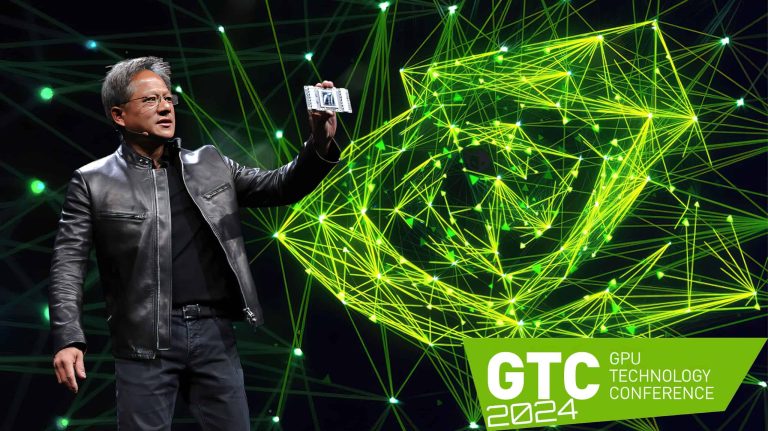
Right now, companies are finding ways of squeezing AI into pretty much every single corner of our lives, and this is for better or worse. Nvidia, which was formally the GPU company, has fully transitioned into being an AI company. According to a new report, Nvidia is testing a way to put generative AI into video games.
Right now, Nvidia stands to gain a ton from the AI craze. Several of the world’s largest companies are buying Nvidia’s GPUs by the boatload to train their AI models. This is what boosted Nvidia to being a $2 trillion company. In fact, the company just announced its Blackwell processors. These are the newest chips from Nvidia that will power the next generation of AI models.
Nvidia is testing tools to add generative AI into video games
Generative AI has touched the video game industry in a very small way. AI tools can possibly be used to help developers with coding. While that isn’t very significant, AI is poised to play an even bigger role in video games down the road.
The Game Developers Conference just happened, and we saw some neat stuff there. One notable announcement was from Nvidia. The company showcased its AI digital human tools. These can be used to voice and animate NPCs within games using generative AI. Also, it will supply dialogue for the characters. These tools were showcased through a tech demo called Covert Protocol. It was produced in collaboration with InWorld, a gaming startup. If that name sounds familiar, InWorld also partnered with Microsoft back in November 2023 for much the same thing.
In the tech demo, we see a conversation being held with an NPC. The NPC is responding to the protagonist’s lines, and the responses, movements, and voice are being generated via AI in real time.
Demos
In the clip below, we see an example of a technology called Audio2Face. This is a technology that uses AI to lip-sync character models to dialogue. So, this could be very helpful for studios needing to translate their games or redo lines. It could be a time saver, as it will eliminate the trouble of reanimating character lips.
Another clip shows the upcoming MMO called World of Jade Dynasty. This is another Showcase of the Audio2Face technology.
In both of the videos, it’s obvious that the voices are being AI-generated. They have the same lifeless and inhuman tone of voice that you hear with AI voice generators. Hopefully, studios that utilize this technology will hire human voice actors to record lines rather than going full AI-generated. We will just have to see.
The Google Maps app on Wear OS is getting a nice little update that was previously announced as part of the March Pixel Feature Drop. This update adds public transit directions, helping you navigate bus, train, and ferry routes directly from your wrist.
According to 9to5Google, it appears that the transit directions functionality is arriving as a server-side update in Google Maps for Wear OS (version 11.119.0702.W). This update will make it easier for Wear OS users to plan their commutes and navigate public transportation without having to pull out their phones. Furthermore, the addition of public transit directions further enhances the convenience and utility of the Google Maps app on Wear OS devices.
Using public transit directions with Google Maps on Wear OS (Source: Google)
Wear OS has been receiving some love from Google lately with the addition of helpful new features. Aside from public transit directions, Google also promised fitness-related features for this month. These included the expansion of Pace Training, Heart Zone Training, and a redesigned workout screen for the first-generation Pixel Watch, a long-awaited addition that only Pixel Watch 2 owners benefitted from. Additionally, the OG Pixel Watch will be getting the Fitbit Relax app and automatically recognized workouts, which have also been Pixel Watch 2 exclusives until now.It is unclear if the public transit directions update will apply to non-Pixel Wear OS watches. Although it was announced as a Pixel Feature Drop, since it is technically tied to the Google Maps app, it will likely be available on other Wear OS devices that can run that app as well. We will be keeping an eye on that and updating this article as needed.
In the meantime, if you do have Google Maps installed on your Wear OS watch, we encourage you to go ahead and check for any updates available in the Play Store. This will ensure you have the latest version with all the latest features and improvements.
How does a company navigate over 80 years of technical debt? Which tools do a security team of 5 rely on everyday? What threats are considered most dangerous?
On March 28, 2024, Malwarebytes CEO, Marcin Kleczynski, and Payette Associates Director of Information Technology, Dan Gallivan, will answer these questions and more in our live Byte into Security webinar.
Event details
Date: March 28, 2024 Time: 10 AM PST / 1 PM EST Registration: Open Now
In this webinar, you’ll discover…
How Payette Industries ensures the security of remote teams while handling extensive data repositories.
The impact of moving workloads to the cloud and simplifying systems on enhancing security measures.
Why adopting Managed Detection and Response (MDR) services is crucial for providing round-the-clock monitoring and augmenting the capabilities of internal teams.
Why attend?
This Byte into Security webinar is a must for anyone eager to see how top-tier cybersecurity tactics are applied in real-world scenarios. Whether you’re involved in IT or simply keen on learning about state-of-the-art security practices, Marcin and Dan’s discussion will equip you with valuable insights.
As many of you know by now, the Galaxy Z Fold 6 and Galaxy Z Flip 6 are expected to launch on July 10. That is rather early considering that the event was in late July last year. In previous years, it occurred even later than that. In fact, Samsung used to host it in August. Well, according to a new report, an early arrival of the Galaxy Z Fold 6 and Galaxy Z Flip 6 is spot on.
The Galaxy Z Fold 6 & Flip 6 mass production scheduled to begin early
That basically hints that the phones will launch in the first half of July. That’s a couple of weeks earlier than last year. So, the July 10 date could be spot on, actually.
Why so early, though? Well, the thing is, the Olympic games are kicking off on July 26. That’s a Wednesday, and Samsung usually hosts its Unpacked events on Wednesdays. Furthermore, both the Olympic Games and Samsung’s event are taking place in the same city, Paris.
The event will almost certainly take place in Paris, but that hasn’t been officially confirmed just yet
Well, truth be said, Samsung’s second Unpacked of the year still doesn’t have an official venue, but the rumors are saying it will take place in Paris, so… it makes sense.
The bottom line is, Samsung had to adjust its plans due to everything. That’s basically why we’re seeing an early launch for the Galaxy Z Fold 6 and Galaxy Z Flip 6 this year.
In addition to those two phones, the Galaxy Ring is also expected to arrive. That device’s design was shown off at MWC 2024 in Barcelona. Samsung did not share all that much information about the product itself, though. It was more of a teaser than anything else. The company did say that it’s coming later this year, and we’re presuming it will drop in July.
Android users may have noticed a subtle change to a familiar home screen feature. The “At a Glance” widget, a staple on Android devices, is no longer explicitly tied to Google Assistant. This shift signals a potential rethinking of Google Assistant’s role in the Android experience.
The “At a Glance” widget has long been a helpful tool, conveniently displaying essential information like the current weather, upcoming calendar events, reminders, and more. On Google Pixel devices, it is actually a permanent fixture (for now). On other Android devices, it is usually found within the list of Android widgets under the Google category and is aptly named “Assistant at a Glance,” clearly showcasing its connection to Google Assistant.
In October of last year, the widget received a redesign, giving it a more modern and material look. However, as noticed by 9to5Google, the most recent beta version of the Google app (v.15.11.42.28.x) quietly removed the word “assistant” from the widget’s title and settings descriptions.
“At a Glance” widget description before and after the Google app update
This change leaves room for speculation and suggests a deliberate move to distance the “At a Glance” functionality from the Google Assistant branding. It is unclear at this time what the reasoning behind this decision may be. However, we suspect it has something to do with the launch of the Gemini app on Android, which was rumored to be an eventual replacement for Google Assistant.As it stands right now, the Gemini app on Android devices does not offer the same functionality as the Google Assistant does. It is still lacking basic features such as creating or changing a timer or alarm, reading web pages out loud, or even something as simple as recognizing a song that’s playing.
Regardless of Google’s long-term plans, the change ultimately makes the widget’s name more streamlined and descriptive. I hope this also signifies major improvements to come to the Gemini app in the future in order to make it a true replacement for the tried-and-true Assistant.
We chatted for five minutes about the relative merits of Florence and Rome and then had a further forty-minute conversation about the decentralized future of DNS, which got quite deep and technical at times.
However, don’t worry. Although Davide would love for me to dig into all the nuances and subtleties of the products and services relating to Web3 domain names his company offers, I know that the best articles make one single clear point.
The point I want to make with this article is that Web3 has a habit of blindly walking down the same old centralized approaches that Web2 has taken, often to our disadvantage.
No more so than in the Web3 domain name space.
But first, a little sidebar about domain names, and then ownership.
Are you on the bus?
I can still remember the first time I saw a website address on the back of a bus in Cambridge, back in 2001. It was an advertisement for an estate agency, with two improbably cheerful people in suits standing in front of a house, and a URL at the bottom.
I remember thinking, “Gosh, if people like that are going to put website addresses up on buses, then they might be something significant in the future.”
Domains are the equivalent of buying land in a space of scarcity. Even so, with the universe drawing an obvious parallel in the advert (domain name = real estate), I didn’t go and look for a promising domain name to buy.
I already had my domain — registered in 2001, so it’s 23 years old. And it’s a ridiculous domain: ongar.org. At that time I could have bought vodka.org or spaceships.com, for heaven’s sake!
Back then, hardly anyone appreciated that domain names were like the island of Manhattan just before the skyscrapers started going up. We now consider domain names as significant, even though they’re a made-up concept.
Domains are big business, and even though they are virtual, good ones can change hands for millions of dollars.
About ownership
What is it about blockchain and Web3 that makes them different from databases and Web2?
When you dig into it, the answer is that blockchains allow you to create digital “objects” that you can independently own. For example, provided you are careful with your private key, the Bitcoin you own is yours, and can only be taken from by force; through torture or intimidation.
“A blockchain allows you to create a unique, unforgeable, and unalterable digital item, on a computer network, with clearly defined ownership.”
But when you think about it more deeply, you’ll realize you don’t own much, if anything, in the real world. The loaf of bread you bought from the shop this morning, or the nice-looking pine cone you found on your walk to work is probably the closest you can get to true independent ownership.
You see, although you may ‘own’ a house, (or perhaps dream of owning a house if you’re a millennial), you never really will.
Even if you’ve paid off your mortgage, in most countries you still have to pay property and land taxes or it gets taken off you. So, in a sense, you’re renting it from the government.
Similarly, the government may decide that they want to build a road or bypass through your garden, and again, most countries have laws that allow them to force you to sell your property to them for this purpose.
That doesn’t sound much like ownership to me.
The rent is too high in Web2
We live in a world where the trend has been towards renting and away from owning. Instead of buying music on vinyl or CD, we now borrow it from Spotify, at a price. A subscription to a video streaming service provider means we don’t own our copies of movies anymore.
And on the Internet, we don’t own our Web2 website address — we rent it, through a registrar that gets its authority from ICANN (that’s the Internet Corporation for Assigned Names and Numbers) or some other organization like it.
They get a yearly cut, and we get a leasehold on the domain name.
Why is there rent in Web3?
You would think that in the brave new world of blockchain, the Web3 equivalent of domain name services would respect the concept of ownership.
You’d be wrong.
I searched for companies offering their implementations of domain names in Web3 and found ten leading companies. Only two of them offered you the right to buy your domain name in perpetuity for a fixed fee — Freename and Unstoppable.
The rest use the Web2 business model.
There’s a reason why Web2 methodologies are enticing to companies — they’re highly profitable. Subscriptions make more money over time than selling a one-off license or product.
Just as Google and Facebook (sorry, Meta) were irresistibly compelled to harvest and sell our data for the vast profits this avails them, Web3 companies are drawn to offer subscription models rather than outright ownership in the original spirit of blockchain, because of the recurring stream of revenue they offer.
“But what happens if someone buys a name and then loses the keys or dies without passing them on?” is an objection that one person raised with me.
My response? “So what?”
What happens today the Web2 domain you want, yourcompanyname.com, is not available. You try your-company-name.com, or yourcompanyname.io, or some other suitable domain. You will find one because there are now many top-level domains to choose between and even more second-level domain variants to select from.
As for the number of options and companies out there when it comes to obtaining a Web3 domain?
They highlight the fact that Web3 is still a frontier industry — we still have the opportunity to stake claims and shape its future, or at least vote with our feet and our crypto.
Samsung‘s March 2024 update is available for a few more Galaxy smartphones in the US. The company is pushing the update to the Galaxy S21 FE and Galaxy Note 20 series. The rollout began recently and should reach all users over the next few weeks.
Galaxy S21 FE and Note 20 pick up Samsung’s March update in the US
Over the past three weeks, Samsung has updated all of its flagship smartphones launched since 2021 to the March SMR (Security Maintenance Release) in the US, including foldables. The Galaxy S21 FE was the only model missing the new security patch. The company has just covered the FE phone too, simultaneously expanding the update to the Galaxy Note 20 series. The devices are getting the new release globally.
As of this writing, only carrier-locked variants of the Galaxy S21 FE are receiving the March SMR in the US. The update comes with the firmware build number G990USQSAFXC2. Samsung should cover unlocked units soon. The same update is available in Europe with build number G990BXXS6FXC1 or G990B2XXS5FXC1depending on the device version. A global rollout should be just around the corner.
The latest security patch is also available for the Galaxy Note 20 and Galaxy Note 20 Ultra in the US and some international markets. The US versions are receiving the new SMR with build numbers N98*USQS6HXC1 (carrier-locked) and N98*U1UES6HXC1 (unlocked). It is N98*BXXSAHXC4 for international versions. Like the Galaxy S21 FE, this update for the last Note-branded phones should also go global soon.
Samsung’s March 2024 update has been all about security fixes. It didn’t push additional goodies to any of the 30+ phones it has updated this month. The story remains unchanged for the Galaxy S21 FE and Galaxy Note 20 series. These phones are getting the 46 vulnerability fixes that Samsung added to the March SMR, including two critical Android OS fixes. There are no new features or improvements in tow.
Galaxy Note 20 will no longer get feature updates
Samsung will soon release the One UI 6.1 update for Galaxy devices. It will bring new AI features, UI tweaks, camera improvements, editing tools, and more. However, the Galaxy Note 20 series won’t get it. The Note phones are no longer eligible for feature updates. They didn’t even get Android 14. The devices will also stop receiving security updates around September this year unless Samsung decides to extend support by a few months. It is high time you move on from your Galaxy Note 20.
Even before Apple has announced the iPhone 16 series, rumors about the iPhone 17 display have started to float. The latest one claims Apple is working with its display manufacturers to offer a new screen that has anti-reflective properties and enhanced scratch resistance.
The current-generation Apple iPhone 15 has Ceramic Shield displays, which are quite sturdy and reliable. However, several experts urge new buyers to slap on a screen protector just to be safe. The rumor about the upcoming iPhone 17 display adds that this iOS smartphone wouldn’t need any screen protection accessory. However, these displays may be compromising on another direly-needed feature.
The Apple iPhone 17 may have an anti-reflective display
Apple prioritizes screen toughness for its iPhone devices. The company regularly boasts about the hardness of the display glass, which often matches with independent testing.
The current generation of Apple iPhone devices have, what Apple calls, Ceramic Shield displays. Developed by Corning, the makers of Gorilla Glass, these displays, manufactured exclusively for Apple Inc. are not only tough, but they also have an oleophobic coating.
I have a question for @SamsungMobile@corninggorilla , whether the anti-reflective effect of the Corning Gorilla Armor Glass on the S24 Ultra will disappear over time. If not, that would be great. pic.twitter.com/Vpp6uUiutr
According to the latest rumor, the iPhone 17 display would be anti-reflective, and get improved screen toughness as well as scratch resistance, but this may lower the longevity of the oleophobic layer. In other words, this anti-fingerprint and water-resistant coating would begin to lose its efficacy after about a year.
It is interesting to note that no oleophobic coating lasts forever. Hence, third-party accessory makers do offer liquids and screen protectors that restore the coating.
Will the iPhone 17 need any external or third-party screen protector?
Apple hasn’t confirmed who is manufacturing the glass that will protect the iPhone 17’s display. However, it is possible that the display would have glass developed by Corning as the company has been working with Apple for several years.
Incidentally, Samsung recently launched the Galaxy S24 Ultra, whose screen is protected by a “Gorilla Glass Armor” display panel. Corning makes this glass. While Apple may not use the same marketing term, the latest rumor strongly suggests Apple may source this very glass technology for its upcoming iPhone 17 series of iOS smartphones.
Corning claims, “Gorilla Glass Armor cuts reflections by 75 percent compared to a typical glass surface, and is resistant to micro scratches that build up over time on competing glass panels.” In the marketing material, the company boasts, “The panels offer over 4x more scratch resistance than competitive aluminosilicate cover glasses.”
Apple stores across the world offer protective glass as accessories. Needless to say, these are quite expensive compared to third-party screen protectors. Hence, it is not clear if Apple will intentionally hurt its earnings by eliminating the need for screen protectors.
BunnyLoader is a rapidly developing malware that can steal information, credentials, and cryptocurrencies while also delivering new malware to its victims.
Since its first detection in September 2023, the BunnyLoader malware as a service (MaaS) has regularly enhanced its features.
According to Palo Alto Networks, the consistent improvements of tactics, techniques, and procedures (TTPs) such as infrastructure, packers, encryption, and exfiltration methods aid in the attacker’s ability to avoid detection.
It also aims to impede cybersecurity researchers’ capacity to identify and evaluate the actions of threat actors.
The threat actor responsible for BunnyLoader declared the release of BunnyLoader 3.0 on February 11, 2024, claiming that the malware has been “completely redesigned and enhanced by 90%.”
The threat actor asserts that BunnyLoader payloads have been improved to include:
Payloads/modules “completely rewritten for improved performance”
Reduced payload size
Advanced keylogging capabilities
Evolution Of BunnyLoader
BunnyLoader has developed at a quick pace. Version 1.0, marketed as a C/C++ loader malware and MaaS botnet on the dark web.
The “Player” or “Player_Bunny” threat actor is the one responsible for this malware. The malware’s creator prohibits deploying it on Russian systems.
By September 2023’s end, BunnyLoader had a rapid retooling. BunnyLoader 2.0 was released by the author and seen in the wild by the end of September.
A “private” version of the malware was made available by the creator in October for $350. In contrast to the initial release, the creator concealed this private version and released frequent updates to circumvent antivirus protections.
Specifics Of BunnyLoader 3.0
Senior threat intelligence researcher @RussianPanda9xx publicly shared the release of BunnyLoader 3.0 on X (Twitter).
BunnyLoader 3.0, the most recent version, employs a distinct directory structure on its C2 servers.
The actual malicious payload in BunnyLoader 3.0 is delivered by the threat actor using a dropper that is incorporated with the BunnyLoader malware and is sent via a CMD file.
X (formerly known as Twitter) post by threat intelligence researcher @RussianPanda
When downloading the BunnyLoader 3.0 modules, researchers discovered the following URL structure.
BunnyLoader 3.0 module URLs
Advanced KeyLogging Capabilities
“The BunnyLoader 3.0 keylogger records all keystrokes, saving them to log files in the %localappdata%\Temp folder.
Palo Alto Networks researchers shared with Cyber Security News that the keylogger also attempts to identify when the victim authenticates to sensitive applications or services.
BunnyLoader keylogger log file locations
Additionally, the BunnyLoader 3.0 stealer module operates independently, exfiltrated data directly into the C2 server, and stole passwords.
Using a particular communication routine, the BunnyLoader 3.0 clipper module occasionally checks in with the C2.
By providing the target with the name of a cryptocurrency wallet and the associated wallet address that the threat actor controls, the C2 triggers the clipper.
The BunnyLoader 3.0 DoS module uses a particular communication procedure to wait for commands from the C2.
The module can be instructed by the C2 to launch an HTTP flood attack using the GET or POST protocol against a given URL.
Hence, by revealing these changing strategies and the dynamic nature of the threat, users must be better equipped to strengthen their defenses and safeguard their assets.
Stay updated on Cybersecurity news, Whitepapers, and Infographics. Follow us on LinkedIn & Twitter.
In February, Samsung obtained a regulatory certification for the Galaxy Tab S10+’s battery from India’s BIS (Bureau of Indian Standards). The agency certified the battery with model numbers EB-BX828ABE and EB-BX828ABY. The company has also received a similar certification from Safety Korea, which has published a live photo of the battery.
Galaxy Tab S10+’s battery seen in live photo
Unlike smartphones, Samsung doesn’t launch new flagship Android tablets every 12 months. It launched the Galaxy Tab S7 series in August 2020 and followed up with the Galaxy Tab S8 in February 2022. That’s an 18-month gap between the two lineups. The Galaxy Tab S9 series also arrived 17-18 months later, alongside the fifth-gen foldables in July 2023.
As per this cycle, the Galaxy Tab S10 should debut alongside the Galaxy S25 series early next year. However, there are rumors that Samsung will unveil the new tablets early. While we don’t yet have a concrete timeline, the company might be planning to launch them during its Galaxy Unpacked event in July 2024 where it will unveil the Galaxy Z Fold 6 and Galaxy Z Flip 6.
Amid the rumors, Samsung is collecting regulatory approval for the new tablets. This is the second battery certification for the Galaxy Tab S10+, which bears the model number SM-X828. It indicates the device will arrive in a few months. Unfortunately, we don’t have details about the battery capacity and charging speed. The photo published by Safety Korea is too blurry to give us any information.
If the Galaxy Tab S10 series does arrive alongside the Galaxy Z Fold 6 and Galaxy Z Flip 6, we should soon start seeing more leaks and rumors about them. Foldables expectedly get more attention from the public, so there are already a handful of leaks about them. But the rumor mill shouldn’t take much longer to give us more information about the new flagship tablets.
The upcoming Samsung event could be a massive one
If recent rumors turn out to be accurate, Samsung’s upcoming Galaxy Unpacked event will be massive. While foldables will be the stars of the show, the event may bring several other products. Aside from new flagship tablets, we also expect the company to launch an affordable foldable, Galaxy Watch 7 series, Galaxy Buds 3, and the Galaxy Ring. The latter was formally announced at MWC 2024 last month but specs, price, and availability details are missing. Stay tuned so you don’t miss out on all the latest information about these Samsung products.