Sega announces new content coming to Sonic Dream Team

0

[ad_1]

Sonic Dream Team is the latest mobile entry into the Sonic the Hedgehog franchise, and it puts a new spin on it (no pun intended). The game received positive reviews despite the fact that you can only play it on Apple Arcade. Sega just announced some new content that’s coming to Sonic Dream Team that will make the game that much more fun.

Sonic and the team are stuck inside of one of Eggman’s twisted dreams and must recover the dream orbs in order to make it out. This is the gist of the story, and it may sound a little familiar if you’ve played Sonic Frontiers. However, 3D Prime Adventure, the team behind Sonic Dream Team, was able to create a gameplay experience that’s uniquely Sonic while still remaining unique.

It’s Exclusive to Apple Arcade, which costs $6.99/month. If you’ve yet to get Apple Arcade, you can sign up for a free trial and try it out for a month. You can play that game along with more than 200 other premium titles.

Sonic Dream Team is getting more content

This is the first of several updates that Sonic Dream Team is going to get throughout the year. In this update, you’re getting a few new modes plus some useful tweaks. First off, you’re getting Time Trials. You can’t call it a Sonic game without time trials. In this mode, you’ll run through the stages and try to complete them as quickly as possible and get the best times.

Next, they’re going to be New Boss Missions. The update will bring eight new boss missions to the game. This is for people who can’t get enough.

This new update will also bring Speedruns. This will add ranks to the missions for completionists who want to get the highest rank for each level.

Lastly, this update brings some tweaks to Dr. Crabulous, the Factory Foreman, and the Guardian Hunter. These characters have all been updated with a few new moves to keep the fighting fresh.

As of the writing of this article, the update should have already arrived. Make sure your app is fully updated.

[ad_2]

Source link

Apple Vision Pro now has access to over 1,000 visionOS apps

0

[ad_1]

Apple Vision Pro has never left the headlines since its release. The $3,500 mixed reality headsets keep topping the news pages for several reasons. It’s been close to two weeks since the Vision Pro hit shelves in the US. Apple has made quite a progress with visionOS so far. The company shipped the Vision Pro with over 600 visionOS apps available for the headset, other than 1.5 million iPad apps that remain compatible with the mixed-reality headset. Now, the visionOS supports over 1,000 apps, thus the Apple Vision Pro users have access to them.

Apple Vision Pro now has access to 1,000 visionOS apps

Apple’s SVP of Marketing, Greg Joswiak, announced this update on X. He gives a “big thank you” to the developers and mentions that visionOS now has 1000 “incredible spatial apps,” which are apps made especially for the Apple Vision Pro. Altogether, the visionOS App Store has over 1.5 million apps. But most of these are iPad apps that can run on visionOS in a compatibility mode.

There’s another story to the lack of visionOS apps. The visionOS App Store has sparked some controversies. Even though Apple points out that key apps like Disney+, NBA, and HBO Max offer immersive experiences on Vision Pro, there are still many important apps missing. These include Netflix, Spotify, YouTube, Instagram, and TikTok.

More importantly, YouTube has confirmed that a native visionOS app is in the pipeline. We don’t have a specific date, or timeline for when YouTube will come with an app. But it’s safe to assume that at least, in the coming weeks or months.

How different is a native visionOS app from an iPad app running on Vision Pro

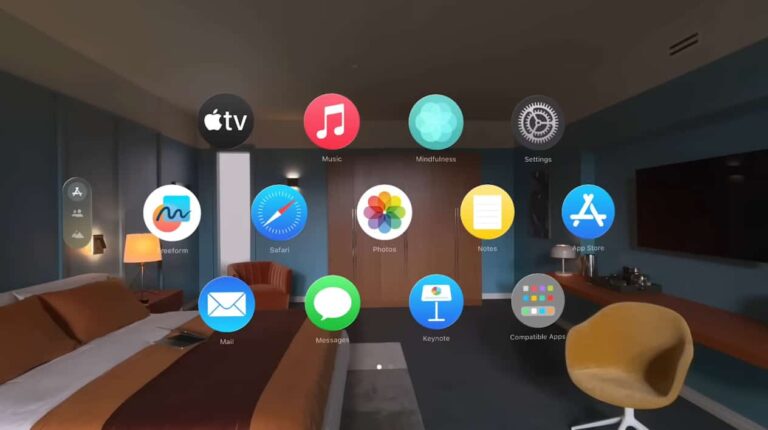
A native visionOS app is designed specifically for the operating system. So, it comes with features like big targets for eye tracking, glass-like frames, and interactive menus around a central window called ornaments. On the other hand, compatible apps run in a flat 2D window that looks the same as on an iPad or iPhone.


[ad_2]

Source link

Google’s Weather widget icons are getting a refresh

0

[ad_1]

Google redesigned its Weather app last year in tandem with the release of the Pixel Fold and Pixel Tablet. Although the new redesign included a clean new interface and a new set of weather icons, its corresponding widget kept the same old icons to represent the weather. This is about to change.

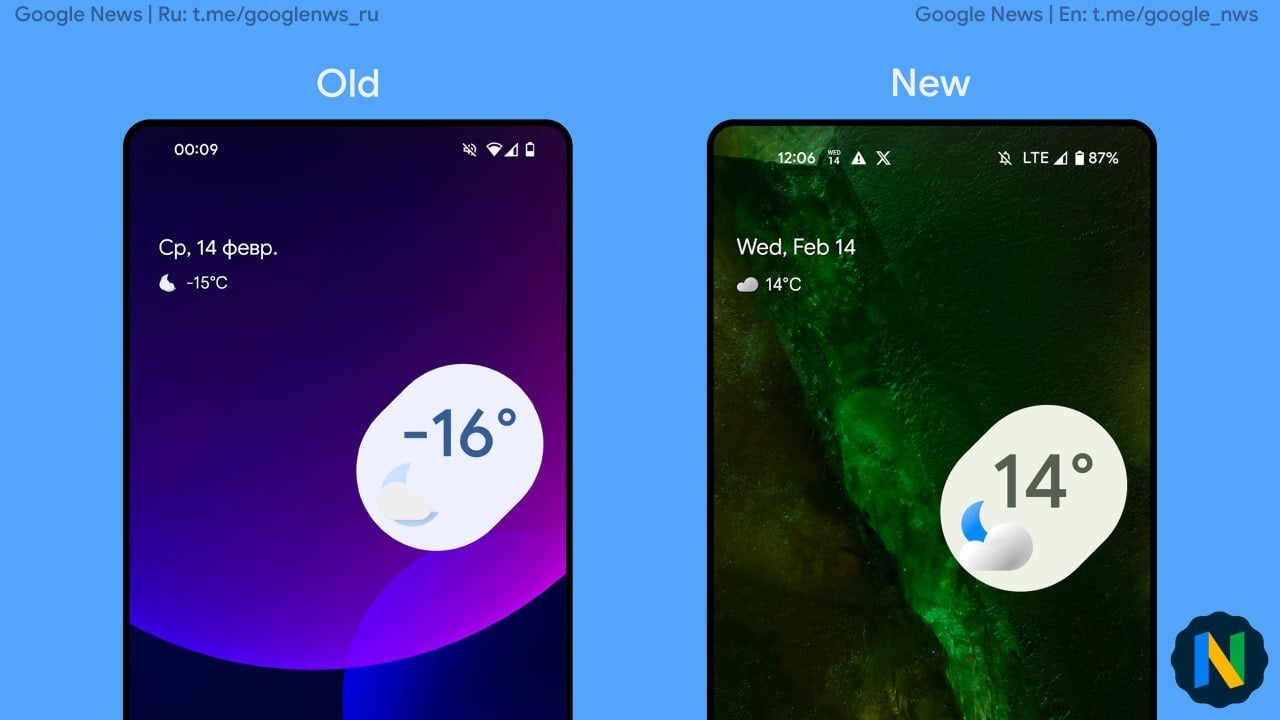
Spotted by the Google News channel on Telegram, it appears that Google is now supporting the new set of weather icons on both the redesigned Weather app and the At a Glance widget that can be installed on devices other than Pixels. As usual when it comes to Google releases, this seems to be a staged rollout, so results on when you will see the new icons appear for you may vary.

Image Source: Google News Channel (Telegram)

As you can see in the image above, the updated icons appear less flat and take more of a 3D aesthetic. Additionally, in the image below, you can get a clearer picture of what the new icons will look like on your home screen weather widget, based on the redesigned weather app, once the change rolls out to your device.

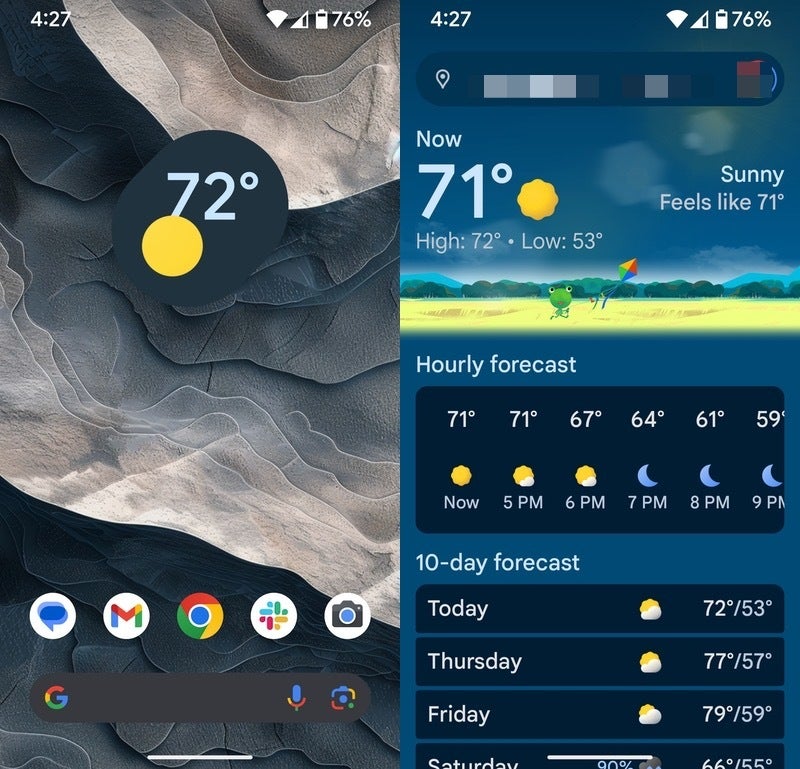
Old weather widget vs new icons in redesigned weather app | Source: Phone Arena

Though not everyone places important in the appearance of widgets, Google has showed a renewed interest in them since the launch of “Material You”. Additionally, since Apple introduced home screen widgets with iOS 14, users on both iPhones and Android devices have sought out ways to customize their home screens to their liking. For those users, having a cohesive look throughout the UI is important, and hopefully this small change can help with that.
It’ll be interesting to see what other widget-related improvements Google’s got in the works. It would be nice to see some new ones pop up with Android 15, along with that rumored option to replace or completely remove the At a Glance widget from Pixel phones’ home screens.

[ad_2]

Source link

Android 12: Everything You Need To Know

0

[ad_1]

The Android 12 is having a bit of a strange rollout this year. Not only is it later than usual, but Google has announced that it is live in AOSP, while the update for Pixels is coming in the “next few weeks”. Typically, this would happen on the same day.

Fast-forward a couple of weeks, and Android 12 is now rolling out to Pixel devices. Anyone with a Pixel 3 or later should see an OTA update available now on their Pixel device.

When will Android 12 be available?

The first developer preview was released on February 18, 2021. However, the final stable version that will be available for the Google Pixel, won’t be released until Q3. In previous years, that meant the Tuesday after Labor Day in September. But it appears to be launching a lot later this year. The stable build released on October 19, 2021.

  • Developer Preview 1 released on February 18, 2021
  • Developer Preview 2 released on March 17, 2021
  • Developer Preview 3 released on April 21, 2021
  • Beta 1 released on May 18, 2021
  • Beta 2 released on June 9, 2021
  • Beta 3 release on July 14, 2021
  • Beta 4 released on August 11, 2021
  • Beta 5 released on September 8, 2021
  • Source code pushed to AOSP on October 4, 2021
  • Stable build released to Pixel devices on October 19, 2021
  • Final Android 12-based update rolled out in July 2022

How many developer previews and betas will there be?

Typically, Google does two developer previews for new versions of Android. Then, it moves onto the “Beta” phase.

This year, there are going to be three developer previews. February through April will see Developer previews. With the first beta coming in May. Likely at what will amount to being Google I/O this year – which undoubtedly will be virtual only. There will then be three betas in May, June, July and the release candidate coming in August. The RC is technically a beta, but it has the final APIs and is essentially the final version.

Google will then release the final version of Android 12 for all eligible Pixel devices in Q3. Which is likely to be around September of 2021.

Screen Shot 2021 02 18 at 12 58 02 PM
Android 12 Release Timeline

What devices will be compatible with the developer previews?

Developer previews are generally only compatible with Pixel devices. Android 12 is compatible with the following Pixel devices:

  • Pixel 3
  • Pixel 3 XL
  • Pixel 3a
  • Pixel 3a XL
  • Pixel 4
  • Pixel 4 XL
  • Pixel 4a
  • Pixel 4a 5G
  • Pixel 5

Other OEMs don’t typically roll out developer previews for their phones. That usually happens within the beta phase.

Update: The Android 12 Beta is also available on these devices now.

What devices will work with the Android 12 Beta?

This year, ASUS, OnePlus, OPPO, TCL, Vivo, Xiaomi, ZTE, Sharp, Tecno, and Realme are all supporting the Android 12 Beta.

Devices that are compatible include:

  • Asus Zenfone 8
  • OnePlus 9, 9 Pro
  • Oppo Find X3 Pro (model CPH2173)
  • TCL 20 Pro 5G
  • Vivo iQOO 7
  • Xiaomi Mi 11, Mi 11 Ultra, Mi 11I, Mi 11X Pro
  • ZTE Axon 30 Ultra 5G
  • as well as models from Sharp, Tecno, and Realme

You can head here to find instructions on how to update your phone to the Android 12 beta.

What dessert name is Android 12 going to have?

Even though Google stopped using dessert names with new versions of Android, back with Android 10, it still uses them internally. And for Android 12, that name is “Snow Cone”. Android 12 Snow Cone does sound pretty good. Too bad, we won’t be seeing that used in official marketing material. But it was still cool to see what the name was going to be.

What features can we expect in Android 12?

Google has announced a slew of features for Android 12, but a lot of them are not yet available in the first beta. Many of these are coming in the second beta or a bit later. But here’s a quick round-up of what features we are seeing in Android 12 already.

Material You

At Google I/O, the company’s head of design, Matias Duarte, took the stage to announce ‘Material You’, which is the next evolution of design for Google.

Essentially, it makes Material Design a bit more personal as the colors will change to fit your wallpaper. And with millions of different colors available, it’s likely that no one will have the same theme available on their smartphone. And this extends further than just through the settings, quick settings, and the home screen. But also through all the apps on your smartphone.

With Material You, Google has taken a page out of Samsung’s book. With One UI, the Settings app consisted of bigger tap areas, and using the bottom two-thirds of the display. Making it easier to use on a larger device. And that’s exactly what Google has done here. Quick Settings are also much larger now.

Privacy Dashboard

This was much leaked ahead of the beta announcement at Google I/O. But the Privacy Dashboard is going to make it easier to control what apps are using what permissions. Going to the Privacy Dashboard, you can see how many times your camera or microphone have been used in the past 24 hours. As well as seeing exactly when each app used it.

The point here is to make it easier to keep your data private, and educate users on what permissions are being used by certain apps.

Along with the Privacy Dashboard, there are also new indicators for when the camera and microphone are being used. These will show up in the right-hand corner and then transition into a green light. This is similar to what Apple has done with iOS over the past few years. So you can easily tell if the camera and/or microphone is being used.

Additionally, you’ll see Quick Settings tiles available for revoking those two permissions in that app. So you can revoke permission to the camera without having to leave the app and dig into settings to find the option.

These features are not yet available, Google says it will debut in the second beta for Android 12, next month.

Android Private Compute Core

This is a bit of a boring feature for Android 12, but it is a big deal. The Android Private Compute Core is not a physical chipset inside of Android but more of a sandboxed part of Android for doing all of the AI features that it has.

To put it simply, the Android Private Compute Core will run a bunch of machine learning functions. Walling it off from the rest of the OS means that it is not able to access the network. Keeping your data on your phone and not in the cloud. The only way it can communicate is with specific APIs, which are supposedly open-source.

Basically, Google has nerfed the powers of artificial intelligence. Keeping it all local.

The built-in Android TV remote

When we first heard about the Android TV remote for Android 12, we didn’t think it was a big deal. But now that Google has explained what exactly it is, this is huge.

With Android 12, there will now be a built-in Android TV remote. That can be used on the Chromecast with Google TV, Sony Android TVs and other Android TV devices. This remote will make it easy to not only control your TV, but also login to different apps on your TV.

This is not yet available in Android 12, but it should come in the next beta (or maybe Beta 3).

How can I download Android 12?

Now that the beta is available for Android 12, you can easily enroll your Pixel device into the program. This means that you will get the update over the air, and it’s super simple to install. It is around 1.88GB in size, so it’s rather large, and will take some time to install.

If you don’t own a Pixel, it’ll be a bit more difficult to install the Android 12 beta on your smartphone. You can check here for instructions on how to do just that.

[ad_2]

Source link

BlackBerry announces additional job cuts in pursuit of profitability

0

[ad_1]

Canadian cybersecurity and IoT (Internet of Things) firm BlackBerry plans to cut more jobs as it pushes toward profitability. The company hasn’t specified the number of layoffs in this round but says it will be on top of the previously announced layoffs affecting around 200 employees. It expects these headcount reductions and other measures to help it return to profitability in a year.

BlackBerry to cut more jobs to reduce operation costs

In October 2023, BlackBerry announced plans to split its IoT and cybersecurity businesses into two separate entities. The company said this move will drive it towards profitability and positive cash flow in the future. It has since taken more actions to reduce annual expenditure by approximately $50 million. Largely focused on the cybersecurity business, these actions included about 200 job cuts.

BlackBerry is now aiming for $100 million of annualized net profit improvements. It plans to achieve this target with further cost reductions and margin expansion. The firm has already identified measures that will help it achieve approximately $55 million of the $100 million annualized target. Sadly, these measures include another round of job cuts within the Cybersecurity business.

According to the company, these layoffs will help it save around $27 million in annual expenses. An additional $8 million will be saved annually through non-layoff actions. BlackBerry is also taking action to reduce its annual general and administrative expenses by $20 million. As part of this move, it has closed 6 of its 36 global offices, including one in San Ramon, California.

BlackBerry expects these measures to reduce its operating cash usage for the fourth quarter of its fiscal year 2024, which ends on February 29, 2024. The company has already seen operating cash usage drop from $56 million in Q2 to $31 million in Q3. It still ended up suffering a net loss of $21 million in the third quarter. The firm aims to become operating cashflow positive by the end of fiscal year 2025.

BlackBerry has established separate leadership teams for the two divisions

As part of its latest press release, BlackBerry announced that it has “made material progress” towards splitting the IoT and cybersecurity businesses. It has already established separate leadership teams for each division and is in the process of establishing divisional back-office teams. The two divisions had standalone Sales, Marketing, and R&D functions even when they were a single entity.

“Efficiencies have been identified in all functions, but in particular within the cost of goods sold and research and development,” BlackBerry said in the press release. “Backed by solid, industry-typical levels of R&D investment, the cybersecurity business is executing its exciting product roadmap in a focused and efficient manner.” It remains to be seen if the company achieves its financial target in the next fiscal year.

[ad_2]

Source link

Walmart is reportedly in talks to acquire TV maker Vizio

0

[ad_1]

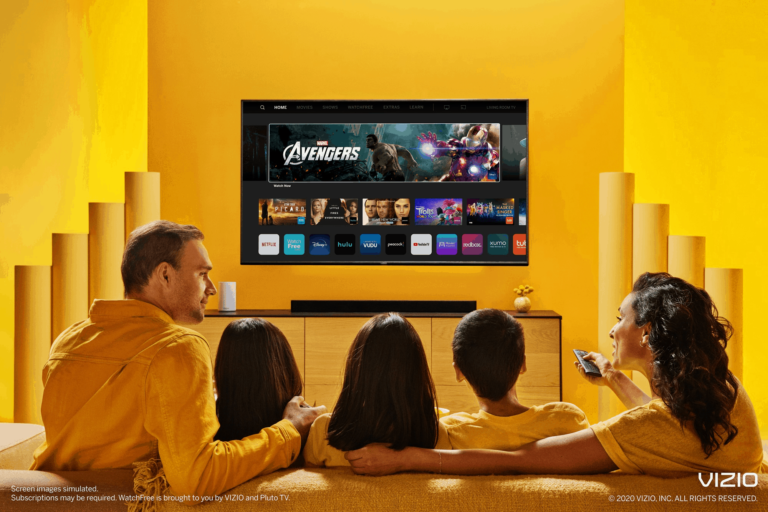
According to The Wall Street Journal, Walmart wants to acquire TV maker Vizio to battle Roku and Amazon Fire TV. The acquisition would allow Walmart to boost its advertising business and directly pitch its products to potential customers.

The deal is reportedly worth $2 billion. Vizio and Walmart have been close partners for many years. Vizio is currently Walmart’s largest customer and the best-selling TV brand in Walmart stores. Neither Walmart nor Vizio have commented about the deal yet. Of course, in 2022, Comcast was also in talks to acquire Vizio, but it never happened.

Affordable TV maker Vizio is soon to be sold to Walmart for $2 billion

Walmart now sells its streaming devices and affordable Android TVs under the Onn brand. However, by acquiring Vizio, the retailer can better compete with Amazon and Roku in the affordable TV market. Additionally, it can access the data collected by Vizio from millions of customers. Walmart can also tap into the personalized ads business.

Another perk of acquiring Vizio for Walmart could be the company’s streaming service, WatchFree+. The WatchFree+ service comes preinstalled on Vizio TVs and doesn’t require additional devices, fees, or subscriptions.

Walmart has been pursuing the idea of launching a streaming service for almost two years. The company reportedly talked about the deal with major distribution brands like Paramount, Disney, and Comcast. The retailer can now achieve its dream by acquiring Vizio and its streaming service, WatchFree+. The service has over 260 free channels. However, it might not be free anymore after Walmart’s acquisition.

Last year Walmart partnered up with Innovid

Last year, Walmart announced a partnership with advertising company Innovid to show personalized ads on connected TVs (CTV). Innovid’s Dynamic Creative Optimization (DCO) helps Walmart to create and share more engaging and interactive ads. In 2022, Walmart also partnered with Roku to show shoppable ads on TVs.

The competition in the affordable TV market is heating up with streaming services like Roku and Amazon launching their own lineup of smart TVs. By owning the TV lineup, the streaming services could have full control over the content and ads they show to the customers and gather as much data as possible.

[ad_2]

Source link

New book explains why Musk bought Twitter. You’ll never guess what his motivation was

0

[ad_1]

To say that Elon Musk is having a tough time with his purchase of Twitter would be a gross understatement. Almost from the moment that Musk closed on the $44 billion transaction in October 2022, the multi-billionaire was like a struggling fisherman trying to land that huge fish on his line. Most of the problems that Musk faced were self-inflicted. He fired employees without realizing how important some were to running Twitter daily. He tried various monetization schemes and at one point warned that Twitter could file for bankruptcy.
With all the problems that Musk has had with Twitter, including making statements that ticked off his major advertisers (such as Apple, IBM, Disney, Sony, Warner Bros. Discovery, Lionsgate, and Paramount Global) who then fled the platform, what was his reasoning for making the purchase in the first place? Surely the man who runs Tesla and has amassed one of the largest personal fortunes in the world had a plan to turn Twitter into something besides “X” before buying the company.
According to an upcoming book about the Twitter acquisition called “Battle for the Bird” by Kurt Wagner, which drops on February 20th, Musk’s purchase of Twitter might have been inspired by revenge. A Twitter account titled @ElonJet was tracking Musk’s private jet and the multi-billionaire asked then-Twitter CEO Parag Agrawal to take down the account. Agrawal refused. 

An excerpt from the book says, “Musk had also unsuccessfully petitioned Agrawal to remove a Twitter account that was tracking his private plane; the billionaire started buying Twitter shares shortly after Agrawal denied his request.” Just days after the deal was completed, Musk said that he wouldn’t close the @ElonJet account because of his “commitment to free speech.” A month later, Musk banned the account.

Saying one thing and then quickly changing his mind became a Musk hallmark and it drove Twitter users crazy during the beginning of Musk’s reign over the platform, especially when it came to the blue verification checkmark which Elon was hoping to monetize. Based on equity grants handed out to key employees in March 2023, Musk was valuing Twitter at $20 billion, less than half what he paid for it, just five months after his purchase of the platform.
Not too many high-profile executives could afford to buy a social media icon on a whim. Musk supposedly does have a long-term goal of turning what is now known as “X” into a super app like China’s WeChat that can handle instant messaging, mobile payments, and social media posts. It’s actually not a bad idea. But Musk might not have the temperament to see it through.

[ad_2]

Source link

ChatGPT Down? Anonymous Sudan Claims Responsibility for DDoS Attacks

0

[ad_1]

Is your ChatGPT down? Or, are you experiencing issues accessing ChatGPT? If so, you’re not alone. ChatGPT has been encountering service disruptions and numerous errors lately. The cause appears to be DDoS attacks, possibly instigated by Anonymous Sudan.

Anonymous Sudan, a now prominent group of hacktivists, has claimed responsibility for targeting ChatGPT and its parent company, OpenAI, with a series of DDoS attacks.

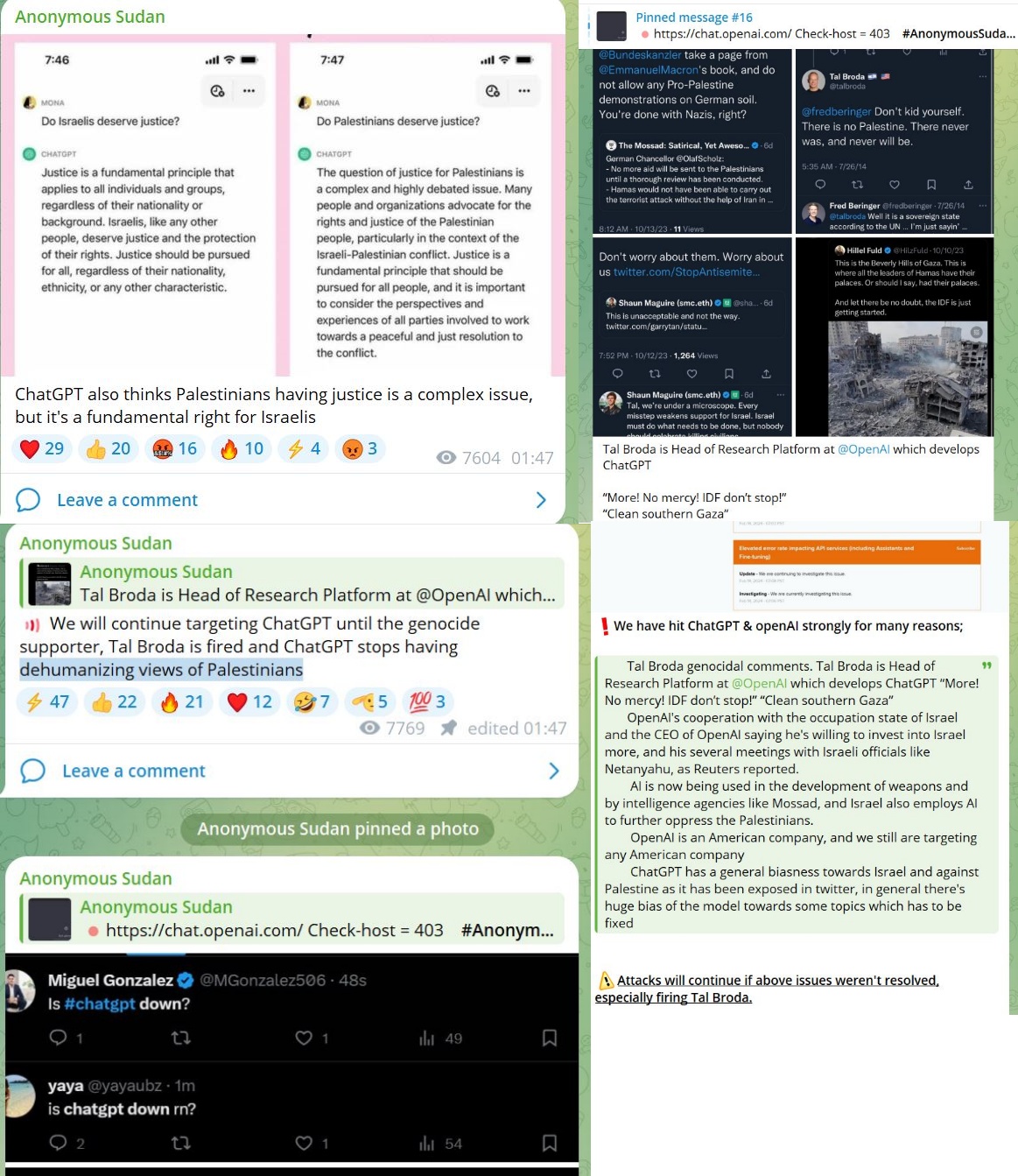
Anonymous Sudan also referenced alleged tweets attributed to Tal Broda, Head of Research Platform at OpenAI. The screenshots of these tweets depict Tal denying the existence of Palestine and criticizing calls for a ceasefire in Gaza.

According to Anonymous Sudan, they plan to continue their DDoS attacks until OpenAI implements behavioural changes to ChatGPT to prevent the propagation of what they deem as “dehumanizing views of Palestinians.” Additionally, they demand the removal of Tal Broda from his position at OpenAI.

ChatGPT Down? Anonymous Sudan Claims Responsibility for DDoS Attacks
Anonymous Sudan on Telegram (Screenshots: Hackread.com)

On the contrary, ChatGPT’s Status Page confirms service disruptions, including login issues. It also notes an “Elevated error rate impacting ChatGPT,” indicating a higher-than-usual number of errors occurring within the system or process. Such errors could arise from various factors, including faulty hardware, software bugs, network issues, DDoS attacks, or even human error.

Nevertheless, OpenAI is actively monitoring the situation and working to resolve the issue. However, as of now, there has been no official confirmation or acknowledgement from OpenAI regarding the company experiencing cyber attacks or the specific reasons behind the ChatGPT errors that users have been reporting since this afternoon.

Anonymous Sudan vs ChatGPT and OpenAI

This isn’t the first instance where Anonymous Sudan has claimed responsibility for DDoSing ChatGPT. Last November, the group made similar claims, and OpenAI acknowledged that its infrastructure was indeed targeted by DDoS attacks.

Expert Commentary

For expert commentary, we reached out to Oded Vanunu, Head of Product Vulnerability Research at Check Point Software. Vanunu linked Anonymous Sudan’s DDoS attacks to a strategy aimed at garnering media attention.

“Russian-affiliated groups Anonymous Sudan and SkyNet have claimed responsibility for the latest outages on the OpenAI website and ChatGPT service. This is according to an ‘official spokesperson’ for Anonymous Sudan going by the name of Crush on Telegram,” said Oded.

“Hacktivists often look for high-profile targets to disrupt in order to bring attention to themselves and in this case, Crush claims the groups attacked OpenAI due to the company’s perceived support of Israel.”

Anonymous Sudan’s Recent Activities

Anonymous Sudan has been notably active in recent times. According to a recent report by Hackread.com, the group has conducted DDoS attacks on various targets, including the Israeli BAZAN Group and the United Arab Emirates-based FlyDubai Airline.

Furthermore, the group targeted Thuraya Mobile Satellite Communications Company, an international mobile-satellite service (MSS) provider headquartered in Dubai, United Arab Emirates (UAE). In both attacks on UAE-based infrastructure, Anonymous Sudan claimed that the UAE’s support for the Rapid Support Forces (RSF) was evident through communication channels.

It’s worth noting that the RSF is a paramilitary force previously operated by the Government of Sudan and has been accused by hacktivists of committing war crimes against the Sudanese people.

  1. Hackers Target Israeli Rocket Alert App Users with Spyware
  2. 10 Top DDoS Attack Protection and Mitigation Companies in 2023
  3. Google, Cloudflare and AWS Disclose Largest DDoS Attack in History
  4. Hackers Send Fake Rocket Alerts to Israelis via Hacked Red Alert App
  5. Researchers Leverage ChatGPT to Expose Notorious macOS Malware
  6. WormGPT – Malicious ChatGPT Alternative Empowering Cybercriminals


[ad_2]

Source link

5 Ways to Maximize the Impact of IaC Scans

0

[ad_1]

Infrastructure-as-code (IaC) continues to gain traction and is even hailed for having changed software development towards greater efficiency and shared responsibilities between the development and operations teams. It is revolutionizing modern IT, especially given the growing prominence of cloud computing.

Simply switching to IaC, however, does not automatically result in benefits, given the rampancy of security vulnerabilities and cyber attacks designed to exploit IaC issues. That’s why it’s crucial to scan your IaC code for possible security vulnerabilities. Organizations that embrace Infrastructure-as-Code need thorough scanning to ensure that the code works as intended and has no issues that can enable or facilitate cyber attacks.

Here are a few ways to maximize the sought-after benefits of IaC scans and ensure that adopting code-based management and provisioning of infrastructure does not become an additional security challenge.

Integrating Security into CI/CD Pipelines

One of the most important steps in ensuring that whichever IaC scanning solutions you use are optimized to deliver the best outcomes is to integrate them with your continuous integration and continuous deployment (CI/CD) pipelines. As organizations adopt DevOps, it only makes sense to incorporate security mechanisms into CI/CD.

This integration enables the following key benefits: the early detection of vulnerabilities, minimizing lag times in the feedback loop, the consistent enforcement of security policies, and continuous security monitoring. Merging security with your CI/CD pipelines propagates the enforcement of security measures and the impact of security controls on the same areas the CI/CD pipelines reach. This eliminates the need to painstakingly identify the coverage of security solutions and configure tools accordingly.

Additionally, having the policy of integrating security and CI/CD pipelines supports collaboration between DevOps and security teams. This makes it inevitable for security, development, and operations teams to proactively work together to configure infrastructure efficiently and securely and address challenges together.

Continuous Scanning

Cybersecurity pundits often include continuous security validation in their recommendations to ensure protection against cyber threats. This extends to the security of IaC.

Given the growing aggressiveness and sophistication of cyber attacks, it is not enough to rely on periodic or regular checks. Cybercriminals are getting faster at exploiting security vulnerabilities. Leaving any window of opportunity for attacks to happen can lead to disastrous consequences.

It is advisable to employ automated IaC scanning tools to make sure that vulnerabilities are spotted and addressed as promptly as possible. These tools can continuously examine code repositories, configuration files, as well as deployment scripts to detect possible security issues and bring them to light for appropriate action – before cybercriminals discover and take advantage of them.

Adhering to Compliance Requirements

Some might see this advice as hackneyed and ambiguous, but it is important to emphasize the value of best practices and complying with cybersecurity regulations. If the idea of best practices sounds vague, it helps to turn to authoritative cybersecurity information sources like the OWASP IaC security cheat sheet. There are many sources of useful cybersecurity guides and insights to make Infrastructure-as-Code secure and reliable.

When it comes to cybersecurity regulations, none directly target IaC practices. However, IaC management is indirectly covered by existing regulations such as the Payment Card Industry Data Security Standard (PCI DSS) and the General Data Protection Regulation (GDPR) that impose requirements on having security controls over infrastructure components configured and managed via IaC.

IaC scanning tools that do not have features which align with the standards described in best practices and regulatory requirements are not worth using. If these tools have the necessary functions, it is also important to properly configure or activate them in line with what best practices and regulations indicate.

Prioritizing Remediation

Current technologies afford the ability to conduct continuous security scanning and address some issues automatically. However, not all issues can be properly remedied automatically. Human involvement is still required to resolve complex concerns detected in your IaC code. IaC tools can raise an endless deluge of vulnerability alerts or notifications, but it’s up to the humans overseeing the security scanning to keep up.

As such, it is important to come up with a sensible prioritization plan. Some tools provide risk-based scoring systems to make it easier for people to address the most urgent issues. These are highly useful to avoid getting overwhelmed by the problem of information overload that is common in cybersecurity tools.

Take note that it is inadvisable to rely entirely on the IaC testing tools when it comes to identifying critical assets and resources. Proper and purposeful configuration is a must, and it may be necessary to seek the assistance of outside cybersecurity experts when doing this.

Addressing the Human Weakness

People continue to be the biggest weakness when it comes to cybersecurity. Highly sophisticated scanning solutions are essentially useless if those responsible for evaluating and managing IaC security are not well-versed with the appropriate courses of action to take. Also, without proper configuration, the best IaC scanning solutions are unlikely to provide the expected outcomes.

Hence, it is essential to invest in cybersecurity training to empower teams with the right skills and knowledge for effective security management in the context of IaC environments. Infrastructure as code engineers usually have some background in cybersecurity, but not many of them have the expertise needed, especially when it comes to the most recent threats and concerted attacks.

Development and operations teams should work together with security professionals to implement secure coding practices and formulate IaC security guidelines that address the specific needs of an organization. This collaboration helps enable more effective threat detection by fostering a culture of security awareness.

In Summary

Maximizing the impact of IaC scans entails the use of the right tools and people overseeing these tools with the necessary knowledge and insights. IaC scanning tools should be capable of continuous scanning, integration with CI/CD pipelines, and providing risk-based scoring systems for remediation prioritization. They should also align with best practices and regulations.

At the same time, the teams using these tools should take full advantage of their functions and have enough cybersecurity savvy and experience, which can be achieved with cybersecurity training and collaboration among the development, operations, and security teams.

  1. The Best Ways to Automate SBOM Creation
  2. ARMO integrates ChatGPT to secure Kubernetes
  3. Kotlin app development company – How to choose
  4. Automated API Testing Differs from Manual API Testing
  5. What Are the Security Benefits of Using a Digital Signature?


[ad_2]

Source link

How To Record The Screen On Your Samsung Phone Or Tablet

0

[ad_1]

If something significant happens on your Galaxy phone or tablet, then you can always take a screenshot. However, what if it’s something that a simple picture can’t capture? This is where screen recording comes in. Ever since Android 5.0 Lollipop, Android users have been able to use screen recorders to capture videos of what’s happening on their screens. Now, the screen record functionality is built into Galaxy phones and tablets. If you want to know how to record the screen on your Galaxy phone or tablet, here’s a handy how-to guide for you.

Make sure you have the right software version to record the screen

Before you start trying to record your screen, you’ll need to make sure that your phone or tablet can even do it. If you have an older device, you might not be able to. Samsung introduced the screen recording feature with its One UI version 2 running on Android 10. This came out in December 2019, and it brought the native screen recording feature.

You can use the native screen recorder if you have a Galaxy S10 or later, Galaxy Note10 or later, Galaxy Tab S6 or later, Galaxy A53 5G, Galaxy A52, Galaxy A32 5G, or any of the Galaxy Z Fold/Flip phones. While One UI 2 did come out to the Galaxy S9 and Note9, you can’t use the feature on those phones.

If you don’t have any of the devices listed above, don’t fret! At the end of the article, we’ll explain an alternative using a 3rd-party app.

Access your screen recorder

If you have an eligible phone, then this is where the fun begins. Accessing your screen recorder is as easy as accessing the notification shade. Just swipe down from the top of the screen to summon your notification shade, then swipe down again to get all of your options. You should see a video camera icon among your quick settings. If not, then you’ll need to place it.

Swipe to the left to get to the next page of quick settings. There’s a chance that you’ll see it there. If you still don’t see it, then press the “+” icon in the circle at the end of the quick settings. There, you’ll see all of the rest of the quick settings that you can place. Search for the camcorder icon. When you find it, hold your finger down on it and drag it to the place you want to drop it.

Adjust the settings

If you’re eager to get recording, you can just tap on the button, but there are some settings you can use to customize the recording experience. Hold down on the screen recorder icon, and you’ll be taken to the settings page. There are two sections of the settings page; go to the bottom section.

Audio source

Here, you’ll be able to select the audio source. The first option is no sound, but the second option says Media sounds. This means that the phone will record the sound of whatever’s happening on your phone. If you’re playing a game, you’ll hear everything that’s going on in the game and nothing else.

Under that, you have an option called Media and mic. This will use the device’s external microphones to record audio along with the media sounds. This means that you’ll be able to hear yourself and your surroundings when playing your video.

Video resolution & selfie camera

Next, you’ll be able to adjust the video resolution. The higher the resolution you record, the larger the file will be, so you might want to make sure you have the storage before you pick the high-resolution option.

You’ll then see the option to adjust the selfie video size. While you’re recording, you have the option to activate the selfie camera and show your face along with the video. In the settings, you’ll be able to pick how big you want the selfie video to be compared to the rest of the video.

Last, but not least, you can toggle the ability to show the taps on the screen. When you have this enabled, every time you tap on the screen while recording, you’ll see a little dot appear where you tapped during the playback.

How to Record record the screen on your Galaxy device

Now that you’ve found the icon and adjusted the settings, you can start recording. When you press the screen record button, you’ll see a popup screen telling you about screen recording. When you record, EVERYTHING on your screen will be recorded, so be careful about what you have on your screen while recording. Also, you’ll be able to pick the audio source and whether or not you want to show the taps.

If you’re good to go, press the Start recording button on the bottom right. You’ll see the popup disappear and a “3…2…1” countdown appear. Under the numbers, there’s a Skip countdown button that will let you start recording immediately.

The toolbar

When you start recording, you’ll see a toolbar appear up top. This provides some extra options while recording. For starters, there’s a pencil icon on the left. This will let you draw on the screen, and those markings will be recorded in real-time. You can use this to emphasize anything particular on the screen.

Next, you’ll see a little person icon. This will activate the selfie camera, and you’ll see your face appear on the video. If you don’t want to see your face, simply tap it again and it’ll disappear.

Last, but not least, you’ll see the pause recording button and the stop recording button on the right side. Pausing the recording will stop it temporarily and let you continue by pressing it again.

After the recording

Now that you’ve finished recording your video, it’s time to figure out what to do with it. Immediately after stopping the recording, you’ll see a notification telling you that the recording has finished. Tapping on the notification will automatically play the video using the default video player.

What if you want to do some work on the video? Well, tap on the downward-facing arrow on the notification, and you’ll see some additional options. Tap on the Edit button on the bottom, and it will take you to a rudimentary video editor. There, you’ll be able to trim and crop the video, add filters, and adjust the exposure and color settings. Also, you’ll be able to add stickers, marks, and text to the video. After that, tap on the Save as copy button to save your work.

If you want to find your finished masterpiece, open up the gallery. Your screen recordings will be in the screen recordings folder.

[Updated February 2024] Sharing your video recording

You’re likely going to want to send your screen recordings to other people or different apps. If that’s the case, it’s easy to do so. After you take a screen recording, you’ll see a notification pop up with some options. If you don’t see the options, swipe down on the notification to reveal them.

Tap on the Share option to see your share sheet. The share sheet will show you several options for sharing your screen recording; there are two rows of options. The top row will show you the sharing methods you most recently used. This will include devices you shared to, text message conversations, people you messaged on social media, ETC.

The second row will show you the apps that you can share to. Swipe left on this row to reveal more apps. At the very end of the row, you’ll see a More button. Tapping this will open a full shelf of apps that you share the screen recording to. If you want to edit it, tap on the video editing software you want to use.

What if your phone doesn’t have native screen recording?

Your Galaxy phone most likely has the ability to screen record, but if you’re rocking an older phone, then you might not have the functionality. Phones older than the Galaxy S10 don’t have native screen recording capabilities, so if you have one, you’re going to need to look to the Google Play Store for an alternative.

One great option you should consider is called XRecorder. This is an app that gives you the same features as your native screen recorder with some added features. You can record up to your phone’s max resolution with the ability to adjust the image quality and frame rate. However, frame rates higher than 60FPS require the premium subscription.

You can also choose options such as recording while the screen is off and shaking your phone to stop recording. These are just a few of the features that you can use.

Getting the subscription will give you more features and functionality. It costs $5.99/month, $16.99/year, and $28.99 for life.

Download XRecord

[ad_2]

Source link