If you love the smell of napalm in the morning, you’ll love this smell, too: US senators grilled tech CEOs and Mark Zuckerberg specifically.
At a Wednesday Senate hearing, lawmakers discussed how social media platforms are failing to protect children from escalating threats of sexual predation on their networks and urged Congress to pass legislation (via Reuters).
That’s the latest effort by lawmakers to address the concerns of parents and mental health experts that social media companies prioritize profits over making sure their products are safe for children.
The hearing brought together Meta (Facebook, Instagram) CEO Mark Zuckerberg, X/Twitter CEO Linda Yaccarino, Snap CEO Evan Spiegel, TikTok CEO Shou Zi Chew and Discord CEO Jason Citron to testify.
Senator Lindsey Graham confronted Zuckerberg directly, but didn’t leave his colleagues out of it as well:
“Mr. Zuckerberg, you and the companies before us, I know you don’t mean it to be so, but you have blood on your hands”, said Senator Lindsey Graham and added: “You have a product that’s killing people”. That last part is a bit ironic, given one of Lindsey Graham’s latest tweets, but let’s not digress.
“This disturbing growth in child sexual exploitation is driven by one thing: changes in technology”, says Senator Dick Durbin during the hearing. Durbin, being the Judiciary Committee’s Democratic chairman, cited statistics from the National Center for Missing and Exploited Children nonprofit group that showed skyrocketing growth in financial “sextortion” – the malevolent act in which a predator tricks a minor into sending explicit photos and videos.
As the hearing kicked off, the committee played a video in which children spoke about being victimized on social media. “I was sexually exploited on Facebook,” said one child in the video, who appeared in shadow.
Parents of kids who were harmed due to social media were present at the Senate hearing. They held pictures of their children and some jeered Zuckerberg during his statement and interrupted him with shouts.
Zuckerberg expressed regret about what they had experienced and pledged to work to prevent it from happening to others, but stopped short of taking responsibility for facilitating the abuse.
Ransomware has been one of the top threats to organizations, contributing several millions of dollars to multiple organizations worldwide.
Most of these ransomware operators infiltrate the systems, steal sensitive data, and lock the systems with ransomware.
There have been a variety of ransomware activities in the past, such as WannaCry, GandCrab, and many others.
Most of the ransomware operators use custom-written ransomware for their operations. However, there has been a rise in Python-based ransomware variants in recent years.
DocumentRun Free ThreatScan on Your Mailbox
Trustifi’s Advanced threat protection prevents the widest spectrum of sophisticated attacks before they reach a user’s mailbox. Try Trustifi Free Threat Scan with Sophisticated AI-Powered Email Protection .
New Python Ransomware
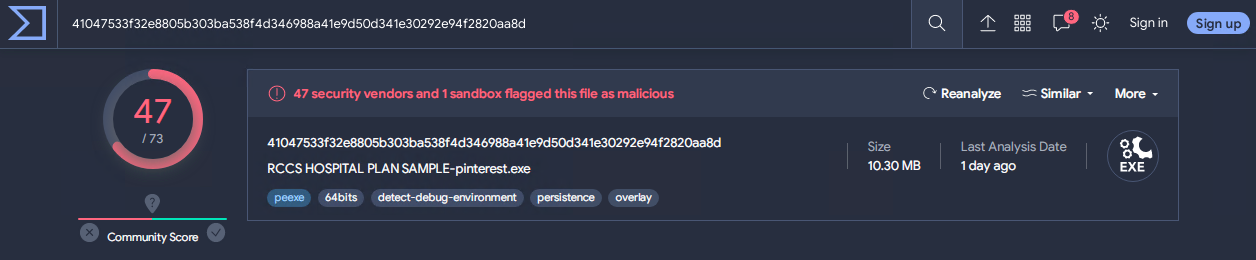
According to the K7 labs report, a recent ransomware sample was found and investigated. It turned out to be written in Python, which is not common. The ransomware binary was checked in VirusTotal and was detected by 47 antivirus providers.
Virustotal Analysis (Source: K7 Security Labs)
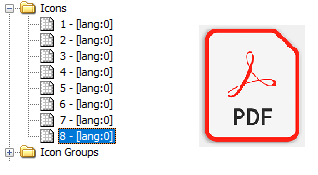
The malicious file was found to be an executable file compiled in C++. Moreover, the executable file had a PDF icon as a means of disguising its original extension. To further investigate, the malicious PDF file was extracted with pyinstxtractor. Further analysis revealed the main source code file under the name “grinchv3.pyc”.
PDF and pyinstxtractor (Source: K7 Security Labs)
Behavioral Analysis
The script was written with several lines of code under a single class named “sweet.” The __init__ function of the class gathers additional information and performs the following functions.
Fetches the current user of the victim machine
Drive partition scanning (A:\ to Z:\ is scanned)
Determining the Type of files to encrypt
Moreover, the encryption is started only after adding the unlock notes under the name “UNLOCK MY FILES.txt” on all the file paths that are about to be encrypted. For encryption, the Fernet Python cryptography module was used. After encrypting, a pop-up message is configured to be shown to the user.
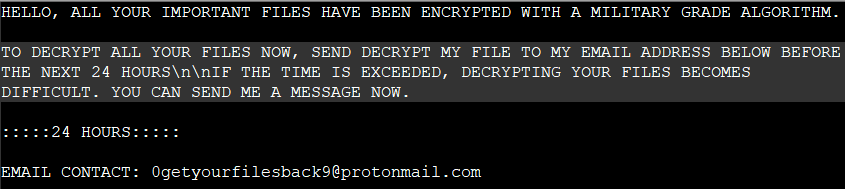
All the encrypted files are under the extension “.enc” and remain unreadable after the ransomware encrypts them. Furthermore, the ransom notes include the email address of the attacker to contact for decryption.
Ransom Note (Source: K7 Security Labs)
K7 Security Labs has published a complete report about this new Python ransomware variant. It provides detailed information about this new Python-based ransomware source code, encryption methodology, and experimental and behavioral analysis.
Sideloading has been in the news recently because starting with the release of iOS 17.4 in the EU, an update expected to surface in March, iPhone users in the 27 EU member countries will be able to install apps from third-party app stores. Speaking about sideloading, a practice that Android users have been able to do since day one, Google has been making some changes as well although in the opposite direction.
When Android 14 was released last year, Google started issuing warnings for Pixel users sideloading an app update from a different source. The warning alerted users that if they installed an app update from a third-party app store, they could receive updates from any source on their phone. Originally spotted for Google apps only on Pixel phones, it seems that more Android users have seen this warning lately for non-Google apps on Samsung Galaxy handsets.
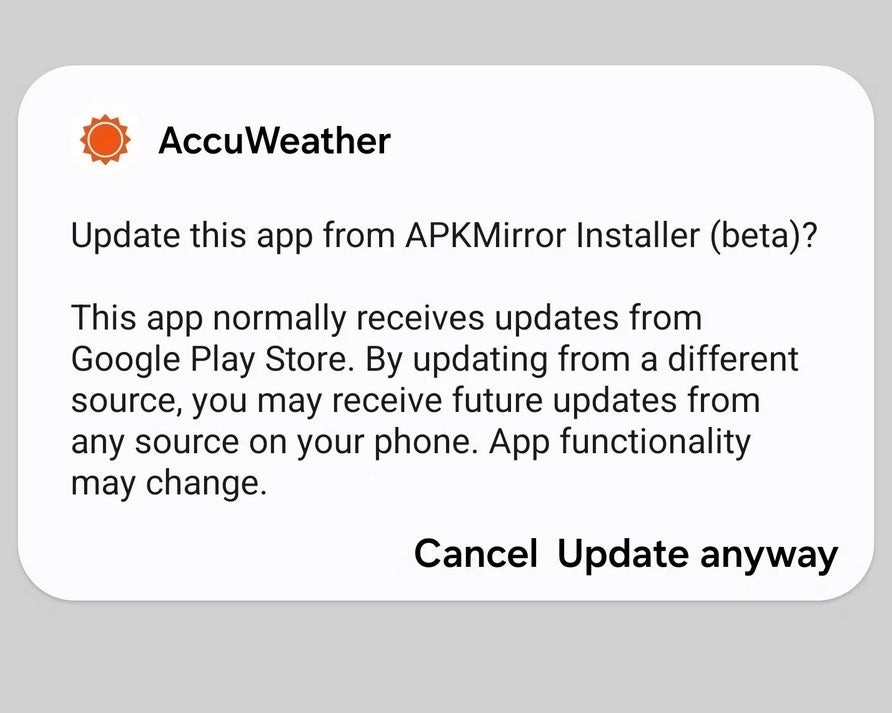
For example, one warning received by a Galaxy S23 Ultra user came when he was about to install an update for the AccuWeather app from a third-party app store. The message said, “Update this app from APK Mirror Installer (beta)? This app normally receives updates from Google Play Store. By updating from a different source, you may receive future updates from any source on your phone. App functionality may change.” The user is given two options at the bottom right of the notice: “Cancel” or “Update anyway.”
Some Android users sideloading app updates are seeing warnings like this from Google
The warning appears only once. If you download an app from the Play Store and then sideload an updated version from a third-party source, you won’t receive the warning again for the next update. And the issue is, if you do install an update from a third-party app store, for some reason it might not have a feature that was available on the previous version of the app.
And we haven’t even touched upon the worries about malware. We get it. Some iPhone and Android users feel that since they paid for their phones, it should be up to them to take the risk that the app they installed from a third-party store contains some sort of dangerous malware. Sure, Google Play Protect does perform real-time APK scanning for sideloaded apps, but we’ve seen how some apps slip under the screen in the Play Store.
Google’s warnings might be a pain in the butt to those who take a laissez-faire approach to sideloading apps. But you know what could be a bigger pain in the butt? Seeing all those complaints from those who sideloaded a malicious app, had their bank accounts and credit cards drained, and complain that they had no idea that something like this could happen.
Mercedes-Benz has been reported to have leaked its source code due to a GitHub token leak from an organization employee.
This particular leak was identified during an internet scan from a research team, revealing a GitHub repository holding this information.
This token gave unrestricted and unmonitored access to the entire source code that was hosted on the Internal GitHub Enterprise server, which had sensitive information such as intellectual property and compromised information, including Database Connection Strings, Cloud Access Keys, Blueprints, Design Documents, SSO Passwords, API Keys, and Other Critical internal information.
DocumentRun Free ThreatScan on Your Mailbox
Trustifi’s Advanced threat protection prevents the widest spectrum of sophisticated attacks before they reach a user’s mailbox. Try Trustifi Free Threat Scan with Sophisticated AI-Powered Email Protection .
Results if Exploited
According to the reports shared with Cyber Security News, if a threat actor had access to this token, there was a variety of sensitive information that the threat actor could use for various malicious operations.
A threat actor could have utilized this token to retrieve all the sensitive information including API keys, Cloud Access keys, etc., to steal data from Mercedes-Benz.
Further, this information could have also been sold at dark web marketplaces in exchange for bitcoins or any cryptocurrency.
Additionally, there could also be financial consequences that could have happened due to data theft, extortion, backdoor deployment, ransomware deployment, and any malicious activities that could benefit the attacker.
From a company perspective, if these data consisted of any kind of consumer information, GDPR violations could have taken place that could cause millions of dollars in loss.
On the other hand, this also spoils Mercedes-Benz’s reputation, leading to a reduction in customers’ trust followed by a loss of business.
Redhunt Labs report details the incident’s consequences, impact, risk, and other information.
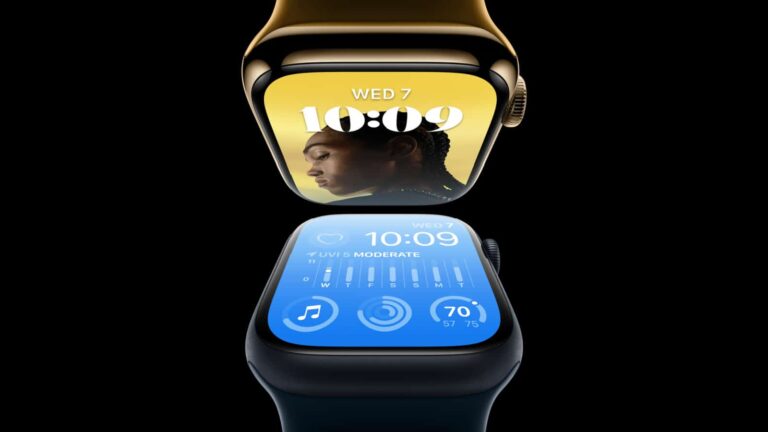
Best Buy has put the Apple Watch Series 8 on clearance, which likely means once stock runs out, it’s gone. And Apple no longer sells the Series 8, so it’ll be hard to find this particular model. But right now, you can find it for just $319. That’s going to save you $80 off of its regular price. This does bring it down to an all-time low. Typically, this drops by $50 for $349, so seeing it at $319 is rather impressive.
The Apple Watch Series 8 is one of the best smartwatches on the market, and it’s currently on sale for $319. This is a great opportunity to get your hands on this powerful device, which is packed with features that can help you stay healthy, fit, and connected.
Here are just a few of the reasons why you should buy the Apple Watch Series 8:
It’s a great fitness tracker. The Apple Watch Series 8 has a variety of sensors that can track your heart rate, sleep, workouts, and more. This data can help you stay motivated and make informed decisions about your health.
It’s a great communication device. The Apple Watch Series 8 can make and receive calls, send and receive text messages, and use apps like Messages, Mail, and FaceTime. This makes it easy to stay connected with friends and family, even when you’re on the go.
It’s a great safety device. The Apple Watch Series 8 has features like fall detection and emergency SOS that can help keep you safe. If you fall, the watch will automatically call for help. And if you’re in a dangerous situation, you can press the side button three times to quickly call emergency services.
It’s a great fashion accessory. The Apple Watch Series 8 is available in a variety of colors and styles, so you can find one that matches your personal style. And with its sleek design, the Apple Watch Series 8 is sure to turn heads.
You can pick up the Apple Watch Series 8 from Best Buy today before stock runs out.
The Samsung Galaxy S24 Ultra managed to steal the thunder from its siblings since the launch event. The Galaxy S24 and Galaxy S24+ are also quite compelling devices, and the vanilla model actually got a high repairability score in the latest test.
The Galaxy S24 earned a high repairability score, just like its ‘Ultra’ sibling
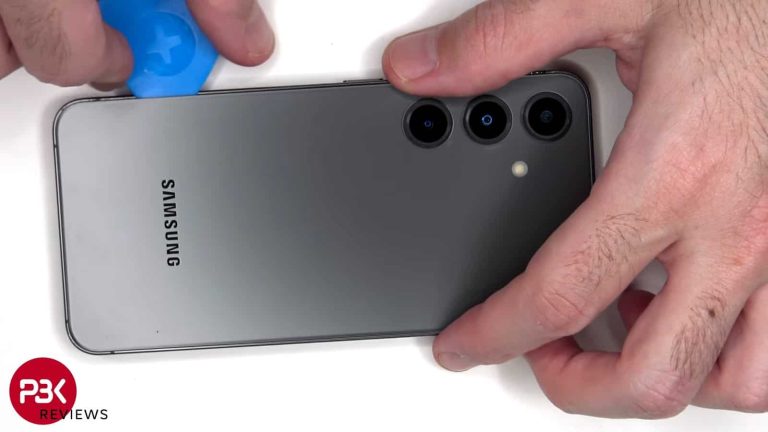
A well-known YouTube channel, PBKReviews did the test. The phone got disassembled, and based on that, the internals, and re-assembly, a repairability score was figured out. The Galaxy S24 actually managed to get a 9/10 repairability score, which is quite high, needless to say.
Before we get down to it, do note that the Galaxy S24 Ultra got the same treatment recently. PKBReviews gave the ‘Ultra’ model a 9/10 repairability score as well, so Samsung did a good job with both devices. We presume that the ‘Plus’ model is in the same boat.
Now, believe it or not, the Galaxy S24 also has a rather large vapor chamber on the inside. It is larger than the one in the Galaxy S23, and that’s something you can see in the video embedded below the article.
The vapor chamber is almost as twice as large as the Galaxy S23’s
It’s almost twice as large as the one in the Galaxy S23. It’s not exactly trailing behind the ‘Ultra’ model in that regard, not at all. Now, in order to access the phone, the back needs to be pried off after applying enough heat.
The good news is that the camera lens covers can be replaced individually. The phone’s mainboard has a dual-layer design. So, that didn’t change compared to last year’s model.
The rear cameras can be removed easily, while the front-facing ones, not so much. That one is glued into place, so you’ll need to use a knife to cut the glue.
The battery can be removed rather easily
As far as the battery goes, it can be removed easily thanks to a pull tab. The screen is more of a problem, however. The source says that removing it is almost impossible without damaging it. However, if you’re removing the display, chances are you want to replace it, so… it’s a moot point. Removing it is not difficult, just keep in mind you’ll likely damage it.
How did the phone get a 9/10 repairability score, however? Well, the source says that parts availability is counted into the score too, as is the ease of battery replacement, and the ease of replacement of various other parts of the phone.
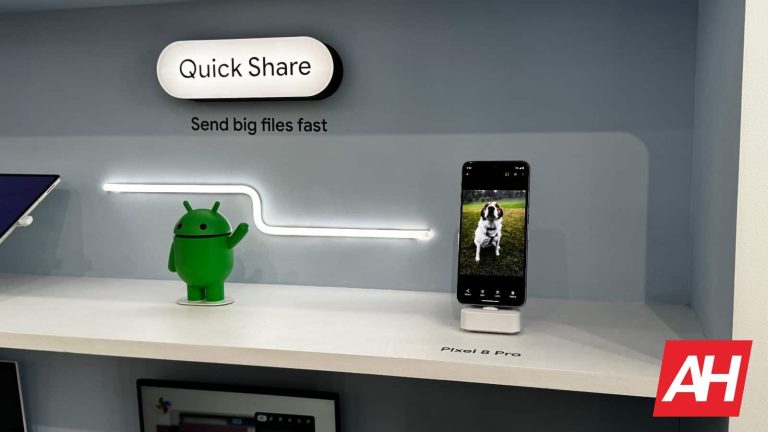
The rebranded and improved version of Nearby Share, called Quick Share, has begun rolling out to some Google Pixel phones. This rebranding was confirmed to be happening by Google back in early January of this year. It’s not just a name change either. Quick Share is aiming to be better than Nearby Share in a multitude of ways, and truly give Apple’s AirDrop a run for its money.
The change has begun appearing on some Pixel phones
Quick Share isn’t going to be a unified rollout, it appears. Users have reported that they’ve noticed their Nearby Share option has switched to Quick Share without any alerts. When using it for the first time, a small popup shows up to inform the user of the name change. The popup doesn’t mention anything else, probably so the average consumer isn’t bombarded with technical jargon.
Mishaal Rahman, considered to be an expert on Android, tweeted about the change showing up across certain devices. He cites X user @android_setting for the tip, however. Commenters corroborated the reports by sharing their own experiences. It seems it’s only some Google Pixel phones that are receiving this update, including the Pixel Fold. The reason for this, as Mishaal pointed out, might be because Google’s Quick Share and Samsung’s Quick Share are different. Google’s version is the version that will be making its way to all Android phones eventually. Meanwhile, Samsung’s Quick Share will operate solely on Samsung devices.
How does Quick Share improve on Nearby Share?
Quick Share came about as a collaboration between Samsung and Google. The two tech giants teamed up to produce a truly competitive alternative to AirDrop. Quick Share was initially just a Samsung feature, but Google is now rebranding its Nearby Share to the same name as part of the joint effort. It will be increasing the limit on the file sizes allowed to be shared between devices.
The two companies will also be designing their services so they do not conflict with each other. Google’s version of Quick Share, for example, will be disabled on Samsung devices. However, Samsung’s version will be perfectly compatible with Google’s. Furthermore, Google has started trying to get PC manufacturers to install Quick Share in their products. If these proposals go through, Android and Windows could finally see the sort of unity Apple fans enjoy.
Quick Share is probably going to start rolling out much faster pretty soon. The average user might not even notice it appear, but they will get used to the utility of it soon enough.
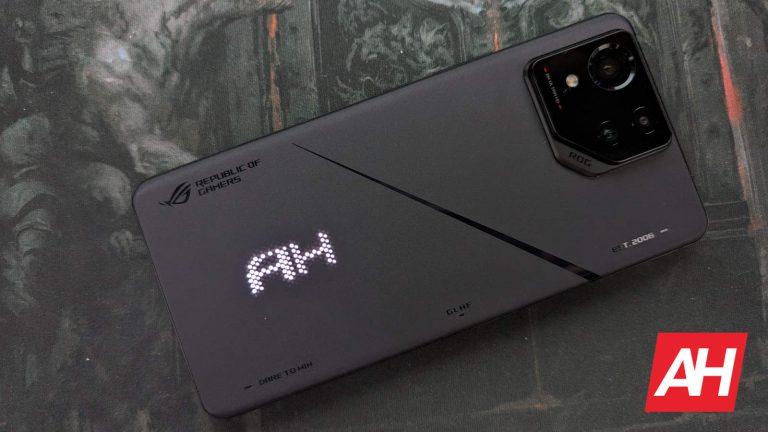
The ROG Phone 8 Pro comes with a lot of cool features tailored for gamers, and one of those is the new AniMe Vision display that sits on the back. When looking at the back of the phone you might never notice that the display is there. That’s because it’s hidden when not in use. It’s essentially the same type of display you can find on ASUS’s ROG Zephyrus laptops, only those are called the AniMe Matrix displays. They’re the same thing though, and they use a ton of programmable Mini LEDs to make up little pictures and animations.
With the AniMe Vision display on the ROG Phone 8 Pro, you can choose from a collection of pre-loaded animations that ASUS provides. This includes things like the ROG Eye logo, a “Game Start” message, and a few others. There are also quite a few animations for different phone functions. Things like battery percentage, and incoming calls and messages. There’s even an animation for a media visualizer that pops up when you play music on the phone.
The coolest part though, is that you can customize the animations with your own stuff. This includes uploading your own animations. Now, this isn’t entirely new. It was available with the ROG Vision display that first popped up with the ROG Phone 5 series and stuck around till the ROG Phone 7 series. The big difference is that because the AniMe Vision uses Mini LEDs the animations look kind of like retro pixel graphics. This will limit what you can use for an animation if you want it to look good. But you can play around with stuff and find something that fits your preference. With all of that said, if you’re unsure how to customize the animations, this guide will walk you through it.
How to customize the AniMe Vision animations on ROG Phone 8 Pro
There are a few ways to customize the AniMe Vision display, so we’ll go over all of them with steps for each one. The process is pretty simple and doesn’t take long. But if you aren’t sure where to look it can be easy to miss.
Uploading your own animations to the AniMe Vision display
This is probably going to be the most enjoyable method to use as you have the opportunity to add some pretty cool animations. That being said, the AniMe Vision display will support GIF and PNG formats only. GIFs will be the animations you want to use if you want something that isn’t a static image. You also need to make sure that whichever image type you choose is a specific size. The image you use has to be 254 x 128 or it won’t be compatible. It also needs to be mono-color (black and white).
With that in mind, let’s go over how to set it up.
Find a picture you want to use
The obvious first step is finding something you want to use. You have a wide world of options. Just remember that if you want the animation to look good you’ll have to think more carefully about what you use. If you need some inspiration, GIF images of stuff in retro pixel graphics are good choices. Things like Pac-Man, Link from the Legend of Zelda, Mario, Yoshi, and any iconic characters from older games could work really well. But feel free to use your imagination and find something you like. You can also find some being shared by other ROG Forum community users here.
Download the image
This is another obvious step here, but we felt it was worth mentioning solely for a couple of reasons. It might be more convenient to download the image on the phone but it will need to be no larger than the size listed above. With this in mind, it might be easier to find an image on the PC and use something like GIMP to resize it properly, then transfer it to the phone for use. But find your images however it’s most convenient for you.
Launch the Armoury Crate app
Now that you have the image downloaded, launch the Armoury Crate app. This is where you’ll find a lot of the unique ROG Phone 8 series features that other phones don’t offer.
Go to the ‘Console’ tab and tap “more settings” on the AniMe Vision section
Next, go to the Console tab. This is where you’ll be able to find and adjust the special features that the phone offers. It’s also where you can access and enable the different phone profiles, including X Mode for peak performance while gaming. Scroll to the AniMe Vision section and tap on the More Settings button.
Tap on one of the functions
Most of the functions will support custom AniMe Vision animations. However, there are a few which only support the pre-loaded options. Such as Screen Off, the Timer Countdown, and Music Visualizer. Anything else will allow the customization.
Tap the “+” button in the bottom corner and select Import
Once you tap the + button you’ll see a little pop-up menu of options. Select the “import” option to use your own GIF or PNG.
Select your GIF images
Remember, it has to be 254 x 128 or it won’t work. if you have other GIF images saved on your phone, they’ll pop up along with the ones that are compatible. Just select the compatible GIFs you want to import and then hit “add.”
Tap on the “Custom” tab for the desired function
Once you have the GIF images uploaded, go back to the function you want to use them on and tap on the Custom tab. Here you’ll see any custom imported GIFs that you can apply. Select the one you want and it will automatically apply to the display. Also, make sure the toggle is enabled so the AniMe Vision animation is on.
Draw your own animation
This is a pretty neat way to customize the AniMe Vision display if you want to get a little more creative. The neat thing with the Draw option is you can add filters to whatever you draw to be a part of the animation. Like flashing or fading in and out.
Keep in mind getting something that looks nice here may be a little harder, but again, play around with it until you get something you like.
Tap the “+” button and select Draw
Just like before with the import option, you’ll tap the + button to bring up the pop-up menu and this time select the draw option.
Draw your animation
Once you tap on the draw option, you’ll need to turn your phone sideways and hold it in landscape mode. You can then draw your animation on the designated part of the screen. If you wish to preview it before saving, tap the eye button in the top right corner. This will put a preview of it on the back of the phone.
Add a filter
After you’re done drawing what you want, tap on the magic wand icon in the legend on the right-hand side of the display. This will bring up the filter options you can select from. Choose one and then check the preview again if you wish.
Save your animation
Now that you’re done coming up with something, you can save it by hitting the save disk icon next to the preview icon. Go back to the custom tab and it’ll be there along with any GIFs that you imported.
Add some text or a gamer tag
The last thing you can do when customizing is add some text or a gamer tag. This is a neat way to add some personal touches.
Tap the “+” button and select the text icon
Go back to the desired function and then tap the + button again, and this time select the text icon.
Type your text
Type in anything you want here. It can be your gamer tag, your name, a short message, or really anything. But please use common sense and make sure what you type is appropriate. You also have a maximum of 20 characters.
Choose the font and speed
Now that you’ve typed something in, you can also change the font and speed of the text. Again, you can preview it on the back if you want, then hit the save icon once you’re done. And that’s pretty much it. These are all the ways you can customize the AniMe Vision display on the ROG Phone 8 Pro. Any text animations you create will be visible in the custom tab along with the others.
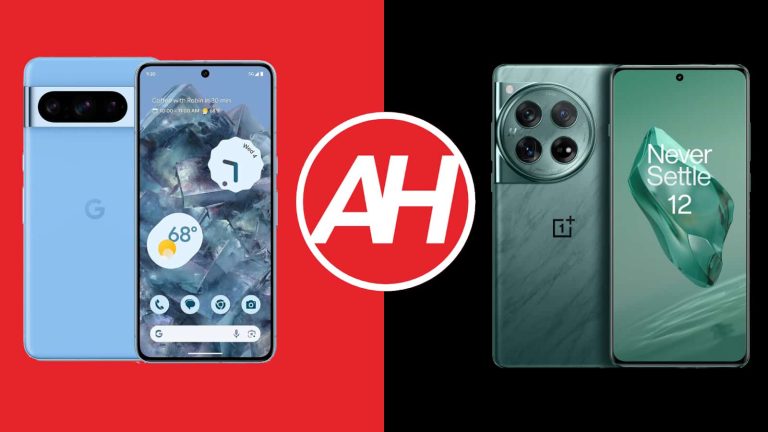
OnePlus managed to create a truly compelling and impressive flagship for 2024, the OnePlus 12. That device launched back in December, but its global variant arrived earlier this month (January). That being said, in this article, we’ll compare the Google Pixel 8 Pro vs OnePlus 12. In other words, the very best of Google is going against the best OnePlus has to offer. Both are large-format flagship smartphones.
These two phones do look somewhat different and also come with rather different specifications. Both of them are quite compelling, though. We’ll first list their specifications, and will then move to compare their designs, displays, performance, battery life, cameras, and audio performance. There’s a lot to talk about here, so let’s get started.
Both of these devices are made out of metal and glass. They do look quite different, though, especially when you check out their backsides. The Google Pixel 8 Pro features a flat display with a centered display camera hole and very thin bezels. The OnePlus 12 features a curved display with a centered display camera hole and very thin bezels. The bezels on either phone are not uniform, but they’re very close to it.
The Pixel 8 Pro has a camera visor on the back, which hosts three cameras. That visor connects to the left and right sides of the frame, and it’s covered by metal. The OnePlus 12 includes a more regular camera island in the top-left corner. There are three cameras included in there. Both smartphones include all their physical buttons on the right-hand side, though they’re placed there in different order. The OnePlus 12 also has a physical switch on the left-hand side, the alert slider.
The OnePlus 12 does have a slightly larger display than the Google Pixel 8 Pro. It is a bit taller because of it, but it’s also narrower, as its display is curved. The OnePlus 12 is also slightly thicker than the Google Pixel 8 Pro, but only barely. Both smartphones are water and dust-resistant, but they do come with different certifications. The Pixel 8 Pro offers IP68 certification, while the OnePlus 12 is IP65 certified.
They both feel quite premium in the hand, but also quite slippery at the same time. Using a case with these two phones may be a good idea, at least for most of you.
Google Pixel 8 Pro vs OnePlus 12: Display
Google’s flagship features a 6.7-inch 2992 x 1344 LTPO OLED display. That panel is flat and it has a 120Hz refresh rate, which is adaptive, by the way. This phone supports HDR10+ content, and its brightness goes up to 2,400 nits at its peak. The display aspect ratio here is 20:9, in case you were wondering, while OnePlus also used the Gorilla Glass Victus 2 display protection from Corning.
Google Pixel 8 Pro
The OnePlus 12, on the flip side, includes a 6.82-inch QHD+ (3168 x 1440) LTPO AMOLED display. That panel is curved, and it can project up to 1 billion colors. It also offers an adaptive refresh rate (1-120Hz), and Dolby Vision support. HDR10+ content is also supported here, and the display has a theoretical top brightness of 4,500 nits. Corning’s Gorilla Glass Victus 2 display protection is used here too.
What are the takeaways from these two displays? Well, both are great, to be quite honest. Both are quite vivid, very sharp and have deep blacks. The viewing angles are also outstanding on both displays. Even the touch response is more than good enough. They are both also plenty bright when you’re outdoors, even in direct sunlight. We don’t really have a single complaint when it comes to these two panels.
Google Pixel 8 Pro vs OnePlus 12: Performance
Google’s Pixel 8 Pro handset is fueled by the Google Tensor G3 processor. Google also included 12GB of LPDDR5X RAM inside of it, while the company is using UFS 3.1 flash storage here. The OnePlus 12, on the other hand, includes the Snapdragon 8 Gen 3 processor. You can choose between 12GB and 16GB of RAM here, and LPDDR5X RAM is used. OnePlus opted for faster UFS 4.0 flash storage here.
On paper, the OnePlus 12 is a more powerful smartphone. Not only does it come with a more powerful processor, but it has faster storage on top of that. The Google Tensor G3 enables some neat AI features on the Pixel 8 Pro, though. They both offer great performance in day-to-day usage. The OnePlus 12 may be a bit snappier when it comes to opening apps and such actions, but the differences are negligible.
Both smartphones do a great job when it comes to multitasking, and everything ranging from browsing and consuming multimedia, to processing images and shooting photos. You may notice a difference in the gaming department, though, depending on what you’re playing. If you’re playing more demanding games, the OnePlus 12 is the better option. Not only will it offer a better performance, but it will heat up less than the Pixel 8 Pro. Google’s flagship can handle gaming, though, don’t get us wrong.
Google Pixel 8 Pro vs OnePlus 12: Battery
Google’s flagship comes with a 5,050mAh battery on the inside. The OnePlus 12 includes a larger 5,400mAh battery. The battery capacity is not always indicative of battery life difference, but in this case, it is, at least partially. The OnePlus 12 offers outstanding battery life, one of the best we’ve seen on a flagship smartphone. The Google Pixel 8 Pro is very good in that department, but it cannot compete with the OnePlus 12.
The OnePlus 12 managed to last very long in our battery drain test. In day-to-day usage, we’ve been getting great numbers from that device and even managed to pass the 9-hour screen-on-time mark with a bit of battery life left in the tank. Do note that such days did not include gaming, but did include various other tasks. The Pixel 8 Pro, during similar usage, was able to cross the 7-hour screen-on-time mark and was closer to being depleted than the OnePlus 12 after 9 hours of screen usage. After 5 hours of screen usage, the OnePlus 12 had over 50% of battery life left on most days, just to give you an idea of what we’re talking about here.
If you do run out of battery life ahead of time, the OnePlus 12 will also charge faster. In fact, the OnePlus 12’s wireless charging is faster than the Pixel 8 Pro’s wired charging. It supports 100W wired (80W in the US) charging, along with 50W wireless charging, and 10W reverse wireless charging. On top of that, it comes with a charger in the box. The Pixel 8 Pro does not include a charger, and it supports 30W wired, 23W wireless, and 5W reverse wireless charging.
Google Pixel 8 Pro vs OnePlus 12: Cameras
The Google Pixel 8 Pro features a 50-megapixel main camera, a 48-megapixel ultrawide unit (126-degree FoV), and a 48-megapixel periscope telephoto camera (5x optical zoom). The OnePlus 12 includes a 50-megapixel main camera, a 48-megapixel ultrawide unit (114-degree FoV), and a 64-megapixel periscope telephoto camera (3x optical zoom). It’s also worth noting that Hasselblad is a part of the OnePlus 12 equation.
OnePlus 12
The camera performance on both sides is very good, to say the least. The Pixel 8 Pro provides contrasty shots that do tend to look a bit unrealistic, but also great at the same time. The OnePlus 12 does offer more realistic shots, with outstanding colors. The details provided by both smartphones are great, and both do a great job in HDR conditions too. The Pixel 8 Pro does tend to give the image a slightly cooler tone, though.
Ultrawide cameras are great on both phones, and they do a great job of keeping the same color profile as the main shooters, in most situations. Telephoto cameras do a very good job too. The OnePlus 12 did a better job up to 5x, while Google’s did a better job from 5-10x. In low light, the Pixel 8 Pro tends to brighten up the scene more than the OnePlus 12, which results in different images. The ones from the OnePlus 12 tend to look more realistic. Both phones manage to preserve quite a bit of detail in low-light conditions.
Audio
Each of the two devices has a set of stereo speakers included. Speakers on both smartphones are very good, and they offer a similar level of loudness. They’re also well-optimized for sound, and even though they’re not the best around, they’re good enough.
If you were hoping to find an audio jack on either of the two devices, well, that won’t happen. You can always utilize their Type-C ports if you want to connect your headphones via a wire, though. If not, Bluetooth 5.3 is at your disposal on the Pixel 8 Pro, while the OnePlus 12 offers Bluetooth 5.4.
The Federal Communications Commission (FCC) has announced that its recent actions with the Federal Trade Commission (FTC) against international robocalls appear to have had an effect.
Robocalls are automated phone calls, often associated with scams and unwanted solicitations, which can be a nuisance to individuals and businesses alike.
In November, 2023, the FCC and FTC sent separate, but coordinated, warning letters to specific gateway providers demanding these providers cease to serve as entry ways for international robocalls to the US. Failure by a gateway provider to take reasonable and effective steps to prevent their networks from transmitting illegal traffic could ultimately result in an order by the FCC directing downstream providers to block and cease accepting all of the gateway provider’s traffic, they were warned.
From the reduced number of traceback requests the FCC deducts that this has had a positive effect. According to USTelecom’s Industry Traceback Group (ITG), there is a downward trend in tracebacks related to traffic entering the US network through these providers.
The ITG is a group of companies from across the wireline, wireless, VoIP, and cable industries that collaborate to trace, source, and ultimately, stop illegal robocalls.
Robocalls are not only an annoying waste of time and resources, they often serve as a prelude to more targeted scams. Scam calls in particular can result in serious financial losses and frustration. So the FCC has made combatting unlawful robocalls and malicious caller ID spoofing a top consumer protection priority.
There are apps that can help you block robocalls. Malwarebytes for iOS, for example, blocks all incoming robocalls and text message scams. The Malwarebytes iOS app also protects you from phishing attacks and malware. If, by chance, you click a malicious link or attempt to navigate to a fraudulent site, Malwarebytes will block the site from loading.
Some wireless companies are also providing services, which will display some variation of the message “possible scam” on the screen for unknown numbers that call you.
What to do if you answer a robocall
When you receive a call from someone outside your contact list only to hear a recorded message playing back at you, that’s a robocall.
Hang up as soon as you realize that it is an automated robocall.
Do not engage with the call at all.
Don’t follow any instructions.
Avoid giving away any personal information.
Report the robocall.
If you’ve lost money to a phone scam or have information about the company or scammer who called you, tell the FTC at ReportFraud.ftc.gov.
If you didn’t lose money and just want to report a call, use the streamlined reporting form at DoNotCall.gov
It is important to not engage in any conversation or respond to any prompts to minimize the risk of fraud. Even the smallest snippets of your voice being recorded, can be used in scams against you or your loved ones.
We don’t just report on iOS security—we provide it