Malware Hidden In PyPI Packages Attacking Windows Machines

0
[ad_1]

A PyPI malware author identified as “WS” was discovered by researchers to be covertly uploading malicious packages to PyPI that were impacting both Windows and Linux devices. 

Over time, the malware author distributes multiple information-stealing packages into the PyPI library, each with unique payload complexities. From the detected packages alone, it is predicted that there may be over 2000 victims of “WS.”

Over several months, the instance of this specific malware author has come to light, demonstrating the significant amount of destruction that has occurred.

The Python community has created the Python Package Index (PyPI), an open repository of software packages to aid in the rapid development or updating of applications. 

Although most packages uploaded to PyPI are uploaded by dedicated people seeking to promote the Python community, malicious packages are also frequently provided by threat actors.

Document
Free Webinar

Compounding the problem are zero-day vulnerabilities like the MOVEit SQLi, Zimbra XSS, and 300+ such vulnerabilities that get discovered each month. Delays in fixing these vulnerabilities lead to compliance issues, these delay can be minimized with a unique feature on AppTrana that helps you to get “Zero vulnerability report” within 72 hours.

Info Stealing Packages Hidden in PyPI

According to Fortinet, the identified packages published by the author “WS” are as follows:

  • nigpal
  • figflix
  • telerer
  • seGMM
  • fbdebug
  • sGMM
  • myGens
  • NewGends
  • TestLibs111

These demonstrate attack techniques similar to those described in a blog post by Checkmarx that was published four months prior.

The resemblance raises the possibility of a link to an early 2023 harmful effort. The setup.py files in these packages contain base64-encoded source code for PE or other Python scripts. 

The final malicious payload is dropped and executed when these Python packages are installed, depending on the operating system of the victim devices.
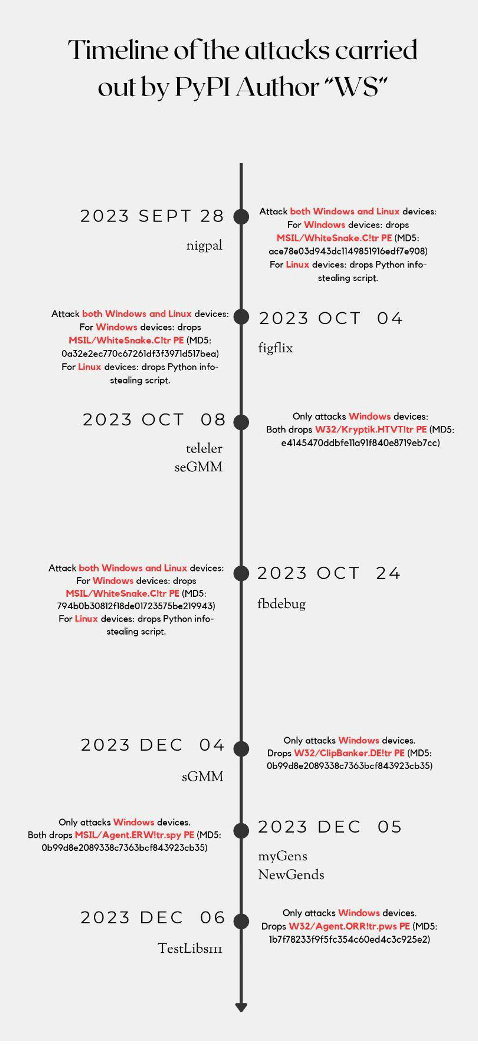
Malicious PyPI packages published by the author “WS”

Packages released before December 2023 can particularly transmit a Python script intended to steal data from Linux systems or, in the case of a Windows victim, deploy the malware known as Whitesnake PE.

“A subtle distinction lies in the new method now being used by the Python script to transmit stolen data. Instead of relying on a single fixed URL, these new malware variants use a range of IP addresses as the destination, likely to ensure successful data transmission even if one server fails”, Fortinet shared with Cyber Security News.

The PE Payload of the myGens & NewGends Packages is analyzed. It attempts to gather user data, including the host credentials and IP address of the user.
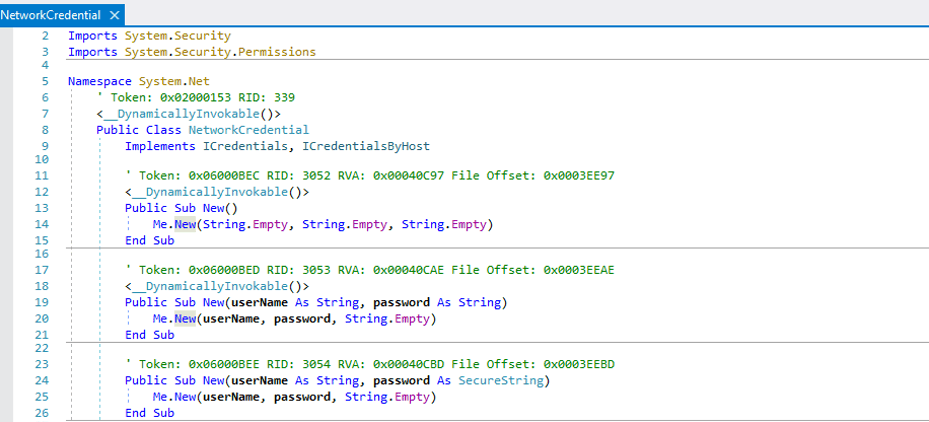
Collects User information

This latest set of packages primarily targets Windows users, in contrast to previous attacks that were directed at both Linux and Windows users. Even though each package has a slightly different executable payload, they all attempt to steal confidential data from victims.

Recommendation

When utilizing open-source packages, users are advised to proceed with extreme caution, making sure that no harmful content or payloads are present that could leave their targeted devices vulnerable to information theft.


[ad_2]
Source link

Enhancing Accuracy in Asset Tracking Systems

0
[ad_1]

In today’s evolving trends, businesses are constantly searching for ways to streamline their operations and enhance efficiency. One area where this becomes particularly important is in asset tracking systems.

Whether it’s keeping track of inventory in a store, monitoring equipment in a hospital, or managing assets in a warehouse, accurate and efficient asset tracking is crucial for businesses of all sizes and industries. In the pursuit of improving accuracy within asset tracking systems, barcode scanning solutions have emerged as a game changer.

What Are Barcode Scanning Solutions?

Barcode scanning solutions are hardware and software that enable the precise reading of barcodes. These barcodes consist of lines or patterns that represent information, such as product details or unique identifiers. Asset tags with barcodes are widely used in many industries due to the various benefits they provide.

Benefits of Barcode Scanning Solutions

Accuracy

Barcode scanning solutions offer precision when it comes to asset tracking systems. By eliminating errors associated with data entry, businesses can significantly reduce discrepancies in inventory counts and enhance overall operational efficiency.

Speed

With barcode scanning solutions, the time-consuming task of inputting each item’s information is eliminated. Instead, employees can simply scan items using devices or integrated scanners, significantly expediting the process.

Real-time Updates

Barcode scanning solutions offer the advantage of providing updates by transferring data to integrated software systems. This ensures that vital information regarding inventory levels, locations, maintenance schedules, and other crucial data is constantly updated and easily accessible.

Improved Inventory Management

Efficient and accurate inventory management is essential for businesses aiming to optimize their operations. Barcode asset tags and scanning solutions simplify this process by allowing businesses to monitor stock levels across locations precisely, automatically generating reorder requests when necessary.

Types of Barcode Scanning Solutions

Handheld Scanners

Handheld scanners are devices commonly used by employees for direct barcode scanning. These scanners can be wired or wireless and are known for their ease of use and reliability. With advancements, many handheld devices now include integrated touch screens and user-friendly interfaces for efficiency.

Mobile Devices with Integrated Scanning

In recent years, there has been a growing popularity in using mobile devices such as smartphones and tablets equipped with built-in barcode scanning capabilities. This approach allows businesses to leverage their existing hardware, reducing costs while maximizing convenience.

Stationary Scanners

Designed for large-volume scanning environments, stationary scanners are fixed machines that capture multiple barcodes simultaneously. Such barcode scanners are commonly used in warehouse settings or at store checkout counters. These scanners provide identification of multiple items at once.

Integration with Asset Tracking Software

Seamless Integration

The best barcode scanning solutions smoothly integrate with asset tracking software systems, making it easier to handle data. This ensures that there are no errors when transmitting and synchronizing data between the scanner and software, ultimately boosting accuracy and productivity.

Tracking Capabilities

By integrating barcode scanning solutions with asset tracking software, businesses can effectively monitor aspects of their assets’ lifecycles. From acquisition to disposal, companies can easily track the location of items, their maintenance history, warranty information, and more through a system.

Customization Options

Each industry has its tracking requirements. Barcode scanning solutions that offer customization options allow businesses to tailor their asset tracking systems to meet needs. Whether adding custom fields or developing features within the software interface, customization empowers users to maximize their system’s capabilities.

Conclusion

Barcode scanning solutions have improved accuracy in asset tracking systems by enhancing efficiency and reducing errors associated with data entry. Whether you’re using scanners or incorporating devices with scanning capabilities, implementing these solutions brings about advantages like precise inventory management and instant updates.

By integrating these solutions with software systems for tracking assets, businesses can optimize their operations further by monitoring multiple aspects of an asset’s lifecycle and tailoring the system to meet specific requirements.

Choosing to embrace barcode scanning solutions is a choice for any business aiming to boost accuracy in their asset tracking systems, streamline operations, and ultimately enhance their performance.

  1. The Role of Software Escrow in Mitigating Business Risks
  2. Data Security Threats for Businesses: Strengthen Your Defense
  3. Using GenAI in Your Business? Here Is What You Need To Know
  4. Finclusive, Verida, and cheqd Launch Reusable KYC/KYB Solution
  5. 2024 Trends for Securing Business Premises: Essential Technologies

[ad_2]
Source link

OnePlus 12 finally goes global with an appealing price tag

0
[ad_1]

OnePlus has finally brought its latest flagship, the OnePlus 12, to global markets. As a reminder, the phone launched in China in early December. It took OnePlus almost two months to make it official outside of its homeland.

The company did that on purpose, as the same happened with the OnePlus 11 last year. Having said that, the global model is now official, as it will be available in the US, Canada, Europe, and more regions.

The global variant of the OnePlus 12 is finally official

In regards to the differences between the Chinese variant and the global one. Well, the global model doesn’t come with up to 24GB of RAM, it caps out at 16GB. It also includes Google Play Services out of the box, of course, and a global version of OnePlus’ software. Everything else is the same.

This smartphone does look very similar to its predecessor. It’s made out of metal and glass, and it has a curved display on the front. A centered display camera hole sits at the very top of the display. The bezels around the display are extremely thin.

The alert slider is now moved to the left-hand side, while all the physical buttons sit on the left. The camera oreo on the back does look similar to last year’s, but it’s larger now, due to the company’s new camera hardware.

The Snapdragon 8 Gen 3 fuels the phone, while you’re getting up to 16GB of RAM

The Snapdragon 8 Gen 3 fuels the OnePlus 12, Qualcomm’s new processor. It offers a 30% improvement in CPU performance and a 25% enhancement in GPU performance. Those are Qualcomm’s claims, and OnePlus only relayed them. OnePlus also made sure to keep the phone cool at all times by including a Dual Cryo-velocity VC Cooling System. OnePlus actually has some big claims when it comes to gaming with this phone.

OnePlus 12 global image 6

The OnePlus 12 comes with 12GB or 16GB of LPDDR5X RAM, depending on the model you choose. Those two RAM variants include 256GB and 512GB of UFS 4.0 flash storage, respectively.

On the front, you’ll find a 6.82-inch QHD+ display, and this an LTPO AMOLED display. In other words, you’re getting an adaptive refresh rate here, as it can jump between 1Hz and 120Hz. Its theoretical max brightness is 4,500, and this display got an A+ rating from DisplayMate.

OnePlus 12 global image 4

OnePlus included a noticeably bigger battery pack than last year

The phone’s battery is also bigger than last year. It includes a 5,400mAh battery pack and supports 80W SuperVOOC wired charging in the US. It goes up to 100W in Europe. 50W AirVOOC wireless charging is also on board. Do note that the charger is on board too.

There are also a total of 16 antennas included in the phone. OnePlus says that this will enable “the full potential of high-speed connectivity”, and also enable stability when it comes to those connections.

There are three cameras included on the back. The main one is a 50-megapixel LYT-808 unit from Sony. It has a large f/1.6 aperture, and this is a 1/1.4-inch sensor. The second camera on the back is a 64-megapixel periscope telephoto unit from OmniVision. It’s the OV64B unit with 3x zoom capability, and 6x “in-sensor zoom”. This phone can zoom up to 120x, and OIS is supported, as is in the main camera. The third camera on the back is a 48-megapixel ultrawide unit. That camera offers a wide field of view of 114 degrees.

OnePlus 12 global image 3

Android 14 comes pre-installed, along with OnePlus’ OxygenOS 14

Android 14 comes pre-installed on the global OnePlus 12 variant, along with OxgygenOS 14. OnePlus announced two colors for the phone, Flowy Emerald and Silky Black.

The OnePlus 12 with 12GB of RAM and 256GB of storage is priced at $799.99/CAD$1,069. The variant with 16GB of RAM and 512GB of storage will set you back $899.99/CAD$1,199.99. Do note that you can offer ANY phone in ANY condition in order to get a $100 discount over at OnePlus.com.

In addition to OnePlus.com, the OnePlus 12 will also sell through Amazon and Best Buy in the US and Canada. It will go on sale starting on February 6. The pre-orders are kicking off today, though.

Pre-order the OnePlus 12 (OnePlus.com)

Pre-order the OnePlus 12 (Best Buy)

Pre-order the OnePlus 12 (Amazon)


[ad_2]
Source link

Viber launches a unique Business Calls service

0
[ad_1]
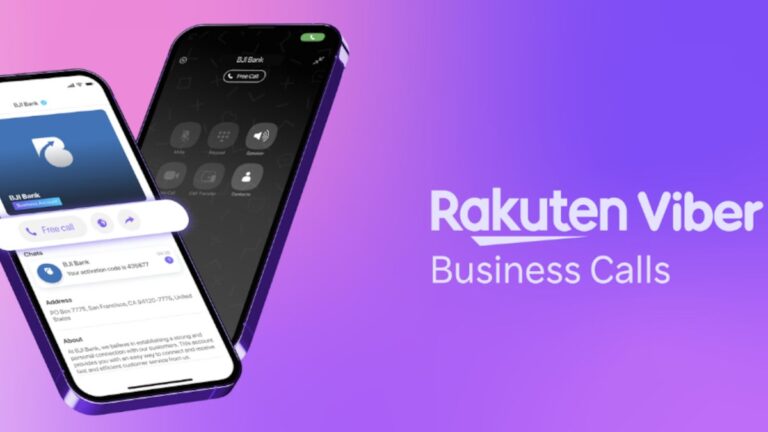
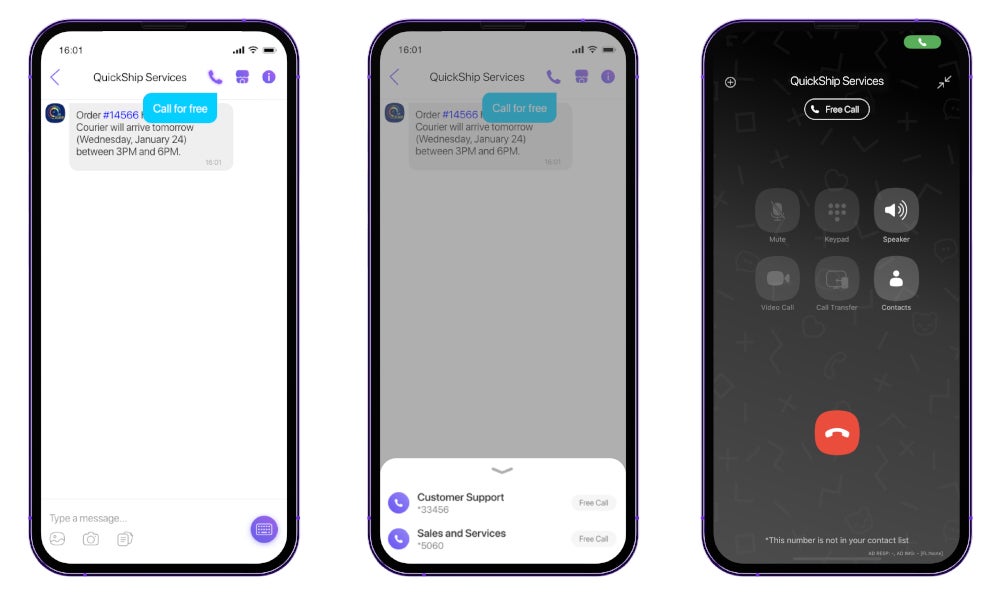
Viber announced a rather unique service that allows users to make free international calls to landline numbers directly through its app, Business Calls. The new tool makes it easier for Viber users to track their orders, get support in the retail and delivery sectors or simply assisting them with product inquiries.Specifically designed for businesses, the new service allows early adopters to create searchable business accounts with an embedded Viber Business Call button or add the tool to their existing accounts in the app.

“Rakuten Viber was the first messaging app to offer business messaging nine years ago, revolutionizing the way businesses communicate with their customers. Since then, we have developed a robust business messaging ecosystem and are now taking a significant step forward by introducing in-app Business Calls, a distinctive offering in the market,” says Cristina Constandache, Chief Revenue Officer at Rakuten Viber

Additionally, users can initiate a call directly from a chat with a business. At the same time, brands will be able to include a Viber call link on their websites to make it easier for customers to get in touch with them.

More importantly, all business calls will be free for customers, regardless of where they’re calling from. It’s also important to add that businesses can either designate a specific number for Viber or continue to use their regular call center number.

According to Viber, the new Business Calls service is now available globally. If you’re a business, you’re advised to contact the Viber team to learn how to get started.


[ad_2]
Source link

North Korean Hackers Attacking Cybersecurity Professionals

0
[ad_1]

Hackers target cybersecurity professionals as successfully compromising their systems or gaining access to their credentials provides a gateway to valuable information and tools.

Besides this, gaining control over cybersecurity professionals’ systems could be a strategic move to disrupt or evade detection during significant attacks.

Cybersecurity researchers at SentinelOne discovered that North Korean hackers are actively targeting cybersecurity professionals to steal threat research reports.

Document
Free Webinar

Compounding the problem are zero-day vulnerabilities like the MOVEit SQLi, Zimbra XSS, and 300+ such vulnerabilities that get discovered each month. Delays in fixing these vulnerabilities lead to compliance issues, these delay can be minimized with a unique feature on AppTrana that helps you to get “Zero vulnerability report” within 72 hours.

North Korean Hackers Attacking Cybersecurity Professionals

SentinelLabs tracked “ScarCruft” targeting South Korean experts on North Korea. Persistent attacks on individuals lasted two months, and ScarCruft (aka APT37) is a tested malware that is linked to Kimsuky. 

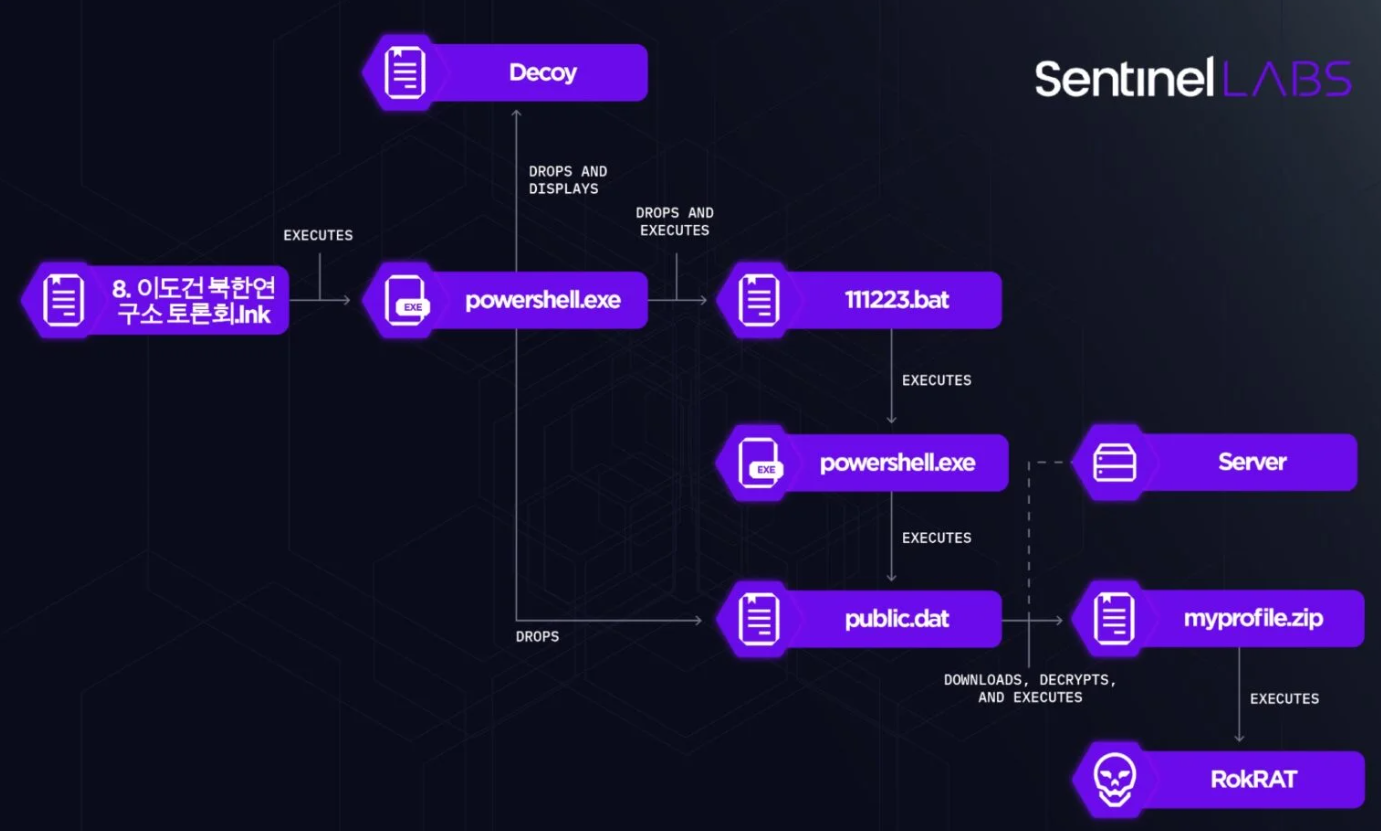
Decoy documents mimic threat reports that target cyber experts. ScarCruft uses oversized LNK files for RokRAT delivery, a potent backdoor. 

Tactics that the threat actors use resemble earlier 2023 campaigns. Focus on experts aids in gathering strategic intel for North Korea. 

However, targeting cybersecurity professionals suggests interest in defense strategies.

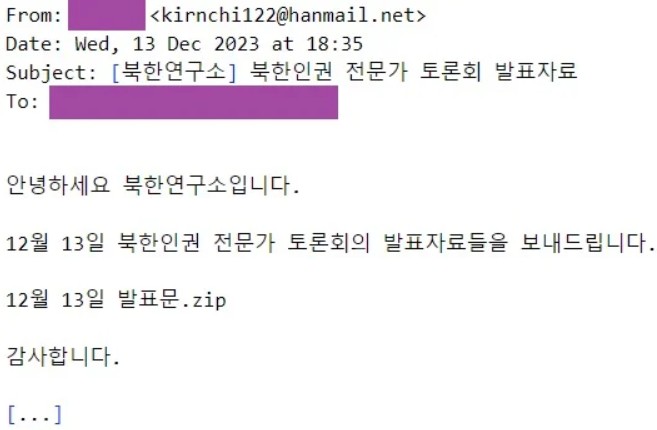
On Dec 13, 2023, a phishing email from kirnchi122[@]hanmail.net, posing as a North Korea Research Institute member, targeted a North Korean affairs expert. 

The email appears current, and it references a fake event on the same date that claims to offer presentation materials in a December 13th announcement.zip archive.

Phishing email (Source - SentinelOne)
Phishing email (Source – SentinelOne)

Of nine files, seven are harmless Hangul Word Processor (HWP) and PowerPoint docs, while two are harmful LNK files. 

The LNK files that are popular for malware exploit Microsoft’s default macro security. To blend in, all the files that are named after North Korean human rights start with a number. 

Here, by using the Hangul Word Processor icon, the LNK files masquerade as Hanword docs.

Infection chain (Source - SentinelOne)
Infection chain (Source – SentinelOne)

In December 2023, ScarCruft targeted individuals previously attacked on November 16, 2023, revealing the adversary’s persistence. 

The earlier campaign involved a news organization, with a phishing email from c039911[@]daum.net attaching two malicious HWP files impersonating North Korean market price analysis.

Documents with OLE objects in HWP format reveal C2 URLs upon activation. Metadata links accounts, like Daily NK’s, hinting at North Korean targeting strategies. Similarities to Kimsuky campaigns raise questions about the Daily NK-related malware. 

ScarCruft’s overlap with a Russian missile organization further underscores its tactics. Investigation of C2 URLs and user parameters is ongoing. The infrastructure details uncover Cherry Servers’ use and Namecheap domain registration tactics. 

The actor’s domain rotation aims to evade detection, as seen in instances like instantreceive[.]org mimicking GitHub. This pattern aligns with North Korea-associated threat actors.

For successful protection, targets must be more aware of and comprehend the attacks and infection strategies by the threat actors.


[ad_2]
Source link

“The mother of all breaches”: 26 billion records found online

0
[ad_1]

Security researchers have discovered billions of exposed records online, calling it the “mother of all breaches”.

However, the dataset doesn’t seem to be from one single data breach, but more a compilation of multiple breaches. These sets are often created by data enrichment companies. Data enrichment is the process of combining first party data from internal sources with disparate data from other internal systems or third party data from external sources. Enriched data is a valuable asset for any organization because it becomes more useful and insightful.

The researchers stated:

“While the team identified over 26 billion records, duplicates are also highly likely. However, the leaked data contains far more information than just credentials – most of the exposed data is sensitive and, therefore, valuable for malicious actors.”

In other news about leaked personal data, a cybercriminal going by the name of “emo” claims they have 15 million unique records of project management tool Trello accounts for sale.

emo offering 15,115,516 unique lines of Trello user information for sale

Trello is used by many organizations, so it understandably raised some concerns.

Atlassian, the company that runs Trello, however denies there has been a breach. It seems as if someone has used a large collection of email addresses and tested it against Trello.

This brings us to the question: when do you call a giant leak of personal information a breach, and when don’t you?

A definition of a breach that makes sense to me is this one:

“A breach is an incident where data is inadvertently exposed in a vulnerable system, usually due to insufficient access controls or security weaknesses in the software.”

So you might say that exposing of billions of records was a breach because it is unlikely the instance was left open on purpose. After all, that amount of data can be sold for a pretty penny.

And Atlassian can safely say it was not breached, since the criminals used an existing feature. Maybe in larger numbers than intended, but why admit you shouldn’t have allowed it?

Some people will say that a data breach can only be the result of a hack and everything else is a leak. If you look at it that way, neither one of the datasets came from a breach. One set was stumbled upon and the other was created by using a legitimate API.

But to those affected the end result is pretty much the same whether your data was leaked in a breach, accumulated by scraping, or gathered by a data enrichment company. Your information is out there in the open for every cybercriminal to use at their perusal.

If you want to find out if your data is exposed online, you can try our free Digital Footprint scan. Fill in the email address you’re curious about (it’s best to submit the one you most frequently use) and we’ll send you a report.

You might be surprised. Remember though that it’s not embarrassing to you if your email address was found in a breach, but it is good to know if it was and where a password may have been included.

We found 9 breaches including one exposed password

If the passwords it throws up at you look familiar, it would be a good idea to change the password where you’ve used it, enable 2FA, and check if it’s been re-used for other accounts.

Scammers are very good at using information found in breaches in social engineering attacks. Even the fact that your data may have been leaked in a breach is something scammers will readily use to launch a phishing attack and see what more they can find out from you.

Last year, over 2,000 companies and government entities reported data breaches impacting over 400 million personal accounts. Set up Identity Monitoring to get alerts whenever your data is exposed in a new breach.


We don’t just report on threats – we help safeguard your entire digital identity

Cybersecurity risks should never spread beyond a headline. Protect your—and your family’s—personal information by using Malwarebytes Identity Theft Protection.


[ad_2]
Source link

The “Reply” function is missing from Google Messages notifications

0
[ad_1]

For years, we’ve been able to quickly reply to messages through Google Messages notifications. It eliminates you having to open the app and tap on the text field just to reply to a message. However, a feature is only useful if it works, and it appears that this might not be the case. Some users are reporting that the reply feature is missing from Google Messages notifications.

Google Messages is missing the reply function in the notifications

This was first reported by a Reddit user who posted a screenshot. We see that, for some reason, the space next to the Mark as read button is empty. Right now, we’re not quite sure how widespread this issue is. Another user posted the same issue in the help center for Google Messages. So this is not an isolated incident. However, we were not able to replicate the issue here at Android Headlines, and the same goes for the folks at 9To5Google.

Reddit reply missing google messages
Screenshot from Reddit user

According to the reports, both users mentioned using the most up-to-date version of Google Messages, which was updated on January 18th. The second report states that the user is using the most up-to-date version of Android running on their pixel 6a. So it appears that this issue could be a temporary bug that Google just needs to fix up. If more reports of this issue hit the surface, it should hopefully get Google’s attention.

In other Google Messages news, image captioning is on its way

We recently got a leak of a new feature potentially coming to Google Messages. This will eventually allow you to post captions to images that you send to other people. Instead of sending text and images as separate messages, this feature will allow people to send them both in one message.

This is one of the many benefits of RCS technology, and it’s certain to make using the platform much better. At this point, we’re not sure when Google is going to release this feature.


[ad_2]
Source link

TikTok layoffs hit 100 employees working in LA, NY, ATX, and more

0
[ad_1]

TikTok became the latest major tech company to announce layoffs. NPR reports that TikTok has laid off about 100 employees working across places, including Los Angeles, New York, Austin, and abroad. Most TikTok layoffs were from the sales and advertising team, a spokesperson confirmed.

TikTok layoffs hit at least 100 employees

According to an NPR report, TikTok cut at least 100 jobs from the company across places. The employees at TikTok have said that the company is cutting jobs to save money, it noted. The company’s spokesperson also said that about 60 workers, mainly from the sales and advertising department, were laid off as part of a regular restructuring plan. After letting go of these employees, TikTok has planned a town hall meeting for Tuesday.

TikTok parent ByteDance, last year, cut a lot of jobs at the Nuverse — the company that makes Marvel Snap. Before this, TikTok also let go of some employees in the middle of 2022 because they were making changes worldwide. Then, in early 2023, it posed another round of layoffs in Dublin, letting go of the people who were in charge of hiring new employees.

NPR’s report further notes that TikTok is one of the popular apps and employs about 7,000 employees in the US alone. It is home to more than 150,000 employees worldwide. The report writes that these layoffs are “the latest sign of pain in the tech industry.”

More than 10,000 employees have lost their jobs already

2024, so far, has been a painful year for the employees especially. According to layoffs.fyi, close to 11,000 employees have lost their jobs already. The most recent layoffs come from tech giants and video game publishers like Riot Games, Amazon, YouTube, and more.

Nevertheless, experts believe that the tech industry could be a smoother ride this year, as compared to 2023. It notes strong numbers for the US’s big tech earnings season. Meanwhile, some analysts also believe that the industry is at the start of a tech bull market, particularly in artificial intelligence (AI).


[ad_2]
Source link

Google Messages might get a boost with a new image captioning feature

0
[ad_1]

Google Messages, with its whopping 1 billion active users, is а driving force behind RCS (Rich Communication Services) popularity on Android. The app receives new features and updates regularly to keep the innovation rolling. The latest scoop? A potential image captioning feature in the works.

Leaker AssembleDebug on X (via Android Police) stumbled upon a flag that hints at caption support for media in RCS on Google Messages, suggesting ongoing development. While the exact release date is still under wraps, it will come with a future app update.


Unlike its chat app counterparts, including WhatsApp and Telegram, Google Messages presently lacks support for native image captioning. This potential addition aligns with industry norms, letting users seamlessly add context to shared media within the ongoing conversation.Right now, sharing multiple images on Google Messages means juggling separate messages for additional info, which is a bit of a hassle. The rumored image captioning feature aims to untangle this knot, promising a more straightforward experience for users.

Beyond just user convenience, this enhancement plays into Google’s grand plan of making RCS the go-to messaging protocol. RCS, with its real-time delivery, read receipts, and group chat perks stands head and shoulders above traditional SMS/MMS messaging. Yet, its widespread embrace hinges on both carrier and device compatibility.

Most big carriers, like AT&T, Verizon, and T-Mobile, offer RCS functionality on newer Android-powered Google and Samsung devices.

Zooming out, Google’s exploration of multi-SIM RCS support and Apple’s nod to RCS texting for iPhones hint at a potential farewell to the old guard of SMS and MMS messaging. The future seems poised for RCS to take center stage and redefine the messaging landscape.


[ad_2]
Source link

Leveraging AI for Enhanced Threat Detection and Prevention

0
[ad_1]

In today’s ever-evolving cyberspace, organizations face an ever-increasing number of cyber threats. Malicious actors are constantly seeking to exploit vulnerabilities to gain advantage or engage in harmful activities. As businesses continue to adopt digital transformation, it becomes crucial to implement data security measures.

One promising solution gaining popularity is the use of artificial intelligence (AI) technologies to enhance threat detection and prevention. By leveraging AI alongside stringent security protocols, organizations can better safeguard their data assets and protect their intellectual property.

The Role of AI in Data Security

Artificial intelligence encompasses a range of technologies, including machine learning and natural language processing, that allow systems to mimic human behaviour when processing large amounts of data. In the domain of data management security, AI proves invaluable by identifying patterns, detecting anomalies, and swiftly recognizing threats faster than any human could.

Many cyber attacks leave behind signatures or patterns that can be identified by algorithms. For example, AI-powered systems can analyze real-time network traffic to promptly identify suspicious behaviour or detect known malware signatures. Additionally, AI algorithms continuously learn from the threats encountered over time, continually improving their accuracy in detecting threats.

Utilizing Machine Learning Algorithms

Machine learning algorithms play a role in using AI to improve threat detection and prevention. These algorithms analyze real-time data to train models that can identify patterns and detect anomalies on a large scale automatically.

By examining vast amounts of data from multiple sources, machine learning algorithms gain insights into user behaviour patterns related to unauthorized activities and security breaches. They establish baselines by analyzing data, making them effective in accurately detecting deviations from expected behaviour.

Additionally, machine learning algorithms help automate incident response procedures by centralizing alerts based on predefined rulesets tied to risk thresholds. This proactive approach enables IT teams to address threats promptly instead of waiting for end-user reports.

Threat Intelligence with Natural Language Processing

Natural language processing (NLP) adds another dimension to the AI-powered data security landscape. One application of NLP involves extracting insights from cybersecurity reports and quickly breaking down complex information.

Using sentiment analysis algorithms, NLP can evaluate the impact of newly disclosed vulnerabilities on public forums and social media networks. This consolidated intelligence streamlines the identification process for emerging threats or vulnerabilities to be exploited by cybercriminals.

Improving User Behavioral Analytics

Gaining insights into security risks within an organization’s network infrastructure relies on understanding user behaviour patterns. By leveraging AI-driven user behavioural analytics, organizations can create profiles of what constitutes user behaviours. This is achieved by considering factors such as the time spent on applications, destinations of network traffic, and the history of file access.

Once the system establishes patterns, it can promptly raise alerts whenever deviations or anomalies occur. This proactive approach significantly reduces response time in addressing incidents that might be overlooked using security methodologies.

Addressing Uncertainty with Explainable AI

Explainable AI plays a role in inspiring confidence in AI-powered detection systems. Explainability ensures that humans can understand the patterns identified by machine learning models and provides clarity on how decisions are made.

Organizations should prioritize adopting AI solutions that offer transparency in decision-making processes through clear model outputs supported by audit trails. Having explanations behind flagged activities assures stakeholders that these detections were based on reasoning rather than mere computational guesswork.

Conclusion

The landscape of data security is continuously evolving due to increasing sophistication in cyber threats. By integrating artificial intelligence technologies with established security measures, organizations can gain a considerable edge in mitigating risks and protecting their invaluable data assets. The capacity of AI to efficiently analyze large volumes of data and identify patterns enables faster detection and prevention of potential breaches.

Through learning and adaptation, AI fortifies the security stance of organizations, enhancing their resilience against emerging cyber threats. Embracing AI for data security is increasingly becoming imperative for businesses aiming to maintain an edge in the ever-evolving digital era.

  1. Volkswagen Goes AI, Integrates ChatGPT into its Vehicles
  2. Evolution of AI Assistants: Breakthroughs in Software Development
  3. Poisoned Data, Malicious Manipulation: NIST Study Reveals AI Vulnerabilities
  4. 12 Best AI-powered Customer Communication Platforms for Contact Centers
  5. Reflectiz Introduces AI-powered Insights on Top of Its Smart Alerting System

[ad_2]
Source link