In the last month, plenty of Motorola’s G-series phones have surfaced in leaked renders. These include the G 5G (2024), G24 Power, G34, and G04. Now, the Moto G Stylus (2024) is the latest device to have appeared in CAD-based renders revealing its design from all angles as well as some key specifications.
The Moto G Stylus (2024) has a familiar design
The Moto G Stylus (2024) is seen with the same design language as the previously leaked Motorola phones. It seems that the Lenovo-owned brand is making this design mainstream on its upcoming G-series devices.
The upcoming smartphone features a flat frame with the power and volume rocker located on the right side. On the front, the renders reveal a centrally placed small punch-hole cutout that will house the selfie camera. The screen is surrounded by thin bezels on all sides except the bottom chin.
Coming to the back panel, the Moto G Stylus (2024) has a rectangular camera island that elevates slightly. It is reminiscent of the OPPO Find X5 and Reno 8 series. The text on the module confirms a 50MP primary sensor and a secondary lens along with an LED flash unit. There is the iconic Motorola batwing logo at the center of the rear panel.
At the bottom, the Moto G Stylus (2024) has a 3.5mm headphone jack, a USB-C port, and a speaker grille. A stylus slot is seen located at the far right side of the device. Dimension-wise, the upcoming offering measures 162.5 x 74.7 x 8.09mm and weighs 190g. This phone is slightly shorter and slimmer than its predecessor.
The G Stylus (2024) could debut sometime around May
The Moto G Stylus (2024) could arrive as the successor to the Moto G Stylus (2023) that arrived in May last year. The report adds that it will feature a 6.5-inch display with an FHD+ resolution and increased refresh rate. Rumor has it that this device will use an unknown Snapdragon processor, come with 128GB storage, have a 5,000mAh battery unit, and run on Android 13.
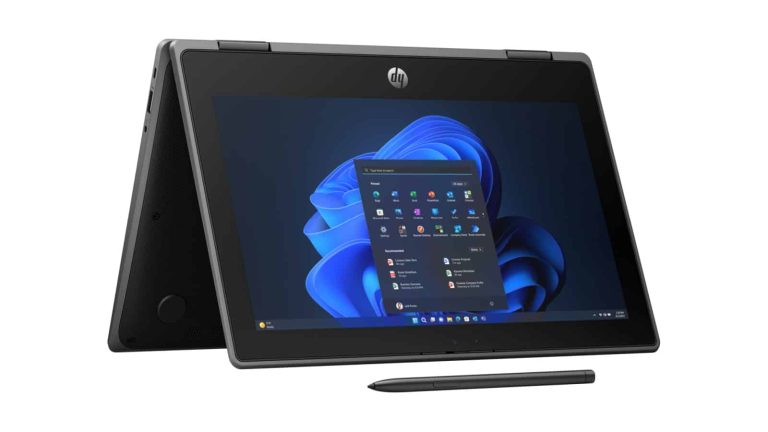
HP has announced a range of new Fortis laptops at CES 2024, designed and purpose-built to be the driving force for the productivity of today’s students and frontline workers. The suite of laptops contains four new products. The Fortis x360 G5 Chromebook, Fortis G10 Chromebook, Fortis G11 Chromebook, and the Fortis x360 G11 Notebook PC. As you can tell, three of these laptops run on Google’s Chrome OS while the fourth laptop, the Fortis x360 Notebook PC, will run on Windows 11.
What’s neat about all of these laptops is that they’re all priced at under $500. In fact, each of the three Chromebooks will retail for under $400. The Fortis x360 G5 Chromebook will retail for $369, while the Fortis G10 and G11 will retail for $309 and $319 respectively. The Fortis x360 Notebook PC meanwhile, will retail for $479. HP has laid out some pretty affordable prices here. Especially considering the target market for these devices. The lower nature of the cost should make it easier for schools and businesses to scoop up these laptops in larger quantities as needed.
All four new HP Fortis laptops are engineered for durability
As these laptops are made for students and frontline workers, it’s safe to say that they’ll need to be at least somewhat durable. Luckily, HP built these laptops to be just that and then some. All of them were engineered for durability. Some may be built more durable than others though. The Fortis Notebook for example was designed with metal corners on the inside to reinforce the laptop’s overall structure. It includes other reinforced internal components too. Such as co-molded rubber trim and Corning Gorilla Glass 3.
HP says it’s “built strong and built to last,” having passed 19 MIL-STD810 tests. Allowing it to take bumps, drops, and spills thanks to its ruggedized exterior and interior. The Chromebooks feature similar durability, passing the same MIL-STD810 tests. The x360 Chromebook even features a reinforced hinge. Case in point, these laptops were designed to withstand the everyday rigors of life with a student or a worker out in the field. Accidents happen. But that shouldn’t limit you from continuing to use your laptop when you might need it most.
HP also promises uninterrupted productivity thanks to the inclusion of Intel N-Series processors, up to 16GB of RAM, and 128GB of UFS storage. They feature Wi-Fi 6E support and optional 4G LTE support too. Plus they get up to 11 hours of battery life. And in the event that you happen to use that up, the battery can be charged quickly. HP says you can get the battery back to 90% with just an hour and a half on the charger. All four laptops are available starting today and can be picked up directly through HP.
Voice assistants are really handy nowadays for finding info or getting things done, and a lot of people are using them – about 146 million in the US alone. Now, Google Assistant, one of the most popular ones, is about to see some changes.
In a recent blog post, Google spilled the beans that it’s streamlining its Assistant by waving goodbye to almost 20 features. The goal? Sharpening up quality and reliability, aiming for a smoother Assistant experience across all devices. Starting January 26, if you try to call on one of these features, you might get a heads-up that it’s taking a bow after a certain date.
Here’s a brief on some of the features taking a hit:
Controlling audiobooks on Google Play Books by voice is out. You can still cast them from your mobile.
No more cookbook management on Google Assistant – transferring recipes, instructional videos, and step-by-step guides are out. But fear not, as you can still use Google Assistant to search for recipes online and on YouTube.
No more setting media, music, or radio alarms on Google Assistant devices. Instead, you can create a custom Routine or use a standard alarm.
Stopwatch management on Smart Displays and Speakers will be a thing of the past. But worry not, as setting timers and alarms is still a go.
Voice calling a device or broadcasting to your Google Family Group will be a no-go. Still, you can broadcast to devices within your home.
Sending emails, video, or audio messages with your voice will no longer be an option. However, you can still make calls and send text messages.
No more asking for contact information. You can still make calls to them.
No more App Launcher in Google Assistant driving mode on Google Maps for messages and calls. However, you can use voice control on Google Maps in the same way.
Voice control for activities will be off the table for Fitbit Sense and Versa 3 devices. Instead, you will have to use the buttons on your device for activity control. Pixel Watches still support voice control for activities.
Calls from speakers and Smart Displays won’t display a caller ID unless you’re using Duo.
Voice-checking personal travel itineraries is out. However, you can still inquire about flight status.
Voice actions like sending payments, making reservations, or posting on social media will no longer be supported. However, you can still ask the Assistant to open your installed apps.
Google isn’t just about removing features; it’s also enhancing your experience in the Google app. Now, the microphone icon triggers Search results in response to your queries, streamlining its most popular use. Activating Assistant remains the same – simply say “Hey Google,” long-press on the home or power button (on select Android phones), or open the Google Assistant app on iOS.
However, the microphone icon in the Search bar won’t support actions like “turn on the lights” or “send a message” anymore. This applies to the Pixel Search bar, too, which will activate Voice Search instead of Assistant. To ensure you have the latest version of Google Assistant, you’ll be prompted to upgrade the Google app if you’re using an older version (v12 and older).
Hackers use the Mirai botnet to launch large-scale Distributed Denial of Service (DDoS) attacks by exploiting vulnerable Internet of Things (IoT) devices.
Mirai’s ability to recruit a massive number of compromised devices allows attackers to do the following things to the targeted online services or websites:
Cybersecurity researchers at Akamai recently discovered a new Mirai-based botnet, “NoaBot, ” that is actively attacking Linux devices.
DocumentFree Webinar
Compounding the problem are zero-day vulnerabilities like the MOVEit SQLi, Zimbra XSS, and 300+ such vulnerabilities that get discovered each month. Delays in fixing these vulnerabilities lead to compliance issues, these delay can be minimized with a unique feature on AppTrana that helps you to get “Zero vulnerability report” within 72 hours.
Technical Analysis
NoaBot primarily targets Linux IoT devices for DDoS attacks. Mirai botnet was initially identified in 2016, and its source code is publicly available, leading to various variants appearing.
However, NoaBot initially surfaced in early 2023 and is evolving with:-
Not only that even researchers also noted several incidents of dropping P2PInfect worm samples which link both campaigns.
NoaBot mirrors Mirai’s capabilities but diverges in code. Unlike Mirai’s Telnet-based spreader, NoaBot uses SSH with a unique “hi” connection.
SSH packet with the ‘hi’ string (Source – Akamai)
While embedded song lyrics in early samples remain unexplained, the developers of this botnet removed the lyrics in the later versions.
NoaBot alters Mirai by employing a distinct SSH credential dictionary and introducing post-breach functions like:-
Installing backdoors
Spreading to new victims
Unlike Mirai, NoaBot is compiled with uClibc, which helps in altering antivirus detection to SSH scanner or generic trojan signatures, and the following things complicate the reverse engineering:-
Statically compiled
Symbol-stripped
Obfuscates strings
Newer samples introduce command-line arguments, including “noa” for persistence via crontab entry. The “Noa-” prefix in antivirus detections suggests widespread use and the evolution of post-breach operations.
The miner is a self-compiled XMRig variant that extracts configurations before execution. However, instead of using the following things, it introduces code before mining logic:
The XMRig configuration usually reveals the following things:
Mining pool details
Wallet addresses
Apart from this, the threat actors evade detection by dynamically modifying the command line and encrypting the pool details by communicating with Google’s DNS for domain resolution.
In 2023, 849 source IPs globally attacked honeypots, with a notable hotspot in China contributing to 10% of all attacks.
Global geolocation heatmap of NoaBot attack sources (Source – Akamai)
849 distinct IP addresses hit honeypots in 2023. Their global activity is quite evenly distributed, according to their geolocation data. Given that the software is wormable, it stands to reason that each new victim also becomes an attacker. On the other hand, China is the standout location for all the action.
Recommendations
To secure networks, cybersecurity researchers recommend:
Limit SSH access.
Always use strong passwords.
Do not use any default or used passwords.
Shared malware credential sets on GitHub aid protection.
Monitor the binary names, process names, and cron jobs to detect the malware.
Access IOC CSV files and YARA signatures in the repository.
Test environments with an Infection Monkey configuration.
Employ the cryptojacking plug-in to assess defenses against stronger credentials.
Try Kelltron’s cost-effective penetration testing services to assess and evaluate the security posture of digital systems – Free Demo
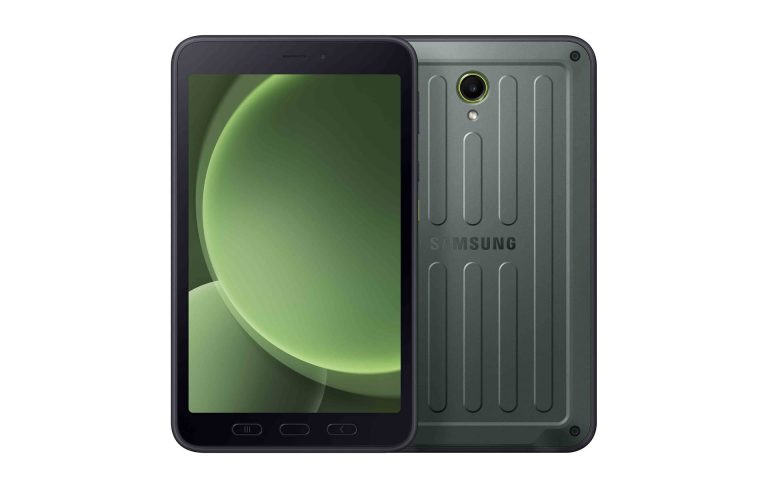
Alongside the Galaxy Xcover 7, Samsung also launched a new rugged Android tablet. The Galaxy Tab Active 5 arrives as a mid-range rugged tablet targeted at field and frontline workers dealing with daily challenging environments. The device will go on sale later this month.
Galaxy Tab Active 5 is a compact rugged tablet
The Galaxy Tab Active 5 measures 126.8 x 213.8 x 10.1mm in dimension and weighs 433 grams. This makes it a relatively compact tablet. However, Samsung hasn’t compromised on its ruggedness. You get a MIL-STD-810H military standard build with shock resistance to drops of up to 1.8 meters when using the bundled protective case. The case has a holster for keeping the S Pen, so there’s an added benefit of using it.
Speaking of the S Pen, it has a rugged design too. Both the tablet and the stylus pen have an IP68 rating for dust and water resistance. Samsung has also slapped a layer of Corning Gorilla Glass 5 on top of the display for added protection. The display is an 8-inch TFT panel with a WUXGA resolution and up to 120Hz refresh rate. It boasts Touch Sensitivity for increased responsiveness in wet conditions or with gloves.
Samsung has equipped the Galaxy Tab Active 5 with a 5nm octa-core processor. It might be the Exynos 1380 that powered the Galaxy A54 and Galaxy Tab S9 FE series last year. The chipset has a peak CPU speed of 2.4GHz. The tablet will be available in 6GB+128GB and 8GB+256GB configurations with microSD card support up to 1TB. You get Samsung Knox security with Samsung Knox Vault, face recognition, and a side-mounted fingerprint scanner.
While the chipset supports 5G cellular connectivity, the Galaxy Tab Active 5 will also be available in a non-cellular (Wi-Fi) version. You get Wi-Fi 6, Bluetooth v5.3, and NFC connectivity on both variants. If you pick the cellular model, you might be able to use two SIMs simultaneously depending on the eSIM availability for your carrier and region. The tablet only supports one physical SIM.
The tablet works without a battery too
The Galaxy Tab Active 5 packs a 5,050mAh user-replaceable battery that charges via a USB Type-C port as well as a Pogo Pin. However, it can run without a battery too. The No Battery Mode bypasses the battery and directly sends the power to the device. It requires a USB-C power accessory supporting 9V, 2.3A or above, and PD 2.0 or above. The idea is to prolong the battery life when the device is used non-stop at kiosks or in vehicles.
The new rugged tablet has a 13MP rear-facing camera with LED flash. It supports quick barcode scanning via Knox Capture. There’s also a 5MP selfie camera here. Other known specs and features include a 3.5mm headphone jack, Dolby Atmos audio, GPS, a customizable Active Key, Android 14, and a wide range of built-in sensors, including accelerometer, geomagnetic, gyro, light, hall, and proximity sensor.
Price & availability
The Galaxy Tab Active 5 will be available in Europe later this month. Samsung has priced the Wi-Fi version at €479 and the 5G version at €579 in Germany. In Switzerland, the tablet starts at 449 Swiss Franc (CHF), equivalent to €482 or $528. The Korean firm hasn’t shared price and availability details for other markets such as the US. We will let you know when we have more information.
Investigative journalist Huib Modderkolk from Dutch national newspaper De Volkskrant uncovered that 36-year-old Dutch civil engineer Erik van Sabben played a ‘crucial role’ in a 2007 mission supported by the US and Israel. He was instrumental in deploying the advanced Stuxnet virus to sabotage an Iranian nuclear complex.
A two-year-long investigation by the Dutch newspaper De Volkskrant has uncovered a startling operation where a Dutch engineer was recruited by the Netherlands’ intelligence agency, the AIVD, to deploy malware at an Iranian nuclear facility using a seemingly harmless water pump.
The then 36-year-old Dutch civil engineer, Erik van Sabben, played a ‘crucial role’ in a 2007 mission backed by the US and Israel to sabotage an Iranian nuclear complex, releasing a highly advanced software virus called Stuxnet, bringing the Iranian nuclear program to a halt.
The malware was planted on a water pump installed in the Natanz-based Iranian nuclear complex after Van Sabben infiltrated it. His family claims he panicked before the attack. He died in a motorbike crash in Dubai two years after this incident.
Reportedly, Van Sabben worked at Dubai-based heavy transport firm, TTS International, where he could easily transport Western equipment to Iran. He was willing to take risks as he and his employer had connections in Iran.
He used his position as a cover to infiltrate the facility and deliver the Stuxnet payload. The cover-and-stricken operation, involving the American CIA and Israeli Mossad, destroyed nearly a thousand ultracentrifuges for uranium enrichment, causing Iran’s nuclear weapons program to be delayed for a few years.
Van Sabben was recruited in 2005 for this job because he seemed the ideal candidate as he had a sound technical background, did business in Iran, and was married to an Iranian woman, Volkskrant journalist Huib Modderkolk wrote in their detailed investigative report.
In 2012, The New York Times reported that former US Presidents George Bush Jr. and Barack Obama had personally granted permission to deploy Stuxnet in Iran, aiming to break centrifuges without Iran’s knowledge of the source of the sabotage. However, the Dutch agency did not inform its then government led by the CDA’s Jan Pieter Balkenende and the parliamentary committee about this mission.
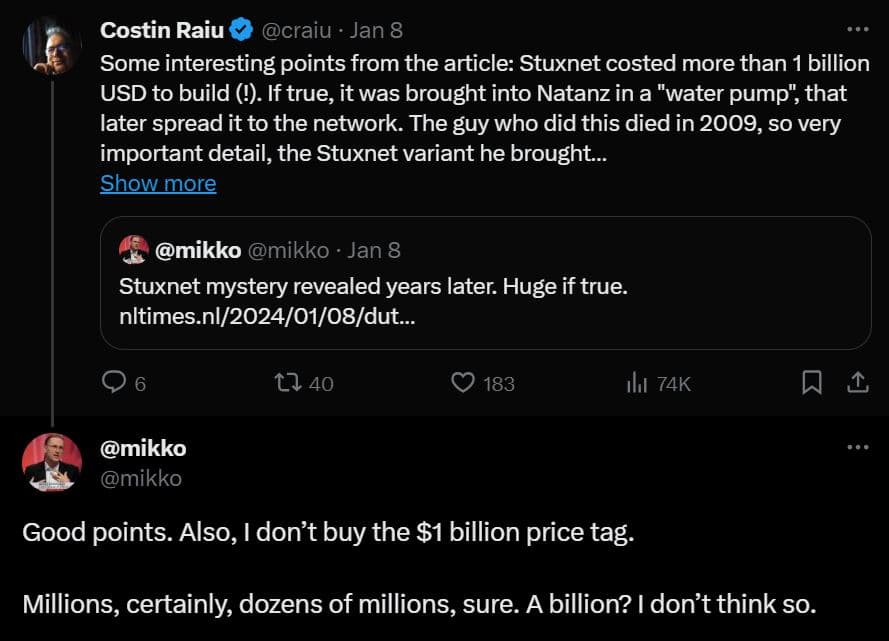
De Volkskrant’s investigation reveals that Stuxnet cost between $1 and $2 billion. However, cybersecurity experts like WithSecure’s chief research officer Mikko Hypponen, have expressed doubts about the actual cost. Raiu also noted that the Stuxnet version Van Sabben installed back then could be Stuxnet 0.5, which wasn’t as impactful as its subsequent variants.
In 2019, the paper claimed that while the Netherlands played a significant role in the Stuxnet sabotage campaign, initially it was believed that the virus was installed by an Iranian engineer. MPs have called for an investigation into the claims, and the operation is also the subject of an NPO 2 documentary series.
The world of mobile gaming is currently experiencing a revolutionary transformation as technology, entertainment and finance prove to seamlessly merge together in an unprecedented manner. One type of rapidly emerging platform epitomizes this perfectly: the cryptocurrency casino. While the first cryptocurrency casinos popped up on desktop computers over a decade ago, today’s games are migrating to various mobile settings, including Android apps. Whether you are an experienced gamer, a cryptocurrency enthusiast or a curious lover of all things entertainment, take notes as this guide offers an overview of the cryptocurrency casino landscape to help elevate your mobile gaming journey.
Blockchain and Mobile Gaming
First thing is first: a brief overview of how cryptocurrencies have entered so strongly into the gaming market. Ultimately, it comes down to the essence of blockchain technology, which boasts a fundamental architecture that perfectly aligns with some of the crucial ethos of online gaming: privacy and fairness. Cryptocurrencies operate independently from central banks, leveraging blockchain for faster and more secure transactions. Blockchain acts as a distributed ledger, recording all transactions across a network of computers and making them inherently transparent and secure.
Today, players can enjoy a range of cryptocurrency-related games, from slots and other traditional casino games to innovative blockchain-based games, each offering a unique blend of entertainment and the potential for reward. While the first crypto casinos were created based on Bitcoin—featuring no-frills dice-rolling games and basic slots—a recent article from NewsBTC says that the top modern crypto casinos accept a wide variety of different tokens and have branched out into many different types of wagering activities, from classic casino games to sports betting and more.
Today’s Mobile Crypto Slots
Slots represent a sort of everlasting corner piece of the online gambling industry, partly due to the huge array of themes, bonus features and jackpots that they offer. Players unfamiliar with modern slots may be imagining games with simple graphics and unimaginative concepts; however, some of today’s developers have revolutionized the way users experience these types of games. Creators like NetEnt and Microgaming consistently release games with impressive designs, immersive themes and interactive details that truly elevate the slot genre.
Crypto slots blend traditional slot mechanics with the efficiency of cryptocurrency transactions. With ‘mega wins’ becoming increasingly popular, there is growing excitement for the chance at a life-changing jackpot with a single spin—and with crypto as an option for funding bankrolls and receiving potential payouts, players can anticipate a quick and seamless experience. Add that to generous welcome bonuses, and it’s easy to understand why crypto slots have exploded in popularity.
Table Games and Live Dealers
The mobile crypto gaming landscape is not limited to slots. Classic table games like blackjack, roulette and baccarat have found a new life on mobile platforms. These games particularly benefit from the advantages of cryptocurrency, including faster transactions and potentially higher betting limits; however, a particularly intriguing advancement is the introduction of live dealer games.
Live dealer games blend the convenience of online play with the authenticity of a real casino experience. Real-life croupiers deal cards and interact with players in real-time and, with the possible integration of VR and AR technology on the docket, virtual environments are becoming increasingly more realistic to being on an actual casino floor. Users are also likely to find potentially higher wagering limits. One note to keep in mind, however, is that a stable connection is also required for these types of live-streaming experiences.
Play-to-Earn and NFT Games
A significant shift in the overall gaming industry—mobile and desktop gaming alike—is the emergence of blockchain-based, play-to-earn games. These games often integrate the concept of non-fungible tokens (NFTs), allowing players to own in-game assets. Games like Axie Infinity and The Sandbox have pioneered this space, with players able to earn tokens through their in-game activities.
Players can buy, sell and trade these NFTs, giving them a tangible value that extends beyond the game. And while these models begin to blur the lines between entertainment and financial gain, it’s important to distinguish between gaming that requires paid access, wagering or other financial inputs versus gaming that simply requires time. While both types of games can provide excitement, entertainment and the potential to win, players should never invest more than they can afford to lose.
Exercising Responsible Gaming and Reasonable Precaution
Due to the innate volatility of the cryptocurrency market, players should always approach mobile crypto gaming with caution, making sure to set firm budgets and loss limits. Consider doing light research to gain an understanding of basic gambling strategies as well as brushing up on the mechanics of the cryptocurrency market. Always check the reputability of your chosen cryptocurrency gaming operators—this is where consulting online guides and trust reviews could be paramount.
Furthermore, it is imperative to implement security protocols like strong passwords and two-factor authentication to guarantee secure cryptocurrency transactions on Android devices. Many cryptocurrency wallet apps, exchanges and casino platforms offer built-in support for this security feature. Users can enable it by linking their accounts to a trusted authentication app, such as Google Authenticator or Authy. While security is usually a top priority for these types of platforms, users must also do their due diligence to protect their accounts.
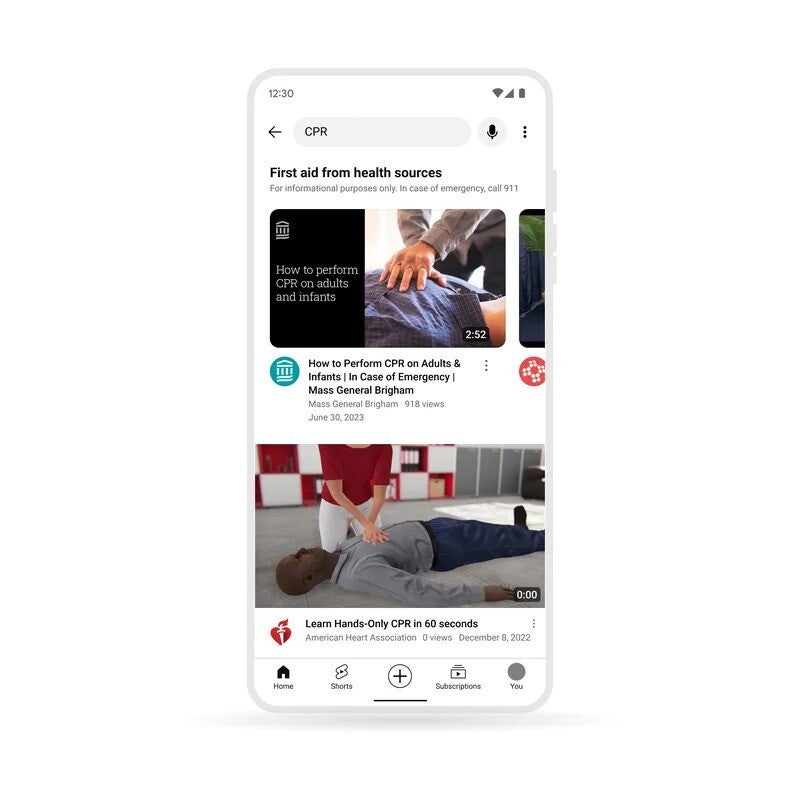
YouTube simplifies the way we discover step-by-step first aid and emergency care videos. Authoritative health organizations are behind these new videos, now prominently placed at the top of search results. With the new first-aid information shelves, you can quickly access credible and actionable information without complex instructions.
These shelves cover key health topics like CPR, choking, Heimlich, bleeding, heart attack, stroke, seizure, and opioid overdose.
Image Credit–YouTube
YouTube Health teamed up with Mass General Brigham and the Mexican Red Cross for content on the shelves. Their videos, alongside others from leading health organizations, cover CPR, stopping bleeding, and aiding someone overdosing.
The new first-aid information health shelves are launching in English and Spanish in the US. However, the company promises the new feature rollout to more countries and in more languages soon.
Merranda Logan, MD, MPH, Associate Chief Academic Officer at Mass General Brigham, said: “We are thrilled to expand our YouTube educational series to include step-by-step basic first aid and emergency care videos in multiple languages.”
“We are very pleased to collaborate with YouTube Health to bring videos with techniques approved by the Mexican Red Cross and help people with first aid information just when they need medical support the most. We want to help save lives and prevent bad first aid techniques that can be performed without the right medical knowledge,” added Ana Robles Quijano, National Fundraising Coordinator from the Mexican Red Cross.
Since its 2020 launch, YouTube Health has aimed to make high-quality health content easily accessible worldwide. It introduces new features like health labels to identify licensed medical professionals and crisis resource panels for viewers in times of distress.
The OnePlus 12R has surfaced a ton of times thus far, though it was mostly in the OnePlus Ace 3 form. Those two phones do look the same, and we just got yet another confirmation of that. A well-known tipster has shared the official black and blue OnePlus 12R renders. These images come from Roland Quandt.
The OnePlus 12R leaked from all angles in official renders
You can see the images below, split between two categories. Both colors are shown from all sides here. There’s really nothing to surprise us anymore design-wise, everything is laid out here.
Black variant renders:
Blue variant renders:
The tipster notes this is the EU model of the phone, though it doesn’t really make much difference, as the same variants will likely be available elsewhere. The phone does resemble the OnePlus 12 quite a bit.
You’re getting a curved screen on the front, with a centered display camera hole. The bezels are quite thin here. You’ll notice the physical buttons on the right, and an alert slider on the left.
Three cameras sit on the back, and the phone will launch on January 23
On the back, three cameras sit inside a circular camera island, which is connected to the frame via a piece of metal. There are four cutouts inside of that camera island, but only three cameras. The backplate on this phone is curved towards the sides.
This smartphone will become official on January 23. It is coming to the US, Europe, and India. The phone will feature a 6.78-inch 2780 x 1264 LTPO AMOLED display with a 120Hz refresh rate. That display will also be quite bright.
The Snapdragon 8 Gen 2 will fuel the OnePlus 12R. RAM and storage variants will be a bit different compared to the OnePlus Ace 3. The OnePlus 12R will start at 8GB of RAM, and the other model will include 16GB of RAM.
A 5,500mAh battery will power the phone, and you’ll also get 100W charging with the included charger. A 50-megapixel main camera (Sony’s IMX890 sensor) will be backed by an 8-megapixel ultrawide camera and a 2-megapixel macro shooter.
Ah, time, that one thing we can never get back. 2023 was the year when our mobile screens saw more action than a Hollywood blockbuster. Thanks to a comprehensive report from data.ai, we’ve got the scoop on which apps took most of US residents’ time and money last year.
First off, Americans were a bit less glued to phones last year. The average daily screen time dipped from 2022’s 4.42 hours to 4.34 hours in 2023. Not a massive drop, but hey, every minute counts in the digital world. For reference, let’s zoom out and go global for a second. In 2023, the world average for daily screen time hit a whopping 5 hours. That’s up 6% from 2022.
Now, let’s dive deeper into the topic and see where all that time went.
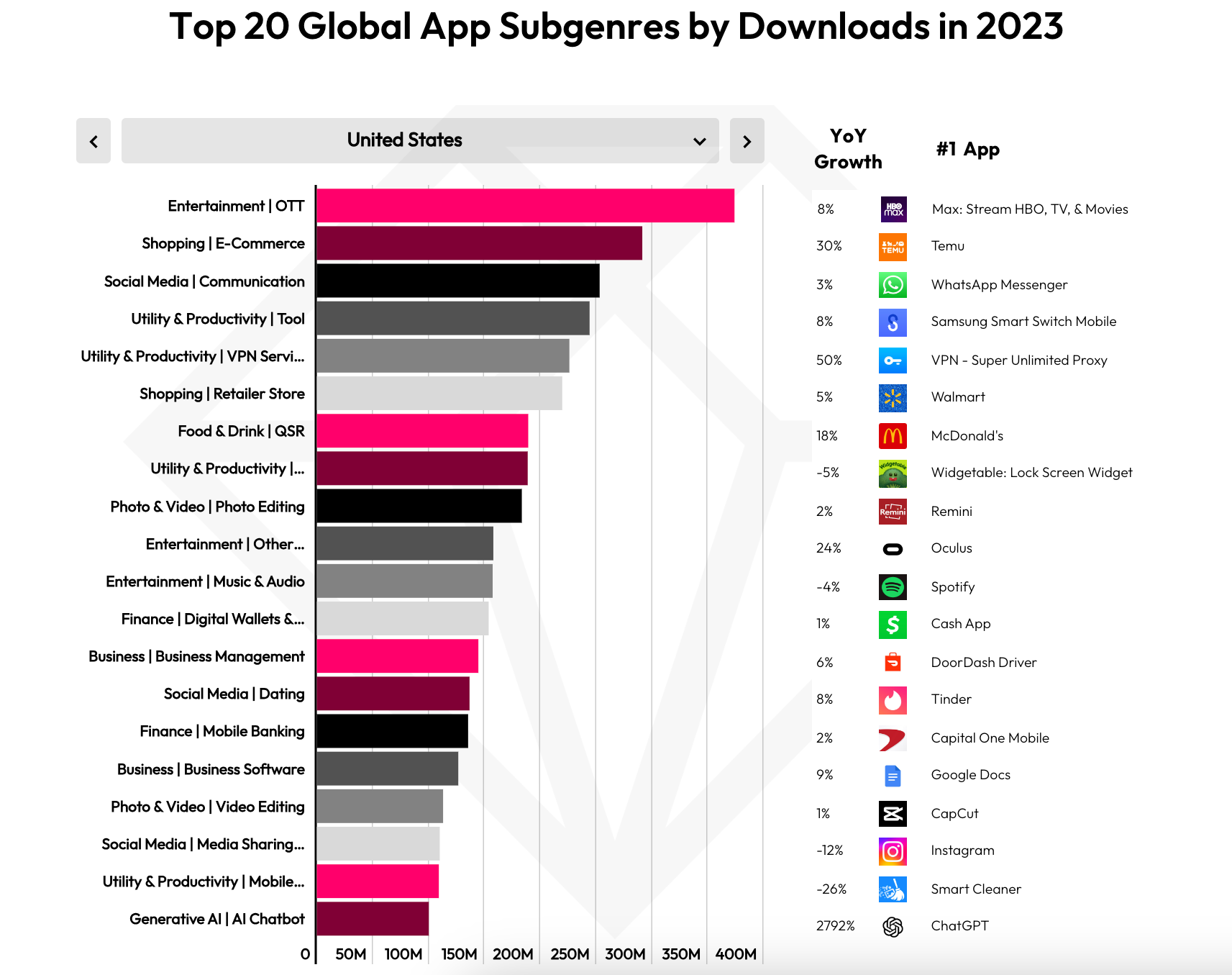
Top app subgenres by downloads in 2023
Image Credit–data.ai
Globally, VPN Service & Web Accelerator apps were the stars, boasting a 42% growth in downloads. But in the US, the scene was quite different. The crown went to HBO’s Max, nestled in the entertainment subgenre. No big shocker there, considering HBO Max 2023 transformation into the revamped streaming service Max, which surely stirred up some download frenzy!But it wasn’t all about streaming shows and movies. The shopping app Temu made some noise in the Shopping and E-Commerce subgenre. And let’s not forget our old pal, WhatsApp Messenger, leading the charge in the Social Media and Communication category with a modest 3% growth.
But the real talk of the town was AI. Despite the Generative AI and AI Chatbot category being at the bottom of the top 20, the ChatGPT app skyrocketed with a 2792% growth. For a newbie app, this might seem standard, but it is quite a success by any measure. Betting on its growth in 2024? You wouldn’t be the only one.
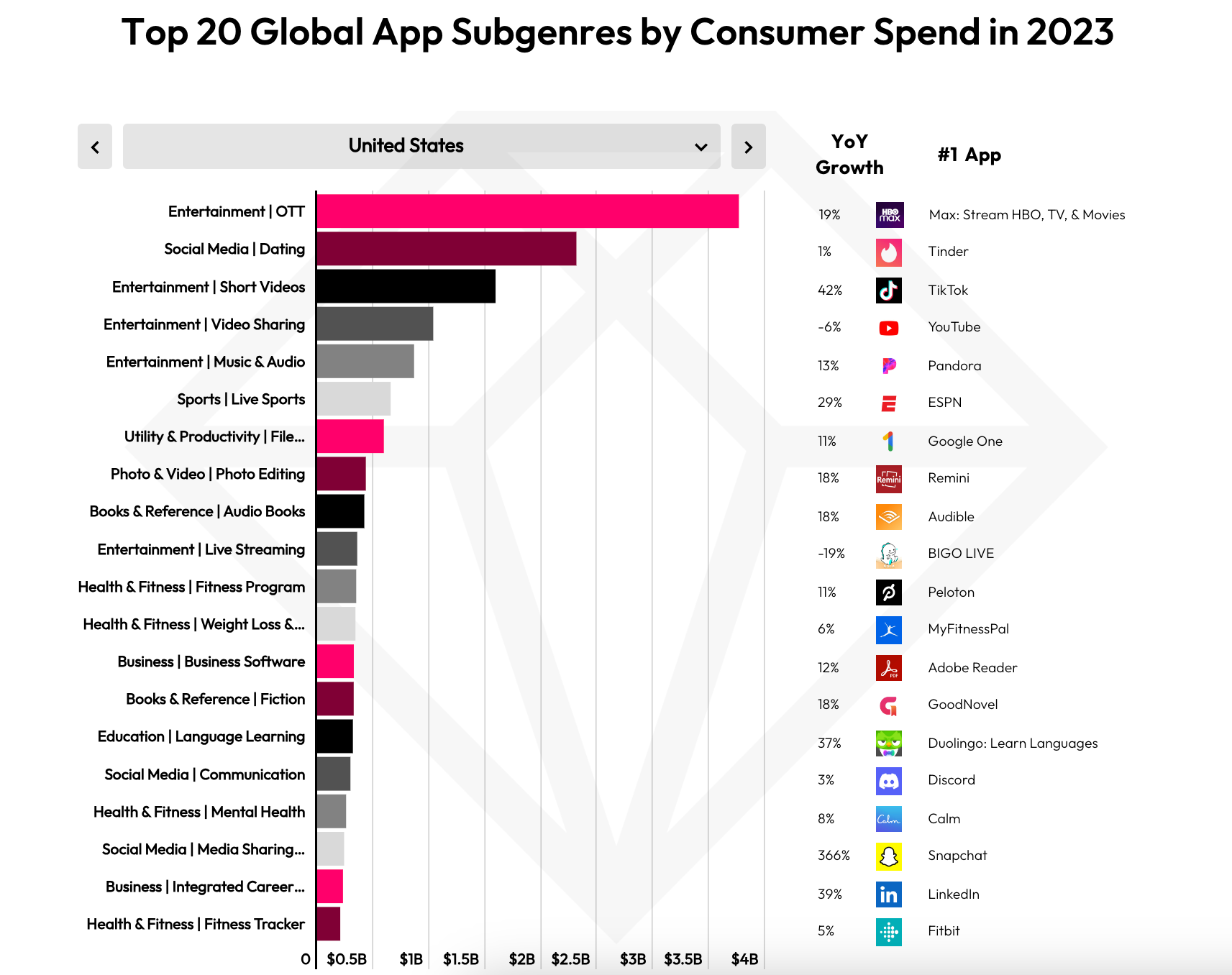
Top app subgenres by money spend in 2023
Image Credit–data.ai
Now, let’s talk about where we threw our dollars. Max tops the charts again. The second place goes to Tinder in the social media| dating subgenre. In the US, Tinder had folks swiping right to the tune of over $2.3 billion, netting a cool 1% growth year-over-year.
Not to be outdone, TikTok users were also opening their wallets, spending more than $1.5 billion on the app. Interestingly, TikTok made history as the first app to reach a whopping $10 billion in total consumer spending.
Meanwhile, Snapchat wasn’t just sitting pretty with filters; its numbers soared last year. While the app might not be leading the pack in overall consumer spending, it is making waves with a staggering 366% year-over-year growth. This impressive leap is largely credited to its newly introduced subscription service.
In 2023, it was all about video in the US consumer spending scene. The Over-the-Top (OTT) subgenre topped the charts, showing us that streaming services are more popular than ever. And it wasn’t just about binge-watching shows; short videos, video sharing, and live sports apps also saw impressive double-digit growth compared to 2022.
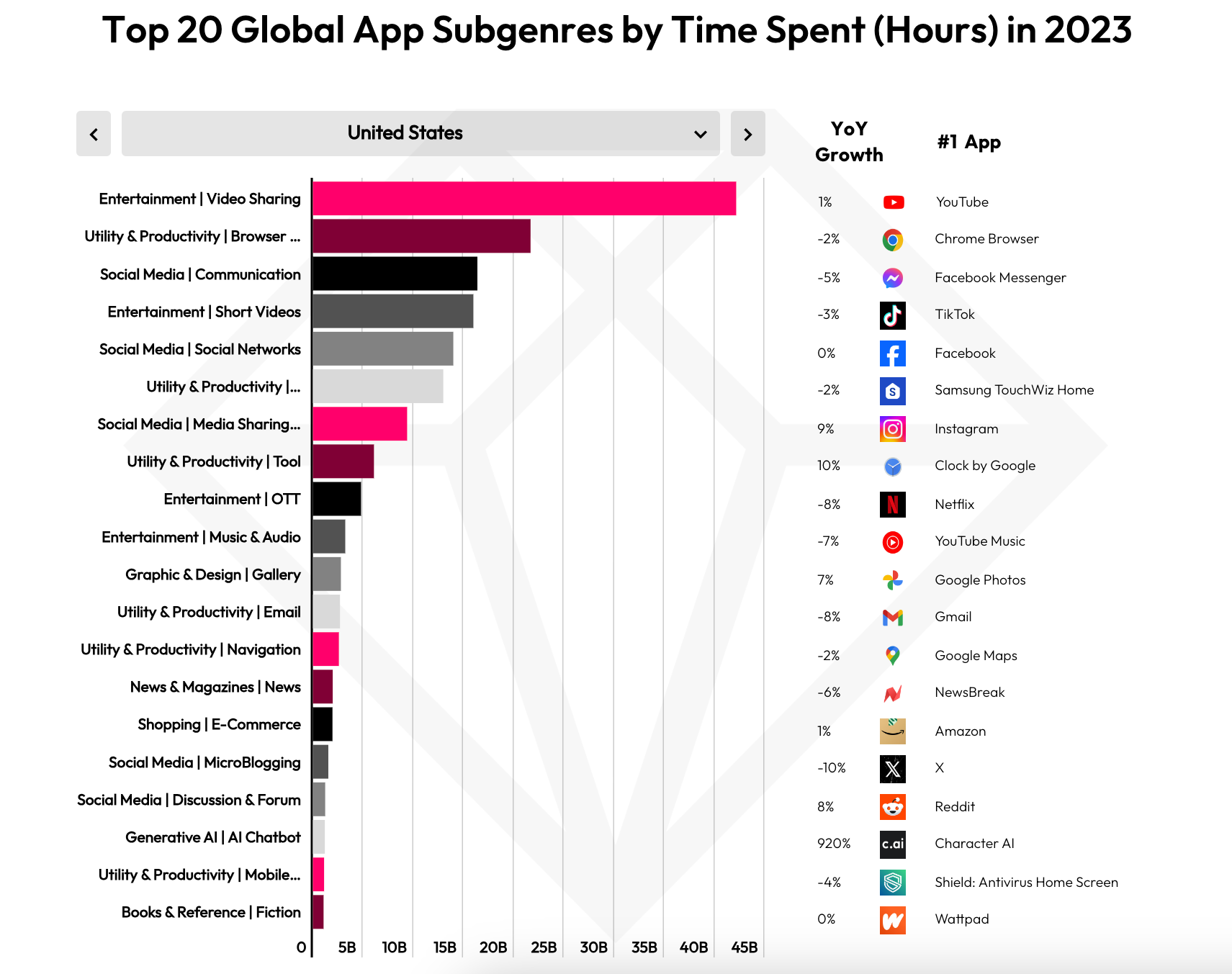
Top app subgenres by time spend in 2023
Image Credit–data.ai
Shifting gears to what might be the most crucial category: the apps where we invest our time. In 2023, four out of the top five subgenres by time spent belonged to Entertainment and Social Media. This is a big deal — these five subgenres alone hogged more than two-thirds of the total time we spent on mobile apps. To give you an idea of the scale, consider this: on Android alone, globally, users spent a mind-blowing 2.3 trillion hours on social media. Moving on.
YouTube, unsurprisingly, clinched the top spot for time spent in 2023. Probably everyone knows what YouTube is, and the numbers indeed, do all the talking. US residents collectively poured more than 40 billion hours into watching YouTube content last year. That is a 1% increase compared to 2022, further cementing YouTube’s place as a favorite go-to for digital entertainment.
In the world of apps, Media Sharing Networks saw the biggest growth spurt in 2023, surging by 35% year-over-year. Leading this charge were popular apps like Instagram and Snapchat. On the other hand, traditional Social Networks didn’t show much change, remaining roughly flat compared to 2022.
There’s also been talk about microblogging platforms, like X (formerly known as Twitter), losing their edge. Despite new entrants like Threads trying to shake things up, the microblogging sector isn’t booming like before. In fact, time spent by US users on X in 2023 dropped by 10% compared to the previous year.
Netflix, also saw an 8% decline in time spent, mirroring the 8% growth of HBO’s Max. Coincidence? I think not. On the flip side, Character.AI in the Generative AI and AI Chatbot subgenre is the app with the most growth. US users spent nearly 2 billion hours creating and chatting with AI characters.
So, what’s the gist? 2023 was a year where we juggled AI, social media, shopping, a bit of romance, and, of course, loads of video content. Quite a year for our mobile apps, right?