A trusted tipster has just shared information regarding two upcoming foldable phones from Vivo. The devices in question are the Vivo X Fold 3 and Vivo X Fold 3 Pro, as powerful cameras are expected. Well, in addition to powerful specs in general.
These two devices have model numbers V2303A and V2337A, and the spec info is coming from Digital Chat Station. He is one of the most prominent tipsters from China, thus we have no reason to doubt this information.
The Vivo X Fold 3 will have powerful cameras, at least the ‘Pro’ model
Do note that we’re talking about the specs of the ‘Pro’ model here. The regular Vivo X Fold 3 is still a mystery. The Snapdragon 8 Gen 3 will fuel the device, while a powerful camera setup is tipped.
The phone is said to include three cameras on the back. A 50-megapixel main camera will be OIS-enabled. In addition to that, you’ll find a periscope telephoto camera back there, and an ultrawide unit. The Sony LYT-900 is a possibility, but the tipster didn’t mention anything about that. It could be a bit unrealistic to see that sensor on a foldable, but we’ll see.
The phone’s main display will offer a 2K resolution, and a 120Hz refresh rate. The outer display will also offer a 120Hz refresh rate, but we’re still not sure about the resolution. Both of those panels will be of the OLED variety.
100W wired and 50W wireless charging is tipped
An ultrasonic fingerprint scanner is also mentioned, and one will be included on each of the phone’s displays. The Vivo X Fold 3 Pro will support 100W wired charging, and 50W wireless charging, based on the information shared here
In addition to all that, you can also expect the phone to be both thinner and lighter. The Vivo X Fold 2 was quite hefty at 279 grams. This one is expected to go under 250 grams, it seems. That’s something that Gizmochina mentioned.
The Vivo X Fold arrived in April 2022, while its successor came in April 2023. So, will the Vivo X Fold 3 series arrive in April 2024? Well, it’s possible. Some reports are claiming it will launch in Q1 next year, though, we’ll see. Oh, and also, the Vivo Pad 3 is tipped to launch alongside these foldables.
VR is great, but it’s not the best for social situations if you can’t cast your feed to another device. This is why Meta Quest devices came with Chromecast compatibility. This allowed you to display what you see on a large display so that other people could join in on the fun. However, for some reason, Chromecast support is leaving Meta Quest devices.
Google Chromecast is one of the easiest ways to cast to your devices. It comes bundled with a ton of devices, and your smart TV is most likely compatible with it. This means that there was a high chance that you would have been able to easily cast to it. Also, casting using Chromecast only involves a few taps/clicks to start.
But, Meta Quest devices are losing Chromecast support
This is another case where a company gets rid of a feature that everyone is enjoying for seemingly no reason. Android Central reached out for comment, but Meta has yet to respond.
As per the report, Meta Quest users are losing support for the feature. This is no bug, as the company also confirmed that it’s dropping the feature. In a note on the official help page, Meta says that “Chromecast is not fully supported with Meta Quest.” We’re not sure what the company means by “not fully compatible”. We don’t know if it’s now only available in certain regions or on certain Quest models.
You can still cast using your Meta Quest… but it’s a hassle
This doesn’t mean that you can’t cast anymore; it just means that, if you want to cast, you’ll need to jump through a few hoops. If you’re one of the unlucky souls who lost Chromecast support, you’ll need to go to the Universal menu. There, go to the Camera section and go to Cast.
Select the device you’re casting to (computer or Meta Quest app on your phone). At that point, you’ll then need to cast the feed from your phone to your Chromecast device.
Amazon Prime launched in 2005 as a way for customers to get their products quicker, without paying for incredibly over-priced overnight or two-day shipping. Of course, now, that has become the norm and a lot of places offer it for free (some if you spend a certain amount). But in the nearly 16 years since Prime launched, a lot has changed. It now offers more than just unlimited next-day and two-day shipping.
We’re going to go over everything you need to know about Amazon Prime in 2023. And help you decide if you should spend your money on Amazon Prime or not.
What is Amazon Prime?
As mentioned before, Amazon launched Prime in the US in February of 2005. It was originally meant as a way for customers to get unlimited two-day shipping on a ton of items that Amazon sold. It was $79 when it debuted in 2005, which seemed pretty pricey since the majority of us did not rely on Amazon to buy basically everything, like we do in 2023.
Since 2015, we’ve seen a few price increases, though it hasn’t increased all that much. It’s now $119, with the first increase coming in 2014 to $99 and the second in 2018 to $119. Despite shipping costs having skyrocketed for Amazon in the 16 years since Prime first debuted.
Amazon has also expanded Prime to offer much more than just unlimited next-day and two-day shipping. It comes with a number of other perks now. Like Prime Video, Twitch Prime, Same Day shipping, Whole Foods discounts and more. But we’ll talk more about Amazon Prime perks a bit later.
As of 2023, Amazon has said that there are over 200 million Prime subscribers worldwide. The pandemic in 2020 helped really boost that number too. As people everywhere relied on Amazon to deliver their most needed products.
As mentioned, Amazon Prime is $139 per year. That comes out to about $11.58 per month, the same as most streaming services. Amazon does offer a monthly plan for Prime, though it is a bit more expensive and we’d recommend going with the yearly option.
If you opt to pay monthly, it’ll be $14.99 per month. That comes out to $179.88 per year, versus the $139 price if you were to pay yearly.
Is there a student discount?
Yes.
Amazon does offer Prime Student. Which will cost students $69.99 per year. Or they can opt to go monthly at $7.49 per month. Like with the regular Amazon Prime price, it is also much cheaper to just pay it yearly than per month.
There are also some added benefits for Amazon Prime Student. Including a longer free trial. Prime Student is six months long, versus a Prime free trial being only 30 days. Amazon also allows students to rent textbooks much cheaper than other places like Chegg. Amazon touts up to 90% off, but that will depend on what textbooks are needed.
Any student is eligible for Amazon Prime Student, as long as they have a school email address – that is what is used to confirm you are a student. That also means it is only for college students and not high school students unfortunately. But whether you’re working on your Associate’s, Bachelor’s Master’s or Doctorate, you can still get Prime Student.
For most, the biggest reason to sign up for Prime is going to be the free shipping. And seeing as Amazon sells just about everything you could want or need, that is a big reason to sign up. But Amazon has added a ton of perks in recent years, making Prime a lot more attractive. Here are some of the perks available for Prime members.
Free same-day, overnight & two-day shipping
As mentioned, you can get free delivery as soon as the same day. This will depend on where you live, and what product(s) you are trying to purchase. But if you order by noon, it can arrive the same day, which is incredible. And much more convenient than running to your local Walmart.
Almost every thing on Amazon can be delivered within two days. There are some exceptions, particularly things that are not shipped and sold by Amazon.com, but rather shipped by third parties that sell on Amazon’s website.
Prime Now
A really popular service that Amazon has launched in a few cities, is Prime Now. Essentially, you can get stuff delivered to your door within two hours of ordering it. Amazon also offers this service for groceries in certain cities. Surprisingly, this is not available everywhere that has Whole Foods.
The cities that Prime Now is available in, is still pretty small. So you’ll want to check and see if you live in a city that has it or not.
Amazon Prime Video
One of the bigger perks of Prime, is probably Prime Video. Which is Amazon’s own streaming service, and has thousands of hours of movies and TV shows. That are available on your smartphone, tablet, smart TV, gaming consoles and other devices. There are also a ton of exclusive TV shows and movies available on Amazon Prime Video. And it’s available for free with Amazon Prime.
Now if you want just Prime Video, you can get it separately and not get Prime as a whole. It’ll cost you $8.99 per month. And at that price, you might as well just get Prime. As it’s only $12 more for the entire year.
Amazon Music Unlimited
Amazon also has a streaming music service, which you can sign up for, or get it free with Prime. You can stream Prime Music free, which has a smaller catalog of music available for Prime members, about two million songs. It is also ad-free.
There is also Amazon Music Unlimited, which has 50 million songs, but Prime members do still get a discount on Music Unlimited – even though it’s not free. You can sign up for Music Unlimited here. It’ll cost Prime members $7.99 per month versus $9.99 per month for non-Prime members.
Finally, there’s Amazon Music HD. This is like Music Unlimited, but higher quality. It’s going to give you CD-quality music, but streaming. And it costs $14.99 per month. There’s no discount for Prime members though. You can sign up for Amazon Music HD here.
Amazon bought Twitch in 2014, to compete with Google and its YouTube Gaming platform, though only one still exists in 2023. Anyways, Amazon decided to bring twitch into its Prime perks. So with Twitch Prime, gamers are able to get free games and in-game items each month. With Twitch Prime, you can also sign up for one free Twitch premium streamer a month. This allows users to support their favorite Twitch streamers and get access to exclusive features.
Free Kindle & Audible Content
With Prime, members are able to borrow a selection of free Kindle ebooks, magazines and much more with their subscription. You will also get a free Kindle book every month from a pre-selected list. Now you may not be getting the New York Times Bestsellers every month, but they are still free books. Prime members can also access a number of podcasts and audiobooks from Audible for free.
Amazon Photos
With Google Photos ditching its unlimited storage option, this is going to become a big deal for Prime members. As Amazon offers unlimited storage for Amazon Photos, and you can also get 5GB of storage for videos with Prime. So you can back up all of your photos to Amazon Photos for no extra charge.
Whole Foods
Amazon bought whole Foods in 2017, and essentially turned it into a place where you can pick up your Amazon packages, instead of them piling up in front of your home. Prime members can get special discounts at Whole Foods, which regular shoppers won’t get. You can also order groceries from Whole Foods and pick it up within an hour, but you will need to buy at least $35 worth of groceries.
Some locations will do grocery delivery as well.
Amazon Rewards Visa Card Cash Back
Perhaps not for everyone, but Amazon does also have a credit card for Prime members. The Amazon Rewards Visa Card will give Prime members up to 5% cash back on purchases from Amazon or at Whole Foods. And you’ll get 2% cash back at drug stores, gas stations and restaurants. And finally up to 1% cash back everywhere else.
Of course, not every Prime member is able to get this credit card. As it will depend on your credit score. But this is one of the better cash back cards out there. Particularly if you shop on Amazon quite often.
Alexa & Early Deals
Prime members can also get exclusive deals from Alexa. Just ask Alexa “What are your deals” and she’ll list them off. You can then purchase them with your voice, making it super easy to take advantage of these sales.
Amazon also offers early deals for Prime members. Particularly around Prime Day and Black Friday. Amazon is able to make these shopping holidays last closer to a month rather than a day or two. Because of these early deals. And you get early access to Lightning deals. Those deals typically last around six hours (or until stock is out), but Prime members can get access to them 30 minutes early.
Can I share Prime with others?
Yes. You can share your Prime benefits with up to one other person.
However, if you are using a Prime Student account, you cannot share this with anyone.
This means that you could share your Prime benefits with another person and split the cost, making it just $60 per year per person, instead of $120.
What is Prime Day?
This is another perk of Amazon Prime actually, and that’s Prime Day.
Amazon launched Prime Day in 2015. It started out as a one-day event in July to rival Black Friday, and for the most part, only Prime members could participate. Since then, it has grown to be almost a week long event. Some might even say a month-long event, with the many “Early Prime Day” deals that Amazon does leading up to the big day.
In 2023, Prime Day will take place on July 11 and July 12. Which is when Prime Day normally takes place, though the past few years things have been a bit different due to the pandemic.
Prime Day did start out as a bit of a joke. The first two years, stock was so limited on the good products, that they sold out quickly. And a lot of people were left with buying things like toilet paper. Though after 2020, that’s not necessarily a bad thing. These days, you can get a lot more things on sale on Prime Day, including some great discounts on smart TVs, smartphones, and much more.
Other retailers also do their own Prime Day events around Amazon’s big day. To help cash in on all of that spending. Walmart and Best Buy in particular do Prime Day events.
Now, you can actually take part in Prime Day without being a Prime member. But not everything will be available to you. Many deals are for “Prime Members only”.
With the many benefits that Amazon has with Prime now, it is definitely worth it.
At $139 per year, that’s a little less than $12 per month, it’s almost the same price as most streaming services, for instance Netflix Standard is $15.49, MAX is $9.99 with ads and $15.99 without. And you’re going to get a whole lot more out of it. Including Amazon Prime Video too.
These days, we buy just about everything from Amazon, which makes Prime something that is a must-have. With that free next-day and two-day shipping available. Not to mention the fact that Amazon will sometimes deliver earlier than stated. It’s a really good subscription service to take advantage of.
Even if you only use a few of the perks included in Amazon Prime, it makes the service worth it for $119 per year. And that’s exactly what Amazon is banking on here. Giving you loads of perks, knowing that you will only use a couple (at most). Because Amazon would actually be losing money if every member used every perk available with Prime.
For years, Apple was ridiculed for claiming that you could play games on the Mac. But now, it’s really true that you can do just that. Thanks to Apple Silicon and its pretty beefy GPU cores, gaming on the Mac is now incredible and sometimes better than PC.
Apple’s Mac product marketing manager, Goron Keppel has just done an interview with Inverse, talking about how the Mac is becoming a leading gaming platform, and it’s all thanks to Apple Silicon. Apple has a renewed interest in gaming on Mac, an interest which we have not seen in the last 25 years.
Keppel told Inverse that “every Mac that ships with Apple Silicon can play AAA games pretty fantastically. Apple Silicon has been transformative of our mainstream systems that got tremendous boosts in graphics with M1, M2, and now with M3.” Keppel isn’t just blowing smoke here; anyone who has used any Apple Silicon-based Mac in the past three years will agree with him. The performance of these new Macs is incredible and blows away similarly-specced PCs.
Apple Silicon was designed for Gaming
Apple’s software marketing manager, Leland Martin, says, “Apple Silicon started fresh with a unified hardware platform that not only makes it easier for developers to create Mac games but will allow for those games to run on other Apple devices.”
One of the reasons that Apple fell out of grace with gaming developers was that Apple did not support specific computer hardware. Even looking at Apple’s Intel-based Mac lineup, there were integrated and discrete GPU options. Which Martin says “can add complexity when you’re developing games. Because you have multiple different hardware permutations to consider.”
Martin says that Apple has effectively eliminated that completely with Apple Silicon. Instead, it has a “unified gaming platform now across iPhone, iPad and Mac.” This means that once a game is designed for one platform, it’s a relatively straightforward process to bring it to the others.
Another member of the Mac Marketing Team, Doug Brooks, stated that “Gaming was fundamentally part of the Apple Silicon design.” Continued by stating that “before a chip even exists, gaming is fundamentally incorporated during those early planning stages and then throughout the development.”
Martin also boasted about how Apple has already seen a boost in interest from developers thanks to its Game Porting Toolkit. “We’ve definitely seen interest from developers and publishers like Kojima Productions and Annapurna Interactive Games on how to take advantage of both parts of the Game Porting Toolkit,” Martin says.
Will the Mac take over PC in terms of gaming? Likely not. However, the Mac is the single most popular laptop on earth right now. So, bringing in that market share for game studios is a big deal.
The OnePlus 12R is coming, and its display info just got confirmed by the company. Before we get into that, do note that the OnePlus Ace 3 will be the OnePlus 12R in China. That device will actually launch before the OnePlus 12R, so this is kind of the confirmation for the ONePlus Ace 3 (it comes from Weibo). The exact same info applies to the OnePlus 12R, though.
The OnePlus 12R display info has been revealed by the company
Having that in mind, the OnePlus 12R will feature a BOE X1 display. That’s the same panel the OnePlus 12 utilizes, actually. We’re looking at a 1.5K resolution here (a bit lower than on the OnePlus 12), and this is an OLED display.
The max brightness on the panel will be 4,500 nits, which is industry-leading. Do note that you’ll never get that high, though. This display also has the industry-leading 8T LTPO (Low-Temperature Polycrystalline Oxide) circuit design. That’s great for power consumption.
The OnePlus 12R will also have OnePlus’ Bright Eyes Eye Protection tech. That tech basically adjusts the display’s brightness and color temperature automatically in order to save your eyesight as much as possible.
The OnePlus Ace 3 is coming on January 4, the OnePlus 12R will follow on January 23
The OnePlus Ace 3 will launch on January 4, while the OnePlus 12R will launch on January 23. As already mentioned, those two devices will be the same, but made for different markets.
This is the very first OnePlus R series device that will leave China. OnePlus usually launches the ‘Ace’ model in China, and the ‘R’ model in India. That will change starting with the OnePlus 12R.
The OnePlus 12R will be fueled by the Snapdragon 8 Gen 2 processor. The phone’s design has also been revealed already, and it will basically look like the OnePlus 12. There will be some subtle differences that you really have to look for in order to spot them.
Its camera setup on the back will also be inferior to the OnePlus 12. OnePlus had to cut costs somewhere. If the company gets the price tag right, the OnePlus 12R will be a great phone for many people.
Hackers exploit Zero-Days because these vulnerabilities are unknown to software developers, making them valuable for launching attacks before developing patches.
Zero-day exploits provide an opportunity to:-
Compromise systems
Gain unauthorized access
Cause significant damage
Steal sensitive information
Cybersecurity researchers at Securelist recently discovered a malicious operation dubbed “Triangulation,” in which threat actors exploit the 0-click iMessage attack using four zero-days to hack iPhones.
Zero-days discovered
Here below, we have mentioned all the four zero-days that were discovered:-
Attack chain
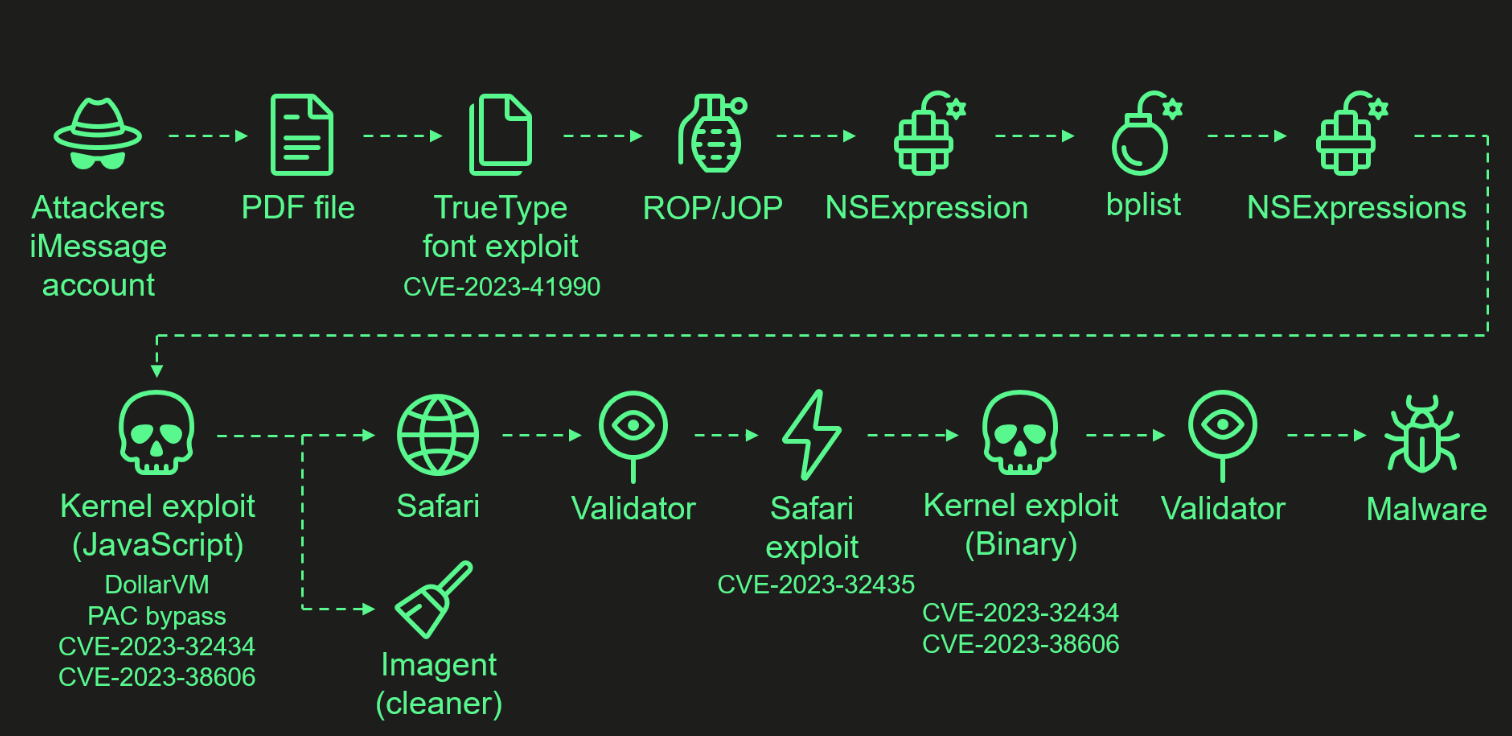
Attackers send a harmful iMessage attachment that exploits a code execution vulnerability (CVE-2023-41990) in Apple’s ADJUST TrueType font.
It employs return/jump-oriented programming and multiple stages in NSExpression/NSPredicate language. It patches JavaScriptCore to run a privilege escalation exploit in obfuscated JavaScript, totaling around 11,000 lines.
The exploit leverages DollarVM to control JavaScriptCore’s memory and execute native API functions.
It was designed for both old and new iPhones, and for the recent models, it bypasses the PAC.
Meanwhile, the CVE-2023-32434 is exploited to gain read/write access via XNU’s syscalls. However, to bypass the Page Protection Layer, it uses the MMIO registers, which CVE-2023-38606 mitigated.
Attack chain (Source – Securelist)
Technical analysis
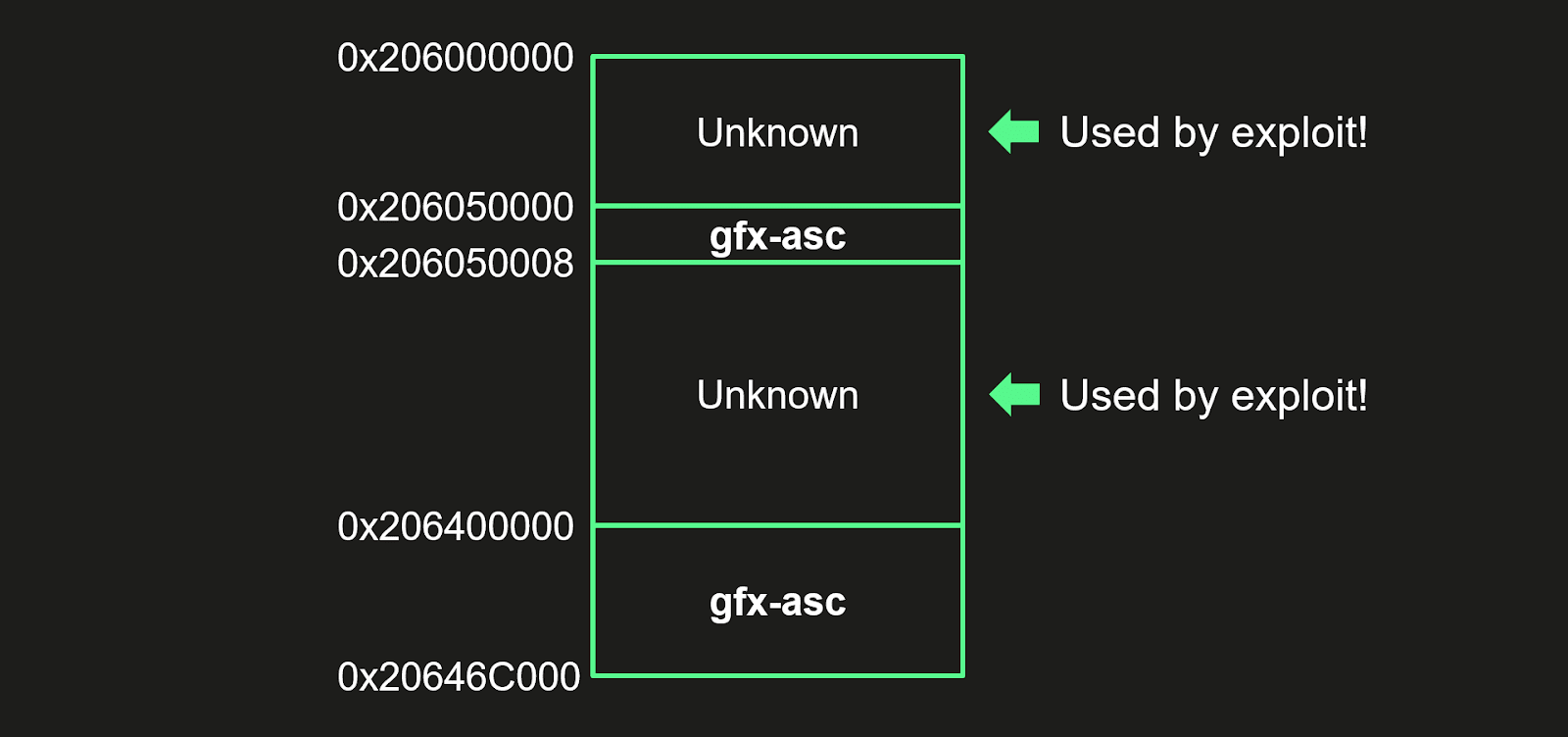
SoC peripheral devices have MMIO registers mapped via DeviceTree. Operation Triangulation exploit targets unknown MMIOs in Apple A12–A16 Bionic SoCs at:-
0x206040000
0x206140000
0x206150000
Despite extensive searches, no references were found in device tree files, source code, firmware, or kernel images. SoC has MMIO ranges at:-
0x206400000–0x20646C000
0x206050000–0x206050008
Exploit uses the following unknown addresses mainly within gfx-asc regions, hinting at GPU coprocessor:-
0x206040000
0x206140008
0x206140108
0x206150020
0x206150040
0x206150048
Correlation of the gfx-asc MMIO ranges (Source – Securelist)
Here, the device tree and pmgr utility was used to find the GFX register in the power manager MMIO range. Through the SERROR Exception, the GPU coprocessor involvement was confirmed.
The 0x206040000 register was explored during the exploit stages, and it’s been identified CoreSight MMIO debug registers for the GPU coprocessor.
The ml_dbgwrap_halt_cpu function was discovered in the XNU source code and recognized the purpose of unknown registers, like 0x206150020 for A15/A16 Bionic SoCs.
For page table patching, the PPL bypass hardware feature was revealed and exploited for kernel debugging on iPhones.
Moreover, the m1n1 tool used to trace MMIO registers on M1 found no usage by macOS and shared similarity with 37C3 presentation on Blu-ray drive vulnerability.
The iOS 16.6 fix was mitigated by adding MMIO ranges to the device tree and the Pmap-io-ranges in the device tree used by XNU to control physical address mapping.
Unusual vulnerability puzzles the researchers, as the origin and purpose of unknown hardware features confuse the experts; however, it’s unclear if Apple or a third party designed it.
This flaw exposes the uselessness of the advanced hardware protections against smart attackers. Besides this, hardware security leans on “security through obscurity,” which is a flawed approach.
OnePlus is gearing up to kick off 2024 with a bang. The China-based company will enter the year with at least three product launches. These are the OnePlus 12, OnePlus 12R (OnePlus Ace 3 in China), and OnePlus Buds 3. Those tracking the news already know that the OnePlus 12 has already debuted in the homeland on December 5th. However, the global variant will hit the shelves on January 23rd.
The OnePlus Buds 3 confirmed to launch along with the OnePlus Ace 3 / OnePlus 12R
Meanwhile, the OnePlus Ace 3 may feature a 6.78-inch OLED display with support for up to 4,500nits peak brightness and up to 120Hz adaptive refresh rate. Under the hood, it may pack a Qualcomm Snapdragon 8 Gen 2 chipset. In terms of the camera, we expect a triple camera setup on the rear consisting of a 50MP OIS primary lens, an 8MP ultrawide lens, and a 2MP macro module. There’ll also be a 16MP front shooter for selfies and video chats. It will, most likely, launch in two colors globally: Star Black and Moon Sea Blue. There’s also a Sand Gold variant, but that’ll be a China exclusive.
Specifications of the OnePlus Buds 3
OnePlus claims that the upcoming Buds 3 earbuds aim to deliver “flagship sound quality” to a broader audience. When they launch, the OnePlus Buds Pro 3 are anticipated to pack features like true (48dB) wireless noise cancellation, Google Fast Pair, and dual connection capabilities. There’s speculation that these earbuds will offer 3D spatial audio and boast a battery life of up to 44 hours. The pair may also feature an IP55 water and dust resistance rating. Meanwhile, interested buyers in China can already place pre-orders through Tmall, JD, and OPPO Mall.
Security researchers at Kaspersky have recently revealed a highly advanced iMessage vulnerability, dubbing it “Operation Triangulation.” Researchers found that this exploit was active between 2019 and December 2022 by its complexity. It utilizes a series of zero-day vulnerabilities to create what they describe as the “most sophisticated attack chain” ever known.
The presentation at the Chaos Communication Congress marks the first time that the researchers publicly revealed the details of the exploits and vulnerabilities used in this advanced iMessage attack.
Operation Triangulation employed a 0-click iMessage attack, using four zero-day vulnerabilities to target iOS versions up to iOS 16.2. Researchers started the attack with a malicious iMessage attachment that isn’t noticeable by users. The attachment exploited a remote code execution vulnerability in the Apple-only ADJUST TrueType font instruction, present since the early 90s.
Intricacies of the most sophisticated iMessage exploit: Operation Triangulation
Credit: Securelist
This complex attack involved multiple stages, including JavaScript exploits, intricately coded with around 11,000 lines, and the manipulation of JavaScriptCore‘s memory. The exploit aimed to gain control over the entire physical memory of the device, using techniques such as Pointer Authentication Code bypass and hardware memory-mapped I/O registers.
One notable aspect of the attack was the use of an unknown hardware feature in Apple-designed SoCs, which allowed attackers to write data to a specific physical address, bypassing hardware-based memory protection. This feature, seemingly unused by the firmware, raised questions about its origin and purpose, with Kaspersky guessing it might have been intended for debugging or testing purposes.
The researchers accordingly revealed their intent to share these technical details to encourage collaboration among iOS security researchers, seeking confirmation of their findings and potential explanations for how attackers might have discovered and utilized this mysterious hardware feature.
The Operation Triangulation attack chain stands out not only for its technical sophistication but also for the collaboration between security researchers to shed light on its intricacies. Smartphone security remains a critical concern and understanding and addressing such advanced exploits are essential to safeguarding your data and privacy.
Barracuda Email Security Gateway (ESG) Appliance has been discovered with an Arbitrary code Execution vulnerability exploited by a China Nexus threat actor tracked as UNC4841.
Additionally, the vulnerability targeted only a limited number of ESG devices.
However, Barracuda has deployed a security update to all the active ESGs to address this vulnerability, and has been automatically applied to all the devices, which does not require any action from the user.
The new vulnerability has been assigned to CVE-2023-7102, and the severity is yet to be categorized.
Chinese Hackers Exploit New Zero-Day
This vulnerability exists due to using a third-party library, “Spreadsheet::ParseExcel,” in the Barracuda ESG appliances.
This open-source third-party library is vulnerable to arbitrary code execution that can be exploited by sending a specially crafted Excel email attachment to the affected device.
The Chinese Nexus threat actors have been using this vulnerability to deploy new variants of SEASPY and SALTWATER malware to the affected devices.
However, Barracuda has patched these vulnerabilities accordingly. Moreover, Barracuda stated, “Barracuda has filed CVE-2023-7102 about Barracuda’s use of Spreadsheet::ParseExcel which has been patched”.
Another vulnerability, CVE-2023-7101, affected the same spreadsheet: ParseExcel, and no patches or updates were available.
Nevertheless, both of these vulnerabilities were associated with a previously discovered vulnerability, CVE-2023-2868, that was exploited by the same threat group in May and June 2023.
Furthermore, a complete report about these vulnerabilities, along with additional information, has been published, which provides detailed information about this vulnerability and the previously discovered vulnerabilities.
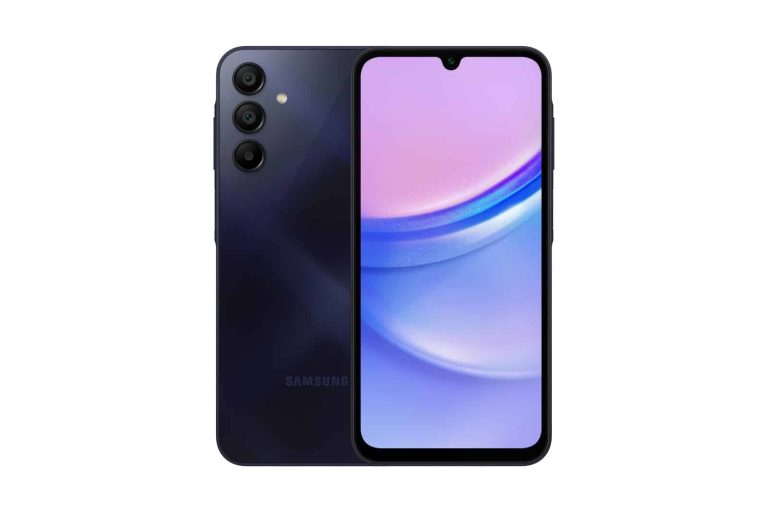
Earlier this month, Samsung launched the Galaxy A15 as its latest affordable 5G smartphone. The company is now readying an M series equivalent of the device, aptly called the Galaxy M15. Like its predecessors, it should mostly be a rebadged Galaxy A15 with a few changes. As expected, the most notable change will be a bigger battery than the A series model.
Samsung’s Galaxy M15 will pack a huge battery
Samsung launches budget and mid-range Android smartphones under three different lineups—A, M, and F series. Some models are mostly rebadged versions of the same device, while others share fewer similarities. For example, this year’s Galaxy A14 and Galaxy M14 have the same design and pack pretty much the same specs. On the other hand, the Galaxy A54 and Galaxy M54 have a lot of dissimilarities, including the display and cameras.
However, despite varying strategies across different price points, Samsung has always packed bigger batteries inside M series phones. The Galaxy A14, Galaxy A34, and Galaxy M54 all have 6,000mAh batteries. Their A series equivalents feature 5,000mAh units. It appears that won’t change with the next-gen models. SamMobile reports that the Galaxy M15 will feature a 6,000mAh battery, 1,000 mAh more than the newly launched Galaxy A15.
The publication doesn’t have any other information about the upcoming M series phone. However, since it is expected to be a rebadged Galaxy A15, we may already have a fair idea about its spec sheet. The latter device sports a 6.5-inch Super AMOLED display with a 90Hz refresh rate and 800 nits brightness. It is available in 4G/LTE and 5G connectivity options, powered by MediaTek’s Helio G99 and Dimensity 6100+ chipsets, respectively.
You get up to 8GB of RAM, 256GB of storage, a triple rear camera setup headed by a 50MP primary shooter, a 13MP front camera, a 3.5mm headphone jack, a side-mounted capacitive fingerprint scanner, 25W wired charging, Wi-Fi 5, and Bluetooth 5.3. It remains to be seen whether the Galaxy M15 keeps everything unchanged or if Samsung decides to tweak a few things. The Galaxy A15 runs Android 14 out of the box and will get four major Android OS updates.
The new phone might debut after the Galaxy S24 flagships
Samsung debuted the Galaxy M14 about two months after the Galaxy A14. Based on this, we might not see the Galaxy M15 go official anytime soon. The company may unveil it sometime in February next year. Ahead of that, Samsung has a big launch event coming up for the Galaxy S24 series. The new flagships are expected to break cover on January 17, 2024. We should get to know more about the upcoming budget phone soon.