A post on the Apple Developer website (via 9to5Mac) reveals that a new “contingent pricing” feature will be available in the App Store. The subscription gets its name because customers can be given a discount on a subscription contingent on them having an active subscription to another publication. That discount will continue to be offered every month as long as the customer remains subscribed to both publications.
Here is what Apple told developers on the website: “Contingent pricing for subscriptions on the App Store — a new feature that helps you attract and retain subscribers — lets you give customers a discounted subscription price as long as they’re actively subscribed to a different subscription. It can be used for subscriptions from one developer or two different developers. We’re currently piloting this feature and will be onboarding more developers in the coming months.”
Apple goes on to say that developers should start planning how they will work contingent pricing into their App Store pricing strategies. A link on the website will allow developers to sign up to receive a notification from Apple in January which is when the company will inform developers of more details related to “contingent pricing.”
In 2024, Apple will allow developers to offer contingent pricing on subscriptions in the App Store
In explaining exactly what “contingent pricing” is, Apple writes, “For example, you might offer Ocean Journal premium subscribers the opportunity to subscribe to Mountain Climber for a discounted price of $4.99/month instead of the regular $5.99/month. Customers pay the discounted price as long as they remain Ocean Journal subscribers.”
While Apple is writing to developers, the tech giant does explain how customers will be able to find publications in the App Store that offer “contingent pricing.” Apple says that customers will find the discounted pricing in a publication’s App Store listing, off-platform marketing channels, and planned placements in the App Store.
Apple says that it will help developers manage the implementation of “contingent pricing” by offering customers “a seamless redemption and purchasing experience” based on the contingent price proposition that the developers will be providing.
Obviously “contingent pricing” isn’t going to be available to App Store customers until sometime next year.
How would you like to find out a friend or family member’s current location from your Google Contacts app? It sounds pretty cool, right? Android users are beginning to get this feature pushed out to them by Google in version 4.22.37.586680692 of the Google Contacts app. My Pixel 6 Pro running Android 14 QPR2 Beta 2 has yet to receive this update.
You can check to see which version of the Contacts app your Android phone is running by going to Settings > Apps and scrolling to Contacts. Tap on Contacts to see the App info page. Scroll down to the bottom of the page and at the very bottom of the screen, the version number of the app will appear. If you don’t have the necessary version running on your phone, there is no need to panic. You’ll get it in due time.
Now there are some important instructions. This feature is available to you only for those contacts who share their location with you in Google Maps and whose Gmail address you have on their Contacts card. If so, you’ll see a small part of the bottom of the screen dedicated to Google Maps-Location sharing. This will reveal whether the other party can see your location and if so, for how long they will be able to do so.
Find the location of your friends and family in the Google Contacts app. Image credit-Android Central
A button that says Maps will appear on this portion of the Contacts card. Tap on it and you’ll be able to see the person’s location in Google Maps. Besides making sure that your Contacts card for a specific friend or family member includes his/her Gmail address, and that the person shares his/her Google Maps location with you, you must use the Google Contacts app on your Android phone and not one offered by the manufacturer of your phone.
If your Android phone isn’t using Google Contacts, you can find the app in the Play Store by tapping on this link. And the beauty of this feature is that once you find the location of your friend or family member on Google Maps, one tap will give you directions to his/her location.
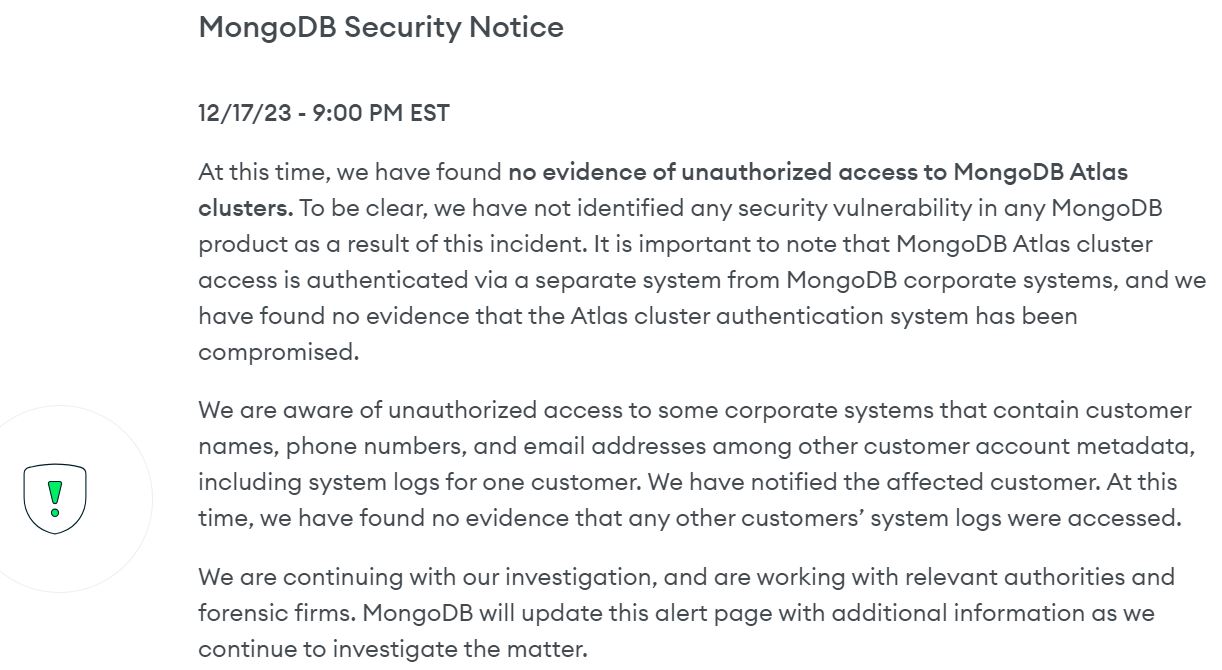
In an email, Lena Smart, MongoDB’s Chief Information Security Officer (CISO), confirmed the latest MongoDB Data Breach, revealing that while investigations are underway, it has been verified that hackers accessed customer metadata and contact information.
MongoDB, a leading database management company, has fallen victim to a security incident resulting in unauthorized access to certain corporate systems. The breach, detected on the evening of December 13th, 2023, US Eastern Standard Time, has prompted an immediate and comprehensive investigation by the company.
The breach includes the exposure of customer account metadata and contact information, heightening concerns about the potential misuse of sensitive data. MongoDB activated its incident response process upon the discovery of suspicious activities, but it is believed that the unauthorized access may have been ongoing for some time before being detected.
Lena Smart, MongoDB’s Chief Information Security Officer (CISO), sent an email communication to MongoDB customers, outlining the details of the breach and urging caution in the wake of potential social engineering and phishing threats. The company assures customers that, as of now, there is no indication of exposure to the data stored in MongoDB Atlas, a cloud-based database service.
Despite the incident, MongoDB is actively managing the situation, with ongoing updates promised on their alert page (mongodb.com/alerts) as the investigation progresses. Relevant authorities have also been notified, underlining the seriousness of the security breach.
In a subsequent update at 5:25 PM EST on December 16, 2023, MongoDB reported a spike in login attempts, causing issues for customers attempting to access the MongoDB Atlas and Support Portal. However, MongoDB clarified that this was unrelated to the security incident and advised affected users to try again in a few minutes.
Lena Smart, in her email to customers, emphasized proactive steps to mitigate potential risks. MongoDB recommends customers be vigilant for social engineering and phishing attacks and take immediate action, such as activating phishing-resistant multi-factor authentication (MFA) and regularly rotating MongoDB Atlas passwords.
Hi,
MongoDB is investigating a security incident involving
unauthorized access to certain MongoDB corporate
systems. This includes exposure of customer account
metadata and contact information. At this time, we
are NOT aware of any exposure to the data that
customers store in MongoDB Atlas.
We detected suspicious activity on Wednesday (Dec.
13th, 2023) evening US Eastern Standard Time and
immediately activated our incident response process.
We are still conducting an active investigation and
believe that this unauthorized access has been going
on for some period of time before discovery. We have
also started notifying relevant authorities.
What should you do next?
Since we are aware that some customer
account metadata and contact information was
accessed, please be vigilant for social
engineering and phishing attacks.
If not already implemented, we encourage all
customers to activate phishing-resistant multi-
factor authentication (MFA) and regularly rotate
passwords.
MongoDB will continue to update mongodb.com/alerts
with additional information as we continue to
investigate the matter.
Sincerely,
Lena Smart
MongoDB CISO
Email sent by the company’s CISO reveals the latest MongoDB data breach (Screenshot credit: Hackread.com)
As the investigation unfolds, MongoDB customers are anxiously awaiting further updates on the situation. The incident serves as a stark reminder of the constant and evolving threats faced by companies in the digital age, underscoring the importance of robust cybersecurity measures and the need for continuous vigilance in safeguarding sensitive customer information.
Whitehat hackers are vital for companies, large to small, but what if some businesses fail to grasp the significance of ethical hacking?
In a recent cybersecurity incident, three Polish hackers achieved success in repairing the malfunctioning software of a train, initially serviced by independent repair shops for a regional rail operator.
However, the narrative took a twist when accusations arose against the manufacturer, Newag, alleging that they remotely rendered inoperable trains serviced by the Polish train repair company, SPS. That’s not all, reportedly, Newag is threatening the hackers with a lawsuit.
The practice of remotely disabling or “bricking” products serviced by third-party entities is not unfamiliar, as major tech companies, such as Apple, adopt similar measures to safeguard revenue streams.
While we don’t want to get overly religious or emotional, it’s an undeniable fact that Whitehat hackers, also known as ethical hackers or cybersecurity researchers, are nothing short of a blessing. Numerous cases exist where ethical hackers have saved companies from devastating hacks.
Further, take, for instance, this whitehat hackerwho went the extra mile to unlock a car for a family that lost their keys. And let’s not forget the notorious WannaCry ransomware attack, which was successfully thwarted by a whitehat hacker, while cybersecurity and technology giants remained clueless. However, Newag’s response to the event highlights a notable lack of understanding of cybersecurity on their part.
The issues surrounding Newag’s Impuls series of trains, which are operated by independent entities, have been ongoing since the summer, adversely affecting customer service. These trains exhibited mysterious failures, refusing to restart after routine maintenance. To unravel the mystery behind these disruptions, SPS enlisted the expertise of Dragon Sector, a group of ethical hackers.
Insights from Dragon Sector reveal a concerning aspect of Newag trains’ software programming in Poland. According to the ethical hacking group, Newag’s trains were equipped with a unique feature that triggered a software lockdown if they remained stationary for more than 10 days.
Regardless, the complexities of Newag’s software go beyond mere inactivity, extending to a sophisticated mechanism that activates when a train parks at specific GPS locations.
Remarkably, these preset GPS locations align strategically with independent repair shops spread across Poland. This means that the software lockdown could be initiated not only based on the duration of inactivity but also when a train is parked at designated locations, which happen to coincide with indie repair shops.
A noteworthy revelation is that at least one of these predetermined GPS locations included a repair shop still in the construction phase at the time when the programming details came to light. This raises questions about the intention and scope of Newag’s software lockdown strategy, as it appears to extend beyond the straightforward goal of preventing prolonged inactivity.
One of Dragon Sector’s hackers, Michał Kowalczyk, stated that this issue seems deliberate from Newag. “Today we are sure that it was a deliberate action on Newag’s part. We discovered the manufacturer’s interference in the software, which led to forced failures and to the fact that the trains did not start,” Michał claimed.
Zaufana Trzecia Strona, a Polish language IT security news website also reportsthat repair countermeasures would activate if parts were replaced without a hidden unlock sequence in the train’s computer. Additionally, codes would shut the train down after one million kilometres, and hardware could allow remote interaction with Newag trains.
Newag, Poland’s oldest railway company, denies accusations and blames SPS for initiating a conspiracy theory. The company now demandsthe repaired trains be removed from service immediately, claiming they had been “hacked” and might be unsafe.
Newag claims the story is slander from competitors and threatens to sue Dragon Sector. The company believes it to be an attack on independent repair, which has become a controversial issue pitting consumers and companies like Apple, John Deere, and many across the car industry against each other. Right-to-repair is combated through proprietary software and encryption that the company can only read.
Lower Silesian Railways, a rail operator, has been in a disputewith Newag, which produces its Impuls 45WE hybrid multiple units. In June 2022, the railroad experienced multiple no-start failures with these trainsets, resulting in fewer trains running than scheduled and impacting passenger service.
Nevertheless, this should come as no surprise, as companies and businesses frequently don’t appreciate the efforts of whitehat hackers who are doing good. Cybersecurity researchers like Rob Dyke and Wesley Wineberg are prime examples of what can occur when companies fail to grasp the importance of responsible disclosures.
Cybersecurity researchers from Kaspersky’s Global Emergency Response Team (GERT) have identified that the NKAbuse malware is actively targeting devices in Colombia, Mexico, and Vietnam.
Kaspersky’s Global Emergency Response Team (GERT) has discovered a new multiplatform malware threat that uses innovative tactics to hijack victims. The malware, dubbed NKAbuse, uses New Kind of Network (NKN) technology, a blockchain-powered peer-to-peer network protocol to spread its infection.
NKAbuse is a Go-based backdoor used as a botnet to target Linux desktops and potentially IoT devices. The malware allows attackers to launch Distributed Denial of Service (DDoS) attacks or fling remote access trojans (RATs).
It is worth noting that the backdoor relies on NKN for anonymous yet reliable data exchange. For your information, NKN is an open-source protocol that allows peer-to-peer data exchange over a public blockchain with over 60,000 active nodes. It aims to provide a decentralized alternative to client-to-server methods while preserving speed and privacy.
The botnet can carry out flooding attacks using the 60,000 official nodes and links back to its C2 (command & control) servers. It features an extensive arsenal of DDoS attacks and multiple features to turn into a powerful backdoor or RAT.
The malware implant creates a structure called “Heartbeat” that communicates with the bot master regularly. It stores information about the infected host, including the victim’s PID, IP address, free memory, and current configuration.
Kaspersky researchers uncovered NKAbuse while investigating an incident targeting one of its customers in the finance sector. Further examination revealed that NKAbuse exploits an old Apache Struts 2 vulnerability (tracked as CVE-2017-5638).
The vulnerability, as reported by Hackread.com in December 2017, allows attackers to execute commands on the server using a “shell” header and Bash and then execute a command to download the initial script.
NKAbuse leverages the NKN protocol to communicate with the bot master and send/receive information. It creates a new account and multiclient to simultaneously send/receive data from multiple clients.
The NKN account is initialized with a 64-character string representing the public key and remote address. Once the client is set up, the malware establishes a handler to accept incoming messages, which contains 42 cases, each performing different actions based on the sent code.
NKN data routing diagram (Image: Kaspersky’s GERT)
Researchers observed that attackers exploited the Struts 2 flaw using a publicly available proof of concept exploit. They executed a remote shell script, determining the victim’s operating system and installing a second-stage payload. Using NKAbuse’s amd64 version, the attack achieved persistence through cron jobs.
“This particular implant appears to have been meticulously crafted for integration into a botnet, yet it can adapt to functioning as a backdoor in a specific host and its use of blockchain technology ensures both reliability and anonymity, which indicates the potential for this botnet to expand steadily over time, seemingly devoid of an identifiable central controller.”
Kaspersky’s Global Emergency Response Team (GERT)
NKAbuse has no self-propagation functionality and can target at least eight different architectures, although Linux is the priority. Successful implantation can lead to data compromise, theft, remote administration, persistence, and DDoS attacks.
For now, its operators are focusing on infecting devices in Colombia, Mexico, and Vietnam. However, researchers suspect its potential for expansion over time.
The alleged HONOR Magic6 Porsche Design has surfaced on Weibo in two possible iterations. We’re not sure if either of these two designs will be used, while there’s even a chance both will. Let’s dive in, shall we.
Two possible HONOR Magic6 Porsche Design phones have surfaced
If you check out the images below this paragraph, you’ll see the first design that surfaced. That design is based on a sketch shared by the ‘fixed focus digital’ tipster. You can see both the render and the sketch below.
The camera layout on the back looks similar to what we’ve seen on the HONOR Magic5 lineup. One camera sits a level above the other two, to form a nicely arranged trio of shooters on the back.
The phone has vegan leather on the back, and that backplate is curved towards the sides. There also seem to be some indents on the back. The camera array is part of a two-tone finish of the camera island, and the entire camera island has a circular shape.
One leaked devices has a two-tone vegan leather backplate
The second design that surfaced is visible below this paragraph. This one looks less like the HONOR Magic5 series, but it looks great overall. Many would probably say even better than the first design.
You’ll notice a dual-tone finish on the back, as black and red colors are combined. Vegan Leather is applied on the back, and this phone is more squarish than the previous one.
This camera array is different. The camera island is once again circular, but the cameras are aligned horizontally here. The central camera is obviously the largest, and that is also the main camera.
Do note that both of these designs could be accurate, as one could depict the HONOR Magic6 Porsche Design, and the other Magic6 Pro Porsche Design. Who knows. We still don’t know if one or two Porsche Design phones will be launched.
One of these two designs is probably legit… at least one
There’s a good chance only one of these designs is accurate, though. They are noticeably different, and there’s a greater chance we’ll get only one Porsche Design phone.
The Pixel Repair Mode tool aims to safeguard user privacy during repairs by preventing unauthorized access to device data. With Repair Mode enabled, users can hand over their Pixel phones for repairs. It won’t require time-consuming backup, wipe, and restoration processes. Once the repair is complete, users can easily disable Repair Mode, ensuring a quick and efficient repair experience.
To further empower users in identifying and addressing issues with their Pixel phones, Google is launching the Pixel Diagnostic App. Users can access this app by entering *#*#7287#*#* on the dial pad, allowing them to perform diagnostic tests on their devices both before and after repairs. The app provides various diagnostic tools to check for physical defects, display problems, sensor issues, and connectivity problems. This initiative is a proactive step to ensure users have a properly functioning device post-repair.
Google introduces a tool for swift repairs and efficient device maintenance with Pixel Repair Mode
Google is revamping its repair manuals to make them more user-friendly for technicians and DIYers (DIY or Do it Yourself). The redesigned manuals offer a clear and concise guide for repairing Pixel phones, facilitating efficient and effective repair processes. While currently available for select models such as the Google Pixel Fold, Google Pixel 8, and Google Pixel 8 Pro, Google plans to expand the availability of repair manuals to cover previous and upcoming Pixel devices in the coming months.
In addition to providing tools for individual users, Google is expanding its repair options through partnerships with independent repair providers like uBreakiFix. With over 700 locations across the U.S., users can conveniently access repair services, whether in or out of warranty. Google’s commitment to sustainability, product longevity, and repairability underscores its dedication to offering users a seamless and extended lifespan for their Pixel devices.
As part of its broader initiative to support repairers, whether professional or DIY enthusiasts, Google is making genuine spare parts available through iFixit and introducing repair fixtures and tools from Shyft Global Services. This holistic approach aims to enhance repair accessibility and reduce the environmental impact of device maintenance.
Motorola Moto G24 Power and Moto G34 have surfaced in leaked renders. The high-resolution leaked images give us a look at the upcoming Moto G-series duo. Additionally, the Moto G24 has also been spotted in a 360-degree leaked video. The Moto G34 could arrive as the successor to the G32 that debuted last year because there was no G33 this year. Meanwhile, the Lenovo-owned brand announced the G Power 5G (2023) earlier this year.
Moto G24 Power, G34 spotted in leaked renders
The Moto G24 Power and the Moto G34 look almost similar. Both phones have a boxy design with a power button that appears to double up as a fingerprint scanner. The back panel has a slightly elevated rectangular camera island with curved edges. On the front, the Moto G duo has a centre-aligned punch-hole cutout and a thick bottom chin.
The bottom part of the Moto G24 Power and G34 has a USB-C port and a speaker grille. A 3.5mm headphone jack is located at the top of the G24 Power whereas, on the G34, it is at the bottom.
The Moto G24 Power has a glossy back panel and is seen in Silver and Dark Blue colors. On the other hand, the Moto G34 seems to have a faux leather-like texture and the renders reveal the device in Dark Blue and Light Blue color options. The leaked renders also reveal that the Moto G24 Power and G34 will feature a 50MP camera. The additional sensor is expected to be a 2MP lens.
Moto G24 also surfaces in a 360-degree leaked video
In addition to the leaked renders, the Moto G24 also appeared in a 360-degree video shared by tipster Evan Blass. It looks similar to the G24 Power with a flat frame and a side-mounted fingerprint scanner. The leaked video reveals the smartphone in Green, Black, and Pink color options. The Moto G24 is expected to arrive as the successor to the Moto G23 that went official earlier in January this year.
Samsung has plenty of higher-end devices to offer. The Galaxy S23+ is one of the company’s flagships for 2023, and the Galaxy S23 FE is… well, it’s an odd product. It’s supposed to be a budget flagship, but it’s not really. In any case, in this article, we’ll compare those two phones, the Samsung Galaxy S23 FE vs Samsung Galaxy S23+. They are very similar in size, and design, plus their software builds are also rather similar. There are differences here, worthy of comparing, though.
There is a reason the Galaxy S23+ is a more expensive phone, of course. We’ll first list their specifications, and will then move to compare their designs, displays, performance, battery life, cameras, and audio performance. That being said, let’s get to it, shall we?
Specs
Samsung Galaxy S23 FE vs Samsung Galaxy S23+, respectively
Samsung Galaxy S23 FE vs Samsung Galaxy S23+: Design
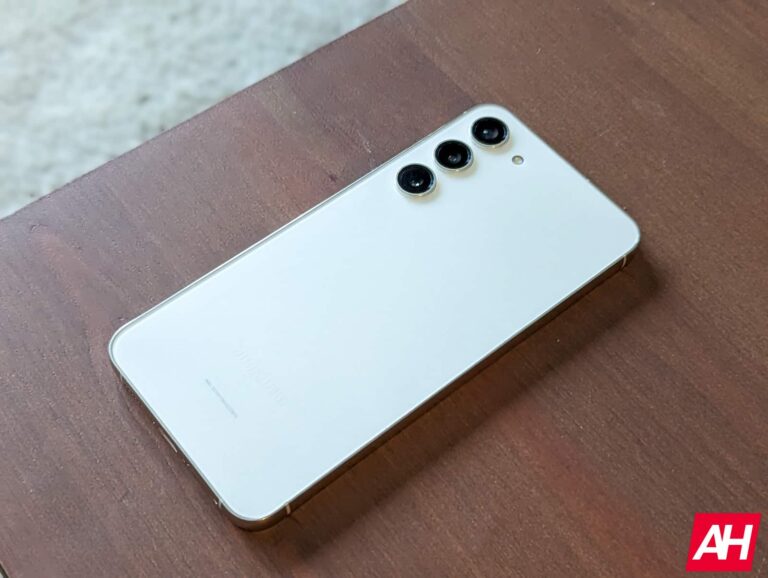
When you first lay your eyes on these two phones, you’ll notice a lot of similarities between them. They basically have the same design language. Both phones not only have the same general shape, but they also include a centered display camera hole, and basically the same design on the back side. You’ll notice three vertically-aligned cameras on both phones, which are located in the top-left corner of the back. Each of those cameras is basically its own camera island.
The Galaxy S23+ does have a larger display, and yet it’s somehow both shorter, narrower, and thinner than the Galaxy S23 FE. How’s that possible? Well, the phone has thinner bezels all around, noticeably thinner bezels. That’s one of the cost-cutting moves from Samsung for the Galaxy S23 FE. Another differentiating factor is the position of the LED flash, it’s placed higher up on the back of the Galaxy S23+.
Not only is it a bit more compact, but the Galaxy S23+ is also lighter than the Galaxy S23 FE. It weighs 196 grams, compared to 209 grams of the Galaxy S23 FE. Both phones have that hefty premium feeling, but the Galaxy S23+ is definitely a more pleasant phone to operate. Both of them do come with IP68 certification for water and dust resistance, and both feel like well-built smartphones.
Samsung Galaxy S23 FE vs Samsung Galaxy S23+: Display
The Galaxy S23 FE features a 6.4-inch fullHD+ (2340 x 1080) Dynamic AMOLED 2X display. That panel supports HDR10+ content, and it goes up to 1,450 nits of peak brightness. It has a 19.5:9 aspect ratio, and it’s protected by the Gorilla Glass 5 from Corning. This display is flat, in case you were wondering.
Samsung Galaxy S23 FE front
The Galaxy S23+, on the other hand, also has a flat display. That panel measures 6.6 inches, and it’s a fullHD+ (2340 x 1080) display. This is also a Dynamic AMOLED 2X panel, and it also offers a 120Hz refresh rate, and HDR10+ support. This panel does have a slightly higher peak brightness at 1,750 nits. The display aspect ratio is the same as on the Galaxy S23 FE, but the protection is better. It features the Gorilla Glass Victus 2 protection.
There’s really not much to complain about here, display-wise. Both smartphones are really good in that regard. The displays provide vivid colors, with great viewing angles, and the blacks are also deep. They are both quite sharp, and more than bright enough. Truth be said, the Galaxy S23+ does have the advantage there, but the Galaxy S23 FE’s panel is also very bright, so chances are you won’t have any complaints.
Samsung Galaxy S23 FE vs Samsung Galaxy S23+: Performance
The Galaxy S23 FE is fueled by the Snapdragon 8 Gen 1 SoC. It also includes 8GB of LPDDR5 RAM, and UFS 3.1 flash storage. The Galaxy S23+, on the flip side, is fueled by the Snapdragon 8 Gen 2 for Galaxy processor. It includes 8GB of LPDDR5X RAM, and UFS 4.0 flash storage. The Galaxy S23+ is more powerful on paper, no matter how you spin it. Not only does it have a more powerful processor, but it has faster and more power efficient RAM and storage modules.
In regular, everyday tasks, both perform admirably. The Galaxy S23+ is a bit faster in direct comparison, which becomes more obvious when it comes to launching apps and multitasking. Both are fairly fast, though, and perform really well. Where you’ll see the difference is in gaming. The Galaxy S23 FE does get very hot during gaming, even when it comes to more casual games. Our unit did get too hot even, to the point it was not as comfortable to hold. That’s not the case with the Galaxy S23+. That handset can handle even the most demanding of games, and not get too hot to handle.
Samsung Galaxy S23 FE vs Samsung Galaxy S23+: Battery
There is a 4,500mAh battery included inside the Galaxy S23 FE, while a 4,700mAh pack sits inside the Galaxy S23+. The Galaxy S23+ does include a larger display, hence the higher battery capacity. The end result is very similar, though. In fact, from what we’ve seen, the Galaxy S23 FE can provide even better battery life than the Galaxy S23+, though not by much. They’re on the same playing field.
The Galaxy S23 FE was able to go over the 8-hour screen-on-time mark, even with a bit of gaming thrown into the mix. The Galaxy S23+ lingered around 7-7.5 hours of screen-on-time before it shut down. Your mileage may vary, though, of course. There are simply too many factors to consider, ranging from different signal strengths, to different usage patterns, and different apps being used.
The Galaxy S23+ has the advantage in the charging department. It supports 45W wired charging, in addition to 15W wireless charging, and 4.5W reverse wireless charging. The Galaxy S23 FE, on the other hand, supports 25W wired charging, and 15W wireless charging. The Galaxy S23+ does charge a bit faster via a wire. Neither phone comes with a charger in the box, though.
Samsung Galaxy S23 FE vs Samsung Galaxy S23+: Cameras
These two phones seemingly have the same main and ultrawide cameras, but that’s not the case. Different sensors are being used here, the Galaxy S23+ does have the advantage from the hardware standpoint. The Galaxy S23 FE includes a 50-megapixel main camera, a 12-megapixel ultrawide unit (123-degree FoV), and an 8-megapixel telephoto camera (3x optical zoom). On the flip side, the Galaxy S23+ features a 50-megapixel main unit, a 12-megapixel ultrawide camera (120-degree FoV), and a 10-megapixel telephoto camera (3x optical zoom).
Samsung Galaxy S23+ cameras
While both phones are capable of providing really good shots in good lighting, the Galaxy S23+’s advantage becomes obvious in lower light. It provides brighter and more detailed images, in basically every such scenario. The same goes for its ultrawide camera too, as it trumps the Galaxy S23 FE’s offering basically every single time. The color science is similar, though, and both phones do perform well in HDR conditions.
What about the telephoto cameras? Well, that’s something the Galaxy S23+ does better too. The images do end up looking a bit sharper, while we’ve also noticed that the exposure is a bit better on top of it. Don’t get me wrong, though, the Galaxy S23 FE can do a good job, camera-wise, but the Galaxy S23+ is simply better in pretty much every way.
Audio
Both smartphones do include stereo speakers. What was quite surprising for us was the fact that the Galaxy S23 FE speakers are louder in comparison. The difference is not big, but it’s noticeable. The quality of the output is fairly similar, across the spectrum.
Neither of the two phones includes an audio jack. You can always use their Type-C ports, but you’ll need a dongle. Alternatively, Bluetooth 5.3 is available on both phones for wireless audio connections.
Motorola Razr+ users are not receiving software updates and their devices are stuck on the launch software version. Multiple users have complained about the issue on Lenovo’s forum page. Scarily, the thread was started in August this year and continues till today, indicating that Razr+ units haven’t received an update for months.
Motorola Razr+ not getting software updates for months
A recent report revealed that the Motorola Razr+ received an update with build number T2TZ33.18-75-9 including November 2023 security patch. However, this seems to be just one of those units that received updates. Other users have not been very lucky. A user took to Reddit to share that their Razr 40 Ultra (as called in some regions) was stuck on the May 1st security patch for the longest time but has now received the November update. The device updated several times in a row.
Several users who have been affected by the delayed software update also blasted at Motorola on the Lenovo forum saying that their software support is a mess. The company is working on fixing the issue for months going by the responses from Motorola support.
Some Motorola Razr+ users had to download the Rescue and Smart Assistant to obtain the software updates for their devices. Unfortunately it is only limited to Windows and not available on Linux and Mac. Using RSA automatically deletes the device data and returns it to factory settings. Hence, it is not a recommended method over OTA for updating the software to the latest version.
Motorola Razr+ is eligible for three OS updates
The Motorola Razr+ (review) debuted earlier this year with pre-installed Android 13 out of the box. It is eligible for three years of OS updates till Android 17. However, with the delayed updates, it is unclear when the clamshell foldable phone will receive the Android 14 version.