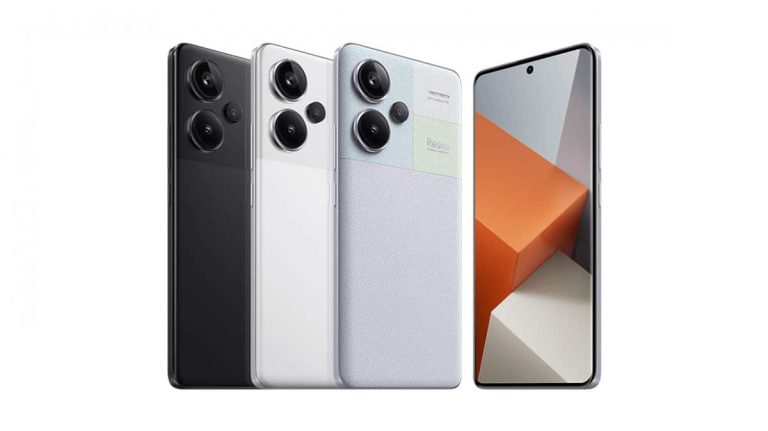
Xiaomi has officially confirmed the global launch date for the Redmi Note 13 series. The company’s new devices will launch globally on January 4 next year. So the launch event is a little less than a month away.
The Redmi Note 13 will hit global markets on January 4
Xiaomi’s global VP confirmed as much via X, while Redmi did the same. The company is using ‘SuperPower. SuperNote.’ tagline for this launch event. These handsets will launch in India, as Redmi India already confirmed, but it’s coming to a number of other regions, including Europe.
The Redmi Note 13 series is basically Xiaomi’s series of mid-range phones. Those mid-rangers can be quite powerful, though, and in this case, we actually know exactly how powerful. Why? Well, the Redmi Note 13 series did launch in China back in September.
We know exactly what to expect, and what phones to expect as well. The Redmi Note 13, Redmi Note 13 Pro, and Redmi Note 13 Pro+ all launched in China. Chances are all three will launch globally, though Xiaomi could opt to release two out of three, we’ll see.
All three phones are quite powerful, but the ‘Pro’ models do stand out
All three of these devices are quite compelling, that’s for sure. Still, the ‘Pro’ and ‘Pro+’ models do stand out, as they’re notably more powerful than the regular Redmi Note 13. Those two phones are fueled by the Snapdragon 7s Gen 2 and MediaTek Dimensity 7200 Ultra chips, respectively.
Both of those processors are 4nm chips, while the MediaTek Dimensity 6080 used in the Redmi Note 13 is a 6nm processor. The three devices have very similar footprints, and they look quite similar as well.
The two higher-end phones do have considerably brighter displays, but all three devices utilize AMOLED panels with a 120Hz refresh rate. You’ll also find more RAM on the ‘Pro’ and ‘Pro+’, while those two phones also have more powerful cameras.
A 200-megapixel main camera is used on both ‘Pro’ handsets
A 200-megapixel main camera is used on both smartphones, while an 8-megapixel ultrawide shooter is too. A 2-megapixel macro camera sits on the back of these devices. The Redmi Note 13 has two cameras on the back, led by a 108-megapixel main shooter.
They have different charging speeds, with the Redmi Note 13 Pro+ being the fastest at 120W. Neither phone supports wireless charging, though. MIUI 14 will also be included on all three phones, and much more.
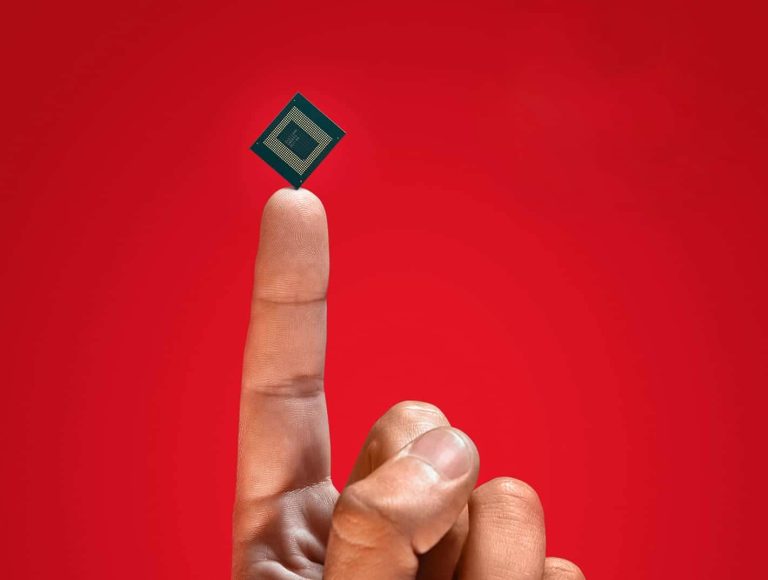
Despite their recent struggles with 3nm yield, Samsung and TSMC appear on track to begin 2nm mass production in 2025. The two semiconductor foundry giants confirmed to the Financial Times that their 2nm tech is “progressing well.” They started making 3nm chips last year.
Samsung and TSMC are vying for 2nm supremacy
Samsung started 3nm (SF3) mass production in June 2022, about six months earlier than TSMC. However, the latter quickly caught up to its arch-rival in achieving a decent yield rate. It went on to produce Apple’s A17 Pro chip for the iPhone 15 Pro lineup using its 3nm (N3) node. TSMC has also secured 3nm chip orders from Qualcomm. Next year’s Snapdragon 8 Gen 4 will be manufactured by the Taiwanese firm.
Samsung, on the other hand, has failed to attract major 3nm orders. It has yet to produce smartphone processors using its most advanced node. Industry insiders say the Korean firm has a similar 3nm yield rate as TSMC—both around 60 percent as of October this year. It isn’t the best yield but Qualcomm reportedly saw a competitive edge in the latter’s 3nm tech.
This is a big loss for Samsung because it upgraded to the GAA (Gate All Around) transistor architecture with 3nm chips. TSMC is sticking to the older FinFET tech and plans to move to the GAA architecture with its 2nm solutions. The Korean firm sees an opportunity here—it will have more experience with the next-gen transistor architecture, which might help speed up development and production.
“We are well-equipped to set up for SF2 mass production by 2025,” Samsung told the Financial Times. “Since we were the first to take the leap and transition to GAA architecture, we are hoping the progress from SF3 to SF2 will be relatively seamless.” Unfortunately, the firm’s technological struggles of the past may continue to haunt it. Industry analysts don’t seem to be confident about its 2nm tech.
“Samsung sees 2nm as a game-changer,” said James Lim, an analyst at US hedge fund Dalton Investments. “But people are still doubtful it can execute the migration better than TSMC.” Dylan Patel, chief analyst at research firm SemiAnalysis added, “Samsung tries to do these quantum leaps. They can claim all they want, but they still have not released a proper 3nm chip.
Apple’s iPhones may be the first to have a 2nm chip
Despite some reports suggesting otherwise, Apple’s iPhones may be the first to have a 2nm chip. That’s because as things stand, the semiconductor industry seems to have more faith in TSMC’s 2nm tech than Samsung. Since the former makes Apple’s chipsets, it could introduce the world’s first 2nm processor for mobile devices in 2025—for the iPhone 17 series.
In a statement to the Financial Times, TSMC said that the N2 technology development was “progressing well and on track for volume production in 2025, and will be the most advanced semiconductor technology in the industry in both density and energy efficiency when it is introduced.” It remains to be seen whether Samsung can challenge it with superior yield and production capacity.
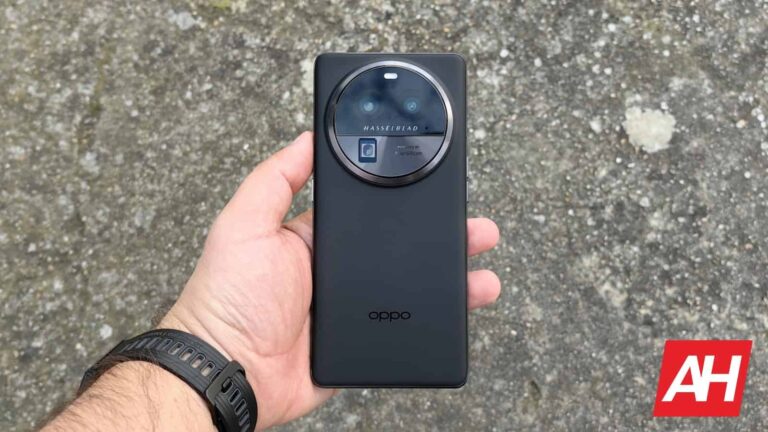
The OPPO Find X7 flagship series is expected to arrive in Q1 next year, and a well-known tipster just revealed the models that are coming. In addition to that, the SoCs that will fuel them have been tipped too, along with battery capacities.
This information comes from Digital Chat Station, a well-known tipster. In fact, this is one of China’s most prolific tipsters, he’s rarely wrong. That being said, three OPPO Find X7 models are coming.
The OPPO Find X7 series models revealed, we’re getting three devices this time around
The OPPO Find X7 will launch alongside the Find X7 Pro, and Find X7 Ultra. Earlier this year, the company announced two devices, the OPPO Find X6 and Find X6 Pro. OPPO is changing things up this time around.
The OPPO Find X7 will be fueled by the MediaTek Dimensity 9300 SoC. In other words, MediaTek’s most powerful processor will fuel it. The other two devices will utilize the Snapdragon 8 Gen 3 processor, the best Qualcomm has to offer.
The OPPO Find X7 Pro will have the smallest battery pack
Having said that, the OPPO Find X7 Pro will have the smallest battery. It will include a 4,860mAh unit. The other two devices will ship with a 5,000mAh battery pack.
The tipster has also once again confirmed that the Find X7 Pro and quite possibly ‘Ultra’ models will utilize dual periscope telephoto cameras. A 50-megapixel Sony IMX890 camera will support 3x optical zoom. A 50-megapixel Sony IMX858 camera will support 6x optical zoom.
The Sony LYT-900 camera sensor will be used for the main camera on two of these devices
In addition to that, the OPPO Find X7 Pro and Find X7 Ultra are tipped to utilize a 50-megapixel Sony LYT-900 main camera sensor. A 50-megapixel ultrawide camera will also be included in the package.
What’s interesting is that the camera module shown above differs from the one that leaked. It has been provided by Ice Universe, a well-known tipster. An octagon camera setup leaked several times now, but those leaks could be wrong. Truth be said, that camera setup is not exactly eye-pleasing. So, the solution shown in the image above could be way better, design-wise.
Snapchat, like many other apps these days, takes advantage of the use of AI. Snapchat’s My AI suite offers similar functionality to OpenAI’s ChatGPT or Google’s Bar. Although not all Snapchat users want to leverage the AI functionality, as evidenced by around 25K people monthly searching on Google for ways to disable Snapchat’s My AI, Snapchat remains committed to enhancing its AI-powered tools.In a recent update reported by Engadget, Snapchat+ subscribers can now zoom out images with a single click, making the social media app even more user-friendly. For instance, if you have a close-up snapshot of your pet, click “Crop” on the menu, then hit “Extend” at the bottom, and that is it—your extended image is ready.
The updated My AI also empowers subscribers to generate Snaps with a simple prompt. Click the “AI” button on the right in the viewfinder, type in your desired prompt, and shortly, you will have an image to customize before sharing. Snapchat recommends trying out playful prompts like “a dog sleeping on a rocket” or “a futuristic disco.”
Additionally, the Dreams feature now enables the creation of portraits with friends. On the Dreams page, choose a friend, hit “Done,” and you will be able to share the generated portrait of both of you. Snapchat+ subscribers receive one pack of eight Dreams selfies monthly, while non-subscribers get one pack as a free trial before considering the $4-a-month service. Regardless, all users can purchase additional packs for $0.99 each.
Hackers use ransomware to encrypt victims’ files and demand payment (usually in cryptocurrency) for the decryption key.
This malicious tactic allows them to extort money from the following entities by exploiting vulnerabilities in their digital systems:-
Individuals
Businesses
Organizations
In May 2023, this new ransomware variant appeared for the first time and has been actively targeting several industries across the world.
In recent campaigns, this new ransomware has targeted several organizations from the following sectors, reads FourCore report.
Government
Education
Healthcare
IT
Manufacturing
Fortinet has released a comprehensive report on the Rhysida ransomware assaults, which are aimed at Windows machines via VPN devices and RDP.
New Rhysida Ransomware
Rhysida entered Ransomware with a bold strike on the Chilean army, listing over 50 victims. It’s an independent group posing as a cybersecurity team since May 23, highlighting security flaws.
Rhysida excludes encrypting some specific files, and it does its further encryption process with:-
4096-bit RSA key
ChaCha20 algorithm
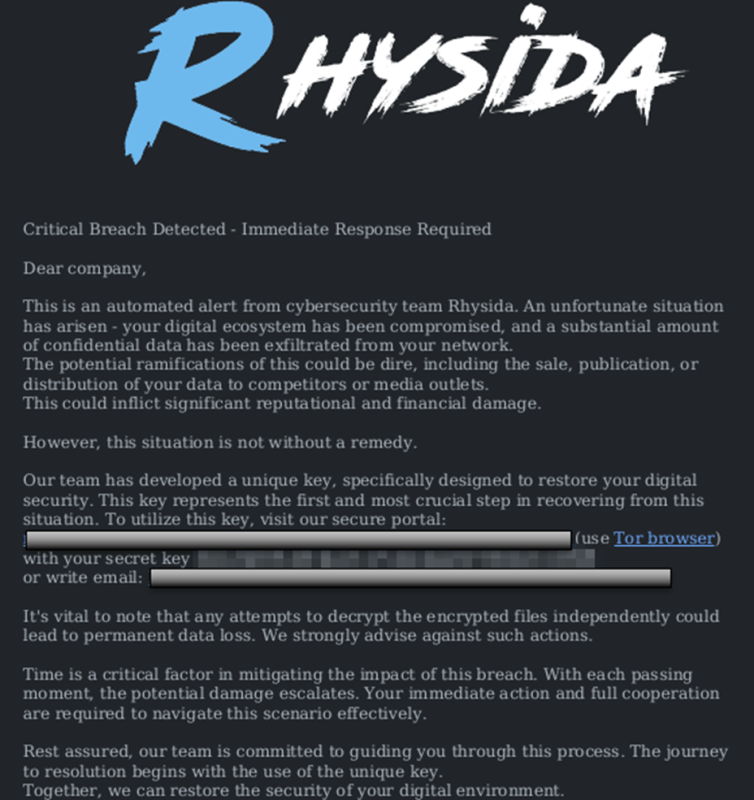
Besides this, all the encrypted files get a .rhysida extension, which alters the wallpaper and then leaves a PDF document as a ransom note.
Rhysida ransom note (Source – FourCore)
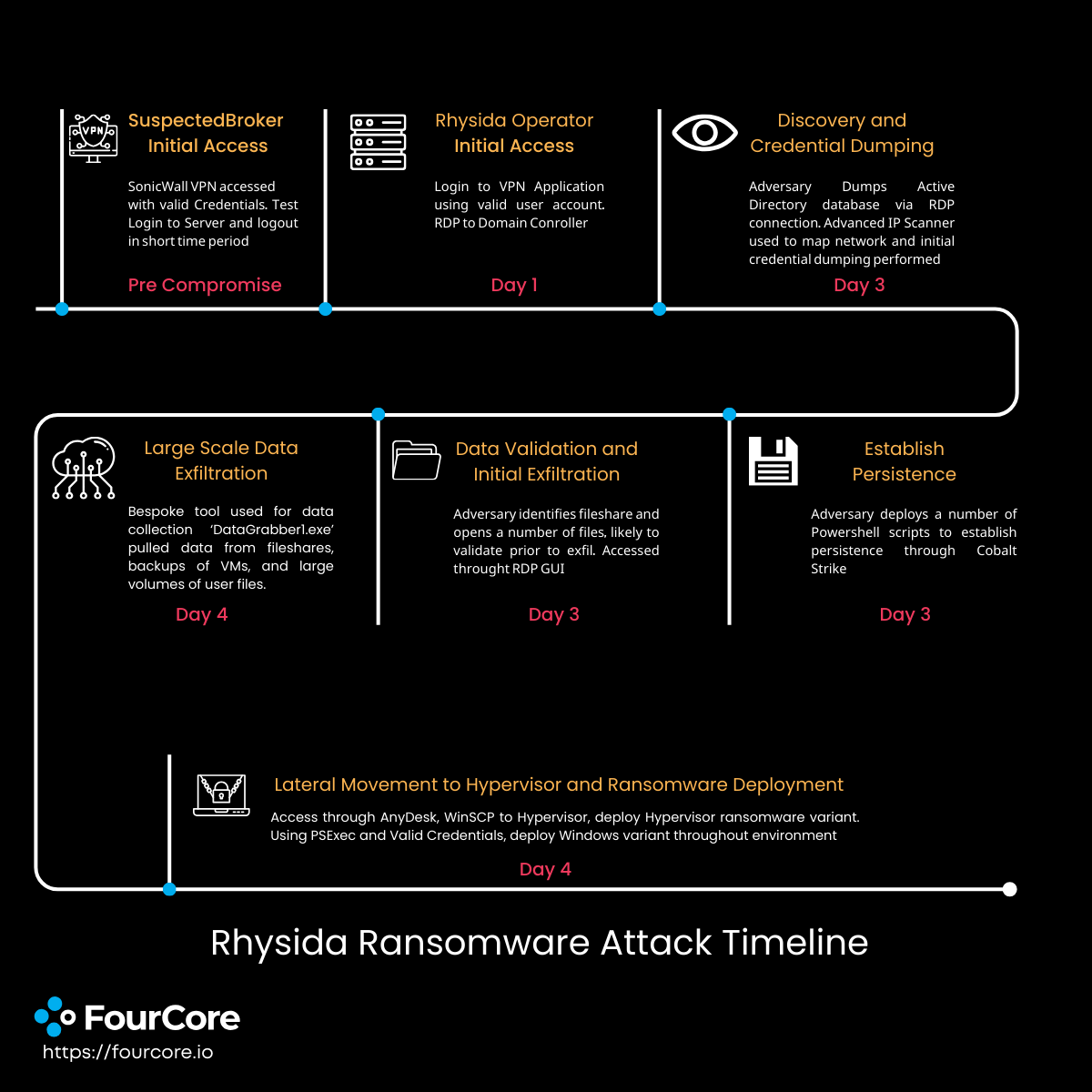
The operators of the Rhysida Ransomware hack victims with new exploits or dark web credentials. They use their Rhysida payload or other ransomware like QuantumLocker, and in some cases, using stolen data, they extort without encrypting files.
Rhysida’s Infection Chain (Source – FourCore)
Rhysida Operators breach via:-
They use phishing and scripts for payloads. Deploying tools like CobaltStrike, they escalate privileges with injections and exploits.
Continuously erasing traces, they spread through RDP, SSH, and tools like PsExec. Leaving Anydesk for access, they exfiltrate data with tools like DataGrabber1 for ransom or sale.
Rhysida operators use standard TTPs, lacking novel techniques. Understanding the entire deployment process is crucial.
The controversial co-founder of a US-based artificial intelligence company returns four days after his surprise ousting as CEO on November 17, 2023.
Former and current CEO Sam Altman founded OpenAI, a software development company, with others in 2015. His co-founders are Elon Musk, Greg Brockman, Ilya Sutskever, John Schulman, and Wojciech Zaremba.
Altman was the driving force behind ChatGPT, an AI application that has created equal amounts of excitement and fear. He pitched the idea to Microsoft, succeeding in persuading CEO Satya Nadella to commit resources to OpenAI to the tune of $10 billion. The tech giant has a 49 percent state in OpenAI. Altman also led negotiations for a tender offer that would bump the company’s valuation to over $80 billion.
OpenAI will use the funds to fuel research and process massive amounts of data. The goal is to get closer to developing an artificial general intelligence (AGI) system. Sam Altman states on the site that the “mission is to ensure that artificial general intelligence [AGI]…benefits all of humanity.”
AGI is a theoretical framework for creating AI software that can autonomously solve various complex problems across different fields of knowledge. It is strong AI compared to the weak AI software that only functions within narrow parameters.
Industry observers also credit Altman for attracting leading AI engineers to the company with the promise of developing massively disruptive technology. His moonshot ethos struck a chord with tech talent eager to do something revolutionary and establish themselves in history.
Despite his significant contributions to OpenAI, his ousting as CEO does not surprise people in the know. Altman has been reportedly clashing with the board for some time, primarily over his “move fast and break things” approach.
Speculations
No one knows exactly what the discussion behind closed doors prompted Altman’s dismissal. The board or anyone else in the know has not forwarded confirmation of the reasons behind the decision.
An OpenAI announcement offered one reason for the ousting. It claimed that Altman failed to be “consistently candid in his communications with the board, hindering its ability to exercise its responsibilities.” Co-founder Greg Brockman resigned in protest, but the notice merely mentions his departure as board chairman. Brockman returned to OpenAI upon the reinstatement of Altman, but it is not yet clear in what capacity.
However, Altman’s lack of candor is unlikely to be the only reason for such a significant move by the board. An internal memo by interim CEO Emmett Shear denies that the dismissal was due to malfeasance or any disagreement on safety. He did not specify its rationale but pledged to investigate the matter.
The lack of information has led to numerous speculations on what really happened. These included too much deference to Microsoft or excessive focus on side projects. Some AI experts believe that the real issue that led to the ejection was a failure in governance.
One is David Shrier, an Imperial College Business School AI professor. He believes that the speed of adoption and potential for commercialization of ChatGPT had sparked tensions between OpenAI Inc. and OpenAI LLP. OpenAI is a for-profit company whose owner remains OpenAI Inc., a 501(c)3 nonprofit organization. The unusual relationship culminated in forming a “capped profit” structure, where any excess profit OpenAI makes goes to the nonprofit.
On paper, the board has complete control over OpenAI. However, the massive operations and influence of OpenAI and its CEO have essentially rendered the board ineffective. The directors have no governance powers over OpenAI, which Shrier considers alarming. He believes that AI technology could lead to an existential crisis, which makes robust governance critical in managing it.
The Letter
One of the more substantiated rumors is that the straw that broke the camel’s back was a letter. Before the board decided to oust Altman, they purportedly received a warning letter from staff researchers. It reportedly stated that OpenAI had made a discovery that was powerful enough to threaten humanity.
While the letter is unavailable for review, Murati sent internal communications informing staffers and the board about Project Q*. Without confirming media speculations on the nature of Q*, some OpenAI employees believe that Q* team members have made a breakthrough in developing AGI.
The authors flagged the progress of an OpenAI team on optimizing AI models to increase their ability to reason and do scientific work. They pointed out the potential danger that highly intelligent machines could pose to humanity. The letter did not specify the precise nature of the threat.
The concerns that led to sending the letter to the board appear to have been triggered by software learning to solve math problems. While that might seem a cause for celebration rather than chagrin, AI researchers disagree. The ability to answer math problems with only one correct answer indicates a significant step toward AGI.
In the APEC CEO Summit 2023, Altman hinted at significant breakthroughs in AI tech in a discussion with other tech experts. In his speech, Altman said in part that “we sort of push the veil of ignorance back and the frontier of discovery forward, and getting to do that is the professional honor of a lifetime.”
The OpenAI board fired Altman the day after the summit.
Why this should cause concern may be encapsulated in what Altman articulated in his article on the site. He stated, “AGI would come with serious risk of misuse, drastic accidents, and societal disruption. [However,] because the upside of AGI is so great, we [should not] stop its development forever.” Altman suggested that AGI developers and society must figure out how to get it right.
Altman has previously brushed aside concerns over releasing products into the market without understanding the consequences. Many have raised concerns over security, bias, confidentiality, accuracy, and ethical issues with ChatGPT since its launch in November 2022. With AGI seemingly at the brink of creation, the fears of what OpenAI will do under Altman’s leadership may seem reasonable.
The Walk Back
However, about 700 OpenAI employees thought otherwise. When the board relieved Altman of his CEO duties, they signed an open letter signaling their displeasure. The letter stated they may resign unless the board reinstated Altman and Brockman. It further requested the board to step down, claiming their actions indicated they “are incapable of overseeing OpenAI.”
After their dismissal, Microsoft immediately hired Altman and Brockman to head a new AI research team. It also opened the doors to any OpenAI who wanted to switch.
Investors also pressured the board to back down on their decision. Altman, who was once at the helm of YCombinator, had a talent for raising funds and attracting top talent. Maintaining the various software platforms of OpenAI requires copious amounts of both. His absence may have created a big problem for the company in financial and human resources terms.
As a result, the OpenAI board would bring back Altman as CEO. They announced the decision on November 21 on X (formerly Twitter) after reaching an “agreement in principle” with him. The details of the agreement have not been made public.
Altman confirmed the reinstatement in an X post, stating that he was looking forward to returning to OpenAI. He said that Nadella fully supports his return under the new board. The Microsoft CEO noted that the changes were an “essential step toward more stable, well-informed, and effective governance.”
The Aftermath
The powers that be in OpenAI also formed a new set of board members, primarily luminaries in business and technology. The previous board of directors was mainly researchers and academics.
The revamped board includes former Salesforce CEO Bret Taylor and former Treasury Secretary Lawrence Summers. Quora CEO Adam D’Angelo is the only holdover from the original board. Taylor takes on the mantle of OpenAI board director. However, D’Angelo led negotiations with outgoing board members that would eventually bring back Altman and Brockman.
Former board members wanted to stay and keep Altman and Brockman in check if there was a reinstatement. They expressed concerns that future board members would let Altman do whatever he wanted. During negotiations, the board decided it would stand by its decision to oust Altman and Brockman.
However, it was to no avail. Helen Toner, who openly criticized OpenAI in October 2023, stepped down to make way for a fresh start. Rand Corporation scientist Tasha McCauley also vacated her seat. OpenAI co-founder Ilya Sutskever also stepped down but appears to have stayed as Chief Scientist.
Plans are afoot to expand the board. Before his ousting, Altman had been pushing for months to add more directors that would include more experienced people. The initial board is smaller but unlikely to stay that way for long. By all accounts, the final board will most likely be a diverse group of people who cleave closer to the non-doom side of AI. The composition of the current board suggests that OpenAI will shift to resemble a typical Silicon Valley company.
It is unclear whether Microsoft will have any role or representation on the board due to the reshuffling. However, given the participation and influence of the tech giant, the directors will likely maintain close ties with Microsoft.
External Effects
The ongoing drama at OpenAI represents global regulation issues, and people will carefully watch what happens next. It prompted the US Federal Trade Commission to issue staff directives authorizing investigations of AI-powered companies selling products and services. The directives provided legal powers to gather evidence, including documents and testimonies.
OpenAI’s aborted ousting also affected negotiations over the proposed AI law in the European Union. It occurred as member states were deep in debates over the approach to regulations, specifically aggressive oversight vs. self-regulation. Some believe that regulations should target foundational models, while others maintain they should focus on applications.
Three EU countries agreed to support self-regulation, indicating that France, Italy, and Germany trusted companies like OpenAI to act responsibly. However, other members see the OpenAI events differently, believing it proved that more robust protocols are necessary. Relying on visionaries and disruptors in the AI space is bound to lead to a disastrous lack of governance.
The failure of the OpenAI board to stand by their decision due to pressure is likely to highlight the power of stakeholders. It amplifies the need for more robust public oversight as the government can theoretically curtail corporate activities that may pose a threat to society. However, calls for government interference with private AI enterprises will probably not go down well with big tech.
The (Possible) Real Deal
The reasons behind Altman’s ousting and reinstatement brought the public’s attention to the views of fringe groups about AI risks. Additionally, the back and forth between the board and Altman brought to light the conflict between Altman’s actions and beliefs.
Altman was one of the most vocal advocates of AI regulation when speaking before the Senate. He stated that his worst fear was that the technology and industry would “cause significant harm to the world….in a lot of different ways.”
However, he focused increasingly on raising funds and forging alliances to advance AI technology that he admittedly did not understand completely. Some industry experts consider the disconnect as disingenuous. His professed fear of a dystopian future directs attention away from what OpenAI is currently doing. In the meantime, OpenAI is garnering even more influence and power as a commercial venture.
On the other hand, the desire for regulation and commercialization are not mutually exclusive concepts. Disruptive technology tends to be very profitable but always goes through growing pains that are eventually resolved over time.
OpenAI, as a for-profit venture and disruptor, will likely go through the same as the lightbulb, Internet, or digital banking. No one wants to go back to before these technologies today, but many feared them at the time. No one in the 1990s would trust their money with anything other than a traditional bank. Yet most people today enjoy the ability to open a retirement account online.
Technological advances will always profoundly affect society in good and bad ways. The only question is how people will manage them so that the good outweighs the bad.
Healthcare company Norton says a May breach led to the theft of data of around 2.5 million of its patients, as well as employees and their dependents.
Norton has more than 40 clinics and hospitals in and around Louisville, Kentucky. In a filing with Maine’s attorney general on Friday, Norton said that on May 9, 2023, it discovered an “external system breach.” While the attackers were in the system, Norton says, the sensitive data of the patients, and employees and their dependents was accessed.
In a security incident notice as well as the letter that was sent to potential victims, Norton said the attackers accessed certain network storage devices, but did not access Norton Healthcare’s medical record system or Norton MyChart, its electronic medical record system.
The leaked information included names, dates of birth, Social Security numbers, health and insurance information, and medical identification numbers. Some people also had their financial account numbers, driver licenses or other government ID numbers, and digital signatures also taken.
While Norton never called the incident a ransomware attack, according to databreaches.net the attack was claimed by ALPHV/BlackCat. We could not confirm this, since at the time of writing, the ALPHV leak site is recovering from an outage due to problems with their hosting provider.
Norton says it told law enforcement about the attack and confirmed it did not pay any ransom payment. ALPHV claims to have extracted 4.7 TB worth of data and posted dozens of files as proof to get negotiations underway.
Our podcast host David Ruiz talked to ransomware expert Allan Liska about the why of the SEC complaint.
Data breach
There are some actions you can take if you are, or suspect you may have been, the victim of a data breach.
Check the vendor’s advice. Every breach is different, so check with the vendor to find out what’s happened, and follow any specific advice they offer.
Change your password. You can make a stolen password useless to thieves by changing it. Choose a strong password that you don’t use for anything else. Better yet, let a password manager choose one for you.
Enable two-factor authentication (2FA). If you can, use a FIDO2-compliant hardware key, laptop or phone as your second factor. Some forms of two-factor authentication (2FA) can be phished just as easily as a password. 2FA that relies on a FIDO2 device can’t be phished.
Watch out for fake vendors. The thieves may contact you posing as the vendor. Check the vendor website to see if they are contacting victims, and verify any contacts using a different communication channel.
Take your time. Phishing attacks often impersonate people or brands you know, and use themes that require urgent attention, such as missed deliveries, account suspensions, and security alerts.
Set up identity monitoring.Identity monitoring alerts you if your personal information is found being traded illegally online, and helps you recover after.
We don’t just report on threats – we help safeguard your entire digital identity
Cybersecurity risks should never spread beyond a headline. Protect your—and your family’s—personal information by using Malwarebytes Identity Theft Protection.
Nothing could announce the Phone (3) as early as the end of February during the upcoming Mobile World Congress. As usual, it will take place in Barcelona, Spain. It’d be interesting to see if Carl Pei brings the Nothing Phone (3) to the show and spills the beans. Android Authority mentions Nothing’s similar moves in the past to showcase the phones. For instance, it notes Carl Pei carried out the Nothing Phone (1) while meeting partners like Qualcomm. Similarly, Qualcomm and Pei partnered for a press release to confirm the Nothing Phone 2’s Snapdragon 8-series processor. And, it counts the upcoming MWC 2024 as a similar stunt.
The cryptic “Nothing to see” slogan (via Android Authority) and background image suggest it might be related to the Nothing Phone (3), potentially focusing on improvements in the camera department. Because the Phone (1)’s camera was considered a weak point, and with the Phone (2) addressing the processor concerns, it’s logical to expect camera upgrades for the Phone (3). It adds that something could be on the way: either a high-end sensor, AI-powered features (like Pixel 8 Pro, or Samsung Galaxy S24 series), or something entirely new.
Here’s what to expect from the Nothing Phone (3)
Nothing is believed to be less likely to bring a design overhaul with the Phone (3) launch. The transparent back design with Glyph “LED” lights is something that differentiates it from other phones in the market. It may focus more on bringing better processors and cameras this time. Meanwhile, the Nothing users expect to see a telephoto lens, Snapdragon 8 Gen 2 or 3, or at least Snapdragon 7 Gen 3 or 4.
Nothing prioritizes clean aesthetics and minimal software, offering customization without bloatware. While the Phone (2) added more themes, the Nothing Phone (3) is expected to follow suit. However, the current update promises to lag behind competitors, so longer support for the Phone (3) is something to hope for.
There’s no confirmed release date for the Nothing Phone (3), but based on previous releases, July 2024 is a possibility. This timing is unusual, as most brands launch phones in early January i.e. Samsung Galaxy flagships, or around September/October i.e. Apple iPhone launches and Google Pixel launches.
No word about the Phone (2a), though
Just recently, several rumors emerged hinting at a potential Nothing Phone (2a) release. The company’s X bio also said, “Something is coming this week.” But it turned out that Nothing had plans for its apparel lines, and the mid-range phone is still in the pipeline.
Epic Games CEO Tim Sweeney says an appeal to its case against Apple is in the works. An appeal is “in the queue for the Supreme Court to consider hearing,” Sweeney said on X. The leader of Epic Games, the company behind Unreal Engine and Fortnite, is riding high after Epic’s win against Google on December 11. In the landmark case, the jury came down with a verdict that Google’s Play Store and in-app billing system have illegal monopoly power.
The jury also decided that the tie between the two is illegal. And that Google’s secret lucrative deals that were designed to stifle competition and keep rival app stores down and out had hurt Epic. It’s still unclear what will happen to Google (if anything) following yesterday’s decision. Google has confirmed it will appeal the verdict. Judge James Donato will also have to decide on what Google’s remedy terms are. Which are supposed to begin in January 2024. But the way is clear for Epic and Sweeney. It’s “on to Cupertino,” the CEO said in another post on X.
Epic Games plans to appeal the Apple trial verdict
If you’re relatively new to the details of this case, the whole thing is about app store fees. It began with both Apple and Google and each company’s 30% fee for any in-app transactions that happened from apps downloaded through their stores. Epic felt these fees were too high and sued both companies. It went to trial with Apple first but that trial had a very different outcome. Apple was awarded the victory earlier this year.
Sweeney is not one to take a loss lying down, however. After a victory against the company that owns the largest app distribution platform globally, Epic is going back for another round against Apple. This time to hopefully win. Should that happen, both iOS and Android stand to go through massive changes with regard to the way apps are distributed.
Both Google and Apple could be forced to allow other in-app payment systems. They could also be forced to do away with or lower the in-app billing fees. It’s tough to say now without knowing for sure whether or not the Supreme Court will even heart Epic’s appeal.
The cybersecurity market is awash with expensive, high-end solutions for detecting vulnerabilities in third-party applications. However, for smaller security teams, free vulnerability scanners offer a practical alternative.
But of course, free doesn’t always mean better—it’s crucial to thoroughly assess free vulnerability scanners before integrating one into your security protocols.
How to choose a free vulnerability scanner? Industry expert Robert Elworthy, NA Solutions Engineering Manager at ThreatDown, has the answers.
Robert has a wealth of experience from his tenure as IT manager at Langdale Industries, where he managed a network of over 500 endpoints. In this article, we’ll break down his advice on selecting a free vulnerability scanner
Limits on the number of scannable endpoints are common with free vulnerability scanners. While a small business with a few devices might find them sufficient, larger enterprises with hundreds of endpoints could exceed these limits.
Elworthy, reflecting on his Langdale experience, highlights the importance of a tool capable of handling large-scale environments efficiently, a critical aspect for organizations with extensive networks:
“Free tools often struggle with large networks,” Elworthy said. “It’s important to choose a tool that can handle large-scale environments without compromising efficiency, especially for organizations with extensive networks, where the ability to scale effectively is crucial.”
2. Understanding scanning requirements
Different scanners have varied requirements. Some scanners need agents installed on each endpoint for in-depth insights, while others conduct less intrusive remote scans.
Elworthy emphasizes the need for scanners that minimize the complexity of agent installations, especially in large and diverse IT landscapes:
“Often, when you opt for a free tool, you might need to run the software on-premises or integrate it into your network. This becomes particularly challenging with remote work and constantly shifting targets,” Elworthy said. “How do you deploy an agent to gather the necessary information? It’s not always straightforward with free tools.”
3. Evaluating reporting capabilities
The effectiveness of a vulnerability scanner is largely measured by its reporting capabilities, but free vulnerability scanners might provide basic reports that overlook critical remediation details.
“You must consider how you can utilize the data once it’s acquired. Some tools may display the data, but offer limited reporting or feedback capabilities, which can be a significant limitation,” Elworthy said.
4. Checking ongoing support
Cyber threats evolve rapidly, and so must your scanner. Tools like OWASP ZAP are updated frequently but require users to stay on top of these updates manually, which could add to your team’s workload.
“Without ongoing support, free tools risk becoming outdated as new vulnerabilities are discovered,” Elworthy said. “To make sure your organization isn’t unaware of emerging threats, you should confirm a free vulnerability scanner has a process for frequently updating its vulnerability database.”
5. Integration capabilities
Integration with other security tools is crucial. Elworthy stressed the importance of tools that aid in both vulnerability identification and remediation:
“It’s important to have a scanner that not only detects vulnerabilities but also offers guidance on remediation.” Elworthy said. “Many free tools don’t automatically patch vulnerabilities found during scans since remediation is a separate process. Integrating with patch management is critical to easily fix any vulnerabilities found.”
6. Uncovering hidden costs
The labor involved in configuring, updating, and mastering free vulnerability scanners represents a substantial investment. Elworthy points out the hidden labor costs in using “free” tools, which can affect team efficiency:
“The time and labor required to maintain scans and update tools can be significant,” Elworthy said, reflecting on his time at Langdale. “There are often-overlooked costs associated with ‘free’ vulnerability scanners. They may not require direct financial investment, but the manpower and time needed for their effective operation can be substantial.”
For teams seeking a streamlined approach, the ThreatDown Vulnerability Assessment solution, free for all ThreatDown customers, offers:
Single, Lightweight Agent
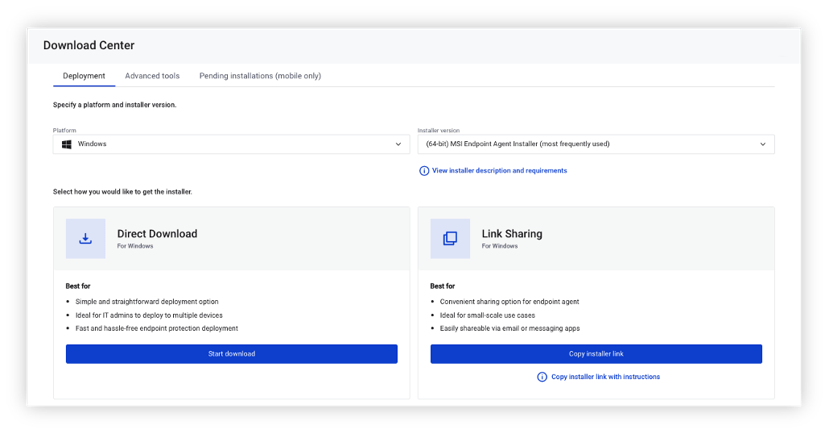
To simplify security and reduce costs, Vulnerability Assessment deploys easily in minutes without a reboot, using the same agent and cloud-based console that powers all ThreatDown endpoint security technologies.
Quick Vulnerability Scans
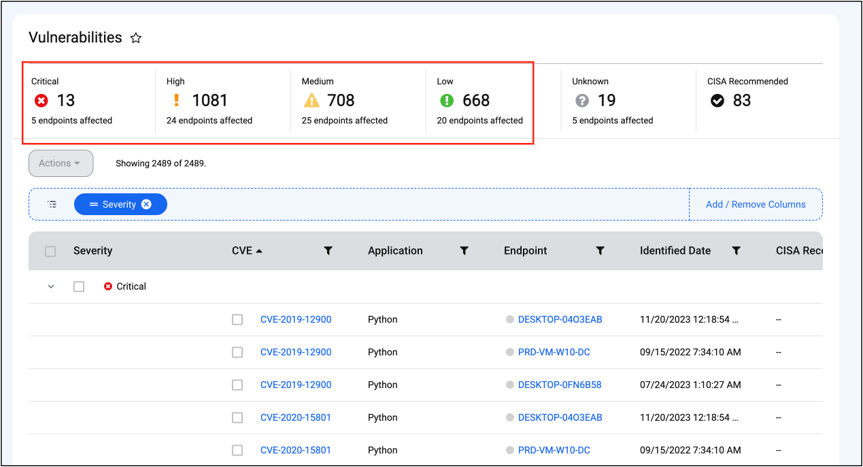
Identifies vulnerabilities in modern and legacy applications in less than a minute.
Accurate severity ratings
Utilizes the Common Vulnerability Scoring System (CVSS) and Cybersecurity and Infrastructure Security Agency (CISA) recommendations to evaluate and rank vulnerabilities for proper prioritization.
Security Advisor Integration
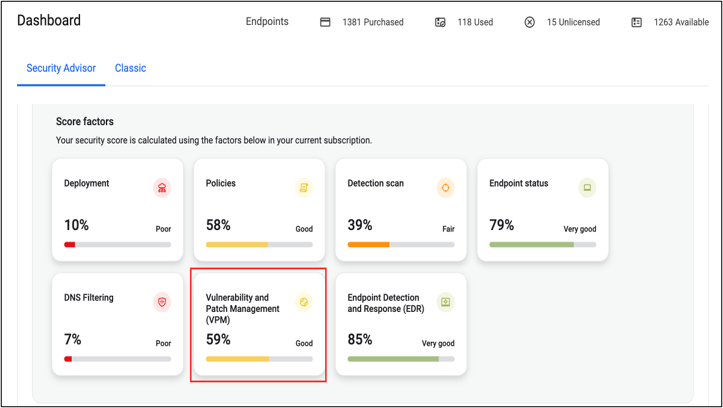
Our Security Advisor tool to analyzes an organization’s cybersecurity health—such as by assessment of current inventory and which assets are vulnerable—and generates a score based off what it finds. To improve the endpoint security health score, Security Advisor delivers recommendations to address discovered vulnerabilities: patching, updates, or policy changes.
Beyond the no-cost appeal
Opting for a free vulnerability scanner is about more than avoiding expenses. It’s about striking the right balance between cost, functionality, and available resources.
The ThreatDown Vulnerability Assessment solution simplifies the process with features like a lightweight agent, quick vulnerability scans, accurate severity ratings based on CVSS and CISA guidelines, and integration with Security Advisor for tailored recommendations and ThreatDown Patch Management for automated remediation.