YouTube now offers Creators more control over their videos’ comments with a new “Pause” option

0
[ad_1]
Youtube Content Creators can now enjoy a little breather with the introduction of a new “Pause” feature in their comment moderation toolbox. This straightforward option gives them the power to freeze the creation of new comments for a specific video, while simultaneously preserving existing comments. This provides much-needed flexibility for managing online discussions and maintaining a positive online environment.Prior to this update, Content Creators only had the harsh choices of either disabling comments entirely or manually reviewing each one before it appeared publicly. This could be burdensome, especially for popular channels with a constant influx of comments.

The “Pause” option offers a much-needed middle ground, allowing creators to take a break from moderating comments when they become overwhelming — without resorting to complete shutdowns — and gain more control over the conversation by temporarily stopping the flow of new comments. This can be helpful during live streams or other unpredictable situations where managing comments in real-time can be challenging.

YouTube revealed that during the testing phase of this feature, both creators and moderators found the “Pause” option to be incredibly useful. It suddenly empowered them to create a more positive and engaging community, focus on other aspects of their channel, or simply take a mental break.

This update also marks a renaming of existing comment moderation settings for clarity and ease of use. However, the underlying functionality remains the same. Here’s a quick breakdown of the available options:

  • On, with optional comment moderation settings:
    • None: All comments are automatically published without review.
    • Basic: Potentially inappropriate comments are held for review.
    • Strict: A wider range of potentially inappropriate comments are held for review.
    • Hold All: All comments are held for review.
  • Pause: No new comments can be posted, but existing comments remain visible.
  • Off: Comments are disabled entirely.

Credit: YouTube Creators Channel

The new “Pause” feature is a welcome addition to YouTube’s comment moderation tools, offering creators more control and flexibility in managing their online communities. I’m curious to see how the larger YouTube community will react to this change and whether it will become part of the solution when it comes to curbing comment spam.

[ad_2]
Source link

AH Reader’s Choice Awards: Best Budget Phone of 2023

0
[ad_1]

The Google Pixel 7a made us fall in love with it, and it looks like our readers feel the same way

It’s the end of the year, and it’s time to do a wrap on some of the best phones we’ve seen these past 365 days. There were a ton of amazing affordable phones that came out over 2023, but one phone seemed to resonate the most with our readers, and that’s the Google Pixel 7a.

Many of our readers most likely purchased this phone when it launched earlier this year. If you’re looking to pick up a Pixel 7a for yourself, you won’t be sorry. This handset was able to bring the best Pixel experience for its price, and it definitely outshined other phones in the same bracket.

The thing that makes this phone incredible is the attention and care that Google had put into this phone to give you the best Pixel experience at $500. Both the hardware and software are developed by Google, so you know that it’s designed to work seamlessly and smoothly. It uses the same hardware powering the amazing Pixel 7 Pro, and it’s in a $500 phone!

This means that it’s going to be incredibly powerful, as we’re talking about flagship-level hardware. Not only that, but Google is a huge AI company. The Pixel 7 Pro was one of the smartest phones on the market because of the powerful artificial intelligence that comes on the chip. Well, you’re getting that same chip this time around.

We can’t forget about that screen

This phone has a screen that’s comfortably small, but it’s still able to give you a top-notch viewing experience. Google gave this one of its amazing screens. Google used the same screen in this phone that it used with the Pixel 7. However, it just won’t be as silky smooth. Anyway, this screen is still beautiful. Whatever you’re watching on this phone will pop. It doesn’t matter if you’re watching movies, TV shows, or videos, you’re going to have a great time. Google calibrated the display to be one to beat.

What’s a Pixel if not a great camera phone?

We can’t talk about the Pixel 7a without talking about the amazing camera experience. Pixel phones are known for their superior cameras, and this phone is no exception. No doubt, the Pixel 7a has one of the best cameras of any phone of this price, if not the best.

Using Google’s amazing image processing capabilities, this phone produces results that will impress anyone. It’s truly a fantastic camera for both well-lit and low-light shots. If you’re a person who wants a powerful camera experience in your phone, then the Pixel 7a’s camera is for you.

Take those aspects and bundle them with great speakers and battery performance, and you have the best phone that you can get for only $500. This is why the Pixel 7a won the AH Reader’s Choice Award.


[ad_2]
Source link

iPhone 16 to get a major microphone upgrade for AI purposes

0
[ad_1]

Apple will seemingly issue a major microphone upgrade for the iPhone 16. This information comes from Ming-Chi Kuo, a well-known analyst, who shared his thoughts via the Medium platform.

The iPhone 16 could get a major microphone upgrade to boost AI

He said that “strengthening Siri’s hardware and software features and specifications is the key to promoting AI-generated content”. He basically said that Apple will rely on improved voice input to boost Siri, kind of.

Apple’s generative AI goals and integration of large-language models (LLMs) into Siri seem to be the goal. Now, these improved microphones will offer a better signal-to-noise ratio, first and foremost. Better water resistance is also mentioned.

Considering that many other companies are heavily focusing on generative AI, Apple will seemingly go in that direction as well. It’s not exactly a secret that Siri has been lagging behind the competition, so we can expect some major improvements moving forward.

The Siri team got reorganized earlier this year

Apple actually reorganized the Siri team in Q3 this year, so that it gets the best possible team to push the tech forward. Now, it seems like AAC and Goertek will supply microphones for the iPhone 16.

Kuo says that the “ASP of microphones for each iPhone 16 will be at least 100–150% higher than that of the iPhone 15”.

The iPhone 16 series is not exactly around the corner. The Apple iPhone 15 models were announced a couple of months ago, so we’re in for a long wait. The iPhone 16 series will almost certainly arrive in September next year.

Based on everything we’ve seen thus far, generative AI will be a huge focus for Apple. That goes for both iPhone 16 and iOS 18 in combination. This is not the first time we’ve seen such rumors, nor is it the first time the info is coming from a trusted source.


[ad_2]
Source link

Threads rolls out “Tags”, its own simplified version of hashtags

0
[ad_1]

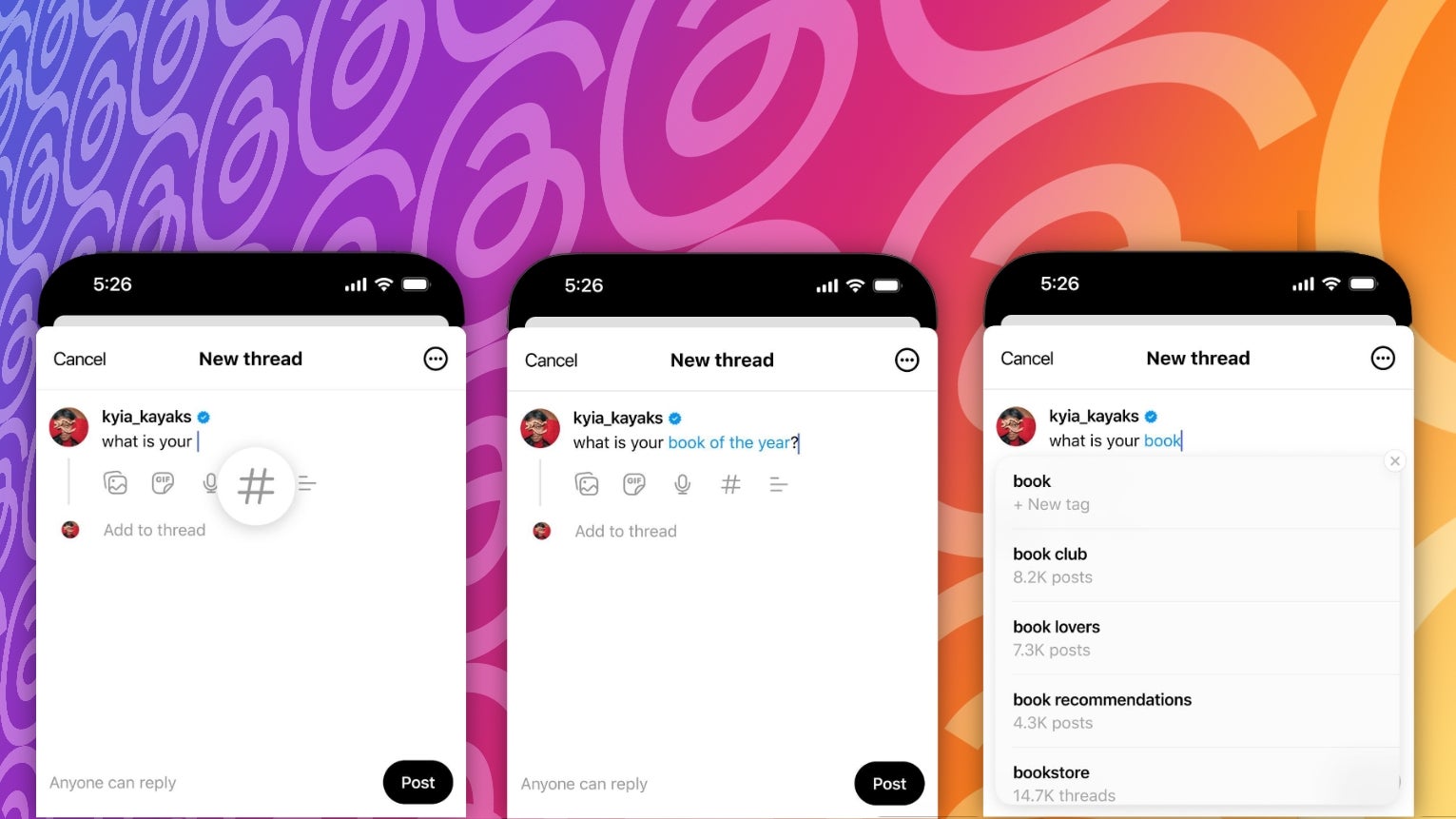
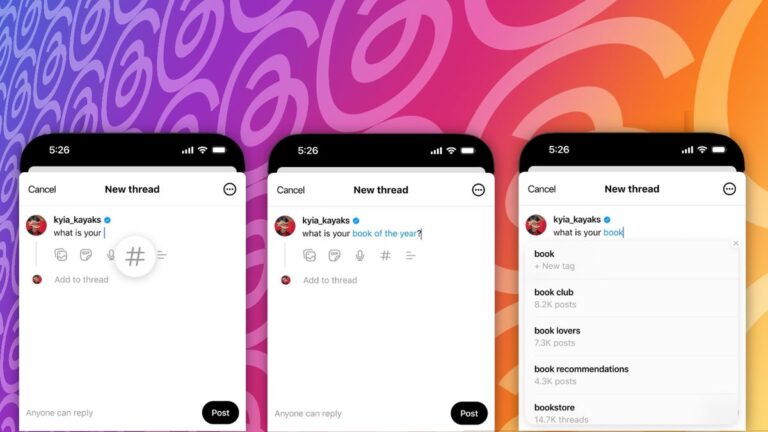
Meta’s Twitter competitor, Threads, is adding a new feature called “Tags,” which aims to simplify the way users categorize and discover content. Unlike traditional hashtags, Tags offer a more focused and streamlined approach to topic grouping, with several key differences.
Firstly, Threads limits users to just one tag per post. This eliminates the clutter of spammy hashtag lists often seen on other platforms, allowing for more meaningful and focused discussions. Meta believes this approach makes it easier for users to find and engage with content they’re genuinely interested in.

Secondly, Tags are integrated seamlessly within the text, appearing as blue hyperlinks rather than standalone hashtags prepended with the # symbol. This creates a cleaner and more visually appealing experience, while still maintaining their functionality.

Adding a Tag is simple: users can either type the # symbol followed by the desired Tag text directly within their post, or select it from the new post UI. This intuitive design ensures accessibility and ease of use. Unfortunately, it does not appear that tags are yet supported on the web version of the app, even if you manually type in the tag (#) symbol.

Instagram and Threads boss, Adam Mosseri, explained in his own post that Tags also support phrases and special characters, and that their purpose is to help “categorize your posts and make it easier for others to find and join in on the conversation.” He also stressed that the decision to not show the famous hashtag (#) symbol in the published post and to limit tags to one per post was done purposely in order to discourage engagement hacking.

With its focus on simplicity and clarity, Threads’ Tags feature represents a fresh approach into organizing topics and conversations in a more intelligent and user-centric manner. Keeping spammers out of the platform’s search results has been a goal for the platform and hopefully this implementation achieves just that.

[ad_2]
Source link

Bluetooth Vulnerability Enables Keystroke Injection on Android, Linux, macOS, iOS

0
[ad_1]

Keystroke injection is a method wherein malicious commands or keystrokes are remotely injected into a system to compromise or manipulate its functionality, often exploited for unauthorized access or control.

A critical vulnerability in Bluetooth allows attackers to take control of Android, Linux, macOS, and iOS devices, including devices in Lockdown Mode. This vulnerability is tracked as CVE-2023-45866 and disclosed by security researcher Marc Newlin. 

It enables attackers to connect to vulnerable devices without user confirmation and inject keystrokes, potentially allowing them to install malicious apps, run arbitrary commands, and perform other unauthorized actions (except those requiring password/biometric authentication). The software vendors were notified about the flaw in August 2023.

This vulnerability was first identified in 2016 in non-Bluetooth wireless mice and keyboards. Back then, it was assumed that Bluetooth was secure and promoted as a better alternative to vulnerable custom protocols.

In 2023, a challenge forced Newlin to focus on Apple’s Magic Keyboard due to its reliance on Bluetooth and Apple’s security reputation. Initial research revealed limited information about Bluetooth, macOS, and iOS, necessitating extensive learning. 

Later, unauthenticated Bluetooth keystroke injection vulnerabilities in macOS and iOS were discovered, which were exploitable even when Lockdown Mode was enabled. Similar flaws were identified in Linux and Android, suggesting a broader issue beyond individual implementations. The Bluetooth HID specification analysis revealed a combination of protocol design and implementation bugs.

Newlin explained in his post on GitHub that multiple Bluetooth stacks had authentication bypass vulnerabilities. The attack exploits an “unauthenticated pairing mechanism” defined within the Bluetooth specification, tricking the target device into accepting a fake keyboard.

This deception allows an attacker in close proximity to connect and inject keystrokes, potentially enabling them to install apps and execute arbitrary commands. It is worth noting that unpatched devices are vulnerable under specific conditions, such as:

  • Android: Bluetooth must be enabled.
  • Linux/BlueZ: Bluetooth must be discoverable/connectable.
  • iOS/macOS: Bluetooth must be enabled, and a Magic Keyboard must be paired with the device.

These vulnerabilities can be exploited with a standard Bluetooth adapter on a Linux computer. Notably, some vulnerabilities predate “MouseJack“, affecting Android devices as far back as version 4.2.2 (released in 2012). 

In a comment to Hackread.com, Ken Dunham, Director of Cyber Threat at Qualys said “The two new Bluetooth vulnerabilities that exist for Android, Linux, MacOS, and iOS enable unauthorized attackers to perform an “unauthenticated pairing”, then possibly enable execution of code and to run arbitrary commands.”

“Bluetooth attacks are limited to close physical proximity. As a workaround, users of vulnerable systems can limit their attack surface and risk until patched by disabling Bluetooth,” Dunham advised.

While a fix for the Linux vulnerability existed since 2020 (CVE-2020-0556), it was surprisingly left disabled by default. Despite announcements by major Linux distributions, only ChromeOS is known to have implemented the fix. The latest BlueZ patch for CVE-2023-45866 finally enables this crucial fix by default.

It is a serious vulnerability impacting a vast array of devices, exposing potential security risks inherent to Bluetooth technology. However, according to Google, “fixes for these issues that affect Android 11 through 14 are available to impacted OEMs. All currently-supported Pixel devices will receive this fix via December OTA updates.”

  1. BlueRepli attack bypasses Bluetooth authentication on Android
  2. BleedingTooth Bluetooth vulnerability allows RCE in Linux devices
  3. Update your devices: New Bluetooth flaw lets attackers monitor traffic
  4. BlueBorne Bluetooth Flaw Affects Millions of Smartphones, IoT and PCs
  5. Hackers can crash Google’s Nest Dropcams by exploiting Bluetooth flaws

[ad_2]
Source link

The Galaxy Note 20, A52 & more snag the December update

0
[ad_1]

A couple of days back, Samsung released the December security patch for the Galaxy S23 series in the US. The new security update has yet to roll out to the phones in other markets. Meanwhile, a few more Galaxy devices have started picking up the latest SMR (Security Maintenance Release). The December security update is available for the Galaxy Note 20 series, Galaxy A52, and Galaxy A03.

The Galaxy Note 20 series gets Samsung’s December update

Samsung stopped making Note-branded flagship phones after the Galaxy Note 20 series in 2020. It brought the S Pen to the Ultra model in the S series. Debuting with Android 10, the last Note phones received updates up to Android 13. They aren’t eligible for Android 14 or other feature updates. It’s only security patches for them now, at least until August 2024.

Thankfully, Samsung is still pushing those security releases to the Galaxy Note 20 and Galaxy Note 20 Ultra every month. The December 2023 SMR is rolling out to both 4G and 5G versions of the duo in Latin America. The new firmware build number for the 4G versions is N98*FXXS9HWL1. That, for the 5G versions, is N98*BXXS9HWL1. The official changelog supplied by Samsung confirms that the update doesn’t bring any new features.

The Korean firm recently revealed that the December SMR patches more than 60 vulnerabilities. These include seven critical and 40-odd high-severity security flaws in the Android OS, as well as over a dozen Galaxy-specific issues affecting Contacts, Knox Guard, Smart Manager, AR Emoji, Camera, and other system components. The latest update patches these issues on the Galaxy Note 20 phones.

The two Note phones should soon receive the December security update in more markets, including the US (4G versions weren’t released in the US). If you’re holding onto these aging but iconic Samsung devices, watch out for a notification promoting you to download the update over the air (OTA). You can also manually check for updates from Settings > Software update > Download and install.

The latest security patch is also available for the Galaxy A52 and A03

Alongside the Galaxy Note 20 series, Samsung is pushing the December security update to the Galaxy A52 and Galaxy A03. The 4G version of the former is receiving the update with the build number A525MUBS6DWK3. It is A035FXXS5CWK1 for the latter. There is no 5G version of the Galaxy A03, which isn’t eligible for Android 14. The Galaxy A52, meanwhile, is expected to receive the Android 14 update later this month.


[ad_2]
Source link

How to access Google Gemini

0
[ad_1]

The next generation of Google’s AI is here, as the company launched Gemini. It, in many ways, succeeds Bard, and it’s meant to be a proper competitor to OpenAI’s GPT-4. If you’ve been following this model’s development, then you should be excited to sink your teeth into it. Well, if you don’t know how, then here’s how to access Gemini.

At this stage, there’s more than one way to try out this model, but not all of them are available. As of December 2023, the most advanced version of Gemini isn’t available to the public. This article will be updated when it’s available. For the time being, two of the three versions of the model are accessible for you to use.

Also, at the time of writing this article, Gemini is still new. Google will most likely make the model accessible from more sources as time goes on. Be sure to check back to see if there are any additional ways to access it.

How to access Google Gemini

It’s time to take your AI to the next level, and you think that Gemini is the way to do so. It’s a leap over Bard, and it could be just what your business needs to become more streamlined. So, how do you gain access to this powerful model? There are a few ways that you can access it right now.

Before we get started, it’s important to know that there are three versions of Gemini. The largest and most capable version is called Gemini Ultra. This is the high-octane enterprise-level AI solution that major companies are going to be using.

Below that, there’s Gemini Pro, which is a great middle ground. It’s powerful (more powerful than Bard), and it should be perfect for startups and independent users.

Lastly, the smallest version is called Gemini Nano. This version is perfect for on-device computations, so it’s much smaller in scale compared to the others.

Through the Pixel 8 Pro

This might surprise you, but one way that you can access Gemini is through the Google Pixel 8 Pro. If you have this phone, then you have access to a version of the model called Gemini Nano. It’s the most compact version of the model, and it’s optimized to fit on a phone. Gemini Nano is designed for on-device computations.

Because it was added to the Pixel 8 Pro, this makes it essentially one of the smartest phones on the market if not the smartest. It runs the Google Tensor G3 chip, which is a chip that’s designed around AI. It already ran some insane AI before Gemini. Now, the company boosted its AI prowess with the new model.

Summarize in Recorder

Now, Gemini Nano will manifest in two key features in the phone right now. Starting off, there’s Summarize in Recorder. When you’re using Google’s voice recorder app, you’ll be able to use the AI on your chip to transcribe your audio recordings. Then, it will use generative AI to create a short and sweet summary of those recordings.

Say, you record a conversation with your friend about a story idea, and it goes on for some time. You can use the tool to give you a quick summary of your conversation and pick up on what ideas you discussed.

Smart Replies

Next, there’s the Smart Reply function. This feature goes through Gboard, and it will suggest replies that you can send to people you’re talking to in your conversations. While a feature like this isn’t entirely new, it will use conversation awareness to get an idea of what you’re talking about. Then, it will suggest the replies based on the conversation.

A list of only two features might sound disappointing, but Gemini just launched. As time goes on, we expect Google to roll out more features that leverage Gemini Nano. If you plan to pick up a Pixel 8, you’ll be able to see these features first-hand.

One thing to note is that more chips are being built with more powerful on-device AI capabilities. There’s no telling if we’ll see Gemini Nano make it to other phones using other chips.

Through Bard

If you’re an avid Google Bard user, then you’ve probably already had a taste of Gemini without knowing it. As a part of the release, Google upgraded Bard with a “fine-tuned” version of Gemini Pro. We’re not sure what Google means by “fine-tuned” exactly, but we’re sure that it means that it was trimmed down a bit in terms of its capabilities.

Gemini is multimodal, so it can understand and produce multiple forms of media including text, images, audio, and video. However, For the time being, Bard will not be getting multimodal capabilities. You’re still bound to text output.

Regardless, you’ll be able to enjoy the advanced reasoning capabilities that come along with Gemini Pro. So, your responses will be much smarter, and you’re less likely to run into hallucinations.

Gemini Ultra

If you’re disappointed that Gemini Pro for Bard doesn’t have multimodal capabilities, well this release might be what you’re looking for. In early 2024, Google is going to introduce an even more augmented version of Bard that’s powered by Gemini Ultra. The implementation of Gemini Ultra will bring the multimodal capabilities to Bard that you’ve been hoping for.

Gemini Ultra is the largest and most powerful version of the model, and it outpaces Gemini Pro in several areas. Getting access to it will bring much better reasoning capabilities and just an overall smarter experience.

The only thing is that we’re not sure how accessible it’s going to be. It’d be nice if people could access it free of charge, but there’d be no point in making Pro available to the public. We expect that Google will put Gemini Ultra behind a paywall. Gemini Ultra is an ultra-capable model, and there’s no doubt that it’s built for large enterprise applications. We expect the company to charge an enterprise fee, but that remains to be seen.

How to access Bard

If you’re not a Bard member, then you’ll need to sign up before using it. Go to the Google Bard website and sign in with your Google account. After you do that, you’ll want to take the time and read the information that the company presents you with. The company should give you information about what Bard is all about and how the company is using your data. If you’re careful about your data, take the time to read any information that the company gives you.

After that point, you’ll see Bard in all of its glory. You’ll see the chat bar at the bottom of the screen. At this point, you’ll be looking at the upgraded version of Bard that’s powered by Gemini.


[ad_2]
Source link

Exploitation Methods Used by PlugX Malware Revealed

0
[ad_1]

PlugX malware is sophisticated in evasion, as it uses the following techniques to avoid detection by antivirus programs, making it challenging for security measures to identify and mitigate its presence:-

  • Polymorphic coding
  • Rootkit functionalities
  • Encryption

That’s why PlugX malware stands out as a challenging and evasive malware in the ever-evolving landscape of cybersecurity threats.

With its advanced capabilities, it has a history marked by:-

  • Cyber espionage
  • Targeted attacks
  • An ongoing battle with security experts

Cybersecurity researchers at Splunk recently unmasked all the sophisticated evasion techniques used by the PlugX malware.

Technical analysis

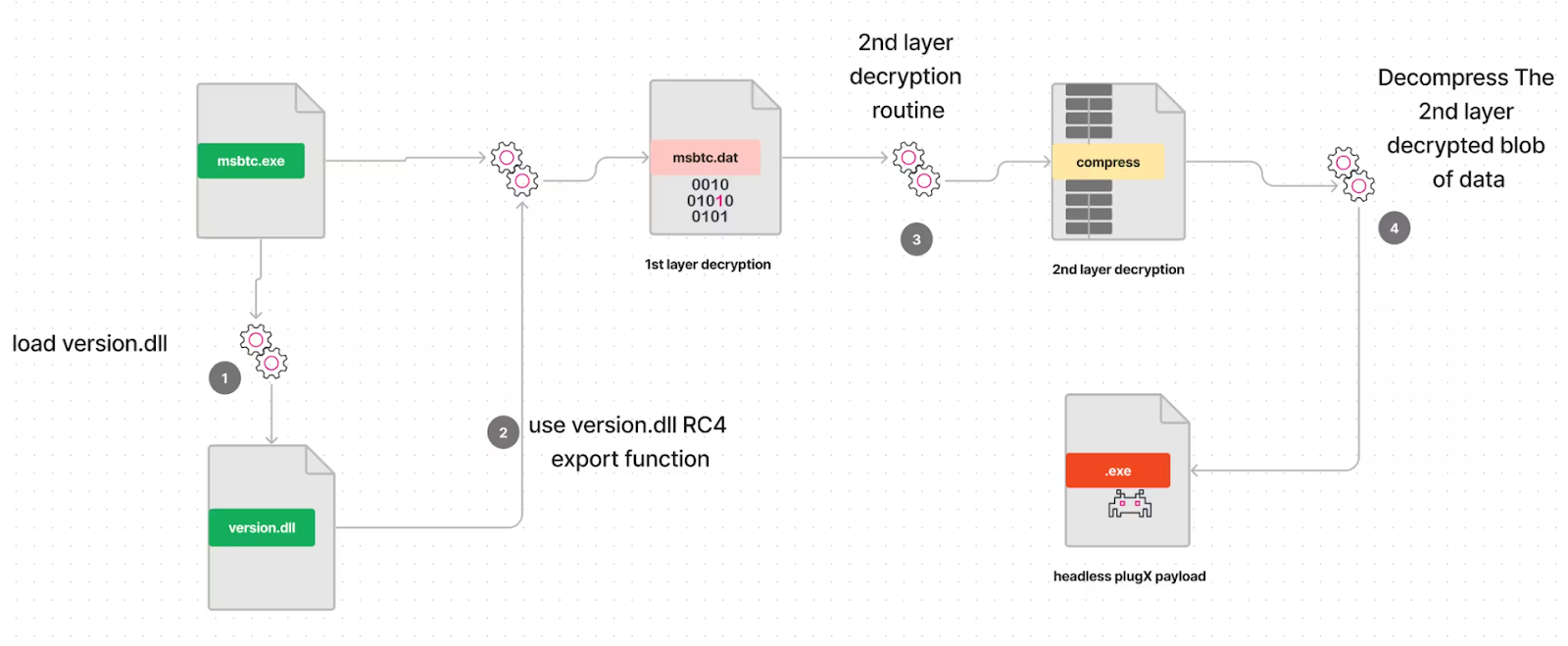
The PlugX variant, like predecessors, sideloads ‘version.dll’ via ‘msbtc.exe’ to execute malicious code. Meanwhile, the ‘msbtc.dat’ decryption begins with ‘Version.DLL’ using the RC4 algorithm in the ‘VerQueryValueW’ function. 

After that, the successful decryption activates the critical headers for final payload decompression.

Decryption and Decompression of PlugX Payload (Source – Splunk)

Malware advances to a second decryption layer with XOR and basic math in the researchers’ extraction tool. Transformations create the compressed layer, unpacked with the ‘RtlDecompressBuffer()’ API.

The ‘msbtc.cfg’ decryption differs from ‘msbtc.dat.’ It uses the same key and RC4 algorithm as ‘Version.DLL’ for efficiency. A Python tool, plugx_extractor.py, automates extraction, simplifying analysis and empowering security professionals.

The PlugX decrypts ‘msbtc.dat,’ injects into ‘msdtc.exe,’ a Windows service managing distributed transactions, and does the following things:-

  • Communicates with C2 server.
  • Retrieves host info.
  • Queries ipinfo.io for network details.
  • Adds “Microsoft Edge” firewall rule for covert communication on a specified port like 7777.
  • Manipulates host settings for stealthy operation.
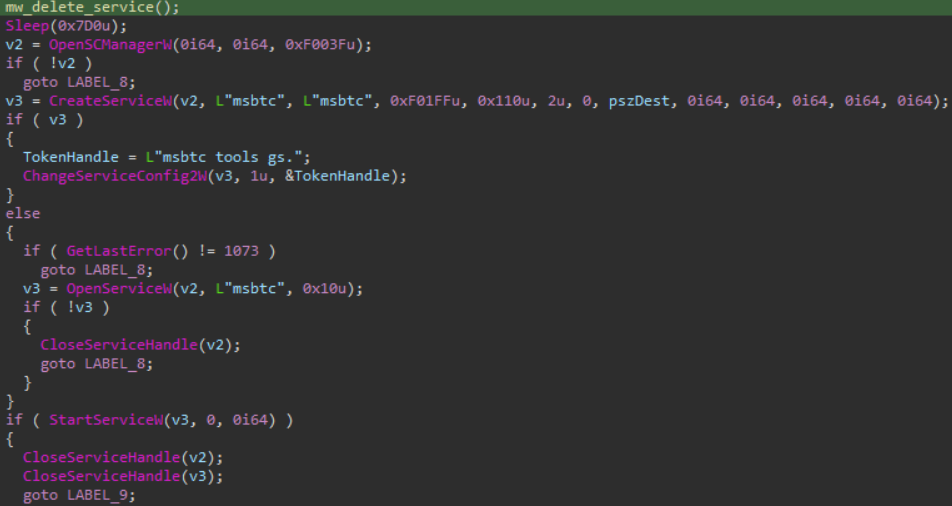
  • Installs a service on ‘msbtc.exe’ for persistence and elevated privileges.

To perform the following two essential functions, this service is configured:-

  • Automated Decryption
  • Dynamic Payload Loading
Create msbtc.exe services (Source – Splunk)

PlugX’s initial phase erases past traces for seamless reinstallation, dropping essential components in “%programdata%\MSB.” 

It gains privilege escalation by impersonating the user through “explorer.exe,” hiding activities. The malware features keylogging, discreetly storing data in “%ALLUSERPROFILE%\MSB\kl” for exfiltration to the C2 server.

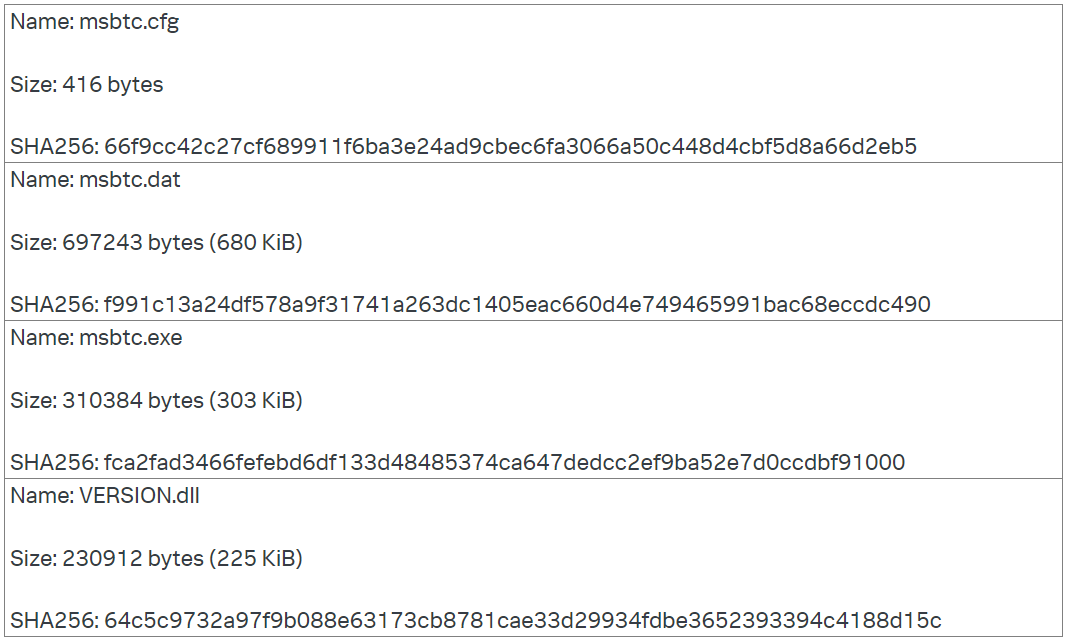
IOCs

IOCs (Source – Splunk)

[ad_2]
Source link

Cracked macOS Software Laced with New Trojan Proxy Malware

0
[ad_1]

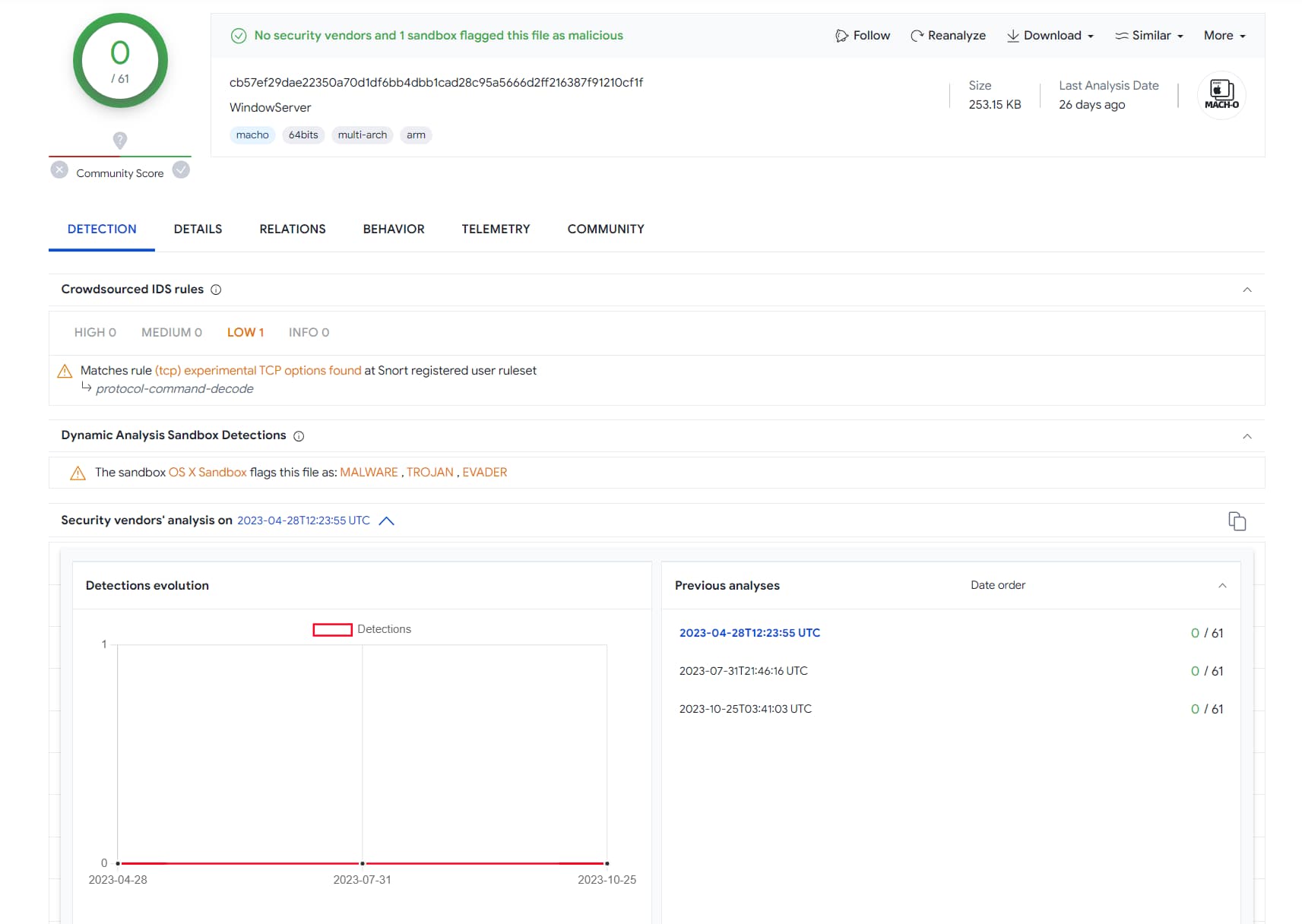
Kaspersky recently uncovered the most recent Trojan Proxy malware campaign, revealing that the earliest submission of the payload on VirusTotal can be traced back to April 28, 2023.

Cybercriminals have typically been keen on exploiting macOS applications to target Mac users, and this time, they might just have hit the jackpot. According to the latest research from cybersecurity researchers at Kaspersky, threat actors are deploying a novel Trojan Proxy malware in cracked applications, distributed via unauthorized websites. The plan behind this operation is to compromise Mac devices.

Researchers observed that the campaign’s earliest payload submission on VirusTotal was on April 28, 2023. Further probing revealed that the malware is disguised within popular copyrighted macOS software available on warez sites.

For your information, Warez sites are websites that offer copyrighted digital content, such as software, movies, music, ebooks, and games, for free or at a significantly lower price than the original product.

Cracked macOS Software Laced with New Proxy Trojan Malware

The malware allows attackers to build a proxy server network to commit crimes or make profits. When installed, this malware converts computers into anonymous traffic-forwarding terminals, allowing malware operators to perform malicious activities, such as phishing, hacking, or conducting illegal transactions. 

“Attackers can use this type of malware to gain money by building a proxy server network or to perform criminal acts on behalf of the victim: to launch attacks on websites, companies and individuals, buy guns, drugs, and other illicit goods” researchers explained in a blog post.

Infected applications appear as legitimate cracked software, distributed as .PKG installers rather than the usual disk images. A post-installation script replaces two system files with malicious versions from the app resources and grants them administration permissions. A fake Google configuration file (p.plist) automatically starts the WindowServer malware file as a system process. 

This binary file was uploaded on VirusTotal on April 28 but wasn’t recognized as malware then. The malware utilizes DNS-over-HTTPS (DoH) to get the C2 server IP address and connects via WebSockets, receiving commands for the various malicious activities the Trojan can perform and sending information. 

However, during their research, investigators didn’t receive a server response beyond the 0x38 command and noted that the client supported TCP and UDP connections. Earlier versions relied on traditional DNS requests instead of DoH for C&C server acquisition.

It is worth noting that selling access to these proxies is a highly profitable business, encompassing massive botnets. Kaspersky researchers noted that Mac devices aren’t immune to this deep-rooted threat, which is why this campaign works. 

Attackers are exploiting the popularity of cracked versions of copyrighted software, specifically commercial software/programs, as users prefer to avoid paying for premium software.

Around 35 instances of popular image editing, data recovery, video compression and editing, and network scanning tools-related apps laced with Trojan Proxy were identified by Kaspersky.

Beyond macOS, researchers have identified Android and Windows versions connecting to the same C&C server. This means a larger distribution network for cracked software laced with Trojan Proxy malware could be at work.

Menlo Security’s chief security architect, Lionel Litty, shared with Hackread.com that using DoH and WebSocket indicates that threat actors are focusing more on evading network-based detection mechanisms.

“The use of DoH and WebSocket shows that more sophisticated bad actors are focused on evading network-based detection mechanisms an enterprise may have deployed,” Litty explained.

“DoH will often mean the malware can evade detection from products that look at DNS traffic for IOCs since DNS traffic is now wrapped within HTTPS connections that may not be inspected or that are inspected by solutions that do not understand DoH semantics,” Little added.

“Likewise, network devices that inspect HTTPS traffic may not understand WebSocket semantics and may fail to run signature-based detections that target the payloads of C&C traffic used by the malware” Litty warned.

  1. macOS Ventura Background Task Flaws Exploited for Malware
  2. LockBit Ransomware Expands Attack Spectrum to Mac Devices
  3. MacStealer: A New Malware Targeting macOS Catalina Devices
  4. Windows, Linux, macOS Users Targeted by Chinese Iron Tiger APT
  5. New Malware Turns Windows and macOS Devices into Proxy Nodes

[ad_2]
Source link

OnePlus Nord 3 starts getting Android 14 update

0
[ad_1]

Android 14 update has started rolling out to a number of OnePlus phones thus far. The company’s 2023 flagship, the OnePlus 11 started getting the update, and the same goes for the OnePlus 10T, and more devices. Well, the latest in the line is the OnePlus Nord 3, as Android 14 has started rolling out to that phone.

Android 14 is rolling out to the OnePlus Nord 3 devices, though the rollout is quite limited for now

Do note that the update has started rolling out in a single market, for now. It is rolling out to Open Beta participants in India. That update is expected to spread like wildfire if no major bugs pop up. So, other markets should start getting it soon.

The OnePlus Nord 3 twin, OnePlus 11R, has started receiving this update too. The build numbers for the update are a bit different between them. The OnePlus Nord 3 is receiving CPH2491_14.0.0.100, while the OnePlus 11R is receiving CPH2487_14.0.0.201. OxygenOS 14 comes pre-installed on Android 14 here, of course.

Fluid Cloud, File Dock & Smart Cutout are useful, newly-added features

Having said that, a number of features are added here, the same as on other devices that are getting the update. Let’s start with Fluid Cloud. It is a new way of interaction with morphing forms. This allows you to view up-to-date info at a glance.

File Dock has also been added. This feature allows you to use drag and drop to transfer content between apps and devices. The Content Extraction feature can recognize and extract text and images from the screen. A single tap is required for this.

Smart Cutout is another useful feature added with OxygenOS 14. It allows you to separate multiple objects in a photo from the background. That way you don’t have to manually cut something out from a picture.

The ‘Shelf’ has been improved, and the same goes for the company’s Aquamorphic Design

The ‘Shelf’ has been improved, as more widget recommendations have been added. General system stability has been improved by the company. Apps should launch a bit faster now, while the OS will be smoother and animations better.

The company’s Aquamorphic Design has been cleaned up as well. It will have a clearer color style following this update. Some Aquamorphic-themed ringtones have been added too, and the notification sounds have been revamped.

On top of all that, a carbon tracking AOD screen has been added. It visualizes the carbon emissions you avoid when walking, instead of using a car.


[ad_2]
Source link