Twitch will be ceasing its operations in Korea (South Korea, not North Korea, duh!) early next year.
After several years of consideration and effort to find a way to continue operating in Korea, Twitch has decided to end its operations in Korea as of February 27, 2024, Korean time.
That’s what an official blog post from Twitch reads, upsetting many Korean streamers days before Christmas.
“We deeply understand that this decision is very disappointing news for Korean streamers who have invested a lot of time and effort into building their communities on Twitch and who depend on Twitch for their livelihood”, continues the post and provides an explanation of why they had to come to this decision.
What happened?
The Amazon-owned streaming platform says it has been operating at “significant losses” because of high local costs. The company specifically pointed to the high network fees in the country. Korea introduced legislation that would force major content providers to pay to use networks in the country (via Android Authority).
Twitch has tried to balance things out and somewhat reduce costs, introducing various solutions such as adjusting the maximum video quality to 720p, but that’s apparently not enough:
“The cost of running Twitch in Korea is currently prohibitively high. We have put a lot of effort into finding ways to continue operating in Korea by reducing costs. First, we introduced and tested the P2P model regarding source quality, and then adjusted the maximum video quality to 720p. Although these efforts were able to reduce costs somewhat, the network fees in Korea were 10 times higher than in most other countries, making operations no longer feasible. As a result, Twitch has continued to operate with difficulty in Korea with significant losses, but has reached a situation where it can no longer find a way to continue operations”, the company explains.
What will change after February 27, 2024?
As stated by Twitch, operations in Korea are scheduled to end on February 27, 2024, after which “Korean viewers will no longer be able to purchase Twitch’s paid products and streamers will no longer be able to generate revenue through Twitch”.
The OnePlus 10 Pro is now getting the Android 14 update, coming to more regions soon
Do note that the same is the same as with the other two phones, though. The update is starting its rollout in India, and beta testers are the first to get it. The update will soon spread to other markets, though, including both North America and Europe.
We do have a changelog available, so we can see what’s new. The changes are similar to what we’ve seen on other phones, though. The ‘Fluid Cloud’ feature is being added. That’s a new way of interaction with morphing forms, it allows the user to view up-to-date info at a glance.
The ‘File Dock’ feature has also been added. That feature allows the user to use drag and drop to transfer content between both apps and devices. On top of that, ‘Content Extraction’ and ‘Smart Cutout’ features have been added too. The first one can recognize and extract text and images, the second one can separate multiple subjects in a photo from the background.
The ‘Shelf’ has been improved too, as more widget recommendations have been added. The security has been boosted as well, as improved photo and video-related permission management is now here.
The overall system stability has been improved with this update
Overall system stability has been improved too, thanks to this update. That goes for the launch speed of apps, and the overall smoothness and animations of the system, says OnePlus.
On top of everything that was said, OnePlus also upgraded the ‘Aquamorphic Design’ that is used on the device. It now has a natural, gentle, and clearer color style, for a more comfortable experience.
Aquamorphic-themed ringtones have been added, the the system notification sounds have been revamped. OnePlus also added a carbon tracking AOD screen. It can visualize the carbon emissions that you avoid by walking, instead of driving a car. It will change as you move during the day.
Just recently, Google rolled out the Pixel Camera app 9.2 with its fresh design and features to all Pixel users, but the excitement doesn’t end there. The latest findings in the update suggest that Google has more up its sleeves, particularly tailored for the Pixel Fold.
Android Authority reports that the Pixel Camera 9.2 update brings to light strings hinting at an upcoming Dual Screen feature, internally known as “Saturn.” It looks like the Dual Screen feature is poised to let the Pixel Fold leverage its outer/rear display for preview while capturing the shot using the inner display.
Similar functionalities have been seen on the Galaxy Z Fold 5 and the OnePlus Open, so it’s no surprise Google is joining the foldable bandwagon.
However, according to the source, there are some limitations outlined in the strings. The Dual Screen feature won’t function in Battery Saver mode on your Pixel Fold, and it’s a no-go when the device is running too hot. These limitations align with Google’s approach of disabling certain camera features on Pixels when they heat up.
Right now, the Dual Screen feature isn’t operational on the Pixel Fold, even with APK sideloading. However, there’s a glimmer of hope for the future as the strings indicate ongoing work on this feature. Given it’s not officially announced, take this intel with a grain of salt—Google might flip the switch on or off at any given moment. Stay tuned for potential updates on this evolving feature.
Google stepped into the foldable smartphone arena this year with the Pixel Fold. Unfolding to reveal a 7.6-inch OLED display, it also features a 5.8-inch cover display. Going head-to-head with competitors like the Galaxy Z Fold 5, the newly launched OnePlus Open, and the Oppo Find N3, Google’s debut in the foldable market has some tough competition.
He did not name the specific models, but if we had to guess, we’d say that vanilla, Pro, and Ultimate models are on the way. Now, the Porsche Design variant could launch either instead of the ‘Ultimate’ phone, or simply in addition to it.
Three HONOR Magic6 flagships are on the way, including a ‘Porsche Design’ one
The tipster did share some additional info too. He claims that all three devices will have two selfie cameras. All of them will hide those selfie cameras inside an oval punch hole, or in other words, a pill-shaped camera cutout.
He referred to the three phones as ‘middle size’, ‘large size’, and ‘extra large size’. That points to the fact each of them will have a different size, with the most powerful one being the largest one at the same time.
Digital Chat Station also said that the first two smartphones will have a circular camera island on the back. The biggest and most powerful phone will include something between a circle and a rectangle, it seems.
The HONOR Magic6 Lite launched as the first ‘Magic6’ phone
The HONOR Magic6 Lite is the first smartphone from the series, and it launched recently. That is a budget phone, and does not belong in the ‘flagship’ devices mentioned here, despite the fact it’s a ‘Magic6’ phone. So, we’ll get three additional ones, in addition to that phone.
The HONOR Magic6 series will likely launch in the first quarter of next year. The HONOR Magic5 series arrived in February this year, so it makes sense for HONOR to aim for the first quarter of 2024.
In fact, we’re convinced that the HONOR Magic6 flagships will debut at MWC 2023 in Barcelona. That tradeshow will take place from February 27 to March 2. It is possible HONOR will host an event prior to the official beginning of the show, though.
According to the crypto bug bounty and cybersecurity firm Immunefi, hackings accounted for $335,574,150 in losses in November 2023, involving 18 incidents.
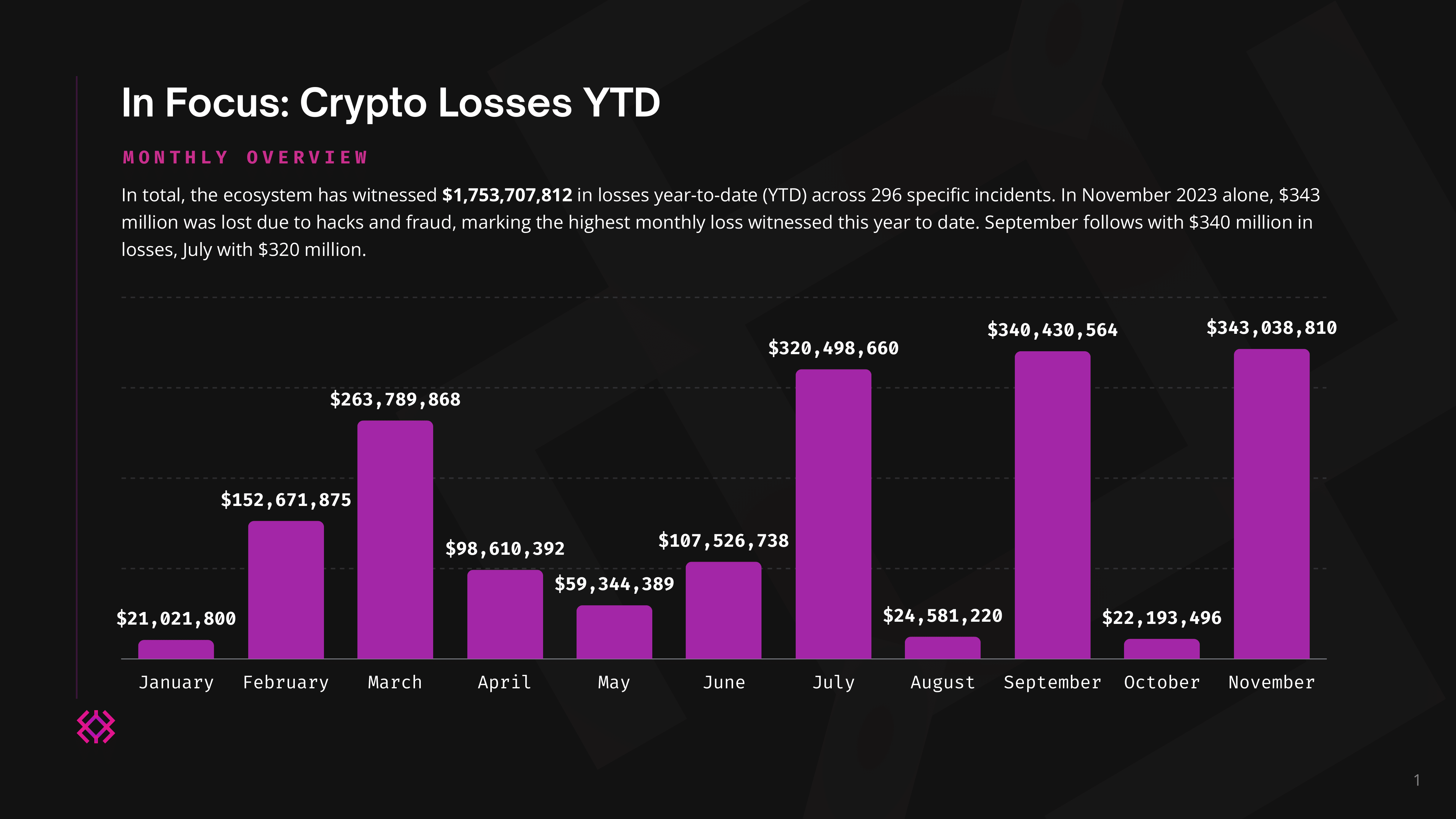
The world’s leading blockchain cybersecurity platform, Immunefi, has published its Crypto Losses in November 2023 Report, according to which cryptocurrency losses have surpassed $1.75 billion due to hacks and rug pull attacks between January and November 2023. This includes 296 distinct incidents. The cryptocurrency ecosystem has witnessed $1,753,707,812 in losses year-to-date (YTD) across 296 specific incidents.
Graph credit: Immunefi
The report is quite concerning. It comes at the same time when the cybersecurity firm Unciphered discovered a critical vulnerability, dubbed ‘Randstorm,’ that has put billions of dollars in Bitcoin and crypto assets at risk due to outdated wallets.
In Immunefi’s October 2023 report, the Singapore-based Immunefi revealed that cryptocurrency attacks surged by 153% year-over-year in Q3 2023. The two largest exploits targeting Multichain and Mixin Network collectively accounted for 47.5% of all losses. The North Korean state-sponsored hacking group Lazarus Group’s cyberattack represented 30% of the total losses, with $208.6 million in stolen funds.
According to Immunefi’s latest report (PDF), a record-breaking $343 million was lost to fraud and hacks in November 2023 alone, making it the highest monthly loss this year, representing a significant 15.4x increase from October 2023’s losses that amounted to $22 million.
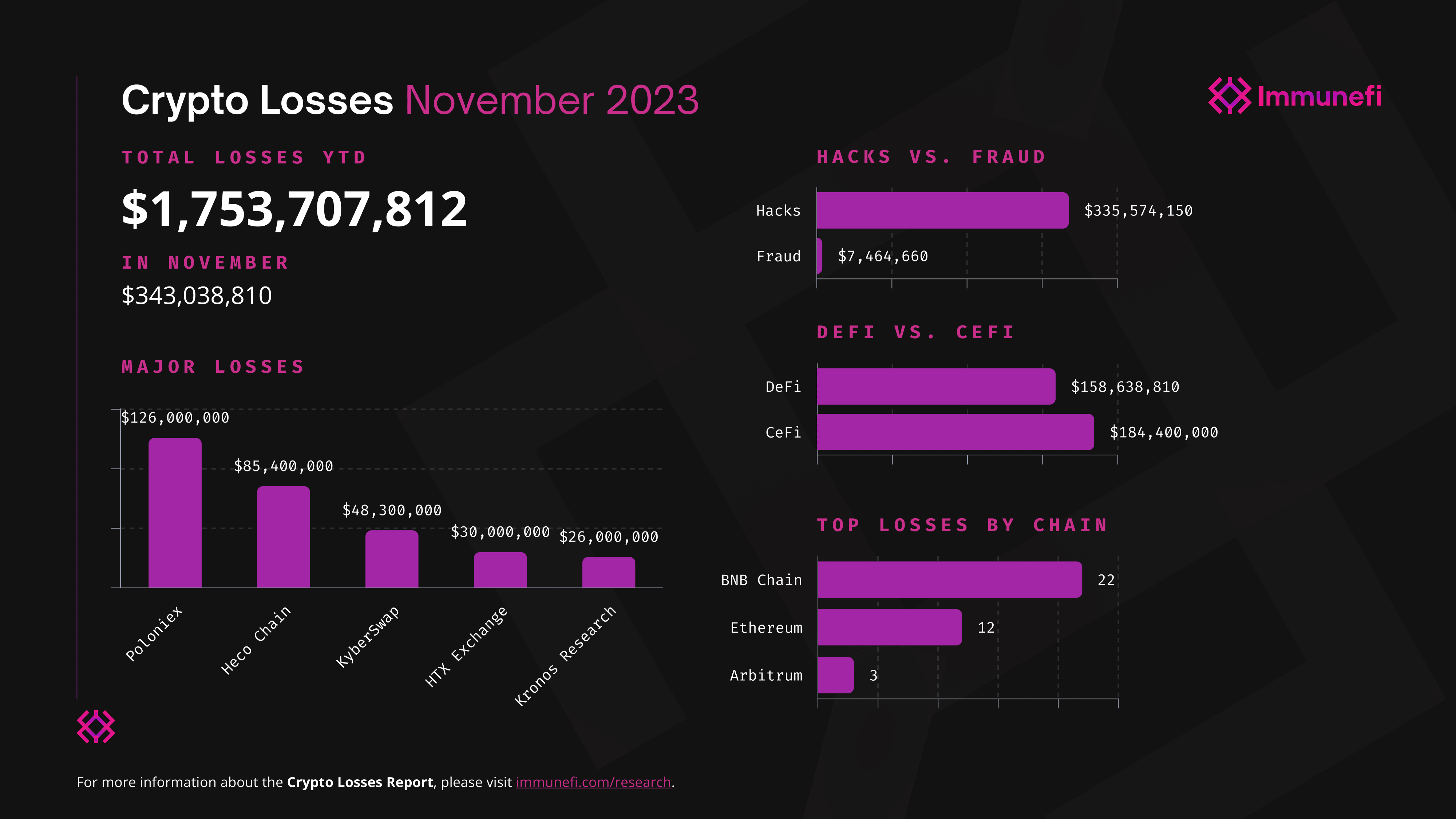
Hackings accounted for $335,574,150 in losses in November 2023, involving 18 incidents. This highlights that hacking poses a persistent threat in the cryptocurrency space.
On the other hand, fraudulent activities resulted in losses of $7,464,660 in 23 separate incidents, which is comparatively lower than hacking but remains a concerning issue in the industry.
In a notable shift, Centralized Finance (CeFi) emerged as the primary target for exploits in November 2023, surpassing Decentralized Finance (DeFi) in lost funds. Immunefi found that CeFi accounted for 53.8% of overall losses, whereas DeFi accounted for 46.2%. These spikes are primarily attributed to high-profile attacks on platforms like HTX Exchange, Poloniex, and Kronos Research.
DeFi platforms recorded $158,638,810 in losses in November 2023 in 37 distinct incidents, making DeFi a vulnerable sector. CeFi platforms suffered $184,400,000 in losses in November 2023 in four incidents.
The BNB Chain and Ethereum blockchains remained the most targeted platforms in November 2023, accounting for more than half (83%) of the total losses in all targeted chains.
BNB Chain became a target of 22 incidents, leading to losses of 53.7% of the total losses, whereas Ethereum accounted for 29.3% of the total losses with 12 incidents. Arbitrum, Optimism, Avalanche, Fantom, and Heco Chain each suffered one attack in November 2023, contributing the remaining 2.4% of the total losses.
Immunefi is the premier bug bounty and security services provider, safeguarding Web3 ecosystems and protecting a staggering $50 billion in user funds with its vast network of white hackers.
Graph credit: Immunefi
Immunefiempowers cybersecurity experts to scrutinize project code, detect and responsibly disclose vulnerabilities, and offer rewards for their contributions. This collaborative approach, according to the company, has resulted in the disbursement of over $85 million in total bounties, averting potential losses of over $25 billion in user funds. Since its inception, Immunefi has saved over $25 billion from being stolen.
As an investor in the ever-evolving world of cryptocurrency, DeFi, blockchain, and Web3, it’s crucial to prioritize the security of your digital assets. Here are 5 essential tips to protect your funds from hackers and cyber attacks:
Secure Your Wallets
Use Cold Wallets: These hardware devices store your private keys offline, making them significantly less susceptible to cyberattacks compared to hot wallets (software wallets connected to the internet). Popular cold wallets include Ledger, Trezor, and KeepKey.
Diversify Your Wallets: Don’t store all your funds in one wallet. Distribute them across multiple wallets for better risk management.
Implement Strong Passwords: Use unique and complex passwords for all your wallets and exchanges. Consider password managers for efficient management.
Enable 2-Factor Authentication (2FA): 2FA adds an extra layer of security by requiring a second verification factor, like a code sent to your phone, when logging in or making transactions.
Practice Cybersecurity Hygiene
Stay Vigilant: Be wary of phishing scams, unsolicited emails, and suspicious links. Never share your private keys or seed phrases with anyone, even those claiming to be support personnel.
Keep Software Updated: Ensure your operating systems, wallets, and other relevant software are updated with the latest security patches.
Use Secure Networks: Avoid using public Wi-Fi for accessing your crypto accounts. Opt for secure, private networks whenever possible.
Be Cautious of dApps: Before interacting with any dApp (decentralized application), research its reputation and security practices.
Choose Reputable Platforms:
Research Exchanges: Before investing in an exchange, thoroughly research its security features, reputation, and regulatory compliance.
Prioritize Transparency: Choose platforms that prioritize transparency in their operations and code.
Beware of Unknown Projects: Exercise caution when investing in unfamiliar projects or dApps. Conduct thorough research and due diligence before committing any funds.
Stay Informed and Educate Yourself:
Continuously learn: The crypto landscape is constantly evolving, so stay updated on the latest security threats and best practices. Follow reliable sources and participate in educational communities.
Be aware of common scams: Learn about common phishing tactics, exit scams, and other fraudulent activities targeting crypto investors.
Seek expert advice: If you’re unsure about any aspect of crypto security, don’t hesitate to consult with a trusted security expert or financial advisor.
Backup Your Keys:
Always have a backup plan: Create backups of your private keys and seed phrases and store them securely offline, preferably in multiple locations.
Consider multi-signature wallets: These wallets require multiple keys to authorize transactions, offering an additional layer of protection.
Lastly, but most importantly, visit Hackread.com regularly. Follow us on X (formerly Twitter), Facebook, or LinkedIn to stay updated on daily cybersecurity news and threats.
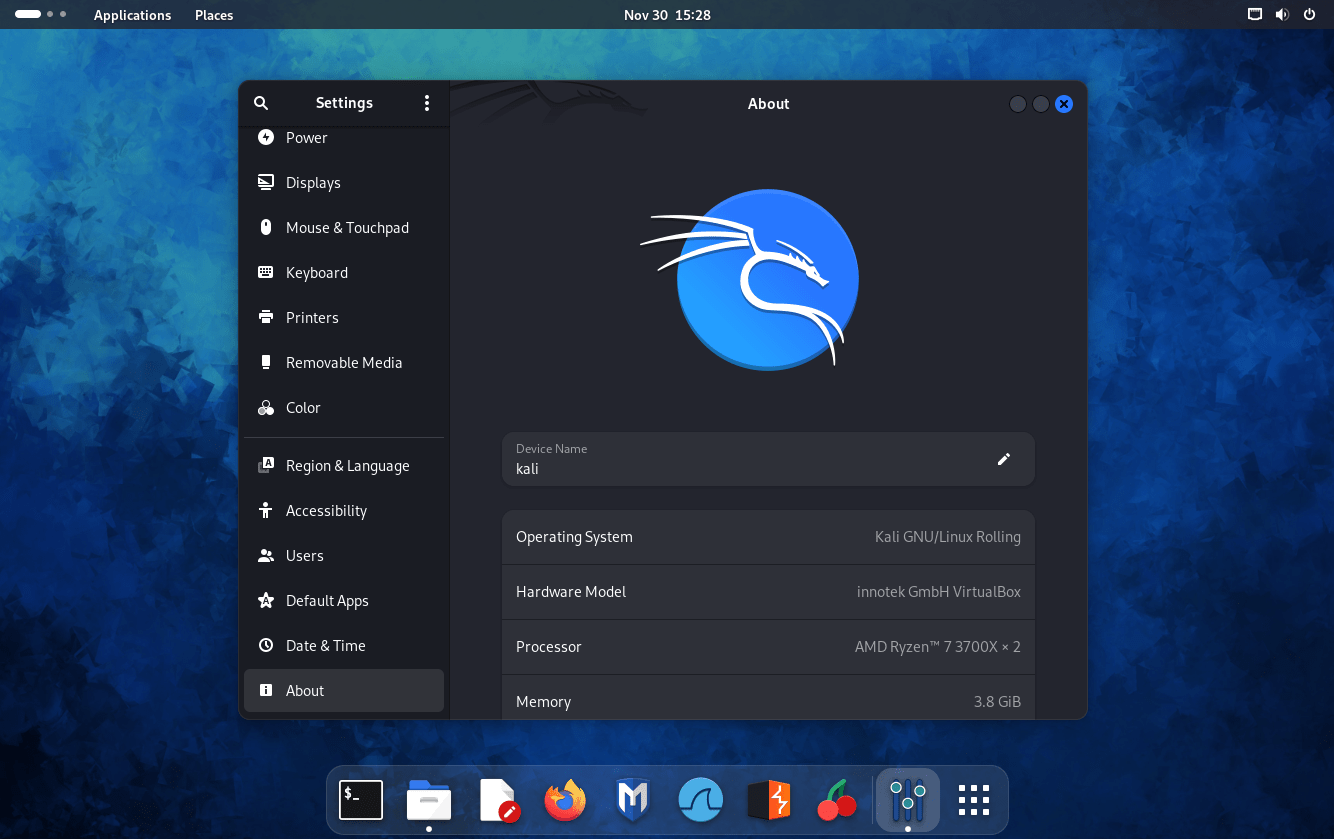
Kali Linux 2023.4, the latest version of Offensive Security’s renowned operating system, has been released, and it includes the advanced Gnome 45 desktop environment and 15 new tools, with enhancements to existing ones.
Kali Linux is a Linux distribution intended for network security analysis, ethical hacking, and penetration testing. It is based on the Debian Testing branch, and the majority of the packages it utilizes are obtained from the Debian repositories.
Before we wrap up the year, it’s time to get out one last Kali release for 2023.
Announcing Kali 2023.4! https://t.co/ta6f7p1Oxk for a focus on the addition of Hyper-V support to Vagrant, ARM64 Cloud images, support for the Pi 5, and an update to Gnome 45. Check it out! pic.twitter.com/CqjgyPZ6TN
Cloud ARM64 – Amazon AWS and Microsoft Azure have ARM64 option
Vagrant Hyper-V – Vagrant Hyper-V Support
Raspberry Pi 5 – Kali on the latest Raspberry Pi foundation device
GNOME 45 – Kali theme is on the latest versions
GNOME 45 is now here
The new updates are as follows:
Full-height sidebars in many updated apps
Highly improved speed of search in nautilus file manager
The update for nautilus will arrive soon
Improved settings** app (gnome-control-center)
Updated color schemes for gnome-text-editor
Updated themes for shell, libadwaita, gtk-3 and gtk-4
Updated gnome-shell extensions
Shell updates, including a new workspace indicator, replacing the previous “Activities” button
Scrolling your mouse wheel while hovering over the indicator is also possible to switch between workspaces.
Internal Infrastructure:
Peak at what is going on behind the scenes with mirrorbits. Mirrorbits is incredibly reliable software that was first released ten years ago. It is based on modern technology, specifically Go and Redis.
It was created by Ludovic Fauvet of VideoLAN; it served as a means of distributing the VLC media player. Additionally, an increasing number of FOSS projects, including GNOME, Jenkins, Lineage OS, and many more, have adopted it throughout the years.
15 New Tools:
The fifteen new tools included in this version are as follows:
cabby – TAXII client implementation
cti-taxii-client – TAXII 2 client library
enum4linux-ng – Next generation version of enum4linux with additional features (a Windows/Samba enumeration tool)
exiflooter – Finds geolocation on all image URLs and directories
You can visit Kali Linux’s official website to get the most recent version of Kali Linux (Kali Linux 2023.4), either in 32-bit or 64-bit, depending on your requirements.
HONOR has announced the very first ‘Magic6’ phone, the Magic6 Lite, for global markets. This handset will be the most affordable one in the series. As a reminder, the HONOR Magic6 Pro devices are expected to drop in the first quarter of 2024.
The HONOR Magic6 Lite is official, and it looks very similar to its predecessor
That being said, the HONOR Magic6 Lite does resemble its predecessor quite a bit. It still has a curved display with a display camera hole. That circular camera island is located on the back, with a two-tone finish. The cameras are located in the outer black-colored ring.
The HONOR Magic6 Lite features a 6.78-inch AMOLED display with a 2652 x 1200 resolution. This display is curved, and it has a 120Hz refresh rate. It also offers a 1920Hz PWM dimming, and a peak brightness of 1,200 nits.
The Snapdragon 6 Gen 1 SoC is fueling this smartphone, which is a 4nm processor. That is a considerable improvement over the Snapdragon 695 located in its predecessor. The phone also has 8GB of RAM and 256GB of storage.
A 5,800mAh battery is included, as is a 108MP main camera
A 5,800mAh battery sits on the inside of this phone, while 35W wired charging is supported. Yes, the phone does ship with a charger. Android 13 comes pre-installed here, with MagicOS 7.2. The phone is also IP53 certified for water and dust resistance.
A 108-megapixel main camera (f/1.75 aperture) sits on the back of the phone. A 5-megapixel ultrawide camera (f/2.2 aperture) is also located back there, as is a 2-megapixel macro camera (f/2.4 aperture).
On the front, you’ll find a 16-megapixel snapper. The phone does support Bluetooth 5.1, and has two nano SIM card slots. 5G is also supported. The HONOR Magic6 Lite measures 163.6 x 75.5 x 7.98mm, and weighs 185 grams.
This smartphone was announced in four colors, Emerald Green, Midnight Black, Sunrise Orange, and Titanium Silver. The device will become available from December 27, though its price tag is still unknown.
Ever since Google hopped on the generative AI train, the company has been hard at work injecting its AI into several of its products. One of the tools it created is the Help Me Write AI tool. You’re able to access it on platforms such as Google Docs and Gmail, but the company is working on making it more accessible. Google is working on implementing Help Me Write into Chrome for desktop.
As its name suggests, Help Me Write is a tool that lends a hand to help you write content. Say, you need a suggestion for an email to send to a client. Well, you can tell the tool what you want your email to be about, and it will draft an email for you. It could come in handy if you need an idea of what to write. The same thing goes for writing documents in Google Docs.
Google is working on bringing Help Me Write to Chrome for desktop
For the time being, this feature is only for Gmail, Google Docs, Google Keep, and Google Messages. Also, it’s available on the app versions of these platforms. However, the company is looking to expand this feature in a big way. According to the Chromium Gerrit open-source project, chrome is working on making the feature a mainstay in the Chrome browser for desktop. This means that people will be able to access this feature no matter what site they’re on.
Judging by the information we have, you’ll be able to access the Help Me Write feature in any text field that you click. You’ll be able to summon the feature from the right-click drop-down menu. When you summon the feature, you’ll see a separate little window pop up that you’ll type your query into.
There will be differences between this implementation and what you get currently. For starters, the feature will scan the page you’re on for further context. This will help it get a better grasp of what you want it to type up. That’s extremely useful, as it gives the feature a higher chance of drafting exactly what you need on the first try.
Another difference has to do with the options to refine what it produced. You’ll have fewer options to refine the draft. It will only give you the option to shorten and elaborate the answer along with the choice to make it more formal or casual. That’s it. Using it on Docs gives you substantially more options.
When will you be able to use this tool?
The story for that is a little complicated. Right now, the average Joe won’t be able to try it out. The feature is actually locked behind a handful of flags in Chrome. Even if you know how to activate flags, there’s one flag that’s just not available to be unlocked, so we’re all out of luck. We’re just going to need to wait for Google to push this to the public, which some speculate won’t be until February 2024.
At first, several Chromebook users won’t be able to use the feature, as Google could introduce this as a Chromebook Plus-exclusive feature. However, in the case of Chromebook Plus, it could be a full system-wide feature which might work outside of the browser.
Non-Chromebook Plus users could get the browser version along with Windows and Linux users. This is an interesting feature, and we can’t wait until it lands.
Back in 2014, Instagram was all the craze, and the ability to take videos only made the whole experience better. Some people like to watch their old videos and relive the good old days, but some people are running into an issue. There’s a bug causing old Instagram videos to be muted.
If you’re old enough to have been making videos back in 2014, don’t worry, you’re not losing your hearing just yet. Instagram confirmed that there’s a bug causing older videos to be muted randomly. According to several sources, this problem has been going on for a few weeks.
This issue only seems to be affecting videos taken around 2014. That’s probably why it took so long for it to gain traction. When you’re on the app, you’re not likely to see videos as old as nine days, let alone nine years. If you’re looking at videos that old, you’re definitely part of a small crowd of people.
Instagram muted your old videos, but there’s a fix coming
While you can’t enjoy your memories from the good old days (ya know, before TikTok and other awful things), don’t worry. Instagram confirmed that it knows this issue exists and that it’s working on a solution.
The only thing is that we don’t know when the company is going to have the fix ready. If you want to rewatch old videos of the Ice Bucket Challenge or people singing “What Does The Fox Say”, there’s no telling when you’ll be able to again. The best thing to do is keep checking to make sure that your Instagram app is up to date.
For all we know, the fix could come with the update where Meta, the company that owns the app, disconnects the Instagram and Facebook Messenger. Go to Instagram in your respective app store and see if there’s an Update button. If you see it, then you know what to do!
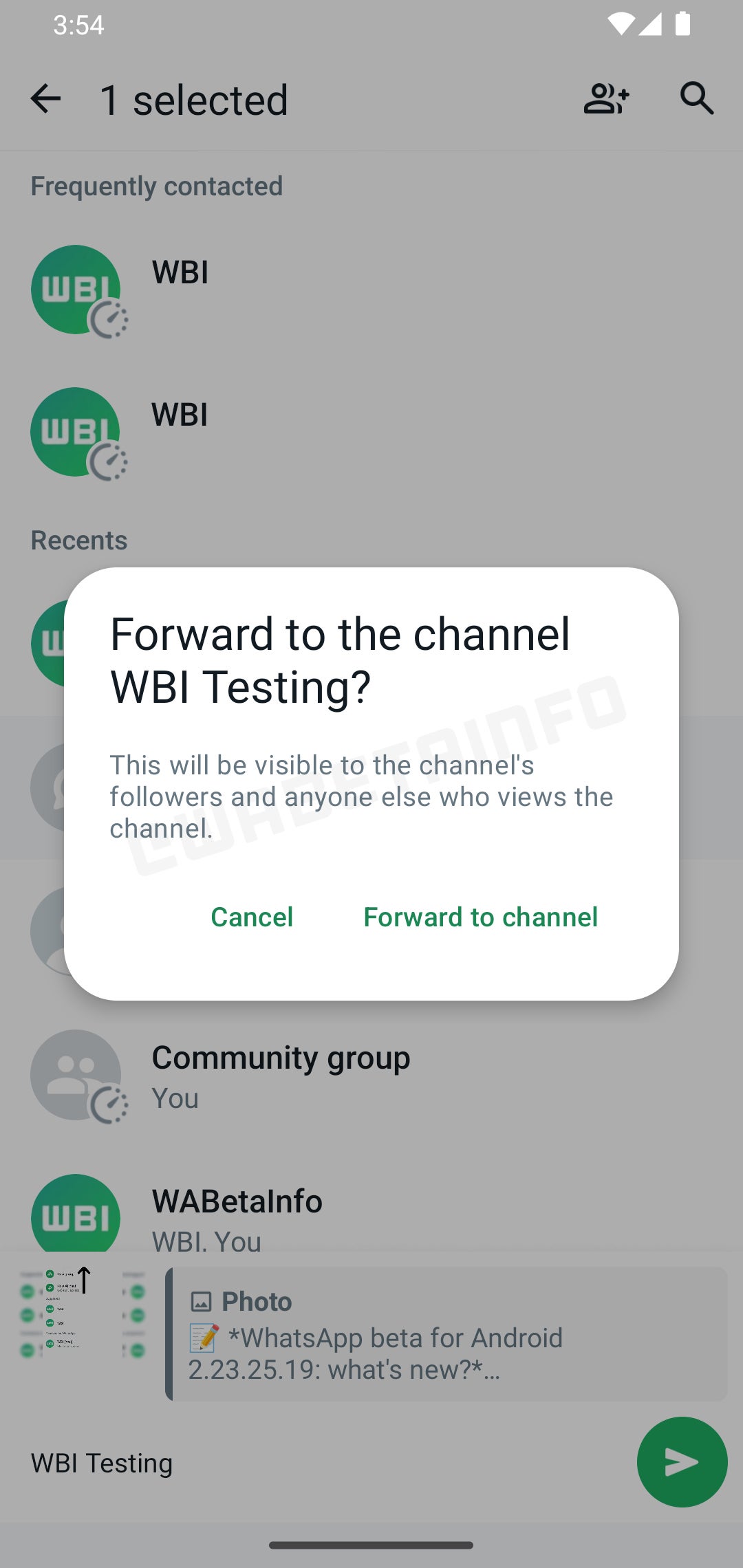
According to WABetaInfo, a reliable source for WhatsApp updates, the messaging app is set to allow message forwarding to channels in an upcoming update.
Image Credit–WABetaInfo
This handy feature, spotted in the latest WhatsApp beta for Android 2.23.26.2 update, will allow channel owners to forward various messages, such as text, images, videos, GIFs, audio messages, stickers, and updates from other channels. This feature might help streamline channel management by saving time for admins.
Currently, direct forwarding to channels isn’t an option. However, with this update, channel admins will have a more efficient way to share messages from different chats, including group and private conversations. This improvement is especially beneficial for those overseeing multiple channels, making their tasks considerably more straightforward.
WhatsApp introduced Channels not too long ago, catching up with competitors like Telegram. Channels operate like groups, where only the admin can send messages. You can follow celebrities or channels about different topics that interest you. Or, you can stay in the loop with the latest news by keeping tabs on various media sources.
WhatsApp’s debut of channels this year hit a bit of a rough patch. Some essential stuff was MIA at the beginning, making many users give it the side-eye. But the platform’s been hustling to catch up ever since. It has been dropping new channel features like message editing and channel usernames, trying to keep things fresh and user-friendly.