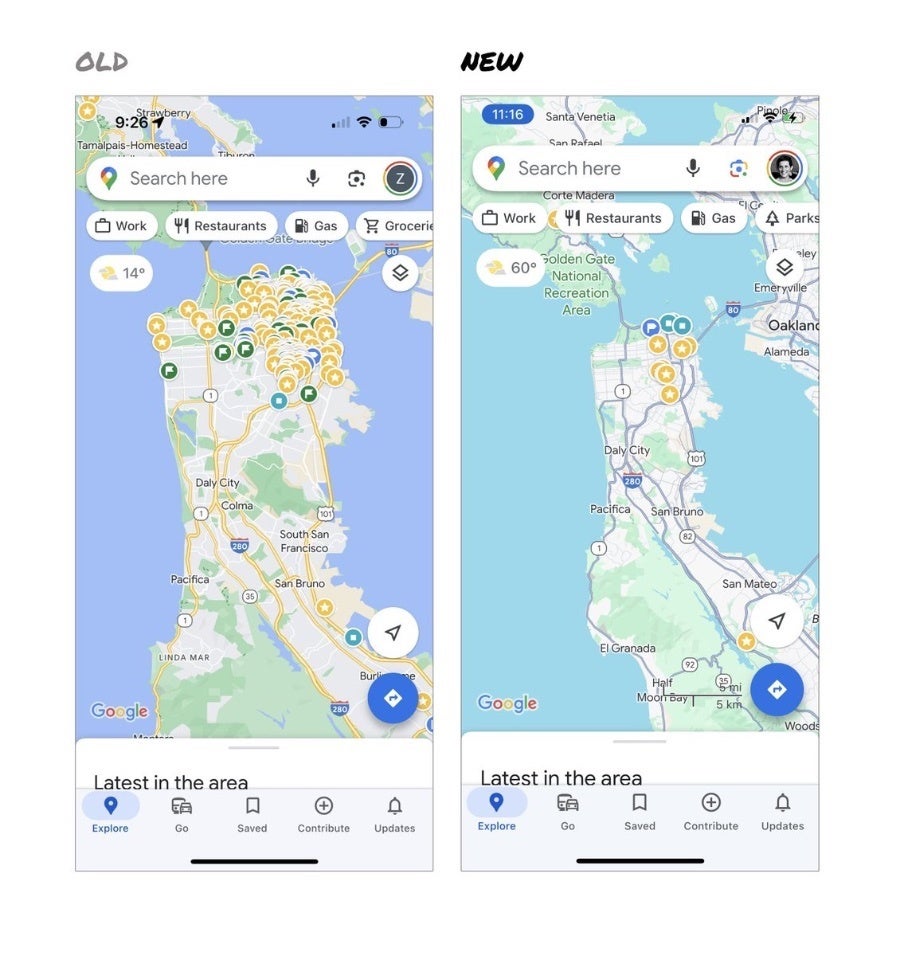
Google Maps’ confusing new color palette has now reached Android Auto

0
[ad_1]
Google Maps has undergone a significant visual transformation which was announced by the company back in the beginning of the month. This overhaul included some new features but also introduced a new, cooler, color palette that was received with mixed reactions. While the original rollout only included Android, iOS, and the web versions of Maps, it is now also rolling out to the Android Auto counterpart.
The new design’s color palette replaces the traditional warm hues with a more refreshing and contemporary aesthetic, designed to enhance usability and improve the overall user experience. The most noticeable change is the replacement of the familiar tan color for roads with a range of grays.

The intent for this shift was to make roads stand out more prominently against the backdrop of parks and forests, which now feature a lighter shade of green. Additionally, freeways were given a darker gray hue with subtle blue undertones, blending seamlessly with water bodies that now display a lighter blue shade.


These changes are complemented by a reduction in the use of yellow, which allows orange pins for restaurants to stand out more distinctly. This design choice is meant to ensure that key points of interest are easily identifiable, enhancing the overall usability of the app. The new color scheme also extends beyond the map itself, permeating the app’s user interface.

As originally reported by 9to5Google, these changes have been found by many users of the app to be quite jarring and even dangerous. The sentiment echoes throughout  Reddit and other social media with users stating that the new colors make it difficult to discern between road types. Even an ex-Google Maps designer felt the need to chime in on her discontent with the direction the Google Maps team has taken.

In fact, some users have found the new scheme with brighter colors to mimic Apple Maps’ and have taken to Google Maps support to express their frustration. While Google finds the new palette to offer several advantages and enhance legibility, it does not appear that the user base agrees with this opinion.

Google has been gradually rolling out the new color palette since October, with testing beginning in August. The update is now widely available across the web, Android, and iOS platforms, including Android Auto. It remains unclear what Google’s position is on the users’ complaints or whether the company intends to implement further changes.


[ad_2]
Source link

Cybersecurity tool investments rising in Asia-Pacific Cyberattacks

0
[ad_1]

Investments in cybersecurity tools have been on the rise in the Asia-Pacific region, owing to the increased prevalence of cyberattacks. It is projected that the market will grow at a CAGR of 16.4% by 2032.

The market for cyber warfare has been growing rapidly and was valued at $37.5 billion in 2022. It is expected to witness significant growth and reach a valuation of $127.1 billion by 2032, with a compound annual growth rate (CAGR) of 13.3% from 2023 to 2032.

Document
Free Webinar

In the upcoming webinar, Karthik Krishnamoorthy, CTO and Vivek Gopalan, VP of Products at Indusface demonstrate how APIs could be hacked. The session will cover: an exploit of OWASP API Top 10 vulnerability, a brute force account take-over (ATO) attack on API, a DDoS attack on an API, how a WAAP could bolster security over an API gateway

The hackers use offensive and defensive tactics, encompassing cyberattacks, espionage, and sabotage.

Cyber warfare employs a range of tactics that are readily available to cybercriminals, including email attachments, pop-up windows, malware, instant messages, and other forms of online deception, reads the report.

These methods are used to infiltrate and compromise digital systems, often with the goal of stealing sensitive data or gaining unauthorized access to critical infrastructure. It is important to be aware of these tactics and to take appropriate measures to safeguard against them.

Notably, This includes different parts intended to protect, utilize, and interfere with digital infrastructure and information systems at the local, state, and international levels.

The pandemic made it easier for cybercriminals to exploit weaknesses in the infrastructure supporting remote work and healthcare. Cyberattacks on critical infrastructure, medical facilities, and COVID-19 research groups significantly increased.

In 2022, the aerospace and defense sector had the largest share of the cyber warfare market; this trend is expected to continue in the upcoming years.

This can be linked to its function in detecting and reducing cyber threats, exchanging data with governmental organizations, and working with cybersecurity companies and other sectors to improve cybersecurity in general. 

The BFSI segment would also display the fastest CAGR of 17.8% throughout the forecast period, owing to the adoption of digitalization and rapid use of Fintech mobile apps.

Through its sections on company profiles and the competitive landscape, the market report offers a thorough insight into the key participants in the cyber warfare market.

An analysis of the major businesses’ financial accounts, strategic market approach, major developments, market position, geographic reach, and other important factors are all included in the evaluation process. 

Experience how StorageGuard eliminates the security blind spots in your storage systems by trying a 14-day free trial.


[ad_2]
Source link

HONOR Magic6 series will be ‘meticulously refined’: CEO

0
[ad_1]

HONOR’s CEO, Zhao Ming, talked to the media following the HONOR 100 series launch in China. The company’s CEO did actually mention HONOR’s upcoming flagships during the interview. He said, according to Sparrows News, that the HONOR Magic6 series will be “meticulously refined”.

The HONOR Magic6 series to be ‘meticulously refined’, says CEO

Something along the lines of “groundbreaking innovations” was also mentioned. Zhao Ming did confirm the inclusion of satellite communication in the HONOR Magic6 series. We’re not sure if that functionality will be available globally, though. The company will also be relying on AI quite a bit when it comes to the Magic6 series.

Now, the HONOR Magic6 series is expected to launch next year. The HONOR Magic5 series launched in February this year, so the Magic6 series is expected around the same time. In fact, we expect those phones to arrive around MWC 2024.

Earlier, a well-known tipster, Digital Chat Station, said that the Magic6 Pro will include a 1-inch camera sensor. Surprisingly, however, he mentioned OmniVision’s upcoming OV50K camera sensor.

The Magic6 Pro will use a 1-inch camera sensor with LOFIC tech

This camera sensor will introduce something called the LOFIC technology. (Lateral Overflow Integration Capacitor). This should help prevent overexposure in HDR images.

We don’t have all the information about that camera sensor, in fact, the information is scarce. OmniVision is expected to announce it in the near future, and the Magic6 series could have an exclusive period with it.

That will be the company’s first 1-inch camera sensor, by the way. The Snapdragon 8 Gen 3 is expected to fuel the HONOR Magic6 Pro, as the Snapdragon 8 Gen 2 was included inside the HONOR Magic5 Pro.

Android 14 is expected to come out of the box, along with HONOR’s MagicOS 8.0. The phone will also pack in top-of-the-line specs across the board, including a 120Hz LTPO OLED display with high PWM dimming, stereo speakers, top-of-the-line RAM and storage, and so on.


[ad_2]
Source link

Casetify says it’s ‘a bastion of originality’ amidst Dbrand lawsuit

0
[ad_1]

Casetify has released a statement defending itself amidst the current lawsuit against the company, calling itself “a bastion of originality”. Casetify, a company known primarily for its smartphone cases, has found itself in hot water recently. Dbrand, another company famous for smartphone skins and cases, filed a lawsuit alongside YouTuber JerryRigEverything. Casetify responded on X, where it made the claim of originality.

Dbrand suing Casetify over copyright theft

The whole ordeal started a couple of days ago when JerryRigEverything made the lawsuit public. Zack Nelson, more famously known as JerryRigEverything on YouTube, uploaded a video titled “I’VE BEEN ROBBED”. A departure from his traditional style of content, Zack revealed that he was partnering up with Dbrand and taking Casetify to court. He explained how he and Dbrand collaborate and make the ‘Teardown’ series of cases. These cases are named after the YouTuber’s famous teardown videos where he takes apart devices.

Zack then went on to explain how he came across cases on Casetify’s store page that looked similar to his. Initially thinking Dbrand finally had competition, he quickly realized the case designs were blatantly stolen. To prove his allegations, Zack showed off Casetify cases he had bought just for the video. He explained how he sneaks in little easter eggs in the case skins every now and then. The Casetify skins featured these easter eggs, as well as other dead giveaways. Zack also did side-by-side comparisons that further proved the Casetify skins were copy-paste jobs.

Casetify “a bastion of originality” and “investigating”

After the lawsuit became public knowledge the news of Casetify’s copyright theft spread like wildfire. Where other JerryRigEverything videos have been garnering 500k to 800k views, the video about the lawsuit has crossed 4.5 million. Casetify took to X to make a statement saying, “CASETIFY has always been a bastion of originality”. They also mentioned that they had removed all the offending case designs from their platforms. Furthermore, Casetify says they are investigating the “copyright allegations”.

The statement on X has been receiving very negative responses so far. Even big name YouTubers like MKBHD can be found laughing in the comments below the post. Community Notes also keep changing; providing more damning evidence against the brand. To add insult to injury, Zack’s side-by-side analysis also showed that the Casetify skins fell behind Dbrand’s in print quality. The comments under the post have been quick to point out this fact as well. Zack says the lawsuit will probably take time, but the plethora of evidence against Casetify paints a very clear picture on who can be expected to go home victorious.


[ad_2]
Source link

Throwing in the towel: Paris mayor quits X and says some nasty stuff on her way out

0
[ad_1]

Paris mayor Anne Hidalgo can’t take it anymore and announces that she’s going to quit X/Twitter. What a blow for Elon Musk, will he ever recover?

On her way out, Anne Hidalgo managed to say some nasty stuff, calling X/Twitter a “gigantic global sewer” that was “destroying our democracies” by spreading “abuse” and “misinformation” (via Reuters).

She posted a lengthy tweet about her decision in both French and English, here’s the English version:

If someone stops and thinks about what City of Love’s current shape is and compares that to what the city looked like, let’s say, 50 years ago, it turns out it’s a major irony that none other than the mayor of Paris is raging about sewers. Mind you, that’s the same mayor whose administration decided in 2023 to ditch the plan to combat Paris’ rat problem and instead opt for a more peaceful “state of coexistence” with the rodents. Rats were responsible for the mass proliferation of the bubonic plague that wiped out nearly half the city’s population in the 14th century.Back to Hidalgo’s beef with X/Twitter:

She then goes on to accuse X/Twitter of meddling in elections: “Not to mention the daily external meddling in electoral processes, aimed at destabilizing our democracies and undermining their image and sovereignty”.

Speaking of elections, last year Anne Hidalgo was a presidential candidate in France and she received 1.7% of the vote. This is the lowest result a presidential candidate for the centre-left Socialist Party (PS-S&D) has ever received in the first round.


[ad_2]
Source link

New Alerts Issued For CitrixBleed Flaw Following Active Exploits

0
[ad_1]

Given the continuous rise in active exploitation of the now-known CitrixBleed flaw, governments issued new alerts to patch unpatched Netscaler systems. The recent alerts originate from the Government of Australia and the United States, alongside a separate warning from the vendor, Citrix.

CitrixBleed Flaw Exploitations On The Rise – Warn Govt Alerts

Though it has been a while since the CitrixBleed vulnerability made it to the news, many vulnerable systems remain unpatched. This fact is evident from the rising exploitation attempts in the wild.

Given this scenario, new alerts have been issued by the governments of the United States and Australia, urging users to patch their systems for the CitrixBleed flaw as soon as possible.

According to the joint advisory from the US Cybersecurity and Infrastructure Security Agency (CISA), Federal Bureau of Investigation (FBI), Multi-State Information Sharing & Analysis Center (MS-ISAC), and Australian Signals Directorate’s Australian Cyber Security Centre (ASD’s ACSC), they have detected active exploitation of the CitrixBleed vulnerability in the wild, where the most notable instances trace back to the notorious LockBit ransomware group.

As stated, LockBit 3.0 ransomware recently targeted the aviation giant Boeing, confirming the incident by leaking stolen files. Initially, it remained unclear how exactly the LockBit ransomware compromised Boeing’s network. However, it eventually turned out that the threat actors exploited the CitrixBleed vulnerability to conduct the attack.

About CitrixBleed Vulnerability

CitrixBleed, CVE-2023-4966, is a severe security vulnerability (CVSS 9.4) in the Citrix NetScaler ADC and NetScaler Gateway. Exploiting this vulnerability allows unauthorized data disclosure, as Citrix explained in its blog post, elaborating on the flaw.

Amidst its disclosure, the vulnerability caught the attention of criminal hackers, leading to active exploitation attempts. Citrix also confirmed detecting targeting attacks involving this exploit, and the US CISA also included it in its Known Exploited Vulnerabilities Catalog.

Soon, Citrix patched the vulnerability with the subsequent releases of NetScaler ADC and NetScaler Gateway, urging users to update immediately.

However, despite numerous media reports and prompt patching, many organizations, such as Boeing, still failed to patch their systems, falling prey to the threat actors.

Therefore, once again, the joint advisory from the US and Australian governments and Citrix’s alert serves as a stark reminder for all users to patch their systems to prevent potential threats.

Let us know your thoughts in the comments.


[ad_2]
Source link

Study Finds Amazon, eBay and Afterpay as Top Android User Data Collectors

0
[ad_1]

As per Atlas VPN’s research, besides Amazon, eBay, and Afterpay, other popular apps were also found to be sharing personal details and financial data with third parties.

To shop for Black Friday and Cyber Monday, most users turn to smartphones and tablets to secure the best deals. However, it is essential to be aware of potential risks, such as how various vendors collect your data, to navigate the shopping season safely.

According to the latest research conducted by the Atlas VPN team, numerous leading online shopping platforms collect sensitive user data, with some going as far as sharing this information with third parties without the users’ knowledge.

The platforms underwent assessment across various data collection categories, encompassing personal details, financial information, and user geolocation. The evaluated data points included the user’s name, phone number, payment method, and precise location, which were further categorized into extended data types for more in-depth analysis.

In addition, Atlas VPN researchers assessed the Google Play app profiles of the 60 most popular Android apps within the shopping category. The apps were ranked according to the number of user information data points collected.

The researchers chose apps from App Figures’ top Android shopping app charts for 2023 for their analysis. The charts comprised various apps, including shopping, buy now and pay later, and discount offer apps. Researchers have shared their list of the year’s top 15 highest-user data-collecting apps.

According to their report, Amazon and eBay have been declared the highest data-collecting platforms among all the Android shopping apps researchers examined. Reportedly, eBay collects 28 user data points, and Amazon collects 25.

The popular buy-now app Afterpay was the third-highest data collecting platform with 22 data points against 7 data types. It was the only identified app that didn’t just collect data but also shared sensitive data such as in-app messages, emails, SMS messages, and credit scores with third parties.

Next were Home Improvement retailer Lowe’s health retail platform iHerb and Vinted, a secondhand products marketplace. Each collected 21 data points. Chinese e-comm website Alibaba and home goods giant Home Depot collected 20 data points across 9 data types. Poshmark, another secondhand goods retailer, collected significant user data with 19 data points in 7 categories.

The rest of the apps included Nike, Wayfair, OfferUp, Craigslist, ASOS, and H&M apps, each collecting 18 data points. Among the 60 apps examined by Atlas VPN, Kohl’s app didn’t collect any data. A staggering 75% of the apps share user data with third parties. For instance, 52% and 38% of apps shared app activity, app info, and performance data, typically used to enhance user experience. 

Moreover, 58% of the apps shared personal data like names, home addresses, email IDs, and phone numbers with third parties. A whopping 25% of these apps shared device IDs or other unique identifiers for smartphones and tablets.

Around one-third, or 37%, of the apps disclosed financial data, including purchase history and payment details, whereas 28% shared location data with external sources. The extent of data sharing among Android shopping apps is alarming and a threat to user privacy.

Cybersecurity writer at Atlas VPN, Vilius Kardelis, shared his thoughts on shopping app data collection with Hackread.com, stating that:

“In today’s digital age, your personal information is being extensively collected by apps and shared with countless firms. This holiday season, approach all apps aware your data is being collected. Take the time to carefully read privacy policies, be mindful of the permissions you grant, and prioritize safe shopping practices to safeguard your personal information.”

Surprised? Don’t be!

Smartphone apps are designed to collect user data, and the extent and duration of this collection are subjects of debate. Contrarily, data collection and sharing constitute a lucrative business for technology giants.

In 2021, researchers claimed that Android sends more data to Google than iOS does to Apple. The research suggested that Android devices collect and transmit twice as much data to Google compared to iOS to Apple. However, Google refuted these findings.

In August of last year, researchers compiled a list of the 10 Android Educational Apps that collect the most user data. The list, available here, includes some of the most prominent and widely used Android apps globally.

Conclusion:

There isn’t much one can do to prevent apps from collecting data. However, if you are an Android user, consider downloading apps only after reviewing the section on the Play Store that details the data the app collects.

  1. Fake GitHub Repos Delivering Malware as PoCs
  2. Google kicks out 600 malicious apps from Play Store
  3. Apple removed all major VPN apps from Chinese App Store
  4. Google removes ClearURLs Chrome extension from its store
  5. Google Fails To Remove “App Developer” Behind Malware Scam

[ad_2]
Source link

Huawei P70 design appears in suspicious leak

0
[ad_1]

The alleged Huawei P70 design has just surfaced in a rather suspicious leak. Three images appeared on Weibo, showing what seems to be a 3D model of a smartphone. The XMAGE branding is present on the back, and people are guessing this is the upcoming Huawei P70.

The alleged Huawei P70 appears in a rather suspicious leak

Now, there’s also a chance we’re looking at the Huawei Nova 12 Ultra here, of course. Considering the design of the Huawei Nova 11 series, that is definitely a possibility, should Huawei opt to include the XMAGE camera setup on the device.

In any case, you will notice that only the back side of the device is shown in these images. There are three cameras included on the back, and they’re vertically-aligned. The topmost camera seems to host the larger sensor. It is noticeably larger than the rest.

We still don’t know what main camera sensor is Huawei planning to use on the Huawei P70 series. The Huawei Mate 60 Pro has a truly capable main camera with variable aperture, so we’re expecting to see something similar on the Huawei P70 series.

The phone that leaked has a slightly curved backplate, towards the frame. It also includes all of the physical buttons on the right-hand side. The power/lock button is the lowest, while there are two separate volume control buttons above it.

The Huawei P70 series could utilize the Kirin 9000s processor

The Huawei P70 series could be fueled by the Kirin 9000s processor. That is the chip SMIC and Huawei announced a while back, and it’s a 7nm processor that supports 5G connectivity. It’s also the first Kirin SoC after a long, long time.

Huawei was unable to utilize 5G connectivity on its devices since the US ban hit, until this chip launched. The company was forced to limit the SoCs it used to 4G connectivity. Those were mostly Snapdragon chips.

The Huawei P60 series launched in March this year. The Huawei P70 series is expected to arrive around the same time next year.


[ad_2]
Source link

Dimensity 9300 stress test reveals heavy CPU throttling

0
[ad_1]

Earlier this month, MediaTek launched a new 4nm flagship Android smartphone processor, the Dimensity 9300. While it is a highly capable SoC, it lacks power-efficient CPU cores. The Taiwanese firm has fitted the chipset with four prime cores and four mid cores. Unsurprisingly, there are concerns about its efficiency and thermal management capabilities. It appears the company is relying on heavy performance throttling to keep the temperature in check.

A stress test shows the Dimensity 9300 throttling the CPU to stay cool

The Dimensity 9300 features one Cortex-X4 prime core clocked at 3.25GHz, three more Cortex-X4 cores at 2.85GHz, and four Cortex-A720 mid cores at 2.0GHz. MediaTek says this “groundbreaking All Big Core” design brings a 40% boost in peak CPU performance. However, with no efficiency cores, it was bound to be a power hog when running at its peak speed. There have been reports of the chip getting uncomfortably hot long before it arrived.

We expected MediaTek to throttle the CPU to ensure that the Dimensity 9300 doesn’t overheat. It has turned out that way. YouTuber @KaroulSahil recently ran the CPU Throttling Test on the new MediaTek processor to measure its performance. The test loads the CPU with up to 100 threads, which are a series of instructions or tasks. The test results posted (via Wccftech) on X show that the chip started throttling after just two minutes.

While throttling, one of the new MediaTek chip’s CPUs operated at a frequency of just 0.60GHz. Four of them ran at a speed of 1.20GHz while the other three reached a 1.50GHz frequency (the peak CPU speed is 3.25GHz). That’s a massive performance throttling. As you can see in the image below, the Dimensity 9300’s CPU was throttled to 46% of its max performance to avoid overheating and keep power consumption in check.

Dimensity 9300 CPU performance throttling test

This test was carried out on the Vivo X100 Pro. The device features a vapor chamber to efficiently dissipate heat away from the processor and main board. However, that doesn’t seem to have helped the Dimensity 9300 perform at peak speed for much longer. The chip itself is fabricated using TSMC’s energy-efficient N4P 4nm process node but the lack of efficiency cores was always a problem.

CPU throttling in normal use should be lower

Of course, it isn’t like competing chipsets, such as Qualcomm’s Snapdragon 8 Gen 3, won’t throttle the performance during the CPU Throttling Test. The sole purpose of the test is to push chips to their limits. Even the most thermally efficient processors can’t pass the test without CPU throttling. The Dimensity 9300 may not throttle its CPU so much during normal use. However, from what it looks like, ditching efficiency cores wasn’t a wise move from MediaTek. It remains to be seen whether the company will stick to this CPU design for the Dimensity 9400 next year.


[ad_2]
Source link

North Korean Hackers Exploit MagicLine4NX Zero-day

0
[ad_1]

North Korea, DPRK threat actors, have been reportedly involved in several supply-chain attacks to gain unauthorized access to the intranet of an organization.

One of the software exploited by the DPRK threat actors was the MagicLine4NX security authentication program, which contained a zero-day vulnerability.

This vulnerability allowed initial intrusion into an internet-facing system and moved laterally or gained unauthorized access to information.

The threat actors were using a watering-hole attack for these attacks in which one compromise led to supply-chain infection.

The vulnerability was undisclosed but found to be existing in versions MagicLine4NX 1.0.0.1 ~ 1.0.0.26.

Document
Free Webinar

In the upcoming webinar, Karthik Krishnamoorthy, CTO and Vivek Gopalan, VP of Products at Indusface demonstrate how APIs could be hacked. The session will cover: an exploit of OWASP API Top 10 vulnerability, a brute force account take-over (ATO) attack on API, a DDoS attack on an API, how a WAAP could bolster security over an API gateway

MagicLine4NX Zero-day

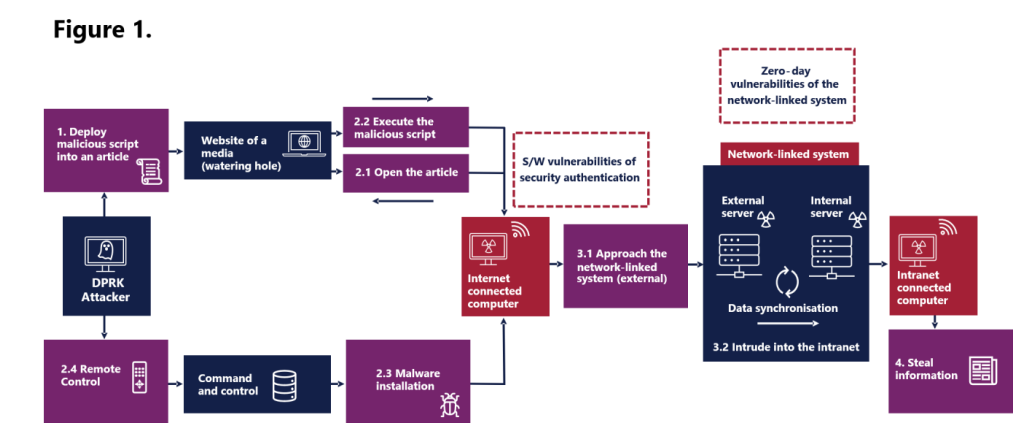
As part of the initial access with the Watering-hole attack, threat actors compromised a media outlet website and deployed a malicious script that runs only when accessed by specific IP ranges. 

Suppose any victim from the particular IP range opens an infected article on the compromised website. In that case, the malicious code is executed due to the vulnerable software that connects the victim’s computer to the Command and Control server (C2), providing remote access to the threat actors.

Attack Flow (Source: NCSC)

The threat actors were then able to access an internet-connected server from the compromised system and exploit the data synchronization function of the network-linked system for spreading malicious code to business-side servers and stealing sensitive information.

Two C2 servers

The business servers affected with malicious codes had two C2 servers one of them acts as a gateway in the middle, and the other is located on the external internet.

In addition to this, the malicious code was capable of exfiltrating initial beacon data and executing encrypted payloads.

However, the code was not able to move laterally due to the security policy of the solution and was blocked from moving, which prevented several pieces of information from being exposed.

Furthermore, a complete report has been published by NCSC, providing detailed information on the DPRK threat actors and their supply chain attack vectors.

Experience how StorageGuard eliminates the security blind spots in your storage systems by trying a 14-day free trial.


[ad_2]
Source link