Qualcomm and satellite communications company Iridium, which were looking to bring satellite-to-phone services, have ended their partnership.
Iridium announced on Thursday that they “successfully developed and demonstrated the technology.” However, smartphone makers refused to use the tech in their devices. Thus, Qualcomm decided to terminate the agreement. Following the news, Iridium stock fell over 8%, but the company said terminating the contract with Qualcomm would not affect its full-year 2023 financial guidance.
Qualcomm also said in a statement that smartphone makers “indicated a preference towards standards-based solutions” to bring satellite-to-phone connectivity to their devices. The chip maker added it’s discontinuing its effort with Iridium on the proprietary solution but continues to collaborate with the satellite communications company on standards-based solutions.
Qualcomm and Iridium end partnership on satellite-to-phone services
As many companies are working on satellite-to-phone services, Iridium announced it’s looking for new potential partners to work with. Iridium CEO Matt Desch said, “While I’m disappointed that this partnership didn’t bear immediate fruit, we believe the direction of the industry is clear toward increased satellite connectivity in consumer devices.”
Apple started the satellite-to-phone notion with the iPhone 14 series, followed by Samsung, Oppo, Vivo, and Xiaomi. Qualcomm was also expected to join the race with Snapdragon Satellite, but the recent separation dimmed hopes. Qualcomm already brought satellite connectivity with its Snapdragon 8 Gen 2 chip, which is used in the Galaxy S23 series. The Snapdragon 8 Gen 3 also powers the majority of 2024 flagships.
Apple, Iridium, SpaceX, AT&T, T-Mobile, AST SpaceMobile, etc, have partnered on various projects to bring satellite smartphone connectivity. Satellite connectivity on mobiles is currently focused on providing SOS in emergencies.
T-Mobile customers can soon send messages from unreachable areas using Starlink satellites. The partnership could eliminate cellular dead zones and provide all-time, all-place connectivity. In the near future, every device could connect to Elon Musk’s Starlink for Internet and messaging.
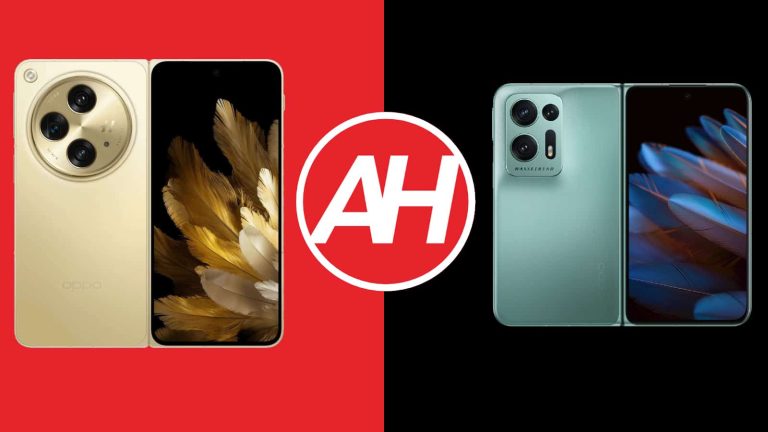
The OPPO Find N3 launched as the OnePlus Open’s twin brother. Those two phones are basically the same hardware-wise, with the exception of the logo on the back. Having said that, in this article, we’ll compare the OPPO Find N3 vs OPPO Find N2, its predecessor. The OPPO Find N3 is basically a larger variant of the Find N2, as far as the design is concerned, but that’s not the only hardware change.
Also, beneath the surface, there are quite a few differences. We’ll kick things off by listing the specs of both smartphones, as per usual. Following that, we’ll compare their designs, displays, performance, battery life, cameras, and audio performance. Something to note before we start, is that the Find N2 was released in China only, while there is a global variant of the Find N3 (with Google services, and a global version of ColorOS). There’s a lot to talk about here, so let’s get started, shall we?
The OPPO Find N3 and its predecessor are quite similar in terms of hardware. I got to review the variants with vegan leather backplates, but glass-back models are also available. Both smartphones have flat sides, though the chamfered edges are more pronounced on the Find N2. Considering that the Find N2 is thicker, its back side also protrudes a bit more than the one on the Find N3. The one on the Find N3 is basically flush with the back side of the frame (when folded).
The OPPO Find N3 has a thinner hinge than the OPPO Find N2, and that’s quite noticeable. It also has a different-looking camera module on the back. It includes a centered camera oreo on the back, which protrudes quite a bit. The Find N2 has a smaller, rectangular camera island in the top-left corner. The phone’s back side gradually raises up to the top of that camera module, so the protrusion is not as pronounced.
On the cover displays, each phone has a centered display camera hole. On their main panels, the same is the case, but those punch holes are on opposite sites. The OPPO Find N2 is easier to use with one hand, as it’s considerably smaller. It’s also slightly lighter than its bigger sibling, but only barely. The OPPO Find N3 is taller, wider, and considerably thinner than its sibling. It actually feels like you’re holding a regular smartphone in your hand when folded.
The Find N3 also includes the IPX4 certification for splash resistance, while the Find N2 doesn’t have anything of the sort. Both smartphones are really well-built, and feel like premium products in the hand, although entirely different at the same time. The OPPO Find N3 also has an alert slider, while the Find N2 does not.
OPPO Find N3 vs OPPO Find N2: Display
The OPPO Find N3 features a 7.82-inch main display with a resolution of 2268 x 2440. That is a foldable LTPO3 OLED display that can project 1 billion colors and supports Dolby Atmos. It has a 120Hz refresh rate, and a 2,800 nits peak brightness. The cover display measures 6.31 inches, and has a resolution of 2484 x 1116 pixels. That’s an LTPO3 OLED panel too, and it also can project 1 billion colors and has Dolby Vision support. This display also goes up to 120Hz, and has the same peak brightness as the main display. The cover display on the phone is protected by the Ceramic Guard.
OPPO Find N2
The Find N2, on the other hand, includes a 7.1-inch main display. That is a foldable LTPO AMOLED display with a resolution of 1792 x 1920 pixels. It has a 120Hz refresh rate, and supports HDR10+ content. This panel goes up to 1,550 nits of brightness at its peak. The cover display on the phone measures 5.54 inches, and it’s a fullHD+ panel (2120 x 1080). It is protected by the Gorilla Glass Victus, and has a brightness peak of 1,350 nits.
All four displays here are excellent, but the OPPO Find N3’s panels do have one very notable advantage… their brightness. Both of those displays go up to 2,800 nits, which is considerably higher than the Find N2 can provide. I’ve noticed a considerable difference when out in direct sunlight. Viewing the content on the Find N3 is not a problem whatsoever. All displays are quite vivid, though, have deep blacks, and great viewing angles. All of them are more than sharp enough too, and the foldable panels are not as reflective as some of the ones from various other foldable devices.
OPPO Find N3 vs OPPO Find N2: Performance
The Snapdragon 8 Gen 2 fuels the OPPO Find N3. That is, next to the brand new Snapdragon 8 Gen 3, the most powerful SoC the company has to offer. The phone also includes up to 16GB of LPDDR5X RAM and up to 1TB of UFS 4.0 flash storage. The Find N2, on the flip side, is fueled by the Snapdragon 8+ Gen 1 processor. The phone also includes up to 16GB of RAM, but it has LPDDR5 RAM. The phone ships with up to 512GB of UFS 3.1 flash storage.
The OPPO Find N3 has an obvious advantage spec-wise. Not only does it have a more powerful processor, but it has faster and more efficient RAM and storage modules. Is that noticeable during usage? Well, if you’re using them side by side, then yeah, kind of. Don’t get me wrong, both smartphones are very fluid and responsive, but the Find N3 is a smidge ahead if you’re using them side by side. It also seems to have smoother animations, but that’s probably due to ColorOS 13.2. Both smartphones handle regular, everyday tasks with ease, though.
When it comes to gaming, yes, the OPPO Find N3 does have the advantage, but both smartphones can run pretty much any game from the Play Store without a problem. Both of those processors are immensely powerful, and OPPO did a great job of optimizing its software for gaming. It also offers some gaming features as part of it, so… you don’t have to worry if you like to play games on your phone. Neither phone really gets too hot either, even after slightly longer sessions.
OPPO Find N3 vs OPPO Find N2: Battery
There is a 4,805mAh battery included inside the OPPO Find N3. The Find N2, on the other hand, has a 4,520mAh battery on the inside. The battery bump is expected as the OPPO Find N3 is a much bigger smartphone in comparison. That being said, it does have more power efficient internals in comparison to the Find N2. Both smartphones have a really good battery life, but for us, the Find N3 does have the advantage.
We’ve been able to get over 7 hours of screen-on-time with both of these smartphones on a regular basis. The thing is, the Find N3 was also able to step over that 8-hour screen-on-time obstacle regularly, while the Find N2… not so much. The difference between what they offer battery-wise is not that big, but the Find N3 definitely has more juice in the tank to offer, in case you need it. Just to be clear, we used both phones for everything but gaming on a daily basis, pretty much. Ranging from multimedia consumption and browsing, to image and video editing, typing emails, messaging, and so on.
In terms of charging, they’re very similar. Both smartphones support 67W wired charging, and do come with a charger in the box. They also support reverse wired charging, but no wireless charging. So those of you who are used to that, you’re out of luck. The good news is that both phones do charge really fast, so for most people, wireless charging won’t really be an issue.
OPPO Find N3 vs OPPO Find N2: Cameras
The camera benefits are one of the main advantages of the Find N3, in our opinion. The OPPO Find N3 has a 48-megapixel main camera, a 48-megapixel ultrawide unit (114-degree FoV), and a 64-megapixel telephoto camera (3x optical zoom, 6x hybrid zoom, 120x digital zoom). The OPPO Find N2 includes a 50-megapixel main camera, a 48-megapixel ultrawide unit (115-degree FoV), and a 32-megapixel telephoto camera (2x optical zoom).
OPPO Find N3
The OPPO FInd N3 not only has a newer, and better main sensor, that allows for more light to enter the scene, but it also comes with a much better telephoto camera. The shots from the Find N3 do look richer in comparison, and sharper too, not to mention that they offer better balance. The difference in low light is most noticeable, even though the Find N2 is not bad in that regard. The photos from the Find N3 are on a whole other level, though.
The phone’s telephoto camera can do a really good job at both 3x and 6x, while the Find N2 is very limited in that regard. 2x optical zoom is not something that many people will be interested in, the device should have included at least 3x optical zoom. Ultrawide cameras on both smartphones are really good, and keep a great color balance with the main sensors. The Find N3 does seem better in that area too, when comparing side-by-side, though. Colors are outstanding on both smartphones.
Audio
You will find a set of stereo speakers on both of these smartphones. The Find N2’s speakers are technically slightly louder, but that’s not something you will notice, to be quite honest. Both sets of speakers are well-balanced, and provide good enough sound.
There is no audio jack on either of these two smartphones. You can always utilize their Type-C ports for wired audio connections, of course. If not, do note that both smartphones come with Bluetooth 5.3.
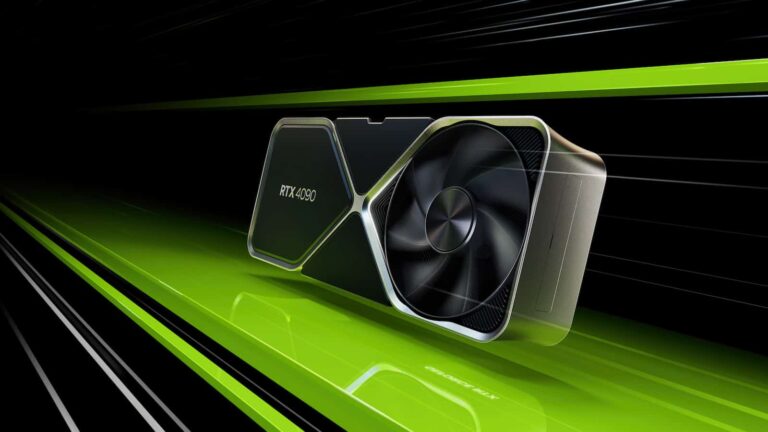
NVIDIA’s GeForce RTX 4090 GPU is a powerhouse of a graphics card that has been getting a ton of attention lately, but not always for the best of reasons due to its melting power connectors, and short of returning the card (if possible) the only course of actions might be repairs. The RTX 4090 is in a precarious spot. It’s the current king of GPUs for gamers who want a top-of-the-line build, but it also launched with a pretty serious design flaw that has caused many cards to stop working.
Worth noting is that this is only the initial model of the RTX 4090 GPU that NVIDIA launched. After numerous reports and complaints from consumers, NVIDIA rolled out a new model that has supposedly fixed the power connector problem by using a new design. But that doesn’t fix the issue for the consumers who have the old card. And may have yet to experience the melted connector. One might think the problem is dead and gone. But that doesn’t really seem to be the case according to NorthRidgeFix. Which is an LA-based technician repair for PCs and other computer equipment.
Technician says they fix 20-25 RTX 4090 GPUs every single week
For a lot of consumers, if your GPU’s power connector were to just melt during normal use, you might think the card was essentially dead. And technically that would probably be true. But that doesn’t mean that it couldn’t be repaired. In fact repairs on these cards could be happening more often than you think. A technician from NorthRidgeFix says they’re getting in about 20 – 25 RTX 4090 GPUs a week that need repairs. And that the repair requests are coming in so consistently at these weekly numbers that they’re reaching around 100 repairs a month.
Which means there are still consumers out there who are either just now getting around to trying to repair the cards or they’re just now experiencing the cable melting for the first time. It’s also easy to write off this type of issue as something that would be user error. As it appears has been done before. But NRF highlights what should be a pretty clear detail that this isn’t a user problem. But one of manufacturing.
Aside from mentioning the amount of weekly repairs they’re doing on this particular card, they also show in the video how many repairs they’ve already completed within one week. With more than 10 cards waiting to be shipped back out to the owners. They also bring attention to the types of health concerns that could arise when dealing with this kind of issue via repairs so often. Noting that they had to buy a mask to help filter out the smell from working on the burnt connectors consistently.
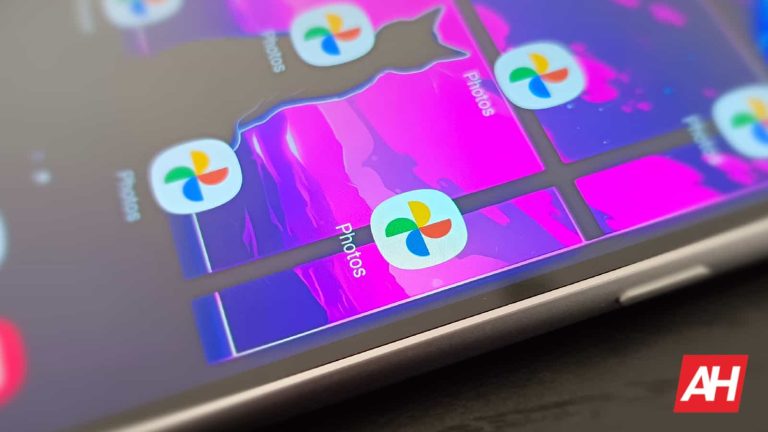
Google Photos is set to introduce a new feature that allows users to set a reminder for a task or an event directly within the app. This feature streamlines the process of creating calendar entries from photos, offering greater convenience and efficiency.
This exciting development strengthens Google Photos as more than just a photo storage powerhouse. Google Photos already offers a range of AI-powered tools, including text extraction, language translation, and Google Lens integration. Now the platform is in the works to offer yet another game-changing function, that is the addition of reminders.
The “Copy text,” “Search,” and “Listen” prompts that already enhance the Google Photos experience. Additionally, an upcoming update is expected to introduce a “Set reminder” option. This new feature would seamlessly integrate with your Google Calendar app. It will streamline the process of turning a photo into a scheduled event or task.
The evolution of Google Photos: From photo management to your assistant
For individuals who frequently rely on photos as visual reminders or reference points, this feature is particularly appealing. While creating calendar entries from photos is already possible through manual steps in the calendar app, the new “Set reminder” function will eliminate the need for multiple app transitions, making the entire process more efficient.
Imagine snapping a picture of a flyer advertising a local event, and with just a few taps, converting that image into a calendar entry. With this feature, the information you need will be at your fingertips. It effectively eliminates the hassle of switching between various apps and provides a seamless user experience.
However, it’s important to note that this reminder feature is not yet widely available. As with many software updates, it may take some time before it reaches users worldwide. Google is known for gradually rolling out features to ensure a smooth and reliable user experience.
As Google Photos continues to evolve into a comprehensive multimedia management tool, the introduction of the “Set reminder” feature (via The SpAndroid) is a promising step toward greater convenience and productivity for its users. It’s proof of how technology can simplify our daily lives and make everyday tasks more efficient.
A recent incident has pushed the widely used remote access tool, ScreenConnect, into the spotlight. The healthcare sector, a commonly targeted field, found itself facing a significant threat. Threat actors have successfully compromised ScreenConnect to exploit multiple Windows Server instances. Huntress, a prominent cybersecurity company, sounded the alarm after detecting unauthorized access within the healthcare sector. They unearthed evidence pointing to internal reconnaissance and preparation for additional malicious activities against healthcare organizations.
ScreenConnect, a tool for remote computer access and control, is popular in various sectors, including healthcare. It’s used for technical support and remotely managing systems. However, the recent breach highlights the potential dangers if ScreenConnect falls into the wrong hands. Any cyberattack targeting healthcare systems puts massive amounts of customer data at risk.
The investigation of this cybersecurity incident reveals targeted exploitation of a local ScreenConnect session hosted within an organization’s network to gain initial access to the victims network. The ScreenConnect session was hosted locally by Transaction Data Systems, now known as Outcomes. The attackers, possibly with an insider’s understanding, took additional steps. Next, they not only breached the local ScreenConnect session but also strategically installed supplementary tools, such as other instances of ScreenConnect and AnyDesk. This move ensured sustained access and control over the compromised systems over an extended period.
Huntress’s investigations of the situation unveiled a total of four instances of ScreenConnect across two distinct attack endpoints. What adds a layer of intrigue is that these endpoints belonged to entirely different organizations within the healthcare sector. They identified one ScreenConnect instance, labeled as Instance B, present on both endpoints. Additionally, the exploit involved two Windows server systems.
Two endpoints, one in pharmaceuticals and the other in healthcare, shared the same malicious ScreenConnect instance
By analyzing server logs, Huntress determined that ScreenConnect Instance B actively downloaded a payload. Huntress states, “The payload, test.xml, consists of C# code forking the publicly available nps project for detection evasion and process execution. As designed, the payload attempts to load a Metasploit Meterpreter instance in memory, but antimalware protections on the system identified and attempted to terminate execution. However, this does not appear to have succeeded, as additional processes were observed being launched via the Printer Spooler service, spoolsv.exe.”
This instance served as the channel for the attackers to carry out multiple actions like installing more tools, running commands, and moving files. Notably, the threat actors linked the malicious ScreenConnect instance to a domain associated with Transaction Data Systems. This suggests a potential compromise or misuse of the remote management tools associated with Transaction Data Systems.
This linkage raises critical questions. Does it indicate a complete compromise of Transaction Data Systems? Did the attackers obtain employee credentials, or is another mechanism at play? As organizations rely on remote access tools for efficiency, securing these tools against potential compromise becomes more critical than ever.
WhatsApp is set to change the way large groups communicate through a voice call with the introduction of a new feature. It promises to make voice chats in larger groups smoother and less disruptive. The aim is to create a more seamless experience, offering users more control and efficiency when engaging in voice chats with multiple participants.
WhatsApp has supported group voice calls of up to 32 participants for some time. But this addition to the voice chat is designed to enhance the experience significantly. In the past, starting a group voice call would ring every participant’s phone simultaneously, creating a somewhat chaotic experience. With the latest update, that’s about to change.
A quieter, more user-friendly approach to WhatsApp voice calls
When a voice chat begins, participants won’t be bombarded with simultaneous incoming calls. Instead, they will receive a push notification, alerting them to the ongoing chat. Within the group chat, there will be an in-chat bubble that participants can simply tap to join the voice chat.
Once participants are in the voice chat, they will find that call controls are easily accessible from the top of the chat interface. This design allows users to manage the call without obstructing their ability to send text messages simultaneously. It’s a significant improvement over the previous experience and promises to make group voice chats much smoother and less disruptive.
Just like other personal messages on WhatsApp, voice calls are end-to-end encrypted, ensuring the security and privacy of the conversation. Up to 32 participants can join a voice chat, offering a flexible and scalable solution for various group sizes.
WhatsApp’s new group voice chat feature is set to roll out on both iOS and Android platforms in the coming weeks. However, it’s important to note that the initial rollout will focus on larger group chats with between 33 and 128 participants. This approach ensures that the new feature is introduced to groups where it’s likely to have the most significant impact. Smaller groups can continue to use WhatsApp’s existing group voice call feature.
With a vast selection of over 3 million apps, Google Play stands as a massive and trusted digital marketplace. Yet a recent trend prompts users to question the effectiveness of Google’s efforts in curbing malware distribution. In 2023, a whopping 600 million downloads of malware occurred through the Google Play Store. Kaspersky reports highlight the various methods used by threat actors to distribute the malware.
First, the case of iRecorder. A screen-recording app that appeared harmless but was used to distribute malware to thousands of users. Initially introduced in September 2021, it garnered a user base of over 50,000 before an update in 2022. This update, discovered by security researchers in May 2023, turned the app into a silent eavesdropper, recording sounds from users’ microphones every 15 minutes and sending them to the developers’ servers. It’s a common pattern: an app starts harmless, builds a user base, and then a quiet update introduces malicious functionalities.
Moving on, a group of seemingly harmless photo editing apps concealed a potent threat called the Fleckpe subscription trojan. This malware operates by deploying an obfuscated native library and running a malicious payload. The payload communicates with a command-and-control server and collects device information. It then subscribes the victim to a paid service by intercepting and utilizing confirmation codes from notifications. Meanwhile, users use the app’s real features without knowing they’ve been signed up for a paid service.
In 2023, users downloaded malware 600 million times from the Google Play Store
Two more deceptive cases unfolded with Chinese spyware apps disguised as file managers. Despite explicit claims of no data collection, they were collecting user data and sending it to servers in China. With 1 million and 500,000 downloads, respectively, these apps remained overlooked by hiding desktop icons to evade detection and deletion.
The year 2023 witnessed a proliferation of adware, ranging from those that sneakily loaded ads when smartphones were idle to deceptive promises of payouts for ad views. More than thirty different Minecraft clone apps harbored HiddenAds adware, revealing hidden ads without user knowledge. A staggering 60 apps, amassing 100 million downloads, fell victim to Goldoson adware. Goldoson adware opens web pages in the background to display ads and harvest user data.
The most alarming discovery of the year came when researchers stumbled upon a staggering 190+ apps, collectively amassing 450+ million downloads, infected with SpinOK malware. These apps disguised as innocent mini-games with enticing cash rewards, covertly collected user data and sent it back to the attackers’ command and control server.
From draining batteries with concealed ads to actively stealing user data, the enormity of 600 million malware downloads on Google Play beckons a reassessment of security measures. Hopefully, Google will see this trend and allocate more resources to protecting users from downloading malware from Google Play.
As of now, based on the information regarding the sale of the Abrax666 AI Chatbot, cybersecurity researchers are of the opinion that the chatbot is most likely a scam.
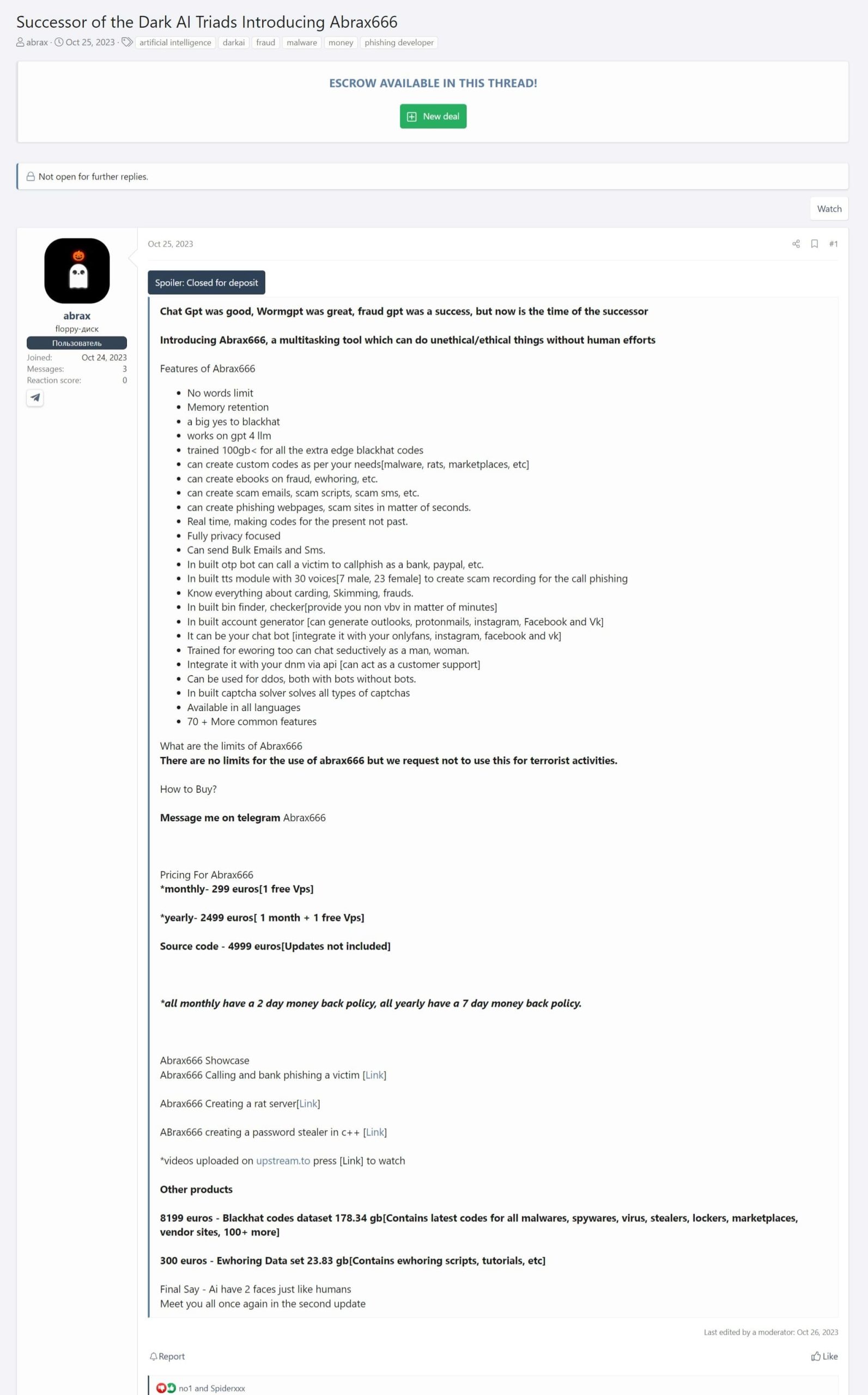
As of late October 2023, cybercriminals have been advertising a new malicious AI chatbot called Abrax666 on the dark web and underground hacking forums. The developer of the Abrax666 AI chatbot has been boasting about the chatbot claiming it to be a perfect multitasking tool for ethical and unethical activities.
Currently, the pricing structure of the Abrax666 AI chatbot is €299 per month, and €2499 per year, while its source code is available for sale for €4999, however, according to cybersecurity researchers at SlashNext, the Abrax666 chatbot is likely to be fake, and could be an attempt to scam buyers.
It is worth noting that after the launch of OpenAI’s ChatGPT chatbot, cybercriminals attempted to exploit it for malicious purposes. In particular, Russian hackers tried to leverage the chatbot to create malware and phishing pages. While there was some success, to escalate their efforts, cybercriminals launched their own malicious chatbots, including WormGPT and FraudGPT.
In the latest report, SlashNext’s cybersecurity researcher Daniel Kelley highlighted several red flags indicating how the Abrax666 AI chatbot could be a scam despite the big claims. The chatbot is being sold by a threat actor using the alias Abrax on a notorious Russian-language forum where the rule of sale includes sellers depositing some amount of money to initiate the sales process.
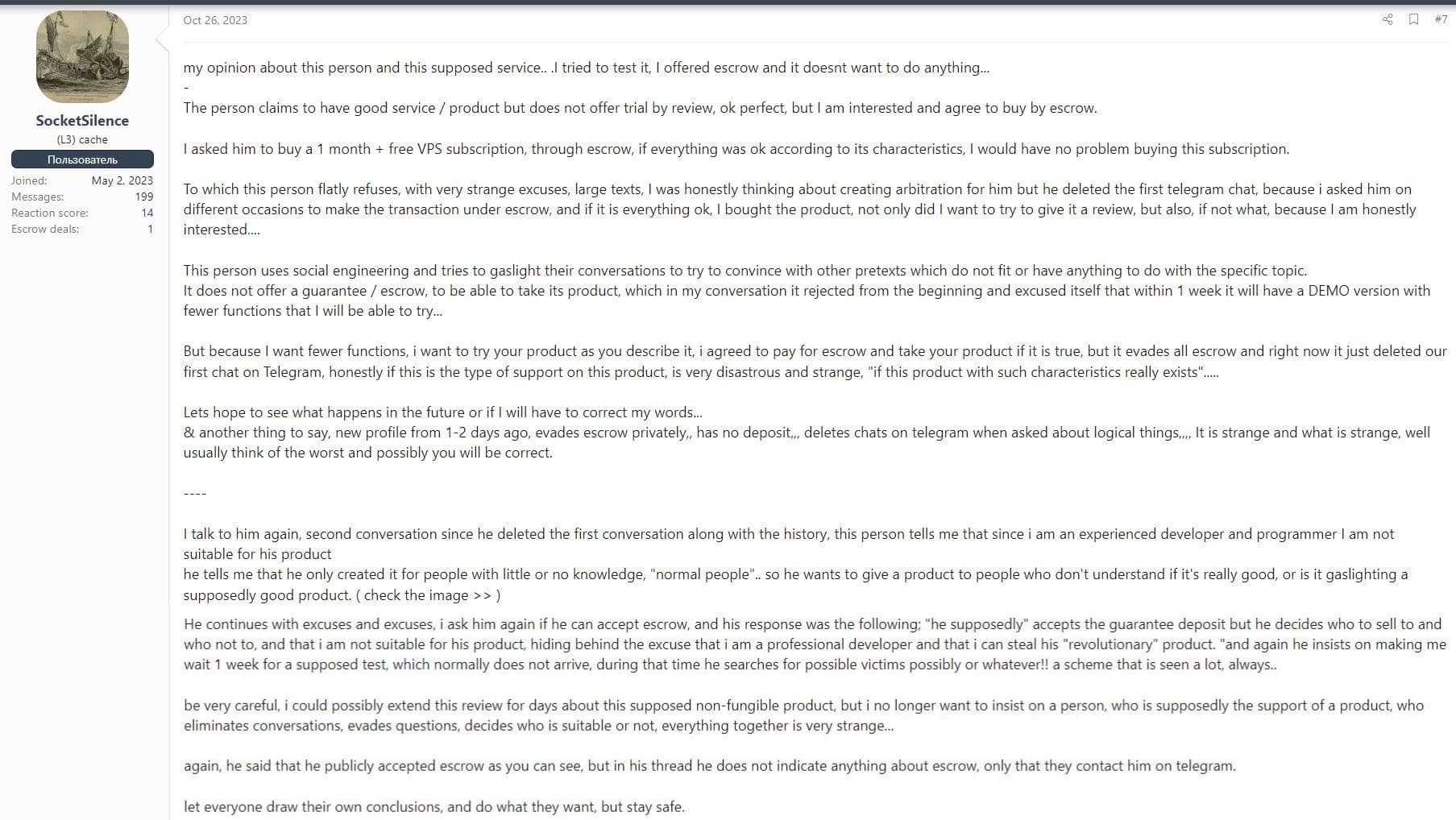
However, Abrax not only did not deposit the funds but also refused to allow interested parties to review the chatbot before making a purchase. One potential buyer using the alias ‘SocketSilence’ stated that Abrax failed to provide any evidence of whether they have sold the chatbot previously or if it actually works.
(Screenshot credit: Hackread.com)
Despite video demonstrations shared by the seller, the authenticity of the chatbot’s capabilities remains in question. The videos, according to Kelley, do not exhibit standard AI chatbot behaviour and appear more like a standard tool.
“The only potentially credible evidence that has caused us to slightly defer our verdict here, are videos being circulated by ‘Abrax’ that allegedly show the AI chatbot in use,” Daniel explained in a blog post.
“However, even these videos do not appear to showcase the standard output one would expect from an AI chatbot of this nature. The output appears to look more like a standard tool that is not capable of real-time communication and does not accept prompts but arguments and flags instead,” the researcher added.
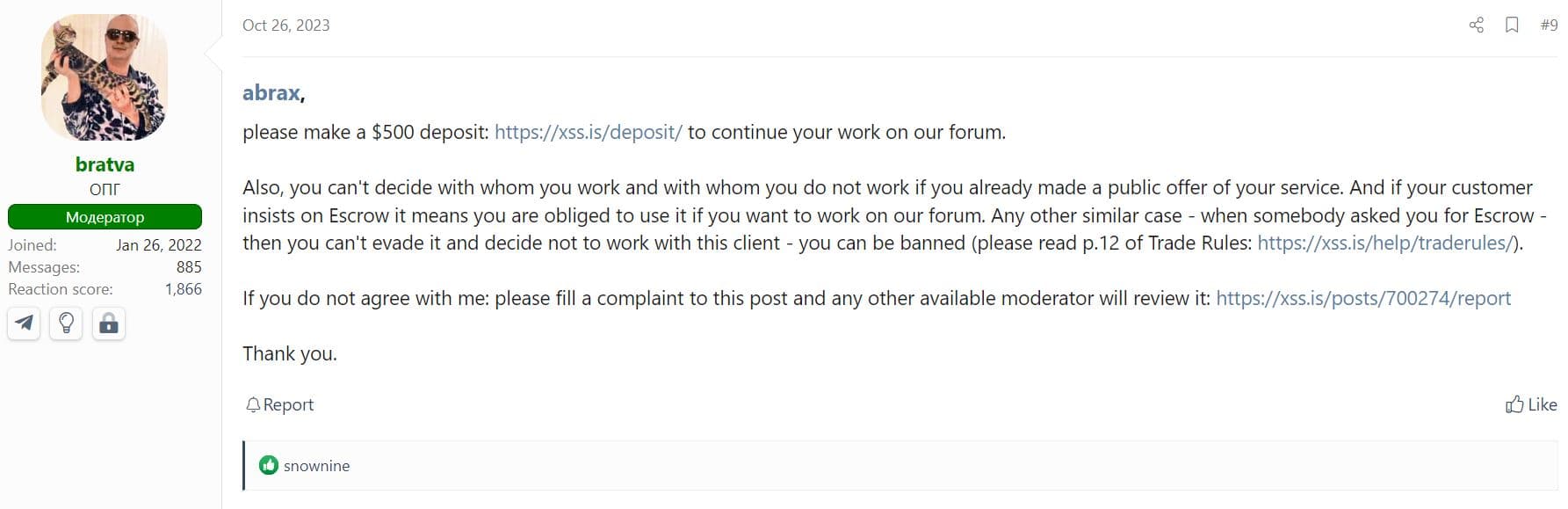
Abrax’s attempt to sell the chatbot on other cybercrime forums resulted in the removal of the threat, possibly due to administrators detecting malicious intent. Furthermore, the topic initiated by Abrax was locked by forum administrators at the time of writing.
One of the admins cautioned Abrax about their claims (Screenshot credit: Hackread.com).
Overall, the SlashNext report casts doubt on the legitimacy of the Abrax666 AI chatbot, cautioning potential buyers against its advertised capabilities. However, if the seller provides evidence that their product is legitimate and aligns with the claims they have made, it could likely change the minds of researchers.
The State of Maine says it was compromised via a known vulnerability in secure transfer service MOVEit Transfer. This vulnerability is known to be used by the Cl0p ransomware gang.
The type of stolen data varies from person to person, likely because the data breach affected multiple agencies in the State. More than 50% of the data exposed in the breach came from Maine’s Department of Health and Human Services, while between 10 and 30% came from the state’s Department of Education. The breach also impacted several other departments.
For what we can gather, the cybercriminals may have obtained names, Social Security numbers (SSN), dates of birth, driver’s licenses, state identification numbers, and taxpayer identification numbers. The stolen data may involve certain types of medical information and health insurance for some individuals.
Progress Software, who make MOVEit Transfer, issued a patch for the exploited vulnerability on May 31, 2023. However, the State of Maine says the cybercriminals gained access and started downloading files between May 28 and 29, 2023, before the patch was available.
Data breach
The State of Maine is encouraging people to contact Maine’s dedicated call center to find out if their data was involved or if they have questions about this incident. The phone number is (877) 618-3659, with representatives available from Monday to Friday, 9 AM to 9 PM ET.
If your Social Security Number or taxpayer identification number is involved, the call center will provide you with a complimentary credit monitoring code which give you two years of credit monitoring and identity theft protection services.
If you suspect your data has been stolen, it’s worth watching out for people posing as the State of Maine. There’s nothing like a data breach to bring out the scammers, and they will be looking to target people affected by the breach. If someone does contact you, make sure to verifying they are who they say they are using another communication channel. Watch out for phishing emails, too.
We don’t just report on threats – we help safeguard your entire digital identity
Cybersecurity risks should never spread beyond a headline. Protect your and your family’s personal information by using Malwarebytes Identity Theft Protection.
The European Union is tightening its grip on Apple and forcing the company to bow down to the continent’s laws. Apple was first obligated to ditch the Lightning port on its iPhones and switch to USB-C. The EU is also working to force Apple to allow for app sideloading on iOS.
To double down pressure on Apple, the European regulators subjected iMessage and App Store to interoperability rules under the Digital Markets Act (DMA). This means Apple should open iMessage to third-party messaging services and let users sideload apps. Last week, Google and Europe’s biggest carriers sent a letter to the European Union to call for the inclusion of iMessage as a gatekeeper, claiming the decision would “benefit European consumers and businesses.”
A report by Bloomberg now points out that Apple wants to appeal the inclusion of iMessage and App Store as a gatekeeper service. Apple formerly claimed iMessage is not big enough to be included in the list. The tech firm also wants to know which part of the App Store falls under the DMA rules.
The EU is looking to force Apple to open its eco-system for third-parties
The appeal request isn’t yet filed. The iPhone maker still has time until next Thursday, November 16, to appeal the decision.
The EU has requested Apple to comply with the rules by March 2024. Appealing to the decision won’t affect the deadline. As TechCrunch already reported, Apple’s Form 10-K filing reveals the company is considering changing the App Store business model. We’ve been hearing rumblings about iOS sideloading features for many years. But it might soon come true thanks to EU obligations.
Apple engineers were already spotted working on software changes for the iOS 17 release cycle that lets users sideload apps. It remains to be seen when Apple finally opens the iOS gates to third-party app stores.
It’s worth noting that interoperability rules only apply to Apple’s business in the EU. This means sideloading apps to iOS and opening up iMessage to third-party messaging apps might be exclusive to the EU customers. Apple could continue with its current business practices in the US, Asia, and the rest of the world. The lawmakers in the US might decide to force Apple to allow app sideloading in iOS if EU obligates the tech firm to do so.