Smack-dab in between premium and budget phones, we have premium mid-rangers. These are devices that offer a powerful experience with just enough cutbacks to keep the price down. Motorola has its Edge series of phones, and the base Edge sits in that premium mid-range area. We were given the opportunity to review the Moto Edge 2023.
At $599, it sits right in a spot where you should expect to see pretty premium features. It’s the less expensive sibling to the Moto Edge+ 2023, and that costs a cool $200 more. So, $599 is a pretty good sweet spot for a premium mid-ranger.
Some phones at this price deliver a truly premium experience while some others are letdowns. So, does this phone deliver a top-notch smartphone experience, or is it just on the edge of greatness? Let’s find out in this review.
Moto Edge 2023 review: Design
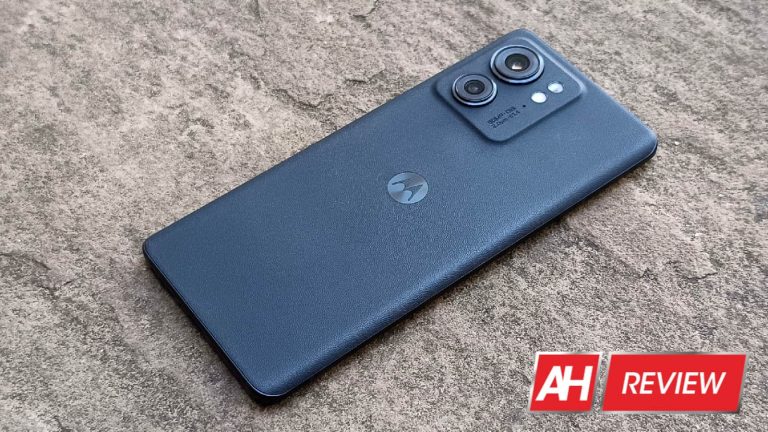
Let’s start with the first thing you’ll notice about this phone; the design. Honestly, I like phones that are unapologetically thick. They have a reassuring heft that lets you know that they can survive abuse and keep on going. That being said, I’m in love with the extremely sleek and stunning design of the Moto Edge 2023.
The phone has this soft-touch matte material covering the back that gives the phone such a sleek and debonair look. It’s like the smartphone version of James Bond. Motorola usually uses glass that plays with the light in different ways, but this time, there’s this elegant leather covering the back of the phone. It’s absolutely gorgeous.

Also, the phone is extremely thin. Do you remember a couple of years ago when every phone was racing to be the thinnest on the market? Think back to the Galaxy S6 and the iPhone 6s. Well, the Moto Edge 2023 might remind you of that time. The phone’s front and back curve inward, so it’s very thin around the edge.
On the back of the phone, we see the very squarish camera island that doesn’t jut from the chassis all that much. The island is rather shallow, which kind of distracts from the fact that the actual camera lenses protrude a bit more.
All in all, Motorola gave this phone a very understated look that doesn’t stand out because of its radical design or colors. It sticks out because of its subdued and business-like appearance. I love it!
Moto Edge 2023 review: Build quality
With thinness comes fragility; however, Motorola didn’t want to abide by that rule. I said that this phone is thin, but I never said that it felt fragile or cheap. It doesn’t feel thin as much as it feels dense. There’s still a nice heft to the phone that makes it feel like Motorola used quality materials with it.
When I pick it up, I know that I’m holding a device that was crafted to give me a powerful experience. Nothing about it feels cheap, even though this is an affordable device. Also, nothing on it creaks, moves, flexes, or otherwise symbolizes that it’s a cheap device. Motorola is looking to give you a premium experience, and it didn’t skip the first step which is the hardware.
Moto Edge 2023 review: Display
The design is the first thing you’ll notice about the phone, but what you’re going to be looking at the most is the screen. Motorola hasn’t really been known for its displays. I reviewed the Motorola Edge+ from last year, and I wasn’t particularly impressed with the display on that phone.
However, that was a year ago, and display technology can change quickly. Let’s see how the Moto Edge 2023’s display performs. I’m reviewing the display on its Saturated setting with the color temperature set to neutral because those are the settings out of the box.
Colors
Motorola packed a ton of color into this phone’s display. I know that OLED panels are colorful, but it’s up to the OEM to decide how juicy the colors should be. the colors on this display just burst from the screen and to great effect. They’re saturated and punchy, but they stop short of being too much.

Motorola was able to find that sweet spot between saturated and oversaturated. All of the colors are super pleasant to look at.
As for the color temperature, it seems to lean more toward the warm side. All of the colors have a bit of warmth to them, but it’s not too warm. Also, when I put a white screen on the phone and place it next to a device with a neutral color temperature, I can see a slightly yellowish tint on the Motorola’s display. It’s not bad or terribly noticeable, especially if you’re using the phone casually.
All I know is that if you like saturated colors, then you’ll be satisfied with this display.
Brightness
A display’s brightness is one of the most important aspects of it. It can look as amazing as it wants, but if you can’t see it outside, there’s not much point. The display on the Moto Edge 2023 is pleasantly bright. It’s not as bright as the phones that get to or just below 2,000 nits, but that’s not 100% necessary. It gets plenty bright; bright enough to see perfectly fine in any indoor lighting conditions. Actually, you’ll find yourself turning the brightness down when inside.
In the sun, I was able to see the display perfectly clearly. I used this phone in the middle of the bright afternoon sun, the kind of conditions where cheaper phones just become expensive mirrors. The Moto Edge 2023’s display was perfectly visible.
Also, when you have Ambient Brightness on, the phone will further increase the brightness when it detects that it’s in a bright environment. This will make everything on the screen even more legible.
Smoothness
When it comes to smoothness, the Moto Edge 2023 takes the cake. This display is extremely fluid with an impressive 144Hz display. This means that everything from social media to scrolling webpages to navigating the interface is as smooth as butter.
Adjustments
If you don’t like how the display looks out of the box then you can make some adjustments. Firstly, if the colors are just too much for you, then you can set the color saturation setting to Natural. This will give the display a closer appearance to an LCD panel.
Under that, you’ll see a slider showing the color temperature. You can make the screen cooler (more blue) or warmer (more yellow/orange) to suit your liking.

All in all
As I said, the Moto Edge+ from last year was a different phone. This year, the company really stepped up its game and gave the Moto Edge 2023 an absolutely jaw-dropping display. It’s absolutely beautiful and it makes using this phone a treat.
Moto Edge 2023 review: Speakers
A great screen goes hand-in-hand with a great set of speakers. The speakers on the Moto Edge 2023 are a bit of a weird story because they come with Dolby Atmos enabled out of the box, and there’s no way to turn it off. So, I’ll be reviewing the sound with Dolby Atmos enabled on its Smart audio setting. There are adjustments that can be made to the audio, and I’ll cover them later in the section.
Clarity
So, I was blown away by the clarity of these speakers. The speakers of the Moto Edge+ were middle-of-the-road, but the speakers in the Moto Edge 2023 are miles ahead of that phone. The sound is so crisp and clear.
Every genre that I listen to just sounds amazing. The sound overall is extremely detailed. A true testament to that is how they sound with classical music. I know that listening to classical music on smartphone speakers sounds like some sort of cruel punishment, but I did.
I was astounded by how detailed the sound was. I listened to orchestral music and I could actually hear the grit on the lower strings as the players pulled their bows across. That came out clearly. Listening to Tchaikovsky’s 6th Symphony, Movement 2, I could actually hear the texture of the cellos at the beginning. They projected so clearly along with the winds above them.
This also goes for more modern musical genres. Each and every part of the music just projected clearly. The crunchy bass of 80s pop, the prevalent high-hats of 90s hip-hop/R&B, the synthetic kick drums of 2000s pop, etc. all sound crystal clear.
Loudness
When it comes to the loudness, there’s enough power behind these speakers to fill a room with sound. I listened to them in my living room with the volume cranked to 100%, and I could clearly hear the speakers in the kitchen.
Not only are the speakers loud, but they also do a great job of staving off audio distortion. Even at full volume, the music was pretty clear. They’re not quite good enough to replace your Bluetooth speaker, but they’re not far off.

Low-end
Smartphone speakers tend to lack a bit in the low-end audio department. You want to hear a good amount of bass with your music. It adds depth and warmth to what you’re listening to.
I was thoroughly impressed with the low-end performance of these speakers. Circling back to classical music, this genre isn’t naturally bass-heavy, but these speakers do a beautiful job of bringing out the low hum of the lower instruments. Hearing that along with that grit that I talked about earlier just makes for a great effect.
With more modern genres, the story is much the same. The bass supports the higher tones in the sound beautifully, and I hear that most with warmer music. Listening to 90s R&B, the lower notes ring amazingly. I’m hearing tones that I just don’t hear with other smartphone speakers, and I’m super impressed.
The only thing I’d say is that most 80s music won’t sound as amazing as other genres. In the 80s, we heard crunchier and higher-pitched basses; it’s something that characterized much of the music. Well, it’s hard for 80s basses to cut through the rest of the sound with these speakers. So, you’ll have a different experience listening to 80s music with this phone.
High-end
The low-end gets a nice boost with these speakers, and that goes for the high-end as well. These speakers did the impressive feat of accenting the high-end without going into the shrill territory. I think that there’s a bit more high-end to the sound than low-end, but the speakers don’t sound thin.
So, when you’re listening to music with a lot of higher percussion, you’ll hear those instruments get a nice added push. Also, if you’re listening to orchestral music, the higher instruments like violins and flutes will sound perfectly clear. Motorola, along with Dolby, balanced the audio to keep the highs in check, and that adds to the overall sound.
If you’re listening to music with lyrics, then good news for you. Voices sound amazing with these speakers.
Adjustments
That was a review of the out-of-the-box settings, but you can further customize your sound to your liking. Under the Dolby Atmos section, you can choose which sound profile you want. Each sound profile is optimized for different types of media. There’s one for Music, Movies, Podcasts, and Games. There are two other profiles as well. One is the Smart audio profile which will adjust the audio automatically based on the content you’re listening to. Also, there’s a custom profile that will let you dial in your own settings.

You can also customize settings for each sound profile. For each profile, you can choose from three EQ presets. In the Custom sound profile, there’s a customizable nine-band EQ that you can adjust along with the presets.
All in all, I think that the speakers are some of the best I’ve ever heard on a smartphone and one of the best aspects of this phone.
Moto Edge 2023 review: Performance
The performance of the Moto Edge 2023 has been stellar. I have been testing this phone out with a selection of apps. No matter the app, this phone performed smoothly.
This also goes for navigating the interface. I didn’t run into any instances of lag or stutter performance. I use the phone with the 144Hz mode, and I could not get it to slow down at all. I didn’t notice any dropped frames or lock-ups. Motorola did a great job of optimizing the software for its phone. This is an affordable device, but Motorola didn’t cut corners on the performance in order to cut costs.
Fingerprint scanner
The Moto Edge 2023 has an under-display fingerprint scanner, which is a nice change of pace compared to the side-mounted fingerprint scanner of last year’s Edge phone. As for the performance, it’s extremely fast. You just need to hold your finger on it for a fraction of a second, and it will unlock.
As for accuracy, it reads my fingerprint more than 99% of the time. I didn’t have any issues with unlocking the phone.
Moto Edge 2023 review: Gaming
When it comes to gaming, this phone is a hardy performer. I used it with a wide range of games from simple 2D platformers to some of the most graphically intensive games on the market. Let’s dive in to see how this phone performs.

2D games
When it comes to 2D games, the Moto Edge 2023 didn’t even break a sweat. I played a variety of 2D games on this phone, and the phone tackled them without any issues or dropped frames. While 2D games aren’t the most demanding, there are some titles that can slow down weaker hardware.
In the case of this phone, you won’t have any issues playing any of the 2D games coming to the market. This came as no surprise because of the superior performance I’ve been seeing throughout.
Mid-range 3D games
Cranking up the graphics a bit, I use this phone with games like DragonBall Legends, Asphalt 9, and Sky: Children of The Light. Neither one of these titles managed to give this phone any issues. These games aren’t the most graphically intensive on the market, but they do get up there. They’ll slow down weaker hardware.
However, the Moto Edge 2023 didn’t slow down at all. The races in Asphalt 9 get pretty intense, and Sky often renders large areas. It didn’t matter, however. I got consistently smooth performance while playing these games. So, games with this level of graphics are no challenge for the Moto Edge 2023.
Upper-tier games
This was to be expected; we can’t have a phone performance review without talking about some of the games that have been baking phones across the Android ecosystem. I’m talking about Honkai Star Rail and Genshin Impact.

Starting off with Star Rail, I turned the graphics to their highest settings, and I could see the phone struggling a bit. The performance wasn’t bad by any means. I couldn’t get 60fps at that setting, but I was still able to get a pretty smooth frame rate, regardless. The frame rate was at its worst during intense battle sequences, and it only dipped to just below 30fps. It never really dipped low enough to be choppy.
So, I think playing this game on its highest settings is definitely an option. You’ll still get pretty smooth gameplay. You can crank the graphics down a bit to smooth it out even more if you want.
Genshin Impact
Moving onto Genshin Impact, the story is a little bit weird. Going by first impressions, I’d say “Never crank this game up to its highest settings!” When I enabled the settings, I saw the games’ performance tank hard. It locked up for a second when I rotated the screen.
I was all set to call it, but then I played the game for a few more minutes. After about a minute, I saw the performance improve. It was relatively smooth and playable. There were definitely a fair number of dropped frames that happened, but they didn’t hinder the gaming experience. This was also during battle sequences.
It’s just like Star Rail in that it’s pretty smooth and perfectly playable on its highest settings. You can smooth out the gameplay by knocking the settings down a bit if you want. All in all, it’s not the best gaming performance in the market, but it definitely keeps up.
Heat performance
The phone didn’t really heat up while using it casually. However, while doing intense gaming, it did get pretty warm. It wasn’t unbearable, however. It never got to the point where it was uncomfortable to hold.
Moto Edge 2023 review: Camera
Last year’s Moto Edge+ 2022 didn’t have the best camera performance. However, this year, it seems that Motorola wanted to up its game. The camera on the Moto Edge 2023 brings some notable improvements over last year’s phone, but there’s one major issue.
Details
This year, Motorola brought some improvements to the details that the camera could capture. The pictures I captured all retained a nice amount of sharpness, and the camera avoided that weird watercolor effect that I saw with the Edge+ 2022. I can zoom into the picture pretty far before I start to see degradation in the image quality.
Contrast
The overall contrast delivered by this camera was really pleasant. I didn’t find any areas of the pictures to be overly bright or dark. Also, in high-contrast shots, all of the shadows were crisp where they needed to be. All in all, I have no complaints about the contrast.

Low-light
The low-light performance is solid. It’s not spectacular, but you won’t be getting bad results. Moving to moderately diminished lighting conditions, we get the usual loss of sharpness. There was a notable drop in details, but the phone still managed to boost the brightness a fair bit.
Colors
So, I’m wondering if Motorola forgot about a little thing I’d like to call restraint. The Moto Edge 2023 produces images with colors that are just off the charts. Motorola may have cranked up the colors just a bit too much. Scenes that were pretty muted in color came out with an extra level of color slathered on. The image of the rocks shows rocks that have a mostly neutral tone. However, the phone added an extra pop of color that just wasn’t there.
Images with the sky show an oversaturated and candy-like blue that just doesn’t accurately represent the scene. The same thing goes for the blue flowers below.
Don’t get me wrong, there are some images where the color balance is beautiful. The image of the bush below, I think was a great photo. A bit oversaturated, yes, but it wasn’t too much. The same goes for the image of the thaumatophyllum xanadu on the right. These images are juicy but kept in line.
However, most other pictures have exaggerated colors. The first image below shows a tree stump in mid-afternoon light. It should have come out more neutral, but it was exceptionally warm with the green of the plants accentuated.
Overall, I think that the performance of the camera is solid, but the colors are just too much.
Moto Edge 2023 Review: Battery
When it comes to battery performance, the fact that this phone did a good job was no surprise. I’ve tested several Motorola devices in the past, and neither one of them disappointed me when it came to battery life. The story with the Moto Edge 2023 is much the same.
On days with moderate usage, I would end it with just under half the battery left. I had enough battery power to let it stay idle overnight and use it for the best part of the next day. With light usage, I could have definitely pushed it to two days.
Even on heavier days with more gaming, video watching, and camera tests, I was still able to make it to bed with a little bit of juice in the tank. However, at that point, the battery had dropped to a point where I started to worry about leaving it idle overnight.

When it comes to charging, Motorola provided a 68W charger with this phone. With that, the phone can charge from 0% to full and less than an hour. If you need a quick top-up, you can throw the phone on the charger and get back more than 20%. I’d say that the battery and charging performance of this phone are great and they live up to the standard set by Motorola.
Final Verdict
The Moto Edge 2023 has the misfortune of Being the less premium sibling to another phone. Because of this, it’s so easy to think of it as a low-powered or low-performing device. It would either push people to opt for the more expensive sibling or just ditch the line altogether.
However, the Moto Edge 2023 is one of those phones that make you forget that you’re using an affordable device. Whenever I pick up the phone and feel the heft in the hand, look at that beautiful display, or observe the smooth performance, it never dawns on me that I’m using the cheaper version of a flagship handset.

Just about every aspect from the display to the speakers to the performance to the build quality all betray this phone’s price. I didn’t feel like I was getting a below Flagship level experience, I felt like I was getting a true-to-form flagship experience.
Don’t get me wrong, as this phone does have its flaws. They are few, but most of them manifest in the camera performance. The color reproduction is extremely off. It’s the kind of camera that can produce a completely different mood than the scene actually represented, and that’s not a good thing.
However, that being said, I 100% recommend that you pick up this phone. It is a fantastic device and well worth the money.
[ad_2]
Source link