Samsung TV owners will need to say goodbye to the Steam Link app soon. For those unaware, Steam Link is an app that allows you to connect to your Steam account on a PC. If Steam is open and running on that PC, then the app will connect to it and you can stream games from it on a different screen. This was an easy way for people to stream their Steam games in the living room or on other screens in the home.
While it’s been available on Samsung TVs for a while, that will no longer be the case next month. With the app being discontinued officially on November 30. Those who used Steam Link to play games from their PC on the big screen will need to find alternate methods for doing so. Thankfully there are options. GeForce NOW has an official app for Samsung TVs through Samsung Gaming Hub. While this doesn’t connect to your PC for remote access, it does connect to your Steam account. So you can still play the same games for the most part.
The downside of course is that you won’t have access to your entire library. As not every game on Steam is compatible with GeForce NOW. But it is one way to play those games.
The Steam Link app for Samsung TVs was maintained by Samsung
For clarification, as pointed out by Valve in a community post (via The Verge) the Steam Link app was brought over to Samsung TVs by Samsung itself. It was developed by Samsung and maintained by Samsung. Who has since stopped supporting the app now that Gaming Hub is available. Basically Samsung chose to support cloud gaming via Gaming Hub instead. If you really prefer Steam Link, there is a way to still use it on your Samsung TV. You won’t be able to use a native app on the TV after November 30. But you can use the Android app.
If you get your hands on a Chromecast with Google TV for example, you can access the app that way. Steam Link is also still available for Apple TV.
ASUS is gearing up for WiFi 7-powered gaming with its new ROG Rapture GT-BE98 Pro router which allows you to “game beyond speeds.” This new gaming router doesn’t appear to have an official release date yet and so far there’s no availability for it either. This also means there’s no pricing information. That being said, given the current cost of the ROG Rapture GT-BE98, it probably won’t be an inexpensive option. Nor would it be expected to be with all of the new tech inside.
The big feature here is that this is WiFi 7-ready. But it also makes quite a few improvements over the non-pro model. For starters, it has now has two 6GHz bands whereas the non-pro model only has one. It’s not all different though. ASUS has kept the same design with a total of 8 antennas, and the same exact shape.
ASUS bumps the ROG Rapture GT-BE98 Pro up to two 6GHz bands
This is another really notable improvement over the non-pro model. As it bumps up to two 6GHz bands instead of just one. It also comes with one 5GHz band and one 2.4GHz band. The router can support speeds of up to 30 Gbps and the router has dual 10Gbps ports. You may never see those speeds if your internet service provider doesn’t support them. But if they ever do, you would be ready for it with this router.
Since this is a gaming router there is, as to be expected, plenty of gaming-focused features. ASUS baked in hardware that is better suited for cloud gaming than other competing options. Plus there’s a dedicated gaming port. This is a 10Gbps port that will prioritize any gaming device you hardwire into it. So if you plug your PC into the router instead of using the wireless, it’ll get priority for bandwidth during high-traffic usage. Such as when multiple people are using connected devices at the same time.
This feature in particular isn’t new. Routers have been offering stuff like this for years. And many of them allow you to set priority devices within companion apps. But ASUS is offering a way around that by giving you a dedicated port that you can hardwire into. So long as it’s always plugged into this port, it will always have priority.
On that same token, the router also offers a mobile game mode that lets you prioritize game traffic to your favorite mobile games for lower latency. Although it won’t be cheap, the ROG Rapture GT-BE98 Pro is bound to be a solid router for gamers.
Dive into Manchester’s vibrant influencer marketing scene. Discover key strategies, leading influencer marketing agencies, and how brands are making waves in the UK’s digital realm.
Manchester, a city historically rich with industrial roots, cultural flair, and undeniable charisma, has evolved into a powerhouse in the modern digital age. While many globally recognize it for its iconic football clubs and vibrant music scene, there is another revolution quietly unfurling in its midst: influencer marketing.
In a world that is rapidly digitalizing, the voice of influencers in shaping consumer choices is unmistakably powerful. Meanwhile, in Manchester, this movement is gaining momentum like never before.
With its unusual blend of traditional charm and contemporary vibe, the city is setting the stage for a digital marketing renaissance. As brands are seeking to forge authentic connections in an increasingly virtual world, Manchester’s influencer ecosystem offers a myriad of opportunities.
What is behind this surge, and how are global and local brands harnessing the city’s potential in their digital strategies? Let us embark on this journey through the cobbled streets of Manchester and into its digital realms.
Manchester’s Unique Digital Landscape
Manchester, with its intricate tapestry of history and culture, is forging ahead as a beacon for digital prowess. This iconic city, celebrated as the heartbeat of the industrial revolution, is now undergoing a transformative shift, positioning itself at the epicenter of a digital renaissance led by the dynamic world of influencers.
Its cobbled streets and grandiose historic edifices stand in stark contrast, yet in harmonious coexistence, with the burgeoning digital spaces buzzing with the energy of a younger generation. This beautiful interplay between the old and the new sets a captivating backdrop for influencer marketing endeavors.
As businesses delve deep into Manchester’s digital realm, they uncover a realm that is rich in contrasts. It is where tradition meets modernity, where historic grandeur complements digital dynamism. This distinctive Manchester essence provides a refreshing and diversified palette for brands aiming to craft compelling and resonant digital narratives.
Influencer Marketing Factory and Its Global Approach
Introducing The Influencer Marketing Factory, the global titan is steering the course of influencer-driven strategies and campaigns. With an operational footprint spanning continents, this influencer marketing agency has firmly anchored its flag in the diverse terrains of the digital world. Manchester, however, is more than just another pin on their global map; it is a testament to their versatility, strategic acumen, and deep-rooted understanding of regional intricacies.
While their global experiences encompass the vibrant hustle of New York’s avenues to the romantically winding waterways of Venice in Manchester, they employ a distinct approach. They harness the city’s unparalleled essence, weaving campaigns that not only echo Manchester’s unique heartbeat but also reverberate on an international scale.
At the core of their success is a balanced alchemy of art and science; they seamlessly marry creative narratives with robust, data-backed strategies. This ensures brands do not just communicate but connect, fostering engagements that are meaningful and memorable with their desired audience.
Pioneering with Purpose: Brands Making a Difference
Nestled in the heart of the UK, Manchester boasts a rich tapestry of brands, ranging from time-honored names with legacies spanning decades to innovative start-ups poised to reshape their sectors. For these brands, influencer marketing transcends the conventional. It is not confined to mere product showcases or trending hashtags; it is a potent tool that embodies their missions and visions.
Driven by a deeper sense of purpose, these Manchester-based brands are pioneering a shift in narrative. By aligning with influencers who share their ethos, they champion causes like environmental sustainability, social justice, and community upliftment. It is a symphony of authentic story-telling, where influencers become the voice of the brand’s ideals, reaching out to audiences, sparking conversations, and inspiring action.
The collaborations are no longer just transactional; they are transformational. The resulting narratives resonate on a personal level, stirring emotions and fostering a sense of belonging and shared responsibility among followers. These brands and influencers collectively showcase the true potential of influencer marketing. Their joint efforts underscore a compelling truth: when anchored in authenticity and purpose, influencer marketing not only drives engagement but also catalyzes positive societal change.
Metrics, Authenticity, and the Path Forward
In the bustling digital metropolis of Manchester, a significant transformation is underway in the realm of influencer marketing. Gone are the days when surface-level metrics, like fleeting likes or shares, defined success. Today, Manchester’s brands are spearheading a more profound approach, prioritizing depth over breadth. The emphasis has shifted from mere numbers to the quality of interactions, from surface engagements to deep-rooted connections.
Brands, now more discerning, sift through the digital noise to identify influencers whose values align with theirs. It is no longer just about a polished image or a perfectly curated feed; it is about genuine narratives, raw moments, and authentic engagements. The influencer’s ability to foster trust and cultivate a community that truly values their insights and opinions has become paramount.
In this dynamic landscape, both brands and influencers in Manchester are collaboratively weaving tales that resonate deeply with audiences, tales that mirror real-life experiences, challenges, and triumphs. In the meantime, as this evolution gains momentum, it is redefining the contours of influencer marketing. Manchester, with its blend of innovation and tradition, stands as a beacon, heralding an era where authenticity is not just preferred; it is imperative.
The Bottom Line
As we navigate the intertwined avenues of Manchester’s digital landscape, one thing becomes clear: the city, with its rich history and dynamic present, is charting a new course for the future of influencer marketing. This is not just a passing trend or a fleeting buzzword in marketing meetings. It is a seismic shift in how brands communicate, connect, and cultivate relationships with their audiences.
With the expertise of agencies like the Influencer Marketing Factory, brands in Manchester are not just participants but pioneers in this new age of marketing. They are crafting stories that resonate, building bridges of trust, and showcasing that authenticity and innovation can go hand in hand.
As we look ahead, Manchester’s influencer marketing landscape promises a blend of creativity, authenticity, and strategic insight. It is an exciting time for brands and influencers alike, and the world watches eagerly as Manchester continues to redefine the digital marketing playbook. The city’s influencer marketing tale is just beginning, and it promises twists, turns, and triumphs in every chapter.
TikTok is the short-form video king, and it has other platforms copying its homework. Well, it looks like TikTok is looking to tackle some bigger fish, and by that, we mean longer videos. According to a new report, it seems that TikTok could be testing 15-minute-long videos.
Right now, of the short-form video platforms, TikTok offers the longest videos with 10-minute uploads. It’s weird that its videos are so much longer compared to YouTube Shorts because YouTube offers longer videos. In any case, people use TikTok to post short videos, but if you want to start making revenue from your videos, you’ll actually need to start making longer videos.
That’s a part of the newer revenue program that the company unveiled a few months ago. TikTok wants to focus on making longer-form and higher-quality content.
You might see 15-minute-long TikToks in the future
At this point, this is still leaked information, so you’ll want to take it with a grain of salt. The company could take this away at any point.
According to the source, TikTok could be thinking about increasing its max video length by 50% to reach a whopping 15 minutes. While 15 minutes isn’t much in a world where you can post 10-hour-long YouTube videos, it’s still very long for the short-form video scene.
Right now, we’re not 100% sure if the company is going to bring this, as we’re still dealing with a leak. On Threads, @mattnavarra posted a tweet showing what looks like a screenshot of a TikTok update. It reads, “Upload videos up to 15 minutes long! Make sure your app is up-to-date, then try uploading from your app or desktop on tiktok.com”
This may have been discovered from within the app’s code. At this point, we’re not sure if TikTok is going to go through with this. We’re just going to have to wait until the company confirms this information.
On Tuesday, Qualcomm kicked off the Snapdragon Tech Summit, which also means the Snapdragon 8 Gen 3 was announced. This is the company’s newest flagship chipset, that we expect to see in a lot of new phones. And some new phones starting in just a few weeks – according to Qualcomm.
The Snapdragon 8 Gen 3 is a new chipset that was designed meticulously with Generative AI in mind. And that should not be a surprise. Generative AI is really taking over these days, and many phones are adding features using it. So it makes sense to add it into the processor, so those features can be taken to the next level.
Get ready for phones with 24GB of RAM
While the Generative AI stuff is cool, and the Qualcomm AI Engine is nice to see here, the real news is in the specs of the new Snapdragon 8 Gen 3. Which tells us a few things to expect for 2024 and even later in 2023. One of those things is that the Snapdragon 8 Gen 3 is able to support up to 24GB of RAM, and that is up to LP-DDR5x at up to 4800MHz. Now we’ve heard that Samsung has been manufacturing 24GB RAM for phones lately, and now we are likely to see it coming very soon.
A few other interesting tidbits from the Snapdragon 8 Gen 3 spec sheet include device display support for 4K @ 60Hz and QHD+ @ 144Hz. So this hasn’t really changed much. But there is external display support for up to 8K @ 30Hz and up to 1080p @ 240Hz.
Finally, this is running on a 4nm process, the same as its predecessor, but on a slightly updated process from TSMC. Interesting that Qualcomm isn’t making the leap to 3nm like Apple did and MediaTek is doing.
Qualcomm says it expects phones from ASUS, HONOR, iQOO, Meizu, NIO, Nubia, OnePlus, OPPO, realme, Redmi, RedMagic, Sony, vivo, Xiaomi and ZTE to come with the new Snapdragon 8 Gen 3, starting in just a few weeks. Notably absent there is Samsung and Google. While Google is definitely sticking with Tensor, Samsung is a bit of a surprise. But it does not mean that the Galaxy S24 will be going all-in on Exynos. This same thing happened last year, only for Samsung to use the Snapdragon 8 Gen 2.
Reports have recently surfaced claiming that Reddit, the news aggregator and community site, is reportedly planning to block AI startups from scraping data from its website. Should the company go through with it, news crawlers such as what Google and Bing use, may end up affected.
The reports originate from a Washington Post report claiming that Reddit might remove the ability to log in to the site using Google credentials, as well as block the tech giant’s web crawlers from scraping the site. The news post cited Reddit’s recent struggles with reaching an agreement with AI companies, such as Google, to pay for the data they get off the site.
This was later denied by Reddit, although not in its entirety, by only explicitly denouncing the Google login portion of the report. This left the second part, blocking web crawlers, up to interpretation.
What is happening with data scraping?
Recently, AI startups and the manner in which their chatbots are trained, has become a subject of controversy with news websites such as Reddit, X, etc. This has resulted in several news organizations having to block these attempts via API blocks and limits. X CEO, Elon Musk, has famously criticized AI startups for scraping his platform’s data and blaming this issue for the recent API changes he implemented on the site.
Reddit had a similar issue a few months back, forcing the company to follow X’s lead in blocking APIs, a move that caused a ton of controversy and prompted many sub-reddits to permanently shut down. However, the issue now seems to be that of the search crawlers, which continue to scrape the site for free.
AI startups have traditionally relied on publicly available web data to train their chatbots and other AI models. This allows them to avoid the costly and time-consuming process of creating their own datasets. However, news organizations and other content creators have increasingly expressed frustration with this practice, arguing that AI startups are profiting from their work without paying for it.
However, blocking search engine crawlers from accessing its website, would mean that Reddit content would no longer appear in Google and Bing search results. This would be a significant setback for Reddit, as search engines are a major source of traffic for the website.
This does not seem to worry Reddit, though, as an anonymous source that is reportedly a Reddit representative was quoted saying “Reddit can survive without search.” As AI becomes more powerful and widespread, the demand for data to train AI models will only increase, so hopefully search giants and news sites can reach an agreement and resolution to this soon.
On September 13th, 2023, the Malwarebytes MDR team spotted a new DarkGate malware campaign on a client network.
First publicly reported in 2018, DarkGate is a Windows-based malware with a wide-range of capabilities including credential stealing and remote access to victim endpoints. Until recently, it was only seen being delivered through traditional email malspam campaigns. In late August 2023, however, researchers at Trusec found evidence of a campaign using external Teams messages to deliver the DarkGate Loader.
On September 13th, 2023, the Malwarebytes MDR team spotted the same campaign on a client network.
The Initial Incident
The threat began as a phishing attempt via Microsoft Teams. The attackers sent a malicious ZIP file named “C_onfidential Sign_ificant Company Changes.zip” (the names may vary in different iterations of the attack).
Phishing message sent to targets via Microsoft Teams in the same DarkGate campaign. Image: Truesec
A number of employees clicked on this file believing it to be legitimate. Inside this ZIP file, however, were several malicious shortcut files, or LNK files, that were disguised as PDF documents.
The names of these LNK files included “EMPLOYEES_AFFECTED_BY_TRANSITION.PDF.LNK” and “COMPANY_TRANSFORMATIONS.PDF.LNK“.
The Malicious Command
When employees clicked on these shortcuts, it triggered a malicious command line. Its purpose? To download and run a harmful script from a remote IP address. Fortunately, Malwarebytes EDR recognized this IP as a ‘Known bad’ destination and blocked it.
Multiple attempts to execute processes such as curl commands
DarkGate Loader – The Culprit
As the MDR team delved deeper into the incident, they discovered that this was not a random attack. It was connected to a known malware attack campaign using Teams phishing to install DarkGate Loader. The use of the curl command is to fetch and deposit malicious files onto the victim’s machine:
The malicious command attempts to run an AutoIt script (btbgvbyy.au3). Director of Threat Intelligence Jerome Segura notes the use of AutoIt, a legitimate scripting language, was already present in the very early versions of DarkGate.
Infected system exhibiting Indicators of Compromise (IOCs)
Recognizing the gravity of the situation, the team began collecting Indicators of Compromise (IOCs). This included hashes of the ZIP file, its contents, and samples of the malevolent script initiated by the shortcuts.
Actions Taken
Swift action was taken by isolating the affected machines. Although Malwarebytes EDR had already blocked the malicious IP, the MDR team took extra precautions, ensuring that no persistence mechanisms were present on the endpoints, which could have given attackers a backdoor to the system.
The MDR team also suggested blocking the download of files from external accounts in Microsoft Teams, which was the primary attack vector in this campaign.
Lessons from the Incident
By using a combination of evasion techniques, the threat actors behind these campaigns are able to distribute DarkGate with a minimal system footprint. If the infection had continued, the company could have faced potential data breaches, operational disruptions, financial losses, and more.
Fortunately, the collaborative efforts of Malwarebytes MDR, EDR, and the customer successfully mitigated the DarkGate malware and safeguarded the customer’s digital environment against possible reinfection.
Qualcomm announced the Snapdragon 8 Gen 3 flagship processor at its annual Snapdragon Tech Summit event in Maui, on October 24. This is the third-generation of the Snapdragon 8, since Qualcomm moved to this new naming scheme. This is the new processor that you will find in most flagship smartphones going into the new year. And it’s a pretty powerful one.
These days, silicon doesn’t change a whole lot from year to year, in fact the Snapdragon 8 Gen 3 is still a 4nm chip, like the Snapdragon 8 Gen 2 was. But with Qualcomm, there’s a lot more in this chip than just processing power. In fact, this is the first chipset to be built meticulously for Generative AI.
Qualcomm claims that the Snapdragon 8 Gen 3 is now 30% faster and 20% more efficient. But that’s only scratching the surface. Here, we’re going to tell you everything you need to know about the new Snapdragon 8 Gen 3 mobile processor.
Qualcomm Snapdragon 8 Gen 3 specs
The new Snapdragon 8 Gen 3 does have slightly faster clock speeds compared to the Snapdragon 8 Gen 2. It’s still an eight-core processor here, using Qualcomm’s Kryo CPU cores. There are two efficiency cores that are clocked up to 2.3GHz, with five performance cores up to 3.2GHz. There’s also a prime core that is up to 3.3GHz. That is now the fastest clock speed we have seen on a mobile processor, which is rather impressive. Especially since this is still a very efficient processor.
The new Adreno GPU sports real-time hardware-accelerated Ray Tracing with Global Illumination. It also has support for Unreal Engine 5 Lumen Global Illumination and Reflections System. Snapdragon Game Super Resolution is here as well as HDR Gaming. Which is 10-bit color depth, Rec. 2020 color gamut. Making gaming on any Snapdragon 8 Gen 3 smartphone, an absolutely incredible experience.
Improvements to the camera
It might sound a bit weird to talk about improvements to the camera, when we’re talking about a chipset. But the chipset is a big part of what cameras are in a phone. With the Snapdragon 8 Gen 3, it can support up to 200-megapixel photo capture. That’s not necessarily new since the Galaxy S23 Ultra on Snapdragon 8 Gen 2 could do this. But it is also supporting up to 108-megapixel single camera @ 30fps with Zero Shutter Lag. Up to 64+36 megapixel dual camera @ 30fps with Zero Shutter Lag, or up to 36-megapixel triple-cameras @ 30fps with Zero Shutter Lag.
Qualcomm has also included support for 4K video capture @ 120 fps, 8K HDR video capture @ 30 fps, and slow-mo video capture at 720p @ 960 fps. There’s also Night Vision video capture available with RAW AI Noise Reduction in 4K 60 fps, which is really impressive, at a processor level.
This is all part of Qualcomm’s new and improved Spectra ISP (Image Signal Processor). And it does also have support for DCG HDR image sensors, Staggered HDR image sensors, QDOL HDR image sensors, Less Blanking HDR image sensors and Multi-Frame HDR image sensors.
Of course, since the Snapdragon 8 Gen 3 is built for AI, there’s some AI parts to the Spectra ISP. That includes AI-based face detection, and AI for 3A (auto-focus, auto-exposure and auto-white balance).
New Snapdragon X75 5G Modem
Perhaps the most important part of the processor these days, the modem. With the Snapdragon 8 Gen 3, Qualcomm is introducing a new Snapdragon X75 5G modem.
The Snapdragon X75 is 5G Advanced-ready, it does also have 5G mmWave and 5G sub-6 available. As well as 5G standalone and non-standalone modes, standalone mmWave and mmWave sub-6 dual connectivity. With FDD and TDD support too. This new modem can achieve downlink speeds of up to 10Gbps, and uplink speeds of up to 3.5Gbps. Keep in mind that these speeds are in perfect conditions in Qualcomm’s lab. And you’ll likely never see speeds that fast.
AI has leaked into the Snapdragon X75 5G modem as well, with the new Qualcomm 5G AI Suite Gen 2. Which includes Sensor-modem-RF solution for mmWave beam management, AI-enhanced channel state feedback, AI-enhanced antenna tuning, Qualcomm 5G AI processor Gen 2 with dedicated tensor hardware accelerator. Among many other features.
Finally, this modem does support 3GPP Release 17 and Release 18.
What’s new in Snapdragon 8 Gen 3?
Many of the features on new smartphones are actually generated from the processor. Since the processor is essentially the brains of the device, it makes sense. So while many might think of the processor in gigahertz and megahertz, it’s actually a lot more than that now. So here’s what’s new in the Snapdragon 8 Gen 3.
Generative AI
Generative AI has been everywhere recently, and now it’s built-into the Snapdragon 8 Gen 3. Qualcomm says that their first AI Engine to support multi-modal generative AI models. And this includes LLM (large language models), LVM (language vision models) and transformer network-based automatic speech recognition (ASR) at over 10B parameters – solely on device. So what does this mean for users? Well, that means that AI is going to get better, faster, and not require an internet connection. Since it can all be done on device.
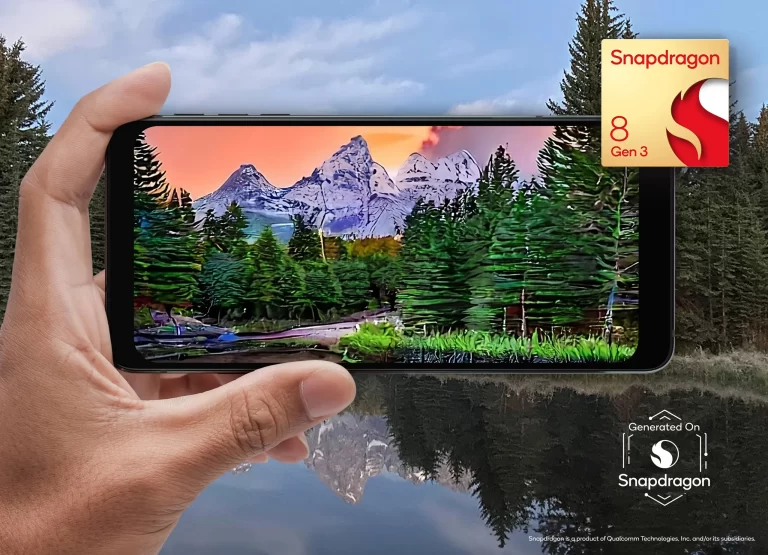
The Qualcomm AI Engine also includes the world’s fastest stable diffusion which enables you to generate an image at a fraction of a second. So you can quickly generate multiple options to pick from or create various social media posts in an instant.
This is thanks to a 98% faster Qualcomm Hexagon NPU performance and up to 40% performance/watt. And up to 3.5x AI performance increase on the Qualcomm Sensing Hub. Basically the bottom line here is that AI is going to get better and faster, with the Snapdragon 8 Gen 3.
Console-level gaming in your pocket
With the Snapdragon 8 Gen 3, you’re also getting console-level gaming in your pocket, thanks to the Snapdragon Elite Gaming features. Qualcomm actually claims that it is “console-defying”. And that’s just how good the graphics are with the Snapdragon 8 Gen 3.
Snapdragon Elite Gaming does include Hardware-Accelerated Ray Tracing with Global Illumination, which is a first-in-mobile feature. And that is thanks to the Unreal Engine 5.2. You can also get ultra-smooth and lag-free graphics at 240Hz on supported displays.
Qualcomm has also added Snapdragon Game Super Resolution, which will let you plug your phone into an external display and upscale to 8K resolution. Then there’s also the Adreno Frame Motion Engine 2.0 which is able to generate even higher quality scenes, by doubling the frame rate while maintaining the same power consumption.
Snapdragon Sight gains AI
AI is literally everywhere, including in Snapdragon Sight – the name that Qualcomm uses for its camera and ISP features. And this year, Qualcomm is adding Video Object Eraser by Arcsoft, which can remove unwanted people and objects in your video at the tap of a finger. There are also two always-sensing cameras in the front and back that allow for easy QR code scanning, face unlock and more.
One of the more interesting features here is the new Zoom Anyplace feature. This is powered by Samsung’s first 200-megapixel image sensor optimized for Snapdragon. This allows capture of multiple videos, object tracking and 2x and 4x zoom – all in 4K.
A couple of cooler features include Photo Expansion and Vloggers View. Photo Expansion intuitively extends a photo beyond what was actually captured. Which sounds a bit mind-blowing, but it is using AI to do this. The other is Vloggers View which lets you share both your selfie camera and rear camera video simultaneously, putting you in the action as you share and narrate.
When can we expect smartphones powered by Snapdragon 8 Gen 3?
Qualcomm says that we can expect to see smartphones coming out powered by Snapdragon 8 Gen 3 in the next few weeks. While Qualcomm never mentions the exact device that’s coming, they prefer to leave that up to their partners. They have mentioned some names of companies preparing Snapdragon 8 Gen 3 products.
These names include ASUS, HONOR, iQOO, Meizu, NIO, Nubia, OnePlus, OPPO, realme, Redmi, RedMagic, Sony, vivo, Xiaomi and ZTE.
Obviously, there are two pretty big omissions there. Google and Samsung. Google will obviously continue using its Tensor chipsets, but the more surprising one here is Samsung. Especially given the recent rumors of Samsung going all-in on Exynos next year for the Galaxy S24. But don’t read to much into this. Since Samsung is never mentioned in these announcements, but they do generally use Snapdragon in their flagships, and last year they only used Snapdragon – no Exynos in the Galaxy S23 lineup until the Galaxy S23 FE came along.
So we should start seeing what the Snapdragon 8 Gen 3 is capable of in the real world, pretty soon, and well before CES in January.
Today, Qualcomm announced the Snapdragon X Elite. This is the new flagship processor that Qualcomm will be pushing for laptops. It recently announced the new naming scheme for these desktop-class processors, and this is the first one to go under that new name.
Qualcomm is touting that the Snapdragon X Elite has “Best-in-class CPU with high performance and remarkable power efficiency”. Which is rather impressive for an ARM-based processor that can be used in laptops.
The Snapdragon X Elite is pretty powerful, it’s using Qualcomm’s new Oryon CPU, which uses a 64-bit architecture. It has 12 cores, up to 3.8GHz clock speeds. And it also has single and dual-core boost up to 4.3GHz. So this is a pretty powerful processor here. It also has the Qualcomm Adreno GPU with up to 4.6 TFLOPs.
Finally, connectivity. On the Snapdragon X Elite, there is support for WiFi 7, as well as WiFi 6E and WiFi 6. There’s also support for WiFi bands including 2.4GHz, 5GHz and 6GHz. Which is huge for laptops, which can really take advantage of those faster speeds. When it comes to Bluetooth, there’s also support for Bluetooth 5.4 here. We can’t forget about USB support, which comes with USB 4.0, and it can support up to three USB-C ports.
Snapdragon X Elite was built for AI
Much like the Snapdragon 8 Gen 3, the new Snapdragon X Elite was also built for AI. Which is the new buzzword, so no surprise that Qualcomm is doing it too. The Qualcomm AI Engine with has an integrated Qualcomm Hexagon NPU which delivers experiences for creativity, video conferencing, security and productivity assistants. Qualcomm claims that Snapdragon X Elite is capable of running Generative AI LLM models over 13 billion parameters on-device and there’s also blazing-fast speeds.
Qualcomm says that PCs with the new Snapdragon X Elite processor is going to be available starting in mid-2024. Qualcomm has not mentioned which PC vendors are using the Snapdragon X Elite. But in the past, we have seen PCs with Snapdragon processors from Lenovo and Samsung, among a few others.
The critical API security flaws in the social sign-in and OAuth (Open Authentication) implementations affected high-profile companies like Vidio, Grammarly, and Bukalapak.
Salt Security’s Salt Labs research team has identified vulnerabilities in the social login implementations of three popular websites.
These vulnerabilities can expose over a billion user accounts to account hijacking and data leakage, given that social login is a standard feature found in almost all major and non-major websites.
Eighty percent of the targets Salt Labs’ investigated contained security flaws concerning social login features.
Researchers have revealed a small set of impacted targets.
This discovery highlights the risks associated with social login functionality.
The leading API security firm, Salt Security’s Salt Labs research team, has identified critical API security flaws in the social sign-in and the OAuth (Open Authentication) implementations of several high-profile online firms, including Vidio, Grammarly, and Bukalapak.
Investigation revealed that through Pass-The-Token Attack, a threat actor could exploit the vulnerabilities, gaining unauthorized access to a user’s accounts on dozens of websites and access their credit cards, bank accounts, and other sensitive data.
This research marks the third and final installment in the team’s OAuth hijacking series. Previously, Salt Labs researchers had identified vulnerabilities in Expoand Booking.com.
For your information, OAuth is a widely used authentication method. Many websites and web services use it to enable the user-friendly one-click login process. Moreover, through OAuth implementation, users can log in to their social media accounts, such as Facebook or Google, to register on a website instead of creating a new login ID and password.
The vulnerabilities were detected in the social sign-in process’ access token verification step. It is a crucial component of the OAuth implementation on websites. The issue occurred due to improper token verification in the process, allowing adversaries to obtain unauthorized access.
In a blog post, Salt Labs Security Researcher Aviad Carmel wrote that their research team could exploit this flaw through the Pass-The-Token Attack, which involves inserting a token from another website to gain access to user accounts.
Vulnerability Impact on Vidio.com
On the Vidio website, researchers discovered the vulnerabilities while logging in through Facebook. The website (Vidio.com) didn’t verify the token or OAuth itself, which is a glaring flaw, allowing manipulation of the API calls to insert an access token created for another application. This alternate token-AppID combination allowed researchers to impersonate a user on the website and get the opportunity to take over thousands of accounts.
Vulnerability Impact on Bukalapak.com
One of Indonesia’s largest eCommerce platforms, Bukalapak’s website, also failed to verify the access token when users registered with a social login. Salt Labs team inserted a token from another website and was able to access a user’s credentials from the website, obtaining full control of the account.
It is worth noting that in May 2020, a hacker was discovered selling user data belonging to 13 million Bukalapak user accounts.
Vulnerability Impact on Grammarly
The researchers observed the AI-powered writing tool Grammarly.com website to learn the site’s code-sending terminology. Afterward, they could manipulate the API exchange to insert code used to verify users on a different website and successfully obtained user account credentials and performed account takeover.
Following the coordinated disclosure practice, Salt Labs researchers notified all three sites, and the issues have now been addressed. They believe the vulnerabilities could have impacted at least a billion accounts associated with the three affected sites.
The flaws although have been addressed but could have exposed sensitive login details and allowed adversaries to launch versatile range of attacks. This is a shocking discovery because thousands of websites use social sign-in functionality and billions of users worldwide could be at risk of threats like identity theft and financial fraud.
Social Login is a very common feature that is implemented on almost every major (and non-major) web service. Around 80% of our targets included some kind of security issue related to social login functionality. The impact is that we were successfully able to take over more than 1 billion accounts across all the targets, which includes the ones identified in this research plus many others.
Yaniv Balmas – VP of Research at Salt Security
Dicussion at SecTor
Aviad Carmel and Yaniv Balmas of Salt Security will be hosting a speaking session titled: Uh-OAuth! – Breaking (and Fixing) OAuth Implementations” – Wednesday, October 25, 4:00-5:00pm, Meeting Room 718A.
For your information, SecTor is a Black Hat conference that focuses on underground threats and corporate defenses. It is held annually in Toronto, Canada. The conference is known for its high-quality speakers and attendees, and it is a must-attend event for anyone interested in the latest information on security threats and defenses. SecTor 2023 will be held October 23-26, 2023 at the Metro Toronto Convention Centre.







 Phishing message sent to targets via Microsoft Teams in the same DarkGate campaign. Image: Truesec