The largest DDoS attack on the Internet has occurred, following the exploitation of a new zero-day vulnerability by hackers.
Google, Cloudflare, and AWS have confirmed that unknown adversaries exploited a new zero-day vulnerability called HTTP/2 Rapid Reset to launch digital history’s largest-ever record DDoS attack.
The attack peaked at 398 million RPS, which is 7 times higher than the previous largest DDoS attack recorded by Google.
AWS and Cloudflare had previously recorded DDoS attacks peaking at 200 million RPS.
The zero-day flaw lets adversaries send specially designed HTTP/2 requests to a target server, triggering an extensive response, which is further amplified by sending it to vulnerable IoT devices or misconfigured servers.
This novel technique is based on stream multiplexing.
In this case, threat actors sent amplified traffic to diverse targets, including financial entities, gaming corporations, and government agencies, causing significant damage to several of them.
Three of the world’s leading tech firms, Google, Amazon Web Services (AWS), and Cloudflare, have jointly disclosed a new 0-day flaw exploited by unknown threat actors to launch the largest Distributed Denial of Service attack (DDoS attack) recorded to date.
Dubbed HTTP/2 Rapid Reset, the vulnerability lets attacker send specially designed HTTP/2 requests to their target server and trigger a large-scale response. They can further amplify this response by sending the same request to as many vulnerable IoT devices and misconfigured servers as they want. The vulnerability is tracked as CVE-2023-44487 and has been assigned a CVSS score of 7.5 out of 10, rated High Severity.
The largest ever DDoS attack resulting from HTTP/2 Rapid Reset’s exploitation peaked at 398 million requests per second (RPS), seven times higher than the previous largest attack recorded by Google.
Cloudflare and AWS had previously recorded DDoS attacks peaking at slightly over 200 million RPS. Cloudflare claims to have mitigated over 1,100 other attacks, peaking at 10 million RPS until August 2023, and 184 of them were greater than the company’s previously reported DDoS record of 71 million RPS. These are still startling revelations compared to last year when the highest recorded DDoS attack peaked at 46 million RPS.
A wide range of targets have been identified, including financial institutions, government agencies, and gaming companies. The attack caused massive damage to many of these targets, but most were able to mitigate them through filtering, rate limiting, and other techniques.
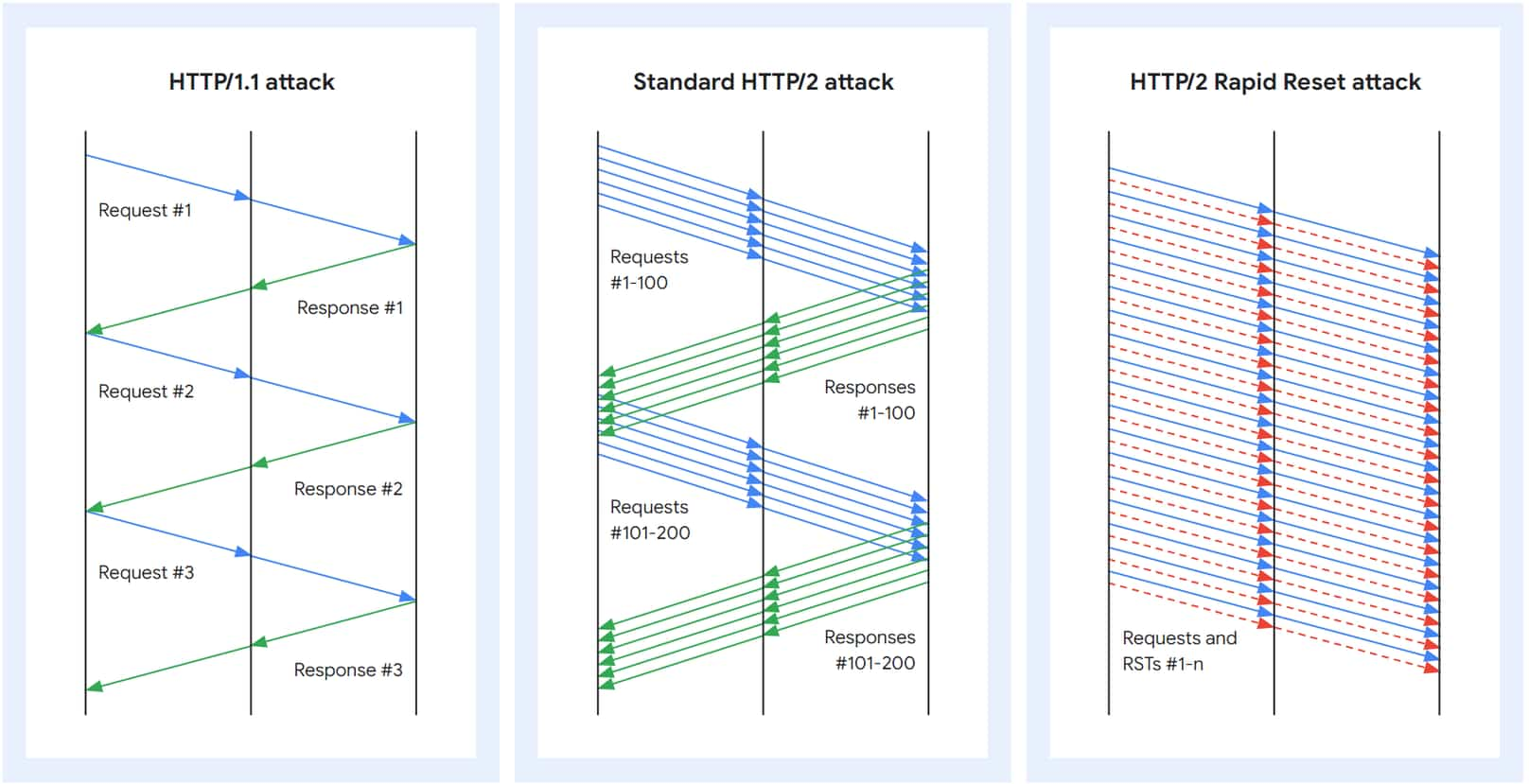
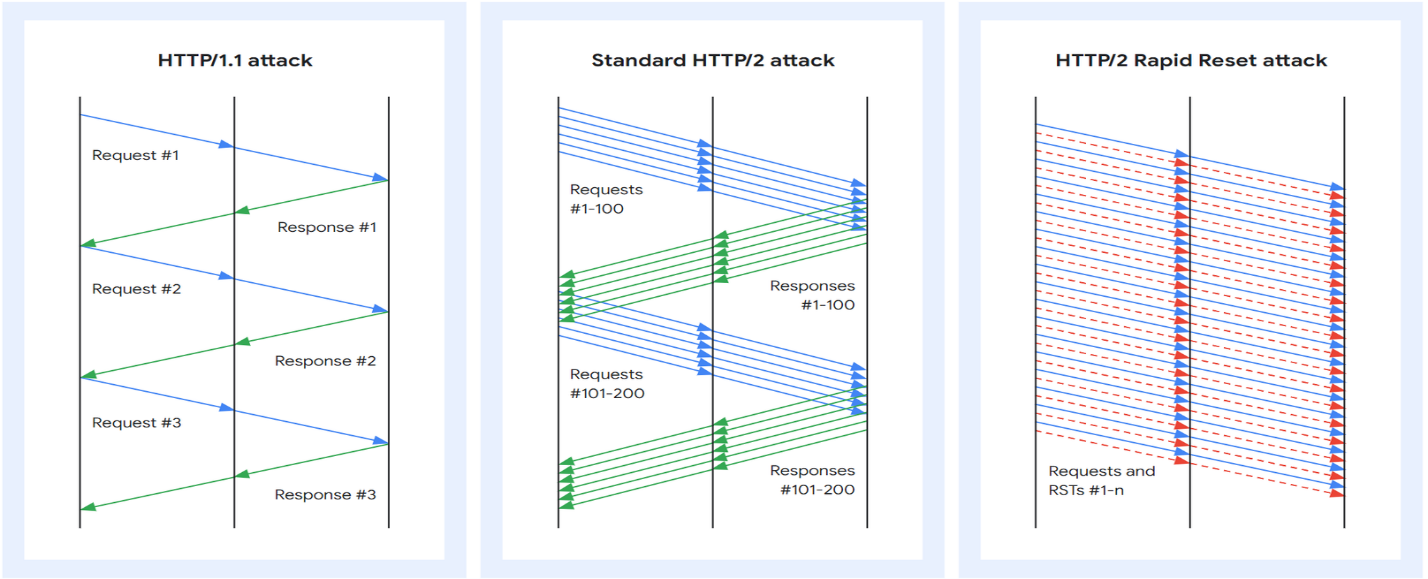
In its blog post, Google noted that this is a ‘hyper volumetric novel attack that relies on stream multiplexing. The attack exploits a weakness in the HTTP2 protocol, which lets clients identify the server a previous stream has to cancel by sending an RST_STREAM frame. It is worth noting that the protocol doesn’t require client-server coordination for this cancellation, and the client performs it unilaterally.
The attack is dubbed Rapid Reset because when the RST_STREAM frame is sent from one endpoint right after sending a request frame, the other endpoint starts working and rapidly resets the request. The request gets cancelled later, but the HTTP/2 connection remains open.
HTTP/1.1 and HTTP/2 request and response pattern (Source: Google)
This is a concerning issue because HTTP/2 protocol is a critical element of around 0% of all web apps and facilitates interaction between a browser and a website. It is responsible for determining the quality and speed of how visitors interact with websites.
Exploitation of such a critical protocol indicates that DDoS attack remains a potent and growing threat. Organizations must take necessary steps such as promptly patching systems, upgrading their security mechanisms, and using rate limiting and filtering or at least having an incident response plan to deal with DDoS attacks.
What smartphone owner can do without accessories? Google has its Pixel 8 series of phones, and there are a ton of different accessories that you can buy for them. If you ordered the Pixel 8, and you don’t know what kind of accessories you should be getting with this phone, then look no further. Here are some of the best Pixel 8 accessories that you can buy.
The Google Pixel 8 phones are the latest handsets from the company, and they bring some amazing features over the past iterations. For starters, there’s the faster Tensor G3 processor, more advanced AI, an improved camera system, and much more. They’re definitely worth the buy if you’re looking for the best Android experience that you can get.
Below, we have the pre-order links for these phones. There’s one for the Pixel 8 and the Pixel 8 Pro.
Below, we’re going to list some of the best items you can buy to augment your Pixel 8 experience. We’re talking about speakers, cases, earbuds, and other useful items. This list will be updated each month, so you should check back every now and then for new items. So, let’s dive in.
Google Pixel Buds Pro
Most people who use a smartphone will want a nice pair of earbuds to listen to music or podcasts. Well, if you’re using a Pixel phone, then a great option to consider would be the Pixel Buds Pro. As you can tell, these are earbuds from Google, but these are the most advanced from the company.
The Google Pixel Buds Pro come with all of the advanced audio features that you’ll see on premium earbuds. They have both ANC (active noise cancelation) and transparency mode, which are a standard addition to premium earbuds. Not only that, but Google also brought spatial audio with these earbuds so you’ll have a more immersive listening experience.
During Google’s Pixel event in 2023, the company announced some new features for the buds that make them an even more compelling buy. For starters, they will detect when you’re talking to someone and automatically pause the music and turn on transparency mode. These are a great pair of earbuds to get your Pixel experience started off.
So, you’re clumsy, you’re paranoid about breaking your phone, or you just want to give it a new aesthetic. Well, Caseology has you covered. The Nano Pop is a slim and form-fitting case that you can put on your Pixel 8. This case comes in four different color combinations that will add a nice pop of color to your phone if you’re not a fan of the original color.
It’s not only fashionable; the Nano pop is a sturdy case that will keep your phone safe during a fall. It’s made from Military-grade polycarbonate and thermoplastic polyurethane. This gives the case multiple layers of protection in the case of an accident. The bumpers on the side will help protect the edges of your phone.
Lastly, there’s a raised lip on the back of the camera that will protect the case package. This is great, as the camera glass can be susceptible to cracking during a fall. You don’t want that to happen, as it might affect your photos. The lip will keep the camera glass from making contact with the ground.
So, we have to face facts; Google didn’t put a charger in the box with its Pixel 8. That might not be a massive issue, seeing as most people have chargers of their own. However, not everyone does. If you don’t, here’s an opportunity to change that. Anker is one of the best companies to buy chargers from, and here’s a powerful one for your phone and other devices.
At $74.99, it’s a little pricey, but the Anker 100W GaN USB-C Charger can be a game-changer for you. Firstly, this charger has three USB ports, so you can charge multiple devices at the same time. There are two USB-C ports and one USB-A port. So, you can rest assured if more than one device is dying.
Speaking of devices, this isn’t only for your phones. This charger can deliver 100W of power, so you’re able to use it to charge your phone, tablet, and even your computer. If you have a Macbook, a smaller laptop, or a Chromebook, you can use this charger to charge it.
The Pixel 8 comes with this new Actua display technology. It’s a nice display, and you want to keep it nice. This is why you’d want to grab a screen protector for your phone. In the event of a fall, the screen protector will break and leave your actual display intact. It’s much better to break a screen protector than to get your phone repaired.
This is a three-pack of screen protectors, so if you break one, you can rest assured that you’ll have some spares. Plus, getting three is a great value for $12.99. These screen protectors are made from very resilient tempered glass with a 9H rating. This is glass that’s been heat-treated to be more sturdy during a fall. It will take more of the impact. While you have the screen protector on, you’ll still be able to use your fingerprint scanner.
You won’t only get protection for your screen, but you’ll also have protection for your camera package. This pack comes with a protector that will go over the back visor. This will add additional protection in case your phone falls on its back. Having cracked camera glass could really have a bad effect on your photos.
The Pixel 8 has a nice pair of speakers, but no phone can compare to a good Bluetooth speaker. JBL is one of the top brands for Bluetooth speakers, and the company has the JBL Go 3. At $49.95, this speaker is a steal for how great it is. It’s not just a speaker meant for the indoors, but it can also rough it in the outdoors.
The JBL Go 3 is a powerful speaker that you can use both inside and outside. It’s loud enough to fill the room with sound, so you can use it for friendly get-togethers. Along with that, it’s loud enough to be heard in an outdoor setting. This means that you can use this at your pool party or at the beach.
It’s also meant to survive the elements. It’s IP67 water and dust-resistant. This means that it can be submerged in up to 3ft of fresh water for up to 30 minutes. Also, you won’t have any issues with it if you drop it in the sand. It’s the kind of speaker that you’d want to take with you outside.
The Pixel Watch 2 was introduced along with the Pixel 8, and it’s the best smartwatch that you can use along with your Pixel 8. It costs the same $349 that the original watch cost at launch. This watch comes with a bunch of improvements over the original Pixel Watch, and that’s a plus.
This watch comes with the new Wear OS 4 which brings some improvements over Wear OS 3 from last year. Not only that, but this watch has an updated processor that helps it fly through the software.
The Pixel Watch 2 has a similar design to the original Pixel Watch, so you can bet that it will look nice on your wrist. It has a minimalist design with a round and very bright screen. This, coupled with the added health and fitness features, means that you’ll have a great user experience.
You have to keep your device charged. The Pixel 8 will give you good battery life that will improve over time, but you can always add some more juice. The INIU Portable Charger is a great option if you need some serious power in your hands for only $39.98. This is a large portable charger that can get your phone from 0% to 100% multiple times.
It’s a 20,000mAh battery, and the Pixel 8 has a 4,575mAh battery. It will be able to charge your phone a handful of times before it needs a charge itself. There are two USB-A ports on it along with a USB-C port. This means that it will be able to charge multiple devices at the same time.
It’s a large battery, but you still want to keep an eye on how much power it has in the tank. This is why there’s a handy LCD display on the front of the charger. It will tell you how much power it has left, so you’ll know when to charge it.
Sure, the Pixel 8 comes with a charger cord, but you can always upgrade. Uni has a USB-C cable that can deliver a ton of power for only $19.99. It’s a 10ft charger cord that can charge your mobile devices. Not only your phones, but also your Chromebooks, Macbooks, and small Windows laptops.
This is an extremely long cord that should be able to reach as far as you need. It’s 10-foot , and that’s great if you need it to reach across your bed, our desk, or the kitchen table. So, you won’t have to worry about putting your device in awkward places to reach the charger. Not only that, but it’s extremely resilient. It’s made from a sturdy woven material that will last you a long time.
This cord supports up to 100W of power. So, if you have a 100W wall adaptor, just know that you’ll be able to deliver the full charge to your device.
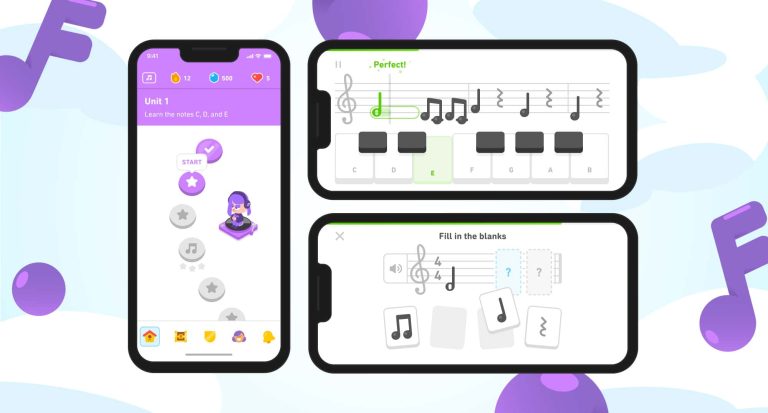
Ever since its launch, Duolingo has transformed the way we learn languages, thanks in part to its playful and user-friendly lessons. Now, after months of rumours, Duolingo has officially announced its new music course called “Duolingo Music,” aimed at helping young aspiring musicians learn the basics through “hundreds of bite-sized lessons.”
As per the report, the program will start with the fundamentals of individual notes and their positions on a virtual piano, encouraging users to match the sounds of each note with their corresponding positions on a musical staff. Once completed, the program then progresses to reading sheet music and translating auditory cues into songs, with the ultimate goal of enabling users to play compositions.
How did the company design the course?
According to Karen Chow, the Teaching/Curriculum Expert at Duolingo, the company first identified the key principles of music education, spanning from playing instruments to ear training, and then transformed them into simple lessons, offering users hundreds of interactive exercises that gradually build their musical knowledge without overwhelming them. This approach not only made learning music engaging and enjoyable but also ensured that Duolingo’s course caters to a wide range of audiences.
Duolingo teaching maths
In addition to the music lessons, the company is also expanding its efforts into mathematics, with a focus on cultivating “advanced real-world math skills,” such as quickly calculating tips and hourly wages.
“While Duolingo is known for language, we’re expanding to math and music because these are subjects that people often find intimidating, and we want to show people that learning these different subjects is possible and can be a lot of fun!” said Karen Chow.
For users eager to try out these new features, they can sign up on the waitlist for the music course. However, it’s important to note that Duolingo Music will initially be available to iOS users in English and Spanish, with plans to support Android devices in the near future.
Following the newest update to the Android Auto app, some users are noticing a new “disconnect” option when using a wireless connection to their vehicles. This addition will allow users to quickly disconnect their phone from the car’s infotainment system.
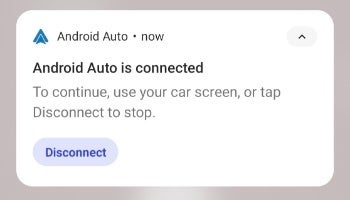
Initially spotted by Mishaal Rahman, a new “Disconnect” button is appearing as part of the Android Auto notification shade on Android phones. Although its appearance coincides with the 10.6 version update of the Android Auto app, it is unclear if the feature is tied to this version or simply an A/B test to a limited number of users.
This is a welcome addition to Android Auto, as it is currently a bit of a hassle to disconnect from the system. This will be particularly useful in cases where multiple users, already set up for wireless connection in a car, are in it at the same time.
In those cases, the users that did not need to be connected had to either put their phones in airplane mode (or turn off Bluetooth), or physically disconnect the Android Auto adapter if one of those was being used. This could be inconvenient and time-consuming, especially if you were in the middle of a trip.
The new “Disconnect” button now gives you an easy way to terminate an Android Auto connection by simply tapping it and confirming your intention. The Android Auto app will then disconnect from the car’s infotainment system and you will be able to use your phone normally.
As of today, the Android Auto app’s update to version 10.6 is rolling out via the Play Store. Though it does not guarantee the addition of the disconnect feature, which is sure to be a welcome addition to the platform, it does roll out the usual bug fixes that are normally expected with these releases.
There are the cheap store-helf headphones that you get just to funnel sound into your ears. There are also the high-priced premium headphones that you buy to immerse yourself into your music. Well, we were given the opportunity to review the Edifier W820NB, which promise to be a mixture of both. Do these headphones sit in the sweet spot between affordable and premium? Let’s find out in this review.
As stated before, these headphones sit in the middle of affordability and premium. They’re the kind of headphones to buy if you don’t want to break the bank, but you do care about the sound going into your ears. If you’re looking for a more premium experience, then you might also want to look at the Edifier WH950NB.
At $199, these headphones offer a great listening experience with several great features. They have great noise cancelation, amazing build quality, access to advanced features in the Edifier Connect app, and more. Read our Edifier WH950NB review to learn more.
Edifier W820NB Review: Design
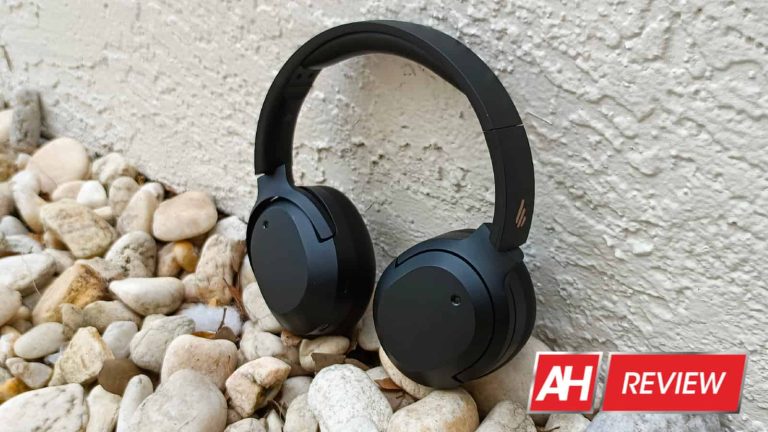
In terms of design, the Edifier W820NB are pretty standard. They have a pretty simple design overall. There’s a nice bevel on the outside of the ear cups that gives them a bit of an angular look.
The microphones sit on the top of the ear cups with an additional microphone on the side of the right ear cup. Under that, we see the USB-C port and the buttons.
When it comes to the design of the Edifier W820NB, you wouldn’t really be able to pick them out of a line. You don’t have a radical or extremely sleek design. They’re very basic, which should be expected from an affordable pair of headphones.
I’m obviously not going to dock points for this. Their understated design does lend a bit of professionalism to the look. Many cheaper headphones go all out with wild colors or crazy designs. They’re meant to appeal to a younger audience. So, if you want a more professional look then, these headphones definitely have that look. When it comes to design, less is more.
Edifier W820NB Review: Build quality
The main selling point of these headphones is their affordability, and it’s obvious the second that you pick them up. There are no tricks or smoke and mirrors to make these headphones seem more expensive than they are. They’re inexpensive headphones, and they feel like it.
These headphones have a fully plastic design. Everything from the headband to the joints is all plastic, which gives the headphones a very lightweight and cheap feeling. I know that these are affordable headphones, but honestly, they feel cheap for an $80 pair of headphones. $80 is cheap to the premium Sony headphones, but it’s still a notable chunk of change. When I pick up the Edifier W820NB, it almost feels like I’m holding a $30 pair of headphones. I think that Edifier could have put a little more effort into the overall feeling.
One of the main gripes that I have with the build quality is the creaking. When I pick them up, put them on, adjust the cups, or interact with them in any way, I hear the plastic creaking loudly. That only adds to the cheap feeling. It gets rather distracting when listening to music. Again, these are $80 headphones. This shouldn’t really be happening.
But, there’s a silver lining
There is one good thing about the lightweight feeling. If you’re planning on listening to headphones for extended periods of time, they will not weigh your head down. Honestly, when I put them on, it feels like nothing is sitting on my head.
I typically use these headphones for work, and that means 6+ hours of usage. At the end of a shift, I never feel tired or weighed down.
Edifier W820NB Review: Color options
The Edifier W820NB come in three different color options. I reviewed the black color, but there’s also a light gray color. This one looks nice as well. It doesn’t have that super sleek look that you would get with a set of black headphones, but the gray color gives them a certain elegance.
Lastly, there’s an Ivory color. The body of the headphones are a bright sand color while the ear cups and headband padding are a darker shade (closer to a darker tan). This gives them a warmer aesthetic. Either way you cut it, all of the colors look very nice.
Edifier W820NB Review: Controls
While build quality and audio quality are important for a pair of headphones, it’s also important to be able to use them easily. All of the buttons for the Edifier W820NB are on the right ear cup. They’re all easily accessible, as when I put my hand on the earcup, my thumb naturally rests on the controls.
There are four buttons, and all of them serve multiple purposes. There’s a long rubber piece that houses the volume up, volume down, and power button. Separately, there’s the Bluetooth button.
The volume buttons have double purposes, as you’d expect. Holding the volume up button will skip to the next track, and holding the volume down button will restart the track. If you hold it down again within a few seconds, it will go to the previous track.
Holding the power button will power on/off the headphones. If you just press the power button while the headphones are on, then it will play/pause the music. As for the Bluetooth button, when you press it, it will cycle between ANC (active noise cancelation), ambient sound, and regular modes. If you hold the button, you’ll enter Bluetooth pairing mode.
Convenience
Feeling for the buttons can take a little getting used to. The volume up button has a small protruding “+” sign that you can feel, but the volume down button doesn’t. You’d expect to feel a little “-” sign when looking to change the volume, but you don’t. It’s not bad, but it’s slightly off-putting for some reason.
One of the best things I like about the controls for these headphones is the convenience of the Bluetooth pairing. With the Edifier WB950NB, if you want to pair with a new device, you’ll have to disconnect the headphones using the old device. You’ll either do that, or you’ll need to turn the headphones off and turn them on while continuing to hold the power button until it enters pairing mode. With the W820NB, you just have to hold down the Bluetooth button for a few seconds to enter Bluetooth pairing mode.
Switching sound modes
There are two more minor gripes that I have, and they have to do with switching the sound modes (ANC, ambient, and normal). Firstly, when you’re switching between the modes, you’ll cycle between them. so, you have to wait for the voice to announce what mode you’re on before you can pick the next one. It’s a bit cumbersome if you have to switch modes on the fly.
It’d be nice if the company added a button that was dedicated to just switching modes. Maybe one that you can tap to enable ANC, double-press to enable ambient mode, and hold down to get to normal mode. This means each mode would be one gesture away.
The second gripe is one that I’ve had with other Edifier wearable audio gear. When you enable a mode, you will hear the voice announce the mode. This mutes the content that you’re hearing to speak, which is a bit annoying. You can mute the voice prompts from the Edifier Connect app, and that makes it less annoying. Your content is muted for a split second while it switches modes.
The issue with that is that you won’t be able to hear the other indicators like the low battery or Bluetooth pairing indicator. So, there’s a bit of a trade-off. I think that being able to just disable the voice prompts so that they don’t mute your audio while keeping the other sounds would be nice.
Edifier W820NB Review: Noise cancelation
Edifier’s devices typically come with great noise cancelation, and these headphones are no different. The ANC does a great job of filtering a wide range of ambient noise. It’s definitely a lot better than what the price would suggest.
AC units, traffic, and other noises are pretty much muted when I turn on the mode. Honestly, I was surprised at how good the ANC is on these headphones, as they’re a cheaper pair. I’d put them on par with some of Edifier’s more expensive devices.
The only issue I have is that they’re not great at filtering the wind. I know that the wind is extremely hard to filter. However, I think that these headphones are behind in that regard.
Edifier W820NB Review: Audio
Now, let’s move on to the actual sound that you hear from these headphones. Being a cheaper set of headphones, my expectations for the sound weren’t particularly high. However, this is the Edifier we’re talking about. This company is definitely not a company to be overlooked. Let’s get into it.
Loudness
There’s always the chance that you run into headphones with an underpowered sound. However, the Edifier W820NB get plenty loud. I didn’t have any issues listening to music or podcasts while outside. Each time you press the volume up/down button, it will raise/lower the volume by about 6.5% each time, so you have 16 volume levels in all. That’s about standard for most Bluetooth devices.
Space
The Edifier W820NB actually have a pretty spacious sound. I was impressed, actually. When I’m using them, it really sounds like I’m in an open space with the instruments and singers around me. Each instrument and singer has their place in the sound space. In fact, I think that the space is one of the best aspects of the sound.
There are other headphones with such a cluttered sound with extremely saturated bass that it really bogs down the audio. This tires out the ears much faster, making you either take them off or, heaven forbid, switch to another set of headphones.
Low-end
Edifier’s speakers typically pique my interest because of their excellent balance of high-end and low-end. They avoid overdoing it on the bass leading to a muddy sound. Their speakers incorporate just the right amount of bass to give depth and character to the sound.
In the case of the Edifier W820NB, I can’t quite say that this is the case. The sound isn’t low and muddy; it’s actually the opposite. It tends to lean toward the high-end. There’s a fair amount of bass to keep the sound tasty, but I hear the high-end more than anything else.
The overall sound doesn’t go as far as to sound shrill. However, if you’re looking to listen to more bass-heavy music, you’ll find yourself wanting just a bit more low-end.
High-end
What these headphones lack in low-end, they make up for in a pleasant boost to the high-end. Vocals sing nicely over the music, high hats pop, and pianos get a nice lift. The thing is that these headphones sound nice regardless of whatever genre you’re listening to, but they shine in certain genres of music. I’ll go over which genres I found them to sound better in just a bit.
A great thing about the high-end is that it’s restrained. The higher tones get a nice boost, but it stops short of being too much. As I said, the sound doesn’t become shrill.
Edifier W820NB Review: Listening to different genres
Different headphones shine while listening to different genres of music, and the Edifier W820NB definitely have their standouts. I listened to different types of music with these headphones; some of them are genres that I listen to all the time and others are for the review.
Classical
With classical, the pleasantly spacious audio and lighter bass work in these headphone’s favor. They make for a crisp and clear sound. With classical, all of the ranges are equally important, as each instrument has a role to play. So, you’ll want to make sure that you have a detailed sound.
Several headphones and other audio equipment tend to lean on the bassy side of things. That’s good for more modern bass-heavy music, but it makes classical and other instrumental music sound muddy.
When it comes to the low end, it’s diminished, but it’s just enough to give the lower instruments enough attention. There’s just a bit of warmth added to the sound, and it keeps from going overboard. Listening to classical music is a treat with these headphones.
Cinematic
Both classical and cinematic music use orchestral instruments, but cinematic music focuses on the low end more than classical. This actually balances out the headphones’ weaker low-end performance to create an absolutely tasty sound. The impactful hit of the bass drums backed up by bombastic synth just sings perfectly with the Edifier W820NB. The bass is well-represented with these headphones, but the sound still remains spacious and open.
70s pop
The spacious sound works well for this music. Moving from large orchestral studios with classical to smaller personal studios, we get a more intimate sound. The open and clear sound means that I can hear every note of every instrument.
That’s nice, but I feel the lack of bass more with 70s pop than classical. The electric basses in a lot of the 70s pop I listened to are usually pretty warm. However, the low-end just didn’t sing through as I’d like. The songs sound nice, but there just wasn’t too much depth to the sound.
On the upside, and this goes for all of the other genres, the vocals sounded crisp and clean.
80s pop
In terms of immersion, I think that 80s pop might be a weak point for these headphones. With a lot of 80s music, there seems to be this emphasis on the higher tones. A lot of the electric basses were brighter, and we heard a lot of higher synth. Because of this, the audio will sound rather thin compared to 70s pop.
This is something to think about if you’re going to be listening to a lot of 80s music. It won’t sound bad, but some added low-end would help out the sound a lot.
90s Hip-hop/R&B
Jumping up another decade, the sound warmed up quite a bit. A lot of the 90s R&B focused on deep smothering bass. Thus, we have the same effect that we had with the cinematic music. The added warmth with the bass helps to balance out the low-end performance of the headphones. This is especially true with mid-90s hip-hop and R&B.
Admittedly, it will still be light compared to a pair of headphones designed to be bassy. However, it’s still pleasant nonetheless.
Early 2000s pop
I found that listening to early 2000s pop strikes a balance between 80s pop and 90s R&B. The music is pretty warm with the synthetic bass. The sound is notably warm while being slightly less immersive than 90s R&B. I would say that this is about standard.
Edifier W820NB Review: App experience
If you use other Edifier wearables, then you should know about the powerful Edifier Connect app. This is an incredibly feature-rich app interface that you can use to control your devices. If you need to change the listening mode, customize the controls, adjust the sound, or power off the device, it’s a one-stop shop to do so.
The thing is that, depending on what device you’re using, the functionality will vary. Unfortunately, the Edifier W820NB don’t allow you to use the app to its fullest extent. If you saw our Edifier NeoBuds review or the Edifier WH950NB review, you’d know about the in-depth EQ that you could use to tailor the sound to your tastes.
Well, with the Edifier W820NB, you don’t get that feature. That’s unfortunate, as I would have been able to dial in a bit more low-end or make other changes.
Fortunately, most of the other functionality is present in the app. You can still toggle the Game Mode. This will reduce the latency of the sound so that you can use them to play games. There’s always a delay between the moment something happens on your phone and you hear it. This mode helps reduce that latency. You can also change the audio modes, control your media from the app, and power your headphones off in the app.
Edifier W820NB Review: Battery and charging
This is a pair of headphones that is hard to kill in a sitting. I listened to music using these headphones non-stop, and I was able to make it just shy of 40 hours. That’s great battery life, and it will survive through pretty much anything that you’re doing. If you use these for work, then they will last you through multiple shifts before they die on you.
As for charging, it takes about two hours to charge these headphones from 0% to 100%. What’s neat is that they can get you about two hours of playback on just a 10-minute charge. So, if these do give up the ghost, you won’t need to charge it for too long to get through the day.
You should get these headphones if:
The Edifier W820NB are for you if you are light on cash but want to experience some of the premium features featured in premium headphones. You want to know what ANC, transparency mode, and game mode are all about. Most cheaper headphones don’t have those features or an app interface to control them with. Well, at just $80, you can have this experience.
The Edifier W820NB are also for you if you want a lighter sound when listening to music. You want a nice, spacious, and well-balanced sound to relax to.
Next, you should get these headphones if you like to listen to music that doesn’t require loud and thumping bass. There are other headphones that are made to accent the bass a ton, but these are more balanced. These are for you if you like to venture into other genres of music.
Lastly, you should get these headphones if you want to use headphones for extended periods of time. The Edifier W820NB can go the long run on a single charge, so you won’t have to worry about them dying on you. Also, they’re so lightweight, your head won’t feel weighed down after a while.
You shouldn’t get these headphones if:
The Edifier W820NB are great, but they’re not for everyone. You shouldn’t get these headphones if you are looking for a more premium pair of headphones. The Edifier W820NB give you some premium features, but they’re far from premium.
Also, if you want headphones with better build quality, then you’ll want to pass these up. These headphones are all plastic and they creak when you adjust them.
Lastly, you’ll want to avoid these headphones if you’re into more bass-heavy music. These just don’t give you that same rumble in the low end.
Final verdict
There are devices out there that give you premium features for a lower price. Some of those devices are worth it and others aren’t. In my opinion, while these headphones are affordable, they feel a bit cheaper than they actually are. However, if you’re only going by the build quality, then you’re missing out on the best features.
The sound coming out of these headphones is incredibly spacious and balanced. It makes listening to several genres like classical, cinematic, 70s pop, and 90s R&B a treat. This is especially true if you’re looking to relax.
What they lack in premium build quality, they make up for with great sound quality. I have no problem recommending the Edifier W820NB.
Critical vulnerabilities in Citrix NetScaler ADC and NetScaler Gateway have exposed sensitive information and a denial of service attack.
A malicious cyber actor can exploit one of these vulnerabilities to gain control of an affected machine. Citrix has published security upgrades to address the vulnerabilities impacting several products.
DocumentFREE Demo
Implementing AI-Powered Email security solutions “Trustifi” can secure your business from today’s most dangerous email threats, such as Email Tracking, Blocking, Modifying, Phishing, Account Take Over, Business Email Compromise, Malware & Ransomware
Details of the Critical Vulnerabilities
With a CVSS score of 9.4, the vulnerability designated as CVE-2023–4966 is considered highly severe. Without high-level access, user involvement, or tedious processes, the weakness may be remotely exploited.
The appliance must be set up as a Gateway (VPN virtual server, ICA Proxy, CVPN, RDP Proxy) or an AAA virtual server to be exposed to attacks.
According to the security bulletin, this vulnerability results in “Sensitive information disclosure.”
The second vulnerability reported is CVE-2023-4967, a high-severity issue with a CVSS score of 8.2, allowing for a ‘Denial of Service attack’ on vulnerable devices.
Affected Versions:
The vulnerabilities impact the following supported versions of NetScaler ADC and NetScaler Gateway:
NetScaler ADC and NetScaler Gateway 14.1 before 14.1-8.50
NetScaler ADC and NetScaler Gateway 13.1 before 13.1-49.15
NetScaler ADC and NetScaler Gateway 13.0 before 13.0-92.19
NetScaler ADC 13.1-FIPS before 13.1-37.164
NetScaler ADC 12.1-FIPS before 12.1-55.300
NetScaler ADC 12.1-NDcPP before 12.1-55.300
It is noted that NetScaler ADC and NetScaler Gateway version 12.1 are now End-of-Life (EOL) and are vulnerable.
Updated Versions
NetScaler ADC and NetScaler Gateway 14.1-8.50 and later releases
NetScaler ADC and NetScaler Gateway 13.1-49.15 and later releases of 13.1
NetScaler ADC and NetScaler Gateway 13.0-92.19 and later releases of 13.0
NetScaler ADC 13.1-FIPS 13.1-37.164 and later releases of 13.1-FIPS
NetScaler ADC 12.1-FIPS 12.1-55.300 and later releases of 12.1-FIPS
NetScaler ADC 12.1-NDcPP 12.1-55.300 and later releases of 12.1-NDcPP
NetScaler ADC and NetScaler Gateway version 12.1 are now End-of-Life (EOL). Customers are advised to update one of the supported versions to fix the vulnerabilities.
“Cloud Software Group strongly urges affected customers of NetScaler ADC and NetScaler Gateway to install the relevant updated versions of NetScaler ADC and NetScaler Gateway as soon as possible,” reads Citrix’s security bulletin.
Protect yourself from vulnerabilities using Patch Manager Plus to patch over 850 third-party applications quickly. Take advantage of the free trial to ensure 100% security.
Information belonging to as many as seven million 23andMe customers has been put up for sale on criminal forums following a credential stuffing attack.
Information belonging to as many as seven million 23andMe customers has been put up for sale on criminal forums following a credential stuffing attack against the genomics company.
On Friday October 6, 2023, 23andMe confirmed via a somewhat opaque blog post that threat actors had “obtained information from certain accounts, including information about users’ DNA Relatives profiles.”
The company says cybercriminals stole profile information that users had shared through its DNA Relatives feature, an optional service that lets customers find and connect with genetic relatives who have also signed up to DNA Relatives. It does not explain what data was stolen, or how much of it, but it does indicate that crooks pulled off the heist “where users recycled login credentials”, and not because of a vulnerability in its systems.
We do not have any indication at this time that there has been a data security incident within our systems, or that 23andMe was the source of the account credentials used in these attacks.
In other words, cybercriminals succeeded in getting access to a number of 23andMe accounts where users had used the same password on both 23andMe and a website that had suffered a data breach. Accessing accounts on a website by using lists of usernames and passwords exposed on another is known as “credential stuffing”, and it’s both common and effective. It works because users often use the same password for multiple websites. However, the damage seems to go far beyond the accounts with reused passwords.
It seems the attackers didn’t simply steal the data belonging to the accounts they broke into—they used those accounts to access a much larger trove of data via DNA Relatives. According to Bleeping Computer, “the number of accounts sold by the cybercriminal does not reflect the number of 23andMe accounts breached.”
The Record reports that the stolen data does not include genomic sequencing data, but does include “profile and account ID numbers, names, gender, birth year, maternal and paternal genetic markers, ancestral heritage results, and data on whether or not each user has opted into 23AndMe’s health data.”
The stolen data is only worth something in so far as it can be used to extract money from somebody, so we expect it will be used in social engineering attacks, like scams and phishing. Users of 23andMe are likely to be the targets, so if that includes you, take extra care when answering messages about or apparently from 23andMe. We suggest you visit the website directly to get information and guidance, don’t follow links or download attachments from emails saying they’re from 23andMe, and follow our simple guide to spotting any scam.
23andMe is urging its users to ensure they have strong passwords, to avoid reusing passwords from other sites, and to enable multi-factor authentication (MFA).
Respectfully, we would like to see 23andMe reach a different conclusion. Telling users to choose strong passwords and not to reuse them is great advice that just isn’t working. It’s good in theory but fails in practice. In a world where users have tens or even hundreds of logins to manage, password reuse and weak passwords that are easy to remember are inevitable.
The company is right to emphasise the enormous usefulness of MFA, but rather than asking users to turn it on, why not just make it mandatory? MFA is, by far, the most useful thing you can do to stop credential stuffing, and if it’s switched on it protects users from their bad password habits like reuse.
In 2019, Microsoft’s Alex Weinert wrote that “Based on our studies, your account is more than 99.9% less likely to be compromised if you use MFA.” You won’t find another technology that gets close.
As 23andMe says in its own blog post, “Since 2019 we’ve offered and encouraged users to use multi-factor authentication.” The company deserves credit for offering MFA, but the scale of this attack against it suggests that not enough users are making the choice. The only way to make MFA the norm is to insist on it instead of ask.
We don’t just report on threats—we remove them
Cybersecurity risks should never spread beyond a headline. Keep threats off your devices by downloading Malwarebytes today.
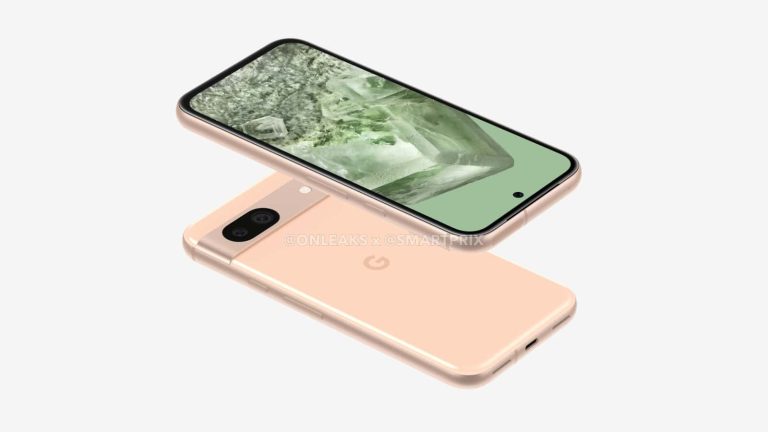
The Google Pixel 8a surfaced in CAD-based renders quite recently. Well, that very same source, @OnLeaks, has just decided to compare the Pixel 8a design to the Pixel 7a and Pixel 8 offerings.
The Google Pixel 8a design gets compared to what its siblings have to offer
He did that via an image, which you check out below. The Pixel 8a poses side-by-side with the other two phones, and you can clearly see the differences in this image.
The Pixel 8a will seemingly be slightly taller than the Pixel 8, and about the same height as the Pixel 7a. So, we can assume it will include a 6.1-inch display, but feature slightly thicker bezels than the Pixel 8.
Now, in regards to the overall design, the phone does resemble the Pixel 8 more. Its corners are way more rounded than the Pixel 7a’s, as Google opted to tweak the design of the Pixel 8 series. In fact, you can check out that difference the best via the video below.
The device’s corners are a lot more rounded than the ones on the Pixel 7a
This video comes from @OnLeaks as well, and it shows the transition from the Pixel 7a to Pixel 8a. You can see that the corners have been drastically cut off on the Pixel 8a, and many would say that’s the better option.
That made the Pixel 8 feel entirely different in the hand, and quite frankly the phone is easier to handle. It is also slightly smaller than the Pixel 7a, and considerably smaller than the Pixel 7, so that helped too.
Either way, the Pixel 8a is coming, but it won’t arrive anytime soon. Chances are that we’ll see it in May next year, at Google I/O, unless Google decided to drastically change its release cycle. So, we’re in for quite a wait. These CAD-based renders popped up very early.
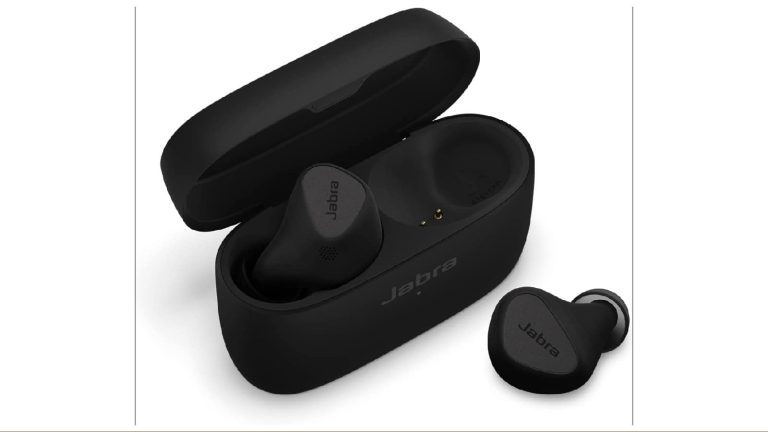
What’s better than a pair of premium earbuds? A pair of premium earbuds that are discounted! The Jabra Elite 5 are now $60 off for Amazon Prime Day.
Jabra is a popular name in the wearable space, and its line of earbuds consists of some of the best earbuds that you can buy. At the top of the pecking order, we have the Elite earbuds. These have some of the best features that you can get on a pair of TWS earbuds.
The Jabra Elite 5 have a pair of 6mm drivers that deliver a powerful sound. They’re capable of producing a great sound for whatever genre you’re listening to. Not only that, but these earbuds come with a wide range of codecs that deliver different listening experiences.
The Jabra Elite 5 are a durable set of earbuds that you can take anywhere, even during your workout. They have an IP55 water and dust resistance rating. This means that you don’t have to worry about them getting damaged if you sweat on them during a workout. They’re also secure enough to survive a light drizzle if you’re caught in the rain.
When it comes to battery life, these earbuds are meant to last you the day. By themselves, the Jabra Elite 5 will last you 7 hours on a single charge. That’s good enough, but they come with a charging case. With the case, they will last you a full 28 hours on a single charge. That’s more than enough to get you through any work shift.
These earbuds come with a great app experience. The Jabra app lets you control multiple aspects of the earbuds. You can enable/disable the ANC and transparency mode, adjust the EQ, update the firmware, and more. These are great earbuds, and the discount only makes them better.
Multiple Google services and Cloud users were allegedly the target of a unique HTTP/2-based DDoS attack.
The attack used a cutting-edge method known as HTTP/2 Rapid Reset, a zero-day vulnerability in the HTTP/2 protocol tagged as CVE-2023-44487 that may be used to launch DDoS attacks.
The stated attack magnitudes are: Amazon mitigated attacks at a rate of 155 million requests per second, Cloudflare at 201 million rps, while Google withstood attacks at a record-breaking 398 million rps.
“These attacks were significantly larger than any previously reported Layer 7 attacks, with the largest attack surpassing 398 million requests per second”, Google said.
DocumentFREE Demo
Implementing AI-Powered Email security solutions “Trustifi” can secure your business from today’s most dangerous email threats, such as Email Tracking, Blocking, Modifying, Phishing, Account Take Over, Business Email Compromise, Malware & Ransomware
Details of the Largest DDoS Attack
In this case, the HTTP/2 protocol allows clients to instruct the server that a previous stream should be canceled by sending an RST_STREAM frame. The protocol does not call for any kind of coordination between the client and server; the client is free to cancel on their own.
The Rapid Reset attack uses this technique to send and reject requests quickly, evading the server’s concurrent stream limit and overwhelming it without exceeding the specified threshold.
Attacks using numerous HTTP/2 connections that quickly switch between requests and resets are known as HTTP/2 rapid reset attacks.
HTTP/1.1 and HTTP/2 request and response pattern
Each connection can have infinite requests in flight due to the ability to reset streams instantly. This allows a threat actor to send a flood of HTTP/2 requests that can overwhelm a targeted website’s capacity to respond to new incoming requests, effectively shutting it down.
Hence, threat actors can overwhelm websites and take them offline by starting hundreds of thousands of HTTP/2 streams and quickly canceling them at scale over an established connection.
According to Cloudflare, this attack was made possible by exploiting various HTTP/2 protocol features and server implementation specifics.
Any vendor implementing HTTP/2 will likely be vulnerable to the attack since it takes advantage of a flaw in the HTTP/2 protocol. All modern web servers were included in this.
“CVE-2023-44487 is a different manifestation of HTTP/2 vulnerability. However, to mitigate it we were able to extend the existing protections to monitor client-sent RST_STREAM frames and close connections when they are being used for abuse. The legitimate client uses for RST_STREAM are unaffected”, Cloudflare reports.
The attack technique has been shared with web server suppliers by Cloudflare, Google, and AWS; all hope that these companies will roll out updates.
Protect yourself from vulnerabilities using Patch Manager Plus to patch over 850 third-party applications quickly. Take advantage of the free trial to ensure 100% security.