Researchers have discovered a new phishing campaign that exploits Microsoft’s Bing Chat to promote malicious URLs. The campaign involves creating malicious ads via legit ads businesses to rank higher and appear in Bing Chat responses to lure victims.
Bing Chat May Show Malicious Ads
According to a recent report from Malwarebytes Labs, Microsoft’s Bing Chat is inadvertently serving as a malware distributor by showing malicious ads. While the technology is legit, threat actors have likely meddled with its advertising features to display their malicious URLs in Bing Chat responses.
Bing Chat is a recent technology from Microsoft that leverages ChatGPT to provide users with AI-powered search results, including sponsored links or ads. The tech giant rolled out this feature earlier this year with Microsoft Edge browser and Bing Search.
As explained, the Malwarebytes team entered a search query about downloading the “Advanced IP scanner” to Bing Chat. In response, they found an advertisement URL as the top suggested result, followed by the tool’s official website. Given the ad’s top placement, it is more likely to be clicked by an average user, which risks users’ security.
Clicking on the link would redirect the user to a temporary web page (mynetfoldersip[.]cfd) that validates the incoming request as a genuine user through various parameters, such as time zone, system settings, etc. Otherwise, the web page would redirect to a decoy page upon detecting a sandbox, a bot, or a virtual machine.
For genuine users, the web page would redirect to a phishing website (advenced-ip-scanner[.]com), mimicking the Advanced IP Scanner’s official site. This phishing website lures the victims into downloading the MSI installer, which triggers the malware infection.
To run this campaign, the threat actors compromised the ad account of a legitimate Australian business to create fake ads.
The researchers warn the users to stay vigilant when clicking on any URLs and downloading files and equip their devices with robust anti-malware to fend off known cyber threats.
Tomorrow will be a very interesting day for Android and Pixel fans. Not only is Google launching its Pixel 8 series devices, and the Pixel Watch 2, but Android 14 will also drop on the same day.
Android 14 will start rolling out tomorrow, it will arrive alongside the Pixel 8 series
This information comes from a Canadian carrier, Telus. The carrier said that ‘Android U’ has an ‘Approx date’ of Wednesday, October 4. It also said that the update is coming to the Google Pixel 7a, Pixel 7 Pro, Pixel 7, Pixel 6a, Pixel 6 Pro, Pixel 6, Pixel 5, Pixel 4a (5G), and Pixel 4a.
Now, you will notice that the Pixel 4a is on that list, and it shouldn’t be, as it won’t get a stable Android 14 update. All the other phones will, plus the Pixel Fold. The Pixel 8 and Pixel 8 Pro will ship with Android 14 out of the box.
Telus did note that “All dates are approximate and subject to change”, though. Also, the carrier did remove this info from its site in the meantime, but we have a feeling it’s spot on, but Google probably asked them to remove it.
This update was expected to drop last month
As a reminder, Android 14 was expected to start rolling out last month. Google apparently wanted to wait for this launch event instead. We don’t know if it’s a simple choice, or perhaps it wanted to further polish the experience.
By doing this, the company basically reverted back to the schedule from Android 12. Android 12 started rolling out on the same day the Pixel 6 series dropped two years ago.
All in all, tomorrow will be a bit day for Google and the fans of the company’s products. Android 14 may not be a huge overhaul of the Android OS experience, but it does bring several new features and changes. On top of that, Google will further polish the experience with this update.
Google vs DoJ trial is ongoing, and all kinds of interesting info is coming from it. Remarks of Google’s Vice President for Finance, Michael Roszak, came to light. The Google exec basically compared the search business with the “cigarettes or drugs” business. This happened years ago.
A Google exec compared the search business with “cigarettes or drugs” businesses
He did that during a training offered by the company on communications in July 2017, reports Livemint. That info was spotted in the document released online by the Justice Department.
To be more accurate, this is what Roszak said: “Search advertising is one of the world’s greatest business models ever created… there are illicit businesses (cigarettes or drugs) that could rival these economics, but we are fortunate to have an amazing business”.
Roszak continued: “We’ve essentially been able to ignore one of the fundamental laws of economics – supply and demand. We could mostly ignore the demand side of the equation (users and queries) and only focus on supply side of advertisers, ad formats, and sales”. That actually gives a really nice explanation of what it’s like to be a top dog in the search business.
He also noted that Google was smart about it. He said that the company used “smart marketing/distribution investments” in order to get its product basically everywhere.
The DoJ hopes this will help its case, while Google doesn’t think it’s relevant at all
The Department of Justice (DoJ) is hoping that this document, amongst many others, will help it prove Google’s anticompetitive tactics to remain in a dominant position when it comes to the search business.
On the flip side, Google was against this document even being used in the trial. Why? Well, the company’s lawyers said that this document is not a business record, and thus it does not reflect the opinion of the company.
Furthermore, a Google spokesperson clarified things while talking to Bloomberg. This document was apparently drafted for a public speaking class. It was supposed to be “hyperbolic and attention-grabbing”.
Cloudflare, a prominent cybersecurity vendor renowned for its web protection services, faces a security challenge that could expose its customers to unforeseen risks.
A recent disclosure from Certitude highlights a vulnerability that could allow attackers to bypass certain protection mechanisms offered by Cloudflare, leaving customers susceptible to attacks that the platform is designed to prevent.
DocumentFREE Demo
Implementing AI-Powered Email security solutions “Trustifi” can secure your business from today’s most dangerous email threats, such as Email Tracking, Blocking, Modifying, Phishing, Account Take Over, Business Email Compromise, Malware & Ransomware
Vulnerability Overview:
In their official documentation, Cloudflare outlines various mechanisms to safeguard origin servers from malicious traffic.
However, this disclosure has shed light on a crucial gap in protection that stems from a trust relationship between Cloudflare and its customers’ websites.
Attackers who use their Cloudflare accounts to abuse this trust relationship can exploit this trust relationship, rendering configured security measures ineffective.
1. Authenticated Origin Pulls:
One of the mechanisms affected is “Authenticated Origin Pulls,” which is considered “very secure” by Cloudflare. This method relies on client SSL certificates to authenticate connections between Cloudflare’s reverse proxy servers and the origin server.
The issue arises when customers opt for the convenience of using Cloudflare’s certificate. This choice allows any connection originating from Cloudflare, regardless of the tenant, to be accepted.
Attackers can exploit this by setting up a custom domain, pointing it to the victim’s IP address, and then bypassing protection features configured by the victim.
2. Allowlist Cloudflare IP addresses:
Another mechanism, “Allowlist Cloudflare IP addresses,” is labeled as “moderately secure.” It relies on rejecting connections that don’t originate from Cloudflare’s IP address ranges.
Similar to authenticated origin pulls, this mechanism has a vulnerability that allows all connections from Cloudflare, regardless of the tenant, to be permitted.
Attackers can exploit this by directing their attacks through Cloudflare’s infrastructure while bypassing the victim’s protection features.
Cloudflare customers should consider these vulnerabilities seriously and review their protection strategies.
For the “Allowlist Cloudflare IP addresses” mechanism, it’s recommended to use Cloudflare Aegis, which provides dedicated egress IP addresses instead of shared IP address ranges. Additionally, for “Authenticated Origin Pulls,” customers should opt for custom certificates to ensure better security.
Cloudflare has been made aware of these vulnerabilities, and it is hoped that they will implement protection mechanisms to mitigate these risks and provide clearer guidance to customers with weak configurations.
Protect yourself from vulnerabilities using Patch Manager Plus to quickly patch over 850 third-party applications. Take advantage of the free trial to ensure 100% security.
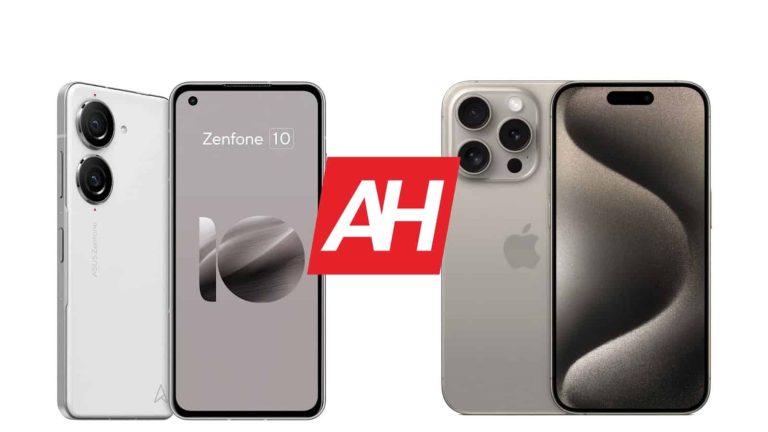
Apple’s new iPhones dropped not long ago. The iPhone 15 Pro is the company’s new compact flagship, and in this article, we’ll compare it to a worthy competitor. We’ll compare the ASUS ZenFone 10 vs Apple iPhone 15 Pro. The ZenFone 10 may not be as popular as phones from Apple and Samsung, but it has proven to be an excellent smartphone, as did its predecessor. Considering that they’re both rather compact phones, and also flagship phones, comparing them does make sense.
We’ll first list their specifications, and will then move to compare their designs, displays, performance, battery life, cameras, and audio performance. These two phones are immensely different, which should make for an interesting comparison, to say the least. Having said that, let’s get this party started.
Specs
ASUS ZenFone 10 vs Apple iPhone 15 Pro, respectively
– Screen size: 5.92-inch Super AMOLED display (144Hz, HDR10+, 1,100 nits) 6.1-inch Super Retina XDR display with ProMotion (120Hz, HDR10, 2,000 nits) – Display resolution: 2400 x 1080 2796 x 1290 – SoC: Qualcomm Snapdragon 8 Gen 2 Apple A17 Pro – RAM: 8GB/16GB (LPDDR5X) 8GB – Storage: 128GB/256GB/512GB (UFS 4.0) 128GB/256GB/512GB/1TB (NVMe) – Rear cameras: 50MP (f/1.9 aperture, gimbal OIS), 13MP (f/2.2 aperture, 120-degree FoV) 48MP (f/1.78 aperture, second-gen sensor-shift OIS), 12MP (ultrawide, f/2.2 aperture, 120-degree FoV, macro photography), 12MP (telephoto, f/2.8 aperture, 3x optical zoom) – Front cameras: 32MP (f/2.5 aperture) 12MP (f/1.9 aperture) + TrueDepth – Battery: 4,300mAh 4,355mAh – Charging: 30W wired, 15W wireless, 5W reverse wired (charger included) 20W wired, 15W MagSafe wireless, 7.5W Qi wireless, 4.5W reverse wired (charger not included) – Dimensions (unfolded): 146.5 x 68.1 x 9.4mm 146.6 x 70.6 x 8.25mm – Weight: 172 grams 187 grams – Connectivity: 5G, LTE, NFC, Wi-Fi, USB Type-C, Bluetooth 5.3/5.2 – Security: Side-facing fingerprint scanner Advanced facial scanning – OS: Android 13 with ZenUI iOS 17 – Price: $699 $999 – Buy: Amazon Apple
ASUS ZenFone 10 vs Apple iPhone 15 Pro: Design
The ASUS ZenFone 10 is made out of aluminum and plastic. Do note that by ‘plastic’ I don’t mean your regular, cheap plastic. This phone’s backplate feels like a sheet of paper, it has some grip, and a specific feel to it. The sides on the phone are flat, but with chamfered edges, for comfort. A display camera hole sits in the top-left corner, while the phone’s display is flat. The bezels are thin, but not uniform. Two cameras are located on the back of the phone, and each one is its own camera island, basically.
The iPhone 15 Pro, on the other hand, is made out of titanium and glass. Its sides are also flat, but have slightly curved edges. The bezels on this phone are very thin, and uniform, but there’s a pill-shaped cutout at the top of the display, much larger than the display camera hole on the ZenFone 10. The phone’s backplate doesn’t exactly curve out a bit, like on the ZenFone 10. This phone has three cameras on the back, and they have Apple’s recognizable alignment. They’re all placed in the top-left corner.
The two phones are almost equally tall, while the ZenFone 10 is a bit narrower, and a bit thicker. ASUS’ handset is also lighter, about 15 grams lighter, though both are fairly light. They do offer a completely different in-hand feel, though. Both smartphones do come with an IP68 certification for water and dust resistance, and both are rather easy to use with one hand. The ZenFone 10 more so, though.
ASUS ZenFone 10 vs Apple iPhone 15 Pro: Display
The ASUS ZenFone 10 includes a 5.92-inch fullHD+ (2400 x 1080) Super AMOLED display. That panel is flat, and has a 144Hz refresh rate. Do note that this refresh rate is only accessible in some games. It supports HDR10+ content, and its brightness gets up to 1,100 nits of brightness at its peak. You’ll also find Corning’s Gorilla Glass Victus protection on top of this display.
ASUS ZenFone 10
On the flip side, the iPhone 15 Pro, includes a 6.1-inch 2556 x 1179 LTPO Super Retina XDR OLED panel. That display is flat, and has a 120Hz refresh rate. It supports HDR10 content, and has Dolby Vision support too. This panel gets up to 2,000 nits of brightness at its peak, and is protected by the Ceramic Shield glass. It has a slightly narrower aspect ratio than the ZenFone 10’s display.
Both of these displays are excellent. They are both sharp enough, and even though the iPhone 15 Pro’s panel is sharper, you won’t really notice that. Well, the vast majority of you will not notice it, not at that display size. The viewing angles are great, and the displays are very vivid with deep blacks. The touch response is good on both. The iPhone 15 Pro does have one major advantage, though, its brightness. This display does get noticeably brighter than the ZenFone 10’s.
ASUS ZenFone 10 vs Apple iPhone 15 Pro: Performance
The Snapdragon 8 Gen 2 fuels the ZenFone 10, while ASUS also included up to 16GB of LPDDR5X RAM here. The phone comes with UFS 4.0 flash storage too. So, the best of the best, basically. The iPhone 15 Pro, on the flip side, has the Apple A17 Pro SoC, Apple’s most powerful processor to date. It also includes 8GB of RAM, and NVMe flash storage, up to 1TB.
Both smartphones are very smooth during day-to-day usage. They simply do not slow down, they’re very smooth and responsive. The same goes for gaming, actually. They can run any game you can find in their respective app stores, without a problem. The thing is, the iPhone 15 Pro does get quite hot, at least in some units. Apple did acknowledge this, and is working on a fix at the time of writing this article. So, chances are that won’t be an issue any longer, we’ll have to wait and see. Heat is not an issue for the ZenFone 10, however. It’s one of the smoothest Android devices on the market.
ASUS ZenFone 10 vs Apple iPhone 15 Pro: Battery
ASUS included a 4,300mAh battery inside the ZenFone 10. The iPhone 15 Pro, on the flip side, includes a 3,274mAh battery. Apple’s handsets usually have considerably smaller batteries than their Android counterparts. That doesn’t have to mean worse battery life, though, but in this case, it does. The ZenFone 10 is easily the best compact phone in the market when it comes to battery life, at least as far as high-end phones go.
We’ve managed to cross the 9-hour screen-on-time mark on the ZenFone 10 easily, and even the 10-hour mark on occasion. The iPhone 15 Pro will fly closer to 6-7 hours of screen-on-time, though all that will depend on your usage, of course. You’ll use different apps compared to us, and will have different usage habits. Also, we did not really play games during our usage, aside from days when we specifically tested gaming, of course. So, take that into account.
The ZenFone 10 supports 30W wired, 15W wireless, and 5W reverse wired charging. The Apple iPhone 15 Pro, on the flip side, supports 20W wired, 15W MagSafe wireless, 7.5W Qi wireless, and 4.5W reverse wired charging. Qi2 charging will also be supported when the time comes. Do note that the ZenFone 10 includes a charger in the box, while the iPhone 15 Pro does not.
ASUS ZenFone 10 vs Apple iPhone 15 Pro: Cameras
The ZenFone 10 includes two cameras on the back, while the iPhone 15 Pro has three. ASUS placed a 50-megapixel main camera (f/1.9 aperture, gimbal OIS) inside the ZenFone 10, along with a 13-megapixel ultrawide camera (f/2.2 aperture, 120-degree FoV). The iPhone 15 Pro, on the other hand, has a 48-megapixel main camera (f/1.8 aperture, sensor-shift OIS), along with a 12-megapixel ultrawide unit (120-degree FoV), and a 12-megapixel telephoto camera (4x optical zoom, OIS, 3x optical zoom).
Apple iPhone 15 Pro
The camera department is the area the iPhone 15 Pro has the edge in. The pictures on this phone do look better in comparison, most of the time. The shots during the day look more natural, with better-looking colors, and more detail. The iPhone 15 Pro does take 24-megapixel shots by default. The ZenFone 10 shots look good, but tend to look a bit oversaturated at times, and also the details when you pixel peep are not as good in comparison. Their ultrawide cameras are both good, but that’s also an area that the iPhone 15 Pro does better in, as does when it comes to telephoto shots, as the ZenFone 10 does not have a telephoto camera.
In low light, both phones perform really well, but once again, the iPhone 15 Pro shots do look better overall. They offer better balance, and better colors, not to mention faster shutter speed. The video is immensely stable on the ZenFone 10, and is good overall, but the iPhone 15 Pro does have the edge when we look at video recording as a whole.
Audio
You will find a set of stereo speakers inside of both of these smartphones. Both sets of speakers are really good, and offer well-balanced audio output. Both sets are loud enough too, in case you were wondering.
The ZenFone 10 does come with an audio jack, unlike the iPhone 15 Pro, in case you still use wired headphones. You can utilize the iPhone 15 Pro’s Type-C port if you need it, though. Both smartphones are also equipped with Bluetooth 5.3 for wireless audio connections.
A new beta update to WhatsApp now gives users the ability to easily share Channel update links with others. This is a pretty handy feature, as it simplifies the entire process of sharing a link from one chat to another. Currently, this feature is in its beta testing phase and is available to a handful of users around the world.
It enables users to share messages sent to WhatsApp Channels as links for quick and easy access later. These links will allow the recipients you send them to access the particular message with information you want them to have. Instead of copying the entire message or forwarding it to others, users can now share them as links to their friends and family.
WhatsApp will make this link feature available to all and not just the owners or creators of the channel. This is great as it’ll promote the sharing of content-specific messages to others, hence relieving them of the stress of sorting for the exact message later on. You will get a brief breakdown of the usage of this new feature in this article.
The coming WhatsApp Channels update link feature might simplify sharing a message with others
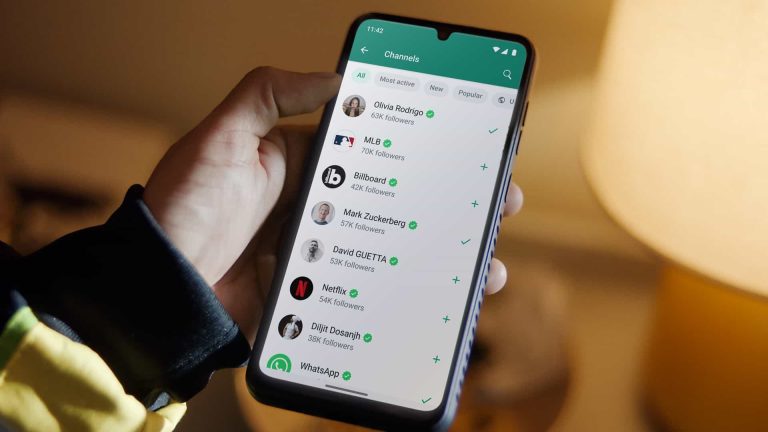
WhatsApp Channels is one of the new features that the social media company is making available to the public. This feature enables individuals or businesses to connect with many people who share similar interests. Unlike the regular WhatsApp group chats, Channels uses one-to-many messaging, meaning that only the owner of the platform does the talking.
Members of these channels can then react to messages or share access and share information or updates with others. When it comes to sharing on Channels, WhatsApp is working to make things a bit easier. To do this, they are rolling out the Channel update link feature to beta testers.
With this coming feature, members of channels can share messages on the channel with others as links. Those they share these links with can click on the link and be taken to the exact message sent to them. This will help them stay abreast with updates on the channel without having to scour through tons of messages.
To use this link-sharing feature, users need to hold down on the message they wish to share as a link. Part of the pop-up options is the link-sharing button, and after pressing this they can select those they wish to share the link to. This feature will come in handy for users trying to give their friends a heads-up about a particular development on the channel.
For now, users can only wait for this feature to pull through the beta testing stage. Once ready for global release, users will get the WhatsApp Channels update link feature on their device via an app update. If you are already part of a channel, will you be willing to try this feature once available?
In a recent phishing campaign, the researchers noticed the use of the long-known ZeroFont phishing technique to trick Microsoft Outlook users. Users need to remain vigilant when interacting with unsolicited emails, specifically checking if the email preview and the actual email body do not match.
Latest ZeroFont Phishing Campaign Targets Outlook Users
In a recent post, Jan Kopriva, an analyst from the Internet Storm Center (ISC) Sans has shared details about a new zerofont phishing campaign.
As the term implies, ZeroFont phishing involves text-based phishing scams, usually involving emails, where the attackers hide some text characters by entering them with zero font size. This makes the characters invisible to the reader, but the algorithms and NLPs can still read them. Thus, such characters may facilitate the attackers in bypassing security checks.
That’s what Kopriva found under attack in a recent phishing campaign. While the post includes the details about the phishing attack, briefly, the phishing email raised suspicion when the researcher noticed a different email preview from the message body when viewing the email via Microsoft Outlook.
Specifically, he found the email preview displaying a phrase, “Scanned and secured by Isc®Advanced Threat protection (APT): 9/22/2023T6:42 AM” that nowhere existed within the email body. This phrase, appearing right below the email subject “Email Opportunity…” added weightage to the email’s safety, tricking a user into believing that the email passed antivirus detection.
However, given that Microsoft Outlook never shows such security alerts with emails and that this phrase didn’t appear within the email body, the researcher spotted the phishing attempt. Then, reading the email message further confirmed his suspicion as it exhibited bad grammar and poor text construction.
Although ZeroFont phishing isn’t a new technique – it first surfaced online in 2018 when Avanan reported it in detail, Kopriva believes such exploitation of this technique to trick users is somewhat new. Therefore, users, particularly those relying on email previews, must remain vigilant while checking emails, especially unsolicited ones, regardless of whether they bypass or claim to have passed email security measures.
Microsoft CEO Satya Nadella testified October 2 as part of the ongoing antitrust trial between Google and the DOJ. In his testimony Nadella said of Google that “It’s really Google’s web, and everyone is just playing in it.”
The statement refers to the difficulty of breaking into the search market. Even for a company like Microsoft, one of the highest valued companies in the world, competing against Google in search is no easy task. The basis of the trial since it began is that Google allegedly illegally operates a monopoly in the search market. Using its considerable market power to force competitors out of the space or otherwise overshadow them through various tactics.
In past trial days it’s been said by DOJ litigator Kenneth Dintzer that Google has applied numerous methods to ensure it stays on top. Including paying companies like Apple and other manufacturers to make Google the default search engine on their devices. Google has also allegedly trained employees to avoid using certain words that could make them sound like monopolists. As well as deleting certain logs from internal communications by turning the history of those chats off.
Microsoft CEO says Bing faces considerable obstacles to gain marketshare from Google
Nadella’s statements are mostly in reference to questioning about Google’s dominance. But they also “affirm” claims made by the DOJ that it’s increasingly difficult for competitors to break into search due to Google’s exclusive deals.
By securing these deals, Google gets more eyes on search which results in more gathered data. Which leads to more revenue that Google then dump into more deals. This ‘flywheel effect’ as it’s called makes it hard for other competitors to gain any traction. According to Nadella, Microsoft has considered shopping a deal to Apple to replace Google search as the default on Apple devices with Bing. A deal that Nadella states would likely cost “billions in short-term losses.”
A few months ago, Microsoft suffered a major breach that gave Chinese hackers access to certain unclassified data. This includes the emails of certain individuals affiliated with the US government. Initially, the breach was said to affect over 25 accounts, but that number was far from the actual figure the hackers were able to access.
New information now clarifies that the hackers were able to steal over 60,000 US government employee emails. That number is outrageous, and it further highlights the need for tighter security measures within the government. Even though the security flaw came from Microsoft’s part, it was able to expose a ton of emails to bad actors.
The emails stolen belong to US staff working in East Asia, the Pacific, and Europe. With these emails, the hackers can move on to perform phishing attacks on unsuspecting individuals. Here is all you need to know about this security breach and how the government is working to avoid such from repeating itself in the future.
Over 60,000 US government emails in the possession of Chinese hackers highlight the need for better information security
The Storm-0558 Chinese hackers are said to be responsible for the Microsoft breach. From this breach, they were able to get access to tons of US government emails. Over 60,000 emails of various US government staff in various locations are in the possession of these hackers.
All emails in the possession of these hackers are unclassified, meaning that they don’t hold any confidential information. However, these hackers can still put them to use while trying to carry out phishing attacks. The attack that gave away these emails took place in July 2023 and went unnoticed for a while.
However, the US government was able to tip Microsoft to the attack, hence prompting an urgent response. It took Microsoft some time to understand how these hackers were able to get access to their system. After some research, it became clear that the Chinese hackers were able to get access to a consumer key for this attack.
With the key, they were not only able to get access to Microsoft’s system but also to steal users’ emails. In a recent briefing, Senator Eric Schmitt threw light on the need for the US government to harden their defenses “against these types of cyberattacks and intrusions in the future.” Certainly, this won’t be the last cyberattack that the US government will have come its way.
With adequate protective and preventive measures, the US government will be able to defend against such attacks. This will not only protect the government and its employees but also the citizens at large. Large data companies also need to ensure they build resilient security systems that can withstand such attacks, hence protecting user information.
Lazarus group has been recently discovered to have targeted an Aerospace company in Spain, which involved deploying several tools, including an undocumented backdoor named “LightlessCan.”
Reports indicate that the threat actor gained access to the organization’s network last year using a spearphishing campaign impersonating a recruiter from Meta.
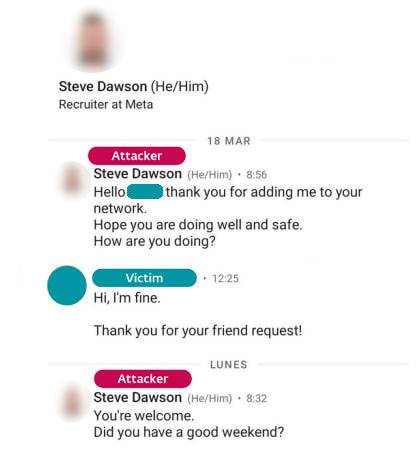
The threat group contacted one of the victims inside the organization via LinkedIn social networking, posing as a recruiter from Meta. The threat actor then sent two coding challenges and a job description PDF, which was malware, resulting in the execution of the malicious payload.
Scammer contacting via Linkedin (Source: ESET)
Lazarus Coding Challenges
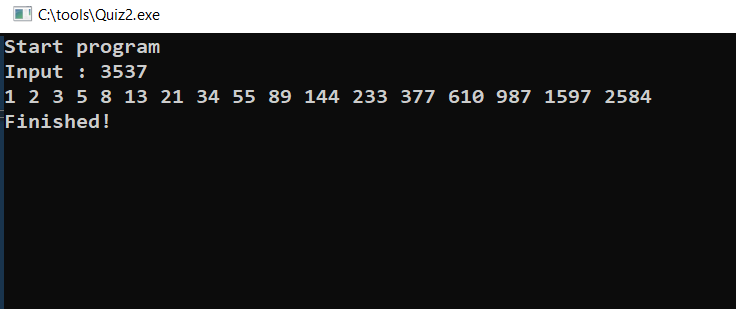
The victim was provided with two malicious executables, Quiz1.exe and Quiz2.exe, embedded inside two ISO images, Quiz1.iso and Quiz2.iso. The victim was tasked with rewriting the code in C++ programming language.
Fibonacci program from Quiz2.exe (Source: ESET)
The two executables were a simple Hello World program and a Fibonacci program. However, the executables were much more than they printed on the console.
Both executables trigger the installation of additional payloads inside the ISO images. The first payload that was delivered was named “NickelLoader” which enables the threat actor to deploy any program on the system’s memory. Followed by other additional payloads which are used by the threat actor for various purposes.
LightlessCan – New Backdoor
One of the most interesting payloads used was the LightlessCan, which was found to be the successor of the Lazarus RAT BlindingCan. LightlessCab supports 68 distinct commands, of which 43 lack their original functionality.
LightlessCan can be confirmed to have been derived from BlindingCan because the order of the shared commands between LightlessCan and BlindingCan has no significant changes.
One of the most important updates on this new backdoor is mimicking Windows Native commands like ping, ipconfig, systeminfo, sc, net, etc.
ESET has published a complete report about this compromise and other detailed information, providing additional information about the source code, payload, exploit chain of the payload, compromising the system, and other information.
Protect yourself from vulnerabilities using Patch Manager Plus to quickly patch over 850 third-party applications. Take advantage of the free trial to ensure 100% security.