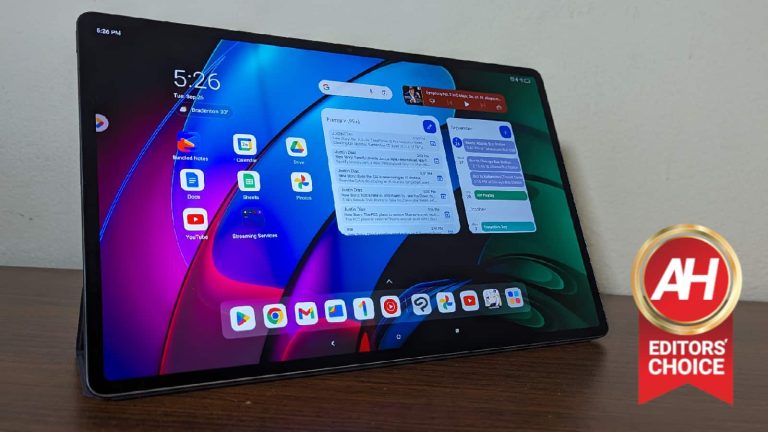
The Android tablet is making a comeback in the tech world. While the tablet market as a whole is on the decline, interest in the Android tablet has been on the rise. Android manufacturers are again putting tender love and care into the tablets that they make. Lenovo has offered its series of tablets for years, and the company gave us its most extreme model. Android Headlines was given the opportunity to review the Lenovo Tab Extreme.
This tablet is, in many ways, a productivity-focused piece of hardware, and it’s no doubt meant to be a competitor the Samsung Galaxy Tab S Ultra tablets. So, what does it have to offer? What makes it better than the latest Galaxy Tab? Why should you buy it? In this review, we’ll answer those questions and any others that you might have. So, let’s dive into this review.
Lenovo Tab Extreme Review: Design
Lenovo has established a design language all its own with its tablets, and the Tab Extreme continues the company’s innate aesthetic. Honestly, I like the design. It has an interesting two-tone look with a predominantly metal design. The majority of the tablet is made from a matte metal.

Across the top of the back, there’s a slender glass strip that houses the cameras and the magnet for the stylus. The strip is reflective, and it gives the tablet a sleek and elegant design. The glass strip on top juts out just a bit.
The design of the Lenovo Tab Extreme is simple, but it definitely sticks out from other tablets that you would see on the market.
Lenovo Tab Extreme Review: Build quality
Let’s not mince words; the Lenovo Tab Extreme is a pricey tablet. Fortunately, its build quality reflects that. It goes far beyond the metal chassis. Any company can slap a metal body on a tablet and call it premium. However, it’s not as simple as that.
This tablet is solidly built with a pleasing heft to it. It’s heavy enough to let you know that it’s premium, but it avoids being bulky. Don’t get me wrong, it definitely gets a bit uncomfortable to hold after a bit. However, it strikes a nice balance between being too heavy and too light.
The Lenovo Tab Extreme is also rather thin. this, coupled with the heft of the tablet makes it feel rather compact. That gives the tablet that solid feeling in the hand.

Lenovo Tab Extreme Review: Display
The Lenovo Tab Extreme has a massive 14.6-inch display, and it’s one of the best parts of the whole experience. I’ve used other Lenovo tablets with similar screen technologies, but this one stands above them and other tablets that I’ve used.
Colors
There are three different color modes that you can choose from: Standard, Natural, and Vibrant. Standard and Natural modes keep the colors toned down to produce a more natural picture. It will remind you of what you’d see from a standard LCD display.
However, this is an OLED panel, and switching it to the Vibrant mode will really punch up the colors. In this mode, pictures and videos just pop with more saturated colors.
That being said, the vibrant color mode shows a level of restraint that keeps them from baking your retinas. The colors are all well-contained, which is important. There is such a thing as too saturated, and thankfully, Lenovo didn’t choose to go overboard.
When you choose a color mode, the color temperature is chosen automatically. However, you can change the color temperature in the display menu.
Brightness
This is the kind of tablet you’re likely to take out with you on work days. So, brightness is important, and Lenovo nailed it. The screen is extremely bright; brighter than what would be necessary in most indoor situations. I had no trouble using this tablet outside in the bright sun. The only time I had trouble with the brightness was when the sun itself was directly reflected in the screen, but no one would realistically try to work like that.

Refresh rate
The Lenovo Tab Extreme comes with a silky smooth 120Hz refresh rate. The refresh rate is only made better by how beautiful the company made the animations in the software.
Overall, the display is one of the main reasons to get this tablet. It’s an absolutely breathtaking display that you’ll love to watch content and do work on. Whether you’re at home, in a brightly lit building, or outside in the sun, it will completely fulfill your needs.
Lenovo Tab Extreme Review: Speakers
Whenever I get a new mobile device, it’s rare that I would use its actual speakers for recreational listening. I’d either throw on a pair of headphones or take out my Bluetooth speaker. The only other tablet that I don’t do this with is the Honor Pad 8.
Basically, tablet speakers have yet to be a suitable replacement for a good Bluetooth speaker… that was until I reviewed the Lenovo Tab Extreme. I was honestly blown away when I heard the sound coming out of these speakers.
In all honesty, shortly after listening to the sound coming out of them, I forgot that I was listening to a tablet. When you’re listening to a bad set of speakers, the bad qualities make themselves apparent throughout the listening experience; it’s hard to forget and just enjoy the audio. The sound from these speakers is so immersive, so punchy, so well-balanced that my ears just accepted it as sound, not sound from a tablet’s speakers.
Loudness
There’s a set of four speakers on this device, and that makes for quite a powerful sound. With a screen this big, you’re likely to use this to show movies or videos to a group of people. These speakers are more than loud enough to spread the sound around a room. I could sit this tablet all the way across my room and listen to music at only half volume.
Low end
When it comes to listening to music, especially more modern music, low end is extremely important. I found that, regardless of the audio setting, the low end was well-contained. Listening to more bass-heavy music, I never found that the bass overwhelmed the audio.
If I could say anything, I’d say that the bass is ever so slightly too subdued. It’s not by a large margin. There are some points when I could used just an ounce more bass. However, the sound isn’t thin by any means.

I get the most low end in the Dolby Atmos settings. I set it to the Warm setting in the Music section. It has the biggest EQ boost in the lower-mids.
High end
The low end is juicy and the high end is crisp. While listening to music, violins cut through, snare drums and high hats have no problem being heard. Just like the bass, the highs keep from being overbearing. They’re subdued, yet they’re still dynamic.
Overall balance
As for the overall balance, these speakers do a good job of representing the full range of frequencies. While listening to modern music, neither the high-end nor low-end felt like too much. However, I felt that the voices did suffer in the Music setting just a bit.
Listening to epic cinematic music, these speakers shine. Simultaneously, I hear the impactive punch of the bass drums, the grit of the low brass, and the higher tones of the strings. It’s an all-around amazing and immersive sound.
When it comes to listening to classical music, balance is extremely important. The bass isn’t emphasized to blow your head off. Rather, each part is meant to flow together in a beautiful tapestry of sound. So, balance is needed for a proper music-listening experience.
I’ve never used a set of tablet speakers better for classical than the speakers on the Lenovo Tab Extreme. Just like with cinematic music, all of the parts get equal attention.
Who are these speakers for?
These speakers are really for everybody because of how balanced they are. If you’re into listening to more modern bass-heavy music, they’re for you. If you’re into more traditional orchestral or classical music, they’re for you. This also goes for watching content. It doesn’t matter if you’re watching an action movie, documentary, drama, or comedy, these speakers are great.
Lenovo Tab Extreme Review: Performance
MediaTek has come a long way since a few years ago. Before, their chips were confined to lower-powered handsets while the Snapdragon processors were held for the performance beasts. However, times have changed; MediaTek is shelling out chips that are going toe-to-toe with the likes of the best Snapdragon processors.
Why is this important? Well, the Lenovo Tab Extreme uses the extremely powerful MediaTek Dimensity 9000 SoC. The Dimensity line of chips has shown itself to be a powerful set of chips, and those on the upper end have no trouble keeping up.

Using this tablet, I had no issue whatsoever. Navigating the interface, using apps, working, content consuming; it didn’t matter what I did on this tablet, everything ran smoothly. I give half of the props to MediaTek for making such a powerful processor, but I also give props to Lenovo for optimizing the software for the chip. I once reviewed a different tablet with the same processor, and I noticed occasional stutter and lag throughout the software. In the case of the Lenovo Tab Extreme, it ran perfectly smoothly.
In terms of RAM management, I didn’t have any problem with too many apps closing in the background. I’d play some games and go on writing with two Chrome windows open. After that, I’ll play some more games and still be able to return to the games I played earlier.
The fact of the matter is that this is a work tablet, and it performs like it.
Lenovo Tab Extreme Review: Gaming
Moving onto gaming, you can expect this tablet to crush most of the games that you’ll throw at it. Starting off with simple and 2D games, this tablet handles them like a dream. Games like Streets of Rage 4, EvoLand, and others like that run 100% smoothly on the Tab Extreme. The Dimensity 9000 is able to power through them without breaking a sweat.
Moving onto simple 3D games, the story is quite the same. We’re talking about games like Dragon Ball Legends and Sky: Children of The Light. These games are pretty good-looking, and they could give weaker hardware some trouble now and then. However, the Tab Extreme doesn’t flinch in the slightest. I’m still able to get a smooth 60fps.
Now, for the final frontier of mobile gaming, the more graphically intensive titles. We’re talking about games like Genshin Impact. This game sits in a class all its own, being one of the prettiest games that you can download on a mobile device, and it’s unplayable on lower-powered devices. However, the Lenovo Tab Extreme handles this game without much issue. Overall, it’s extremely smooth, even when the graphics are turned to their highest setting.
I didn’t have any hiccups while playing the game, and that involved heavy battling and traveling. I’d say that I probably wasn’t able to get a full 60fps throughout, but I know that it was able to get and maintain well over 30fps.

While you might not use this tablet for much gaming, just know that it’s more than capable of running all of the games that you can throw at it.
Lenovo Tab Extreme Review: Battery
So far, most aspects of this tablet have been exceptional. However, when it comes to the battery life, things are rather lukewarm. The battery life in the Lenovo Tab Extreme is pretty average. While using this tablet, I’d have the brightness down to about 70%. On long days, I’d get between five and six hours of screen-on time.
That’s not too bad especially if you use this tablet mostly for work. It will get you through an average day of work. However, if you plan on using it after your work, then you’ll want to have the charger handy.
The battery life isn’t terrible especially considering the fact that the display is so large. It’s similar to how most powerful laptops don’t get the best battery life because the battery is powering so much.
When it comes to charging, Lenovo again went above and beyond. This tablet comes with a large 68W charger in the box. This gets the Tab Extreme charged up in just over an hour.
Lenovo Tab Extreme Review: Camera
The Lenovo Tab Extreme is a top-tier piece of hardware, but all devices have their Achilles heel. For this tablet, it’s the camera. This should come as no surprise and it shouldn’t really dampen the experience. No one really buys a tablet for its camera, and that goes double for a device this big. It’s not quite point-and-shoot-sized. Lenovo put the two cameras on the back of this tablet as a formality. The camera quality in this tablet is what you’d expect from a tablet.

Colors
The Tab Extreme’s display has some nice and juicy colors, but you wouldn’t know it by looking at the pictures it takes. Looking back at the pictures that this tablet produces, the colors are toned down. They’re absolutely dead. Taking a picture of green grass on a sunny day, you’d expect the colors to pop, but they don’t.
In just about every scenario, it looks like someone took a picture, put it in a photo editor, and turned down the saturation. There was only one picture where the sky had a nice juicy shade of blue, but taking a picture of the sky is problematic for a different reason I’ll discuss later. All in all, if you’re in a pinch and you need to use this tablet’s camera, don’t expect it to be anything noteworthy.
Exposure
Now, let’s talk about that sky; just about every picture I took with the sky in it, the sky was blown out. Getting a well-exposed shot on a harsh summer day is hard for any camera, don’t get me wrong. The camera has to compensate for the dark shadows as well as the highlights. However, most other cameras manage to retain some of the colors in the sky while properly exposing everything else. For this tablet, pretty much the entire sky is a wash of white.
One thing that makes the exposure issue worse is the fact that the shadows are still crushed when overcompensating. Shots where the sky is over-exposed still had dark or even completely black spots in the shadows.
Contrast
Moving onto contrast, as you can expect, it’s not good. Just like with the colors, it’s like someone turned down the contrast setting in a photo editor. Photos taken in the bright summer sun have a lot of potential for great contrast, but the pictures just look dull. This is even with the blown-out highlights and crushed shadows.
Video
As you can expect, the videos that this tablet takes aren’t anything special. They have the same issues as with the pictures. The colors and contrast just aren’t there, and the video’s littered with blown-out highlights and crushed shadows. Lastly, the stabilization is also terrible.
Overall
The camera is the worst aspect of this tablet, and you most likely have a much better camera in your pocket. Am I going to dock points from the tablet? No. As stated, the camera is just a formality. It can take pictures and videos; that’s it. The camera can take these if you’re in a pinch, but it’s not a focus of the core experience.

Lenovo Tab Extreme Review: Software
Lenovo’s other tablets have an experience that’s pretty similar to stock Android, but that’s not the case with this tablet. The Lenovo Tab Extreme has a different aesthetic. At the time of this review, this tablet is using Lenovo ZUI version 15.0.765 running on Android 13. So, it’s running the latest version of Android that’s currently out.
The experience overall is pretty familiar if you’re used to modern Android tablets. Being on Android 13, it has the new slew of tablet optimizations that Google pushed out with Android 12L. This means that the notification drawer is split, the recent app screen is a grid, the app doc is there by default, and more.
As for the overall aesthetics, there’s no Material You influence to be found. Lenovo went in its own direction, and that direction is a bit simpler than most other software. It’s pretty toned down when it comes to the animations. Also, the UI isn’t really cluttered with a ton of different features or visual additions. So, the interface is pretty clean for the most part.
There’s almost a glass effect on certain bits of the UI like the notification shade, the app dock, and the folders. There’s a pleasing transparent look to them, and they pair well with the pre-installed wallpapers.
The software looks nice, but since Lenovo went in its own direction with the software, there are no Dynamic Colors. This means that your software won’t take on the color aesthetic of the wallpaper you set. That’s unfortunate, but it’s not the worst thing.
Lenovo Tab Extreme Review: Accessories
The company was kind enough to send us a couple of accessories to test out with the tablet.
Lenovo Precision Pen 3
Let’s start off with the stylus. I used the Lenovo Precision Pen 3 with the Tab Extreme, and this pen is nothing if not precise. You’ll have no trouble using this to write or draw.
When it comes to the functionality of the pen, Lenovo packed a ton of software features into this stylus. Firstly, it connects to the tablet and charges magnetically. When you take it off of the tablet, you have the option to summon a toolbar with additional options. Some of the tools are a magnifier tool, a screenshot tool, and a camera shortcut.
There’s a physical button on the stylus that you can press to perform different tasks. There’s actually a remote control feature that will let you use your stylus’ button for certain tasks while at a distance from the tablet. You can use it to skip tracks, play/pause media, etc.
Aside from that, there are other features and functionality that you have with the stylus.
Lenovo Tab Extreme Keyboard
A tablet like the Tab Extreme needs a keyboard that’s equally as extreme, and that’s what the company gave me to review. This is a combination tablet case and keyboard that’s about as heavy-duty as you can get. It’s made from sturdy materials that will keep the tablet protected from falls.
It has a pretty robust hinge that locks into place to prevent any sliding. The top part of it bends to let you adjust the tablet to the angle that you want. The range of motion is pretty limited, but it’s not too bad. You’re still sure to find the angle that suits you.
The only issue is that it doesn’t offer 100% protection, The back of the case only goes up to the glass section. This means that the thin glass strip at the top is still vulnerable during a drop.
As for the keyboard itself, it’s great as far as keyboard cases go. The back plate is resilient, so you can use it on your lap without it bending or buckling.
As for the keys, they’re also great as far as keyboard cases go. They’re fairly mushy, so if you’re used to using a mechanical keyboard, then it’ll take some getting used to. Also, the keys are pretty large to accommodate the large size of the tablet, so that’ll also take some getting used to. One neat feature of this keyboard is the backlight. It has both a bright and dim mode.
Lenovo Tab Extreme folio case
This provides all-around protection to the Lenovo Tab Extreme. The folio case is made from sturdy materials and will keep your tablet protected during a fall. You can use it as a tablet stand as well because the top flat folds backward. So, you can prop it to watch movies. You can also attach a controller to it and use it to play games on.
Lenovo Tab Extreme Review: Final verdict
Anyone can make a big tablet; anyone can slap a flagship-grade processor into said tablet; anyone can stick an OLED screen onto their tablet, but it doesn’t mean a thing unless you can create an all-around powerful and usable experience. This is exactly what Lenovo did.
The Lenovo Tab Extreme is a fantastic piece of hardware, and it’s the most powerful Android tablet I’ve ever used. The power and performance are top-notch, the software is well-optimized, the display is gorgeous, the speakers are amazing, and it’s all wrapped up in an incredibly sturdy and high-quality chassis.

My only gripe is that the battery performance might leave you with an empty tank on long work days. However, you can always keep the charger with you. Would I recommend this tablet to others who want to get serious work done? Yes, I’d do it in a heartbeat!
[ad_2]
Source link