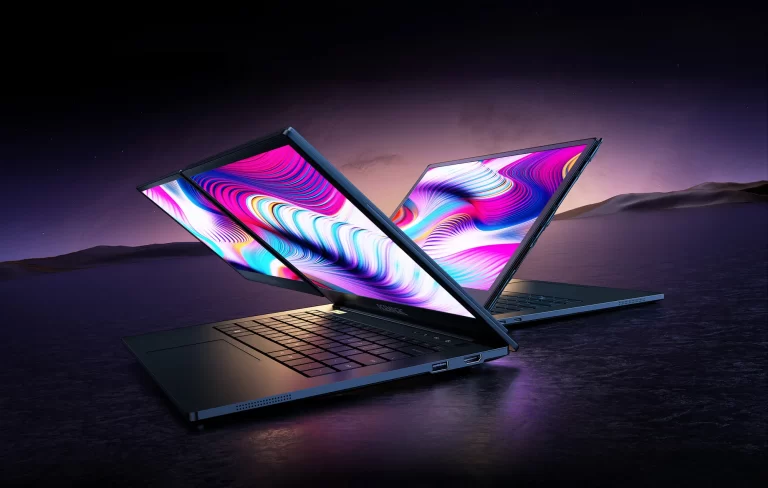
The Acemagic X1 is a new laptop that claims to be the first to integrate a dual-screen setup that can be rotated 360°. The secondary screen can be set in more than one way, offering new possibilities of use and boosting productivity.
The laptop’s two screens are 14 inches. There are two ways to unfold the secondary screen: side-by-side (horizontally) and back-to-back, thanks to a sturdy 360-degree hinge. In the first mode, you can use the laptop as if you had two monitors. This enables more use cases that enhance multitasking. For example, working on one screen and playing a video on another.
Acemagic X1 dual-screen can be set “side-by-side” and back-to-back
The side-by-side mode is useful to take advantage of each screen without wasting space with two or more programs occupying a section of the UI. Then, there is the back-to-back mode that you access after turning the secondary screen backwards. This way, two people can use the device at the same time. For example, a father can work while their son is watching a show. There are already laptops that allow you to rotate the screen for other purposes, such as the Lenovo Flex lineup. However, the inclusion of a dual screen adds more possibilities.
Acemagic had shown the product at the Computex 2024 conference, but under the name Z1A. Now, the dual-screen laptop is called Acemagic X1. Its two 14-inch screens have Full HD resolution. It is powered by an Intel Core i7-1255U processor (10 cores/12 threads). It is rumored that there will be an option with a Core i7-1265U chip, but it has not been confirmed yet.
The Acemagic X1 also has 16 GB of DDR4-3200 RAM and a 1 TB PCIe 3.0 SSD. Other specs include two stereo speakers (2 watts) and a 4,000 mAh battery. Lastly, a pair of NVMe M.2 2280 slots will allow you to expand its storage.
Tecno is quickly becoming a company to worry about, as it’s been expanding its tech portfolio over the past couple of years. It was considered just another B-tier company pumping out cheap phones. However, its stellar Camon 30 Premier (Review) proved that notion to be false. Now, I’ve been given the opportunity to review the Tecno Spark 20 Pro 5G. Does this phone have what it takes to spark your interests, or is it a burnout? Well, that’s what we’re going to find out.
Right now, we’re in an age when premium smartphones are becoming less worthwhile. Each year, the top tech companies charge more and more for the “best” experience. The fact of the matter is that most of what people are paying for, they don’t need. Companies like Samsung and Apple try to make you think that you’re paying $1,299 for their hardware. Rather, you’re paying $800 for the hardware. The rest of the money goes toward paying for the inflated vision; the illusion that what you’re getting is so much better than anything else on the market.
They, and other companies, try to convince you that you NEED all of the extra bells and whistles. The fact of the matter is that most people DON’T. I’ve used and reviewed phones that create a truly flagship-level experience for a fraction of the cost of what the top dogs are charging.
This brings to mind this question: What makes a phone good enough? What are the basics that create a generally reliable experience? Companies like Tecno often have the answer.
Tecno Spark 20 Pro 5G Review: Design
Damn it, Tecno, you never cease to impress me with your designs! Tecno is one of the companies that earns my respect for bringing fresh designs with its phones. Some phones keep a similar design across a year, but other phones receive a complete design overhaul. Also, Tecno is not shy about experimenting with different materials and aesthetics.
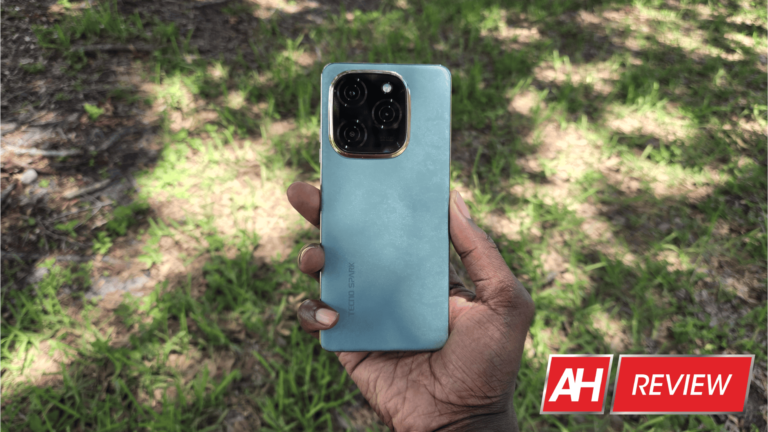
When I took the wraps off of this phone, I didn’t expect what I saw. I have the green colorway of this phone, and it looks absolutely stunning. The back panel has a soft-touch material that feels like a cross between felt and leather. It’s an elegant money-green color that has a cloudy texture. It plays with the light in a very interesting way that’s hard to explain (you kinda need it in your hand).
The back panel is juxtaposed with the gold-colored frame and camera package liner. This color aesthetic makes the phone look luxurious. The materials and colors were chosen to give the Spark 20 Pro the appearance that it came from a boutique store. This is a beautiful phone. It’s not what I’d call elegant, but it’s definitely exciting. The image of the iPhone has been bashed into our heads over the years and Samsung’s modern Galaxy phones are no different. However, the Spark 20 Pro’s design is one that will turn heads.
My only complaint is how significant the camera package is; it’s rather large. I see that there are large rings around the camera lenses. They look like a waste of space. I’m wondering if Tecno could have foregone using the rings to save space to make the camera package just a bit smaller. I know that the company needs space for the camera hardware, but the package is just this big black mass in the middle of the back panel. It clashes with the overall look of the phone.
However, it’s a great-looking phone overall. Tecno has done it again; it delivered an amazing-looking phone to the market. It defies the notion that a phone is automatically doomed to look cheap if it’s affordable.
Tecno Spark 20 Pro 5G Review: Build quality
Ah, the classic downfall of affordable phones. This is something that I have to give props to Samsung and Apple for; build quality. As overrated as these phones can be, you will never pick up a modern Galaxy phone or iPhone and think “This feels like a cheap phone.” They feel so heavy, you could bench press them, and they feel so premium you want to put them in a museum.
Meanwhile, I’ve yet to use a Tecno phone that compares to the feeling of a Galaxy phone or iPhone. The Camon 30 comes the closest, but it still falls short. Well, the Spark 20 Pro is not changing this in any capacity.
This phone’s beautiful design is, sadly, dampened by the cheaper and plasticy feeling in the hand. The pretty golden rail and camera package liner are both made from plastic, and it’s easy to tell. This lends to the overall light feeling in the hand. The glass camera package does add a little bit of weight to the phone, however.
I don’t think that this makes the phone feel bad. It’s just a bit jarring looking at such a premium-looking phone and picking it up. This feeling of lightness gives the user the impression that they’re holding a cheaply-made device.
Bend test
However, that doesn’t mean that it’s cheaply made. In fact, it’s quite the opposite. I did a light bend test on the phone and listened for any sort of creaks or pops. I didn’t hear any, so I can tell that everything was put together properly. Phones made with plastic parts tend to make some sort of noise when stress is applied.
Also, I wasn’t able to get it to flex. In all honesty, I didn’t put a ton of muscle into it, I’ll leave the hardcore bending to Zack Nelson. I applied a bit of force to see how easy it was to get it to flex. It took a bit of force. If you really wanted to, you could snap it, but you won’t need to worry too much about the durability.
Rounding out this section, the buttons are nice and clicky. I feel that the power button is slightly less clicky than the other buttons, but it’s not bad.
Overall
The Spark 20 Pro won’t fool you into thinking that you’re holding a phone that’s more than $400. The lightness and the plastic materials let you know that you’re saving money while buying it (and that Tecno saved money building it).
Is it bad? No. But, I’ve used other phones that felt a bit more premium but cost around the same price. The build quality just isn’t a stand-out feature.
Tecno Spark 20 Pro 5G Review: Display
If you’ve seen my other reviews, you’d know that I have a special place in my heart for Tecno’s displays. The company calibrates its displays beautifully, and I hold them as some of the best displays on the market for color production and overall quality. This also goes for the brightness, which has been increasing over time.
However, this goes for the company’s OLED panels. When it comes to its LCD panels, it sits in the middle of the road. This is how I felt about the display on the Tecno Pova 5. That phone has a nice display, but it didn’t impress me like some of the other phones I’ve reviewed with LCD panels. Its OLED panels, on the other hand, can trade blows with the likes of Samsung.
When it comes to the Spark 20 Pro’s display, I’m not really going to change my tune about Tecno’s LCD displays.
Brightness
Reviewing this phone’s display, I was hit with a wave of nostalgia. I had flashbacks of using phones years ago with displays you could barely see in the sun. Tecno has increased the peak brightness of some of its phones over the years, but the Spark 20 Pro is not evidence of that.
The moment the sun hit the display, the visibility took a substantial blow. It was difficult to see the text, images, videos, games, etc. on the screen. It’s not the kind of phone you’d want to use outside. You’ll be seeing your reflection more than the screen. I feel like it’s similar to the brightness of the Pova 5’s display.
Also, there’s no high-brightness mode. This is the mode that further increases the screen’s brightness when in a bright environment. So, if you plan to use this phone when outside, then you’ll need to keep an eye out for shade.
Colors
Devices like the Galaxy Tab S9 FE, OnePlus Pad, OnePlus Nord N3, and TCL Stylus have some spectacular LCD panels. They’re packed with so much color and calibrated to make those colors look great. So, I’ve definitely used some great LCD displays.
For the Tecno Spark 20 Pro, I don’t have any complaints about the colors. They’re above average for an LCD panel, and they’re nipping at the heels of OLED screens. The colors are pretty saturated across the spectrum with both warm and cool colors. So, you’ll enjoy seeing lush green forests, icy-blue ice caps, and warm sunsets.
I think that the overall color calibration is similar to what I see with Tecno’s OLED panels. The colors are well-balanced, and they have that specific Tecno look. I’d say that the colors are a strong point of the display.
Contrast
The colors are above average, but I don’t think that the contrast is all that great. Looking at high-contrast content, nothing about it really stood out. Black areas are pretty gray. This display is not winning any awards for its contrast.
Adjustments/features
Tecno’s phones usually have a few settings to make the display experience a little better. However, I find that its LCD phones lack in that department. In the display settings, you’re only able to adjust the color temperature. There’s a slider that lets you adjust with some nice precision. You’ll see the color temperature change smoothly as you move.
In terms of features, there’s the Eye Care mode that eliminates blue light. Lastly, this screen caps out at a refresh rate of 120Hz. You’re able to choose between 60Hz, 90Hz, and 120Hz.
Overall
This display isn’t as impressive as the displays in Tecno’s OLED phones, but I won’t say that it subtracts from the overall experience. In fact, this is a generally nice display. It has some nice colors, and it runs at a fluid 120Hz. The only gripe that I have with it is the brightness. Using it outdoors is pretty bad, and it reminds me of phones that are at least six years old.
Tecno Spark 20 Pro 5G Review: Speakers
Oh boy, it’s time to talk about the speakers. The thing is that Tecno phones have great qualities; good speakers aren’t on that list. I haven’t reviewed a single Tecno phone with a pair of speakers that impressed me. They get the job done, and that’s all that I can say.
The overall quality has improved since I reviewed my first Tecno phone, 2023’s Tecno Camon 20 Pro. Since then, I’ve reviewed the Pova 5 Pro, Pova 6 Pro, Phantom V Flip (Review), and Camon 30 Premier. I’ve also reviewed phones from its sister company Infinix (the Infinix Note 30 Pro and Note 40 Pro). The quality has improved since the Camon 20 Pro, I have to admit. However, it hasn’t improved to the point where I’d say they’re particularly good.
Let’s see how the speakers in the Spark 20 Pro perform. Part of the speaker test involved playing six test pieces. Each piece was designed to accentuate a particular aspect of a phone’s speakers. These are the Volume, Distortion, Bass, Treble, Balance, Vocals, and Immersion.
Volume
These speakers are pretty middle-of-the-road when it comes to the volume. They aren’t what I’d call particularly loud, but they’re not too quiet. The speakers are more than loud enough for personal use. I put the phone 1 foot away from an audio meter, and the speakers capped out at 83dB. That’s a little bit quieter than some other phones I’ve reviewed, but it’s not too bad.
Distortion
The distortion was also pretty middle-of-the-road. I felt that the audio starts to distort at the top two or three volume levels. The level of distortion is also pretty average. You’re not going to want to listen to these speakers at full volume if you’re just casually watching a video or listening to music. It’s not bad, but it’s not great. It’s average.
Bass
I feel that Tecno’s speakers typically lack in the bass department. Many of the phones that I used just sound flat. There’s no immersion with the bass. I’m sad to say that Tecno didn’t really do anything to change that this time around.
The test piece that I listened to is a short orchestral piece with plenty of emphasis on the bass. It uses instruments like Double Bass, Bassoons, Contra Bassoons, and Bass Clarinets along with other instruments to fill out the sound.
Just like with other Tecno phones, the lower tones just don’t have any body to them. I can hear the tone of the lower instruments, but it just sounds flat and lifeless. It’s like watching a concert on TV rather than being in the actual concert hall.
I do think that the speakers have just a bit more bass than some of the other Tecno phones I’ve reviewed, but it’s still generally lacking.
Treble
This is another thing that remains constant with Tecno phones. These phones tend to have pretty good treble. Honestly, I think that the higher tones are pretty crisp and clear with these speakers.
The test piece that I used is a short piece with Piano, Celeste, Flutes, Pizzicato Strings, and Violins along with other instruments to fill out the piece. The high-pitched notes really projected nicely. They weren’t the clearest that I’ve heard, but they’re pretty high up there.
Honestly, I think these would be great speakers to have if you are into ASMR. They’re pretty satisfying to listen to if you like the higher and clickier sounds.
Balance
It’s important that the treble and bass mix well when you’re listening to music. The test piece I used to test the balance was a chill-hop piece with an equal focus on treble and bass.
Overall, I think that the speakers are pretty balanced. However, I think that the weak performance in the bass department has an effect. I don’t hear the low end as much as I’d want to. It gets swallowed up by the treble just a bit. So, while the balance is good, it would have been better with a bit more bass.
Vocals
Just like with balance, the vocal performance is important if you want to listen to music on this phone. I listened to a test piece along with several other songs, and I think that these speakers do a nice job with voices.
It gets annoying when you’re listening to a song, and the voices get swallowed up by the rest of the music. With the Spark 20 Pro, the voices all projected nicely in the songs. It’s not quite the best I’ve heard, but it’s still notably good.
Immersion
This is where everything comes together to create a sound that draws you in. There are some phones out there with audio that wraps around the ears. The Tecno Spark 20 is not one of them.
I listened to some lush and encompassing music, and these speakers just fell flat. The bass is lacking and it sounds overall very narrow.
Overall
The speakers in the Spark 20 Pro are just what they are. They’re a set of speakers to get you through the day, and that’s it. I didn’t expect any miracles with this phone, and I didn’t get any. Just like with other Tecno phones, the speakers were very flat. If you’re an avid Tecno user, then you shouldn’t count on these speakers being anything special.
Tecno Spark 20 Pro 5G Review: Performance
Tecno’s phones use the company’s Android skin called HiOS, and this software is typically well-optimized. I haven’t used a phone from the company that performed particularly poorly when it comes to day-to-day use. The Pova 5 Pro stuttered a bit more than I would have wanted, but it was a pretty good performer.
When it comes to the Tecno Spark 20 Pro, I’d say that the performance is pretty par for the course. It uses the MediaTek Dimensity 6080 SoC. This is a pretty mid-range processor that isn’t bad, but it’s not exactly a speed demon. It’s capable of some smooth performance, but it can be pretty easy to push it to its limits.
Running on Tecno’s Android skin, I didn’t run into any instance of serious lag or dropped frames. Navigating the software is super smooth, and that goes for using apps. You think that this isn’t a high bar to clear, but there are some devices out there that have trouble just running the software that comes loaded into them. I’m still in shock from reviewing the TCL Tab 8 LE…
Digging deeper, jumping through apps does seem generally sluggish, and it may be hard for some people to figure out why. While there aren’t any dropped frames or stutters in the software, the thing is that this phone shows its sluggishness in a different area.
When you tap to open an app, takes just a second for it to get to the splash screen. It can be hard to see if you’re not comparing it side-by-side with another phone. After the splash screen, we see that it takes the actual app just a second to load. So, the phone doesn’t slow down during the animations, which would lead to dropped frames, but it takes a second before and after the animations.
The same thing goes for exiting apps. I’d tap on the home button, and it’d be about half a second before I see the actual animation start. It would sometimes be a full second.
Taken alone, these instances aren’t really all that bad. However, if you’re in the middle of using your phone, and it involves jumping between apps, you’ll see the sluggish performance start to slow down your workflow. I didn’t see any dropped frames, but the hesitation between tasks can take a toll.
Benchmarks numbers
I know that benchmark numbers aren’t really a proper measure of a phone’s performance chops, but it’s still interesting to see how the phone stacks up on paper. For this part, I ran the phone through Geekbench 6 and 3D Mark. As I said, this chip isn’t pulling any miracles, and that remains true on paper.
Starting off with the Geekbench scores, the numbers are rather low. We’re talking about how flagship phones used to do almost a decade ago. This phone got a single-core score of 766. To put that into perspective, that’s more than 200 points lower than the Galaxy A54.
Moving onto the multi-core score, it scored 2063. Again, that’s pretty far behind most of the other phones that you can get nowadays. Again, it scores much lower than the Galaxy A54.
As for 3D Mark, the numbers aren’t looking much better. This app runs the phone through an extremely taxing real-time rendered animation, and it monitors how the phone performs. I used the Wildlife extreme test. It got a Best Loop Score of 373 with an average frame rate of 3fps.
Overall
This is not the phone to get if you’re looking for a powerhouse. If you’re trying to get serious work done quickly, then you’ll need to look elsewhere. While the Spark 20 Pro’s performance isn’t problematic, it shows its weakness in certain places. It only makes me wonder how it’s going to perform, a year from now. It’s possible that you’ll start seeing the performance slow down at some point pretty soon.
Tecno Spark 20 Pro 5G Review: Gaming
We often assume that general performance and gaming go hand in hand. The fact of the matter is that some games perform better when it comes to gaming than when it comes to general use. This was the case with the Pova 6 Pro. That phone had the occasional dropped frame when navigating the interface, but it ran Genshin Impact smoothly at its highest graphical settings.
When I saw that the Spark 20 Pro was running the same chip as that phone, I expected a similar performance. This phone also has an enhanced gaming mode that pushes more system resources to the gaming performance. That’s only available for certain games.
2D game
Starting off with a 2D game, I went to the tried and true Survivor.io. While it’s a 2D title, it often has a ton happening on the screen. There are sometimes hundreds of sprites on the screen at the same time, and it can slow down less powerful phones. While playing it on the Spark 20 Pro, there were a handful of instances when I saw dropped frames. The performance wasn’t laggy or stuttery. There were just the occasional dropped frames. This means that more intensive 2D games are sure to slow this phone down.
3D game
Next, I went into 3D gaming and started up Asphalt 9. This is still a pretty intense game nowadays. I turned the graphics all the way to their highest setting. While the Spark 20 tripped a bit on the 2D game, Asphalt ran smoothly. There weren’t any instances of stutters or dropped frames even in the heat of racing.
At this point, games like that, Dragon Ball Legends, and Sky: Children of The Light are middle-of-the-road when it comes to graphical intensity, and I think that this phone handles them nicely. If you’re looking to do some gaming like that, then you won’t have an issue with this phone.
Genshin Impact and Star Rail
Now, it’s time to bring the big dog. Genshin Impact and Honkai Star Rail are two of the most graphically intensive games on the Google Play Store, and they’re some of the best games to test a phone’s gaming chops.
Starting off with Genshin, I turned all of the graphical settings to their highest settings. Several Tecno phones have impressed me with how well they can handle this game, but the Spark 20 Pro’s performance leaves a bit to be desired. The game is playable, but it’s not what I’d call smooth. The frame rate struggles to get above 25fps, it often dips below 20. The sluggish behavior is obvious, but this time all of the graphics turned to their maximum settings.
When I set the graphics to their lowest settings, the gameplay smoothed out. It wasn’t a drastic improvement, but it was noticeable. If you’re a fan of this game, it’s still possible to play it on the Spark 20 Pro. Just know that you’ll need to lower the graphics or deal with substantial stutters.
Star Rail is a game that’s also graphically intensive, and I’m sad to say that the story is worse for this game. The frame rate struggles to get above 10fps with the graphics turned all the way up. On average, Geshin Impact seems to be better optimized than Star Rail, so I tend to get better performance with the former.
With its graphical settings all the way up, I wasn’t able to get more than 10fps. It didn’t matter if I was running through a closed environment or in battle, the game just lagged. Turning the setting to Very low smoothed out the gameplay and gave me about 29fps. The gameplay was smooth with the occasional dropped frame.
Overall
I didn’t expect to get stellar gaming power from the Tecno Spark 20 Pro, and I’ve used phones with the Dimensity 6080 before. While some companies can surprise you, there were no cards up Tecno’s sleeve this time around.
The overall gaming capabilities of this phone aren’t bad. I wasn’t able to run Genshin or Star Rail at their highest settings, but if you’re shelling out for this phone. Let’s be honest, you’re not getting it with the goal of running those games at their full graphical settings. If you want to play these games, you’re more than able to turn the graphics down. Start Rail runs smoothly on Very low and Genshin Impact runs smoothly on High. It’s an average phone for gaming.
Tecno Spark 20 Pro 5G Review: Camera
My history with the cameras in Tecno’s phones is a little complicated. I had very little hope for the brand’s cameras after the abysmal camera from the Camon 20 Pro. That was probably the worst camera I’ve reviewed in a smartphone. However, every phone I’ve reviewed after that was much better the Tecno Phantom V Flip having my favorite performance.
Since the Spark series is on the lower end than the Camon series and the company’s foldables, I didn’t really know what to expect.
Exposure/contrast
When it comes to exposure, I think that the Spark 20 Pro did a really good job at matching the scene. In fact, I’d say it does one of the best jobs out of the phones’ I’ve reviewed. Some of the images, like the one of the rocks, seemed a little dark, but that might have been because of the intense contrast. Even the brightly lit part of the image seemed a little bit dim.
Moving on to the contrast, I was also impressed with this phone’s performance. Some of the images that the phone produced had great contrast. For example, this image of the pile of rocks came out perfectly, and I love the image of the leaves on the ground.
Next. This image of the wall came out amazing as well. There was some nice detail on the wall’s texture. While the wall was the start of this show, the trees and shadows in the background were a little too dark.
I also felt this with the picture of the Stop sign.
It’s not too bad, but I think that you’ll notice it in the images.
Colors
Color reproduction is important to any camera, even though it’s a pretty subjective topic. Looking at the images, I think that Tecno strove for balance over pretty colors.
Oftentimes, cameras tend to boost the greens and reds, but I felt that Tecno kept them pretty well in line. The bright pink pipes would usually be nuclear in the bright sun. The Spark 20 kept them subdued along with the green leaves. The camera gets points for color accuracy, but I would have liked to see just a little more color coming from them.
However, that’s not the story for all of the pictures because in this image of these leaves, there’s just a bit more punch.
Moving on to warmer colors, this yellow flower was nicely represented. The color was nicely saturated, and there was a nice boost to the greens.
When it comes to blues, I think that this phone gave the sky a beautiful color. It’s easy to overdo it with the sky. But, I think that the camera was true to the actual color of the sky.
I think that when it comes to the colors, Tecno played it safe, and that led to some very respectable photos.
Lens flares
One issue I had with this phone that I didn’t have with others was the lens flares. This didn’t happen too often in the images, but I saw them in two. I noticed that they happened with images pointed toward the sky. I see the flares cut across the screen. That’s something that you’ll need to keep in mind. They could ruin a shot.
Low light
When it comes to the low light performance, the results I got were pretty par for the course for an affordable phone. Mid-range phones are at a point where they’re about as good as flagship phones from about half a decade ago in terms of low-light performance. While inside, the Spark 20 Pro was able to pull in some nice details. This is in the evening with diminished sunlight peeking through the blinds.
That first image was pretty good, and it didn’t even suggest that I use the night mode. However, when I brought the lights down even more, it automatically enabled the mode.
The image above was still pretty good in terms of exposure. I can make out details on the floor and the phone’s front cameras. As you can expect, the lower light softens the details just a bit. I didn’t see the details drop that much. With the drop in details came a rise in digital noise. Also, I saw the color saturation drop.
Turning down the lights even more, I definitely ran into some issues with focusing. I saw the phone struggle to focus. This is understandable, but I wouldn’t have had as much trouble with a more expensive handset. Also, the longer exposure didn’t really help out the image. It was still pretty dark.
Overall, I think that the low-light performance isn’t all that bad. It’s pretty average for a modern mid-range phone.
Video
Let’s not kid ourselves, trusting video to be good on a mid-range Android phone is pretty optimistic. The details are pretty bad and the contrast took a major hit. Also, there was no stabilization to be seen. Overall, you’re not going to want this to be your main content creation phone.
Overall
I think that, for the price of this phone, the Tecno Spark 20 has a really good camera. It’s not going to wow you, but I was able to get some generally nice shots. It has its shortcomings, but it’s still a quality camera.
Tecno Spark 20 Pro 5G Review: Battery
So far, my review’s been pretty positive, but this is going to be a bump in the road. This is odd for a few reasons. Firstly, Tecno phones tend to have some pretty good battery life. Second, the Spark 20 Pro has a large 5,000mAh battery.
So, it’s odd that this phone’s battery life is so bad. To test the battery, I charged the phone and played a looping video until it died. Phones with the best battery life last more than 20 hours with the Galaxy S24 Ultra lasting more than 25 hours. Other phones with good battery life last between 15 and 20 hours like the Tecno Camon 30 and the Poco F6 Pro. Some of the worst offenders I’ve reviewed lasted a whopping 10-11 hours like the Moto G 2024 and Moto G 5G 2024.
The Tecno Spark 20 Pro…. lasted 8 hours and 57 minutes. That’s the worst battery life of any phone I’ve used this test on, and I’m wondering what the heck happened. Like I said, it has a 5,000mAh battery, and it’s a Tecno phone. I started the video in the mid-afternoon, and I didn’t expect it to die until early in the morning. However, it was dead before midnight.
If you’re going to use this phone, then you’re going to need to keep it near a charger. Thankfully, the Spark 20 Pro comes with a 33W charger out of the box. Charging technology is just like most others; it’s so easy to be fooled by bigger numbers. Sure, there are phones out there with 68W, 80W, 100W, and 120W chargers. Those numbers are big, but you start seeing diminishing returns the higher you go. In all honesty, jumping from 80W to 120W actually only knocks a few minutes from the overall charging time.
You’re more than fine with the 33W charging. It’s able to charge the phone from 10% to 100% in just over an hour.
Tecno Spark 20 Pro 5G Review: Final verdict
This brings me to the question: what is good enough? You’re obviously not paying $1,000 for good enough; you’re paying that much money for over the top. But, what kind of phone is just enough to cover the bases and give you a generally good smartphone experience? Well, the answer is the Tecno Spark 20 Pro.
It’s very possible for phones with a ton of bell and whistles to fail in certain respects. And, phones like those tend to distract from phones like the Spark 20, phones that do a good job of just prodiving a solid smartphone experience to get you through the day. There aren’t any fancy camera tricks, no on-device AI, no super saturated OLED display, or premium design. It’s just a solid, meat and potatoes, phone. While I’m rocking the Galaxy S24+ (a phone with enough bells and whistles to play in an orchestra), I rather enjoyed my time with this phone.
The battery needs improvements and the speakers aren’t much to write home about, but this phone makes up for them with a nice display, quality camera, relatively smooth software experience, decent gaming chops, and beautiful design.
Honestly, if you could spare the extra coin, I’d recommend getting a Poco F6 or Tecno Camon 30 over this phone. However, I don’t have any reservations about recommending the Tecno Spark 20 Pro.
56 years. How does a company pay tribute to such a long legacy? Well, it keeps making great devices that show how it’s been able to stay in business for so long. Cambridge is a British audio company that hit the scene back in 1968. It’s become synonymous with top-tier audio. That association is well deserved, as the company has launched some rather amazing products over the past half-century. I was given the opportunity to review the Cambridge Melomania M100, Cambridge’s first TWS earbuds.
The road to being an audiophile is not a cheap one to travel, and you’re likely to run into some roadblocks…. by that, I mean you’re likely to run into some super expensive piece of hardware that you can’t hope to afford. Getting the best audio quality imaginable requires several pieces of equipment, but it doesn’t have to always be that way. The M100 are a pair of TWS Bluetooth earbuds, and their price is more than attainable for the average Joe.
As such, you know that you’re not going to be getting the same quality as what you’d get from an expensive pair of wired headphones. However, what makes any company great is the ability to make quality products despite innate drawbacks. Cambridge designed these earbuds to give you amazing sound quality, no matter what sort of technology they use. Are these a quality pair of earbuds, or does the company’s legacy stop at 56 years? Let’s find out.
Cambridge Melomania M100 Review: Design
Cambridge’s devices have a certain aesthetic to them. They mostly have a sleek and professional look. There’s a lot of gray and a lot of sharp corners. I think that the M100 stays to this aesthetic. They only come in one colorway, and that’s a dark gray color. They won’t stand out because of their color.
However, it doesn’t mean that they’re boring. The Melomania M100 have a pretty sleek design with a pleasing irregular shape. We see one of the microphones on the outside which lends a metallic accent to the design. Also, there’s a pleasing ring around the touch-sensitive buttons that do much the same thing.
The company wasn’t going for flashy, as that’s not a part of Cambridge’s identity. Rather, it went for a more elegant and downplayed look. They don’t need to have a radical look to them anyway. Samsung’s earlier earbuds like the Galaxy “Beans” really stood out for their design because that was back when Samsung was the fun company. So, it made fun-looking devices.
With the Melomania M100, you’re not exactly buying them for their radical looks. These earbuds aren’t going to turn heads like a phone would. They do look very nice, regardless.
The charging case shares this look. It’s a very straightforward pill shape, but it has a nice silver ring around it to give it a little bit of flair.
Cambridge Melomania M100 Review: Build quality
Durability seems to be more of a hot topic with phones, but you shouldn’t ignore the build quality of the earbuds you’re using. Earbuds are small; they can fall out of your ear or be stepped on. Cheaper earbuds wouldn’t really be able to take a ton of abuse without some sort of damage. I’ve used earbuds in the past that have gotten damaged from simple falls.
When I pick up the Melomania M100, I get the sense that they’re well-made. All TWS earbuds are light, so the difference in weight between cheaper and more expensive earbuds isn’t all that significant. However, it’s still a difference that you can feel.
Just like with smartphones, you can get a sense of how much effort went into putting the earbuds together. The Melomania M100 feel like they were made with quality materials. When I pick them up, I can feel a nice little bit of heft to them. It’s not immense, but they’re a little bit heavier than cheaper earbuds. Also, it doesn’t feel like the plastic being used is of low quality. Even smaller devices can be built properly, and I think that these earbuds were definitely built properly.
The same thing goes for the charging case. Just like the earbuds themselves, the charging case is susceptible to drops. The case does feel like it was made with quality plastic. It feels like both the case and the earbuds will last me a long time, and that’s the best feeling to have with any device.
Now, let’s dig into the most important aspect of these earbuds. When it comes to reviewing any sort of audio equipment, I focus on the scientific side of testing, and I also focus on the experience. It’s hard to give a good assessment of a pair of earbuds without paying attention to both.
As a disclaimer, there are ways for you to customize the audio through the Melomania app. However, I will be testing the earbuds using the out-of-the-box settings. So, if it sounds like these earbuds have a quality that you don’t like, just know that you’ll be able to make a change if you want.
Starting off with the scientific side of the equation, I ran these earbuds through a few test pieces. Each piece focuses on one aspect of the audio experience. I have a piece that tests the Bass, one for Treble, one for Vocals, one for clarity, and one for Immersion.
Bass
Starting off with the bass, I think that these earbuds handle the bass in quite possibly my favorite way. I’ve used my fair share of earbuds and headphones that put too much emphasis on the low-end. It’s good never when cheaper headphones come like this because they’re not properly calibrated to present that heavy bass in a pleasing way. They wind up sounding muddy.
This is a problem that I didn’t experience with the Melomania M100. There was a good amount of bass to the sound, but the company was able to make it significant without sounding muddy. When I played the test piece, the bass immersed my ears, it didn’t smother them.
The test piece that I used is a short orchestral piece with a heavy emphasis on the lower instruments. It has instruments like Double Bass, Bassoon, Contra Bassoon, and Bass Clarinet along with other instruments to fill out the sound. While the bass was substantial, I was still able to hear the subtle details in the sound like the texture of the Bassoons’ sound and the grit from the bow running across the bass’ strings.
The low end is warm and encompassing, but it gives the ears room to breathe.
Treble
The treble is another area I feel Cambridge did a great job. The test piece I used focused on higher instruments like Violins, Celeste, Piano, and Flute. So, it’s important that these instruments are heard without sounding shrill. If the high-end isn’t properly calibrated, then it could be uncomfortable to hear.
With the Melomania M100, every note sounded crisp and clear. None of the notes were uncomfortable to listen to, and I could hear every detail in them.
It’s often easy to overlook the treble in the sound. A lot of modern music focuses on adding more low-end into the sound, and this is why so many companies design their headphones accordingly. However, if you plan on listening to music for extended periods of time, then you’ll want to make sure that all of the higher notes you hear aren’t causing you any sort of fatigue. These earbuds sound great on the high-end.
Vocals
Unless you have other diabolical plans, you’re buying earbuds to listen to music. As such, they’ll need to reproduce voices nicely. The voices should sound clear and project over the rest of the music.
I’d say that this is the only area where I wasn’t blown away with the M100. Don’t get me wrong, I think that the vocal performance is great. I can hear the voice in the test piece clearly. I’m able to hear all of the nuances and details in the voices.
The only thing is that the voices tend to get just a little bit swallowed up by the music. There are times when I would have liked to hear just a bit more power from the voices. It’s not bad, but I just feel that it could have been just a bit better.
Clarity
If you’re streaming 4K content, what’s the point of watching it on a 720p display? It doesn’t matter how high-quality the music is that you’re streaming, you need to use a pair of earbuds that can properly reproduce a high-quality sound.
The Melomania M100 use Qualcomm’s aptX codec, which means that music can stream at up to 24-bit/96kHz, which gives you a max bit rate of 4,608kbps. So, you can listen to some highly detailed music. This, in tandem with the well-engineered audio drivers in the earbuds, produces a very detailed sound.
The sound comes out crisp and clear, and that goes for the whole frequency spectrum. That was one of the things that struck me when I first started using them. I can hear so much detail in the sound.
Immersion
Lastly, you’re going to be using these earbuds to listen to grand and encompassing music. You’re also likely to watch movies with them as well. As such, you’ll want to make sure that you’re right in the middle of the audio you’re listening to.
In terms of overall immersion, I think that these earbuds do a great job. The sound surrounds me. I feel the same way when I’m watching movies. I can feel everything that happens on the screen.
Overall
When it comes to the scientific test, using specifically-tuned benchmark pieces, I think that these earbuds are fantastic. They focused on different aspects of the sound taken alone. However, there’s more to the audio experience than that.
In this next section, I’ll be focusing on putting it all together. I’ll give you my experience with listening to several genres of music rather than test pieces. I’ll be using certain genres of music that I typically listen to and some that are outside of my listening circle.
Speakers and headphones convey different genres of music differently. If you’re buying a pair of earbuds, then you’ll want to know how they perform with your favorite genres of music. So, let’s dive in.
Classical
Classical music is an extremely diverse genre of music, but I think that the overall balanced audio that these earbuds produce makes listening to classical extremely enjoyable. Earbuds that focus too much on the bass really ruin the classical listening experience because you lose so much detail in the lower instruments because of the muddy reproduction. However, that’s not the case with the Melomania M100.
This, coupled with that crisp and clear audio makes these great earbuds for classical. I’m able to hear so much detail in all of the instruments’ sounds. It doesn’t matter the timbre or register, I can hear it all.
70s pop
Let’s jump ahead a few hundred years. 70s pop had a very specific aesthetic that I enjoy. There’s a certain warmth to the sound, and I think that it plays nicely with the Melomania M100. The deep electric bass rings nicely.
80s pop
Making the shift to 80s music, we hear a shift to a focus on higher tones. As such, I didn’t really hear as much warmth as with 70s music. But there was something else that I heard, punch. Hearing those electronic drums, loud snare crashes, and synthetic basses just added so much impact to the sound. I really liked how much punch I was hearing without needing to turn the volume up too much.
Also, since these earbuds are great at reproducing higher tones, everything sounded nice and balanced. Those trademark 80s high synth and synthetic horns sounded great.
90s R&B
In the 90s, we saw a reintroduction of warmth, and things got even warmer. I liked how these earbuds did with 70s music, but I think that the sound is much more engrossing and wide with 90s music.
Just like with the bass test piece, the bass sounded powerful, but it didn’t sound muddy. That’s one thing that I appreciated with the overall sound.
It’s not only about the low-end. I felt that there was an excellent balance overall with the higher tones. Getting a good balance with music that’s so warm is a challenge, and the Melomania M100 did a great job.
Modern pop
Nowadays, music tends to bring more punch and bass than music from a few decades ago. This is something that I noticed. Just like I said with 80s music, the punch was really satisfying, and I was able to feel a ton of impact without needing to turn the volume up all that much. The bass wasn’t quite as warm, but it was still really significant.
One thing I noticed was that I could hear the voices just a bit clearer with modern pop than with other genres. It wasn’t a massive difference. However, it’s something that stuck out to me.
Overall
There goes the unscientific test. I listened to several genres, and I think I was able to cover a wide range of moods. The Melomania was able to excel in all of them. Everything I listened to sounded amazing, and I wasn’t surprised after the scientific test.
When you have a high-quality pair of earbuds like these, you know that they’ll come with ANC (active noise cancelation). This technology is great for eliminating background noise from your environment to better isolate you with your music.
Just like everything else with these earbuds, I think that the noise cancelation is top-notch. With it on and turned to its maximum setting, I feel like the world gets turned on mute when I activate it. The earbuds do a great job at eliminating a wide range of noise.
There are three different settings that you can use for the noise cancelation. The Low setting won’t block as much noise from your environment. I mostly use that setting when in my room. Middle will cancel out a bit more noise, and that’s good for people in slightly noisy indoor environments. Lastly, there’s the High mode. This mode filters the widest range of noise in my environment. It uses more battery, but it’s worth using when I’m out and about or in a coffee shop.
Overall, this is the best noise cancelation of any pair of earbuds that I’ve reviewed.
Cambridge Melomania M100 Review: Feeling in the ear
I mentioned that these earbuds have a little bit of weight to them. However, they still feel light. They’re lightweight enough to sort of “disappear” in the ear. I often forget that I’m wearing them, and that adds to the overall experience.
It’s the goal of earbuds makers to make it feel like you don’t have anything in your ear. They want to make you feel like the sound just exists around you. It’s like how VR headset makers are trying their hardest to make it feel like there’s nothing on your head so you can feel like you’re inside of the action.
They’re extremely comfortable to use, and I can wear them for long stretches of time.
Cambridge Melomania M100 Review: Battery
A pair of earbuds can be the best pair on the market, but they’re not much if they don’t turn on. Battery longevity is a major subject with earbuds because they’re so small. You’re likely to bring your earbuds with you on a long work day or trip, so being able to last the long haul is super important.
In all honestly, I’ve used these earbuds for both work and play, and I’ve yet to get to the point where they died on me. I have them connected to both my computer and phone, so they see a lot of use in the day. I’ve used these for between six and seven hours a day usually, and I still have some gas in the tank before I have to put them in the charging case. This is with the ANC constantly on as well.
Cambridge says that these are rated to last up to 10 hours on a single charge. I know that I won’t be able to get that number, but I know that I should be good to get up to about eight hours on a single charge. With the charging case, I’m able to get about a day of consistent listening. So, if you’re a casual listener, then you should be able to get about two or three days of listening before you need to plug in the case.
Speaking of the case, I like that the company gave the case wireless charging. When I charged the case, it took about two hours to charge completely. That’s something that you’ll need to keep in mind when you’re charging it.
So, when it comes to battery power, the Melomania M100 are some of the best on the market as far as TWS earbuds go. It’s really good with the ANC turned on. With it off, it’s incredible.
Cambridge Melomania M100 Review: App experience
This is a pair of premium earbuds, so of course it’s going to be an app experience. These earbuds connect through the Melomania app, and it allows you to change certain settings to customize your experience.
The app experience is definitely one of the best that I’ve used, and it’s available for both Android and iOS. I feel that it falls a few steps behind the Edifier Connect app, but it’s still a great experience.
In the app, I can adjust the built-in EQ, change between normal, noise cancelation, and transparent mode, adjust the audible feedback, enable sleep mode, enable gaming mode, and choose an auto power-off timer.
EQ
The EQ is a welcome feature. When you open the EQ, you’ll see six different EQ presets that are set to different types of content. If you want to have a little more control over your sound, then you can adjust the EQ manually.
It’s a 7-band EQ, and it gives you some nice control over the sound. It’s not as intricate as the EQ in the Edifier Connect app, but it’s still pretty nice. Once you make your adjustments, you have the option to save your settings as a preset.
Touch controls
The Melomania M100 have 10 different touch controls that you can use. That’s a good amount compared to other earbuds. You’ll use a combination of tap gestures, hold gestures, and double-tap gestures to use certain controls. Unfortunately, you’re not able to choose which gestures perform which action. What you can do in the app is enable/disable different commands.
The app experience
The overall experience is pretty nice, to be honest. I mentioned the Edifier Connect app, which is more robust. However, it takes about 20 seconds for you to actually get into the app. You have to go through a lengthy splash screen and then wait for it to detect your earbuds. It’s pretty tedious. As for the Melomania app, it takes a few seconds to get in, but it’s closer to five or six seconds.
Everything is laid out in an easy-to-read feed of items, so you don’t have to dig into menus. If you want to change a setting, all you have to do is flick your finger and you’ll most likely see it. Also, once you change a setting, you’ll hear the effect right away.
I don’t have any real complaints about the app experience itself. You’ll want to install it if you want to boost your overall experience.
Cambridge Melomania M100 Review: Final verdict
This is Cambridge’s first pair of TWS earbuds, and I feel the same way about these that I felt about Beyerdynamic’s first earbuds. Even though the company dipped its toe into a completely new form factor, it did an amazing job. Just about every aspect of these earbuds is amazing. From the sleek and elegant design to the app experience to the battery life, everything is high-quality.
Also, let’s not forget about the sound! I was extremely impressed with just how amazing these earbuds sound. I was surprised at how great a pair of Bluetooth earbuds can sound. Not only are these earbuds held back by the limitations of Bluetooth itself, but I was using them with my Android phone. Android caps out at a 48kHz sample rate. Even with these drawbacks, the Melomania M100 sound truly amazing. The audio is so detailed and clear, and it brings so much punch.
If you’re looking to become an audiophile, why not use a pair of earbuds from a true audiophile company? The Cambridge Melomania M100 are some of the best TWS earbuds that you can buy on the market, and I highly recommend that you buy them.
Threads has crossed another user threshold. The company’s CEO Mark Zuckerberg has just announced that Threads now has more than 175 million monthly active users. Notably, the social networking platform has gained over 25 million users in just the last two months.
Threads achieved the 175 million users milestone a year after the launch
Notably, Threads managed to acquire 100 million downloads in its first week after the launch on July 5, 2023. However, it did see a major drop-off in user engagement later on. Since the early success wasn’t sustained, the app’s user base plummeted more than 80% to 8 million daily active users by the end of July 2023. The app was initially released for iOS devices. Later, it was also made available for Android and desktop browsers as well.
Meta’s rival to X is growing at a steady pace this year – although not as quickly as its huge launch. In February, Threads achieved 130 million monthly active users across the globe. The promotion of the app on Instagram and Facebook is the major contributor to the growth. Meta now seems to be focusing on markets where it thinks Threads can take more users from X.
Threads continues to launch new features to grow its user base
Meta has been releasing new features for Threads from time to time to grow the overall user base. Most recently, Threads launched its API for third-party companies. It will enable developers to start working on apps or “experiences” around the Threads social platform. The company has been testing the API functionality with third-party developers since March this year. Now, it is finally available for all third-party developers.
Threads also received new post swipe gestures recently, which allow users to easily curate their recommendations. More features for the growing social media platform are in the pipeline and will be released in the future.
The AI craze has put Google‘s 2030 “net zero” target in serious doubt. The company is rapidly expanding its AI data centers, leading to an increase in carbon or greenhouse gas (GHG) emissions. It’s GHG emissions surged 48% between 2019 and 2024. The firm is still committed to the 2030 target but says the goal is “extremely ambitious,” which isn’t quite a positive outlook.
Google’s carbon emissions have increased drastically in recent years
Like most other tech companies, Google is putting in efforts to reduce carbon emissions and increase the use of renewable energy sources for a sustainable future. While it has made significant progress towards some of its mini-goals, like using plastic-free materials for packaging, its biggest goal appears to be going further away.
In its 2024 environmental report, Google revealed that its carbon emissions increased 13% year-on-year in 2023. As noted by Ars Technica, its pollution amounted to 14.3 million tonnes of carbon equivalent last year. That’s a massive 48% jump from 2019, a surprising movement in the opposite direction. The company should have been cutting its pollution but is adding to it.
Google says data center and supply chain expansions were the main reasons for this massive jump in carbon emissions. Its data center power consumption increased by 17% in 2023 and now accounts for 25% of the company-wide consumption. The firm’s data centers alone accounted for 7-10% of global data center energy consumption. The centers also consumed 17% more water in 2023.
Despite being headed in the wrong direction, Google is committed to the 2030 “net zero” target. The company says it’s an extremely ambitious goal made more challenging by the urgent need to bolster AI infrastructure. However, it is up for the challenge. “Scaling AI… is just as crucial as addressing the environmental impact associated with it,” Google said in its environmental report.
The company’s Chief Sustainability Officer Kate Brandt added that the firm was “working very hard” on reducing its carbon emissions. It has signed deals for clean energy and is exploring opportunities for AI-powered climate solutions. These efforts may bring the desired results in the long run. “We do still expect our emissions to continue to rise before dropping towards our goal,” said Brandt.
Google replenished 1 billion gallons of water in 2023
Google’s water stewardship projects replenished an estimated 1 billion gallons of water in 2023. That amounts to 18% of its freshwater consumption last year, a 3x jump from 6% in 2022. The packaging materials for products launched in 2023 were also at least 99% plastic-free, with the Pixel 8 and Pixel 8 Pro packaging using 100% plastic-free materials. Google says it is using AI to advance climate action by organizing information, improving prediction, and improving optimization.
Hiap Seng Industries, a prominent engineering and construction company, has fallen victim to a ransomware attack that compromised its servers.
The company has swiftly taken measures to contain the breach and ensure the continuity of its business operations.
Upon discovering the ransomware attack by the Edge reports, Hiap Seng Industries immediately isolated its servers from the network to prevent the further spread of the malware.
The company activated its restoration and recovery protocols to maintain business continuity.
These steps are crucial in mitigating the impact of such cyberattacks, which can often lead to significant operational disruptions and financial losses.
Hiap Seng Industries reported that there has been no material impact on its business operations due to the incident.
This swift response highlights the company’s preparedness and resilience in the face of cyber threats.
"Is Your System Under Attack? Try Cynet XDR: Automated Detection & Response for Endpoints, Networks, & Users!"- Free Demo
The company is committed to restoring normalcy and ensuring its clients and stakeholders experience minimal disruption.
Forensic Investigation and Cybersecurity Enhancement
Hiap Seng Industries has engaged third-party cybersecurity experts to conduct a thorough forensic investigation in response to the attack.
These experts will analyze the breach to understand how the ransomware infiltrated the system and identify any potential vulnerabilities.
The findings from this investigation will be pivotal in strengthening the company’s overall cybersecurity posture.
The appointment of external experts underscores Hiap Seng’s dedication to safeguarding its digital infrastructure.
By leveraging the expertise of seasoned cybersecurity professionals, the company aims to fortify its defenses against future cyber threats.
This proactive approach is essential when cyberattacks are becoming increasingly sophisticated and frequent.
Gogs is a standard open-source code hosting system used by many developers.
Several Gogs vulnerabilities have been discovered recently by the cybersecurity researchers at SonarSource.
Gogs can be hacked through these flaws, which put its instances at risk of source code theft, backdoor implantation as well as code removal.
Gogs Vulnerabilities
Despite Gogs’ widespread use, with more than 44,000 GitHub stars and 90 million Docker image downloads, these vulnerabilities remain unpatched.
This finding highlights the need to secure development tools and self-hosted code repositories.
"Is Your System Under Attack? Try Cynet XDR: Automated Detection & Response for Endpoints, Networks, & Users!"- Free Demo
The Gogs’ built-in SSH server contains an Argument Injection Vulnerability that allows authenticated attackers to execute any command on the server.
The vulnerability exploits the ‘–split-string‘ option in the ‘env’ command to bypass security measures.
As a result, this vulnerability continues to be unpatched even in the latest Gogs release (0.13.0).
This security issue is consequently exposed in about 7,300 open Gogs instances on Shodan that largely endangers source code integrity and server protection for several organizations using Gogs for code hosting, reads SonarSource report.
Shodan report (Source – Sonar)
In order to exploit the Gogs SSH server vulnerability, three conditions must be met:-
The built-in SSH server needs to be switched on.
There is a necessity for an authentic SSH key.
The use of “env -–split-string” compatible version.
Exploitable set-ups typically employ GNU core-utils in Ubuntu or Debian, while Alpine Linux-based Docker images and Windows installations are not affected.
If registration is enabled, attackers can easily create accounts and add SSH keys. Admins can confirm this vulnerability by checking their SSH settings in the admin panel and look if ‘env –help’ shows ‘–split-string’ among its options.
Gogs maintainers ceased communication after initially accepting vulnerability reports, leaving all four reported issues unpatched in the latest version.
As a result, users must implement their own mitigations to protect their installations.
Recommendations
Here below we have mentioned all the recommendations and mitigations provided by the security analysts:-
TotalEnergies Clientes SAU has reported a significant cyberattack that has compromised the personal data of 210,715 customers.
The incident has raised serious concerns about data security and the integrity of digital infrastructures in the energy sector.
Unauthorized Access Detected
TotalEnergies Clientes SAU detected unauthorized access to one of its sales management computer systems, which exposed sensitive customer information.
The company has expressed deep displeasure at the breach, highlighting the potential risks such incidents pose to the market’s proper functioning.
“We apologize and condemn this type of criminal act that puts the proper functioning of the market at risk and harms both customers and companies that respect current legislation on data protection,” stated company sources.
In response to the breach, TotalEnergies emphasized its commitment to data protection and confidentiality.
"Is Your System Under Attack? Try Cynet XDR: Automated Detection & Response for Endpoints, Networks, & Users!"- Free Demo
The company stated in a public announcement that “the protection and confidentiality of our customers’ data is an absolute priority.”
TotalEnergies acted swiftly to address the issue, collaborating closely with the Police and the Spanish Data Protection Agency.
The company is determined to initiate all relevant legal actions against those responsible for the cyberattack.
Industry Impact and Future Measures
This cyberattack on TotalEnergies Clientes SAU underscores the growing threat of cybercrime in the energy sector.
The breach affects the company’s customers and raises broader concerns about the security measures in place across the industry.
TotalEnergies’ prompt response and cooperation with authorities highlight the importance of robust cybersecurity protocols and the need for continuous vigilance.
As investigations continue, TotalEnergies assures its customers that it is taking all necessary steps to prevent future incidents and enhance its cybersecurity framework.
The company’s proactive stance reminds us of the critical importance of data protection in an increasingly digital world.
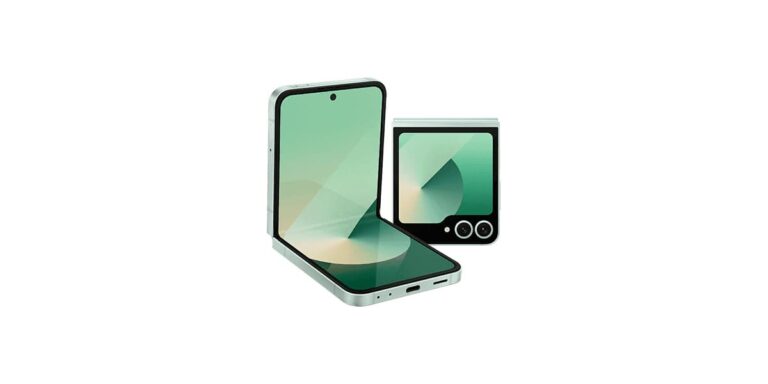
The Samsung Galaxy Z Flip 6 will arrive in a week, and its specs have just leaked again. This time around, the details are coming from Ishan Agarwal, a well-known tipster. This is not the first time we’ve seen the phone’s specs, though this leak is quite detailed.
The Galaxy Z Flip 6 specs have just leaked again, and there’s not much left to hide at this point
The phone will feature a foldable 6.7-inch fullHD+ display with a 120Hz refresh rate. The tipster also says that a 4,000mAh battery will be included on the inside. What’s interesting here is that he also mentioned 35W charging.
Ishan doesn’t seem to be sure about the charging info, however. Previous rumors said 25W charging will be included, and some certifications agree with that. So chances are we’ll be getting 25W charging, not 35W charging.
A camera improvement is in the cards
In any case, two cameras will sit on the back of the phone… well, on the front if the phone is folded. A 50-megapixel main camera (f/1.8 aperture) will be backed by a 12-megapixel ultrawide unit (f/2.2 aperture).
On the main display, the phone will also include a selfie camera, of course. A 10-megapixel (f/2.2 aperture) unit is the camera Samsung chose to use here.
In regards to RAM, only one variant will be available, a 12GB one. Samsung will almost certainly use LPDDR5X RAM here. You will be able to choose between 256GB and 512GB storage options, however. UFS 4.0 flash storage will hopefully be used.
The Samsung Galaxy Z Flip 6 will measure 165 x 71.7 x 7.4mm when folded, based on Ishan’s info. That’s basically all the information that he shared. The phone will launch on July 10 during the company’s event in Paris, France.
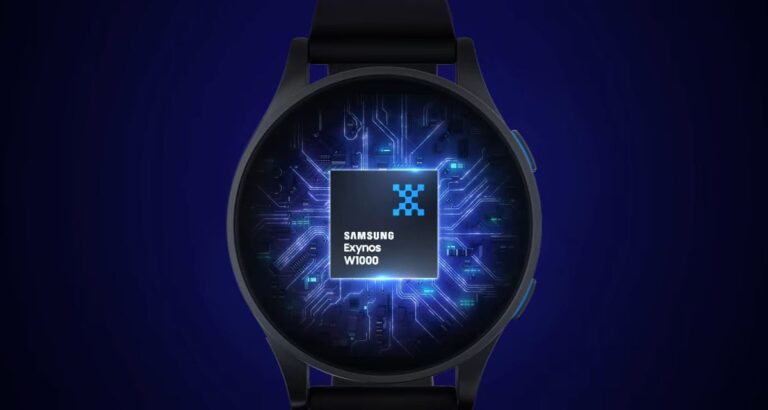
Samsung has launched its first 3nm processor, the Exynos W1000. The new chip will probably power the Galaxy Watch 7 and Galaxy Watch Ultra arriving next week. The company touts “groundbreaking performance” to improve your health, fitness, and productivity from your wrist.
Exynos W1000 finally arrives as Samsung’s first 3nm mobile chip
Samsung started 3nm mass production two years ago but never made a mobile chip on its first-gen 3nm GAA (gate all around) process node. The Exynos W1000 is fabricated on the second-gen 3nm node, its most advanced fabrication process yet. This is already a massive upgrade over the 5nm Exynos W930 powering the Galaxy Watch 6 series. The Galaxy Watch 4 and Watch 5’s Exynos W920 is also a 5nm chip but with a slightly slower CPU.
Speaking of the CPU, Samsung has upgraded the new chip to a penta-core design (five CPU cores), up from two cores. The Exynos W1000 has one ARM Cotex-A78 prime core clocked at 1.6GHz and four Cortex-A55 efficiency cores at 1.5GHz. The company says this CPU setup redefines smartwatch performance capabilities. This architecture brings a 3.4x boost in single-core performance and a 3.7x boost in multi-core performance over the previous generation.
In practical terms, apps will launch faster (up to 2.7x quicker), while switching between apps will also feel smoother. The Exynos W1000’s FOPLP (fan-out panel-level packaging) technology and other technological advancements, coupled with a 3nm process node, make it extremely compact and more power-efficient. This significantly improves the battery life as Samsung can utilize the extra space to equip the watch with a bigger battery.
The Exynos W100 also boasts a 2.5D always-on display (AOD) engine for a more refined AOD experience without taking a toll on the battery life. The Mali-G68 MP2 GOU seemingly carries over unchanged. It can handle qHD displays at up to 640 x 640 pixels or 960 x 540 pixels resolution. The chip supports 32GB of eMMC storage, LPDDR5 memory, and GPS, GLONASS, Beidou, and Galileo positioning systems. The integrated modem still lacks 5G support, though.
The Galaxy Watch 7 & Watch Ultra should debut this chip next week
Rumors have long said that Samsung’s first 3nm processor will debut with the Galaxy Watch 7 and Galaxy Watch Ultra. The new watches are set to go official at next week’s (July 10) Galaxy Unpacked event in Paris, France. Considering all the hardware upgrades on the Exynos W1000, the next generation of Samsung watches may bring a massive leap in power and performance. It won’t be long before we find out what the new chip is truly capable of.






.webp)