Amazon’s Just Walk Out stores offer a glimpse into the future of the retail experience, allowing users to pick up items and exit the store without the need for traditional checkouts. However, the complex set of cameras and sensors needed to make this possible has always posed a significant challenge. Now, in an effort to solve this issue, Amazon is implementing a new RFID-based system.
Initially tested at Lumen Field stadium, the home of the NFL’s Seattle Seahawks, this system allowed fans to make purchases at concession stores without having to endure long queues. This not only saved valuable time for the fans but also increased customer throughput by 60% and doubled total transactions compared to traditional stands.
So, how does the system work?
The system works by incorporating an RFID tag with every product. This means that when a customer enters the Amazon Just Walk Out store, and they’re interested in purchasing a particular item, they can simply pass through an “exit scanner” equipped with RFID scanners to read the tags on every product. Once scanned and the total amount is calculated, users can then scan their credit cards or use the Amazon One scanner before leaving the store. Additionally, they can also wear the item they’ve just bought, thus adding a bit of convenience.
However, it is important to note that Amazon has partnered with Avery Dennison, a prominent provider of RFID sensors and digital identification solutions, to bring this system to life.
Readying Just Walk Out for expansion
While it may seem that Amazon’s previous version of the Just Walk Out stores offered a better experience, the company argues that implementing an RFID-based system is significantly easier for businesses. This is because, instead of installing costly camera systems, stores can transition to RFID tags, install a few exit gates, and streamline their operations.
“Amazon’s Just Walk Out technology is an exciting example of how RFID technology is disrupting traditional retail models. Avery Dennison has been working closely with Amazon from the beginning of this initiative to enable the use of high-quality, advanced RFID sensor technology to establish a fast and reliable automated checkout process,” said Bill Toney, vice president of Global RFID and Digital Market Development at Avery Dennison.
Only a few malware families can claim to have persisted for nearly twenty years, and QakBot (also referred to as QBot) stands among them as one of the most enduring. Since its first appearance in 2008, it has been deployed in numerous attacks, causing significant financial losses of hundreds of millions of dollars.
However, it appears that the recent actions taken by the FBI in cracking down on QakBot’s operations may have dealt a fatal blow to the malware’s activities. Despite this, the past has shown us that malware can sometimes recover from such setbacks.
QakBotis a malware family with a modular design that allows it to operate both as a Remote Access Trojan (RAT) and a loader. Historically, attacks involving this malicious software have primarily targeted businesses in the United States and focused on stealing banking information and other financial credentials.
The malicious software leverages man-in-the-browser functionality, which enables it to execute web injections, manipulating the banking website content that victims view while browsing from an infected device.
QakBot also exhibits worm-like behavior, allowing it to propagate through shared drives and network systems, further complicating its eradication efforts.
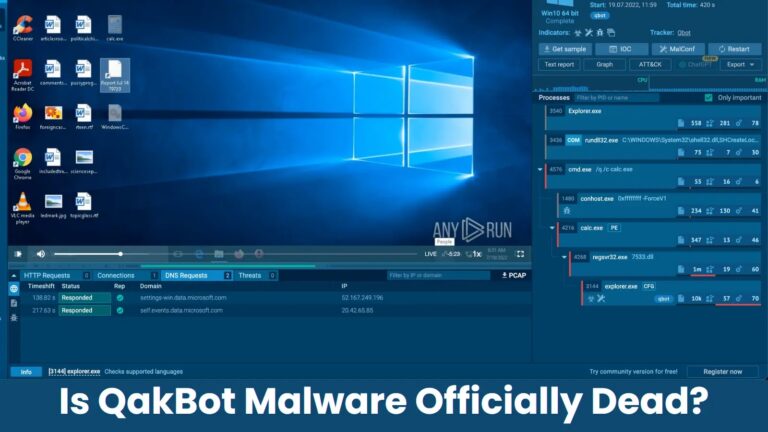
Considering the malware’s primary emphasis on the corporate sector, its most prevalent means of infiltrating systems has been through a malicious document distributed as part of phishing campaigns. For instance, the typical execution path of such a maldoc can be traced using ANY.RUN’s analysis ofa QBot sample.
The process tree created by the QBot sample
The attack begins with a victim downloading the maldoc, which, upon launch, initiates a series of processes by leveraging macros. From there, QBot uses cmd.exe to start a chain of commands and executions, creating folders and temporary files. The trojan then utilizes Powershell to download the payload, which often has a simple name of six digits or letters and a .png extension, despite being an executable file.
Once QBot begins its main execution, it attempts to evade detection by overwriting itself with legitimate Windows processes like calc.exe (calculator), injecting explorer.exe, and adding itself to autorun to gain persistence.
DocumentStart with a free account
Interact with the VM for up to 20 mins, collect IOCs and configurations, and enjoy unlimited analysis for free.
The FBI’s Disruption of QBot’s Operations
In August 2023, the FBI announcedthat in collaboration with other law enforcement agencies, it had successfully taken down the QBot network, resulting in the elimination of the malware from over 700,000 infected computers.
The operation involved accessing Qakbot’s command-and-control infrastructure and redirecting its traffic to the FBI’s servers. These servers then instructed infected computers to download an uninstaller file, effectively removing the malware from the machines.
The agency recovered millions of dollars in cryptocurrency and credentials of more than 6 million victims, including email addresses and passwords. Additionally, the FBI seized 52 servers, which will permanently dismantle the botnet.
Will this put an end to QBot?
Still, the question remains: Will the recent successful operation be the final nail in QBot’s coffin? Unfortunately, it is unlikely, as plenty of similar precedents have existed.
For instance, in 2021, international law enforcement agencies, including the FBI, took down Emotet, one of the largest botnets in history, responsible for infecting over a million computers globally. Interestingly, the tactic employed by the agencies was similar to the one used against QBot: Access to the botnet’s infrastructure was gained, and the malware was uninstalled from all the infected machines using special software. However, 10 months after the crackdown, Emotet was back to its entire operation.
Such precedents demonstrate that QakBot still has the potential to return more robust than before, especially given that no arrests of the actual group of developers behind the malware have been made. All of this suggests that QBot is likely to regain its lost position as one of the most persistent threats.
Conclusion
Although QakBot may have been temporarily removed from the global threat landscape, it is crucial to remain cautious and prepared for its return in the future. To be equipped to rise to any cybersecurity challenge, use ANY.RUN.
It is a regularly updated malware sandbox with an excellent track record of exposing the malicious activities of the newest threats and the latest versions of the existing ones.
Coupled with its unmatched interactivity and a wide selection of VM configuration settings, ANY.RUN will be your best partner in conducting in-depth analysis of the most advanced malware samples in the comfort of an intuitive web interface.
You can use ANY.RUN sandbox for free without limit to get nearly instant reports on any file or link, gain an in-depth look at their activities, and discover the latest samples in the service’s database.
The very first Samsung Galaxy S23 FE teaser is here. It has been shared by a tipster, Abhishek Yadav, who claims that the image you can see below has been sent to “promoters”.
The very first Samsung Galaxy S23 FE teaser has appeared
If you check out that poster below the article, you’ll see the Galaxy S23 FE’s camera array. As leaked images suggested, the phone will include three cameras on the back. They will be vertically-aligned in the top-left corner, just like on the Galaxy S23 and Galaxy S23+.
Now, this image also confirms the light blue color of the phone, and the fact that each of the cameras will protrude directly from the phone’s backplate. There won’t be a camera island on the back or anything of the sort.
It seems like Samsung will use “The New Epic” slogan for this launch, as that’s the caption used here. The tipster says that we can expect the Galaxy S23 FE to launch next month. By the looks of it, October will be packed with tech announcements.
The phone will be available in two different SoC variants
Now, earlier today, both Snapdragon and Exynos versions of the phone got confirmed. The phone appeared on the Google Play Console. The Snapdragon 8 Gen 1 and Exynos 2200 SoCs will be in use. Their availability will be market-dependent.
A 360-degree video and images of the phone also surfaced already. So, we know exactly what to expect. Even the phone’s specifications are not exactly a secret.
Other than the SoCs, that we’ve already mentioned, this phone will also include 8GB of RAM. A 6.4-inch fullHD+ AMOLED display with a 120Hz refresh rate is also tipped. The same goes for a 4,500mAh battery and 25W wired charging.
A 50-megapixel main camera will be backed by an 8-megapixel ultrawide unit, and a 12-megapixel telephoto camera. On the front, you’ll be able to find a 10-megapixel shooter.
Despite all the concerns surrounding generative AI, the technology has proven to be useful if implemented correctly. Now, in a recent development, the Chan Zuckerberg Initiative (CZI) has announced its plans to develop a state-of-the-art GPU cluster with the goal of curing, preventing, and managing all diseases by the end of this century.
At its core, the Chan Zuckerberg Initiative will acquire over 1,000 H100 GPUs to train AI large language models (LLMs) specifically designed for human cells. This approach aims not only to deepen our understanding of how the body reacts to diseases and novel treatments but also to enable researchers to guide a “virtual cell” through a series of simulations.
“LLMs have done an impressive job at helping us understand protein structure, and we think they will be equally great at helping us understand more complex structures like cells,” said Jeff MacGregor, CZI vice president of communications.
Making the tools publicly available
What sets the initiative apart is its commitment to making these tools accessible to a broader spectrum of scientists, considering the exorbitant costs associated with utilizing such powerful computing resources. Moreover, to develop these AI models, CZI will source data from existing datasets, including information curated by a Chan Zuckerberg software tool that profiles approximately 50 million unique cells, as well as resources from CZ Science research institutes.
“AI models could predict how an immune cell responds to an infection, what happens at the cellular level when a child is born with a rare disease, or even how a patient’s body will respond to a new medication. We hope that this collaborative effort will generate new insights about the fundamental characteristics of our cells,” said Chan Zuckerberg.
However, it is important to note that the CZI’s Biohub Network is responsible for acquiring the GPUs, and the project aims to address these scientific challenges over a 10- to 15-year timeframe. Furthermore, the project’s scale is not comparable to similar systems deployed by private sector entities for commercial applications.
If you use Trend Micro Apex One, you should know that the third-party Antivirus uninstaller feature may have a security hole. This flaw could make it possible for random code to be run.
Even though the National Vulnerability Database (NVD) hasn’t proven how bad the problem is yet, you should be careful and take the right steps to protect your system.
But it was also found that this security hole is being used in the real world (ITW). “Trend Micro has seen at least one ongoing attempt in the wild (ITW) to take advantage of this vulnerability. Customers are strongly urged to update as soon as possible.” Trend Micro’s post is read.
Trend Micro has put out a security warning about how to fix this problem. Worry-Free Business Security (WFBS) and Worry-Free Business Security Services (WFBSS) are also vulnerable because of this flaw.
Threat actors can use this hole to send orders to endpoints that are vulnerable. For an attacker to take advantage of this flaw, they must have access to the administrative console on the target machine.
If the exploit works, the attacker may be able to run commands on the PC where the security agent is installed with system rights. Trend Micro has given this vulnerability a score of 9.1 (Critical) for how bad it is.
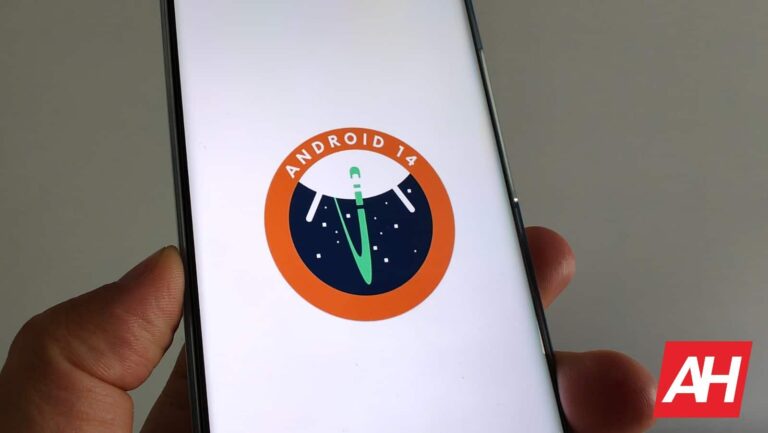
Google may have yet to roll out the stable Android 14 update to Pixel devices, but it has already begun preparations for the next major feature update based on the new Android version. It has released the Android 14 QPR1 Beta 1 for eligible Pixel phones, the Pixel Tablet, and the Pixel Fold.
Quarterly Platform Releases, aka QPRs, are quarterly feature updates for Pixels. Google pushes new features, improvements, and other changes that don’t require an OS upgrade through these releases. QPRs come once every three months throughout the year. Ahead of that, the company tests the update with beta builds. The beta updates are relatively stable, though they do need some finishing touches.
The first QPR or QPR1 usually follows a major Android OS update. Google has delayed the Android 14 release this year for reasons best known to itself. However, this hasn’t stopped the company from pushing the first Android 14 QPR1 beta. The update will be automatically available to Pixel users enrolled in the Android 14 beta program. They don’t need to do anything from their end. The stable QPR1 release will come in December.
The beta update comes with the build number U1B1.230908.003 and bundles the September 2023 security patch. As far as the eligible models are concerned, this beta update is available for the Pixel 5a, Pixel 6, Pixel 6 Pro, Pixel 6a, Pixel 7, Pixel 7 Pro, Pixel 7a, Pixel Tablet, and Pixel Fold. It’s available for the Android Emulator as well. The Pixel 4a 5G and Pixel 5, both of which will get Android 14, are not eligible for further feature updates.
Android 14 QPR1 Beta 1 known issues
The Android 14 QPR1 Beta 1 isn’t completely free of bugs. The official release notes provided by Google state that the device may occasionally fail to connect to cellular service after swapping SIM cards. It’s unclear if this is a temporary issue or a more severe one. We hope it’s the former. The battery level in the status bar may also sometimes show up as 0% temporarily. You can use the Android Beta Feedback app to report bugs if you find any.
This update brings a major new feature as well, particularly for large-screen devices such as foldables and tablets. It lets you change the aspect ratio of apps. A newly added settings menu allows you to manually force apps such as Instagram to go full screen on the Pixel Tablet or Pixel Fold. If the full-screen UI looks too stretched, you can select from other preset aspect ratios such as 4:3 and 16:9.
If you are on the latest Android 14 beta build and don’t want to install Android 14 QPR1 Beta 1 on your Pixel, you can opt out of the beta program by visiting this official website. You will be prompted to downgrade to Android 13, but you can ignore the update. Downgrading will wipe out your device’s data. Keep ignoring the Android 13 downgrade until you receive the stable Android 14 update, which has a build version starting with UP1A.
Qualcomm has embarked on a journey to redefine the broadband experience with the launch of its 10G Fiber Gateway Platform. The new platform, coupled with the company’s Service Defined Wi-Fi technology, will help accelerate broadband innovation in the coming years, ushering the industry into a new era of home connectivity powered by Wi-Fi 7.
As Qualcomm points out, the majority of home broadband connections today are powered by Wi-Fi. However, the diversity of devices, applications, and connectivity technologies makes it “nearly impossible” to manage and maintain the same level of service across the entire network. This is where its Service Defined Wi-Fi technology comes into play. It offers a “unified data flow management architecture, from cloud to device,” to address this challenge.
The Qualcomm 10G Fiber Gateway Platform further elevates the connected experience in the home with sustained high-speed internet. It combines “10G Passive Optical Network (PON) technology with multi-Gigabit Wi-Fi 7 connectivity” to deliver fast connectivity with low latency across the entire network of connected devices. Everything from your smartphone and computer to smart TVs, home security cameras, connected appliances, and more.
Qualcomm wants to redefine the home internet with its 10G Fiber Gateway Platform
According to Qualcomm, its 10G Fiber Gateway Platform will redefine the broadband experience in three fundamental ways. Firstly, it is interoperable with leading operator Optical Line Terminal (OLT) solutions and offers architecture flexibility. This allows service providers to utilize the platform according to their needs. Operators can create a diverse product portfolio and scale their service across the network with a common framework.
Qualcomm’s user experience-first approach further ensures exceptional connectivity and service with real-time connectivity optimizations and other management tools tailored to the unique profile of user applications. Finally, the Qualcomm 10G Fiber Gateway Platform gives service providers and their developers “full access to the technology tools within to drive service innovation in the home.”
The company says developers will get full programmability of the gateway through open APIs. It also offers “comprehensive support for the leading middleware ecosystem, open-source platform OS, and powerful on-board processing.” Additionally, the platform gives access to all building blocks required for a streamlined development. This helps in an accelerated deployment of differentiated services and value-added applications.
In Qualcomm’s words, the new platform will give service providers “unprecedented orchestration and insights to help improve their subscribers’ quality of experience.” It will allow them to offer “differentiated services optimized for applications such as gaming, streaming, and employer-supported work-from-home optimized service.” The new technologies will be commercially available in the summer of 2024, the company confirmed in a press release.
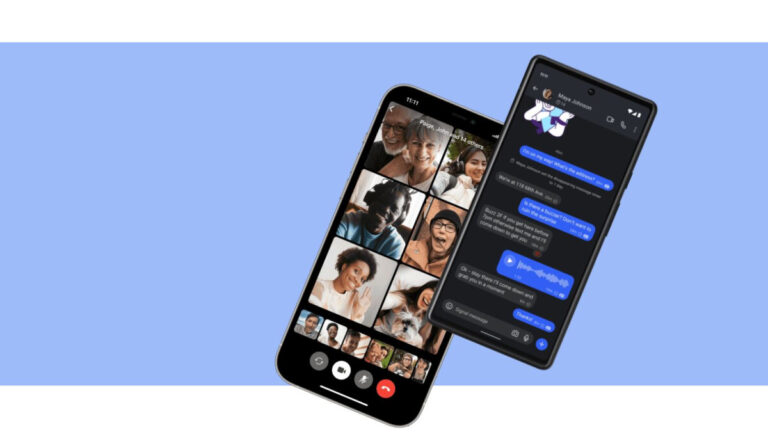
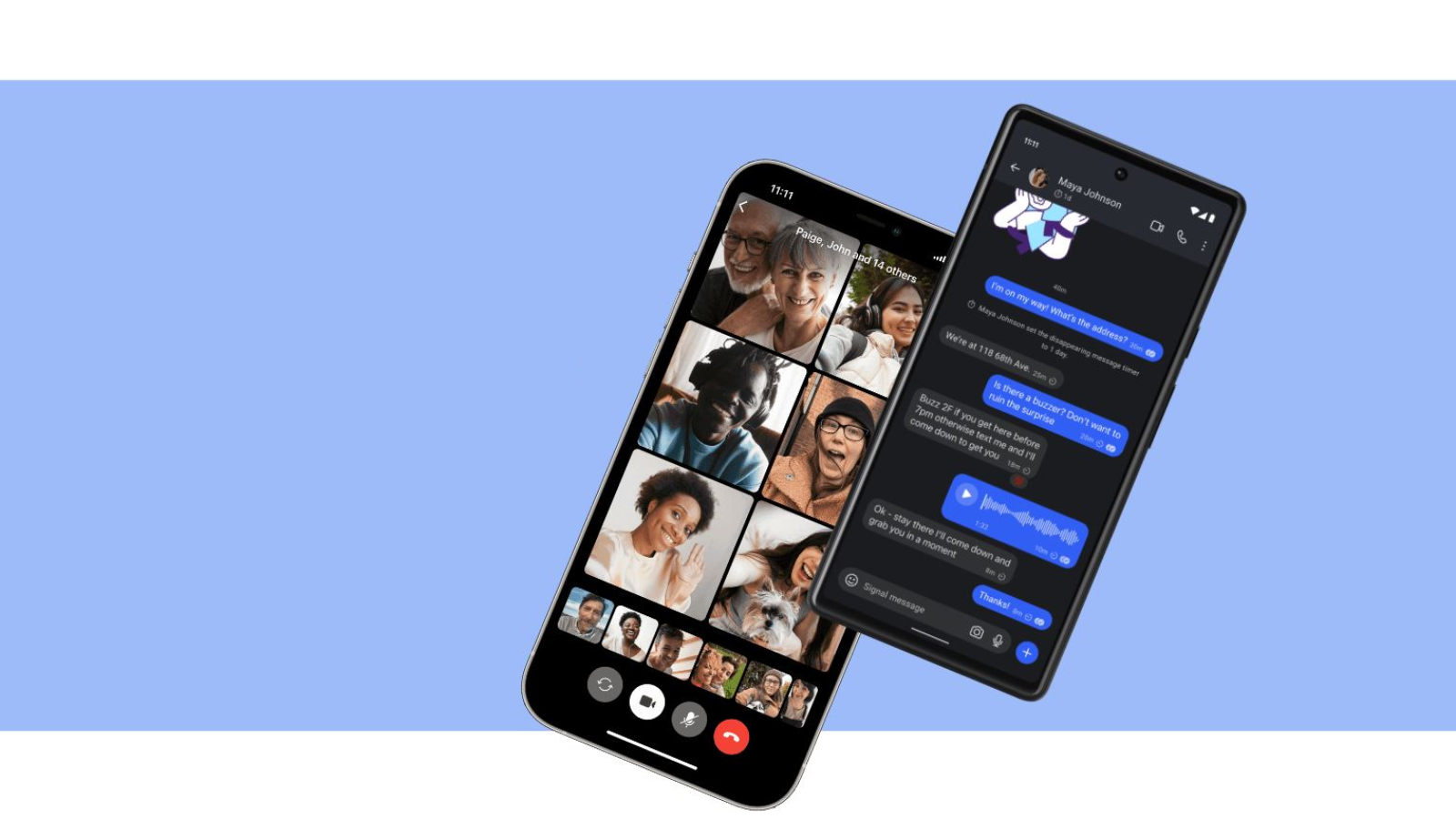
It doesn’t matter where you position yourself on the paranoid spectrum, encrypted messaging is getting more and more popular. And in the world of enciphered chatting, Signal has a special place. Now the popular app wants to get even more secure by shielding itself from an alleged threat that’s to come 5 to 10 years from now.That’s where things are starting to get quantum. Signal is upgrading its cyber security precautions by creating a new specification called PQXDH. We’ll get into it – to a certain degree because we lack the academic degree – but for now, its purpose is to protect against future quantum computers that could break encryption (via Android Police).
“With this upgrade, we are adding a layer of protection against the threat of a quantum computer being built in the future that is powerful enough to break current encryption standards”, reads the Signal blog post that announces the PQXDH.
Why be afraid?
The aforementioned excellent Signal blog post explains how future quantum computers could pose a threat to current standard encrypted messaging. First of all, quantum computers are not better or worse than “regular” computers – they are a completely different kind of beast. Instead of bits as in a classical computer, quantum computers operate on qubits. Rather than 0 or 1, qubits can exist in a superposition of states, in some sense allowing them to be both values at once.Quantum computing will probably not find its way to our homes (although Microsoft Quantum or MacQ sounds cool for OS naming), but they’ll likely be built to aid us in the tasks we give supercomputers to tackle today: modeling protein folding, forecasting weather, or factoring large numbers.
“Although quantum computers already exist, the systems known to exist today do not yet have enough qubits to pose a threat to the public-key cryptography that Signal currently uses. However, if a sufficiently powerful quantum computer were built in the future, it could be used to compute a private key from a public key thereby breaking encrypted messages”, the Signal team warns.
They say there are many timeline predictions for when a sufficiently powerful quantum computer may be created. Some say it’s only a couple of years from now, others say it can’t be properly done for the next 30 or more years. The middle ground seems to be around the 5 to 10-year time horizon. “We are not in a position to judge which timeline is most likely, but we do see a real and growing risk which means we need to take steps today to address the future possibility of a large enough quantum computer being created”, they say.
PQXDH for dummies
The official specification page for Signal’s PQXDH has mercy on us and starts gently: PQXDH stands for Post-Quantum Extended Diffie-Hellman key agreement protocol. PQXDH establishes a shared secret key between two parties who mutually authenticate each other based on public keys. PQXDH provides post-quantum forward secrecy and a form of cryptographic deniability but still relies on the hardness of the discrete log problem for mutual authentication in this revision of the protocol.PQXDH is designed for asynchronous settings where one user (“Bob”) is offline but has published some information to a server. Another user (“Alice”) wants to use that information to send encrypted data to Bob, and also establish a shared secret key for future communication.
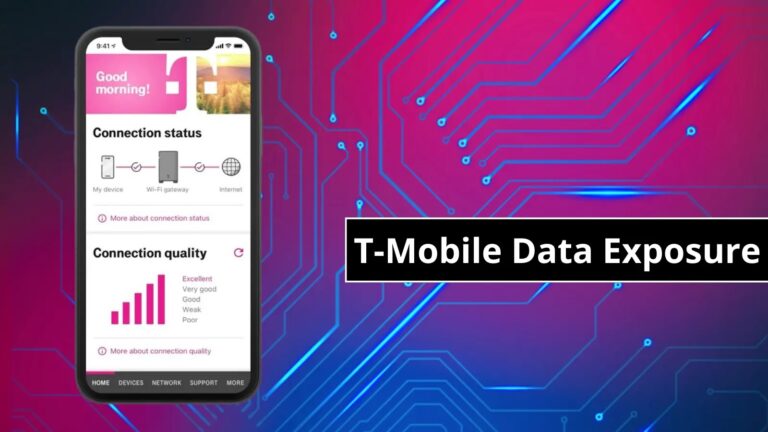
The mobile application of T-Mobile has recently been a cause of concern among its customers due to issues concerning privacy.
Users have reported accessing sensitive information belonging to other customers when logging into their own accounts.
This alarming situation has raised questions about the security of personal data within T-Mobile’s systems.
The incident was first reported in Verge, an American technology news website operated by Vox Media, publishing news, feature stories, guidebooks, product reviews, consumer electronics news, and podcasts.
Several T-Mobile customers took to social media platforms, including X (formerly Twitter) and Reddit, to share their unsettling experiences.
Reports indicate that users could view a range of sensitive data, including contact numbers, device IDs, credit card information, and even home addresses of fellow customers.
DocumentFREE Demo
Implementing AI-Powered Email security solutions “Trustifi” can secure your business from today’s most dangerous email threats, such as Email Tracking, Blocking, Modifying, Phishing, Account Take Over, Business Email Compromise, Malware & Ransomware
This revelation has understandably sparked widespread concern among T-Mobile’s user base.
The full extent of this issue remains uncertain, as some users have indicated that they could access information from multiple accounts.
And ever since then like every 15 minutes it shows another random account!
To safeguard the affected individuals and maintain security, the T-Mobile subreddit has urged its users not to share any further information regarding this incident.
Temporary Technical Glitch
T-Mobile initially attributed the problem to a “technology update” glitch and assured users that it had been resolved as of Wednesday afternoon.
Tara Darrow, a spokesperson for T-Mobile, stated, “There was no cyberattack or breach at T-Mobile.
This temporary system glitch was related to a planned overnight technology update involving limited account information for fewer than 100 customers, which was quickly resolved.”
However, this explanation may raise further questions about the adequacy of T-Mobile’s security protocols.
It’s worth noting that this is not the first time T-Mobile has encountered security-related issues this year. The company disclosed two separate cybersecurity attacks in January and May, highlighting the importance of ensuring robust data protection measures.
As T-Mobile users anxiously await more information and reassurance regarding their data security, this incident serves as a stark reminder of the ongoing challenges faced by companies in safeguarding sensitive customer information in an increasingly interconnected digital landscape.
On September 20th, 7:30 AM ET, T-Mobile officially acknowledged the issue.
On September 20th, 2:35 PM ET, T-Mobile provided a statement confirming that the issue had been resolved and asserting that it was not a security breach.
At its annual Fall event, Amazon has announced a slew of new Fire TV devices, including its brand new product – Fire TV Soundbar. This is a pretty popular product on other platforms. There’s a few different soundbars with Roku and Android TV built-in, and now we have a Fire TV model from Amazon.
The Fire TV Soundbar uses both Bluetooth, so you can get some great audio out of this soundbar and be able to use it with your smartphone, in addition to using it with your TV. And since it is powered by Fire TV, you can plug this into your TV via HDMI and not use up a HDMI port for just a soundbar.
In addition to the soundbar, Amazon is also updating its 4K Fire TV Sticks. The Fire TV Stick 4K gets a pretty solid update, with some newer and more powerful internal hardware. This makes the Fire TV Stick 4K faster and more fluid. Which is huge, since the existing one is getting quite slow these days.
Then there’s the new Fire TV Stick 4K Max, which brings along the Fire TV Ambient Experience that Amazon debuted on its TVs last year. It also adds support for WiFi 6E, and uses a 2GHz quad-core processor inside. Making it Amazon’s most powerful Fire TV Stick yet.
When can I buy these new Fire TV devices?
Amazon has stated that the new Fire TV Soundbar is available today for $119.99. You can order it here. While the Fire TV Stick 4K is available for pre-order today starting at $49.99. There’s also a new Fire TV Stick 4K Max and it’ll be available for $59.99 with pre-orders starting today.
There was no date given for when the Fire TV Stick 4K and 4K Max will start shipping. But it should be pretty soon.