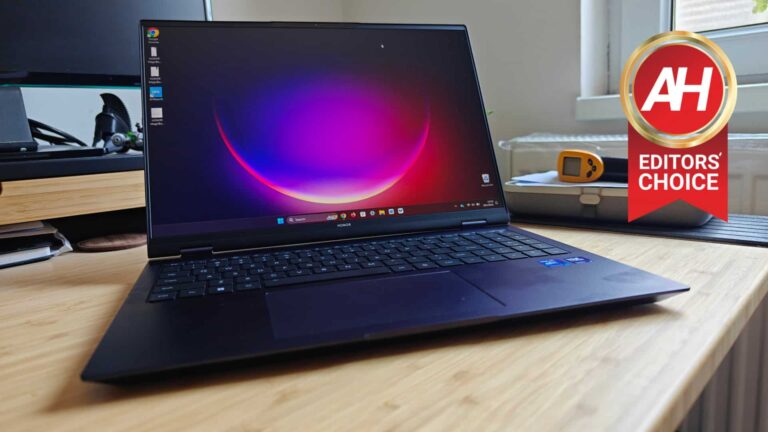
The HONOR MagicBook Pro 16 is the company’s brand-new laptop. It does come in a global variant, and that’s the HONOR MagicBook Pro 16 model that we received for review purposes. Do note that this variant comes with integrated graphics. With that in mind, this is a very powerful machine. It has Intel’s Core Ultra 5 chip on the inside, but that’s not its only strong suit, not even close. In this article, we’ll go over its upsides, and downsides, as per usual, and see whether it’s worth the pricing tag… as this thing is not cheap, that’s for sure. HONOR made some really compelling laptops thus far, so it set a high bar for itself. Let’s see what this thing is all about, starting with its design, and we’ll go from there.
Table of contents
HONOR MagicBook Pro 16 Review: Hardware / Design
The HONOR MagicBook Pro 16 is made out of metal. That design is “enhanced”, as HONOR put it, by the 3D Coloring Spray Technology. In case you’re wondering what that is, it’s a technology that enhances the visual appeal of this product by “creating a neat, unified, and split skyline surfaced design”. The laptop is smooth to the touch, and you can easily say it’s made out of metal… well, aluminum in this case. It is a 16-inch laptop, in case that wasn’t clear based on its name. It is only 19.9mm thick when closed, and it weighs 1.79kg. Considering this is a 16-inch tablet and a 13-14-inch one, that’s kind of nice. Most 16-inch tablets are notably heavier than that.
It comes in White & Purple color options
This tablet comes in White and Purple colors. We received the latter one to review, as you can see in all of the provided images. That purple color is very dark, though, even though the perception will depend on the light that hits it. It looks really nice, though, both in images and in person. The exact dimensions of the laptop are 354 x 242 x 19.9mm. The bezels around the display are very thin, and there’s a HONOR logo placed right under the display.

When it comes to ports, it may seem as if the HONOR MagicBook Pro 16 has only three ports, all of which are placed on the left-hand side. However, that’s not the case, as some additional ports are included on the back. There are two Type-C ports on the left side, which you’ll use for charging, amongst other things. The third port on that side is an audio jack, and it’s placed at the very edge there, towards the display. At the back, there are three additional ports, two USB-A units, and an HDMI port. You will also notice large speaker sections on both the left and right sides. This laptop actually comes with 6 speakers and two built-in microphones. It does support HONOR Spatial Audio as well.
A full-size numeric keyboard is included here, for better or worse
This laptop, considering its size, also comes with a full-size numeric keyboard, which is backlit, by the way. In other words, you do get a numpad here, even though the spacing is not the same as on a regular-sized keyboard, of course. All the keys are mushed together. You do get used to this, but in all honesty, I do prefer when there’s no numpad. I prefer layouts from 14-inch laptops quite a bit more. This layout pushes the QWERTY keyboard a bit more to the left, and all the keys are a bit too mushed together for my liking. As I said, you do get used to it, but it’s not my favorite. The keyboard itself, on the other hand, feels great to use. The key travel is very good considering this is a tablet (1.5mm), just keep in mind this is not a mechanical keyboard or anything of the sort, of course. We’re looking at a good and responsive scissor key setup here. The keys also have a good size to them, they never felt too small.

A large touchpad is also a part of the package
Below the keyboard itself, you’ll notice a large touchpad. It’s more than large enough for comfortable usage, and it has a nice click to it. It’s a mechanical touchpad, not a solid-state one, as the ones you’ll find on the Huawei MateBook Pro, for example. I do prefer that mechanical click, but that’ll depend on your preference. Considering that you do get a numpad here, the letter keys themselves are moved a bit to the left, which meant my palm was resting on that touchpad a bit too frequently. I did get used to that too, and it wasn’t as much of a problem as I thought it would, but still, avoiding some clicks and mouse moves was not possible. The touchpad size is 134.2 x 81.2mm, in case you were wondering. It supports a 5-point multi-touch, even though Windows 11 is limited to a 4-point multi-touch at the moment.

All in all, the design really is great here. All the complaints I had were more of a personal preference than anything else. The device is really well-built, it feels very premium. It has a good keyboard and touchpad. Just keep in mind that a numpad is included here and that the keyboard is moved a bit more to the left because of it.
HONOR MagicBook Pro 16 Review: Display
The HONOR MagicBook Pro 16 has a 16-inch display, as its name says. That’s not exactly a standard these days, it’s a bit larger than that. I’ve mostly been using 14-inch laptops in the last couple of years, and yes, you do notice the difference, very much so. Another detail you should note is that this display has a 16:10 aspect ratio. The resolution is 3072 x 1920, which is plenty, in other words. Nobody will complain about the resolution here, as the panel is as crisp as it gets. The bezels around it are 2.36-inch thick (left and right), while the screen-to-body ratio is 93%, says HONOR.
This display is not only vivid, sharp & bright, but it also protects your eyes
What else is there to say here? Well, quite a bit, actually, believe it or not. HONOR refers to this display as a ‘FullView Display’, and it has a 100% DCI-P3 and sRGB color gamut. Its typical brightness is around 500 nits, we’ll talk more about that later on, though. The display also has the TUV Rheinland Low Blue Light certification and TUV Rheinland Flicker Free Certification. Dynamic Dimming is also a part of the offering, while the E-book mode is also included. In other words, this display should go easy on your eyes. It has all the certifications you’d want, pretty much, while it’s also rather color-accurate.

It is not touch-sensitive, though
The question is, however, how does it look in actual usage? Is it really good, or great even? Well, the latter. Truth be said, I do not have a single complaint about this panel. It’s crisp, vivid, and has great viewing angles. I enjoyed using it, without a doubt. It was great for general usage, image editing, and consuming multimedia. The display is, however, not touch-sensitive, so do note that. Some people like to have that functionality on a laptop, which I do understand, but I never use it when it’s there. I simply hate smudges on the display, and when a laptop does not offer a rotatable display so that you can use it as a tablet, there’s no point, really… at least in my eyes.
This panel does get bright enough, that’s for sure
Alright, we missed one thing… the brightness. Does it get bright enough when needed? Well, yes, very much so. Truth be said, not many of you will use a laptop outdoors in direct sunlight, but very bright rooms are not out of the question. I’ve used it in a coffee shop, on a very sunny day, with glass walls all around me, and also outside in the sun, and the screen did great. Not a single display will do a marvelous job when the sun is hitting it directly, and you should avoid that. Your laptop will also heat up unnecessarily and so on.
HONOR MagicBook Pro 16 Review: Performance
Now, there are two variants of this laptop out there, just so you don’t get confused. One comes with integrated graphics (this one), and the other has an additional GPU. The integrated graphics here is Intel Arc graphics, while the other model includes the 115W Nvidia 4060 GPU, but we haven’t seen that model available outside of China. Do note that you’ll need to use that 200W charger that comes with the laptop if you’d like to use that graphics card, however. Considering we got the variant with integrated graphics, however, that’s not really an option. Needless to say, that Intel Arc graphics card is good for most things, but if you’re planning on gaming… well, the Nvidia 4060 GPU would serve you much better.
The Intel Core Ultra 5 SoC fuels this laptop
I’m getting a bit ahead of myself, though. Let’s start from the top. The HONOR MagicBook Pro 16 is fueled by the Intel Core Ultra 5 processor (125H). In addition to that chip, and the integrated graphics mentioned earlier, this laptop also offers 24GB of LPDDR5X RAM (6,400MHz). There is also a 1TB SSD included in the mix. It is worth noting that there are air vents on the left, right, and back sides of the laptop, even the bottom. That will help with heat dissipation, that’s for sure. The variant of the laptop with a separate GPU has that setup too, and this model does create less heat. Spoiler alert, yes, this laptop runs really well, even when you push it.
It does not get a separate GPU
Once again, do keep in mind that the separate GPU does not kick in unless the laptop is on a provided charger. So, the two variants (with integrated graphics and without it), are basically the same when you use them without a charger. Well, granted, the other model does have even more RAM, but 24GB should be more than enough for everything you’ll do here (at least for the vast majority of you). The device offers two performance modes you can choose from, Smart mode and High-performance mode. The former prioritizes battery life while providing enough performance power, the latter will basically remove brakes and allow this laptop to spread its wings.
Making it stutter is not an easy feat
Needless to say, bogging down this laptop is not easy. It ran great in day-to-day usage, in the two-week period we’ve used it. Browsing was not an issue, neither was multimedia consumption. I wrote tons of emails and articles on the device too, while I also processed some images and edited a couple of videos. Everything ran perfectly. No, this laptop is not made for gaming, as already mentioned, I did however fire up Fortnite for the sake of it, and it ran really well, though it did trigger internal fans, which were not loud at all. I then tried playing Call of Duty: Warzone, and that game also ran fine, though it did stutter on several occasions. I’m not sure if it’s due to the game itself, or the GPU, but it’s possible it’s the game’s fault, I wouldn’t be surprised. Once again, this laptop is capable of gaming, but don’t expect you’ll play truly demanding games without issues. This model does not have a dedicated GPU.
Benchmarks
We also ran some benchmark tests on the device. Below you’ll see Geekbench’s CPU and GPU results, in addition to GFXBench results. This is certainly not the most powerful laptop around, but as long as you’re not into demanding games or something of the sort, it packs plenty of power.
HONOR MagicBook Pro 16 Review: Battery
The HONOR MagicBook Pro 16 comes with a 75Wh battery included. With the included 135W charger, you can get this laptop charged all the way in 70 minutes. A 30-minute charge, on the other hand, will give you around 55% of battery, says the company. We found out that those numbers are quite accurate, actually. It took the laptop 69 minutes to fully charge for us, while charging it for 30 minutes did provide us with a 55% battery charge, on the dot. With that being said, is the battery life any good? Well, yes, actually, it is.
Getting two days of serious work out of this laptop is not a problem
I managed to get two days’ worth of work on this laptop, without dimming the display or anything like that. The brightness was always over 50%, and at times very high as I was in brightly-lit areas. It never failed to provide me with two full days worth of work, and it even had a charge left after all that. Do note that most of my work days are typing (articles and emails), browsing, and image editing. I had a couple of video editing sessions thrown in there, and a bit of multimedia consumption after work too.
It did great in our video stream test too
I actually did a test where I left the MagicBook Pro 16 to stream video for hours with the volume tuned up all the way to 100%, and the same goes for display brightness. It managed to survive for around 5 hours. Lowering both of those to 50% managed to double that time. All-in-all, the battery life is really good. Do note that I used it in ‘Smart mode’ most of the time. I used the ‘Performance mode’ only when gaming.
HONOR MagicBook Pro 16 Review: Software
In regards to software, Windows 11 Home comes pre-installed here. Those of you who have used Windows OS will be right at home. HONOR does include some of its own programs here, which are actually quite useful, but you don’t have to use them if you don’t want to, of course. Those programs are PC Manager and WorkStation. Those are basically the main additions here, and the ones you’ll likely use the most. PC Manager is sort of a hub for connectivity with your phone. You can log into HONOR ID and cast your phone’s screen on the laptop, or vice versa. HONOR Share is built into this program, and it allows you to share files to your phone and back, using Wi-Fi. This actually works really well.
HONOR WorkStation is immensely useful if you have more than one HONOR device
HONOR WorkStation is a place where you can use MagicRing, if you want. If you have more than one HONOR device, this program will be quite useful for you. All you need to do is be logged into the same account, and they’ll be inter-connected. You’ll be able to share files, use connected apps, and so on. Working on relation from your laptop and phone becomes a lot easier this way, and it’s certainly one of the reasons to own both a HONOR laptop and a phone. If you don’t, well, this won’t be of much use to you.

Do note that the HONOR MagicBook Pro 16 will offer a ton of AI features too, but we didn’t have access to them when we were reviewing this laptop. They were not yet available. Those features include AI Subtitle, Magic Text, Text Comprehension, Smart Picture Search, and a lot more. We’re not sure when will they become available, but rest assured, those features are coming.
Windows 11 Home comes pre-installed, and it’s exactly what you’d expect
In regards to Windows 11 Home as a whole, well, there’s not much to talk about, and also plenty to talk about. I don’t want this to become a Windows 11 Home overview article, but for those who have not used Windows just yet, let’s just touch on the basics. Windows OS is the most widespread operating system for computers, and it’s not even close. It works a bit differently to MacOS and Chrome OS, of course, even though it’ll look similar in a number of ways. You have a desktop workspace as default, on which you can add program icons and whatever else you want, basically. There’s always a way on Windows. The bottom bar contains your main Windows menu, and your favorite apps, while there’s also a tray in the bottom-right corner with your notifications, Wi-Fi info, volume info, and so on.
Windows OS is easy to customize
Windows OS in general is easily customizable. You can change pretty much everything you want, as long as you find a way. Microsoft did make some changes painfully simple, though. The company luckily keeps simplifying menus in Windows, as they were atrocious before. That is luckily no longer the case. Finding what you’re looking for is much simpler now. If you go to ‘Settings’, you’ll see some of the customization options that are at your disposal here. You can change the theme entirely or tinker specifically with colors or the desktop background. There are tons of options available for you to choose from. You can even install new ones and create your own. Windows 11 Home gives you so many options for customization, that you can even change the mouse cursor and sounds.
There are also some gaming-specific features included here, even though this is technically not a gaming machine.
HONOR MagicBook Pro 16 Review: Audio
The HONOR MagicBook Pro 16 has 6 speakers. Spatial Audio is supported here, while the same goes for DTS support when you’re using headphones. In regards to speakers, they’re really, really good. These are some of the loudest speakers that we’ve ever had the chance to test on a laptop. It’s not just about the loudness either, they also have a well-defined mid-range specter, while low-end and high-end are not bad either, quite the contrary. Considering the position of these speakers, the sound is also quite impressive, especially considering this is a laptop we’re talking about.

HONOR has a dedicated software suite for audio settings
HONOR also has a software suite that allows you to tinker with the audio settings. You can either choose stereo or spatial audio for the sound profile of these speakers. They will basically mimic spatial audio if you choose that setting. There’s quite a bit of difference between those two settings too, so you’ll want to tinker with them a bit, to get the right option for you. In regards to output through headphones, you can choose between spatial audio and DTS enhancement. The sound is really pleasant, though that will depend on what headphones you use, of course.
HONOR MagicBook Pro 16 Review: Webcam
The HONOR MagicBook Pro 16 has a fullHD front-facing camera. The exact details regarding this camera haven’t been shared by HONOR. You will also notice that two microphones are placed on each of the two sides of the camera. I do my best not to dwell on camera performance all that much, as they’re usually not worth talking about. Most people use webcams for video calls, and that’s pretty much it. So, two details that do matter are image quality and audio input. I conducted two video calls during my usage of the MagicBook Pro 16, and the image quality is… passable. It does get worse as the light goes away, but in general, it’s okay. I’ve seen far worse cameras on laptops.

Microphones for video calls are front-facing & good enough
The voice input is also sufficient. People on the other side said they could hear me just fine despite the fact I didn’t use my headphones. Using a dedicated microphone is always preferred, though, of course. Also, note that I was in a rather quiet environment when I conducted video calls (my office). Considering the quality of the speakers on the device, you can easily hear the other end of the line, by the way. It’s also worth noting that you have a button on the ‘F8’ key on the keyboard, which can block the webcam. All you need to do is tap the ‘Fn’ button first, and then the ‘F8’ key.
HONOR MagicBook Pro 16: Should you buy it?
Is the HONOR MagicBook Pro 16 the laptop you should buy? Well, that’s something only you can answer. However, if it’s in your price budget, and if you find 14-inch laptops too small (mainly in terms of the display), this may be the right solution for you. Not only does it have a gorgeous 16-inch display, but it also includes a numpad on the keyboard. As I mentioned in the review, that keyboard may take some getting used to, if you haven’t used this setup before. Coming from a bunch of 14-inch laptops without a numpad, this took some getting used to. If you’re already using something like this, and you don’t mind it, well, then you’ll be right at home.
The device also has great speakers, good key travel, solid and large trackpad, and so on. The performance is also really good. Just keep in mind that there is also a version of this device with a dedicated GPU available out there, in case you need more graphical power. Even without it, however, the HONOR MagicBook Pro 16 is a very compelling laptop.

You should buy the HONOR MagicBook Pro 16 if you:
…want a larger-than-standard laptop.
…can make use of a 16:10 display aspect ratio.
…need to have a numpad on the keyboard.
…like the brushed metal feel.
…like using Windows OS.
You shouldn’t buy the HONOR MagicBook Pro 16 if you:
…want the most portable laptop out there.
…play demanding games.
…want a straightforward keyboard without a numpad.
[ad_2]
Source link