Threat actors continue to evolve their spam tactics by utilizing legitimate Google Groups to send Fake order messages to target multiple users.
Fake order scams work by notifying victims about the purchase status or confirmation that originally was not placed by the recipient.
They are motivated to steal the victim’s personal credentials – name, address, credit, or banking information, or trick the victim into installing malware on their computer.
Trustwave SpiderLabs has identified a notable surge in these Geek Squad scam email activities delivered via Google Groups.
The new variant of the fake order scam sent to the users to notify them about the victim has been added to the Google group.
Fake Google Notifications Warning
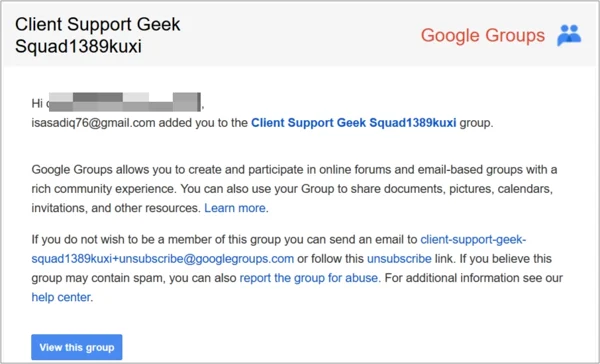
Above is a sample of a scam message sent to the user to join the client support geek squad, and by clicking view, this group will redirect to a fake discussion group.
DocumentFREE Demo
Implementing AI-Powered Email security solutions “Trustifi” can secure your business from today’s most dangerous email threats, such as Email Tracking, Blocking, Modifying, Phishing, Account Take Over, Business Email Compromise, Malware & Ransomware
Later, threat actors can automatically add email addresses, even non-Gmail accounts, into a group and start spamming users.
Fake Email
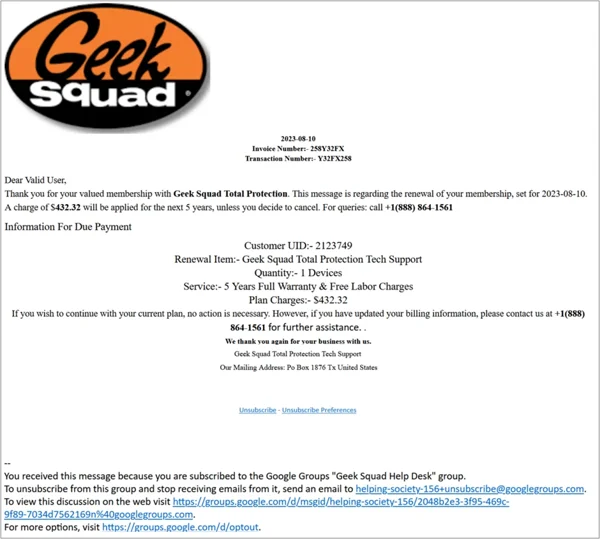
The spam email notified the users about the renewal of their membership in Geek Squad and the amount for the renewal. The customer ID was mentioned to make it legitimate.
It also leaves the customer care number to contact the support team to avoid charging the amount if they do not wish to continue.
If the victims contact the customer care number mentioned in the email, it will connect with spammers, and they are asked to update the online form.
They then instruct the victims to access a website where an application can be downloaded to access the victim’s machine remotely.
Once the scammer has remote access, they pretend to process the refund while secretly browsing their files and accessing sensitive information such as personal documents, banking details, and passwords.
These deceptive schemes cause financial harm to victims and lead to breaches of their personal data.
PurFoods, which offers up a service called Mom’s Meals, helps to provide meals for folks in a variety of different personal situations. From its site:
We work with over 500 health plans, managed care organisations, governments, and agencies to provide access to meals for people covered under Medicare and Medicaid, as well as the opportunity for individuals to order meals on their own.
The PurFoods notification reveals that suspicious account behaviour was first seen back in February of this year. An investigation concluded that at some point between January 16 and February 22, 2023, a cyberattack took place. Certain files in the PurFoods network were encrypted, and investigators also noticed tools present which can be used for data exfiltration. As a result, PurFoods says it “can’t rule out” the possibility that data was exfiltrated from one of its file servers.
The notice stresses that so far there has been no evidence of data being misused, which will be some measure of relief for those using the service. Even so, an abundance of caution has led to a variety of advice for those who think they may be impacted.
Here’s who could be affected by the breach according to PurFoods:
The individuals whose information was involved included clients of PurFoods who received one or more meal deliveries, as well as some current and former employees and independent contractors.
The data potentially at risk, which is quite significant, includes:
Date of birth
Driver’s license/state identification number
Financial account information
Payment card information
Medical record number
Medicare and/or Medicaid identification
Health information
Treatment information
Diagnosis code
Meal category and/or cost
Health insurance information
Patient ID number
Social Security numbers were involved for less than 1% of the total population, most of which are internal to PurFoods.
PurFoods began sending out notification letters by mail on August 25, which included specific information with regard to identity theft protection and availing of “identity restoration services and complimentary credit monitoring”. There’s also a dedicated call center line for people who may have further questions about the breach: (866) 676-4045.
At this point in time, there’s no additional information with regard to the specific ransomware used or whether additional extortion tactics were deployed. The notification does state that this incident is unrelated to the MOVEit attack from a few months prior.
This could potentially prove to be costly for the food provider. As The Register notes, many search results for this breach lead to law firms on the lookout for potential clients impacted by the ransomware attack. We may have to wait a while to see if any data actually does leak online, or if PurFoods reveals any more information about the attackers behind the compromise. For now, if you receive a notification letter we suggest keeping a close eye on your finances, watch out for targeted phishing, and call the PurFoods helpline if you are concerned.
Detect intrusions. Make it harder for intruders to operate inside your organization by segmenting networks and assigning access rights prudently. Use EDR or MDR to detect unusual activity before an attack occurs.
Stop malicious encryption. Deploy Endpoint Detection and Response software like Malwarebytes EDR that uses multiple different detection techniques to identify ransomware, and ransomware rollback to restore damaged system files.
Create offsite, offline backups. Keep backups offsite and offline, beyond the reach of attackers. Test them regularly to make sure you can restore essential business functions swiftly.
Don’t get attacked twice. Once you’ve isolated the outbreak and stopped the first attack, you must remove every trace of the attackers, their malware, their tools, and their methods of entry, to avoid being attacked again.
Malwarebytes EDR and MDR remove all remnants of ransomware and prevents you from getting reinfected. Want to learn more about how we can help protect your business? Get a free trial below.
Sony is giving out a free PlayStation 5 when you buy its 75-inch X93L Mini LED 4K Google TV. You can get the pair for just $3,047. Which is actually about $153 lower than the regular price for just this TV. Since it is normally, $3,299. So a pretty good bundle here.
The Sony X93L is one of the best TVs you can buy right now. That’s mainly because it is a Mini LED TV. Which is going to give you all of the advantages of OLED, but in a brighter display. So if you watch a lot of darker shows or movies, they are going to look great on this TV.
Sony has also included Google TV on this one, so you’re getting access to thousands of apps and games right on your TV. This includes apps like Hulu, YouTube, Netflix and so much more. It also has support for Cast and Google Assistant. Sony has also included BRAVIA CORE which gives you access to 4K UHD movies, with 5 credits that you can use to redeem for the latest movies.
Now onto the PS5 front, the X93L does have some exclusive features for the PS5. Hence the bundle. This TV does have HDMI 2.1, which is going to give you features like 4K@120, as well as VRR and ALLM. Giving you the best possible experience with your PlayStation 5. Now with the PlayStation 5, you’re getting the disc version. So you can actually buy physical games to go on with this console, instead of being limited to downloading them. It also has some breathtaking graphics, and some really good games that are exclusive to the platform.
You can pick up the Sony X93L Mini LED TV and the PlayStation 5 today by clicking the link below. This sale won’t last long, so you’d better hurry.
Hackers can now capture your IP address and expose your physical location by sending a Skype link, even if you don’t click it.
An IP address, which stands for “Internet Protocol address,” is like a unique digital home address for your device on the internet.
The IP addresses are sensitive addresses because they can reveal certain information about you and your online activities like:-
Approximate location
Type of device you’re using
Websites you visit
In a report shared with 404 Media, it’s been affirmed that the cybersecurity researcher behind this discovery, Yossi, has already notified Microsoft about this vulnerability earlier this month.
After being notified by Yossi, Microsoft initially ignored fixing this vulnerability until 404 Media pushed Microsoft for a patch.
DocumentGet a Demo
With DoControl, you can keep your SaaS applications and data safe and secure by creating workflows tailored to your needs. It’s an easy and efficient way to identify and manage risks. You can mitigate the risk and exposure of your organization’s SaaS applications in just a few simple steps.
Reveals User Location
An IP reveals location, especially in less populated areas, due to which this attack potentially threatens the following entities:-
Activists
Dissidents
Journalists
Cooper Quintin, a security researcher and senior public interest technologist at the activist organization the Electronic Frontier Foundation (EFF), verified the vulnerability with a practical demonstration from Yossi.
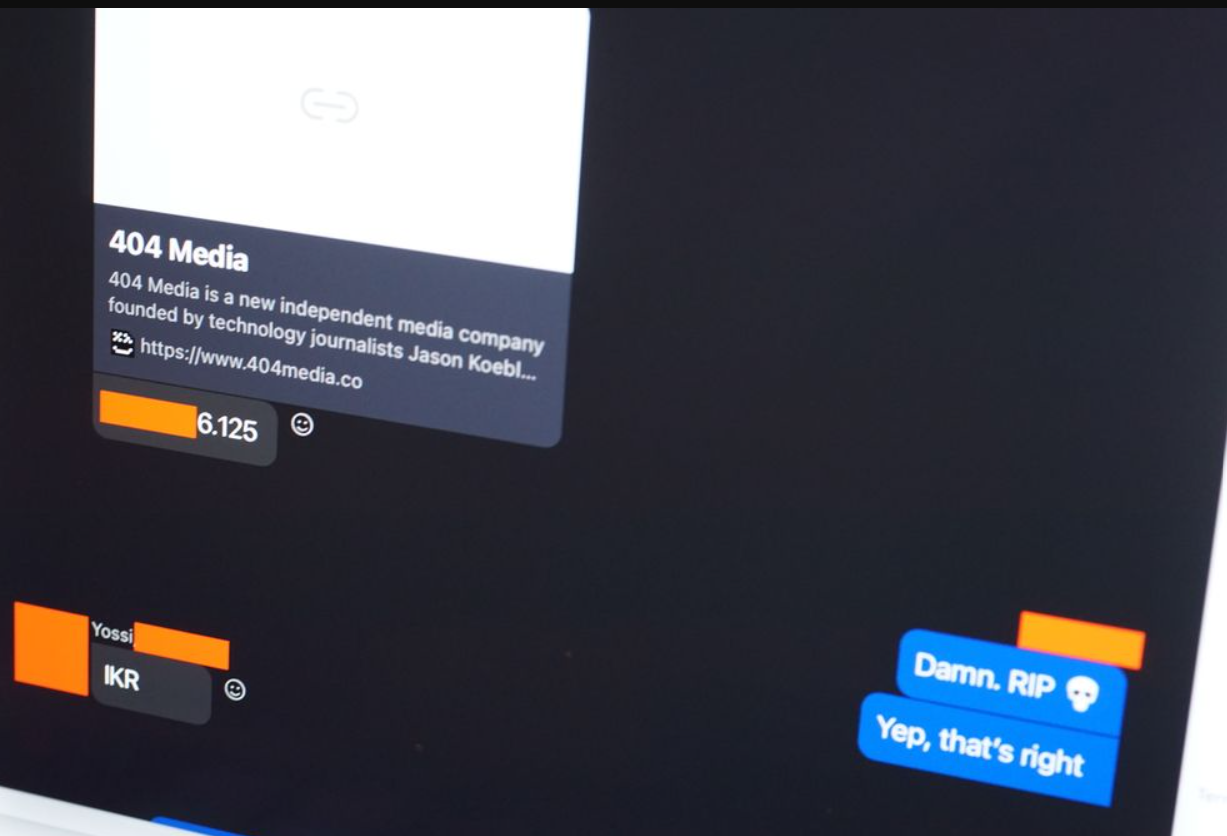
In the practical demo with Cooper Quintin, Yossi sent a legit link on Skype to Cooper, and without clicking on it, the IP address of Cooper Quintin got exposed.
IP grabbing flaw in action (Source – 404Media)
Moreover, Yossi stated that the IP address issue only affected Skype’s mobile apps, not the Mac version.
In normal chats, apps act as buffers between users, often holding IP info. However, in the case of Skype, it seems unusual, as it shares the IPs if hacked, and this could risk the privacy of pseudonymous dissidents.
It’s been justified that the exploitation of this vulnerability is quite simple, as it involves tweaking a certain link parameter.
For now, 404 Media affirmed that they will not disclose any technical details regarding this vulnerability since Microsoft has not yet fixed this flaw.
The Cisco team states that it is aware of reports of the Akira ransomware group going specifically after Cisco VPNs that are not configured for MFA. And they have observed instances where cybercriminals appear to be targeting organizations that do not configure MFA for their VPN users.
One of the reports the team may be aware of was tweeted weeks ago by security researcher and incident responder Aura:
“I’m just gonna go ahead and say it. If you have: Cisco VPN No MFA for it You may get a surprise knock from #Akira #Ransomware soon.”
Cisco VPN solutions are widely used to provide secure, encrypted data transmission between users and corporate networks, often used by remote employees. Gaining access could allow attackers to extract credentials through LSASS (Local Security Authority Subsystem Service) dumps to facilitate further movement within the network and elevate privileges if needed.
What the researchers haven’t been able to determine is how the ransomware operators gained access to Cisco VPN’s account login credentials in the first place, also hindered by the fact that Cisco ASA (Adaptive Security Appliance) doesn’t feature a logging function for successful logins. Only login attempts with invalid username/password combinations can be found in the logs if logging is configured in the affected Cisco’s ASAs.
It is possible that the criminals acquired valid credentials by purchasing them on the dark web, that they are using a zero-day exploit, or that they are using brute-force or credential stuffing attacks. Credential stuffing is a popular tactic of attempting to access online accounts using username-password combinations acquired from already-breached data dumps. In a brute force attack, attackers typically try a lot of common passwords, or a few common passwords across many usernames which is called password spraying. Password spraying focuses on trying a few passwords across many accounts, often to avoid account lockouts and detection.
Cisco says it has seen evidence of brute force and password spraying attempts. Other researchers say they have found evidence of Akira using Cisco VPN gateways in leaked data posted on the group’s extortion page and seem to be leaning towards the vulnerability scenario.
Whichever way was used to gain access, it has become even more apparent that adding MFA is an important factor in fighting off these attacks.
Prevent intrusions. Stop threats early before they can even infiltrate or infect your endpoints. Use endpoint security software that can prevent exploits and malware used to deliver ransomware.
Detect intrusions. Make it harder for intruders to operate inside your organization by segmenting networks and assigning access rights prudently. Use EDR or MDR to detect unusual activity before an attack occurs.
Stop malicious encryption. Deploy Endpoint Detection and Response software like Malwarebytes EDR that uses multiple different detection techniques to identify ransomware, and ransomware rollback to restore damaged system files.
Create offsite, offline backups. Keep backups offsite and offline, beyond the reach of attackers. Test them regularly to make sure you can restore essential business functions swiftly.
Don’t get attacked twice. Once you’ve isolated the outbreak and stopped the first attack, you must remove every trace of the attackers, their malware, their tools, and their methods of entry, to avoid being attacked again.
Malwarebytes EDR and MDR remove all remnants of ransomware and prevents you from getting reinfected. Want to learn more about how we can help protect your business? Get a free trial below.
There are a lot of apps / services that could be considered social media apps these days. Well, in this article, we’ve hand-picked the ones we think are the best in the Android world. There are some apps on this list that you may not even consider social media apps, but they are, at least to an extent. You’ll see some obvious choices listed here, while others are not all that obvious.
Truth be said, there are many more apps available in the Play Store, but we had to stop at a number 10. Do note that the applications shown below are not listed in any specific order. You’ll find our descriptions for every app here, along with a lot of additional information, ranging from the needed Android version to run them, to the pricing of in-app purchases. If you’re interested read on.
Best Social Media Android apps 2023 downloads
Below is a little more information on each app, and a direct link for easy downloading.
All download links go to the app’s Google Play Store listing. Users are always recommended to download apps from Google Play or an authorized app store.
X
– Price: Free to download – In-app purchases: $0.99-$399.99 – Size: Varies with device – Google Play rating: 4.0 out of 5 stars
If you live in the US, chances are you’re using X (formerly known as Twitter). If you’re not, well, you’re missing out. X is popular all over the world, though it’s more popular in some markets, and the US is definitely its main market. X is also one of the best social media platforms around. Once you get used to it, it’s difficult to let it go. It can serve you as a hub for many things, actually, which is what makes it interesting.
You can easily use this app for staying in touch with your family and friends, while also using it as your main source of news. You just need to follow the right people / sources, and there you go. It can also be a great business tool in some situations. The Android app is great, and it does support a dark theme. X will remember where you left off while scrolling the feed, which is one of its best features. You can also choose whether you’d like to see your feed chronologically, or let X choose what to show you.
– Price: Free to download – In-app purchases: $0.05-$2,499.99 – Size: Varies with device – Google Play rating: 4.0 out of 5 stars
Facebook is easily one of the largest and most popular social media networks. Facebook is popular all over the world, and its Android app has gotten a lot better over the years. There are still some bugs in the app, but it’s much better than it was before. It also drains the battery far less than it used to. In other words, the app is now actually quite good. If Facebook is popular where you live, and your friends / family use it, it’s a good choice.
Facebook’s feed is a bit more convoluted than Twitter’s, though, and it works in a different way. Still, you can comment on posts as you can on Twitter, and the general usage scenarios are similar. Facebook is a great business tool as well. If you own a business, you can open up a page on Facebook, and start influencing people all around the world. Facebook also has a great tool for advertising, if that’s something you need.
– Price: Free to download – In-app purchases: $0.05-$999.99 – Size: Varies with device – Google Play rating: 4.3 out of 5 stars
If you love photography, Instagram is where it’s at. This app is all about pictures, with a sprinkle of videos pushed to the mix. Instagram is first and foremost an image-sharing platform. You can find various images shared here, but tons of different users, while celebrities also use it for such purposes. It also has a video aspect, though, that you may or may not like.
Instagram’s stories are the main video part of the app. This concept people seem to love, as it allows them to post short clips to share a part of their day, or whatever else they want. The usage scenarios for stories are much different than what you’d see with TikTok videos, though. Stories disappear after 24 hours, so they’re not exactly meant to be used in the same way. Instagram has a lot to offer, and is worth checking out.
– Price: Free to download – In-app purchases: $0.05-$1,200 – Size: Varies with device – Google Play rating: 4.4 out of 5 stars
TikTok has been one of the most popular Android apps of 2020, if not the most popular one. TikTok is a short-form video platform, and it managed to keep people sane during the quarantine. Tons of new publishers appeared and became famous on the app during that time period as well. TikTok contains tons of interesting short-form videos, ranging from comedy and landscape videography, to educational videos, and so on.
There’s really a lot on there. The best thing is, TikTok’s algorithms are excellent as well. You’ll need to clarify what you’re interested in, and you’ll get relevant videos. It doesn’t stop there, though, the more you use the app, the better recommendations will arrive to you. TikTok is constantly learning what you like, and is excellent in getting the right content your way. It’s really difficult to stop watching videos once you start, though, so that’s a fair warning.
– Price: Free to download – In-app purchases: $0.99-$199.99 – Size: Varies with device – Google Play rating: 3.2 out of 5 stars
Reddit is also one of the most popular social media networks around, though it’s much different than other apps on the list. This app functions on the basis of ‘subreddits’. So, you can subscribe to various subreddits here, like ‘Android’, ‘Amoledbackgrounds’, and ‘aww’, for example. That way, you can access exactly the content you’re interested in. Luckily, there are tons of subreddits on offer, so you’ll definitely find what you’re looking for.
In the ‘Android’ subreddit, you’ll find tons of Android content. From different articles that are quite interesting, to tips and tricks, and so on. The ‘Amoledbackgrounds’ subreddit delivers AMOLED wallpapers for smartphones, while the ‘aww’ subreddit shares cute images. These are just some examples, but there are a ton of interesting subreddits here. You can comment on every post that is submitted to a specific subreddit, and start or participate in various interesting conversations.
– Price: Free to download – In-app purchases: No – Size: Varies with device – Google Play rating: 4.1 out of 5 stars
YouTube needs no special introduction. This is an app for watching videos, and it grew a lot since it was launched. This is Google’s very own application, and it’s a go-to video app for many smartphone users around the world. There are no time limits for video in this app, as is the case on other platforms. You’ll be able to watch really short videos, to some videos that last an hour or more, it all depends on the channel.
Channels are created by creators all over the world, and each of them provides their unique content. You’ll need to find the right content for you, but once you do, YouTube can serve as a TV replacement even, for some people. It has you covered in a lot of categories, ranging from comedy to technology. YouTube is free to use, but do note that ads are a part of the experience in the free version.
– Price: Free to download – In-app purchases: $29.99-$323.88 – Size: Varies with device – Google Play rating: 4.3 out of 5 stars
LinkedIn is an excellent way of staying in touch with your business partners, for finding work, building your business networks, and so on. This is Microsoft’s application, and it’s easily one of the best and most useful apps for businesses. It has been getting better and better over the years. If your business network is good enough, you can easily find work to do really fast, which is a great option to have.
LinkedIn allows you to apply to various jobs that are on offer, that companies offer through the app. You can apply really quickly, and there are a lot of jobs to choose from. The job finder tools is excellent, though this app is also great even if you’re not in search for a new job. It’s great for staying in touch with people from the industry you’re in, and much more than that.
– Price: Free to download – In-app purchases: $0.49-$399.99 – Size: Varies with device – Google Play rating: 4.1 out of 5 stars
Snapchat is also quite unique in its own way. It’s essentially a photo chat app. That alone, makes it unique, but the level of options and features that Snapchat offers is insane. On top of that, it has that ‘Stories’ layer, and some location-sharing features as well. All that makes it feel more like a social media app, rather than a messaging app, though it’s essentially a hybrid between the two.
Snapchat is far more popular with young people than it is with older generations, for a good reason. This app comes with tons of filters that you can apply to your images and videos. Those filters are excellent, and can turn you into a completely different person in real time. They make chatting really fun and interesting. If you’re into something like that, this app is definitely worth trying out.
– Price: Free to download – In-app purchases: $0.99-$299.50 – Size: Varies with device – Google Play rating: 4.4 out of 5 stars
Twitch is the app to have if you’re into gaming. This app serves as both a streaming platform, and a social media platform of sorts. You can follow your favorite streamers on Twitch. For example, if you’re into Call Of Duty Warzone, you can find a ton of well-known streamers on the network, and some less-known ones as well. Esports competitions also tend to be available on Twitch.
Chatting is also possible via this app, of course. You can live chat while you watch a stream, or while you’re streaming as well. Twitch is also great for discovering new multiplayer games and IRL videos. The app does come with a dark mode, and it’s actually really good. The UI is excellent, and the app’s performance is on point. It’s fluid, and I’ve personally never had issues with it.
– Price: Free to download – In-app purchases: No – Size: Varies with device – Google Play rating: 4.5 out of 5 stars
Pinterest is a social media network that many people discarded at first, but it managed to grow a lot since its inception. There’s a good reason for it, it offers something no other apps do. This is the place to go if you’re creative, or you need ideas for whatever. It’s great for home design concepts, looking up fashion products, for fitness tips, for getting recipes, and so much more, actually.
This app’s UI is truly excellent, and the app can learn really fast what you’re interested in. At first, you’ll need to share your interests, but the app will become much smarter in time, once it actually sees what you’re looking into and what you’re interested in. On the homepage, you’ll see a feed dedicated to you, filled with interesting content. You can reshare those posts aka ‘pins’, like them, save them on your ‘boards’, and so on.
When it comes to facing challenges, in recent times, Google AR projects have been going through a lot. First, with the long-awaited Project Iris AR glasses and now the mixed reality headset the company is building. Yes, the next evolution in tech is AR and Google knows this, but it is seriously struggling to get things in order.
The mixed reality product is going to be a partnership between Google, Samsung, and Qualcomm. Each tech company has a major role to play in this partnership to ensure that this product is a success. Google will handle software features (and some hardware elements as well), Samsung will handle the product’s specifications (and possibly its design), and Qualcomm will provide the processor it’d run on.
A lot of people might expect this partnership to be in the best interest of the coming mixed-reality headset. While this might be the case, it turns out that Google is losing its grip on the project. Samsung, on the other hand, is gaining control of the project and calling the major shots.
Samsung might limit Google’s reach with the coming Google AR product
According to reports for the folks at SBS Biz, Samsung is already taking control of the Google mixed reality headset. This control involves telling the specifications and features of the coming product. Reportedly, Samsung is also responsible for pushing back the production process of this product, which will affect its launch.
Google might also be in favour of the extension of this headset’s production, but its staff have different views. Despite the delay, some staff members at Google say that the product is still too early and might not be well-baked. Well, on its part, Samsung might be more than ready with the hardware of this product, but in terms of software, Google might need some more time.
It is good to take to mind the changes that have occurred in the AR department at Google. These changes have seen the rise of new project leaders who might consider doing things differently. While the hardware and specifications of this AR product need to be spot-on gorgeous, its software also needs to be impressive.
Both Google and Samsung are up against a common rival with this coming mixed reality headset. Apple is already on track to launch its Vision Pro headset, which it showed off a few months ago. Sadly, Apple seems to be more organized when it comes to the development of its AR product.
Despite the challenges Google is facing regarding its entry into the AR industry, it isn’t giving up. The company still plans to launch its Project Iris AR glasses, but this might take some time. During this wait period, Google might have the opportunity to perfect its art and stand a chance against the competition.
Hugh Jackman has invited her to dinner. Prince William has told her she has “such a beautiful name.” Once, Ricky Gervais simply needed her photos (“I want you to take a snap of yourself and then send it to me on here…Send it to me on here!” he messaged on Twitter), and even Tom Cruise slipped into her DMs (though he was a tad boring, twice asking about her health and more often showing a core misunderstanding of grammar).
Becky has played it cool, mostly, but there’s no denying the “One That Got Away”—Official Keanu Reeves.
After repeatedly speaking to Becky online, convincing her to download the Cash app, and even promising to send her $20,000 (which Becky said she could use for a new tea towel), Official Keanu Reeves had a change of heart earlier this year: “I hate you,” he said. “We are not in any damn relationship.”
Official Keanu Reeves, of course, is not Keanu Reeves. And hughjackman373—as he labeled himself on Twitter—is not really Hugh Jackman. Neither is “Prince William,” or “Ricky Gervais,” or “Tom Cruise.” All of these “celebrities” online are fake, and that isn’t commentary on celebrity culture. It’s simply a fact, because all of the personas online who have reached out to Becky Holmes are romance scammers.
Romance scams are serious crimes that follow similar plots.
Online, an attractive stranger or celebrity—coupled with an appealing profile picture—will send a message to a complete stranger, often on Twitter, Instagram, Facebook, or LinkedIn. They will flood the stranger with affectionate messages and promises of a perfect life together, sometimes building trust and emotional connection for weeks or even months. As time continues, they will also try to remove the conversation away from the social media platform where it started, instead moving it to WhatsApp, Telegram, Messages, or simple text.
Here, the scam has already started. Away from the major social media and networking platforms, the scammers persistent messages cannot be flagged for abuse or harassment, and the scammer is free to press on. Once an emotional connection is built, the scammer will suddenly be in trouble, and the best way out, is money—the victim’s money.
These crimes target vulnerable people, like recently divorced individuals, widows, and the elderly. But when these same scammers reach out to Becky Holmes, Becky Holmes turns the tables.
Becky once tricked a scammer into thinking she was visiting him in the far-off Antarctic. She has led one to believe that she had accidentally murdered someone and she needed help hiding the body. She has given fake, lewd addresses, wasted their time, and even shut them down when she can by coordinating with local law enforcement.
And today on the Lock and Code podcast with host David Ruiz, Becky Holmes returns to talk about romance scammer “education” and the potential involvement in pyramid schemes, a disappointing lack of government response to protect victims, and the threat of Twitter removing its block function, along with some of the most recent romance scams that Becky has encountered online.
“There’s suddenly been this kind of influx of Elons. Absolutely tons of those have come about… I think I get probably at least one, maybe two a day.”
It’s now official. Apple has sent out invites for a September 12 event at the Steve Jobs’ Theater in Cupertino. Where Apple is going to be announcing the iPhone 15 series, alongside the Apple Watch Series 9, and potentially a couple of other smaller upgrades.
As usual, the event will start at 10AM PT from Apple Park. And the invite is a bit interesting. Showing off the rumored colors for the iPhone 15 Pro models. And it’s using the tagline of “wonderlust”. So read into that what you will.
What to expect from the iPhone 15 series
While we have a whole “what to expect” article that you can read here, about this Apple Event. Let’s go over the main event. That’s the iPhone 15 series.
We’ve actually been seeing leaks for the iPhone 15 for over a year already. Which shouldn’t be a huge surprise, as Apple has been working on this phone for a couple of years already – that’s not exclusive to Apple either. But we’ve seen a lot of rumors come out, and some get shot down. However, the biggest changes we’re expecting to see is, the new mute button. As well as the extremely thin bezels, also on the Pro models. And the Pro Max or Ultra, is set to get a new Periscope lens, allowing for potentially 5x telephoto zoom.
For the non-Pro iPhones, we’re expecting to see a few upgrades, but not nearly as many. It’ll get updated to the A16 Bionic chip, which was in the iPhone 14 Pro last year. It’s also set to get the Dynamic Island, and a number of new colors. It looks like Apple might be going for a bit more of a pastel look this year, for the regular iPhone 15 and iPhone 15 Plus.
Of course, these things could change and we could even see bigger upgrades for the iPhone 15 by the time the event comes around on September 12. This happened with WWDC earlier this year, where we expected iOS 17 to be a small upgrade, and it actually turned out to be a bit larger than that.
Workers definitely have a love/hate relationship with AI. It just depends on your industry, job, and what tasks you do on a daily basis. While there are a ton of people who are not liking this new AI age, there are definitely workers who are on board with the AI ship.
Surveys point to many workers liking AI
Axios surveyed more than 31,000 workers, asking what they most value about AI. The largest chunk, 33%, stated Producing high-quality work in half the time. Next, 23% said Never having to mentally absorb unnecessary information again. Another 23% said it was Cutting the time I spend answering emails and chat in half.
17% stated that it was Outsourcing all of my busywork. Lastly, the smallest chunk, 15%, said they most valued Never having to write a first draft of a document.
It makes sense that workers, especially those who do repetitive tasks, have taken a liking to AI. We can’t deny that it makes certain tasks quick and painless. Stressful tasks that take a long time to perform can be automated or expedited. This could lead to an increase in productivity for the company as a whole.
But, there’s another side to this coin
So, while AI seems to be liked by several folks in the workforce, there’s another side to the coin. The businesses that are hiring more people are hiring AI experts. So, this means that certain workers aren’t at risk of being replaced by AI, but they’re at risk of being replaced by AI experts.
This could lead to a huge shift in the workforce. Writers, artists, musicians, and other workers are going to be booted in lieu of AI experts. This is something that people are going to look into as AI progresses. As time goes on, we” be able to paint a clearer picture of what’s going to happen.