Snapdragon 8+ Gen 2 is here, but not really

0
[ad_1]

Qualcomm may have quietly launched the Snapdragon 8+ Gen 2 but without the “Plus” branding. The company is still calling it Snapdragon 8 Gen 2, though the new chip brings a faster CPU and GPU. And yes, it’s none other than the once-Samsung-exclusive version of the latest Snapdragon flagship.

If you recall, Samsung‘s Galaxy S23 series uses a Qualcomm processor globally. It’s an overclocked version of the Snapdragon 8 Gen 2. The chip itself has a “for Galaxy” suffix on its name and comes with a slightly different part number than the standard version available to other brands. More precisely, its part number is SM8550-AC, while that of the standard chip is SM8550-AB.

In terms of clock speeds, the “for Galaxy” version has its fastest CPU core operating at 3.36GHz and GPU at 719MHz. In comparison, the standard solution has its CPU and GPU clocked at 3.2GHz and 680MHz, respectively. Samsung used this supposedly exclusive processor in the newly launched Galaxy Z Fold 5, Galaxy Z Flip 5, and Galaxy Tab S9 series as well.

However, it turns out its exclusivity of the “for Galaxy” version ended long back. This overclocked chip is already found inside devices from other brands. Namely, ZTE’s Nubia RedMagic 8S Pro debuted a month back featuring this chipset. The folks over at XDA Developers checked its part number and clock speeds, and everything matched with the “for Galaxy” version.

The chip should be this year’s Plus version

Interestingly, both Qualcomm and ZTE still refer to the chip as the Snapdragon 8 Gen 2. But since it has a faster CPU and GPU than the standard version, it should be this year’s Plus version. Qualcomm has been releasing mid-year refreshes of its flagship processors with the “Plus” branding in recent years. They brought nothing apart from faster clock speeds.

This year, there’s no sign of a chip officially called the Snapdragon 8+ Gen 2. By the looks of it, Qualcomm has quietly shipped the processor without a name change. In fact, this appears to be the company’s strategy going forward, though we aren’t very fond of this idea. It might get confusing for consumers to figure out whether a smartphone uses the original chip or the mid-year refresh.

“Given the minor adjustment to CPU prime core frequency, we’re treating this platform as a variant of the original platform (Snapdragon 8 Gen 2),” Qualcomm said in a statement to XDA following this discovery. “Our goal is to maintain our simplified naming structure that was introduced in November 2021 so it’s easier for OEMs and consumers to discover and choose devices powered by Snapdragon.”


[ad_2]
Source link

NY Couple Pleads Guilty to $4.5B Bitcoin Theft in Bitfinex Hack

0
[ad_1]

IN SUMMARY

  1. NY couple who stole $3.6B BTC from 2016 Bitfinex crypto hack pleads guilty.
  2. Lichtenstein used hacking tools to access Bitfinex and move 119K Bitcoin.
  3. The couple used false identities and crypto mixing to launder stolen funds.
  4. Morgan faces up to 5 years; Lichtenstein up to 20 years in prison.
  5. The case serves as a landmark in cryptocurrency cybercrime prosecution.

A New York-based couple, Ilya Lichtenstein and Heather Morgan pleaded guilty to their involvement in the infamous Bitfinex cryptocurrency hack of 2016.

The hack had resulted in the theft of a staggering amount of funds, and after years of investigation, the US Department of Justice (DoJ) achieved its largest-ever finance bust, seizing $3.6 billion worth of Bitcoin connected to the illicit activity.

According to court records, Ilya Lichtenstein, the mastermind behind the cyber attack, confessed to using a sophisticated array of hacking tools and techniques to breach the security defences of the Bitfinex exchange.

Once inside, he proceeded to carry out 2,000 unauthorized transactions, transferring a total of 119,754 bitcoins to his controlled wallets. To cover his tracks, Lichtenstein meticulously erased access credentials, logs, and any other digital evidence that could potentially lead to his identity.

Heather Morgan, Lichtenstein’s wife, was an active accomplice in the money laundering operation. The couple employed deceptive practices, setting up false identities on the darknet and various cryptocurrency exchanges to move and launder the stolen funds.

The couple, arrested in February of last year, employed crypto mixing services to obfuscate the origin of the bitcoins, making it exceptionally challenging for law enforcement to trace the illicitly obtained coins.

Furthermore, the couple created legitimate-looking businesses in the United States to conceal their nefarious activities. Morgan even went as far as promoting her ventures on social media, including TikTok, where she boasted about establishing a multimillion-dollar business without external funding.

Additionally, they allegedly utilized the stolen funds to purchase physical gold coins, which Morgan then buried in an attempt to further hide the money’s origins.

As a result of the criminal actions of Ilya Lichtenstein and Heather Morgan, they now face serious consequences. Lichtenstein pleaded guilty to the conspiracy to commit money laundering, which could lead to a maximum prison sentence of up to 20 years.

Meanwhile, according to the DoJ’s press release, Morgan admitted to one count of money laundering conspiracy and one count of conspiracy to defraud the United States, with each count carrying a maximum sentence of five years in prison.

The magnitude of the funds seized by the DoJ in connection with this case marks a significant achievement in the fight against cybercrime and money laundering in the cryptocurrency space. It serves as a stark warning to those who may attempt to exploit the anonymity and decentralization of digital assets for illicit purposes.

The plea hearing has sent ripples through the crypto community, reinforcing the importance of maintaining robust security measures in exchanges and other crypto-related platforms. It also emphasizes the need for increased vigilance and cooperation between industry stakeholders and law enforcement agencies to ensure the safety and integrity of the cryptocurrency ecosystem.

The sentencing of Lichtenstein and Morgan is scheduled for later this year, and it will undoubtedly serve as a landmark case in the intersection of cryptocurrency, hacking, and money laundering law. The outcome will not only impact the lives of the individuals involved but also set a precedent for future cases involving cybercrime in the world of cryptocurrencies.

  1. Husband – wife among ransomware operators arrested in Ukraine
  2. Gender Diversity in Cybercrime Forums: Women Users on the Rise
  3. Couple sold nuclear warship data hidden in peanut butter sandwich
  4. Couple Arrested For Providing Malware Encryption Service To Crooks

[ad_2]
Source link

The OnePlus Open underwent a big change before its launch

0
[ad_1]

Samsung, Xiaomi, Oppo, Google, Motorola, and Vivo have launched foldable phones, and now it’s time for OnePlus to throw in its chips. Dubbed the OnePlus Open, it’s going to be the company’s first foldable. Thanks to SmartPrix, we know that, just weeks before its official launch, the OnePlus Open underwent a major design change.

Right now, we’re following leaks and rumors surrounding this phone. This has been a pretty exciting year for OnePlus, as it launched its powerful OnePlus 11 along with its first tablet. Now, it’s looking to launch its first foldable. While the launch has been confirmed, you’ll still want to take this information with a grain of salt.

The OnePlus Open had a big design change

The OnePlus Open already looked like a compelling device before this change. However, SmartPrix, in partnership with OnLeaks, was able to show us how the device is expected to look when it officially launches.

The first CAD renders that we saw of the devices showed us a device that looked pretty similar to Oppo’s Find N2. After the change, it seems that this device will take on more of its own identity.

Starting off with the camera package, it’s grown considerably. The circular module will take up more space, and it will protrude from the device slightly more. That won’t help the thinness of the phone, but it will help the camera, as we expect to see a periscopic zoom lens. The Hasselblad logo could be replaced with just an “H”.

The frame of the phone is flatter than what we saw in the previous renders. Imagine if you were to take a modern iPhone and turn it into a foldable phone. Also, it looks like the phone itself will be a little thicker due to the flatter frame. The corners furthest from the hinge are much more rounded.

As for the overall shape of the phone, it looks like OnePlus opted for a shorter design. The new renders make it resemble a Pixel Fold. That’s a good thing because that design choice was well-received.

Opening up the phone, we see another notable change. The internal camera was on the left side of the display. That should come as no surprise, and OnePlus typically put its selfie cameras on the left. However, the new renders show that it will be on the right side.

Rumored specs

We expect this phone to come with the latest and greatest specs when it launches. The outer display could be 6.3 inches while the inner display could be 7.8 inches. According to the leak, they’ll both run at 120Hz.

As for the internals, we expect it to use the Snapdragon 8 Gen 2 SoC and be backed up by 16GB of RAM and 256GB of storage. For the camera, we’re looking at a 48MP camera accompanied by a 64MP telephoto camera, and an ultrawide camera.

Other specs include a side-mounted fingerprint scanner, a 4,800mAh battery, and 68W charging. We expect the OnePlus Open to launch on August 29th.


[ad_2]
Source link

FCC issues record $300 million fine for illegal robocall operation

0
[ad_1]

The Federal Communications Commission (FCC) is going ahead with its record-setting $300 million fine against “the largest illegal robocall operation” it has ever investigated. Originally proposed in December 2022, the unprecedented fine of $299,997,000 takes into account the massive scope of the scam campaign that sold fake auto warranties to Americans.

According to the FCC, the crooks behind this campaign, led by Roy M. Cox and Aaron Michael Jones, have been running the operation since at least 2018. But they got excessively violent with their scam calls in 2021. The group made more than five billion robocalls within just three months in 2021, with over 550 million phone numbers receiving at least one call.

The total population of the US is 330 million, so every citizen received 15 robocalls on average during that period. That’s more than once a week, though the worst-affected Americans may have received multiple calls in a day. To avoid detection and trick users into answering the phone, the callers used more than a million different caller ID numbers. This helped them disguise the origin and intent of the call.

The robocall campaign also targeted healthcare workers and hospitals

The criminality of this campaign doesn’t end there, though. The multi-national enterprise behind the calls, which did business as Sumco Panama, Virtual Telecom, Davis Telecom, Geist Telecom, Fugle Telecom, Tech Direct, Mobi Telecom, and Posting Express, also sent pre-recorded voice calls and telemarketing calls to mobile phones without consent. The nefarious group even dialed numbers registered on the National Do Not Call Registry.

Moreover, the robocalls didn’t identify the caller at the start of the message and lacked a call-back number that could have allowed consumers to opt out of future calls. The FCC previously said that the group even spoofed the phone numbers of hospitals and called healthcare workers during a pandemic, causing confusion and chaos across “vital public safety institutions.”

The agency received complaints from consumers who described the calls as “incessant” and “harassment.” It concluded that this auto warranty scam robocall campaign met its criteria for “egregious violations” and deserves the proposed fine. In addition to the unprecedented fine, the FCC has also placed Cox and Jones, “two of the central players of the operation,” under lifetime bans against making telemarketing calls.

The FCC has already directed all US-based voice service providers to cease carrying traffic associated with the duo, as well as other members of the enterprise behind this campaign. The agency offered the parties a chance to respond, but they didn’t. As such, the regulatory body is proceeding with the proposed fine. Should they fail to pay the fine promptly, it will refer the matter to the US Department of Justice.


[ad_2]
Source link

Android malware apps master list — stay away from these titles at all costs

0
[ad_1]

Official app stores are without a doubt the best place to download software for your phone, particularly when it comes to security. For Android phone owners that place is typically the Google Play Store, but every once in a while malicious apps manage to break through the wall despite all the precautions and safety measures.Figuring out which app is not safe can be difficult though, as the developers that make the malicious ones implement tricky tactics to fool you before and after you tap on the download button. For that reason, we have compiled all of the latest reports containing information about flagged malicious apps on the Google Play Store in chronological order, starting with the most recent one.

Keep in mind that even if an app is removed from Google’s Play Store, that doesn’t mean it will disappear from your phone if you have already downloaded it beforehand. What’s more, many of these apps pop up on the Play Store under a slightly different name after being taken down.

Reports on dangerous Android apps

Cybersecurity firm CloudSEK research (June 1, 2023)


The Cybersecurity firm CloudSEK carried out research via their own proprietary software and discovered apps that contain or had previously contained malware. A total of 193 apps were found, with 43 of them still active on the Google Play Store at the time. These apps have the ability to obtain server addresses, as well as personal data and files.CloudSEK states that the number of users affected by these apps amounts to approximately 30 million, and that most of these apps are casual games that are easily forgotten after being installed and played a little. The researchers advise users to regularly scan their phones via an antivirus software to catch such malicious apps before they get the chance to do damage.

Top 10 infected apps based on number of installs:

  • HexaPop Link 2248 (+5 million downloads)
  • Macaron Match (+1 million downloads)
  • Macaron Boom (+1 million downloads)
  • Jelly Connect (+1 million downloads)
  • Tiler Master (+1 million downloads)
  • Crazy Magic Ball (+1 million downloads)
  • Bitcoin Master (+ 1 million downloads)
  • Happy 2048 (+1 million downloads)
  • Mega Win Slots (+500,000 downloads)

Full list:


GitHub list with SpinOk malware apps (May 29, 2023)

A list of 101 apps containing a SpinOk module with spyware features was shared in GitHub, a platform where developers store and manage their code.

The SpinOk module is presented as a marketing SDK. It collects information from the files on your phone and can then send that data back to the source. It can also gather sensor data from your phone’s sensors to avoid detection by security researchers, which makes it especially dangerous.

As you might notice from looking at the list below, most of the applications are either some kind of game or contain a “prize-winning” system. That is the disguise these apps use to trick users into downloading and engaging them afterward.

The apps listed below are reported to have been installed over 421,000,000 times when the list was uploaded to the website, so the chances are not that slim that one is living in your phone’s app drawer.

Full list:


Kaspersky discovers Android subscription malware (May 4, 2023)

The cybersecurity firm Kaspersky discovered a new family of Trojan subscribers on Google Play at the beginning of May this year, dubbing it Fleckpe. The malware is mostly seen in photo editing apps and wallpaper packs.

After downloading the app and it gets access to your notifications, it sends out a confirmation code. The malware then runs on your phone, contacting the source it came from and providing information about your location and mobile carrier.

Once the information is acquired, the hackers send a paid subscription page that the trojan opens via an invisible browser to sign the user up for a paid subscription using the confirmation code mentioned above. This whole process is completely hidden and the user never finds out about it while using the downloaded app.

Full list:

  • Beauty Camera Plus
  • Beauty Photo Camera
  • Beauty Slimming Photo Editor
  • Fingertip Graffiti
  • GIF Camera Editor
  • HD 4K Wallpaper
  • Impressionism Pro Camera
  • Microclip Video Editor
  • Night Mode Camera Pro
  • Photo Camera Editor
  • Photo Effect Editor

MalwareFox list of known Android Malware Apps (March 16, 2023)

MalwareFox is a company that makes anti-malware software programs, and in March it detailed a list of the latest Android viruses plaguing the Google Play Store. In their report, they talk about each virus and what it does to compromise security.

List of viruses and the top 25 apps some of them were found in:


[ad_2]
Source link

Nothing OS 2.0.2 rolls out for Phone (2) with several new features

0
[ad_1]

Nothing has announced a major Nothing OS update for the Phone (2). The new phone is picking up Android 13-based Nothing OS 2.0.2 with several new features and improvements. It comes about two weeks after the Nothing OS 2.0.1 update.

Nothing OS 2.0.2 brings a host of camera goodies

The latest version of Nothing OS focuses heavily on camera improvements. According to the company’s official release notes, the Phone (2) will now capture better selfies thanks to enhanced photo clarity. The big update also improves the low-light selfies and HDR processing speed of the front camera.

The 50MP dual rear camera setup of the Phone (2) is getting similar photo clarity enhancements in high-resolution mode and low-light environments. Nothing has also improved the stability and contrast of videos and the contrast, Bokeh effect, and clarity of faces in photos when shooting in Portrait Mode. HDR processing of the rear cameras is also getting faster.

Elsewhere, the Nothing OS 2.0.2 update adds a temperature management feature that automatically kills apps if the device gets too hot. For a little bit of uniqueness, the volume controller menu is gaining different icons for each of the company’s audio products. The visuals that appear on the screen when the device runs out of battery have also been refined.

Additionally, Nothing has improved the haptic feedback strength when typing and the occasional sluggish responsiveness of the touchscreen. This update also improves the reliability of cellular networks on the Phone (2). Playing games in HDR should feel smoother too.

The July security patch is part of the package

Along with all of these goodies, the Nothing OS 2.2.2 update for the Phone (2) brings the July 2023 Android security patch. It contains fixes for dozens of critical and high-severity security vulnerabilities. The update also improves the overall system stability and reliability of the device.

Other bug fixes include issues with Dirac Audio and the “double tap to wake” gesture. Nothing says the gesture occasionally misbehaved and became unresponsive for some users. The Phone (2) also had issues with the Google Wallet in cloned apps, and the company has fixed those with the Nothing OS 2.0.2 update.

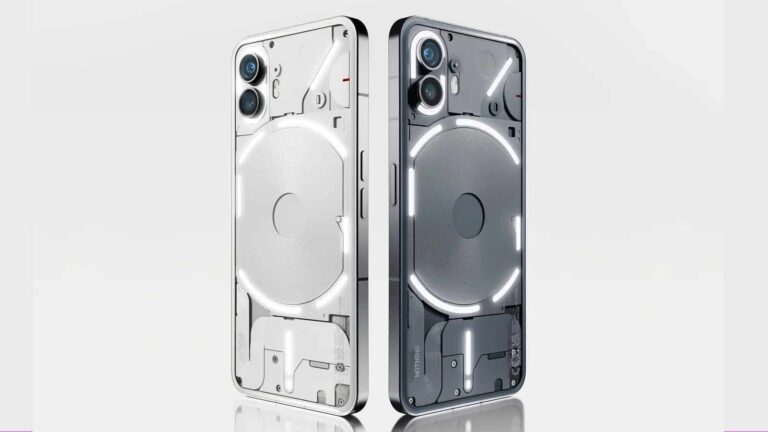
Last but not least, this update fixes an issue with the Bluetooth Quick Settings tile on the Nothing Phone (2). If you’re using the newly launched transparent phone, navigate to Settings > System > System Update to check for updates. The Phone (1) will get Nothing OS 2.0.2 later this month, though the changelog may vary slightly.


[ad_2]
Source link

Man tried to smuggle 68 iPhones by taping them to his body

0
[ad_1]

A rather bizarre report has surfaced in China. A man tried to smuggle 68 iPhones by taping them to his body. He tried to smuggle all those phones into the country, by the way, not the other way around.

A man tried to smuggle 68 iPhones by taping them to his body

This happened on the night of July 31. The man was described to be wearing a dark-blue short-sleeved shirt. He has tried to cross the border by going into the ‘no need to declare’ late at the border.

Needless to say, he had a lot to declare, but he chose not to. His weird walking tipped off the customs officers, though. He was described to be walking in a very stiff and heavy way.

It didn’t take long for the customs officer to realize he was trying to smuggle something, as 68 iPhones were taped to his body. They were taped around his waist, stomach, and legs. You can see the ones taped to his legs in the image below.

iPhone smuggler image 1

This is not a rare occurrence in China

This may seem like an odd story, and it surely is, but customs officers do see situations like this quite often, especially in China. As GizmoChina notes, a man has recently tried to smuggle in 48 CPUs by hiding them in his shoes.

In any case, the iPhone smuggler will be processed, and his punishment will be decided following everything. We’re not sure what he’s facing at this point.

Speaking of iPhones, new ones are right around the corner. The iPhone 15 series is allegedly coming next month. There was some talk of a delay, but it’s possible that will impact one or both ‘Pro’ models, and only in terms of when the sales start. The entire lineup will still likely launch in September.

In fact, a recent report suggested September 13 as the launch date for the iPhone 15 series.


[ad_2]
Source link

Tinder embraces AI to help you find someone to embrace you

0
[ad_1]
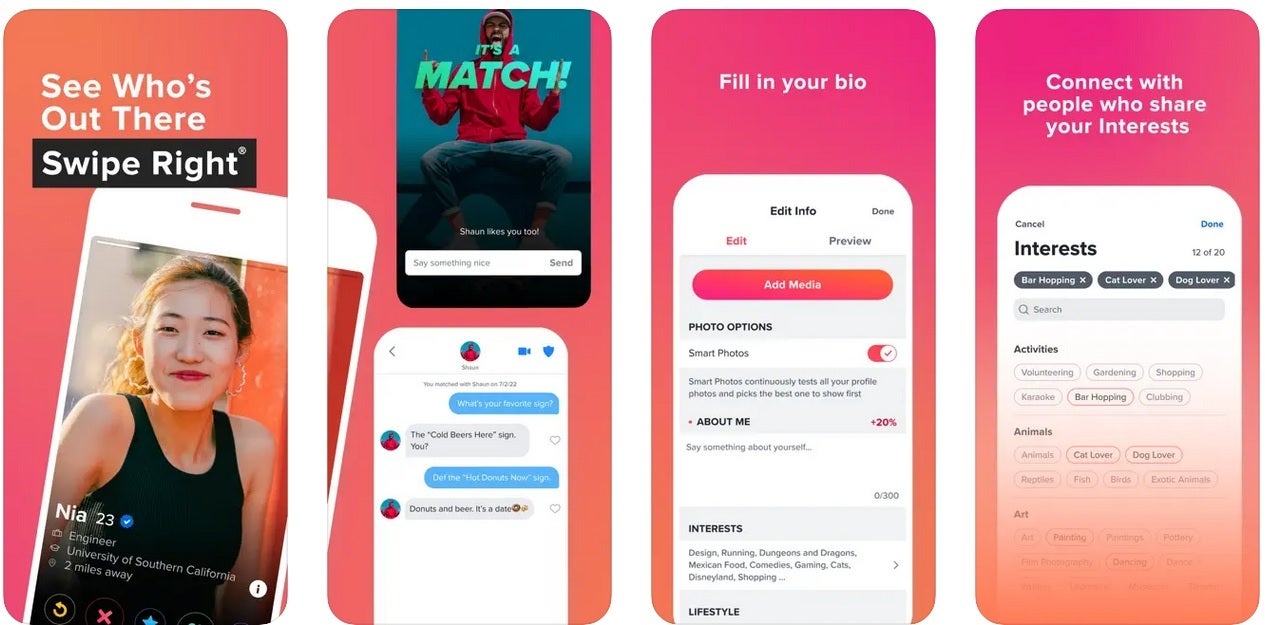
Dating app Tinder (iOS, Android) is the latest app to test the use of artificial intelligence (AI). According to some who use the site, it might be the only intelligence found on the app. However, that’s another story for another day. According to The Guardian, Tinder is working on a new feature that would use AI to help users decide which photo of them should be posted on the app.
The CEO of Tinder’s parent company Match Group, Bernard Kim, said during a conference call with analysts and investors, “I really think AI can help our users build better profiles in a more efficient way that really do showcase their personalities.” Using AI to help users select a photo that captures their best qualities would also “eliminate awkwardness” according to the executive.

Match Group, which says that Tinder has 75 million active users, disseminated a letter to shareholders this week in which it wrote about other possible uses for AI in the app including using it to “surface the right content to the right people to help improve relevancy and, ultimately, user outcomes.” And this could translate into more swipes to the right (a potential match) instead of a swipe to the left (rejecting a potential match).

And generative AI, similar to ChatGPT and Bard, might be used to help Tinder subscribers write the bios used to attract potential dates. This is in the early stages of being tested and is available in test markets only. The goal is for Tinder users to have the conversational chatbot write personal text for the “interests” and “relationship goals” sections of their Tinder profiles. Mark Van Ryswyk, Tinder’s chief product officer, said that survey showed that a third of Tinder users would “absolutely” use generative AI to help them pen their profile.

Other AI-based dating apps have surfaced including Teaser AI (iOS) which is an app that allows you to chat with an AI version of a potential date before you decide which way to swipe on their profile. Another AI-laden app called Blush (iOS, Android) allows users to practice their “relationship and intimacy skills” by talking to a chatbot.

Using AI to enhance your online dating profile does have some issues. According to the communications chief of dating app Inner Circle, Crystal Cansdale, “We can’t ignore that safety is a massive issue here. From scammers, spammers, and fake profiles, the whole industry is worried about how AI can be used to trick people.”


[ad_2]
Source link

Hackers Deliver Magniber Ransomware Via Windows security update

0
[ad_1]

Magniber Ransomware was first detected in late 2017; it targeted South Korean users through malvertising attacks using the Magnitude Exploit Kit. It had been distributed earlier through Internet Explorer(IE) vulnerabilities.

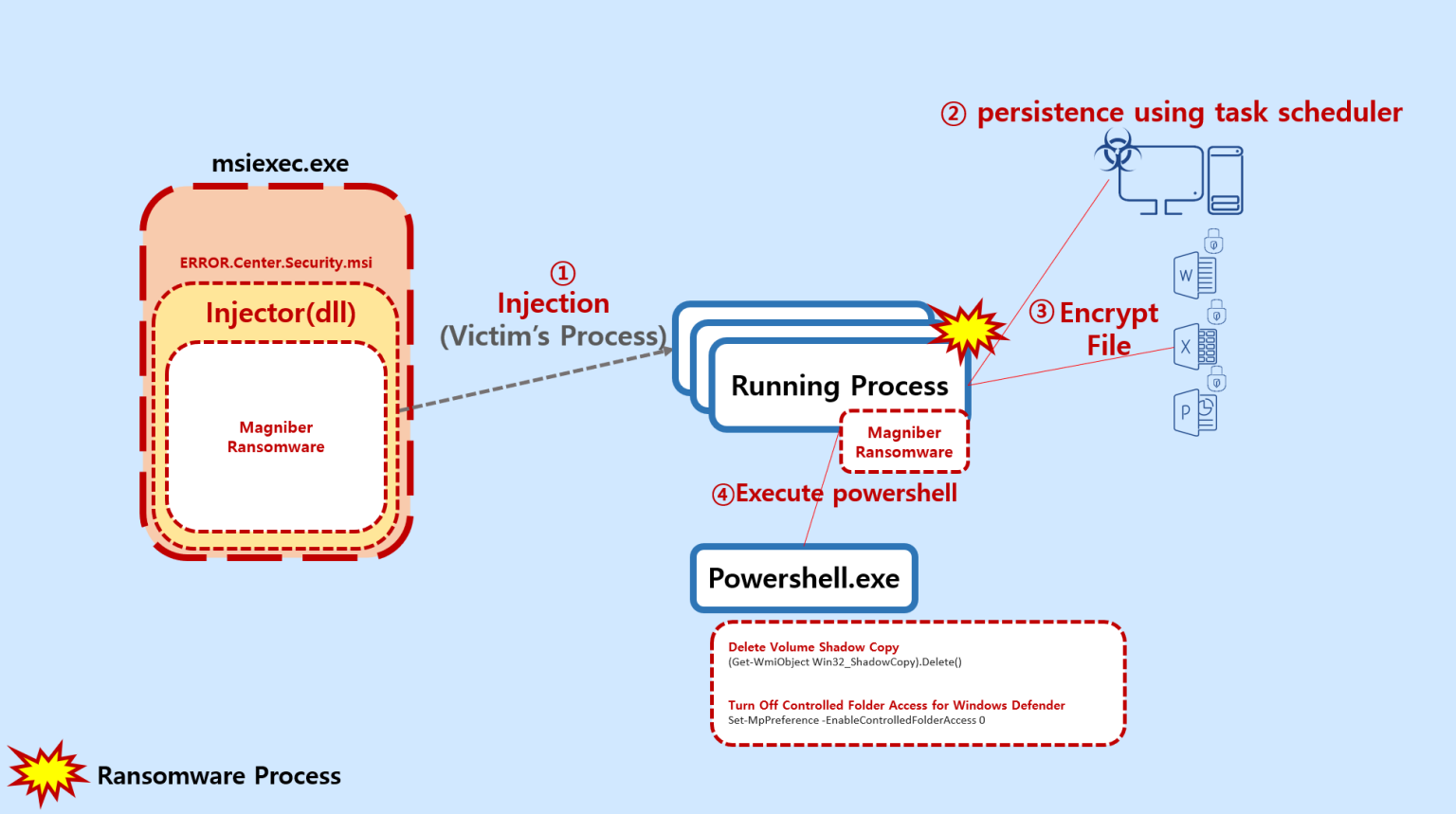
Since Microsoft announced IE’s end of support, it is now being distributed by changing its name to Windows security update package (ex_ERROR.Center.Security.msi) in Edge and Chrome browsers, reported AhnLab.

Since then, it has continued to evolve, adopting new obfuscation strategies and evasion techniques. 

In April 2022, the ransomware drew attention when it masqueraded as a Windows update file, luring victims into installing it. 

Hackers Deliver Magniber Ransomware

Magniber ransomware injects ransomware into a running process, causing the running process to encrypt the user’s files.

It registers the task scheduler for continuous infection and deletes the volume shadow copy to make recovery impossible.

In addition, the Windows Defender Controlled Folder Access command is executed through Powershell.

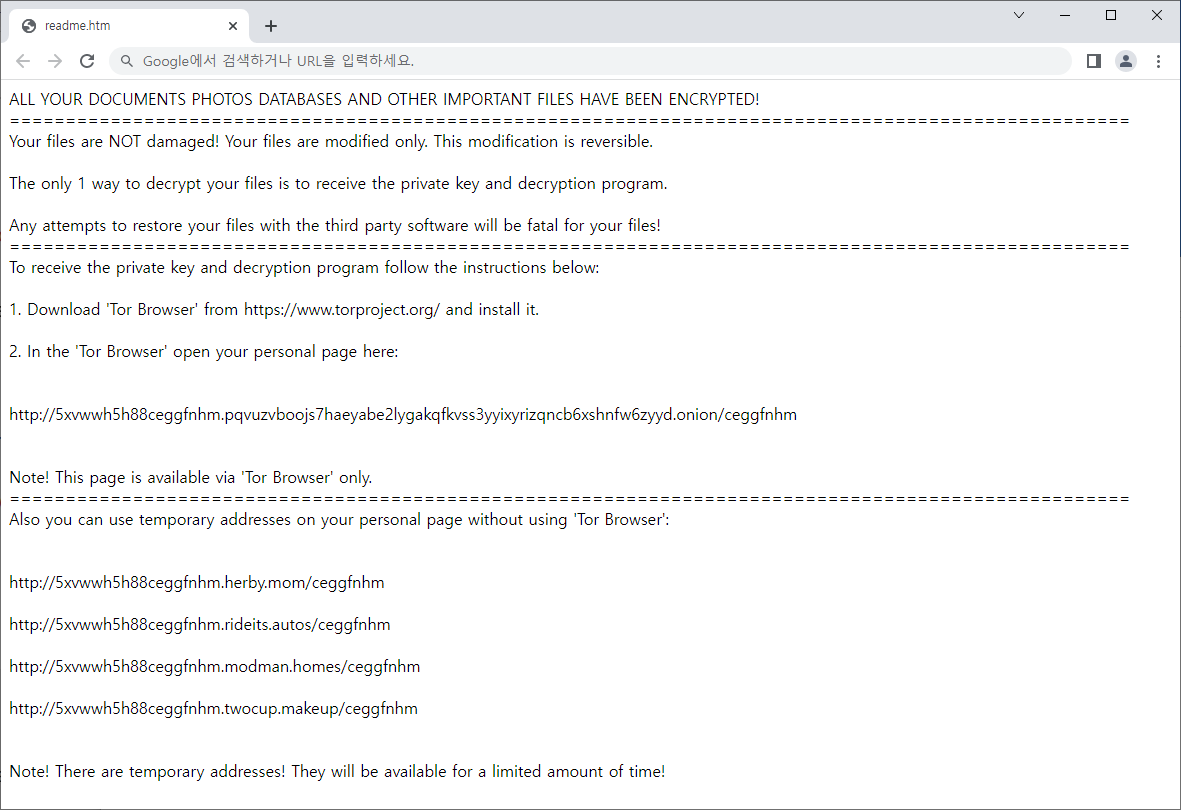
Magniber Ransomware encrypts the user’s file and creates a ransom note (readme.htm) in the path where the encrypted file is located.

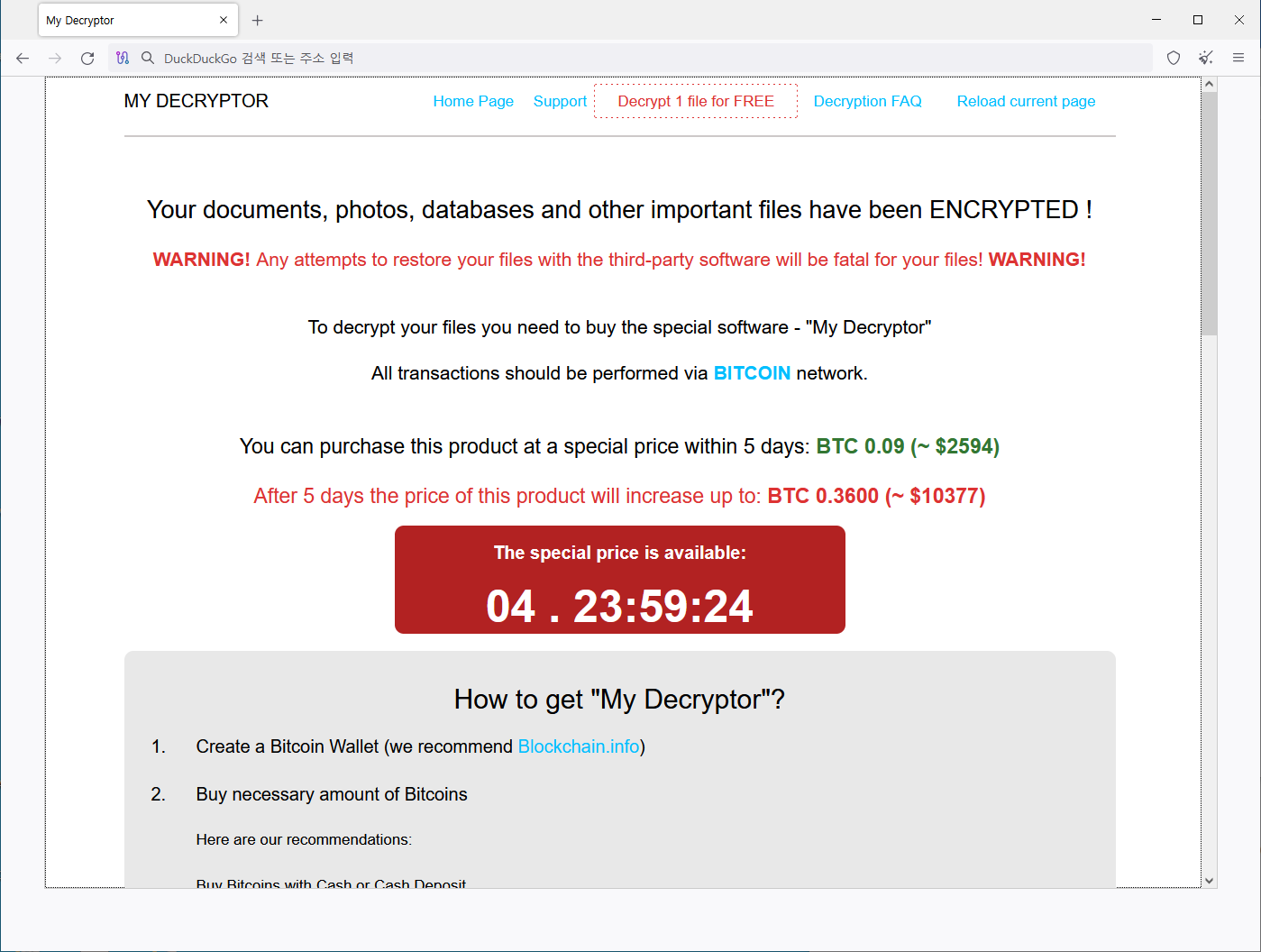
It guides the user to access the URL through the “tor browser” to recover the file. The accessed page is as shown below and it requires Bitcoin to recover the file.

Magniber is being distributed to users of the latest Windows versions of Chrome and Edge browsers through Typosquatting, which exploits domain typos.

IOCs

[Magniber behavior diagnosis]
– Ransom/MDP.Magniber.M4687 (2022.08.03.03)
– Ransom/MDP.Magniber.M4683 (2022.07.19.00)
[Magniber file diagnosis] – Ransomware/Win.Magniber.R592250 (2023.07.18.03)
[Magniver msi MD5]
f5dd30f503577071499a241532479279 
[C2 URL]
hxxp://146[.]19[.]106[.]31/ceggfnhm.msi

Keep yourself informed about the latest Cyber Security News by following us on GoogleNews, Linkedin, Twitter, and Facebook.


[ad_2]
Source link

WhatsApp might make navigation a little less seamless

0
[ad_1]

Swift and easy navigation is key to a good app experience. That’s especially true for apps like WhatsApp which are used a lot for business communication. However, it looks like WhatsApp might be getting rid of the swipe gestures that make navigation so quick and easy.

This change was spotted in the latest beta for the app by WABInfo (via Android Police). So, you won’t see this change if you’re on the stable version of the app. Also, since we’re talking about the beta version of the app, you’ll want to take this news with a grain of salt. There’s no telling if the company will follow through with it.

WhatsApp might take away the swipe gestures

When you’re using WhatsApp, you’ll see the main navigation tabs at the top of the UI. These are your Communities, Chats, Status, and Calls tabs. If you don’t want to bother with reaching for the top of the UI, you can simply swipe left or right on the UI to go to the tab you want.

However, it seems that WhatsApp doesn’t want that feature around anymore. According to the source, version 2.23.16.17 of the app’s beta doesn’t allow you to swipe through the tabs.

This is unfortunate, but it’s not WhatsApp’s doing. This app uses Android’s Material Design 3 design language. In the Material Design 3 guidelines, it advises against swipeable gestures. So, it appears that WhatsApp needs to get rid of the gestures in order to comply with Material Design 3’s outline.

So, while we don’t know for sure if WhatsApp is going to push this to the stable version, it seems likely. We don’t know when it’s going to land, so if you don’t want to give up the gestures, there’s no telling when you’ll lose them.

If you want to keep them, then you might want to hold off on updating your app. However, that solution can only last you so long, as you don’t want to go too long without updating the app.


[ad_2]
Source link