Fitbit users can now finally add American Express cards to their Google Wallet. This means that those who use Fitbit devices can now utilize their American Express cards for payments through Google Wallet. This feature has been long-awaited since Google replaced Fitbit Pay with Google Wallet, and it has now finally been rolled out as part of the Google Play Services v24.25 update.Previously, Google had mentioned the addition of American Express card support in an earlier update, but later retracted it. However, the feature has been reintroduced in the latest update, and users have reported successfully adding their American Express cards to their Fitbit devices. The official changelog for the update also confirms the addition of this feature.
In addition to American Express card support, the Google Play Services v24.25 update brings several other changes for Google Wallet users. These changes include:
The ability to add an e-wallet as a payment method or use linked e-wallets in Google Pay to complete payments on your phone.
New features for IDs added to Wallet on your phone.
The option to use Pixel as a payment method in Wallet on your phone.
The rollout of American Express card support for Fitbit devices is a significant development for users who have been eagerly awaiting this feature. It provides greater flexibility and convenience for those who prefer to use their American Express cards for payments. The additional changes included in the update further enhance the functionality of Google Wallet, making it a more versatile and comprehensive payment solution.
While Google has not officially confirmed the completion of the rollout, the reports of successful additions and the mention in the official changelog suggest that the feature is now widely available. This update is a welcome addition for Fitbit owners, who can now enjoy the convenience of using their American Express cards for payments on their devices.
A Proof-of-Concept (PoC) exploit has been released for a critical SQL Injection vulnerability in Fortra FileCatalyst Workflow.
This vulnerability could potentially allow attackers to modify application data.
This vulnerability, CVE-2024-5276, affects all versions of Fortra FileCatalyst Workflow from 5.1.6 Build 135 and earlier.
The SQL Injection vulnerability, discovered on June 18, 2024, is classified under CWE-20 and CWE-89.
It indicates improper input validation and improper neutralization of special elements used in an SQL command.
The vulnerability has a CVSS v3.1 score of 9.8, reflecting its critical nature (CVSS:3.1/AV:N/AC:L/PR:N/UI:N/S:U/C:H/I:H/A:H).
This attack exploits target software that constructs SQL statements based on user input.
An attacker can craft input strings so that when the target software constructs SQL statements based on the input, the resulting SQL statement performs actions other than those the application intended.
This vulnerability results from the failure of the application to validate input appropriately.
Potential Impacts
This vulnerability’s likely impacts include creating administrative users and deleting or modifying data in the application database.
However, data exfiltration via SQL injection is not possible with this vulnerability.
Successful unauthenticated exploitation requires a Workflow system with anonymous access enabled; otherwise, an authenticated user is needed.
The vulnerability affects all versions of FileCatalyst Workflow from 5.1.6 Build 135 and earlier.
Users of these versions are strongly advised to update their systems to the latest version to mitigate the risk.
Fortra has yet to release an official patch, but users should monitor the vendor’s advisories for updates.
The release of the PoC exploit for this critical SQL Injection vulnerability underscores the importance of timely updates and robust security practices.
Organizations using FileCatalyst Workflow should act swiftly to secure their systems against potential exploitation.
FreeWebinar! 3 Security Trends to Maximize MSP Growth -> Register For Free
AI is all over the place at the moment… as far as technology goes. It’s the current buzzword that is being used. Many smartphone OEMs have included plenty of AI features in their devices. The same goes for Huawei, who believes that AI smartphones will account for 90% of the market by 2030.
This was said by Huawei’s Executive Director and Chairman of the ICT Infrastructure Business Management Committee, Wang Tao. He said it during the keynote speech in Shanghai yesterday.
Huawei believes AI smartphones will take 90% of the market by 2030
He believes that AI-powered smartphones will account for 11% of shipments this year. That could reach the 90% level by 2030, though. He essentially sees the integration of LLMs and AI features becoming a standard for the industry.
Tao said the following: “We will soon see a huge boost to traffic from AI. At the same time, 5G-A networks will be able to provide higher speeds, lower latency, and greater capacity to meet the network demands of the AI era”.
Many smartphones already offer such features and are considered ‘AI smartphones’. Apple joined the fray with the company’s iOS 18 announcement recently. Well, users still don’t have access to all that, at least not in the stable form. Still, they’ll get access in a couple of months.
Companies will be able to run more and more AI tasks locally
When it comes to AI features, your phones need to talk to the server that runs larger LLMs. So for some processes, that is necessary. Companies are expected to be able to do more and more such tasks on smartphones, natively, though. LLMs will be getting more efficient, and processors more powerful and capable in the AI sense.
So, it seems like the AI buzzword is here to stay. Companies likely won’t stop using it, though they may reshape it. Apple, for example, avoided using ‘AI’, and simply calls its features ‘Apple Intelligence’.
Besides this, one investigator discovered the software in an open directory that the Kimsuky threat group probably controls.
An increasing risk like this uses crafty approaches to reach out to gamers and developers across platforms with numerous tricks.
On XenoRAT’s GitHub page, you will find more advanced features such as HVNC, audio spying, and SOCKS5 reverse proxy.
Communication between clients and the controller is done through TCP sockets, and this follows an identifiable pattern that can be used to identify malicious activities.
The worrying point is that the malware is being distributed in .gg domains, which are popular within the esports community and target gamers. The network IDS rules for detection are available on the ET website.
It shows how threat actors increasingly use well-known platforms and communities to spread their tools.
The discovery of SynapseX.revamped.V1.2.rar, an untrusted file that communicated with .gg sites resulted in the creation of a GitHub repository disguised as Roblox scripting engine.
YouTube Account Associated with Xeno RAT & Quasar Distribution (Source – Hunt.io)
The repository contained several harmful executable files, such as XenoRAT and Quasar. Earlier, this GitHub user recognized one file as XWorm malware.
Further inquiries revealed that a YouTube channel called “P-Denny Gaming” was linked to it, which recommended that users turn off Windows Defender before installing that malware.
YouTube Video Instructing Users to Install Synapse X File (Source – Hunt.io)
The content of the channel, together with its comments, tried to make these malicious files appear genuine.
The XenoRAT and other malware are very dangerous to the gaming communities when distributed through .gg domains as well as on GitHub.
These threats take advantage of gamers’ trust in good-looking tools that may result in the possible theft of personal data, game items, and financial details.
Using open-source platforms for malware distribution increases the chances of widespread infections.
Even if users are inclined to download or install software from sites they regard as trustworthy, they should be extremely careful.
For a safe internet gaming environment, one needs to be extra cautious and doubtful since these complex social engineering ploys most affect the gaming community.
FreeWebinar! 3 Security Trends to Maximize MSP Growth -> Register For Free
Based on the latest information, the Xiaomi 15 Pro will deliver one negative and one positive change. This information comes from Digital Chat Station, by the way, one of the most reliable tipsters out there.
He shared some information about the device via Weibo, a Chinese social media network. He confirmed that the phone will be fueled by the Snapdragon 8 Gen 4 SoC. That much was a given.
The Xiaomi 15 Pro will deliver one negative & one positive change, amongst other things
In addition to that, the Xiaomi 15 Pro is said to include a 2K micro-curved display. An ultrasonic fingerprint scanner will also be included, which was not the case on the Xiaomi 14 Pro. That phone featured an optical in-display fingerprint scanner.
Now, in the title, we mentioned one negative and one positive change in specific. Well, here they are. The negative one has to do with the phone’s main camera. Xiaomi looks set to ditch the variable aperture, at least on this model. The phone will likely still be able to capture outstanding photos, but… having a variable aperture is useful.
Variable aperture has proven to be quite effective on smartphones, for shooting in various different lighting situations, amongst other things. Well, the Xiaomi 15 Pro is said to offer a large aperture, but a fixed one.
The company will utilize a silicon-carbon battery
In regards to the positive change, Xiaomi looks set to adopt new battery tech. The phone will allegedly use a silicon-carbon negative electrode battery. Thanks mainly to that battery, the Xiaomi 15 Pro is said to include a larger battery, and yet weigh less than 200 grams. It is said to feature a 5,500mAh unit.
The Xiaomi 14 and Xiaomi 14 Pro launched back in October last year. They are expected to arrive around the same time this year, if not a bit sooner. The launch event will likely take place in China first yet again.
The Xiaomi 14 Pro didn’t even make it to global markets. The Xiaomi 14 and Xiaomi 14 Ultra did, but not the ‘Pro’ model. It remains to be seen if that will be the case this time around too.
Arkansas has sued the makers of the e-commerce platform Temu over alleged deceptive trade practices. The state claims the shopping app is “dangerous malware” abusing system permissions to steal user data. The lawsuit also raises security concerns over the platform’s Chinese origin.
Temu is malware disguised as shopping app, Arkansas lawsuit claims
Launched in the US in 2022, Temu is an online shopping platform owned by PDD Holdings. Originally a Chinese company, PDD Holdings shifted its headquarters to Ireland last year. The firm also runs a separate shopping app called Pinduoduo in China, which security researchers previously labeled as potential spyware. In March 2023, Google briefly removed the latter from the Play Store after some of its “off-Play versions” were found to contain malware.
In his official complaint, Arkansas Attorney General Tim Griffin linked the two apps. Since Temu came several years after Pinduoduo and made its global debut in the US, Griffin believes it was modeled off its Chinese version and may have the same security lapses. “Temu purports to be an online shopping platform, but it is dangerous malware, surreptitiously granting itself access to virtually all data on a user’s cell phone,” the lawsuit begins.
It goes on to make sweeping claims accusing the app’s makers of purposefully designing it to override privacy settings and gain unrestricted access to unnecessary user data. Griffin says Temu sells user data to third parties to make money, violating the privacy rights of Arkansas citizens. The Arkansas AG also pointed to Apple’s now-resolved concerns about the shopping app’s compliance with data security transparency standards in the US and Europe.
Moreover, Griffin’s lawsuit cites findings by an independent research firm saying Temu can potentially hack users. The number of system permissions and the amount of data it can access is too high for a shopping app. It “sneaks” permissions to gain access to the user’s location, saved files, storage device, and more, which aren’t critical to its normal functioning. Temu also collects sensitive or personally identifiable information that it doesn’t need.
Temu’s Chinese ties are a security threat
Arkansas’ lawsuit against Temu goes beyond labeling it as “malware” and raises security concerns over the app’s Chinese ties. Griffin says Temu’s leadership team is “a cadre of former Chinese Communist Party officials.” As such, the platform is a significant security threat to US citizens. This lawsuit seeks an order enjoining the platform’s deceptive trade practices and privacy violations. It also seeks civil penalties and other monetary and equitable relief.
“Temu is not an online marketplace like Amazon or Walmart. It is a data-theft business that sells goods online as a means to an end,” Griffin said in an official statement. “Though it is known as an e-commerce platform, Temu is functionally malware and spyware. It is purposefully designed to gain unrestricted access to a user’s phone operating system. It can override data privacy settings on users’ devices, and it monetizes this unauthorized collection of data.”
KakaoTalk is an Android application that is predominantly installed and used by over 100 million people.
It is a widely popular application in South Korea that has payment, ride-hailing services, shopping, email etc., But the end-to-end encryption is not enabled by default on KakaoTalk as it is an opt-in feature under the name “Secure Chat”.
Further, this End-to-end encryption is not supported in group messaging or voice calling.
However, KakaoTalk has been discovered with a critical vulnerability that could allow an unauthorized remote threat actor to leak an access token of a victim via an HTTP request header.
In addition, this token can also be used to take over the victim’s user account and read their chat messages by registering an attacker-controlled device.
This vulnerability has been assigned with CVE-2023-51219 and the severity is yet to be categorized.
According to the reports shared with Cyber Security News, the main entry point of this vulnerability is the CommerceBuyActivity webview which has multiple attack points as follows:
It can be started with a Deep link (adb shell am start kakaotalk://buy)
Javascript enabled
supports Intent:// that can be used to send data to other non-exported app components via JS
No sanitization
Leaks an Authorization HTTP header that can be done through Netcat listener in a terminal window and running the $ adb shell am start kakaotalk://buy to start the CommerceBuyActivity WebView
However, though there is an option to leak the Authorization header using GET request, there is small validation there that prevents an attacker from loading any arbitrary attacker-controlled URLs.
To overcome this issue, the code was analyzed which provided information that the path, query and fragment of the URL are using the attacker’s input.
URL Redirect To DOM XSS
As KakaoTalk has a same origin policy that does not load any arbitrary URLs, researchers were checking to see if there are any kakao domains that are vulnerable to DOM XSS.
There was one endpoint identified that was vulnerable to redirection to any kakao domain.
To leverage this same site open-redirect for malicious purposes, there was an XSS flaw discovered.
This XSS flaw was found in the m.shoppinghow.kakao.com subdomain which used DOM Invader Canary string and already had an Stored XSS payload. The XSS payload was so simple which was “><img src=x onerror=alert(1);>.
So combining this XSS, attackers created a malicious deep link which was kakaotalk://auth/0/cleanFrontRedirect?returnUrl=https://m.shoppinghow.kakao.com/m/product/Y25001977964/q:”><img src=x onerror=alert(1);>.
This leaked the user’s access token via the Authorization header which was then sent to the attacker-controlled server by encoding the attacker URL to base64.
As a matter of fact, this token can be used to take over the victim’s Kakao mail account that was used for registration.
Additionally, if the user does not have a Kakao mail account, an attacker can still create a new Kakao Mail account and see the chat messages.
Furthermore, another interesting thing is that the Kakao Mail account overwrites the user’s previous registered mail address without any additional checks.
Further the researchers have also detailed about password reset, via Burp, malicious Deep link creation and a Proof-of-concept has also been published on GitHub.
FreeWebinar! 3 Security Trends to Maximize MSP Growth -> Register For Free
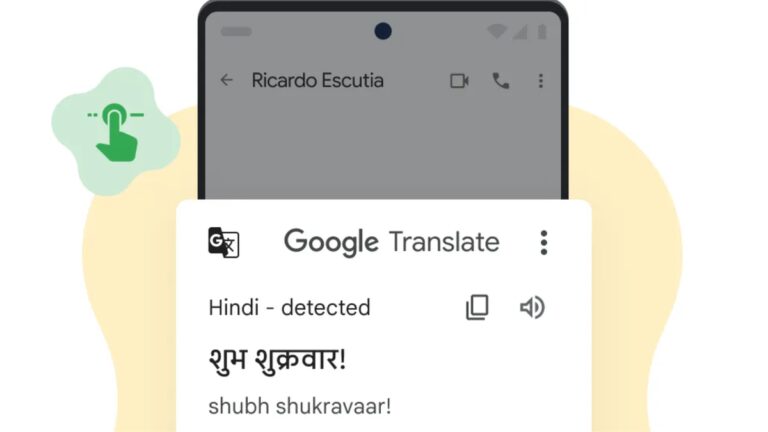
Google has announced that Translate now supports 110 additional languages. This is the biggest update the service has received so far. It was all possible thanks to the power of AI.
For reference, before this update, Google Translate supported 133 languages. Therefore, the service’s language support has grown by more than 82% at once. Google revealed that it used its PaLM 2 AI language model to achieve such a milestone. Using artificial intelligence helps to significantly accelerate learning processes in complex systems, and this is a great example.
110 new languages join the Google Translate-supported list
The blog post highlights some of the new supported languages: Afar, Cantonese, Manx, Nko, Punjabi (Shahmukhi), Tamazight (Amazigh) and Tok Pisin. There are also “languages close to Hindi, like Awadhi and Marwadi” and “French Creoles like Seychellois Creole and Mauritian Creole.” Google’s Isaac Caswell said that “about a quarter of new languages come from Africa.”
Not all new supported languages are widely used. In fact, with this update, the company wants to contribute to the preservation of languages. There are even some that do not have any officially active speakers. Google claims that the update focused on the most common varieties of each language. This allows Google Translate to deliver reliable and usable results in the real world.
8% of the population speaks these languages
In total, the 110 new languages supported by Google Translate represent 8% of the population. This translates into more than 614 million active speakers around the world. The company had advanced its ambitious plans for Translate in 2022. At that time, the company stated that the goal is to support up to 1,000 languages, thanks to the power of AI.
This latest step puts Google closer to its goal. It also further increases the gap with Apple’s language translation service. Currently, Apple Translate supports just over 20 languages, a number that pales in comparison.
Since its launch in 2006, Google Translate has been breaking down language barriers, helping people connect and understand the world better. With advancements in technology, Google has steadily expanded its language repertoire. Now, as AI takes the spotlight in tech, Google is using it to diversify the languages available on Google Translate even further.
110 new languages are coming to Google Translate
The tech giant is introducing 110 new languages to Google Translate, marking its largest expansion to date. This feat is made possible by its PaLM 2 large language model, which Google credits as crucial in enabling Translate to effectively learn closely related languages. This includes languages such as Awadhi and Marwadi, closely related to Hindi, as well as French creoles like Seychellois Creole and Mauritian Creole.
Video credit – Google
As technology advances, and as we continue to partner with expert linguists and native speakers, we’ll support even more language varieties and spelling conventions over time.
– Isaac Caswell, Senior Software Engineer, Google Translate, June 2024
From Cantonese to Qʼeqchiʼ, the latest languages added to Google Translate now serve over 614 million individuals globally, opening up translations for about 8% of the world’s population. These include major languages with millions of speakers, languages used by small Indigenous groups, and some with few native speakers but ongoing efforts to preserve and promote them.
Roughly 25% of the new languages originate from Africa, marking Google’s most extensive expansion of African languages to date. This includes Fon, Kikongo, Luo, Ga, Swati, Venda, and Wolof.
Here are a few of the languages recently added to Google Translate:
Cantonese: a highly requested language for Google Translate for quite some time. However, Google says due to its overlap with Mandarin in writing, finding accurate data and training models can be challenging.
Afar: a tonal language spoken across Djibouti, Eritrea, and Ethiopia, which stands out in this release for garnering the most support from volunteer contributors.
Manx: the Celtic language of the Isle of Man, which nearly faced extinction after its last native speaker passed away in 1974. However, thanks to a revival movement across the island, the language has seen a resurgence, with thousands of speakers now keeping it alive.
NKo: a standardized form of the West African Manding languages that brings together different dialects into a single language. Its unique alphabet was invented in 1949, and today, there is a vibrant community actively developing resources and technology for it.
Punjabi (Shahmukhi): a version of Punjabi written in the Perso-Arabic script (Shahmukhi) is the most widely spoken language in Pakistan.
Tamazight (Amazigh): a Berber language spoken across North Africa. Despite having many dialects, its written form is generally understood across different regions. It is written in both Latin and Tifinagh scripts, both supported by Google Translate.
Tok Pisin: an English-based creole that serves as the lingua franca of Papua New Guinea.
I don’t know about you, but I only speak three languages, so I think tools like Google Translate are super handy. Thanks to them, we can connect with people from all over the world. I mean, no one can learn every language out there, right? But technology can, and that is one of the coolest things about it.
Google has unveiled new features for Chrome Enterprise Core, formerly known as Chrome Browser Cloud Management.
As organizations increasingly rely on cloud computing, hybrid work models, and Bring Your Device (BYOD) policies, the need for robust browser management has never been more critical.
This announcement aims to address these challenges by providing IT and security teams with enhanced visibility and control over their browser environments.
The Browser: A Key to Enterprise Productivity
The modern workplace is evolving, with more work being conducted within the browser than ever before.
Research suggests that by 2030, enterprise browsers will become the core platform for delivering workforce productivity and security software on both managed and unmanaged devices, ensuring a seamless hybrid work experience.
Recognizing this trend, Google has developed Chrome Enterprise Core to help organizations maintain a productive workforce while safeguarding sensitive information.
Chrome Enterprise Core: A Comprehensive Management Solution
Chrome Enterprise Core allows IT administrators to configure and manage browser policies, settings, apps, and extensions across multiple browsers from a single console.
This capability is crucial for organizations with diverse operating systems and devices, and it comes at no cost.
The latest update introduces several new features designed to support IT and security teams more effectively.
One of the key enhancements is the extension of policy management to mobile platforms.
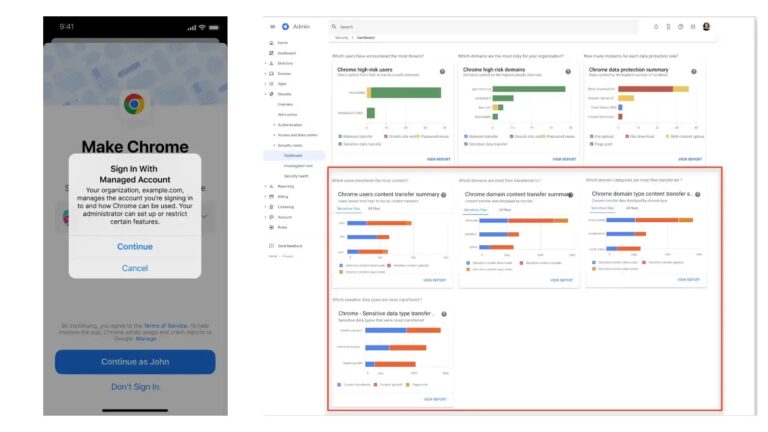
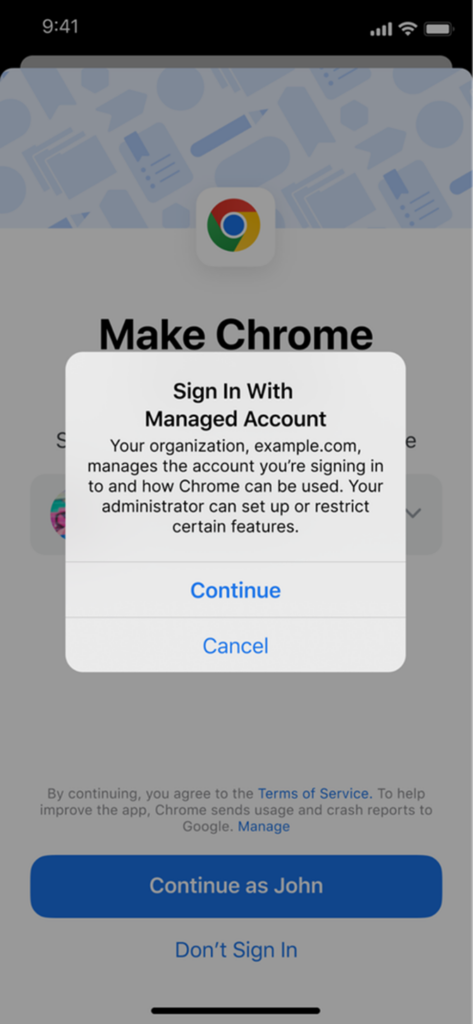
Admins can now push policies to users who sign into Chrome on iOS, covering both unmanaged and managed browsers.
This feature is particularly beneficial for BYOD models, as it allows for a clear separation between a managed work profile and a user’s profile.
This capability is also available on Android, ensuring comprehensive coverage across all mobile platforms.
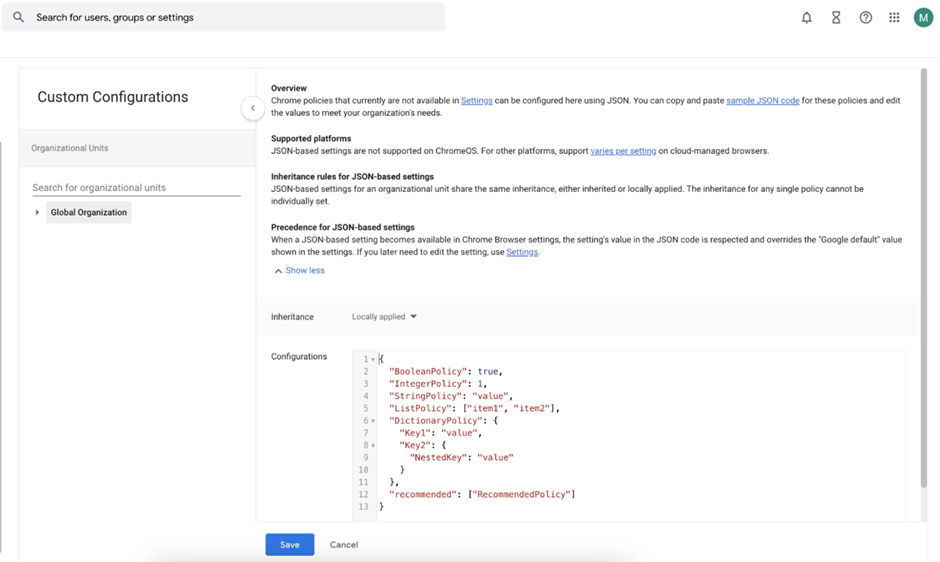
Additionally, Google is launching new JSON custom configurations from the cloud, enabling enterprises to leverage even more policies through cloud management.
This feature allows IT teams to configure any on-prem Group Policy Object (GPO) policy through the cloud, providing greater control over their deployment.
Understanding that every organization has unique needs, Google has introduced more flexible IT management controls.
Organizations can now manage browsers by groups, including multiple groups, and manage at the device and Organizational Unit (OU) level.
This flexibility allows IT teams to apply different policies for various business divisions, geographies, or job roles.
For instance, IT teams can group all Windows devices or all remote developers to apply specific policies.
To facilitate the adoption of Chrome Enterprise Core, Google has introduced new interactive setup guides within the Google Admin console.
These guides provide detailed instructions on setting up and using the most popular capabilities, offering hands-on training for administrators at any stage of their Chrome Enterprise Core journey.
Insights and Action
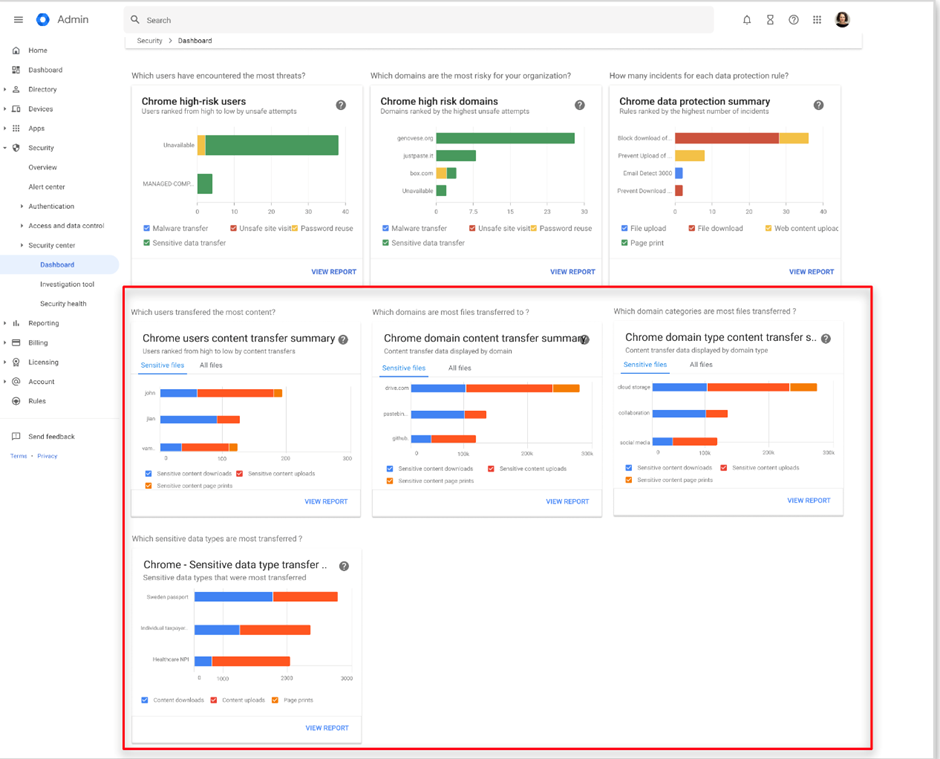
Security InsightsA standout feature of the new update is Chrome security insights, which allows Security and IT admins to enable a one-click security event logging analytics tool.
This tool automatically analyzes all sensitive data movement across the organization’s fleet, scanning data transfers against 50 default Data Loss Prevention (DLP) detectors.
It generates reports on activities such as users with high content transfer, domains with high content transfer, and the most common sensitive data types.
This feature provides increased visibility and insights into potential data exfiltration and insider risk threats.
Crash Reports
Currently available for Workspace Enterprise customers, Chrome security insights will be accessible to all Enterprise Core users in July.
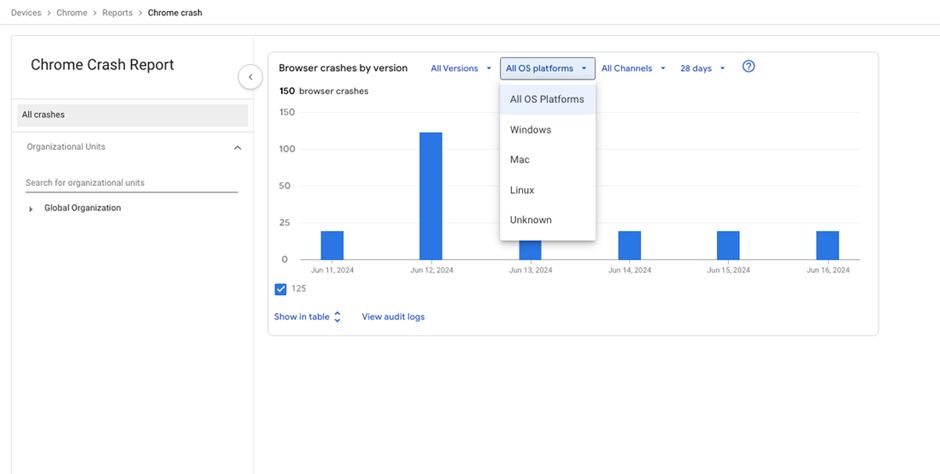
Another valuable addition is the availability of crash reports, which give IT teams insight into crash event trends and allow them to analyze potential browser issues proactively.
This feature helps IT teams respond quickly and troubleshoot problems to minimize end-user disruption.
Crash reporting can be visualized by Chrome version, OS platform, and channel, and is available to all Chrome Enterprise Core users in the “Chrome browser > Reporting” section of the Google Admin console.
Google has introduced a new Inactive Browser Deletion Policy to support data hygiene efforts.
This policy automatically deletes inactive browser information from Google servers after a specified period, giving IT teams time back and ensuring data hygiene.
Google’s latest enhancements to Chrome Enterprise Core demonstrate its commitment to providing IT and security teams with the tools they need to manage and secure their browser environments effectively.
With extended policy management, more flexible IT controls, and insightful analytics, Chrome Enterprise Core is poised to become an indispensable tool for organizations navigating the complexities of modern work environments.
For those not yet using Chrome Enterprise’s cloud management tool, now is the perfect time to get started, as it is free. Happy browsing!
FreeWebinar! 3 Security Trends to Maximize MSP Growth -> Register For Free





.webp)
.webp)