YouTube Music is one of the major competitors to Spotify. As a music streaming service, it has a wide range of features and even wider selection of artists. But what about the app’s design? Well, huge chunks of it have pretty much remained the same for a long time.
But this is Google we’re talking about. We can see the company’s strive for innovation through products like its Android phones, such as the Pixel 7a and Pixel Fold. So how does that translate into refreshing YouTube Music? Well, with a test.
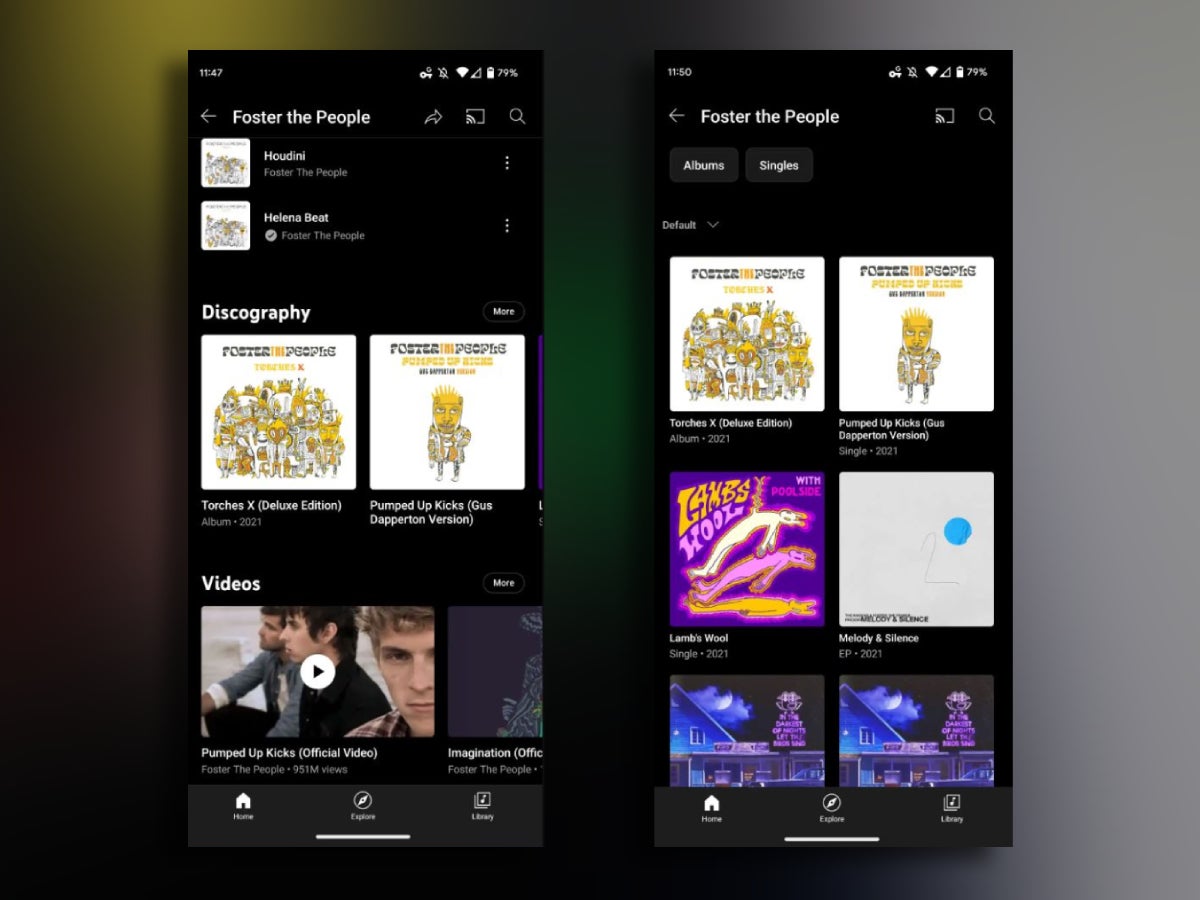
Said test impacts the Artist pages in the app, which up until now was pretty straightforward and conventional. With this change, though, users who navigate to an artist’s page will be able to see a new section labeled “Discography” which includes new filters too.
Some sample screenshots of the changes in questions, courtesy of 9to5Google.
While users will be able to browse the given discography at leisure, they can also utilize the new filtering options to single out Albums or Singles specifically. As someone who appreciates a full album playlist more than some random selection of songs, I personally welcome this change with open arms!
That being said, there was a short appearance of another visual mode too: Top Releases. This, of course, features the given artist’s most successful hits, but for some reason the feature was rolled back a few days after release. That being said: some users are still seeing it, which is… interesting?
That might be because the page launched too early and wasn’t exactly finished, but it also may be due to some other, more dubious reason. Regardless, we’re sure that it will make an appearance again if — and when — the Big G thinks that it is ready.
As 9to5Google points out, this change does limit the content offering on the first page of the artist pane, but in return it is also much easier to navigate. We still don’t know how wide the roll out of this revamp is, so you might want to check for any pending app updates today.
Nothing confirmed some additional details about its upcoming smartphone. In addition to revealing its plan for Nothing Phone (2) updates, the company also revealed the phone’s display size. On top of that, Nothing’s sustainability efforts were also talked about.
Having said that, we’ve already talked about updates in a separate article. The Nothing Phone (2) will receive three years of major Android updates. That means that Android 16 is basically guaranteed. Four years of security updates were also promised by Nothing.
The Nothing Phone (2) will include a larger display, and its size has been revealed
Now, regarding its display. Nothing confirmed that the phone’s display will be 0.15 inches bigger than the one on the Phone (1). That means that we’re looking at a 6.7-inch display, basically, as the Nothing Phone (1) includes a 6.55-inch panel.
The phone’s battery capacity will also increase, from 4,500mAh in the Nothing Phone (1) to 4,700mAh in the Nothing Phone (2). We hope that’ll be enough to fuel the device.
It remains to be seen if the display will be flat or curved, though. Considering its size, we’d guess it’s curved. However, the Nothing Phone (1) included a flat display, so… we’ll have to wait and see.
The Nothing Phone (2) will also have a lower carbon footprint than its predecessor
Nothing also talked about the phone’s carbon footprint, as the company managed to lower it. The Nothing Phone (2) has an SGS certified carbon footprint of 53.45kg, which is over 5kg lower than the Phone (1).
IMAGE
It was confirmed earlier that the Phone (2) will ship with the Snapdragon 8+ Gen 1 SoC. It was also confirmed that the phone will launch in July, so we’re expecting it next month.
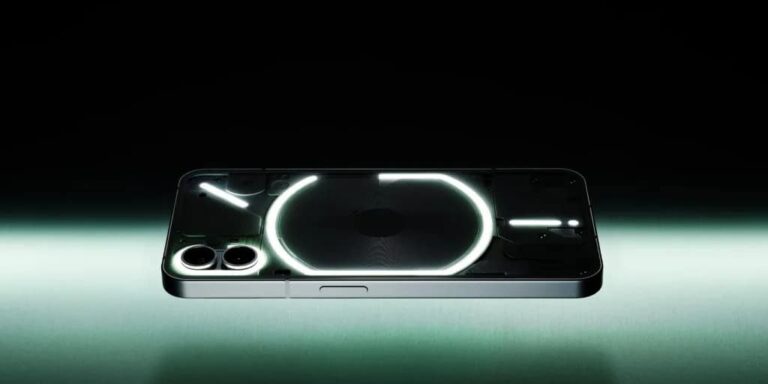
Chances are that the Nothing Phone (2) will keep the same design language as the first-gen model. You can expect a see-through backplate with Glyph LED lights on the back of it.
Proton, the Swiss technology company that has made a name for itself with its privacy-focused services such as Proton Mail, VPN, Calendar, Drive, and password manager, is here with its latest offering. It’s a bundle of all of these services intended for families, plus the company’s future services complete with all premium features. Its password manager, dubbed Proton Pass, is still in beta and not yet available to the public.
Proton launches a family plan bundling all of its services
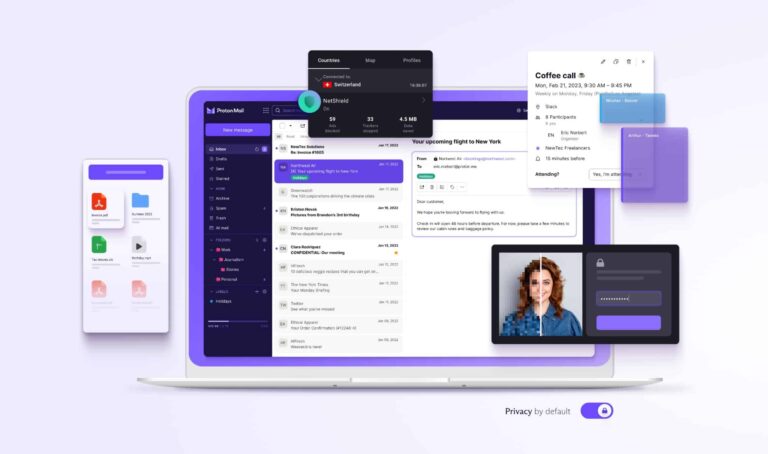
The Proton Family plan can be shared by up to six people. It gives users 3TB of cloud storage in Proton Drive, with the company promising 20GB of bonus storage every year. Additionally, you get full access to Proton Mail. It brings 90 encrypted email addresses (15 each for six users), three custom domains, short-domain email addresses (@pm.me) with unlimited sending and receiving abilities, password protection, unlimited labels, folders, and filters, IMAP support, auto-reply, and more.
Proton VPN is also part of this package. It offers VPN on up to ten devices for each user at the same time. The company promises the highest VPN speed with more than 2,900 encrypted servers in over 65 countries around the world. It also bundles NetShield ad-blocker. Other features include P2P/BitTorrent support, DNS leak prevention, router support, split tunneling, strict no-logs policy, unlimited volume/bandwidth, and kill switch/always-on VPN. Proton Calendar, meanwhile, gives access to 25 personal calendars to each user.
As said earlier, the Proton Family plan also promises access to all future services from the company. Its end-to-end encrypted password manager is currently available to some users in beta. Proton Pass encrypts everything from your username and password to the web address and all other information fields. It also boasts two-factor authentication (2FA) and supports 2FA autofill. The service is open source, allowing anyone to audit the security features. Proton says its password manager will be available to the public soon.
Proton’s family offering starts at $20 a month
Proton’s Family plan costs $29.99 per month. But if you pay for two years upfront, you get full access at just $19.99 per month, billed at $479.76 every two years. The company also offers an annual plan that costs $23.99 per month for a total of $287.88 for a year. You can sign up for Proton Family here. Existing users can follow these instructions to upgrade their Proton plan. Note that the company also offers a free tier with limited access.
If you take a moment to consider what are the staple apps that most of us install on our Android phones, WhatsApp is likely to come up rather quickly. And if that is the case, we can’t really blame you. This end-to-end encrypted instant messaging app is certainly one of the most feature-packed options on the Google Play Store.And speaking of Google, its Material You theming was quite impactful. It was initially introduced with Android 12 and it brought a more unified vibe to Android’s user interface. Right now, we’re expecting Android 14 and the style is still prominent. That speaks for itself right there!
In fact, it is so impactful that it has even begun leaking into non-Google owned apps. Which, in general, is great, as it further serves to unify the look and feel of options and settings menus. It has taken some time, but WhatsApp is finally among the inspired, as testified by this report from WABetaInfo.
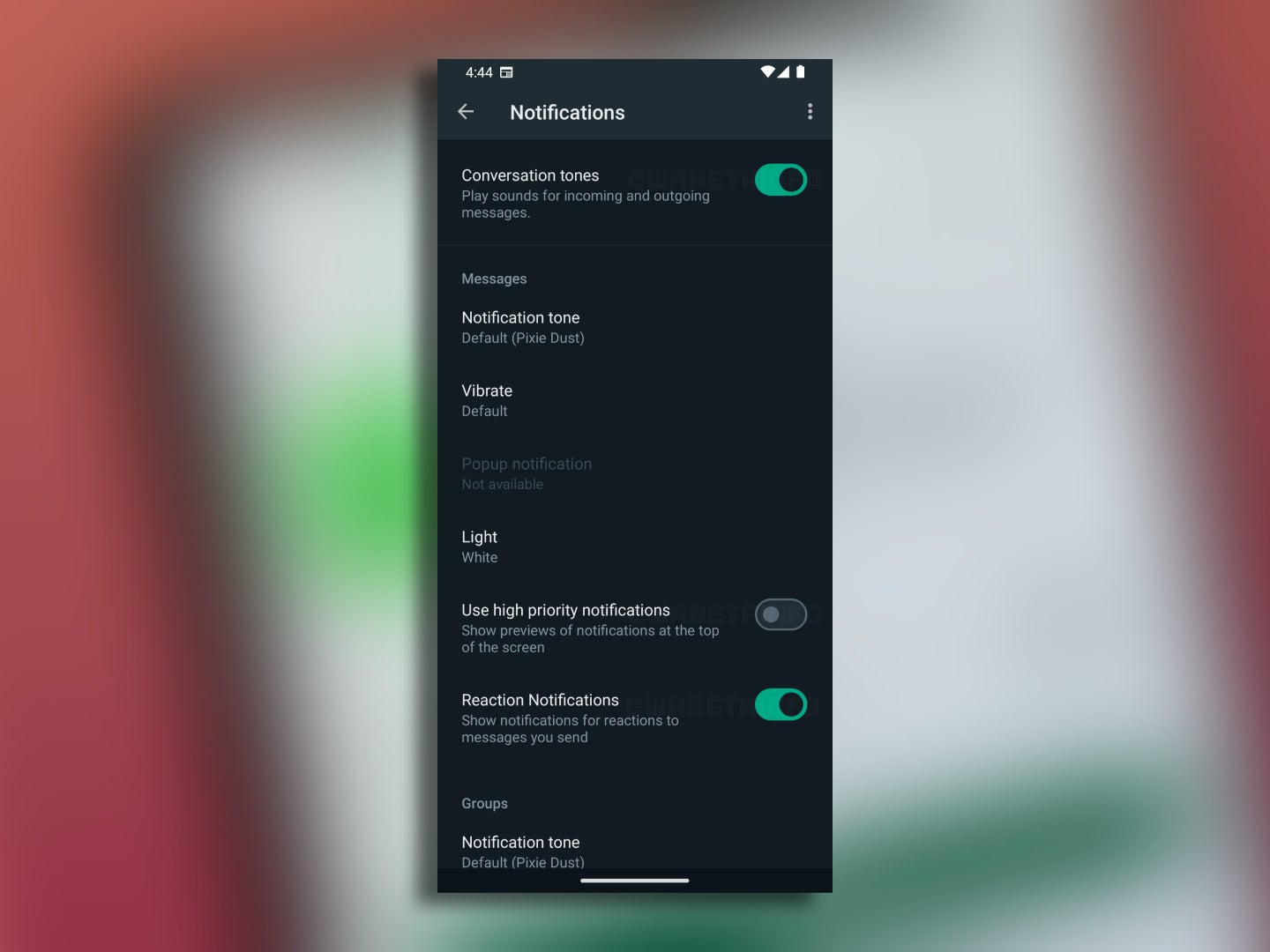
The new switches, as showcased by the WABetaInfo team.
The team has managed to note this change in the 2.23.12.3 version release of the WhatsApp Beta release of the app for Android. What may turn into the start of a more major overhaul seems to be right in line with the Material Design 3 guidelines. This latest release is focusing on revamping the options toggles to fit in with the general aesthetic. Those among you who’ve been vigilant will know that this is just another step in this road, for the Meta-owned company already revamped the navigation bar in a previous beta release.
With this being a Beta release though, we can’t say for certain when it will be ready for a wider live release. What we can remind you of though is that you are free to check and see if you can join the WhatsApp beta, if you want to help out with testing the app’s latest features.
Garmin is back at it with its next round of sports watches in the Fenix 7 Pro series and the Epix Pro (Gen 2) series. Each is capable of providing the wearer with similar features but also come with a few that are unique to their offering.
The Epix Pro series watches for example come with a bright AMOLED display. This should be easier to see in sunlight and on most occasions where you might experience glare. It comes in three different sizes which are 42mm, 47mm, and 51mm. Both the 42mm and 47mm versions cost $899.99 while the 51mm model bumps up that price by $100. You can also get it with a Sapphire display which bumps the starting price to $999.99, and the 51mm Sapphire model goes up to $1,099.99.
Basically, they’re by no means inexpensive and definitely designed for serious active enthusiasts who spend a lot of time with fitness activities, and value having loads of stats and related features. The Epix Pro series also comes with a built-in flashlight for those late-night excursions. The watch features a battery life of up to 10 days in smartwatch mode too. Which is plenty if you’re not fond of throwing your watch on the charger every night.
Garmin’s Fenix 7 Pro series is for the constant wanderer
Do you fancy yourself a serious outdoor enthusiast who likes to explore as much as possible? If so, then Garmin made the Fenix 7 Pro series watches just for you.
They swap out the AMOLED display for a solar-powered display that can keep the watch going long beyond the typical amount of time you get from these devices. And they already start with great battery life to begin with. Garmin claims up to 22 days in smartwatch mode and up to 37 if you use the solar charging. It also has the LED flashlight so you can see better if your adventures get into the late hours of the evening.
Garmin’s Fenix 7 Pro series starts at $799.99 and goes up to $999.99 for the 51mm Sapphire Solar display model.
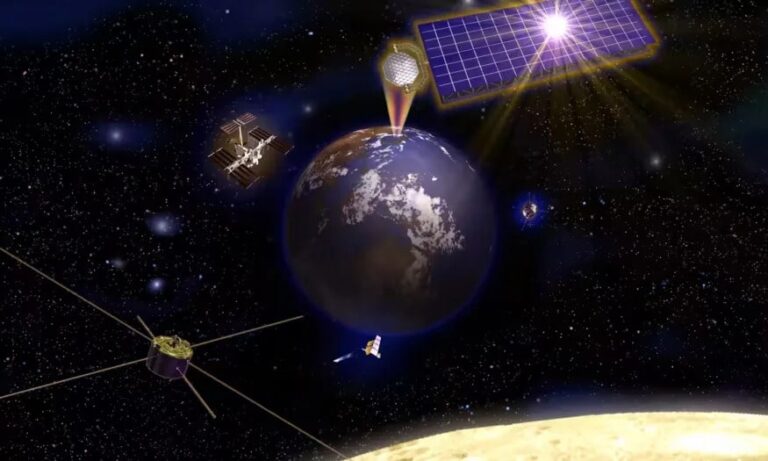
Ever since we first started using solar power back in the 1970s, scientists have been looking for a way to beam solar energy from space since it would essentially solve the world energy crises and provide an almost unlimited source of renewable energy. Now, in line with these efforts, a Japanese public-private partnership is reportedly aiming to conduct the first trial run of this technology in 2025, by launching solar panels into space to generate electricity at an altitude of 36,000 kilometers.
First proposed by an American physicist back in 1968, the concept revolves around converting solar power into microwaves in space, similar to electromagnetic radiation used in microwaves, and then transmitting them back to Earth, where receiving stations convert these microwaves back into electrical energy. This approach not only addresses the current challenge of renewable energy generation but also overcomes the limitation of solar power during cloudy weather.
Japan’s role in developing this technology
Over the past few decades, Japan has been at the forefront of developing this technology, with a group led by former Kyoto University President Hiroshi Matsumoto spearheading the efforts. In the 1980s, they achieved the first successful transmission of power via microwaves in space and in 2015, the Japanese space administration, JAXA, in collaboration with Kyoto University professor Naoki Shinohara successfully transmitted 1.8 kilowatts of power over a distance of over 50 meters to a wireless receiver.
However, it is important to note that other countries, including the United States, in collaboration with the California Institute of Technology and the European Space Agency, are also working on their own methods to commercialize space-based solar power.
While recent advancements and future plans to implement this technology on a large scale have the potential to transform the future of humanity, cost remains a significant challenge. Currently, to generate approximately 1 gigawatt of power, equivalent to that of a nuclear reactor, the solar panels would need to measure 2 kilometres on each side. As a result, even with all the technological advancements, the current installation cost for such a system exceeds $7.1 billion.
Confused about why some of your Insta posts don’t get the reach you would like? Well, over the years many creators have been wondering how Instagram’s rankings work, and the company has tried to explain it to creators before. Now, a new post details how the rankings actually work, reports Engadget.
Instagram explains how recommendations work
The company has published this new blog post in an attempt to clear “misconceptions” about the oh-so-infamous algorithm it’s using. Instagram’s head Adam Mosseri dives deep into the explanations about the rankings.
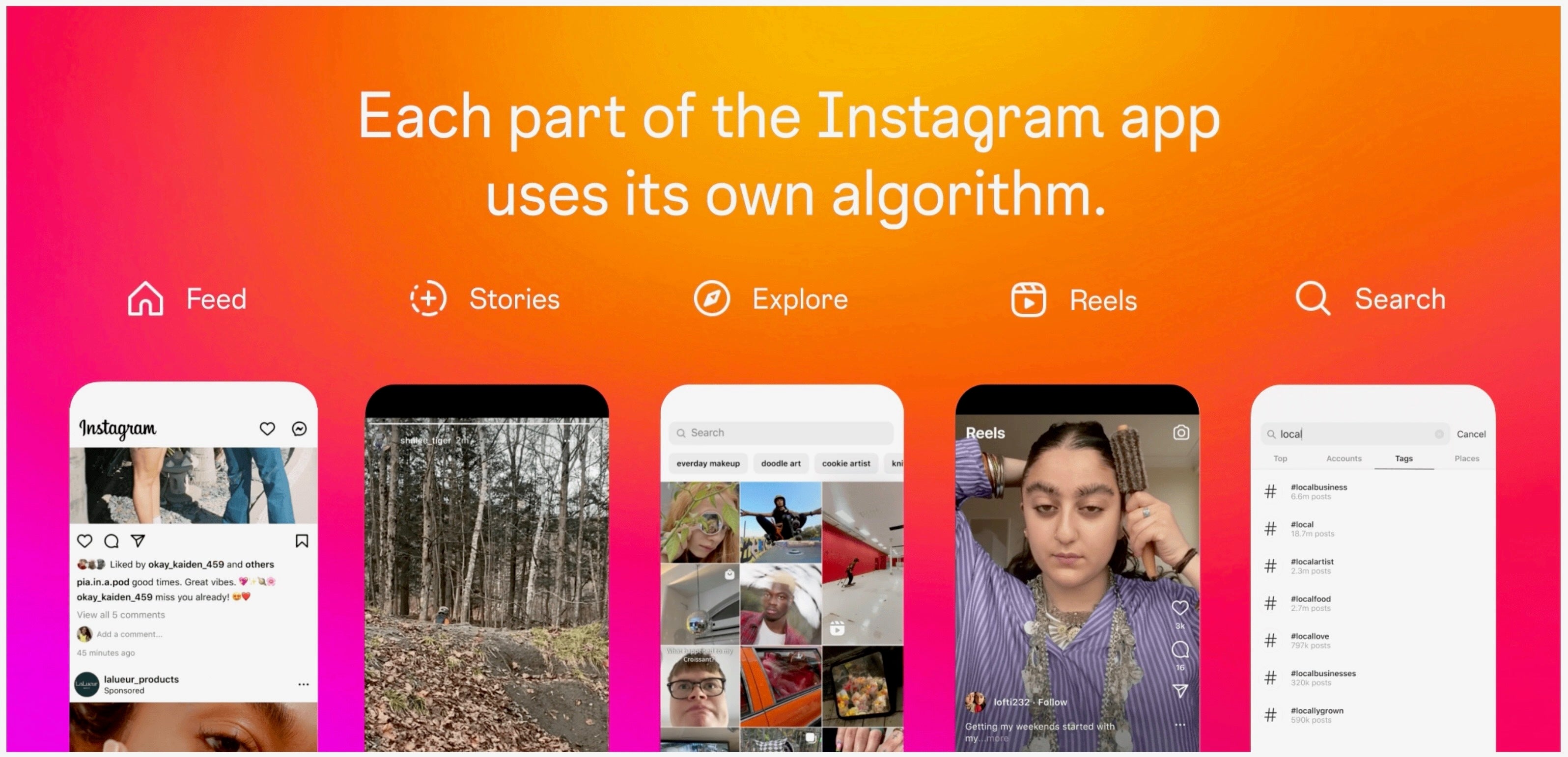
First off, he notes that there isn’t a single algorithm that oversees what people do on the app. He explains there are multiple algorithms and tanking systems, and they are responsible for different aspects of the app, like Explore, Reels, Stories, and Search. He adds that each algorithm uses a plethora of signals to determine how content is shown to each user.
(Image Source – Instagram)
For instance, the posts you see in your feed are determined by your past activity, as well as the interactions you have with the person who made the post. Stories are determined by a similar tactic: for example how likely are you to be friends or family with the person.Meanwhile, recommendations in Explore follow a slightly different approach. Those are based on posts you’ve liked, saved, shared, and commented on in the past, but it’s more likely these posts come from people you haven’t interacted with.
All of this sounds pretty straightforward. Mosseri also goes on to address another aspect of Instagram that has been bugging some creators. The so-called “Shadowbanning”.
Mosseri also addresses Shadowbanning
First off, for those of you who may not know, Shadowbanning is not an official term and is been used by creators who feel their accounts or posts have suddenly gotten a more limited exposure, or are hidden, and that is without any warning or explanation on the part of the social media. Mosseri says that the company is working on increasing transparency if a creator’s content or account is blocked from the app’s recommendations. He says that the app’s account status feature can alert users if their content or their account is considered not eligible for recommendations. You will also have the option to appeal.
On top of that, Mosseri notes that the app is testing new notifications that will be aimed to help creators understand when the reach of their reel may be limited due to a watermark (a watermark appears when a short vid is taken straight out of TikTok and posted onto Reels).
Barracuda Networks, which is currently owned by KKR (Kohlberg Kravis Roberts & Co.,) announced that they had faced a cyber attack in which a Zero Day flaw was exploited, and threat actors extracted data.
The earliest identification of this attack dates back to October 2022.
The flaw existed on their Email Security Gateway (ESG) appliance. The company worked closely with Mandiant cyber security experts to investigate this issue.
The vulnerability was identified to be CVE-2023-2868, and a patch was applied to all ESG appliances worldwide.
This vulnerability exists due to improper processing, validation, and sanitization of the names of the files within the user-supplied .tar file.
An attacker could exploit this by sending a specially crafted file name in a specified manner, resulting in remote command execution on the system through Perl’s qx operator inside the Email Security Gateway (ESG) product.
Affected Products
Products
Versions
Email Security Gateway Application
5.1.3.001-9.2.0.006
Malware Deployment Using Zero-Day
There were three malware deployed by the threat actors using the Barracuda Email Security Gateway Appliance.
SALTWATER – Trojanised malware for uploading or downloading arbitrary files, command execution, proxy, and tunneling. It uses five channels for these functionalities: UploadChannel, DownloadChannel, ProxyChannel, TunnelArgs, and ShellChannel.
SEASPY –Persistent backdoor which looks like a legitimate Barracuda Networks Service by establishing itself as a PCAP filter. It monitors port 25 (SMTP) traffic and contains the backdoor functionality.
Mandiant analysis stated that the code could overlap between SEASPY and cd00r, a publicly available backdoor.
SEASIDE – Lua-based module which monitors SMTP HELO/EHLO commands that are used for receiving command and control (C2) IP address and port. It creates a reverse shell by sending the information as arguments to an external library.
Barracuda Networks said, “We took immediate steps to investigate this vulnerability.
Our investigation revealed that the vulnerability resulted in unauthorized access to several email gateway appliances. As part of our containment strategy, all ESG appliances received a second patch on May 21, 2023.”
The company also confirmed that no other Barracuda products were affected due to this vulnerability, including the SaaS email security services.
They released patches for fixing this vulnerability as part of their BNSF-36456 on May 20, 2023.
US businesses: watch out for Volt Typhoon, a threat actor sponsored by the People’s Republic of China (PRC).
The US Cybersecurity and Infrastructure Security Agency (CISA) has an urgent message for US businesses: watch out for Volt Typhoon, a threat actor sponsored by the People’s Republic of China (PRC).
In this blog, we’ll review Volt Typhoon, dig into how they evade detection, discuss CISA’s protective recommendations, and see how Malwarebytes EDR can help eliminate such threats.
Well-funded and made up of an elite squadron of hackers, APT groups target high-value entities like governments, large corporations, or critical infrastructure. They often deploy multi-stage, multi-vector approaches with a high degree of obfuscation and persistence.
Volt Typhoon is no exception.
Since their arrival on the scene in mid-2021, Volt Typhoon has targeted several critical infrastructure organizations in Guam and elsewhere in the United States. Their victims come from a wide-range of industries, including communications, government, information technology (IT), education, and more.
Observed behavior suggests that the aim of Volt Typhoon is, like most APT groups, not a quick hit but a long-term presence within a system, allowing them to gather as much information as possible while remaining undetected.
Now that we know the basics of who Volt Typhoon is and what they’re after, let’s dive into the specifics of their tools, techniques, and procedures (TTPs).
How Volt Typhoon evades detection
At the heart of Volt Typhoon’s espionage campaigns are their use of living off the land (LOTL) attacks, which are instances when attackers leverage legitimate tools to evade detection.
The fact that so much of the CISA advisory revolves around Volt Typhoon’s use of LOTL techniques emphasizes that these types of threats are a serious concern. By mimicking normal system behavior, LOTL attacks make it extremely difficult for IT teams and security solutions to detect any signs of malicious activities.
Script Block Logging records all blocks of code as they’re executed by PowerShell, which could you point to suspicious activity. Source.
Some of the built-in tools Volt Typhoon uses are wmic, ntdsutil, netsh, and PowerShell.
Let’s look at two examples of how Volt Typhoon uses LOTL attacks at different stages in the attack chain.
LOTL Example #1: Reconnaissance
Volt Typhoon gathers information about local drives using the wmic command, which is a part of the legitimate Windows Management Instrumentation (WMI) toolset.
This command line tool lets them gather details like drive letter, filesystem type, free space, and volume name without needing administrative privileges.
Understanding the storage layout and capacity of the host machine in this way can, for example, help them tailor their tools and techniques to the specific system.
cmd.exe /C "wmic path win32_logicaldisk get caption,filesystem,freespace,size,volumename"
LOTL Example #2: Credential Access
Volt Typhoon attempts to capture two vital assets from Windows Domain Controllers (DCs): the ntds.dit file and the SYSTEM registry hive. Both of these contain a wealth of data, including user details, group affiliations, and encrypted passwords—all of which can be goldmines for unauthorized actors.
To access this information, they utilize the built-in Windows service called Volume Shadow Copy Service. This service helps them create clones of the ntds.dit file and the SYSTEM registry hive, both typically locked due to their importance.
These cloned copies allow Volt Typhoon to avoid modifying the original files, thereby maintaining stealth. By acquiring these files, the attackers can work towards decrypting passwords offline without raising alarms.
Uncovering LOTL attacks such as the type that Volt Typhoon uses requires picking up on subtle anomalies or patterns in system behaviors.
Likewise, CISAs advice to businesses emphasizes the importance of enhancing detection of potential LOTL attacks through robust logging mechanisms, inspecting abnormal account activities, and more:
CISA Advice
Description
Enhance monitoring and logging
Use advanced monitoring systems to track unusual IP addresses, abnormal account activity, and suspicious process creations. Enable “audit process creation,” “include command line in process creation events,” WMI Tracing, and deep PowerShell logging in Windows security logs.
Harden systems and networks
Improve domain controller security and limit port proxy usage. Regularly check firewall configurations and keep a hardened centralized logging server, preferably on a separate network.
Maintain regular checks
Regularly validate the use of administrator privileges and scrutinize all log clearances (Event ID 1102 entries) for intrusion signs. Enable consistent logging on edge devices and network-level logging to identify potential exploitation and lateral movement.
Malwarebytes EDR
Suspicious Activity monitoring with Malwarebytes can detect possible LOTL techniques like the type Volt Typhoon uses. Let’s take the the LOTL Example #2—Credential Access—we explained earlier.
As we described, the actor is trying to exfiltrate the ntds.dit file and the SYSTEM registry hive out of the network to perform password cracking, which is an example of OSCredential Access defined as T1003 by MITRE.
Using Malwarebytes EDR, we can find suspicious activity like this and quickly isolate the endpoint with which it’s associated.
The “dumping” occurs when the `ntds.dit file` and the SYSTEM registry hive are copied from the original (and typically inaccessible due to being locked) location to the `C:\Windows\Temp directory`. This process is effectively extracting or “dumping” the data into a new, more accessible location.
Luckily, Malwarebytes EDR alerted us to this suspicious process and, after investigation, we were able to remediate the endpoint with which the suspicious activity was associated with.
Responding to nation-state sponsored attacks quickly and effectively
The recent information on Volt Typhoon’s activities has catapulted them to the top of cybersecurity concerns for businesses and organizations across the United States.
Sponsored by the Chinese state, Volt Typhoon employs a gamut of stealthy techniques that make their activities challenging to detect. Chief among these tactics is the use of Living Off the Land (LOTL) techniques and leveraging built-in tools—like wmic, ntdsutil, netsh, and PowerShell—for infiltration and persistence within target networks.
To combat these advanced persistent threats, businesses should pair CISA’s recommendations with tools like Malwarebytes EDR to identify and isolate the suspicious activities typical of LOTL attacks.
MDR services offer access to experienced security analysts who can monitor and respond to threats 24/7, detect and respond to APT threats like Volt Typhoon quickly and effectively, and provide ongoing tuning and optimization of EDR solutions to ensure maximum protection.
Whatever your gaming setup is like, having a good few gaming accessories can really elevate the experience and we’ve picked out ten of the best gaming accessories you can get your hands on.
From headsets to keyboards, to mice and beyond, these are some of the best gaming accessories that money can buy. That doesn’t necessarily mean that they’re expensive, just that they’re more worth what you spend than lots of other options.
Most of these accessories we’ve tested ourselves, while a few others were highly recommended by colleagues and friends. Whatever accessories you might need or want for your own gaming setup, these should do the trick. Also worth noting is that the accessories listed here are not for any one platform.
We’ll also be updating this list on a monthly basis, so there may be changes from time to time.
Best Gaming Accessories – Summary
Below is a summary table of the best gaming accessories that we’ve picked out.
If you’re short on time and just want to see what we’ve selected, the table below has all names, prices, and buy links for every accessory.
These two closed-back headsets from Beyerdynamic are some of the best you can get for around their price point. Which is $150 for the MMX 150 and $99.99 for the MMX 100. Fitting, we know.
Both come with detachable META Voice cardioid condenser microphones for vocal clarity, as well as an impedance of 32 ohms, dedicated volume dials for precise audio adjustment and more. And if you go with the MMX 150 you get the benefit of the augmented mode. Turning this on enables sounds from outside the headset to filter in some. So you can hear both the game audio and what’s around you.
Both headsets are wired so you’ll not have the freedom of a wireless headset here. But the comfort and sound quality are awesome and they’re both relatively affordable.
The Razer Naga Pro is one of our selections for best gaming accessories because of its versatility in gaming. There are a lot of different genres of games.
And really not every single game lends itself well to a particular gaming mouse. While any gaming mouse will work with any game type, certain mice are more well suited to certain types of games.
The Naga Pro however, is versatile enough to work with multiple game genres. Building off of the success of past Naga mice, the Naga Pro features the same tried and true 12-button side panel. This particular panel is great for MMO games. Quite simply because it lets you bind many of your abilities to buttons that are right under your thumb. And let’s be honest that’s way easier than hitting the number keys on the keyboard.
It also features two other side panels. One with 6 buttons that’s designed more for MOBA games and battle royale games. And one with a couple of buttons on the side that’s designed more for first-person shooters. The Naga Pro is also wireless, but can be used in wired mode when the battery needs a recharge.
Hands down, this is one of the best gaming mice in existence. Because it fits really any game genre.
I’ve been using this keyboard for the past few months and aside from its lack of compatibility with the PS5, this is one of the best mechanical gaming keyboards you can buy right now. The lightspeed wireless technology makes for a fast connection to your PC, and helps to reduce the amount of latency between your key presses and the game response.
It also has the ability to effortlessly switch between the lightspeed-connected device and a Bluetooth-connected device at the push of a button. Other things like the volume scroll wheel, and dedicated media playback controls are even more reasons to love this keyboard. But most of all, the battery life and build-quality are what make this the keyboard to beat.
While it’s not the only great gaming keyboard out there, it currently stands at the top. If there was one or two things that could be improved though, it would be support for the PS5 via Bluetooth, and the use of USB-C instead of micro USB for the cable connection when charging.
A mouse mat is just a mouse mat. Right? Wrong. Not all mouse mats are created equal. And while the size of the mat you prefer may differ from what others prefer, you want a decent one.
One of the best gaming accessories and the best RGB mouse mat, is the QcK Prism XL from SteelSeries. Since it’s an extended mouse mat, it stretches across your desk and you can fit both your keyboard and mouse on it.
This mat in particular also comes with the RGB lighting strip around the edge in a dual section split. Though you don’t have to use the 2-zone coloring and can set it to something else. It uses a microweave cloth material for the top so you’ve got that nice smooth glide for your mouse, and a fairly grippy bottom to make sure the mat doesn’t move around.
This controller is a magnificent display of some evolutionary controller features. And I could say that over and over until I turn blue in the face and it still wouldn’t accurately portray just how good of a gaming accessory this is.
Between the adaptive triggers and the haptic feedback, the DualSense controller is the only controller you should be considering for your PS5 gaming experience.
The adaptive triggers especially are what really make the DualSense controller something magical. You have to experience it firsthand to get the full impact. But trust us when we say it’s a feature that has huge potential for the immersion and interactivity in games for this generation.
New features aside, the controller just feels good in the hand. It has a good weight to it and the design matches the console. While there aren’t any third-party controllers out there for the PS5 right now, there will be eventually. And once they arrive, the DualSense controller is still the one that you’re going to want to stick with.
This is the perfect headset to pair with the GSX 300 Gaming DAC if you aren’t looking to spend a boatload of money on the headphone setup.
There’s a lot on board here that makes this a fantastic option with an affordable price. For one, it’s Sennheiser so the audio quality is going to be amazing. It also has large cushy ear pads and a comfortable yet breathable headband.
The noise cancelling mic also flips up, which also mutes the mic during chat. So it’s a very convenient design that makes it easy to pop in and pop out of chat at a moment’s notice.
There’s an on-ear dial for volume adjustment on the right side, and it comes with an adapter that lets you use the headset with more than just PC. Including PS4, Xbox One, Nintendo Switch, Mac, Mobile, and any device with a 3.5mm audio port.
When it comes to sound systems for gaming, sometimes it’s best to go big or go home. Of course, that all depends on how much you value a high-quality premium sound system. If you want goo clarity with excellent bass and a wide array of features, check out the Studio 3D Mini from Definitive Technology.
While spendy, this is a soundbar and subwoofer combination that will set your audio senses ablaze. It pumps out some serious sound and is an awesome pairing with consoles like the PS5 and Xbox Series X|S. You could use it as your sound system for PC gaming as well.
It has connection ports for HDMI in and out so it supports HDMI ARC. It also supports optical, Bluetooth, Dolby Atmos, DTS:X, and more. Best of all, is that this soundbar is considerably compact for the power and quality that you get out of it. While the subwoofer is certainly sizeable, the soundbar itself measures 26.5-inches wide, 2-inches tall, and 4.5-inches deep.
On top of all that, it supports Google Assistant, Alexa, and Siri, while also connecting with multiple streaming music sources such as Spotify, Deezer, Apple Music, Pandora and many more.
Keep in mind that at this price, you may want to consider it for more than just gaming. It does make for an excellent gaming sound system though.
Speaking of customization, the new Instinct Pro from SCUF Gaming is one heck of a controller for the Xbox Series X|S, and also one of the best. Like the Elite Series 2, you can swap out some of the buttons, while also adjusting things like the tension of the triggers to require less travel between the button press and the action completion.
On the back you’ll find high-performance grip, as well as four additional buttons. Plus, you can map the buttons to various controls, and save up to three different profiles designed for specific types of games. Which you can swap between on the fly.
If that wasn’t enough, SCUF also allows you to customize the looks. Complete with multiple color options and combinations and more.
The reason we love this headset is because it’s affordable for one, and because it comes with a lot of the design updates that started with the Arctis Nova Pro. Like the redesigned headband system and the extendable ears so it can more easily fit people with all different head sizes. It also features a retractable noise cancelling mic, comes in two colors (Black and White), and it supports the Sonar software when being used on PC for enhanced audio features.
But you don’t have to use it on PC. It will work with any platform that’s compatible with a 3.5mm audio jack. Lastly it only weighs 236g and uses a breathable AirWeave memory foam for comfort during long gaming sessions.
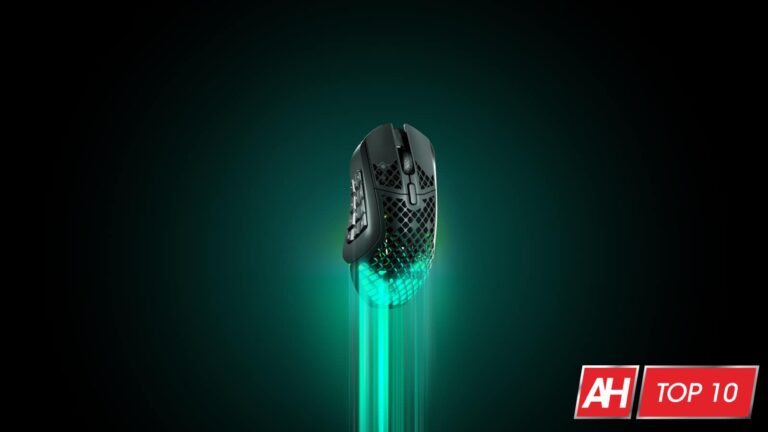
SteelSeries’ new Aerox 9 Wireless mouse is the company’s new MMO mouse, featuring 12 side buttons for all of your abilities as well as a couple extra buttons up top in addition to the multi-function scroll wheel and your left and right clicks.
It’s similar in functionality to the Razer Naga Pro. Another excellent gaming accessory. Where this might have a bit of an advantage is the weight. The Aerox 9 Wireless is 89 grams. Compare that to the 117 grams of the Naga Pro. And while love the Naga Pro, some people prefer a lighter mouse. But may not want to give up the 12 programmable side buttons.
Now you don’t have to settle and you still get a great gaming mouse from a leading brand like SteelSeries. You do have to give up the swappable side plates of the Naga Pro, which means no specialized button layouts for different genres of games. But, if you mostly play MMOs, then that shouldn’t have too big of an impact.






 Script Block Logging records all blocks of code as they’re executed by PowerShell, which could you point to suspicious activity.
 Responding to nation-state sponsored attacks quickly and effectively