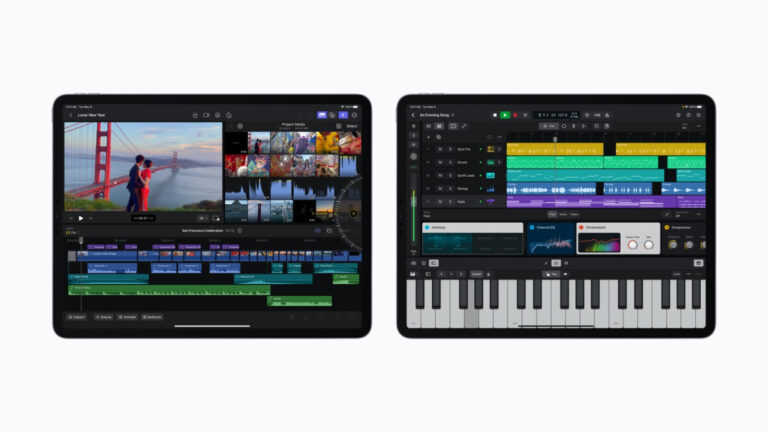
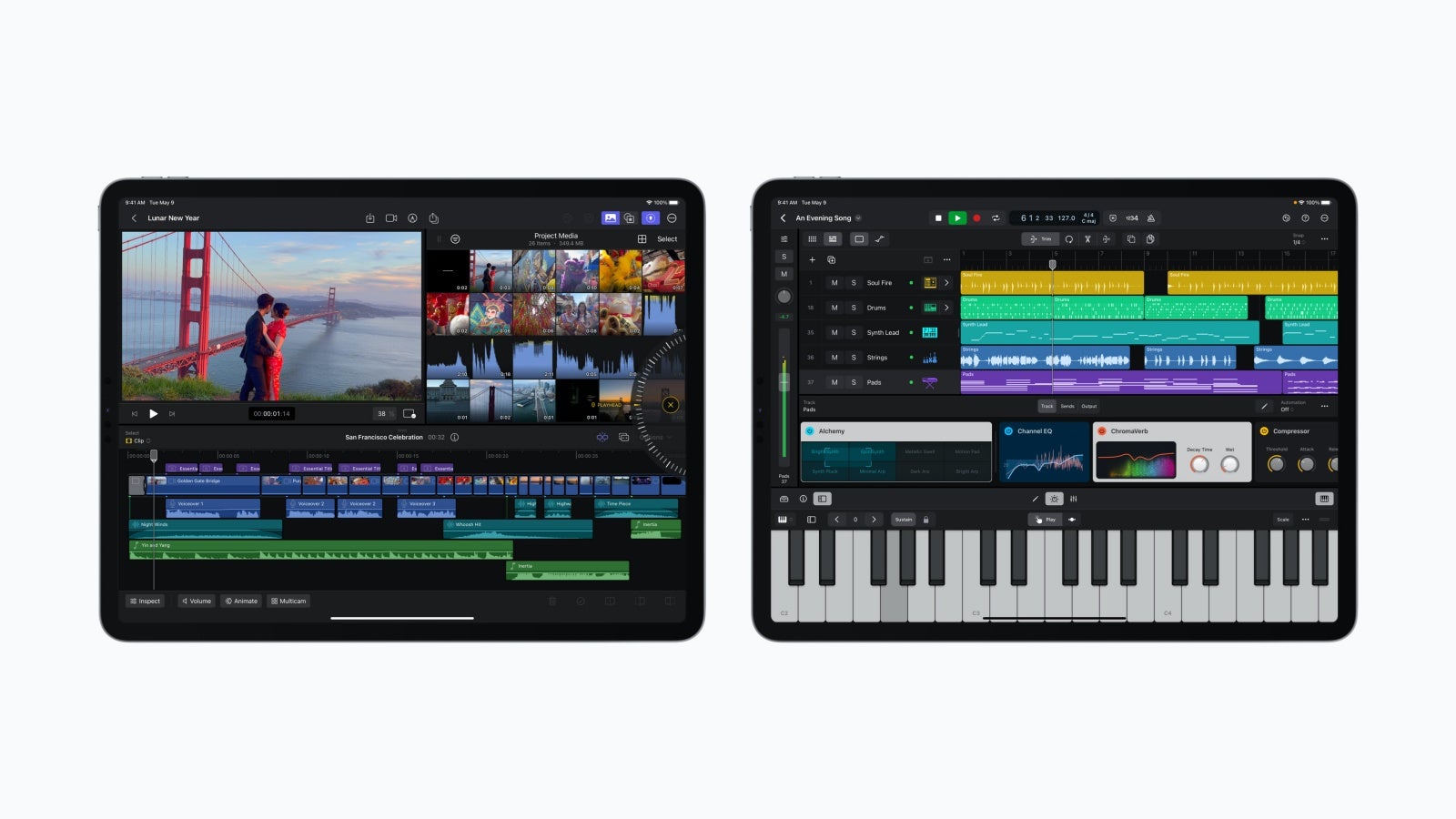
This may sound a little odd, but if you weren’t very excited about next month’s Worldwide Developers Conference (WWDC) prior to yesterday, Apple’s latest big software announcement should make it pretty clear that we’re in for quite a jam-packed event between June 5 and June 9.
That’s because a fairly significant part of the tech giant’s fanbase had been waiting for the official debut of Final Cut Pro and Logic Pro on the world’s most popular tablets for several years now, and if Cupertino decided to drop this highly anticipated news via a press release on a random Tuesday, we can definitely expect bigger things from WWDC 2023.
For the time being, let’s just focus on the announcement at hand, starting with…
Final Cut Pro for iPad
Video creators only have a couple more weeks to wait before they will be able to use quite possibly the most powerful tool in their editing arsenal on the move in exchange for $4.99 a month or $49 a year with a free one-month trial to kick things off the right way.
May 23 is when the App Store will officially welcome this long overdue version of Final Cut Pro, and as you can imagine, there are certain hardware and software limitations to consider before giving the app a try on your trusty old iPad.
Namely, it appears that Final Cut Pro will only work on iPadOS 16.4 and up, which is hardly surprising, while exclusively supporting iPad models powered by the Apple M1 or M2 chip. That includes the iPad Air (2022) in addition to the two latest iPad Pro generations (with both 11 and 12.9-inch screens) but excludes the likes of the “standard” iPad (2022), iPad mini (2021), and iPad Pro (2020).
On the M2-powered 11 and 12.9-inch iPad Pro (2022), Final Cut Pro supports a special Apple Pencil feature, allowing users to “quickly skim and preview footage without ever touching the screen” of their industry-leading tablets.
Pretty much all the other capabilities are the same for everyone, combining tools already available for Mac users with an “all-new” touch interface and different new ways to “unleash your creativity” that are “only possible on iPad.”
Those include a new jog wheel aimed at making the video editing process easier than ever, an aptly named Live Drawing functionality that, well, lets you draw directly on top of your video content with an Apple Pencil, as well as machine learning-based “fast cut” features like Scene Removal Mask, Auto Crop, and Voice Isolation. It’s almost like you don’t need a full-blown computer at all anymore, including for…
Creating music with Logic Pro for iPad
Just like Final Cut Pro, this incredibly helpful and extremely powerful audio-focused tool will be available in the App Store at $4.99 a month or $49 a year starting Tuesday, May 23.
The hardware compatibility list is however much more expansive as far as Logic Pro is concerned, including all iPads with an Apple A12 Bionic processor under the hood or “later.” We’re not going to mention each individual model, but suffice to say the all-in-one professional music creation app should work flawlessly on everything from the iPad (2020) to the iPad mini (2019).
That’s surely going to bring the “complete pro music studio” in many more hands than ever before, although it’s definitely worth keeping in mind that Logic Pro and Final Cut Pro licenses for Macs currently set you back $199.99 and $299.99 respectively, which can actually prove more affordable in the long run.
If you prefer to install Logic Pro on your iPad… for obvious portability and hardware affordability reasons, you should note that you’ll get an “all-new” sound browser with dynamic filtering, Multi-Touch gesture support, Plug-In Tiles, “hundreds” of powerful instruments and effects, and other potentially handy features like Beat Breaker, Quick Sampler, and Step Sequencer.
All in all, it certainly sounds like Apple put a lot of thought and effort into optimizing and improving these popular tools for the best iPads out there, so at least at first glance, it looks like this long wait has paid off handsomely for video and music creators.
After a Twitter engineer posted photos of an Android dashboard showing his WhatsApp microphone being used while he slept, Elon Musk declared that WhatsApp could not be trusted.
A developer for Twitter named Foad Dabiri said that while he was sleeping, the instant messaging app had been using his microphone in the background. According to the screenshot, WhatsApp accessed his microphone in the background from 4 am to 7 am.
WhatsApp has been using the microphone in the background, while I was asleep and since I woke up at 6AM (and that’s just a part of the timeline!) What’s going on? pic.twitter.com/pNIfe4VlHV
Dabiri wrote on Twitter, “WhatsApp has been using the microphone in the background, while I was asleep and since I woke up at 6AM (and that’s just a part of the timeline!) What’s going on?”
Reports say Dabiri seems to have found the problem using the Android 12 privacy dashboard, which allows identifying and limiting an app’s ability to access specific hardware features.
Response from Elon Musk: “WhatsApp cannot be trusted”
Musk, the owner of Twitter, responded by writing: “WhatsApp cannot be trusted,” which led other users to write back by declaring they had deleted the app.
The fact that Meta owns the chat service raises questions about microphone access. WhatsApp claims that the controversy is a misunderstanding.
Even yet, Musk’s remark might damage WhatsApp’s reputation, given that it wouldn’t be the first time he has disparaged the secure messaging service.
Musk urged users to switch to the competing messaging service Signal in 2021 after WhatsApp revealed a new privacy policy outlining how it can share user data with Facebook.
After receiving criticism from the public, WhatsApp delayed the policy modification a week later.
An Android Bug Was the Cause of The Problem
“We believe this is a bug on Android that mis-attributes information in their Privacy Dashboard and have asked Google to investigate and remediate,” WhatsApp said in its tweet.
Furthermore, WhatsApp emphasizes that all phone calls and user communications are still end-to-end encrypted on the platform. This means that unless someone has access to the user’s smartphone, nobody—not even WhatsApp itself—can decrypt voice call data.
Over the last 24 hours we’ve been in touch with a Twitter engineer who posted an issue with his Pixel phone and WhatsApp.
We believe this is a bug on Android that mis-attributes information in their Privacy Dashboard and have asked Google to investigate and remediate. https://t.co/MnBi3qE6Gp
WhatsApp added, “Once granted permission, WhatsApp only accesses the mic when a user is making a call or recording a voice note or video—and even then, these communications are protected by end-to-end encryption so WhatsApp cannot hear them”.
Notably, Musk’s platform, Twitter, aims to one day compete with WhatsApp by developing it into a “super” app capable of social media, personal messaging, and banking. This will entail providing phone calls and end-to-end encryption for direct communications.
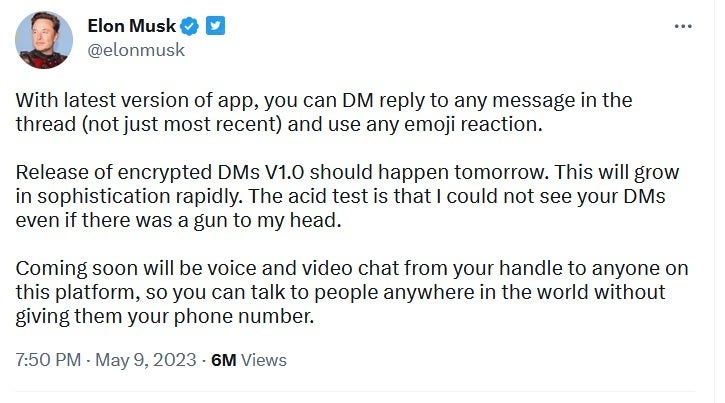
With latest version of app, you can DM reply to any message in the thread (not just most recent) and use any emoji reaction.
Release of encrypted DMs V1.0 should happen tomorrow. This will grow in sophistication rapidly. The acid test is that I could not see your DMs even if…
Musk’s tweet read, “With latest version of app, you can DM reply to any message in the thread (not just most recent) and use any emoji reaction. Release of encrypted DMs V1.0 should happen tomorrow. This will grow in sophistication rapidly. The acid test is that I could not see your DMs even if there was a gun to my head. Coming soon will be voice and video chat from your handle to anyone on this platform, so you can talk to people anywhere in the world without giving them your phone number.”
Samsung seems to have begun testing Android 14 for Galaxy devices. Twitter user @tarunvats33 recently spotted the first One UI 6 test build for the Galaxy S23 series on the company’s servers. The Korean firm is also testing the new One UI version for the Galaxy Z Fold 4 and Galaxy Z Flip 4. One UI 6 is Samsung’s custom software based on Android 14.
Samsung is already testing Android 14 for Galaxy devices
Android 14 is still very much in the early stage of development. Google has only released one beta build so far, with a second beta expected anytime now. We should hear more about the next major Android update at the Google I/O annual conference later today. Meanwhile, Samsung isn’t waiting for the second Android 14 beta build to arrive. The world’s largest smartphone maker has already started testing the new Android version for its Galaxy devices, with One UI on top.
The first One UI 6 test build for the Galaxy S23 Ultra has the build number S918BXXU1BWE2. The update type confirms that it’s a One UI update. The build number also gives it away. The fourth to last character indicates whether an update is a major software release. Every Galaxy device arrives with “A” in that place. It changes to B, C, D, and so on with each major update. Here, the fourth to last character is “B”, which indicates that it’s the first major update for the Galaxy S23 Ultra. The latest Samsung flagship debuted with One UI 5.1 (current firmware version S918BXXS1AWD1).
Samsung also appears to be testing One UI 6 on the Galaxy S23+, and probably the base Galaxy S23 as well. Separately, SamMobile spotted One UI 6 test builds for the Galaxy Z Fold 4 and Galaxy Z Flip 4 as well. The build numbers for the two foldables are F936BXXU2DWE1 and F721BXXU2DWD7, respectively. “D” in the fourth to last place means One UI 6 will be the third major update for the duo. They debuted with Android 12-based One UI 4.1.1 and have since received updates to Android 13-based One UI 5.0 and One UI 5.1.
The stable One UI 6 update should arrive by October
Note that these One UI 6 builds for the Galaxy S23 series and the two foldables aren’t available to the public. Samsung is currently internally testing the new One UI version. But it beginning the test so early suggests a public beta will begin early too. These devices should get a beta program ahead of others, such as the Galaxy S22 series. We will let you know when the company shares more information. Samsung’s stable Android 14 update with One UI 6 is expected to arrive in October this year.
If you have been on the Bing AI waitlist, Microsoft has good news for you. The Bing AI chatbot is now open to everyone through the Bing browser on Edge.
Bing AI is Microsoft’s initiative to battle Google’s search engine. The chatbot has been quite successful in a very short period of time, and even the “godfather of AI” called it a serious challenge to Google’s core business. Prior to this, users need to stay on a waitlist in order to use the chatbot. However, Microsoft announced that Bing AI is now open for public testing, and users can test it by logging into Bing in the Edge browser or the Bing mobile app.
Microsoft’s AI chatbot is powered by OpenAI’s GPT-4, which is the most powerful language model developed by OpenAI. Besides that, Bing AI will be able to deliver graphs, charts, and formatting in response to a query. Most AI chatbots, including Google Bard, now only deliver text responses.
You can now use Microsoft Bing AI without a waitlist
The Bing Image Creator is also a big part of the company’s efforts to battle Google. As per Microsoft’s announcement, the tool now supports over 100 languages and allows users to search in their native language. Additionally, multi-modal support will be added to Bing Image Creator, allowing users to search the web for related content in a photo.
Another great addition to Bing AI is the ability to access chat history and export them. Microsoft says users can now return to previous chats in Bing and continue their conversation. You can also move your chats to the Edge sidebar for easier access. Likewise, Bing AI lets you share your conversion to social media or export it to a new platform with a fixed format.
Bing AI is also equipped with improved summarization capabilities. The feature makes consuming longer content easier by breaking down and summarizing PDFs, longer-form websites, etc. This feature seems great for students.
Microsoft wants to incorporate third-party plug-ins into Bing AI and make a transition from a product to a platform. The company says third-party plug-ins let users perform various tasks, like making reservations in a restaurant through OpenTable. The Wolfram|Alpha also delivers answers to complex math and science questions.
Finally, Microsoft brings a “sleeker and enhanced” user interface to the Edge browser by adding a streamlined look, rounded corners, organized containers, and semi-transparent visual elements.
A significant Indian lending organization ‘Fullerton India’ was breached at the beginning of April 2023. The LockBit ransomware Darknet blog, where hackers listed the business and have since released all the hacked information, confirms it.
According to reports, on May 3, 2023, the LockBit 3.0 ransomware group exposed more than 600 GB of crucial data belonging to Fullerton, India, and its clients on the dark web.
The hackers gave Fullerton India over a week to negotiate a ransom demand of Rs. 24 crores from them. The business declined to engage in negotiations with the hackers.
Information Disclosed on Dark Web
The released data include loan agreements with individuals and legal entities, the status of customer and organizational accounts, agreements with banks and other financial institutions, and data on international transfers.
Also, financial documents, including sales information and mail correspondence on important transactions with attachments. The personal data of the company’s customers, such as Aadhaar card numbers, their residential and property addresses, phone numbers, cheque numbers, and other sensitive information.
Screenshot of Compromised Customer Data (Account Statement)
Along with the clients’ personally identifiable information (PII), other sensitive data has also been disclosed, including customer IDs, bank account numbers and the dates on which they were opened, Real Time Gross Settlement (RTGS) information, National Electronic Funds Transfer (NEFT) information, branch codes, and financial transactions, including withdrawals and deposits.
The company said that “Fullerton India has learnt that some unknown entities have claimed to publish company data on illicit websites. Fullerton India cannot confirm these assertions as it is investigating the issue. The company has engaged with global experts to examine the content of the data, allegedly pertaining to it and to significantly enhance its security environment”.
After the data breach was discovered on April 24, the NBFC major temporarily suspended operations.
Press release regarding “malware incident” issued by Fullerton India
LockBit 3.0 demanded a ransom of $29,999,99, or Rs. 24 crores, to erase the compromised data. The hackers also stated that the company could postpone the deadline for $1,000 every day.
However, LockBit is renowned for using different techniques to push on its victims. They initiate a DDoS attack on the victim’s network and maintain it there until the ransom is paid, in addition to threatening to disclose material on it. It’s unclear if hackers also employed that tactic.
More Samsung Galaxy devices are receiving the May 2023 Android security patch in the US. Following the Galaxy S23 series and the recent foldables, the company has now released the latest security update for the Galaxy S22 and Galaxy Note 20 series. These devices have already received the May SMR (Security Maintenance Release) in some international markets.
As of this writing, the May SMR is only available for the factory-unlocked variants of the Galaxy S22, Galaxy S22+, and Galaxy S22 Ultra in the US. Samsung has released the update on most networks, including AT&T, Verizon, Comcast, Xfinity Mobile, Cricket Wireless, and more. Unlocked Galaxy S22 units on other networks should also join the party soon. The updated firmware build number for the 2022 Samsung flagships is S90*U1UES2CWD3.
The story follows a similar pattern for the Galaxy Note 20 lineup as well. Samsung is once again beginning with unlocked units. The May SMR for the Galaxy Note 20 and Galaxy Note 20 Ultra comes with the build number N98*U1UES4HWD7. The rollout appears wider than the Galaxy S22 series. Carrier-locked variants of all of these Galaxy smartphones should get the latest security update in the US within the next few days.
The latest update for the Galaxy S22 series and the Galaxy Note 20 series in the US doesn’t bring anything notable. Well, it contains plenty of security fixes, but no user-facing changes, improvements, or new features. Nonetheless, the security fixes are pretty important too. According to Samsung, the May SMR patches more than 70 vulnerabilities, at least six of which were critical issues. Most of these patches come from Google and other Android OS partners. But 20-odd patches were Galaxy-specific coming directly from Samsung.
Samsung will push the May update to more Galaxy devices in the US
Samsung has been rolling out the May SMR to eligible Galaxy devices since the last week of April. The Galaxy S23 series was the first to pick up the latest security update in the US. The Korean firm recently added the Galaxy Z Fold 4, Galaxy Z Flip 4, Galaxy Z Fold 3, and Galaxy Z Flip 3 to the party. The addition of the Galaxy S22 and Galaxy Note 20 series should be followed by more eligible models in the coming days.
As always, your Galaxy smartphone will notify you once a new OTA (over the air) update is available. If you haven’t received any such notification, you can navigate to Settings > Software update on your phone and tap on Download and install to check for updates manually. If you still don’t see any pending updates, wait a few days and repeat the steps to check again.
The iPhone 15 series is not official yet, and we’re already getting information regarding the iPhone 16. Ross Young, a well-known display analyst, just revealed the display sizes of the iPhone 16 Pro and Pro Max handsets.
Display sizes of Apple’s iPhone 16 Pro & Pro Max models have been revealed early
He shared, via Twitter, that the official display sizes will be 6.3 and 6.9 inches, respectively. That’s, at least, what Apple will market them at. In fact, they’ll be between 6.2 and 6.3 inches in size on the ‘Pro’, and between 6.8 and 6.9 inches in size on the ‘Pro Max’.
Ross Young promised to reveal the second decimals of both displays in about two weeks. That’s when we’ll know the exact sizes, but for all intents and purposes, these are 6.3 and 6.9-inch displays. So they’ll be bigger than what we’re used to.
That’s not all, though. The source also revealed that the aspect ratios of both displays will “increase slightly”. The iPhone 14 Pro and Pro Max displays have an aspect ratio of 19.5:9. The iPhone 15 series will likely stay in the same lane. What does that mean for the iPhone 16 Pro series? Well, we’ll likely get 20:9 displays.
These two devices will also be the first to rock solid-state buttons
The iPhone 16 Pro and Pro Max models are also expected to include solid-state buttons. Such buttons were expected on the iPhone 15 Pro series, but based on the latest reports, that won’t be happening.
Apple wanted more time to implement them properly. The costs of implementing them in the iPhone 15 Pro series were, allegedly, too high, and the software side of things was also an issue at the time. So Apple decided to push them back to the iPhone 16 Pro series.
That’s pretty much everything we know about the iPhone 16 Pro series, which is understandable. We’re still four months away from the iPhone 15 and 15 Pro series launch event, so… the iPhone 16 phones are not exactly in focus now.
Elon Musk has absorbed plenty of criticism over the chaos and confusion that has reigned over Twitter since he purchased the platform last October. But now he is looking to clean up the mess he has made and improve the site. Earlier today we told you that Musk said that he will purge inactive accounts. But the blockbuster news came later Tuesday when Musk tweeted that encrypted DMs will debut tomorrow, May 10th. He writes, “This will grow in sophistication rapidly. The acid test is that I could not see your DMs even if there was a gun to my head.”
Musk also says that in the current version of the Twitter app, users can send a DM reply to any message in the thread, not just the most recent message. And any emoji reaction can be used. Even more exciting, Twitter subscribers will soon be able to make voice and video calls using their Twitter handle to anyone on the platform. Since you’re making these calls using your Twitter handle, Musk noted that “you can talk to people anywhere in the world without giving them your phone number.”
Twitter Spaces currently allows users to chat by voice using an audio stream. But those calls are public and are available for group chats. But the new voice and video call capabilities are meant for private conversations between Twitter subscribers.
Elon Musk reveals some interesting new information for Twitter users
But encrypting DMs and allowing users to make video and voice calls using their Twitter handles could just be the start of adding new features to the platform that will reverse the decline in Twitter’s valuation. Musk recently discussed increasing the character cap on tweets to 10,000 and spoke about adding some “simple formatting tools.” At last, Musk seems ready to focus on making the changes to Twitter that are needed to improve the user experience first before growing the bottom line.
Following the Cl0p ransomware gang’s attacks that leveraged Fortra’s GoAnywhereMFT software tool, behavioral health provider Brightline informed customers about a data breach related to the attacks.
A pediatric behavioral health startup called Brightline informed its customers that their protected health data may have been stolen as part of a separate ransomware attack on a Brightline third-party service provider.
“Based on the investigation, we identified a limited amount of protected health information/personal information in the files that the unauthorized party acquired, potentially including some combination of the following data elements: individuals’ names, addresses, dates of birth, member identification numbers, date of health plan coverage, and/or employer names,” wrote Brightline in its public notice online.
Though Brightline did not disclose the number of affected customers, recently updated records with the US Department of Health and Humans Services Office of Civil Rights showed that at least 964,301 people were impacted.
The third-party service provider at the heart of the data breach is Fortra, which was recently targeted by the Cl0p ransomware gang in a string of attacks that leveraged an undisclosed vulnerability in the file transfer software called GoAnywhereMFT, which Fortra develops and which is used by businesses worldwide. Malwarebytes Labs reported on the vulnerability in February, urging users to deploy a patch.
GoAnywhere MFT, which stands for managed file transfer, allows businesses to manage and exchange files in a secure and compliant way. According to its website, it caters to more than 3,000 organizations, predominantly ones with over 10,000 employees and 1B USD in revenue.
Brightline was just one of the many victims on the list that Cl0p made using the same vulnerability. The day after the release of the GoAnywhere patch, the Clop ransomware gang contacted BleepingComputer and said they had used the flaw over ten days to steal data from 130 companies.
For many organizations, Brightline offers virtual behavioral and mental health services for the children of benefits-eligible employees. In this light, Brightline has published a list of covered entities impacted by the breach.
Interestingly, the 964,000 number released by the US government may not be complete.
According to the online resource Databreaches.net, by the end of May 3, 2023, the subtotal number of Brightline patients affected by the GoAnywhere incident stood at 1,081,716.
Another remarkable fact Databreaches.net disclosed is that the listing for Brightline on Cl0p’s leak site has disappeared. This is usually an indicator that the victim has paid, but there might be something else going on in this case, since Brightline has been exemplary at providing public information and details about the breach.
Data breach
There are some actions you can take if you are, or suspect you may have been, the victim of a data breach.
Check the vendor’s advice. Every breach is different, so check with the vendor to find out what’s happened, and follow any specific advice they offer.
Change your password. You can make a stolen password useless to thieves by changing it. Choose a strong password that you don’t use for anything else. Better yet, let a password manager choose one for you.
Enable two-factor authentication (2FA). If you can, use a FIDO2-compliant hardware key, laptop or phone as your second factor. Some forms of two-factor authentication (2FA) can be phished just as easily as a password. 2FA that relies on a FIDO2 device can’t be phished.
Watch out for fake vendors. The thieves may contact you posing as the vendor. Check the vendor website to see if they are contacting victims, and verify any contacts using a different communication channel.
Take your time. Phishing attacks often impersonate people or brands you know, and use themes that require urgent attention, such as missed deliveries, account suspensions, and security alerts.
According to the information provided by Brightline, no Social Security numbers or financial accounts were stolen, nor did the stolen files contain anything related to medical services, conditions, diagnoses, or claims for the plan participant or their dependent.
If you are affected by this data security incident, you should have received or will receive a letter (or letters, if you have dependents) from Brightline. Each letter will have a unique code for the member and/or dependent to register for free identity theft and credit monitoring. Brightline will also have a call center available to answer questions. More information, including frequently asked questions, is available on Brightline’s website.
Malwarebytes removes all remnants of ransomware and prevents you from getting reinfected. Want to learn more about how we can help protect your business? Get a free trial below.
The Steam Deck so far has proven to be a wonderful little machine for playing games, but one thing you’ll want is at least one microSD card for storage, and we thought we’d round up the best ones to consider.
Now, if you ended up with the 512GB version of the Steam Deck you may have just enough storage for games you plan to play. 512GB isn’t a lot of storage especially for how big games are these days, but if you’re the type to juggle your installs when you need to make room for something, then it might suffice.
If you’re like us and don’t want to deal with that kind of hassle, then a microSD card for the Steam Deck is definitely the way to go. It’s easier than replacing the internal SSD and if you aren’t sure how to do it, then chances are you might have to pay to have someone do it for you. Making the microSD option cheaper as well.
In short, for the majority of users, a microSD card is going to be the best way to get more game storage on the Steam Deck. But, which ones should you be looking at? You shouldn’t just use any old microSD card. You can, but you shouldn’t, as you want one with optimal speeds for loading games. So here’s our list of the best microSD cards for the Steam Deck that will meet those standards.
Kicking things off we’re suggesting the SanDisk Extreme Pro card for a few reasons. For starters, it comes from Western Digital’s SanDisk brand which has been around forever and is a trusted name in storage products. For another, the Extreme Pro is one of its newer cards and comes in a variety of sizes. Though we wouldn’t suggest anything under a 128GB and for our own purposes, we’d probably go higher than that. Because as noted above, many AAA games these days are insanely large.
More importantly though, this card in particular will give you fast read and write speeds. Which is going to help with load times. In general you want to be looking at something that offers a read/write speed of around 100MB/s. This card has a read speed of up to 170MB/s and a write speed of up to 90MB/s. So it fits right in with you should be looking for.
The only downside to this card is that the 1TB and even the 512GB are a little expensive. That being said, there are other options on this list that cost less and will give you the same amount of storage. For us though, this has performed really well during our testing so far.
PNY XLR8 Gaming Class microSDXC UHS-I (128GB – 512GB)
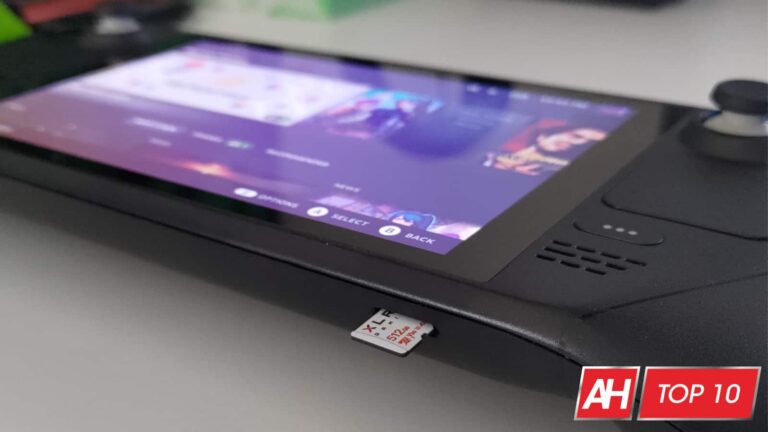
This is actually the first card we started using with the Steam Deck and like the SanDisk Extreme Pro, it has fast read and write speeds. It also comes in up to 512GB in size. We have the 512GB model in our Steam Deck, and it’s been a real boon for allowing us to install more games.
Since we went with the 256GB version of the Steam Deck, storage began to fill up fast with games like Elden Ring and Final Fantasy XIV. So a larger size card was definitely needed. PNY also designed this card specifically to be used for gaming in devices like the Nintendo Switch, mobile devices, and the Steam Deck. That doesn’t mean it can only be used for those devices. But it does help that PNY had portable gaming in mind when making this product.
As for read and write speeds, you’re looking at up to 100MB/s for read and up to 90MB/s for write. Putting it mostly on par with the card above. And easily making this one of the best microSD cards for the Steam Deck.
Samsung is another trusted brand in memory and storage so naturally we’d suggest the Evo Select card as an option. It has the same read and write speeds as the PNY XLR8 Gaming class card, but you’re looking at over twice the price for it right now on Amazon. Normally it retails for $69.99 which is only $10 more than the 512GB PNY card above.
But all of the 512GB models seem to be from third-party resellers. Unfortunately, Samsung’s website is out of stock on this one so Amazon is probably your best bet if you want this particular card. We would suggest the PNY though since you’ll spend less.
That being said, you can also pick up the Evo Select in a 256GB for $29.99 which is pretty affordable.
Another good option is this Lexar card which comes in 128GB, 256GB, and 512GB storage sizes. It’s also a high-speed card with read speeds of up to 100MB/s. The one downside is that the write speeds are a bit slower at up to 30MB/s. So in comparison to any of the other cards so far, it loses out there.
However, this might not make that much of a difference to you. And if that’s the case you can’t go wrong here. We still think the PNY is a better value though with higher write speeds and the same amount of storage for a lower price.
Nevertheless, this is still one of the best microSD cards for the Steam Deck.
If you really prefer a SanDisk card but don’t want to pay as much, then you might want to consider the SanDisk Extreme as opposed to the Extreme Pro. You can pick up this model of microSD card in a 1TB storage size for $167.71 on Amazon at the time of writing. Which is a fraction of the $399.99 price of the Pro model at 1TB.
As for read and write speeds, you’re looking at up to 160MB/s for read and up to 90MB/s for write. So really, you’re not losing much by not getting the Extreme Pro, and you still get a SanDisk card with 1TB of storage for all those games.
Another one of the best cards is the Lexar Play card, which can come in up to 1TB and has read speeds up to 150MB/s. And, the 1TB model only costs $133.99 at the time of writing so this is a pretty good deal compared to other 1TB cards on this list. This was also designed with gaming in mind and works great in devices like the Nintendo Switch. So naturally it’ll be a great option for the Steam Deck too.
If you don’t need a whole lot of extra space, a 128GB version of this card is only $16.99. Not bad, not bad at all.
One last option from Lexar is the Professional 1066x card. This comes in up to 512GB in size and for under $100 you get a pretty decent card with some fast read and write speeds. Specifically, read speeds are up to 160MB/s and write speeds are up to 120MB/s.
It’s not the cheapest 512GB model card on this list but it definitely has faster write speeds than any other option on it. So make of that what you will.
Rounding out this list is the Samsung Evo Plus in a 512GB model card. It’s available at a slightly cheaper price than the Lexar card above and it comes from Samsung so it’s a well-known brand. Read and write speeds aren’t as fast as some of the other options though.
Value-wise, we’d lean towards one of the earlier options, but this is still one of the best microSD cards for the Steam Deck and it isn’t too expensive. Again though, the 512GB card from PNY is the cheapest 512GB option available that’s in this list. And for the combination of read and write speeds and price, plus it being a card that was designed for portable gaming devices, we think it’s a better option.
That being said, all the cards listed should work great for the Steam Deck. So it really comes down to what you want.