The notorious IntelBroker hacker, who has previously been linked to high-profile breaches of major companies and government entities, has claimed to have breached Apple Inc. and stolen the source code of three internally used tools.
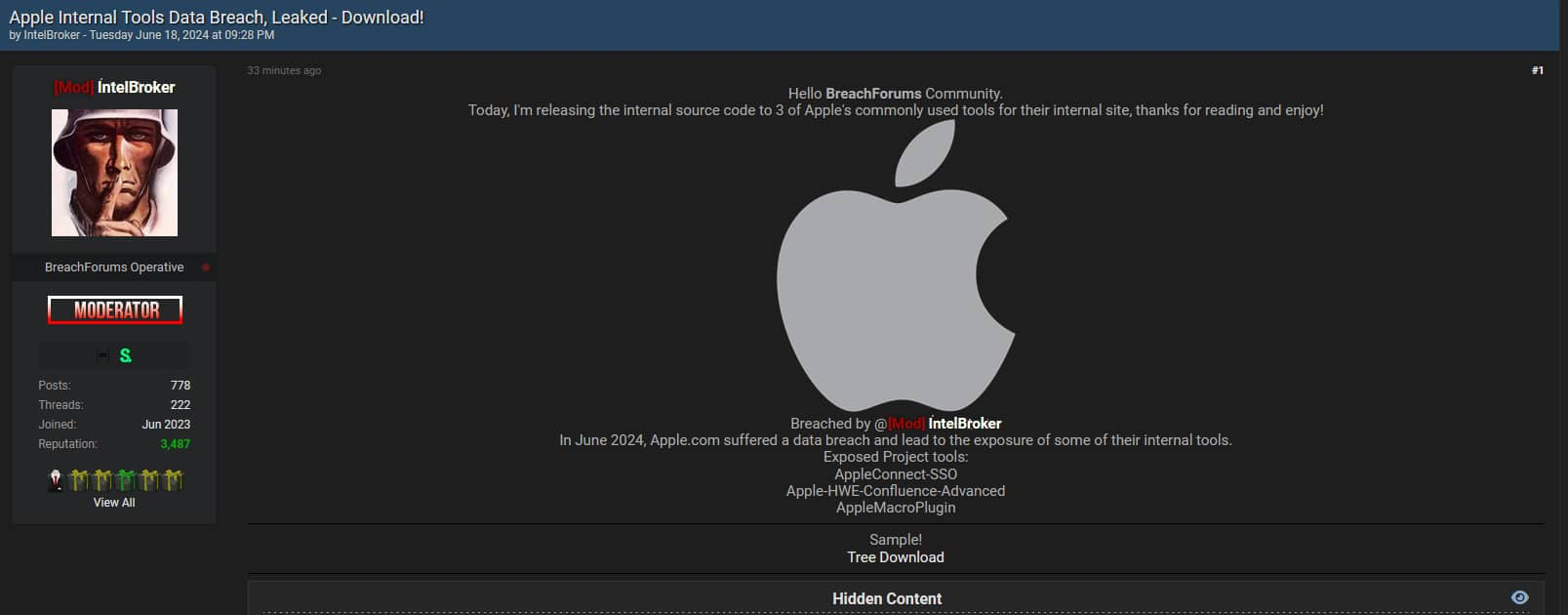
According to a post on the Breach Forums, IntelBroker claims to have accessed Apple’s systems in June 2024, obtaining the source code for the following tools:
AppleConnect-SSO
AppleMacroPlugin
Apple-HWE-Confluence-Advanced
The hacker provided no further details about the breach or the specific purpose of the stolen code. However, it is worth mentioning that this alleged breach does not impact Apple’s customers or their information in any way.
Screenshot of the post published by Intel Broker on Breach Forums (Credit: Hackread.com)
Although there is not much information about the AppleMacroPlugin and Apple-HWE-Confluence-Advanced tools, AppleConnect-SSO is an internal single sign-on (SSO) and authentication system developed by Apple. It allows employees to securely access various applications within Apple’s network. This system is integrated with Apple’s Directory Services database, facilitating secure access to internal resources.
On iOS devices, it includes a gesture-based login option as an alternative to traditional passwords, enhancing ease of use while maintaining security. AppleConnect is utilized through applications on iOS and macOS and can involve various verification methods, including two-step verification and hardware tokens like YubiKey.
IntelBroker and Previous Hacks
This latest claim comes just hours after IntelBroker announced a similar breach of Advanced Micro Devices, Inc. (AMD), an American multinational semiconductor company stealing its employee and product information before putting it for sale.
IntelBroker’s track record is one of significant concern, with previous alleged breaches targeting a wide range of entities, including:
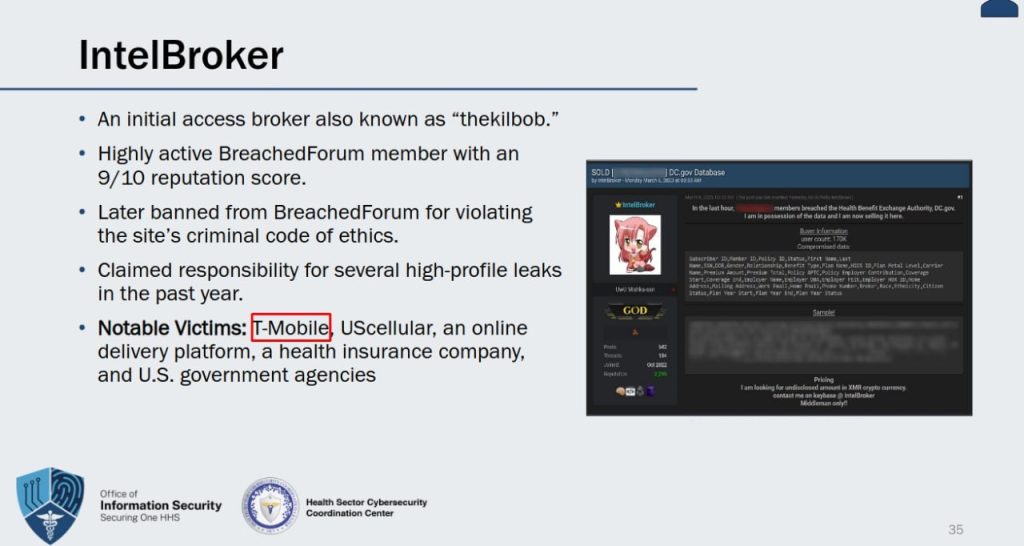
Although the hacker’s origins and affiliates are unknown, according to the United States government, IntelBroker is alleged to be the perpetrator behind one of the T-Mobile data breaches.
The hacker’s motives and affiliations remain unknown, but the frequency and severity of these alleged breaches highlight the growing threat posed by sophisticated cybercriminals.
Apple has not yet commented on the alleged breach. Stay tuned!
WhatsApp has been spotted working on multiple new features and improvements since the beginning of the year, but not many have made it to the stable version yet. Although it’s not unusual for big apps like WhatsApp to get so few new features compared to the number of features that are being tested, we had expected a slightly higher ratio.That said, file this one under the “new features being tested” category. It appears that WhatsApp is working on AR effects and filters for video calls. Many apps have tried in the past to borrow from Snapchat, so it’s no surprise that WhatsApp has decided to add a little bit of fun to one of its most popular functionalities: video calls.
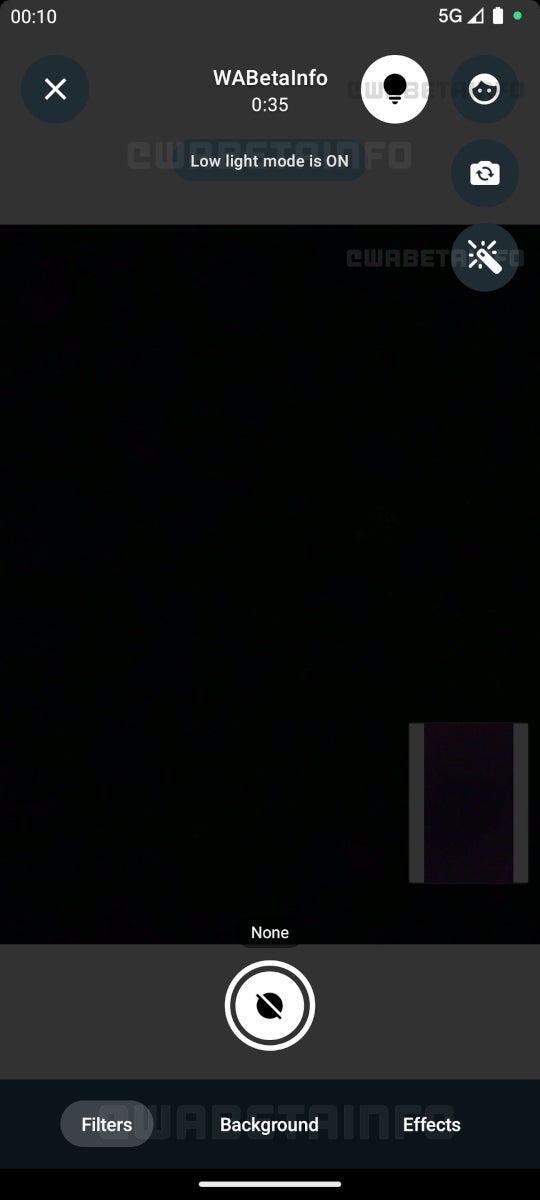
As per WABetaInfo’s report, WhatsApp is now looking to integrate new AR effects and filters that users will be able to apply during video calls. The report claims that WhatsApp users will be able to take advantage of dynamic facial filters, including a touch-up tool meant to smooth their skin appearance, as well as low-light mode when they need to improve visibility.
WhatsApp’s new AR effects/filters for video calls, Credits – WABetaInfo
Besides these AR effects and filters, WhatsApp was also spotted working on a brand-new tool that allows users to edit the background during calls. WABetaInfo claims that this particular will also be available on Desktop apps, not just on mobile.
Last but not least, a new option to use an avatar instead of the real-time video feed is now in the works too. It’s meant to maintain privacy for those who don’t want their face to appear in a video call.
According to a tweet by DarkWebInformer, a well-known source for dark web intelligence, Nevermore has been actively promoting this ransomware builder on underground forums.
🚨Nevermore🚨A threat actor is promoting Nevermore #Ransomware Builder.
FEATURES:
– Strong AES-265 encryption + parallel threads for speed
– Customize and upload your own decryption instructions file (TXT or PDF)
— Dark Web Informer (@DarkWebInformer) June 18, 2024
The tweet garnered significant attention: “Nevermore is now pushing a new ransomware builder.
This tool is highly sophisticated and poses a severe threat.”
Promoting this ransomware builder by a figure as influential as Nevermore is a cause for concern.
Ransomware attacks have already increased, with businesses and individuals falling victim to these malicious campaigns.
The availability of a user-friendly ransomware builder could lower the barrier to entry for aspiring cybercriminals, increasing the frequency and severity of attacks.
Cybersecurity experts are urging organizations to bolster their defenses and remain vigilant. “This development is a stark reminder of the evolving threat landscape,” said cybersecurity analyst Jane Doe.
“Organizations must prioritize cybersecurity measures and educate their employees about the risks of ransomware.”
Law Enforcement Response
Law enforcement agencies are also strengthening their efforts to combat this new threat.
International cooperation and intelligence sharing are crucial in tracking and apprehending cybercriminals like Nevermore.
Authorities are calling on the public to report suspicious activities and stay informed about the latest cybersecurity threats.
Nevermore’s promotion of a ransomware builder is a significant development in the world of cybercrime.
As the threat landscape evolves, individuals and organizations must stay informed and proactively protect themselves from ransomware attacks.
FreeWebinar! 3 Security Trends to Maximize MSP Growth -> Register For Free
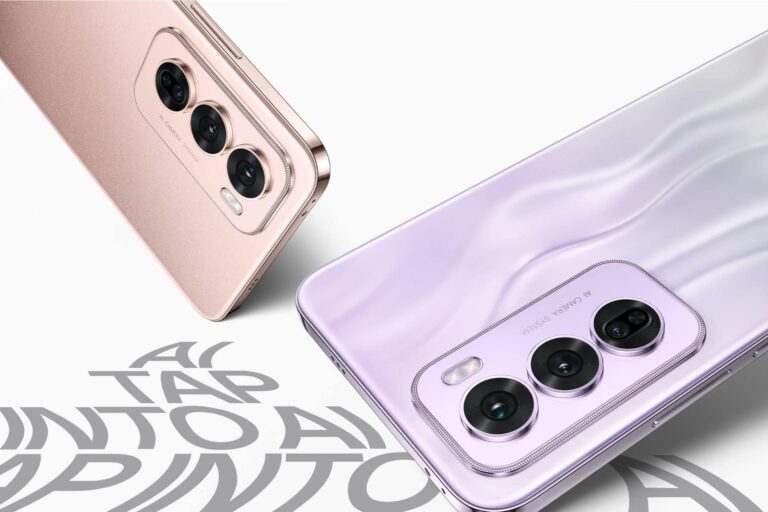
OPPO has officially launched the Reno 12 series with the goodness of AI. While brands like Apple are integrating AI features into two of its expensive iPhones, OPPO decided to take the game to the next level by offering high-end AI tools in its budget and midrange smartphones. Earlier this month, OPPO promised that it would ship AI features on all its phone lines this year.
Now it seems the company is starting to deliver what it promised starting with the OPPO Reno 12 series. Notably, the recently launched OPPO Reno 12 and 12 Pro ship similar AI features available on the flagship Find X7 Ultra. Besides, the OPPO Reno 12 series will wow you with its impressive design and value.
The OPPO Reno 12 boasts a robust design and fast charging capabilities
The standard Reno 12 model flaunts a 6.7-inch curved AMOLED display with a 120Hz refresh rate. It is backed by the protection of Corning Gorilla Glass 7i and packs the custom 4nm Dimensity 7300 Energy SoC under the hood. On top of that, it ships 12GB of LPDDR4X RAM and 256GB/512GB of UFS 3.1 storage.
The Reno 12 houses a triple-rear camera setup including a 50MP Sony LYT-600 as the main camera sensor with OIS support. Besides, there’s an 8MP 112-degree ultra-wide lens and a 2MP macro sensor. On the front, you’ll find a 32MP selfie shooter, too. This entry-level phone packs a 5000mAh battery and supports 80W SuperVOOC charging. And, it can be charged from 0% to 50% in just 18 minutes.
The OPPO Reno 12 Pro launches with an ‘Infinite View Screen’ and awesome camera specs
The OPPO Reno 12 Pro also boasts a 6.7-inch AMOLED display with a refresh rate of 120Hz. However, the Infinite View Screen is the standout feature here. In simpler words, the Reno 12 series is launched with a quad micro-curve design. Oppo says that it brings the goodness of a curved screen’s aesthetics with the grip of a flat screen. And, that it will offer fully immersive visuals and comfort while minimizing accidental touch usually associated with phones with curved displays. Notably, the Reno 12 Pro comes with Corning Gorilla Glass Victus 2. And, it ships with similar RAM and dual storage options as the Reno 12. It also packs the same processor under the hood and boots ColorOS 14.1 out-of-the-box.
The Reno 12 Pro sports a triple-rear camera setup including a 50MP Sony LYT-600 camera sensor with OIS support. Besides, there’s a 50MP telephoto lens along with an 8MP 112-degree ultra-wide lens. On the front, you’ll get a 50MP selfie camera. The Pro model allows shooting 4K video at 30fps using the rear and front cameras. Moreover, it packs a 5000mAh battery and supports 80W SuperVOOC charging. And, it can be fully charged in 46 minutes.
OPPO lives up to its promise of delivering a true AI phone
The Reno 12 series comes with a slew of amazing AI features. For starters, the Reno 12 series comes with AI Eraser 2.0. As the name suggests, using this feature will help you remove unwanted objects from your photos with just a tap. Next, there’s the AI Clear Face feature where AI does the magic and gives everyone in a group photo a star makeover. In addition, you have the AI Studio feature that uses GenAI (generative AI) to create your digital avatars.
The AI Toolbox is another feature on the Reno 12 lineup that uses Google Gemini to analyze in-screen content to offer multiple AI tools like the new Recording Summary which transcribes voice recordings. The next one is the AI Writer feature which generates comments and writes anything for you in Gmail or Outlook. It even helps you with social media posting and generates shopping lists for you.
AI LinkBoost and BeaconLink feature offers you peace of mind in low-network areas
The new AI LinkBoost feature in OPPO’s midrange Android smartphone allows for better signal reception. It can detect when you’re entering or leaving weak-signal areas like an elevator and quickly reconnect to the network. Besides, you can easily switch networks as AI ensures fewer delays and interruptions.
OPPO even has a solution for no-network zones, it’s called BeaconLink. This new feature allows calling nearby people, all just by using Bluetooth. You won’t even need a mobile network or an internet connection. However, the feature requires other parties to keep their Bluetooth on to make or receive calls.
The OPPO Reno 12 series price & availability
The Reno 12 starts at €499 in the global market, whereas, the Reno 12 Pro sets you back by €599. As with other OPPO phones, the Reno 12 series won’t be available in the United States. But, it will be available in different regions on different dates. Worth noting that the Chinese versions of both smartphones are up for sale in China which has more RAM, a better processor, and a few extra features.
Fake websites of authoritative and popular companies claiming to be genuine sites make users believe that the site belongs to that specific company and is safe to use.
Besides this, hackers can more easily lure victims into entering sensitive information or downloading malware by mimicking popular and reputable brands.
Cybersecurity researchers at Rapid 7 identified a fresh malvertising campaign that deceives users into downloading malicious installers pretending to be well-known utilities, such as Google Chrome and Microsoft Teams.
These installers deliver a backdoor named “Oyster” or “Broomstick.” Following its establishment, hands-on keyboard activity involves system enumeration and deployment of other malicious payloads.
When they looked for the software on the Web, users downloaded Microsoft Teams installers from typosquatted websites in three instances.
These were rogue sites posing as authentic Microsoft ones and led trustful users to download malware instead of genuine software applications.
Fake Website
For one, “micrsoft-teams-download[.]com” sent binary MSTeamsSetup_c_l_.exe signed with a certificate issued for Shanxi Yanghua HOME Furnishings Ltd, likely used maliciously to look like a legitimate entity on VirusTotal.
In May 2024, legitimate software was impersonated by multiple installers, one of which employed a Microsoft Teams setup file with a revoked certificate.
The Rapid 7 report states that the Oyster (aka Broomstick, CleanUpLoader) malware family was first distributed via this installer in September 2023.
System data is collected while hardcoded C2s are contacted, consequently making it possible to execute remote code. The recent sample drops CleanUp30.dll, which creates a scheduled task that allows the virus to be launched every 3 hours when it runs itself again.
The C2 domains get decoded using a byte mapping algorithm, and fingerprint machines are infected, which helps send back such information to the C2 infrastructure.
Here below, we have mentioned all the functions that are used to fingerprint the infected machine:-
DsRoleGetPrimaryDomainInformation
GetUserNameW
NetUserGetInfo
GetComputerNameW
RtlGetVersion
While enumerating host information, the data is stored in JSON fields from decoded strings.
The fingerprint is encoded by reversing and byte mapping the string before sending via HTTP POST to whereverhomebe[.]com/, supfoundrysettlers[.]us/, and retdirectyourman[.]eu/.
CleanUp30.dll uses Boost.Beast for HTTP/WebSocket C2 communication. After executing CleanUp30.dll, a PowerShell script spawned, creating a startup shortcut DiskCleanUp.lnk to run CleanUp.dll via rundll32.exe.
This executed the k1.ps1, main.dll, and getresult.exe payloads.
FreeWebinar! 3 Security Trends to Maximize MSP Growth -> Register For Free
AT&T, one of the largest mobile carriers in the United States, has announced a price hike for its legacy unlimited plans. This change is set to take effect in August 2024. According to Android Authority, customers on single service lines will see a monthly price increase of $10. Meanwhile, those with multiple lines under their plan will experience a steeper increase of $20 per month.
AT&T is following in the footsteps of T-Mobile and Verizon
This move by AT&T follows similar actions by its competitors, T-Mobile and Verizon, who have also raised the prices of their plans recently. T-Mobile, for instance, increased the prices of their legacy plans by as much as $5 per line per month just a few weeks ago.
The specific AT&T plans affected by this price hike include a wide range of unlimited offerings. These are Unlimited & More Premium, Unlimited Choice Enhanced, Unlimited & More, Unlimited Choice II, Unlimited Plus, Unlimited Choice, Unlimited Plan, Unlimited Plus Enhanced, Unlimited Value Plan, and AT&T Unlimited Plan (with TV).
The mobile carrier is doing what it can to mitigate the backlash from customers
To mitigate potential backlash from loyal customers, AT&T is encouraging users to transition from older plans to newer ones in their catalog. Historically, price increases have often led to dissatisfaction and complaints from customers.
The carrier is increasing high-speed data and hotspot allowances for the affected plans. For instance, the AT&T Unlimited Choice, Choice II, and Choice Enhanced plans will now include 75GB of high-speed data and 30GB of hotspot data. For those opting for AT&T Unlimited Plus, Plus Enhanced, Unlimited & More Premium, and AT&T Unlimited (with TV), the plans will now offer 100GB of high-speed data and 60GB of hotspot data.
However, Android Authority reports that AT&T customers now face three primary options in response to this price change. They can choose to keep their current plan and accept the higher prices, switch to one of AT&T’s newer plans, or contact customer care to cancel their service entirely.
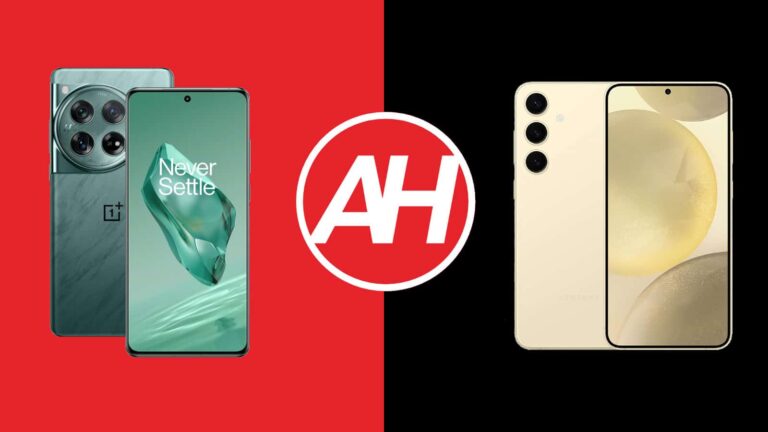
We’ve already compared the very best of OnePlus and Samsung for 2024. In this article, we’ll compare the OnePlus 12 vs Samsung Galaxy S24+. So not exactly the top-end Samsung model, but very close to it. The Galaxy S24+ is also a large member of Samsung’s flagship series, but a step below the ‘Ultra’ variant. Both of these phones are large and powerful, though, so it should be an interesting comparison.
As per usual, we’ll first list their specifications and take it from there. We will check out their designs, displays, performance, battery life, camera performance, and audio output. If you’re still on the fence about getting one of these two phones, this comparison will hopefully be of some help to you. Let’s get down to it, shall we?
Both the OnePlus 12 and Galaxy S24+ are made out of metal and glass. They both use aluminum for their frame and use Corning’s protection on the back. The one on the Galaxy S24+ is newer, though. The Galaxy S24+ is slightly more curved on the corners, while both phone have all their physical buttons on the right side. The alert slider is located on the left-hand side of the OnePlus 12, though.
You will notice that the OnePlus 12 has a curved display, while the one on the Galaxy S24+ is flat. Both phones have a centered display camera hole and very thin bezels around the display. If we flip them around, you’ll see two completely different camera setups. The OnePlus 12 has a circular camera island with four cutouts in there, three of which are for the cameras. The Galaxy S24+ has three vertically aligned cutouts in the top-left corner, and they’re all reserved for the phone’s cameras.
The sides of the Galaxy S24+ are flat, while that’s not the case with the OnePlus 12. OnePlus’ smartphone is the taller of the two, but it also has a larger display, so that’s expected. The two phones are basically the same in terms of width, while the OnePlus 12 is a bit thicker and heavier. It’s around 24 grams heavier. Both devices offer an IP rating for water and dust resistance. The OnePlus 12 comes with an IP65 rating, while the Galaxy S24+ offers an IP68 rating. Both of them are comfortable in the hand, but very slippery. They do have an entirely different in-hand feel, though.
OnePlus 12 vs Samsung Galaxy S24+: Display
There is a 6.82-inch QHD+ (3168 x 1440) LTPO AMOLED display included on the OnePlus 12. That display is flat, and it has an adaptive refresh rate of up to 120Hz. Dolby Vision is supported, and the same goes for HDR10+ content. This display has a theoretical top brightness of 4,500 nits, but you’ll never be able to go that high. The screen-to-body ratio is around 90%, while the Gorilla Glass Victus 2 protects this panel.
Samsung Galaxy S24+
The Galaxy S24+, on the other hand, includes a 6.7-inch QHD+ (3120 x 1440) Dynamic LTPO AMOLED 2X display. That panel is flat, and it has an adaptive refresh rate of up to 120Hz. HDR10+ is supported here, and the display’s top brightness is 2,600 nits. The display aspect ratio is 19.5:9, while the screen-to-body ratio is at around 91%. The Gorilla Glass Victus 2 protects this display.
Both of these displays are great, to say the least. They’re vivid, have great viewing angles, and deep blacks. They have good touch response and good protection. Both displays are also extremely sharp and do get more than bright enough in all conditions. You can easily use either of the two displays in direct sunlight. We’d give an edge to the OnePlus 12 in such conditions, but both are excellent. You can’t really go wrong with either of these two. Just note that the OnePlus has a higher PWM dimming, so if you’re sensitive to OLED displays… that’s the one that may suit you better.
OnePlus 12 vs Samsung Galaxy S24+: Performance
The Snapdragon 8 Gen 3 fuels the OnePlus 12. OnePlus also included up to 16GB of RAM inside the device, along with UFS 4.0 flash storage. The Galaxy S24+, on the flip side, comes with 12GB of LPDDR5X RAM and UFS 4.0 flash storage. The phone is fueled by the Snapdragon 8 Gen 3 for Galaxy processor. It’s basically the same chip, but it has higher clock speeds. In some markets, like in Europe, for example, the Exynos 2400 is included. Do note that we used the Snapdragon model of the phone, so can’t really comment on the Exynos variant.
Both phones offer outstanding performance in basically every way. That’s expected out of them, as they’re equipped with the latest hardware. Both phones will fly through anything you throw at them, without a doubt. They can multitask like nobody’s business, open apps really fast, consume multimedia, are great for browsing, you can process images and video with ease, and so on.
If you’re wondering about gaming, neither phone has a problem with that, quite the contrary. They can both run games with ease, though one thing worth noting is that the OnePlus 12 has better cooling. If you’re planning to play a ton of graphically-intensive titles, that phone may be the better option. On top of that it offers much faster charging, so it will allow you to recharge the device after a gaming session. More on that later. Both phones do offer great performance in basically every way, so no worries.
OnePlus 12 vs Samsung Galaxy S24+: Battery
There is a 5,400mAh battery included inside the OnePlus 12. The Galaxy S24+, on the other hand, has a 4,900mAh battery on the inside. Both phones offer good battery performance, but the OnePlus 12 trumps the Galaxy S24+, easily. The OnePlus 12 was able to last longer for us, basically every time, even though the battery life on the Galaxy S24+ is really good. OnePlus’ flagship simply offers more longevity.
The Galaxy S24+ battery life has changed since launch, it’s not as good. It’s not much worse, but it’s not as good as it initially was, at least for us. Getting 7 hours of screen-on-time is still possible, fi you’re not playing games or anything of the sort. The OnePlus 12 does offer over 20% better battery life in our experience, even over 30% better, I’d say. That phone simply goes the distance when battery life is concerned. Your mileage may vary, though, of course. You’ll be using your phones differently, with different apps, and different signal strengths.
When it comes to charging, the OnePlus 12 is simply the better option. It supports 100W wired (80W in the US) charging, along with 50W wireless charging, and 10W reverse wireless charging. A charger is also included in the box. The Galaxy S24+ supports 45W wired, 15W wireless, and 4.5W reverse wireless charging. The Galaxy S24+ will charge considerably slower, and it doesn’t even come with a charger.
OnePlus 12 vs Samsung Galaxy S24+: Cameras
Both of these phones have three cameras on the back. The OnePlus 12 includes a 50-megapixel main camera, a 48-megapixel ultrawide unit (114-degree FoV), and a 64-megapixel periscope telephoto camera (3x optical zoom). The Galaxy S24+, on the flip side, has a 50-megapixel main camera, a 12-megapixel ultrawide unit (120-degree FoV), and a 10-megapixel telephoto camera (3x optical zoom).
OnePlus 12
While both of these smartphones are capable of capturing good photos, the OnePlus 12 does have the edge. We preferred the vast majority of its images here. The Galaxy S24+ photos can end up looking a bit too processed compared to the ones the OnePlus 12 provides. OnePlus’ flagship provides contrasty shots, and the colors are almost always on point… Hasselblad definitely played a role there. Even when it comes to low-light shots, the OnePlus 12 usually tends to balance them out a bit better.
When the ultrawide and telephoto cameras are concerned, the difference is even more noticeable. The units on the Galaxy S24+ cannot compete in terms of details, and the image quality in general tends to be better from the OnePlus 12. That handset has better camera hardware in that aspect, and it also includes a periscope telephoto camera, which the Galaxy S24+ doesn’t have.
Audio
Both of these phones do come with a set of stereo speakers. Those speakers are really good on both ends, but the ones on the Galaxy S24+ are a bit louder. Still, the difference is not that big, and both sets do provide pleasant sound.
Neither of these two phones includes an audio jack. You can use their Type-C ports if you’d like to connect your wired headphones, though. Alternatively, the OnePlus 12 offers Bluetooth 5.4, while the Galaxy S24+ supports Bluetooth 5.3.
The US Federal Trade Commission (FTC) has officially referred a complaint against TikTok to the US Department of Justice. The complaint could eventually pan out to become a full-fledged governmental probe. The FTC had been investigating the way TikTok handles user data, particularly concerning children.
Why is the FTC seeking the US Justice Department’s intervention?
The FTC has been investigating TikTok, and its parent company ByteDance Inc., for well over a year. The federal agency was looking at several potential violations of US laws by the Chinese company.
Besides the myriad allegations, the FTC suspects ByteDance violates federal laws that protect children on the internet. Additionally, investigations intend to uncover if ByteDance violated laws that bar companies from using “unfair or deceptive” business practices.
It appears the FTC believes its investigation of TikTok’s business practices merits the involvement of the Department of Justice. By referring the case to the DoJ, the FTC has reportedly implied that it could be ready for a full-blown governmental inquiry.
Needless to say, this would be a long-drawn legal battle for ByteDance. Moreover, it could mean American lawmakers may force ByteDance to significantly dilute its ownership stakes in TikTok, effectively breaking up a very profitable company.
1. Today @FTC referred its case against TikTok to the Civil Division at @TheJusticeDept.
Our investigation found reason to believe that TikTok is violating or about to violate the FTC Act and the Children’s Online Privacy Protection Act (COPPA). https://t.co/fhYmUDStiF
In a detailed statement, the FTC has stated that its investigation has, “found reason to believe that TikTok is violating or about to violate the FTC Act and the Children’s Online Privacy Protection Act.”
FTC’s announcing its intention to refer a complaint to the DoJ is surprising because the agency usually refrains from confirming its next move. However, the agency made an exception because the investigation and its outcome are, “in the public interest.” As expected, TikTok has issued a public statement on X (formerly Twitter) expressing its disappointment. The announcement could be one of the biggest blows to ByteDance after the company forked out $5.7 million to settle FTC allegations back in 2019. Incidentally, this was the largest civil penalty the FTC ever obtained in a children’s privacy case.
Our statement on today’s FTC announcement:
We’ve been working with the FTC for more than a year to address its concerns. We’re disappointed the agency is pursuing litigation instead of continuing to work with us on a reasonable solution. We strongly disagree with the FTC’s…
Currently, the default power that Android detects as “fast charging” is 7.5W. This figure is far behind the big advances in modern industry. However, that could change with Android 15, raising the threshold to 20W.
The Android market is full of options with support for high-power fast charging. Commercially, you can find devices with up to 240W fast charging. Meanwhile, brands like Redmi and Realme are even working on reaching 300W. On the other hand, the Android fast charging detection system has not changed at the same rate.
Android 15 would finally tweak the 7.5W fast charging threshold
Android (AOSP) recognizes “fast charging” when your device receives 7.5W of power. That said, each manufacturer is completely free to tweak these values to adjust them to their own fast-charging technologies. However, Google Pixels use the default values set in the AOSP code. This can make it a little difficult for Pixel users to determine if their chargers are working correctly. After all, your lock screen will show a “Fast charging” message even though your device is receiving less than 8W.
It’s noteworthy that Google Pixel devices have not kept pace with the rest of the industry with respect to charging power. The Pixel 8 Pro, the brand’s most premium mobile, supports a maximum of 30W. So, it is possible that this lack of progress has been carried over to the AOSP code. Anyway, a recent finding suggests that Android 15 would detect “fast charging” starting at 20W.
It would mainly help Google Pixel users
Considering the advances available in the industry, 20W still seems a bit short. However, it makes sense considering that Google Pixel devices are the ones that use AOSP fast charging detection. Other manufacturers probably tweak the values to adapt them to the possibilities of their devices. Nor are major advances expected in terms of fast charging for the Pixels in the short term.
The source found the new 20W value in the latest Android 15 beta. However, it is not implemented yet, so the phones running that version still detect fast charging by receiving only 7.5W. Google is expected to definitively push the new values in the first Android 15 stable update. It is even possible that it will occur in future Android 15 betas.
Although this tweak won’t change your life, it will make things easier. Now Google Pixel users will actually know if their devices are charging at relatively high power.
Researchers have detected active attacks from TellYouThePass ransomware that exploits the recently reported PHP flaw. The active exploits make it even more urgent for the users to patch their systems at the earliest.
TellYouThePass Ransomware Began Exploiting PHP Flaw In Recent Campaigns
According to a recent blog post from Imperva, threat actors behind the TellYouThePass ransomware have started attacking the recently disclosed and patched PHP vulnerability CVE-2024-4577.
This vulnerability recently came into the limelight after researchers discovered an authentication bypass in a previous patch for a 12-year-old code execution flaw. Following the bug report, the vulnerability received a fix with PHP versions 8.3.8, 8.2.20, and 8.1.29. However, the threat actors quickly exploited the flaw before users could patch it.
According to Imperva, their researchers detected active exploitation of the flaw soon after its disclosure, which they could link back to the TellYouThePass ransomware.
In this campaign, the attackers exploit the vulnerability using the mshta.exe binary to run a malicious HTML application. This malicious file includes a VBScript, which then decodes into a binary that loads into memory during runtime.
Analyzing this binary made the researchers find a .NET variant of the ransomware that exhibits the core functionalities. It communicates via HTTP with its C&C, encrypts the files on the infected machine, and places the ransom note that demands 0.1 BTC as ransom.
Since the beginning of this campaign, the ransomware has infected numerous systems and websites. While the patch has already been deployed, the extensive impact of this campaign on multiple systems and sites demonstrates how fast the attackers are to attack vulnerable targets.
To avoid ransomware attacks and other threats, users must rush to patch their systems for CVE-2024-4577. Moreover, users must ensure equipping their systems with robust antimalware programs, and deploying web application firewalls (WAFs) on their sites to prevent similar threats.