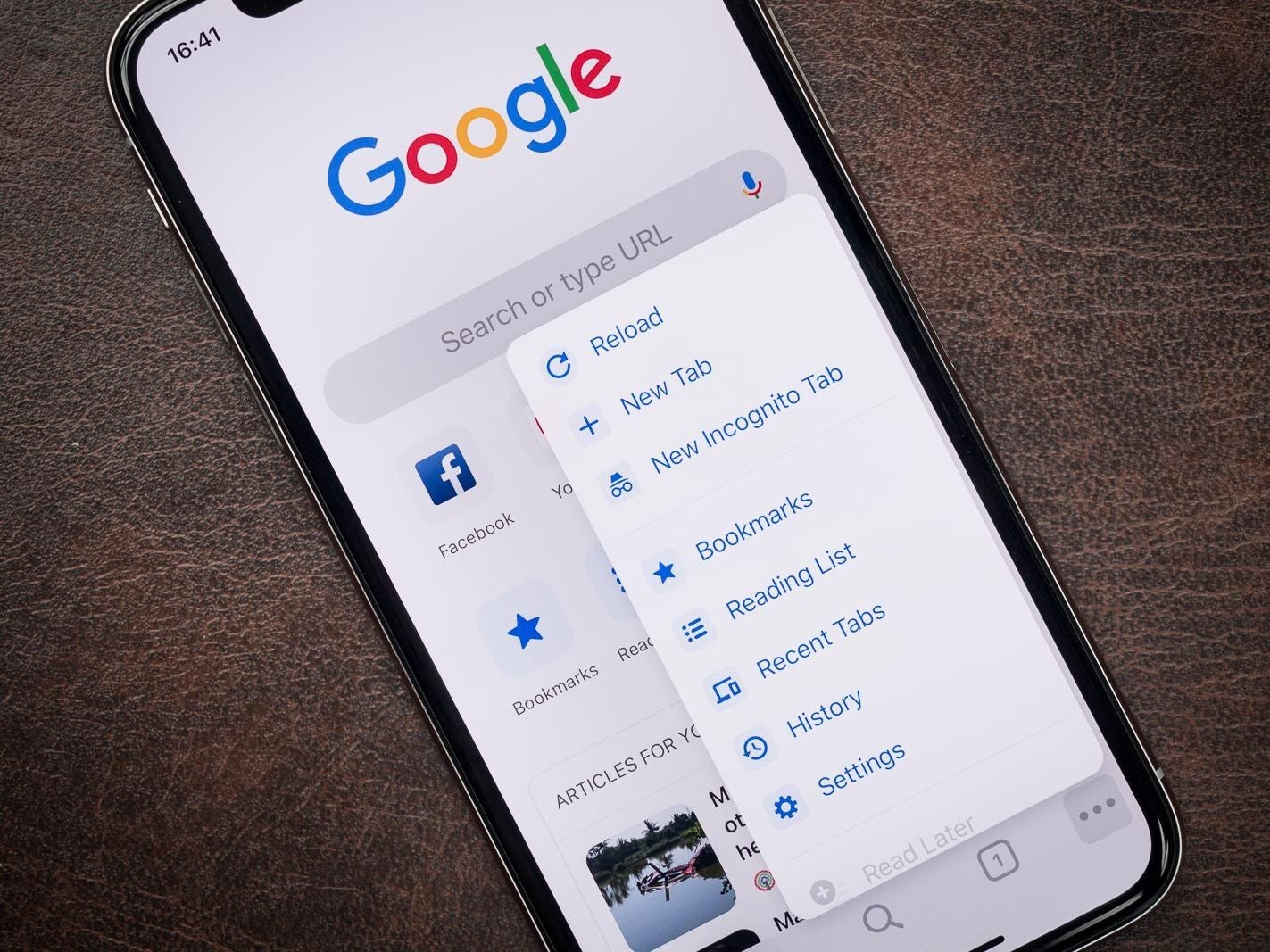
Google’s infamous and popular browser Chrome, which comes pre-installed on some of the best smartphones on the market, will get an update to WebGPU after six years of development time in collaboration with Microsoft, Apple, Intel and Mozilla. The update is expected to impact both the app and desktop experiences, and maybe other browsers that use Chromium as a base.
But wait, what is a WebGPU anyway? Why should you care? Well, a WebGPU is basically an API — something that enables different types of programs to “talk” to each other — that aims to improve the way that Chrome utilizes the hardware associated with the given system on a specific device. Or, in simpler terms: a program that can improve the way that your hardware is used by Chrome in order to achieve prettier and more impressive visual results. Improvement in computational speeds is also expected too, which means less waiting around for loading.
This could start looking even fancier really soon. | Image credit – PhoneArena
But let’s provide an applicable example. Google Meet is an online communication platform, which allows users to get on video calls. Since video is part of the visual department, this new WebGPU API will impact Meet too. A simple example would be that it will increase the responsiveness and accuracy of the blur that users can apply to their surroundings when on a call. Neat, right?
This update is also stated to improve rendering — in this context, the transformation of 2D images into 3D objects — too. This in turn amps up the performance of currently utilized tech and will allow for more impressive results for applications such as Unity’s WebGL, so gamers have something to look forward to too.
One of the goals with this update is to, quote, “have applications work portably across different user systems and browsers”. For you, this means better tools and higher productivity interaction. The tech is already available on the Chrome 113 stable beta, and it is expected to drop on PCs first, followed by a roll out for Android and Linux later on.
And just in case…
… all of this GPU talk got your thumbs itching, check out our recommendation on the best gaming phones available right now.
Telegram is becoming an increasingly popular platform for users as well as cyber-criminals. It has become a Mini Dark-web since 2021 when cyber threat actors have been using them.
The services these threat actors offer vary from Automation of Phishing, selling Phishers kits, and setting up a custom phishing campaign for everyone willing to pay.
To promote their stuff, these phishers create Telegram channels where they conduct polls, train their audience, and provide choices on what kind of personal data they prefer.
Channel links are circulated via GitHub, YouTube, and the Phishing links they make. A detailed analysis of their pricing, services, and other information is listed below.
Offers Now: Telegram Black Market
These threat actors’ services are categorized into two “Paid” and “Free”. Telegram bots help many legitimate users automate regular tasks, answer customer FAQs, set reminders, etc. However, threat actors use the bots for phishing page creation or user data collection.
Creating a phishing page with a telegram bot involves the following steps,
Aspiring phisher joins a bot creator’s channel
Choose the language (English / Arabic)
Bot asks the phisher to create their bot and share its token with the current bot, which they call “Botfather.”
After sharing the token, the botfather generates many fake pages, all with the same domain.
Once the Botfather creates the phishing links, the phisher has to spread the link himself.
Every time there is a victim to these phishing pages, the phisher will receive a message on his bot for which he shared the token with the botfather.
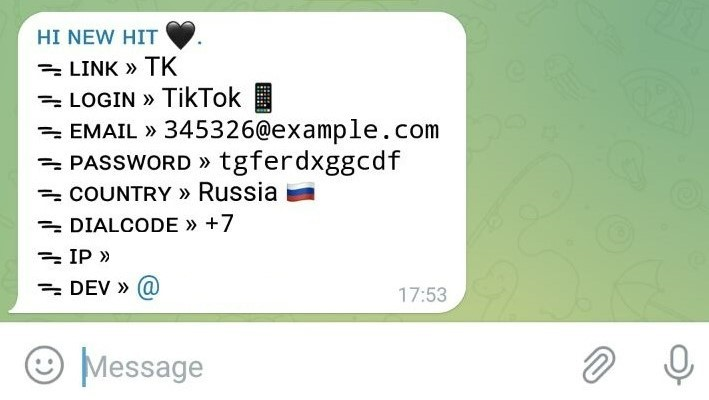
The message will contain which link the victim visited, his IP address, and the credentials he entered.
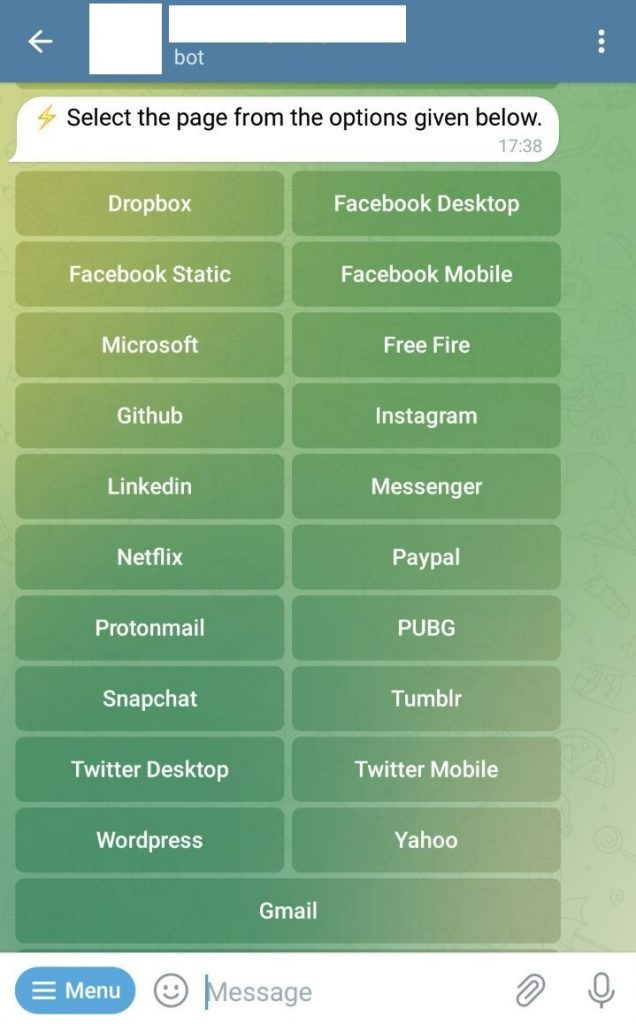
Some bots that generate phishing pages slightly differ from links-generating bots that will initially ask for the service to replicate, such as Dropbox or Google.
Following this, it asks the phisher to enter the link that he wants the users to redirect to once they have fallen for the phishing page, which will typically be a Google homepage. Once the options are given, it generates multiple links containing the same service replicated on all the generated links.
The victims’ credentials will be received directly on this phishing bot on Telegram.
How do Telegram Bots receive these links?
The basic phishing kit offers a service that forwards the required data into a utility with predefined packages available.
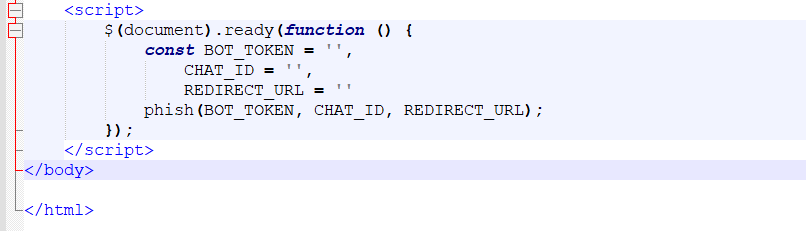
After this, they have a script inside the phishing pages that will forward the stolen data to the bot to which the links are configured. Other information includes the chat identifier token and the URL to which the links have to redirect.
Mysterious question: Why the developer can’t configure this page to send a copy to his server is still unanswered.
These phishers are sometimes so generous that they post a link containing the resource for phishing pages of various brands and are ready-to-use templates.
Subscribers of these channels also frequently see links containing stolen personal data. They also tag these links as verified or not verified data. “YELLOW LIGHT DATA” stands for unverified data.
The research found that threat actors sold bank account credentials based on the available balance. For instance, a bank account with $1,400 was sold at $110, but an account worth $49,000 was sold at $700.
Phishing-As-A-Service (PhaaS)
Like SaaS or PaaS, Phaas (Phishing as a service) is also becoming increasingly popular. SaaS offers Software as a service; likewise, these malicious actors were found to offer “premium” subscriptions for the newbie phishers. This service includes guides for beginners, access to phishing tools, and technical support.
Sometimes, these threat actors mention that they have anti-bot systems, URL encryption, geoblocking, and other exciting features useful for attackers. When I looked closer, they contained scripts blocking web crawlers and other phishing detectors.
These kinds of pages differ in prices with different vendors ranging from $10 per copy to $50 for a several-page archive. Some exclusive featuring pages like 3-D secure support go up to $300.
Privacy watchdog noyb has built a tool for EU users to make it easier to opt out of Meta’s targeted advertising.
After Meta (Facebook and Instagram) switched the legal basis for targeting advertising from automatic consent to opt-out, privacy watchdog noyb has built a tool for users to opt out of targeted advertising and various other claims made by Meta in an easy and legally sound way.
After losing several cases where privacy-focused organizations claimed that Meta was in violation of GDPR regulations, Meta changed the legal basis to process certain first party data in Europe from “Contractual Necessity” to “Legitimate Interests.” GDPR is the EU’s general data protection regulation which governs how the personal data of individuals in the EU may be processed and transferred.
Even in Meta’s own words the new rules shouldn’t make much of a difference:
“It is important to note that this legal change does not prevent personalized advertising on our platform, nor does it affect how advertisers, businesses or users experience our products.”
The GDPR allows the processing of personal data if a company complies with one of the six legal bases in Article 6(1) GDPR, which are almost all irrelevant for advertising, so Meta does need the user’s consent.
But, instead of switching to an “opt-in” system, like Google or Microsoft, Meta argues that its “legitimate interest” to process user data would override the fundamental right to privacy and data protection of users.
In the view of the noyb the “legitimate interest” argument has no lawful foundation, and even if it had, opting-out should be as easy as it is to opt-in. But instead of providing a simple method to opt-out, like clicking a button, Meta requires users to fill out a hidden form. This form requires users to argue why they want to perform an opt-out and explain why Meta’s, non-public, assessment is wrong in their individual case. An action that requires a user to click all the right buttons, understand legalese, and argue their points effectively. This has been made so complicated, that noyb thinks it is highly unlikely that any normal user would be able to successfully complete this process.
This means the days in court are far from over, but in the mean time noyb created a quick and easy way for users to object to the processing in a broad way. It has created a tool that allows users to opt-out of any processing under “legitimate interest“ and generally object to the use of personal data for targeted ads.
In the words of Max Schrems, co-founder and honorary chairman of noyb:
“Our form turns the table: Meta has to argue why they have an overriding interest – not the user. Users can now opt out of data processing, and Facebook must process this objection without delay. We want to make it as easy as possible for those affected to exercise their fundamental rights.”
To use the free tool, users can visit the noyb consent form for collecting the necessary information and sending it to Meta.
Next you are presented with three options.
The Facebook Login option allows you to object via noyb’s servers, using your email address as a sender and verifying that you have a Facebook account via Facebook Login. You will receive a copy of the objection.
The Email Tool option is basically the same except for the fact that you don’t have to log in to Facebook. Instead you will have to provide the email address that you use for Facebook/Instagram and noyb will verify if it’s yours.
Content of the verification email sent to users of the second option
The Email Client option provides you with an example text so you can send an objection email yourself. All you have to do is copy the text into your email client and replace <YOUR_EMAIL_ADDRESS> in two places with the email address that is linked to your Meta account(s).
Knowing Meta, it’s probably too soon to get your hopes up. But sending out that email will at least tell Meta that there are objections and users feel that this is not the way to go about their business.
Malwarebytes removes all remnants of ransomware and prevents you from getting reinfected. Want to learn more about how we can help protect your business? Get a free trial below.
It seems like OPPO is preparing its own version of 300W charging. It will be released under the company’s SuperVOOC branding, and it’s aiming to match Redmi’s 300W offering. As many of you know, Redmi showed off its 300W charging back in February, though it still didn’t make its way to a single product.
OPPO is aiming to rival Redmi with its 300W fast charging
Redmi did, however, confirm that it plans to utilize 300W charging in devices moving forward. The fastest charging now available in a commercial smartphone is Realme’s 240W charging solution. It is included in the Realme GT3. Realme is OPPO’s company, even though it’s now its own company, technically. So OPPO likely had a lot to do with that 240W charging offering.
In any case, OPPO is looking to up the ante once again. The news regarding its 300W charging solution comes from Digital Chat Station, a well-known Chinese tipster. He shared the info via Weibo.
It will likely be presented before the end of this year, and OPPO is aiming to present it while paired with a 4,450mAh battery. You’re probably wondering how fast will this charging be, well, we may have an idea.
OPPO’s offering should be on par with Redmi’s implementation when it comes to charging speed
Redmi’s 300W charging takes under 5 minutes to fully charge a 4,100mAh battery. It takes only 2 minutes and 11 seconds to reach the 50-percent mark. So, OPPO’s 300W charging should offer similar results.
OPPO’s SuperVOOC charging has been serving users well for quite some time now. The company includes super-fast charging in many of its smartphones, even the cheaper ones. We’ve tested it a number of times, and it really does work really well.
The company’s 120W charging is plenty fast, so many people would probably say that they don’t really need charging to be faster than that. If it can be achieved while keeping battery health in check, why wouldn’t companies push forward.
Microsoft Outlook is a business standard when it comes to email clients, but it’s been pretty limited in the number of accounts that it can use. This is inconvenient for people who use more than one email account in their work life. Fortunately, according to XDA Developers, the New Outlook experience will support adding Gmail accounts.
Microsoft Outlook is going through a bit of a renaissance at the moment. Microsoft is making some significant changes to the Outlook application for Windows. The company has been baking this update for several months now, and you’re able to try it out if you’re part of the Insider program.
Basically, Microsoft is revamping the Outlook app in order to give it a more modern look and feel. You should look into it if you’re an avid Outlook user.
Outlook will finally support Gmail accounts
One issue with using Outlook is that it’s pretty limited in terms of supported accounts. Nowadays, people have multiple email accounts for various reasons. A person could have a personal account and one that they need for work. This means that they may need multiple clients just to access their emails.
Microsoft did announce that it’s working on adding support for third-party accounts, and it’s delivering on that promise. Over time, Outlook will have access to more accounts, but it’s starting off with Gmail accounts.
This integration doesn’t stop at letting you access your Gmail emails. Outlook will also allow you to access your Google Calendar and your contacts. That’s great if you’re looking to use this as a one-stop shop for your business email needs. This eliminates the need for you to switch from the Outlook client and access your Google Workspace products on the web.
At this point, we don’t know when the company is going to bring this to the public. However, when it does, we can expect Outlook to see an increase in overall usage, as Gmail is an extremely popular platform.
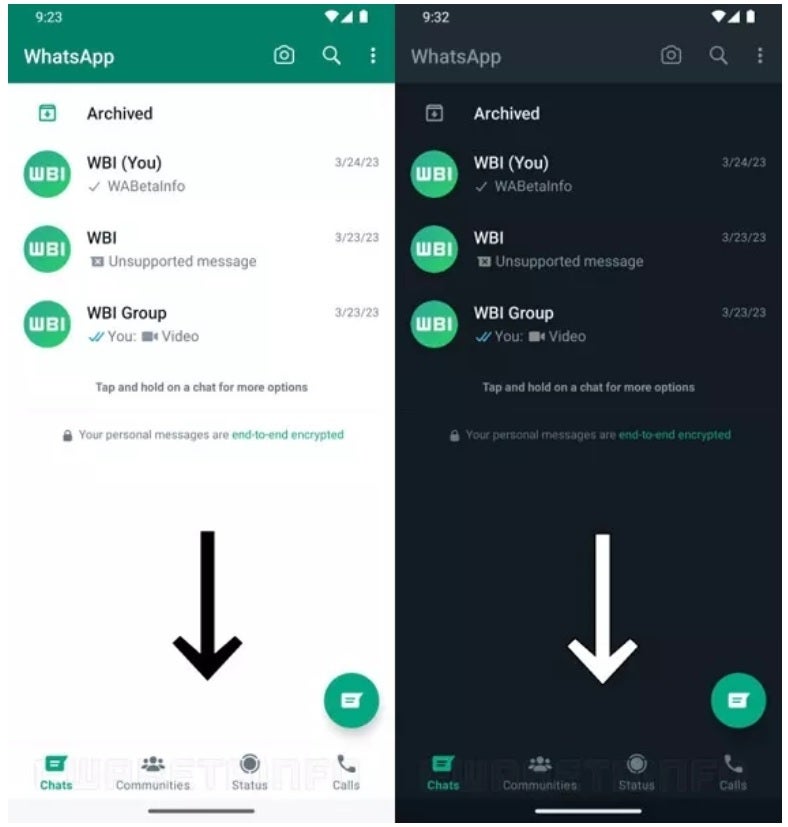
WhatsApp is making a change to its UI as it is in the process of disseminating an update to the Beta version of its Android app. As per WABetaInfo (via AndroidCentral), WhatsApp is moving its navigation tabs (the ones on the top of the Android app that include Communities, Chats, Status, and Calls) to the bottom of the screen. This should make WhatsApp easier to use one-handed on large-screened devices. Moving elements to the bottom of the screen is what Samsung does with its One UI interface.
The new look is found in version 2.23.8.4 of the Android WhatsApp Beta app. To find out which version of WhatsApp you are using, open the app and tap the three-dot overflow menu icon on the right top of the screen. Go to Settings > Help > App info. Wouldn’t you know it, the version of WhatsApp Beta on my Pixel 6 Pro is running version 2.23.8.3. Oh so close! Eventually, the feature will also be found on the public version of the app although it might take a few weeks before this happens.
With the navigation tabs on the bottom, the Android version of WhatsApp will match the iOS version of the messaging app. The WhatsApp iOS app already has the navigation tabs at the bottom of the screen. Moving the tabs to the bottom of the screen is something that Android WhatsApp users have been asking for and now WhatsApp is giving them what they want.
The Android version of the WhatsApp Beta app will have the navigation tabs moved to the bottom. Image credit WABetaInfo
With WhatsApp, users can enjoy messaging that is protected with end-to-end encryption, make phone calls, and engage in video chats. The Meta-owned platform has over 5 billion installs on Android alone and counts 2.24 billion global active users. 100 billion messages are exchanged over WhatsApp every single day. You can install the app on your Android device via the Google Play Store by tapping on this link. Apple iPhone users can install WhatsApp from the App Store by tapping on this link.
We take a look at proposals from Google to make it easier for app users to request data and account deletion from mobile developers.
Google has made multiple security improvements to the general operation of apps over the last 12 months or so. It’s now a little easier to understand what apps want from you. Labels which indicate a level of trustworthiness for developers. Changes made to ensure old, abandoned apps will no longer appear for download on the Play store.
Many apps require you to create an account, and very often those accounts are pinned to websites. This is particularly common with regard to video game apps, but can be a requirement for pretty much anything you choose to install depending on the developer’s needs.
From the Google announcement:
For apps that enable app account creation, developers will soon need to provide an option to initiate account and data deletion from within the app and online. This web requirement, which you will link in your Data safety form, is especially important so that a user can request account and data deletion without having to reinstall an app.
If you’re wondering, Google’s Data Safety Form is a way for developers to inform their users about how their data is used, collected, shared, and so on. All of the developer’s primary safety and privacy practices are listed here. Everything from what the developer itself does to how associated third-party entities work alongside them should be included.
Total account and data deletion
If an app user decides they no longer want anything to do with an application, there is now a way to ensure everything is gone forever. No more remnant accounts sitting around, potentially waiting to be compromised after a long period of abandonment.
From the release:
As the new policy states, when you fulfill a request to delete an account, you must also delete the data associated with that account. The feature also gives developers a way to provide more choice: users who may not want to delete their account entirely can choose to delete other data only where applicable (such as activity history, images, or videos). For developers that need to retain certain data for legitimate reasons such as security, fraud prevention, or regulatory compliance, you must clearly disclose those data retention practices.
As with so many changes of this nature, nothing is happening just yet. Developers have been given some time to get their houses in order if necessary, and submit their comments in relation to the proposed changes. They have from now until the beginning of December to do this. However, an extension is possible if needed which could give them until the end of May 2024. Either way, changes reflecting this new policy won’t kick in until somewhere around the beginning of next year.
As a device user there’s not much you can do about this for now. It’s squarely a heads up for developers to take a long look at the data they collect, and how to dispose of it when the app users feel that it’s no longer needed. Other major store owners are moving to similar policies, and this can only be a good thing for helping to reduce the threat of data theft.
Malwarebytes removes all remnants of ransomware and prevents you from getting reinfected. Want to learn more about how we can help protect your business? Get a free trial below.
Your brand-new Galaxy S23 flagship may have already lost more than 40% of its original value. That’s according to the phone trade-in comparison platform SellCell. They claim that the Galaxy S23 loses 43.3% of its value within the first two months of launch. Google‘s Pixel 7 fares worse with a 45.9% drop in value two months post its launch. The iPhone 14 retains the most value, depreciating just 31% over the same period.
SellCell recently compared the depreciation data of the aforementioned three phones for the first two months after launch. On average, a “like new” Galaxy S23 phone loses 41.1% of its value in the first month, and 43.3% by the end of two months. If the device is only in a “good” condition, the depreciation rate is 43.8% and 47.7%, respectively. The 1TB Galaxy S23 Ultra depreciates the fastest.
Among the latest Google Pixels, the 256GB Pixel 7 depreciates faster than other variants. Overall, the Pixel 7 series lost 43.1% of its value in the first month and 45.9% two months after its launch. That’s for a “like new” device, though. For a “good” condition Pixel 7, the average depreciation rate is 44.9% in the first month and 51.1% by the end of the second month.
The value decline of Apple’s iPhones has been historically less sharp than for Android devices and it was no different for the latest models. SellCell’s estimates show the iPhone 14 series lost 32.3% and 31% of its value in the first two months on average, respectively. This depreciation rate for a “good” condition iPhone 14 is 36.2% and 35%. Interestingly, the new iPhones regained some value in the second month after the usual first-month decline.
Samsung Galaxy phones are closing the depreciation gap with Apple iPhones
While iPhones hold value for much longer than Android devices, Samsung is reportedly doing better than other Android vendors. The Galaxy S23 lineup lost marginally less value in the first two months than the Galaxy S22 (43.3% vs. 46.8%).
The iPhone 14, on the other hand, lost its value almost twice as fast as the iPhone 13 in the first two months (31% vs. 16.4%). In other words, the Galaxy S23 depreciated 1.4 times faster than the iPhone 14. The Galaxy S22 had lost three times its value compared to the iPhone 13 in the same time frame.
Of course, the depreciation rate isn’t a measure of your phone’s quality. Even if the iPhone 14 is depreciating faster, it doesn’t mean the iPhone 13 is better. Likewise, the Galaxy S23 or the Pixel 7 losing more value than the iPhone 14 only indicates that its resale value is lower.
If you plan to hold onto your phone for a long, both of these devices are guaranteed five years of security updates. The Galaxy S23 will also get four major Android updates (until Android 17). The Pixel 7 is only guaranteed three major updates (until Android 16).
Apple has really bloated its iPad lineup in recent years. Making it tougher than ever to find the right iPad for you. But on the flip side, there’s an iPad at almost every price point now. So if you’re on a budget, there’s still a few options available for you.
These days, every iPad has been redesigned, and they also all sport USB-C. So the differences here mostly come down to the processor, slight changes in screen size, ProMotion or 120Hz, and that’s about it. For instance, the Pro iPads are able to do more because they have Mac-power chipsets inside, compared to the iPad Mini or regular iPad.
With that being said, let’s go over the best iPad you can buy in 2023.
For the majority of people out there, the iPad Air is going to be the best iPad to buy. This model offers a lot of the features of the Pro, without the Pro price, and it’s also a bit lighter than the Pro. Making it easier to hold for hours on end. The only real downside to the Air is that it does start out at 64GB of storage. Though that is the same across all the iPads, except for the iPad Pro.
In the iPad Air, you’re getting an M1 chipset, so it’s pretty powerful and will continue to be for years to come. It comes in a variety of colors and also has a pretty good 12MP camera on the front for using with Facetime, Zoom and other apps.
Like the other iPads, except for the Pro’s, the Air does use Touch ID in the power button for authentication. So there’s no Face ID available here. The iPad Air does also work with the second-generation Apple Pencil.
The iPad tenth generation is the best, cheap iPad that you can buy today. It is the cheapest, new iPad available. It’s not the best iPad, as it does have some interesting quirks, like the fact that it has a USB-C port, and still supports the original Apple Pencil which charges via Lightning. So you need a couple of dongles to use the Apple Pencil with this iPad.
At launch, there was a lot of anger for this iPad, because it got the much needed redesign, but it also jumped in price from $329 to $449. Really only making it $50 less than the iPad Air when it’s on sale, which is quite often now. And honestly, unless you get this iPad at a deep discount, you should spend the extra $50 on the iPad Air.
The iPad Pro 12.9 is the best of the best, in terms of iPads. And given its starting price, it should be. This is the 2022 model, which does have the upgraded M2 chipset – the same as the MacBook Air. Which gives it access to some features like Stage Manager. Apple also equipped it with WiFi 6E, giving you super fast WiFi speeds.
There’s two iPad Pro models, but the reason why we chose the 12.9-inch model is the display. Not only is it larger, but it is also a mini LED display, a lot like the new MacBook Pros with the M1 Pro and M1 Max chipset inside. It’s a stunning display, and it is definitely worth this price.
With Stage Manager and this 12.9-inch display, it gives you plenty of room for using multiple apps at the same time. But the size does make it a bit tougher to hold onto because it is about a pound and a half. But the iPad Pro can be a laptop replacement thanks to the Magic Keyboard. Which is a keyboard case that you can pick up and use for the iPad and basically have a full keyboard and trackpad for your iPad. I’ve used it on my iPad Air and absolutely love it.
When it comes to traveling, or reading while you’re traveling, you’ll want a small and lightweight iPad. That’s the iPad Mini. It’s one of the older iPads on this list actually, but it’s still a pretty good option. Because of that, it does have the Apple A15 Bionic chipset inside, it also comes with 64GB or 256GB of storage. Nice to see that Apple has mostly ditched the 128GB storage model.
The iPad Mini is basically a smaller iPad Air, which is not a bad thing. Though when you look at the pricing, it might be. It’s technically $100 less than the Air, but the Air is typically on sale for $499.
One of the good things about the iPad Mini is that it does come in a smaller size, around 8.3-inches. That makes it small enough to hold in one hand, and it doesn’t get hard to hold after a while. Definitely a good thing there. It’s great for reading books on, watching some movies and TV shows, and pilots love it for their flight plan. Because it is so small, so definitely a good buy.
Cybercriminals have compromised eFile.com to host malicious code that allows for the download of Trojans.
The IRS-authorized electronic filing service for tax returns, eFile.com, has been caught serving a couple of malicious JavaScript (JS) files these past few weeks, according to several security researchers and corroborated by BleepingComputer. Note this security incident only concerns eFile.com, not the IRS’ e-file infrastructure and other similar-sounding domains.
As of this writing, eFile.com is clean. Users can access it without worry.
The attack began 18 days ago
The incident first arose as a possibility that something might be up with the website. A Reddit user encountered a fake “Network Error” page when accessing www.efile.com. The page, as shown below, informed visitors their browser “uses an unsupported protocol,” and that they need to click the link it provided to them to update their browser—a known tactic often used by scammers.
This fake error message used to come up when visiting the domain. Uncharacteristically, it told visitors to update their browsers. This made Redditors suspect the domain was hijacked. (Source: /u/SaltyPotter, original image cropped to fit)
This, however, is no scam.
Known figures in cybersecurity, such as MalwareHunterTeam (@malwarehunterteam) and Johannes Ullrich (@johullrich) of SANS, caught wind of the potential site compromise and dug in, with each writing their analysis.
According to both MalwareHunterTeam and Ullrich, a malformed JS file named popper.js contains encrypted malicious code—meaning it cannot be read plainly. Its purpose is to load another JS script called update.js hosted on an Amazon Web Services (AWS) site. update.js contains code used to display the fake error page.
popper.js is a legitimate file modified to do malicious tasks. Because almost every page within the eForm website loads it, the malicious activities we mentioned are triggered every time a user visits any site page.
update.js also contains two hard-coded download URLs, both served on the malicious domain infoamanewonliag[.]online. The two payloads are for two specific browsers visitors typically use, Chrome and Firefox.
“So different browsers get different payloads,” says Ullrich. Chrome users get a payload named “update.exe” with a valid signature from Sichuan Niurui Science and Technology. Firefox users get “installer.exe.” There is no indication if browsers based on Chromium (where Chrome is based) or Quantum (where Firefox is based) could also receive the payloads.
BleepingComputer has independently confirmed the payloads connect to an IP address hosted by Alibaba in China. The same IP also hosts the illicit domain the payloads were downloaded from.
These executables were written in Python. Malwarebytes detects them as Trojan.Downloader.Python.
As of Wednesday, popper.js is free of malicious code.
The backdoor
Once users execute the payload, a PHP script runs quietly in the background. BleepingComputer’s analysis shows that every 10 seconds, the backdoor script connects to a remote command and control (C2) server to receive one or more tasks to perform on the affected system. These include “executing a command and sending its output back to the attackers or downloading additional files onto the computer.”
The backdoor is unsophisticated, but it’s enough to give attackers access to the entire system, including company-owned devices.
“The full scope of this incident, including if the attack successfully infected any eFile.com visitors and customers, remains yet to be learned,” says BleepingComputer.
Malwarebytes removes all remnants of ransomware and prevents you from getting reinfected. Want to learn more about how we can help protect your business? Get a free trial below.





 Content of the verification email sent to users of the second option